• 검색 결과가 없습니다.

Psychiatric Characteristics of the Cardiac Outpatients with Chest PainJea-Geun Lee, MD, Joon Hyouk Choi, MD, Song-Yi Kim, MD, Ki-Seok Kim, MD, and Seung-Jae Joo, MD

N/A
N/A
Protected

Academic year: 2022

Share "Psychiatric Characteristics of the Cardiac Outpatients with Chest PainJea-Geun Lee, MD, Joon Hyouk Choi, MD, Song-Yi Kim, MD, Ki-Seok Kim, MD, and Seung-Jae Joo, MD"

Copied!
10
0
0

로드 중.... (전체 텍스트 보기)

전체 글

(1)

Korean Circulation Journal

Introduction

One of the most common complaints of patient in the cardiology outpatient department is chest pain. The difficulty in differentiating chest pain caused by cardiac and non-cardiac factors has long

been recognized. More than half of the patients referred for coronary angiography (CAG) suffer chest pain that is not of cardiac origin.

1)

Hoffman and colleagues found that of 103 patients with acute chest pain, 14 (13.6%) had acute coronary syndrome (ACS), assessed by coronary computed tomography angiography (CCTA).

2)

Many patients with chest pain do not receive a medical explanation for their pain.

3)

Non-cardiogenic chest pain is associated with impaired psychiatric functioning and reduced quality of life.

4)

Studies have found that patients with non-cardiogenic chest pain had significantly more symptoms of depression and anxiety than those with cardiogenic chest pain.

5)6)

In contrast, other studies have reported no differences in psychiatric characteristics for patients with or without coronary artery disease (CAD).

7-9)

If the causes of chest pain are obvious and include non-psychiatric factors, the condition can be treated based on recent advances in diagnostic tools, medications, interventions, and surgery. However, if the causes of chest pain are psychiatric in nature, cardiologists will not be able to alleviate the patients’ chief complaints.

4)

Print ISSN 1738-5520 • On-line ISSN 1738-5555

Psychiatric Characteristics of the Cardiac Outpatients with Chest Pain

Jea-Geun Lee, MD, Joon Hyouk Choi, MD, Song-Yi Kim, MD, Ki-Seok Kim, MD, and Seung-Jae Joo, MD

Division of Cardiology, Department of Internal Medicine, School of Medicine, Jeju National University, Jeju, Korea

Background and Objective: A cardiologist’s evaluation of psychiatric symptoms in patients with chest pain is rare. This study aimed to determine the psychiatric characteristics of patients with and without coronary artery disease (CAD) and explore their relationship with the intensity of chest pain.

Subjects and Methods: Out of 139 consecutive patients referred to the cardiology outpatient department, 31 with atypical chest pain (heartburn, acid regurgitation, dyspnea, and palpitation) were excluded and 108 were enrolled for the present study. The enrolled patients underwent complete numerical rating scale of chest pain and the symptom checklist for minor psychiatric disorders at the time of first outpatient visit. The non-CAD group consisted of patients with a normal stress test, coronary computed tomography angiogram, or coronary angiogram, and the CAD group included those with an abnormal coronary angiogram.

Results: Nineteen patients (17.6%) were diagnosed with CAD. No differences in the psychiatric characteristics were observed between the groups. “Feeling tense”, “self-reproach”, and “trouble falling asleep” were more frequently observed in the non-CAD (p=0.007; p=0.046;

p=0.044) group. In a multiple linear regression analysis with a stepwise selection, somatization without chest pain in the non-CAD group and hypochondriasis in the CAD group were linearly associated with the intensity of chest pain ( β=0.108, R

2

=0.092, p=0.004; β=

-0.525, R

2

=0.290, p=0.010).

Conclusion: No differences in psychiatric characteristics were observed between the groups. The intensity of chest pain was linearly associated with somatization without chest pain in the non-CAD group and inversely linearly associated with hypochondriasis in the CAD group. (Korean Circ J 2016;46(2):169-178)

KEY WORDS: Chest pain; Coronary disease; Psychology.

Received: March 3, 2015 Revision Received: May 11, 2015 Accepted: August 10, 2015

Correspondence: Joon Hyouk Choi, MD, Division of Cardiology, Depart- ment of Internal Medicine, School of Medicine, Jeju National University, Aran 13 gil 15, Jeju 63241, Korea

Tel: 82-64-717-1700, Fax: 82-64-757-8276 E-mail: [email protected]

• The authors have no financial conflicts of interest.

This is an Open Access article distributed under the terms of the Creative Commons Attribution Non-Commercial License (http://creativecommons.

org/licenses/by-nc/3.0) which permits unrestricted non-commercial use,

distribution, and reproduction in any medium, provided the original work

is properly cited.

(2)

In many previous studies, the effect and necessity of psychiatric intervention or medications have been demonstrated in patients with chest pain with or without CAD.

9-14)

However, the psychiatric evaluation of patients with chest pain by a cardiologist is very rare in Korea. Therefore, the purposes of this study are to 1) determine the psychiatric characteristics of patients with and without CAD, and 2) explore the relationship between the intensity of chest pain and psychiatric characteristics, assessed by cardiologists, in the cardiology outpatient department in Korea. This study also examined the method used to differentiate between cardiogenic and non-cardiogenic chest pain.

Subjects and Methods

Patient enrollment

This prospective cohort study was approved by the ethical committee of the institutional review board of Jeju National University Hospital, and the need for written informed consent was waived owing to the non-interventional nature of the study.

Between May and December 2012, 139 consecutive patients from Jeju, a rural area of Korea, were referred to the cardiology outpatient department based on their complaint of chest pain.

Patients whose atypical chest pain included conditions of heartburn, acid regurgitation, dyspnea, and palpitation were excluded in the study. Consequently, 31 patients were excluded due to conditions of pneumonia (n=2), atrial fibrillation (n=11), heart failure (n=7), and improved symptoms after using proton pump inhibitors (n=11).

Ultimately, 108 patients were enrolled in the study.

Chest pain and non-invasive tests for ischemia

The patients were divided into two groups according to their probability of ACS (unstable angina and non ST-elevation myocardial infarction), as determined by the cardiologists. Group 1 consisted of patients, who were at a low probability for having ACS and Group 2 consisted of patients, who were at a high probability for having ACS. Patients had a high probability of ACS when they demonstrated: (1) chest pain at rest (or with minimal exertion), usually lasting >10 minutes; (2) severe chest pain (within the prior 4–6 weeks); and/or (3) a crescendo pattern (distinctly more severe, prolonged, or frequent).

15)

Group 1 underwent a treadmill test (TMT), single-photon emission computed tomography (SPECT), or CCTA. Subsequently, CAG was performed for the patients who displayed abnormal results, whereas Group 2 received CAG directly.

For the TMT, an abnormal result was defined as the presence of chest pain, electrocardiographic (ECG) changes, or both. A normal

TMT involved no chest pain and no ECG changes. Patients with a normal TMT were not diagnosed with CAD. On SPECT, a reduced tracer uptake in a myocardial region on the resting and/or stress images was defined as abnormal. On CCTA, significant stenosis was defined as the presence of luminal narrowing of a >50% diameter reduction in the cross-sectional images. Patients with a normal CCTA were defined as having non-cardiogenic chest pain.

Coronary angiography

All CAG assessments were performed while the patient was in a fasting condition. Patients provided informed consent before the CAG procedure. Normal saline was administered intravenously before CAG to provide renal protection and to prepare for any potential emergency. Quantitative coronary angiographic analysis was performed using standard techniques and automated edge- detection algorithms (ANCOR V2.0, Siemens, Munich, Germany).

If diagnostic CAG failed to reveal significant stenosis (>50%

diameter stenosis, based on quantitative angiographic analysis), increasing doses of intravenous ergonovine (100 and 200 μg) were administered every 2 min until coronary artery spasms were provoked; a standard, 12-lead ECG was monitored. Variant angina was defined as chest pain and ECG evidence of myocardial ischemia and/or severe transient coronary stenosis.

Questionnaires

The patients provided responses to the numerical rating scale (NRS) of pain (0-10) and the symptom checklist for minor psychiatric disorders (SCL-MPD) questionnaires at the time of first outpatient visit. The SCL-MPD is a Korean questionnaire used to evaluate psychiatric symptoms consisting of 10 dimensions with 67 items. The dimensions measuring paranoia and psychosis were removed in the SCL-90, and hypochondriasis and neurasthenia were added instead. It has been proven to be reliable and valid method of evaluating psychiatric symptoms (total score, 0.980, 0.001).

16)

There are 5 responses to assess the severity of symptoms for each item: “not at all” (0), “few” (1), “usually” (2), “quite severe”

(3) and “very severe” (4). The score for each dimension represents the sum of the scores for the items within that dimension. Patients who were illiterate completed the questionnaires with the help of a research assistant. The total score of the SCL-MPD was converted to a T-score. An abnormal tendency was defined as a T score greater than 60 points.

Statistical analyses

Statistical analyses were performed using SPSS 17.0 software

(SPSS, Chicago, IL, USA). Data are presented as the mean±standard

deviation or the median and interquartile range for continuous

(3)

variables or as frequencies for categorical variables. The goal sample size of 130 subjects with chest pain was determined using the single proportion method with the following values: the proportion of patients with cardiogenic chest pain in a previous study

2)

was 13.6%; the hypothesis value, 5%; significance level, 0.05; power, 80%; and dropout rate, 20%. Comparisons between the two groups were made using the Wilcoxon two-sample test (or the Mann- Whitney test) for continuous variables and the chi-squared test for categorical variables. Spearman correlation analysis was used to evaluate the correlation between the intensity of chest pain and psychiatric variables. Figure 2 was based on Pearson correlation coefficient. Analysis of covariance (ANCOVA) was also performed to compare the associations between chest pain and psychiatric parameters for the CAD and non-CAD groups (adjusting for age, hypertension, previous ischemic heart disease, and hyperlipidemia).

A multiple linear regression analysis with stepwise selection was performed to identify the variables that were independently related to the intensity of chest pain. These were based on an initial full model; p≤0.05 was considered significant.

Results

Baseline characteristics

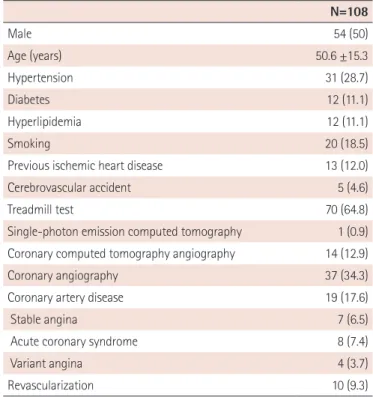
In total, 70 patients (64.8%) underwent a TMT, 14 (12.9%) underwent CCTA, and 37 (34.3%) underwent CAG. Of all patients, 19 (17.6%) were diagnosed with CAD. The clinical diagnoses included stable angina (n=7 [6.5%]; Group 1, n=3 [2.8%]; Group 2, n=4 [3.7%]), variant angina (n=4 [3.7%]; Group 1, n=1 [0.9%];

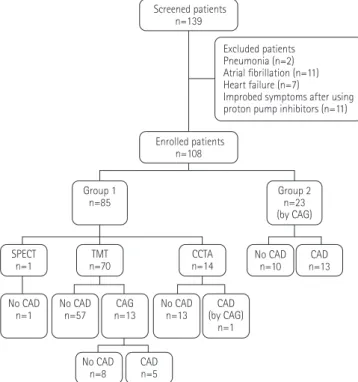
Group 2, n=3 [2.8%], and ACS (n=8 [7.4%]). Revascularization was performed in 10 patients (9.3%; Group 1, n=2 [1.9%]; Group 2, n=8 [7.4%]). Medications for stable and variant angina were administered to 9 patients (8.3%, Table 1). Fig. 1 shows the flow diagram used to differentiate between the CAD and non-CAD groups upon admission to the cardiology outpatient department.

The mean age was significantly higher in the CAD group 63.3±8.4 years vs. 47.8±15.1 years, p<0.001). Hypertension (63.2% vs. 21.3%, p<0.001), hyperlipidemia (26.3% vs. 7.9%, p<0.035), and previous ischemic heart disease (36.8% vs. 6.7%, p<0.001) were more frequently noted in the CAD group than in the non-CAD group (Table 2).

Psychiatric characteristics

The items that received the highest scores and most frequent responses for all patients were, in order, “over-concern about your health” (item 16, hypochondriasis, 2 [1-3], 91%), “over-concern about unusual body signs or sensations” (item 24, hypochondriasis, 2 [1-3], 90%), easily mentally fatigued” (item 8, neurasthenia, 2 [1-3], 84%),

and “worrying too much” (item 23, depression, 2 [1-3], 81%). In the non-CAD group, these items were “over-concern about your health”

(item 16, hypochondriasis, 2 [1-3], 94%), “worrying too much” (item 23, depression, 2 [1-2], 87%), “over-concern about unusual body signs or sensations” (item 24, hypochondriasis, 2 [1-2], 84%), and Table 1. Clinical baseline characteristics of thespatients

N=108

Male 54 (50)

Age (years) 50.6 ±15.3

Hypertension 31 (28.7)

Diabetes 12 (11.1)

Hyperlipidemia 12 (11.1)

Smoking 20 (18.5)

Previous ischemic heart disease 13 (12.0)

Cerebrovascular accident 5 (4.6)

Treadmill test 70 (64.8)

Single-photon emission computed tomography 1 (0.9) Coronary computed tomography angiography 14 (12.9)

Coronary angiography 37 (34.3)

Coronary artery disease 19 (17.6)

Stable angina 7 (6.5)

Acute coronary syndrome 8 (7.4)

Variant angina 4 (3.7)

Revascularization 10 (9.3)

Data are expressed as mean±standard deviation or number (%).

Table 2. Comparison of the clinical baseline characteristics between groups with and without coronary artery disease

Non-CAD

N=89 CAD

N=19 p

Male 44 (49.4) 10 (52.6) 0.800

Age (years) 47.8±15.1 63.3±8.4 <0.001

Systolic BP (mmHg) 131.3±17.7 133.9±22.5 0.583 Diastolic BP (mmHg) 76.6±11.2 73.7±13.7 0.340

Hypertension 19 (21.3) 12 (63.2) <0.001

Diabetes 8 (9.0) 4 (21.1) 0.129

Hyperlipidemia 7 (7.9) 5 (26.3) 0.035

Smoking 18 (20.2) 2 (10.5) 0.323

Previous ischemic heart

disease 6 (6.7) 7 (36.8) 0.001

Cerebrovascular accident 3 (3.4) 2 (10.5) 0.211

Data are expressed as mean±standard deviation or number (%). p: based

on the chi-squared test or Wilcoxon two-sample test (or Mann–Whitney U

test). CAD: coronary artery disease, BP: blood pressure

(4)

Table 3-1. Comparisons of the dimensions and symptoms between groups with and without coronary artery disease N=108 All Non-CAD

N=89 CAD

N=19 p

Numerical rating scale of pain (0-10) 2 (2-6) 4 (2-6) 2 (0-5) 0.105

Somatization (0-44) 12 ( 7-19) 13 (8-20) 9 (6-13) 0.032/0.062*

Somatization without chest pain (0-40) 10 (6-16) 11 (6-17) 8 (5-12) 0.056/0.317*

1. Headache 1(0-1) 1 (0-2) 0 (0-1) 0.051

4. Faintness or dizziness 1 (0-2) 1 (0-2) 0 ((0-1) 0.068

9. Pain in heart or chest 2 (1-3) 2 (1-3) 2 (0-2) 0.130

21. Pain in lower back 1 (0-2) 2 (1-3) 1 ((0-2) 0.126

28. Nausea or upset stomach 0 (0-1) 0 (0-1) 0 (0-1) 0.693

29. Soreness of muscle 1 (0-3) 1 (0-3) 1 (0-3) 0.658

35. Trouble getting breath 1 (0-1) 1 (0-2) 0 (0-1) 0.085

36. Hot or cold spells 1 (0-1) 1 (0-2) 1 (0-1) 0.228

38. Numbness or tingling in parts of body 1 (0-2) 1 (0-3) 1 (0-2) 0.354

39. A lump in throat 0 (0-1) 0 (0-2) 0 (0-1) 0.363

43. Weakness in parts of body 1 (0-2) 1 (0-2) 0 (0-1) 0.052

Anxiety (0-32) 6 (2-11) 7 (3-12) 2 (1-7) 0.056/0.115*

2. Nervousness 1 (0-2) 1 (0-2) 0 (0-2) 0.080

13. Trembling 1 (0-2) 1 (0-2) 0 (0-2) 0.719

17. Suddenly scared for no reason 0 (0-1) 1 (0-2) 0 (0-1) 0.077

26. Feeling fearful 1 (0-2) 1 (0-2) 0 (0-2) 0.283

27. Palpitation 1 (0-2) 1 (0-2) 1 (0-1) 0.092

44. Feeling tense 1 (0-2) 1 (0-2) 0 (0-1) 0.007

57. Spelling of terror and panic 0 (0-2) 0 (0-2) 0 (0-0) 0.100

60. Feeling restlessness 0 (0-1) 0 (0-1) 0 (0-1) 0.742

Depression (0-52) 11 (5-19) 11 (5-20) 12 (7-15) 0.672/0.369*

5. Loss of sexual interest of pleasure 1 (0-2) 1 (0-2) 2 (0-3) 0.474

11. Feeling low in energy 1 (0-2) 1 (0-2) 1 (0-2) 0.869

12. Thought of ending life 0 (0-1) 0 (0-1) 0 (0-1) 0.622

14. Poor appetite 0 (0-1) 0 (0-1) 0 (0-2) 1.000

15. Crying easily 0 (0-1) 0 (0-1) 0 (0-1) 0.780

20. Self-reproach for things 0 (0-2) 1 (0-2) 0 (0-1) 0.046

22. Feeling blue or sad 1 (0-2) 1 (0-2) 1 (0-2) 0.534

23. Worrying too much 2 (1-3) 2 (1-2) 1 (0-3) 0.199

25. Feeling no interest 1 (0-2) 1 (0-2) 1 (0-2) 0.732

41. Feeling hopeless about future 0 (0-1) 0 (0-1) 0 (0-1) 0.548

45. Thoughts of death 1 (0-2) 1 (0-2) 0 (0-2) 0.447

55. Feeing everything is an effort 1 (0-2) 1 (0-2) 0 (0-2) 0.227

61. Feeling of worthlessness 1 (0-1) 1 (0-2) 1 (0-1) 0.563

Anger-hostility (0-24) 3 (1-6) 3 (1-6) 2 (0-4) 0.356/0.306*

7. Feeling easily annoyed 1 (0-2) 1 (1-2) 2 (0-3) 0.838

18. Explosion of uncontrollable anger 0 (0-1) 0 (0-2) 0 (0-1) 0.087

47. Urge to hurt someone 0 (0-1) 0 (0-0) 0 (0-0) 0.132

52. Urge to smash or break things 0 (0-1) 0 (0-0) 0 (0-0) 0.325

58. Frequent arguments 0 (0-1) 0 (0-1) 0 (0-1) 0.567

62. Shouting or throwing things 0 (0-0) 0 (0-0) 0 (0-0) 0.132

Data are expressed as the median (interquartile range). p: based on the Wilcoxon two-sample test (or Mann–Whitney U test). *ANCOVA test: adjusting for

age, hypertension, previous ischemic heart disease, and hyperlipidemia. CAD: coronary artery disease

(5)

Table 3-2. Comparison of the dimensions and symptoms between groups with and without coronary artery disease N=108 All Non-CAD

N=89 CAD

N=19 p

Interpersonal sensitivity (0-20) 4 (2-6) 4 (2-6) 2 (1-5) 0.162/0.885*

46. Feeling uneasy when someone is watching or talking about you 1 (0-2) 1 (0-2) 0 (0-1) 0.275

53. Feeling very self-conscious with others 1 (0-2) 1 (0-2) 1 (0-2) 0.306

64. Feeling shy or uneasy with the opposite sex 0 (0-1) 0 (0-1) 0 (0-1) 0.829

66. Feeling inferior to others 1 (0-1) 1 (0-1) 0 (0-2) 0.774

67. Your feeling being easily hurt 1 (0-1) 1 (0-2) 0 (0-1) 0.080

Phobic anxiety (0-24) 1 (0-4) 1 (0-4) 1 (0-4) 0.597/0.701*

10. Feeling afraid in open spaces 0 (0-0) 0 (0-0) 0 (0-1) 0.309

19. Feeling afraid to go out of your house alone 0 (0-0) 0 (0-0) 0 (0-0) 0.571

34. Feeling afraid to travel on public transport 0 (0-0) 0 (0-0) 0 (0-0) 0.990

37. Any object or place or act scared and then be avoided. 0 (0-1) 0 (0-1) 0 (0-0) 0.111

56. Feeling uneasy in crowd 0 (0-1) 0 (0-1) 0 (0-0) 0.287

59. Feeling nervous when you are left alone 0 (0-1) 0 (0-1) 0 (0-1) 0.860

Obsessive compulsive (0-16) 4 (2-6) 4 (2-6) 2 (0-5) 0.083/0.172*

3. Repeat unpleasant thoughts that won’t leave your mind 1 (0-2) 1 (1-2) 1 (0-3) 0.278

31. Having to check and double check what you do 1 (0-2) 1 (0-2) 1 (0-2) 0.219

50. Having to repeat the same actions, such as counting, washing 0 (0-0) 0 (0-0) 0 (0-0) 0.301

63. Frightening thoughts and images 1 (0-1) 0 (0-1) 0 (0-0) 0.036

Neurasthenia (0-16) 4 (2-7) 4 (3-8) 4 (2-6) 0.570/0.284*

8. Easily mentally fatigued 2 (1-3) 2 (1-3) 2 (1-3) 0.551

32. Cannot mentally relax after becoming excited 1 (0-2) 1 (0-2) 1 (0-2) 0.487

40. Your mind does not think clearly 1 (0-2) 1 (0-2) 1 (0-1) 0.239

65. Your mind easily gets excited by trivial event 1 (0-2) 1 (0-2) 0 (0-2) 0.239

Hypochondriasis (0-16) 6 (4-9) 7 (4-9) 6 (3-7) 0.324/0.217*

16. Over-concern about your health 2 (1-3) 2 (1-3) 2 (0-3) 0.302

24. Over-concern about unusual body signs or sensation 2 (1-3) 2 (1-2) 2 (1-3) 0.911

48. Suffer from many different body discomforts 1 (0-2) 1 (0-2) 1 (0-2) 0.375

54. Over-concern with the fear of having a serious illness 1 (0-2) 1 (1-2) 1 (0-3) 0.530

General (0-24) 7 (4-11) 8 (4-12) 6 (4-11) 0.713/0.141*

6. Trouble remembering things 1 (0-3) 1 (0-2) 2 (0-3) 0.810

30. Trouble falling asleep 1 (0-3) 1 (0-3) 0 (0-2) 0.044

33. Difficult making decision 1 (0-2) 1 (0-2) 0 (0-1) 0.465

42. Trouble concentrating 1 (0-2) 1 (0-2) 0 (0-1) 0.179

49. Awakening in the morning 1 (0-3) 1 (0-3) 1 (1-3) 0.263

51. Sleep that is restless or disturbed 2 (0-3) 1 (0.3) 2 (1-3) 0.480

Total score 62 (33-96) 65 (35-98) 56 (28-74) 0.198/0.159*

Total T-score 49 (41-57) 49 (41-58) 47 (41-52) 0.198

≥60 (T-score, %) 20 (18.5) 17 (19.1) 3 (15.8) 0.736

Data are expressed as the median (interquartile range). p: based on the Wilcoxon two-sample test (or Mann–Whitney U test). *ANCOVA test: adjusting for

age, hypertension, previous ischemic heart disease, and hyperlipidemia. CAD: coronary artery disease

(6)

“easily mentally fatigued” (item 8, neurasthenia, 2 [1-3], 83%). In the CAD group, these items were “easily mentally fatigued” (item 8, neurasthenia, 2 [1-3], 84%), “over-concern about unusual body signs or sensations” (item 24, hypochondriasis, 2 [1-3], 84%), “awakening in the morning” (item 49, general, 1 [1-3], 84%), and “sleep that is restless or disturbed” (item 51, general, 2 [1-3], 79%).

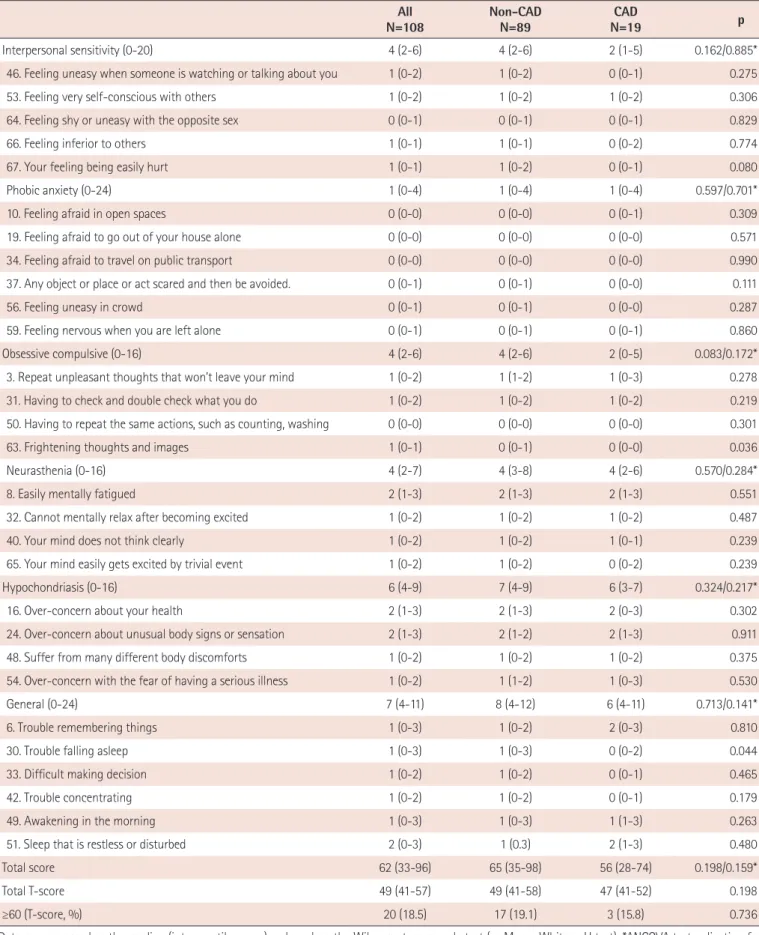
The median values for each subsection of the SCL-MPD for the CAD and non-CAD groups are presented in Tables 3-1 and 3-2.

The differences in the dimension scores, total score, and T score were not statistically significant. The proportions of patients with a high T score (≥60) were not different between the groups (19.1%

vs. 15.8%, p=0.736). Furthermore, no differences were observed in the psychiatric factors between the CAD and non-CAD groups before or after adjusting for age, hypertension, previous ischemic heart disease, and hyperlipidemia. However, “feeling tense” (item 44, anxiety), “self-reproach for things” (item 20, depression), and

“trouble falling asleep” (item 30, general) were more frequently observed in the non-CAD group (1 [0-2] vs. 0 [0-1], p=0.007; 1 [0-2]

vs. 0 [0-1], p=0.046; 1 [0-3] vs. 0 [0-2], p=0.044; Table 3-1 an, 3-2).

The relationship between the intensity of chest pain and psychological characteristics

Statistically significant correlations between the intensity of chest

pain and psychiatric symptom dimensions were observed in the non-CAD group (somatization, rho=0.336, p=0.001; somatization without chest pain, rho=0.294, p=0.005; anxiety, rho=0.229, p=0.031; and hypochondriasis, rho=0.225, p=0.034). Statistically significant inverse correlations between the intensity of chest pain and psychological symptom dimensions were observed in the CAD group (depression, rho=-0.503, p=0.028; hypochondriasis, rho=

-0.647, p=0.003; general, rho=-0.584, p=0.009, Table 4 an, Fige 2).

In a multiple linear regression analysis with a stepwise selection, the score for somatization without chest pain in the non-CAD group and hypochondriasis in the CAD group were associated with the intensity of chest pain ( β=0.108, R

2

=0.092, p=0.004; β=-0.525, R

2

=0.329, p=0.010, Table 5).

Discussion

The present study observed (1) no differences in psychological

Screened patients n=139

Excluded patients Pneumonia (n=2) Atrial fibrillation (n=11) Heart failure (n=7)

Improbed symptoms after using proton pump inhibitors (n=11) Enrolled patients

n=108

Group 1

n=85 Group 2

(by CAG) n=23

SPECT

n=1 TMT

n=70 CCTA

n=14

No CAD

n=1 No CAD

n=57 No CAD

n=13 CAD

(by CAG) n=1 CAD n=5

No CAD n=8

n=13 CAD No CAD

n=10 n=13 CAG

Fig. 1. The flow diagram used to differentiate between the CAD and non- CAD groups from the point of admission to the cardiology outpatient department. CAD: coronary artery disease, CAG: coronary angiography, CCTA: coronary artery computed tomography angiography, SPECT: single- photon emission computed tomography, TMT: treadmill test.

10 8 6 4 2 Numerical rating scale of chest pain 0

Score of somatization without chest pain in non-CAD

0 5 10 15 20 25 30 35

r=0.303* (p=0.004, R

2

=0.092)

10 8 6 4 2 0 -2

Numerical rating scale of chest pain

Score of hypochondriasis in CAD

0 2 4 6 8 10 12 14

r=-0.574* (p=0.010, R

2

=0.329)

Fig. 2. The relationships between the intensity of chest pain and psychological symptom dimensions. Somatization without chest pain in the non CAD group (A). Hypochondriasis in the CAD group (B). CAD, coronary artery disease.

A

B

(7)

characteristics between the groups with and without CAD, though some psychiatric items were different between the groups; (2) a correlation between the intensity of chest pain and somatization without chest pain in the non-CAD group; and (3) an inverse correlation between the intensity of chest pain and hypochondriasis in the CAD group. This study also illustrates the method used by cardiologists to differentiate between cardiogenic and non-cardiogenic chest pain.

It is difficult to differentiate chest pain with cardiac versus non- cardiac causes. However, this study had a standard method for diagnosing cardiogenic chest pain and did not limit the test method to conform to other standards. Therefore, cardiogenic chest pain was defined by (1) abnormality in a non-invasive test (TMT, SPECT) and CAG or (2) abnormality on CAG. According to an earlier cohort study of acute chest pain and CCTA, a small number of patients (only 13.5%) were reported to have ACS.

2)

We also found a small proportion of patients with chest pain diagnosed as CAD in the outpatient department.

Psychiatric characteristics

The SCL-MPD is a simplified version of the SCL-90 questionnaire that contains 67 items. The paranoia and psychosis categories were removed from the SCL-90, and hypochondriasis and neurasthenia were added to the SCL-MPD. As per previous studies, it is evident that paranoia and psychosis are rare and hypochondriasis and neurasthenia are common in patients with chest pain, the SCL-

MPD was found to be more appropriate for this study.

5)6)17)18)

Several studies have reported that scores on tests of panic phobia, somatization, neurasthenia, anxiety, and depression were higher in patients with non-cardiogenic chest pain than patients with cardiogenic chest pain.

5)6)17)18)

In contrast, other studies have reported that psychiatric characteristics did not differ in patients with or without CAD.

7-9)

In this study, some psychiatric symptom dimensions tended to differ between the CAD and non-CAD groups.

Furthermore, some specific items (“feeling tense”, “self-reproach for things” and “trouble falling asleep”) were significantly different between the groups. However, the differences in the dimension scores were not statistically significant. According to a previous study, the lack of difference in psychiatric characteristics between CAD and non-CAD groups could be due to the high psychiatric morbidities in both the groups as the source of chest pain.

7)

According to other previous studies, the chest pain is established as the source of psychiatric morbidities in both the groups.

8)19)

In this study, high psychiatric morbidities (hypochondriasis, neurasthenia, and depression) were also present, as evidenced by high frequency SCL-MPD items. In addition, the proportion of patients with a high SCL-MPD T score (≥60) did not differ between the groups.

Some risk factors in this study (old age, hypertension, and hyperlipidemia) differed between the CAD and non-CAD groups.

A number of studies on psychiatric factors and CAD have not considered the importance of the risk factors.

4-10)17-22)

Psychosocial factors such as depression, anxiety, hostility, social isolation, Table 4. Analysis of the correlation between the intensity of chest pain and psychiatric symptom dimensions

Numerical rating scale of pain All patients

N=108 Non-CAD

N=89 CAD

N=19

rho* p rho* p rho* p

Age -0.049 0.615 0.037 0.732 -0.163 0.504

Somatization 0.264 0.006 0.336 0.001 -0.253 0.296

Somatization without chest pain 0.227 0.018 0.294 0.005 -0.277 0.252

Anxiety 0.165 0.088 0.229 0.031 -0.279 0.247

Depression 0.014 0.888 0.129 0.229 -0.503 0.028

Anger-hostility 0.041 0.677 0.035 0.745 -0.009 0.972

Interpersonal sensitivity 0.006 0.950 0.038 0.725 -0.238 0.327

Phobic anxiety 0.103 0.287 0.155 0.146 -0.182 0.457

Obsessive compulsive 0.041 0.671 0.115 0.283 -0.432 0.065

Neurasthenia 0.099 0.309 0.173 0.104 -0.275 0.255

Hypochondriasis 0.085 0.381 0.225 0.034 -0.647 0.003

General 0.066 0.500 0.195 0.066 -0.584 0.009

Total score 0.123 0.204 0.227 0.032 -0.447 0.055

*Spearman’s correlation analysis. CAD: coronary artery disease

(8)

and life stress are associated with cardiovascular risk factors.

20)

For instance, hypertension is related to anxiety,

21)22)

and the association of metabolic syndrome with depression has been well documented.

23)

These relationships have been explained based on sympathetic nervous system hyperresponsivity, hypercortisolism, and unhealthy lifestyle behaviors.

20-24)

Older populations have less psychological disorders,

25)

and old age is considered as an important cardiovascular risk factor.

26)

Therefore, cardiovascular risk factors should be considered in the studies dealing with psychiatric factors and CAD. No differences were observed in the psychiatric factors between the CAD and non-CAD groups before or after adjusting for age, hypertension, previous ischemic heart disease, and hyperlipidemia in this study.

The intensity of chest pain

In some studies, patients who have experienced chest pain with or without CAD had a higher sensitivity to pain and more severe pain than healthy groups.

8)

In addition, the degree of anxiety was linearly associated with the intensity of pain in sensitive patients.

27)

In this study, linear association between the intensity of chest pain and psychiatric characteristics (somatization without chest pain, anxiety, and hypochondriasis) was observed in the non-CAD group.

An inversely linear association between psychiatric characteristics (depression, hypochondriasis, and general) and the intensity of chest pain was observed in the CAD group. Finally, somatization

without chest pain in the non-CAD group and hypochondriasis in the CAD group had the greatest effect on the intensity of chest pain among the psychiatric characteristics. The cause of the inverse correlation between hypochondriasis and chest pain score in the CAD group might be explained by the fact that hypochondriacs usually have many other symptoms to worry about, so chest pain itself might be a relatively minor concern to them. Additionally, the pain typically occurs only during exertion, not during low-intensity or everyday activities.

Patients with non-cardiogenic chest pain are at a lower risk of death. However, they experience continuing chest pain, limitation of activities, concerns about the cause of their symptoms, and dissatisfaction with medical care

1)4)

and they have high psychiatric morbidities.

4-10)17-20)

Interestingly, gastroesophageal reflux disease, a major cause of non-cardiogenic chest pain, has a high psychiatric morbidity.

28)

Patients with cardiogenic chest pain also had high psychiatric morbidities.

10)19)

Because they are related to cardiovascular risk factors and medication non-adherence,

20)29)

psychiatric morbidities are also predictors of mortality in patients with CAD.

30)

Therefore, psychiatric intervention or medications were necessary and effective in both the groups.

10-14)

This study has several limitations. The prime one is the small sample size and inclusion of multiple psychiatric items. In a study of CCTA and ACS,

2)

ACS was present in 13.6% of patients in the emergency department. We set the hypothesis value of our study Table 5. Multiple linear regression analysis of psychiatric characteristics according to the intensity of chest pain

Non-CAD CAD

R

2

=0.382 R

2

=0.092 R

2

=0.880 R

2

=0.290

β p β p β p β p

Constant 2.488 2.666 9.543 5.882

Somatization without chest pain 0.099 0.129 0.108 0.004* -0.101 0.772

Anxiety 0.114 0.322 0.601 0.433

Depression -0.008 0.912 0.080 0.873

Anger-hostility -0.115 0.375 0.190 0.801

Interpersonal sensitivity -0.012 0.940 0.223 0.855

Phobic anxiety -0.005 0.973 0.045 0.960

Obsessive compulsive -0.009 0.960 -0.656 0.405

Neurasthenia -0.130 0.460 -0.307 0.769

Hypochondriasis 0.031 0.816 -0.581 0.547 -0.525 0.010*

General 0.045 0.653 -0.323 0.535

Age 0.004 0.861 -0.023 0.880

Hypertension 0.190 0.807 -0.178 0.946

Hyperlipidemia -0.257 0.830 -3.095 0.474

Previous ischemic heart disease -0.839 0.505 0.041 0.987

*Variable by multiple linear regression analysis with a stepwise selection. CAD: coronary artery disease

(9)

low (5%), because we recruited patients from the outpatient department. Despite this, 19 patients (17.6%) were diagnosed with CAD. Hence, a well-designed larger cohort study is needed to confirm these results and expand upon this limitation. Second, the patients were limited to cardiac outpatients, because it is more difficult for patients in the emergency room to fill out questionnaires. However, patients with chest pain in the emergency room may be different from those in the outpatient department.

Finally, the use of a more typical diagnostic standard may help us discover less obvious origins of chest pain than the current design.

For instance, intermediate stenosis (50-75%) was also defined as CAD in the direct CAG group. In these cases, the cause of chest pain may not be CAD. Additionally, we cannot rule out variant angina in cases with a normal CCTA. However, the selection of the initial test for CAD, either TMT, SPECT, CCTA, or CAG, was made by the cardiologists. Thus, all patients underwent an initial test similar to the typical practice in the cardiology outpatient department.

Conclusion

No differences in the overall psychiatric characteristics were observed between the groups with and without CAD. However, some psychiatric items were more frequently observed in the non- CAD group. The intensity of chest pain was linearly associated with the score of somatization without chest pain in the non-CAD group and inversely linearly associated with hypochondriasis in the CAD group. In summary, patients with more intense chest pain had more additional discomfort in the non-CAD group, and less health concerns in the CAD group.

Acknowledgments

This study was supported by a research grant from the Jeju National University Hospital (2012-21).

References

1. Papanicolaou MN, Califf RM, Hlatky MA, et al. Prognostic implications of angiographically normal and insignificantly narrowed coronary arteries. Am J Cardiol 1986;58:1181-7.

2. Hoffmann U, Nagurney JT, Moselewski F, et al. Coronary multidetector computed tomography in the assessment of patients with acute chest pain. Circulation 2006;114:2251-60.

3. Kroenke K, Mangelsdorff AD. Common symptoms in ambulatory care: incidence, evaluation, therapy, and outcome. Am J Med 1989;86:262-6.

4. Mayou R, Bryant B, Forfar C, Clark D. Non-cardiac chest pain and benign palpitations in the cardiac clinic. Br Heart J 1994;72:548-53.

5. Channer KS, Papouchado M, James MA, Rees JR. Anxiety and depression in patients with chest pain referred for exercise testing.

Lancet 1985;2:820-3.

6. Cormier LE, Katon W, Russo J, Hollifield M, Hall ML, Vitaliano PP.

Chest pain with negative cardiac diagnostic studies. Relationship to psychiatric illness. J Nerv Ment Dis 1988;176:351-8.

7. Dammen T, Arnesen H, Ekeberg O, Friis S. Psychological factors, pain attribution and medical morbidity in chest-pain patients with and without coronary artery disease. Gen Hosp Psychiatry 2004;26:463-9.

8. Zachariae R, Melchiorsen H, Frøbert O, Bjerring P, Bagger JP.

Experimental pain and psychologic status of patients with chest pain with normal coronary arteries or ischemic heart disease. Am Heart J 2001;142:63-71.

9. Tennant C, Mihailidou A, Scott A, et al. Psychological symptom profiles in patients with chest pain. J Psychosom Res 1994;38:365-71.

10. Kisely SR. The relationship between admission to hospital with chest pain and psychiatric disorder. Aust N Z J Psychiatry 1998;32:172-9.

11. Mayou RA, Bryant BM, Sanders D, Bass C, Klimes I, Forfar C. A controlled trial of cognitive behavioural therapy for non-cardiac chest pain. Psychol Med 1997;27:1021-31.

12. Cannon RO 3rd, Quyyumi AA, Mincemoyer R, et al. Imipramine in patients with chest pain despite normal coronary angiograms. N Engl J Med 1994;330:1411-7.

13. Mayou RA, Bass CM, Bryant BM. Management of non-cardiac chest pain: from research to clinical practice. Heart 1999;81:387-92.

14. Varia I, Logue E, O’Connor C, et al. Randomized trial of sertraline in patients with unexplained chest pain of noncardiac origin. Am Heart J 2000;140:367-72.

15. Wright RS, Anderson JL, Adams CD, et al. 2011 ACCF/AHA focused update incorporated into the ACC/AHA 2007 Guidelines for the management of patients with unstable angina/non-ST-elevation myocardial infarction: a report of the American College of Cardiology Foundation/American Heart Association Task Force on Practice Guidelines developed in collaboration with the American Academy of Family Physicians, Society for Cardiovascular Angiography and Interventions, and the Society of Thoracic Surgeons. J Am Coll Cardiol 2011;57:e215-367.

16. Jeong W, Chang H. Rliability and Validity of Korean Version of Symptom Check list for Minor psychiatric Disorders (SCL-MPD) J Korean Neuropsychiatric Assoc 1987;26:15.

17. Rohani A, Akbari V, Zarei F. Anxiety and depression symptoms in chest pain patients referred for the exercise stress test. Heart Views 2011;12:161-4.

18. Bass C, Wade C. Chest pain with normal coronary arteries: a

comparative study of psychiatric and social morbidity. Psychol Med

(10)

1984;14:51-61.

19. Ladwig KH, Hoberg E, Busch R. Psychological comorbidity in patients with alarming chest pain symptoms. Psychother Psychosom Med Psychol 1998;48:46-54.

20. Rozanski A, Blumenthal JA, Kaplan J. Impact of psychological factors on the pathogenesis of cardiovascular disease and implications for therapy. Circulation 1999;99:2192-217.

21. Watkins LL, Grossman P, Krishnan R, Sherwood A. Anxiety and vagal control of heart rate. Psychosom Med 1998;60:498-502.

22. Lown B, Verrier R, Corbalan R. Psychologic stress and threshold for repetitive ventricular response. Science 1973;182:834-6.

23. Ramasubbu R. Insulin resistance: a metabolic link between depressive disorder and atherosclerotic vascular diseases. Med Hypotheses 2002;59:537-51.

24. Gold PW, Loriaux DL, Roy A, et al. Responses to corticotropin- releasing hormone in the hypercortisolism of depression and Cushing’s disease. Pathophysiologic and diagnostic implications. N Engl J Med 1986;314:1329-35.

25. Reynolds K, Pietrzak RH, El-Gabalawy R, Mackenzie CS, Sareen J.

Prevalence of psychiatric disorders in U.S. older adults: findings from a nationally representative survey. World Psychiatry 2015;14:74-81.

26. D’Agostino RB Sr, Vasan RS, Pencina MJ, et al. General cardiovascular risk profile for use in primary care: the Framingham Heart Study.

Circulation 2008;117:743-53.

27. Chen AC, Dworkin SF, Haug J, Gehrig J. Human pain responsivity in a tonic pain model: psychological determinants. Pain 1989;37:143-60.

28. Kim JY, Kim N, Seo PJ, et al. Association of sleep dysfunction and emotional status with gastroesophageal reflux disease in Korea. J Neurogastroenterol Motil 2013;19:344-54.

29. Dempe C, Jünger J, Hoppe S, et al. Association of anxious and depressive symptoms with medication nonadherence in patients with stable coronary artery disease. J Psychosom Res 2013;74:122-7.

30. Meyer T, Hussein S, Lange HW, Herrmann-Lingen C. Anxiety is

associated with a reduction in both mortality and major adverse

cardiovascular events five years after coronary stenting. Eur J Prev

Cardiol 2015;22:75-82.

수치

Table 2. Comparison of the clinical baseline characteristics between  groups with and without coronary artery disease
Table 3-1. Comparisons of the dimensions and symptoms between groups with and without coronary artery disease N=108All Non-CAD
Table 3-2. Comparison of the dimensions and symptoms between groups with and without coronary artery disease N=108All Non-CAD
Fig. 2. The relationships between the intensity of chest pain and  psychological symptom dimensions

참조

관련 문서

– Mechanisms of overpressure generation – Estimating pore pressure at depth.. Zoback MD, 2007, Reservoir Geomechanics,

Seung Soo Jang Sung Gyun Shin Min Jae Lee Sang Soo Han Chan Ho Choi Sungkyum Kim Woo Sung Cho and Song Hyun Kim POSTECH Yeong Rok Kang Wol Soon Jo Soo Kyung Jeong and

The purpose of this study was to identify the frequency and related factors of advanced airway management for patients with cardiac arrest by the

Result: During the study period, 482 patients had elevated cardiac troponin-T levels. The positive predictive value for the.. The diagnostic importance of

Chang Goo Kang, Ah Hyun Park, Jang Ho Ha, Young Soo Kim, Joon-Ho Oh, Jeong Min Park, Soo Mee Kim, Seung-Jae Lee, Seung Hee Lee, and Han Soo Kim(KAERI). Fabrication

Chang Je Park, Kwoen Ho Kang, Sang Ho Na, Young Hee Kim, Ho Jin Ryu, Geun Il Park, and Kee Chan Song (KAERI). Geun-Suk Choi and

Sang-Keun Woo, Yong Jin Lee, WonHo Lee, Min Hwan Kim, Ji Ae Park, In Ok Ko, Jin Su Kim, Jong Guk Kim, Young Hoon Ji, Joo Hyun Kang, Gi Jeong Cheon, Chang Woon Choi, Sang Moo

IL Soon Hwang, Myung Hyun Kim, Han Gyu Joo, Kyung Woo Yi, Bong Yoo, Moo Hwan Kim, Seung Rok Oh, Yoon Jae Kim, Jong Gye Shin, Kwang Myung Lee, Jae Yong