KOREAN JOURNAL OF ENGLISH LANGUAGE AND LINGUISTICS
ISSN: 1598-1398 / e-ISSN 2586-7474 http://journal.kasell.or.kr
A Comparative Study on Blended Learning and Flipped Learning:
EFL Students’ Learner Autonomy, Independence, and Attitudes
*Na-Young Kim (Sehan University), Seo Young Yoon (Baekseok University)
This is an open-access article distributed under the terms of the Creative Commons License, which permits unrestricted non-commercial use, distribution, and reproduction in any medium, provided the original work is properly cited.
ABSTRACT
Kim, Na-Young and Seo Young Yoon. 2021. A comparative study on blended learning and flipped learning: EFL students’ learner autonomy, independence, and attitudes.
Korean Journal of English Language and Linguistics 21, 171-188.
The purpose of this study was to investigate EFL students’ learner perspectives on blended learning and flipped learning concerning their autonomy, independence, and attitudes. The participants for the study were 114 first-year students taking an English course at a university in Korea. They met once a week for 2 hours for 15 weeks but engaged in different instructional designs of conventional (C), blended learning (BL), and flipped learning (FL). For the C group, in-class instructions and activities were given based on the textbook. The BL group joined online activities following the face-to-face instruction. In contrast, the FL group received the online instruction preceding the face-to-face class. For the quantitative data, the questionnaire was designed based on previous research on learner autonomy, independence, and attitudes. The qualitative data included interviews and classroom observation. The main findings are as follows: the FL group showed the need for teacher presence to improve learner autonomy while the BL group recognized the importance of learner autonomy for their successful learning with fewer learning choices. All groups showed a positive attitude toward learning but felt the need for autonomy training. No group differences were found. Based on the results, suggestions for further study are provided.
Received: Feb. 19, 2021 Revised: March 11, 2021 Accepted: March 16, 2021
Na-Young Kim (1st author) Professor, Sehan Univ.
[email protected] Seo Young Yoon (corresponding author) Professor, Baekseok Univ.
*This work was supported by the Sehan University Research Fund in 2021.
KEYWORDS
EFL, flipped learning, blended learning, learner autonomy, learner independence, learner attitude
1. Introduction
English as a foreign language (EFL) learners have various knowledge backgrounds and mixed language abilities with different goals. They also have various learning needs and different levels of motivation. According to Webb and Doman (2016), this is one of the biggest challenges in a language classroom. For the past years, several EFL professionals have emphasized the strengths of blended and flipped learning, and they have highly promoted their practices in class (Hamdan, McKnight, McKnight and Arfstrom 2013, Harrington 2010, Soliman 2016, Wu and Liu 2013).
Specifically, students in EFL settings have shown a positive attitude towards blended learning (Harrington 2010). According to Wu and Liu (2013), EFL students enjoy themselves in a blended learning environment as it offers the students fun and pleasure. In a blended learning environment, they have flexibility regarding time, place, and even the ways of learning. While interacting online with their classmates and teachers more conveniently, students can enjoy learning with ease and interest. This entertaining experience makes them feel satisfied with EFL blended learning, and both the performance and learning efficiency of EFL students can increase as a result.
In EFL learning, the adoption of the flipped model has also been emphasized, which allows individualized instruction as teachers can reach each student in the class (Soliman 2016). EFL students in flipped learning settings can also have more opportunities to use their target language in collaborative learning environments. They can deepen their understanding of English and use it effectively with immediate feedback from their teacher or peers by interacting with them (Mehring 2016). Furthermore, the flipped EFL classroom has enabled a shift from a teacher-centered to a student-centered approach. According to Hamdan, McKnight, McKnight and Arfstrom (2013), in flipped learning, the students actively participate in verbal and written activities outside the classroom through their online learning community.
In particular, blended and flipped learning advocates have claimed that both online-based instructional designs can enhance EFL students’ learner autonomy (Banditvilai 2016, Han 2015, Hung 2015, Wong and Chu 2014, Yoon 2016). For example, after conducting a case study of using blended learning to enhance EFL students’
language skills and learner autonomy, Banditvilai (2016) discovered that the blended model enhances EFL skills and autonomous learning. Yoon (2016) also found positive learner perspectives on a blended learning model for improving learner autonomy in EFL classes. Regarding flipped learning, Han (2015), Hung (2015), and Wong and Chu (2014) proved that flipped instruction develops EFL learner autonomy, improves learners’ learning attitudes and participation levels, and increases their confidence and commitment levels.
Therefore, for their successful language learning, EFL students’ learner autonomy should be promoted (Yoon 2016). Considering that learner autonomy consists of various features (Thanasoulas 2000) and its measurement are multidimensional (Yoon 2016), the current study investigates EFL students’ learner perspectives concerning their autonomy with their independence and attitudes. According to Mulcahy (1991), learner independence is one of the key features making an autonomous learner. As a goal in the educational world, learner independence has also played an important role in language learning (Finch 2001). Furthermore, independent learners also hold positive attitudes (Mariani 1992). Pichugova, Stepura, and Pravosudov (2016) claimed that learner attitudes should also be considered as a goal to enhance learner autonomy in the EFL context. According to them, autonomous learners have positive attitudes toward learning, and the success of language learning largely depends on learner attitudes.
Previous studies have shown that both blended and flipped learning can enhance EFL students’ learner autonomy (Banditvilai 2016, Han 2015, Hung 2015, Wong and Chu 2014), but the existing studies on blended learning tend to focus on its development and effectiveness. Consequently, there is a need for an in-depth investigation of its impact on learner autonomy (Yoon 2016). Furthermore, there is the dearth of research on flipped learning in the Korean EFL context (Sung 2015). An absence of such studies motivated the researchers to examine the impact of different instructional designs – flipped learning and blended learning – on learner autonomy. Based on the previous research (Sharle and Szabó 2000, Tassinari 2012, Yoon 2016), the present study aims to fill the gap by asking the following questions:
a. What are the impacts of flipped learning and blended learning on learner autonomy in EFL classrooms?
b. What are the impacts of flipped learning and blended learning on learner independence in EFL classrooms?
c. What are the impacts of flipped learning and blended learning on learner attitudes in EFL classrooms?
d. Are there significant differences in learner perspectives between flipped learning and blended learning classes in terms of research questions a, b, and c?
2. Literature Review
2.1 Fliped Learning and Blended Learning
In order to support classroom teaching, technology has been widely used. The advancement of technology has allowed students to learn anytime, anywhere. Furthermore, the various high-tech learning tools have increased the students’ interest and motivation in learning, enhancing their self-directed learning skills (Kim 2017). Such tools have also encouraged the students to engage in collaborative learning, promoting their social interactions through giving and receiving feedback or sharing ideas. In particular, the adaptation of technology has enabled a shift from teacher-centered learning to student-centered learning (Hamdan, McKnight, McKnight and Arfstrom 2013).
In recent years, various pedagogical models have been employed to facilitate technology-assisted learning. One of them is blended learning. This model refers to an approach to education that combines online learning and face-to-face classes. In blended classrooms, traditional teaching methods are supplemented with online educational materials. There are also some opportunities for interaction, training, and assessment online in blended learning. Bañados (2006) claimed that this approach could improve students’ learning outcomes. Students in a blended class can perform much better than those in a non-blended class (Means, Toyama, Murphy, Bakia and Jones 2010). According to previous researches (Alebaikan and Troudi 2010, Yoon 2016), the students also have positive perspectives on blended learning.
Thorne (2003) claimed that blended learning is one of the most essential educational advances of the 21st century. According to Grgurović (2011), future language learning is closely connected to blended learning.
However, Bañados (2006) addressed that both teachers and students should make adjustments in blended classes.
Teachers, for example, need to acquire new skills such as how to integrate materials, how to use hardware and software, and how to solve technical problems. He added that not only should students learn new technology, but they should also become autonomous learners. Murday, Ushida and Chenoweth (2008) also emphasized the importance of the students taking responsibility for their learning. According to them, there is a direct relationship between student motivation and academic progress.
Apart from blended learning, flipped learning has also attracted much attention among scholars from different fields worldwide. Flipped learning is considered a form of blended learning approach by some (Ekmekci 2014) due to its similarities, like using more than one delivery mode utilized in learning. However, the delivery method for instruction is reversed in flipped classes. Teachers prepare online lectures for students to take at home on their own time. The classroom time is spent on doing activities to understand the important concepts and knowledge being delivered. The flipped approach forgoes unnecessary teacher-talk time during class time and expands or deepens learning in class. This changes the focus of class time, drawing attention to the students while taking the focus off the teachers.
According to Bergmann, Overmyer and Wilie (2011), flipped learning is not just about the lectures offered online. There is meaningful interaction through in-class activities. As flipped learning can free instructional time, students can have more interactive and dynamic classroom learning experiences. In the flipped model, most lesson content is delivered by video clips, and the students watch them at home before attending class. That is, the students can synthesize the information they have learned through videos, ask questions as they come up, and work out problems collaboratively with their classmates in class (Bormann 2014). The student-centered approach can be
applied to the flipped instructional design as the students participate in meaningful and collaborative activities outside the classroom via the online learning community (Hamdan, McKnight, McKnight and Arfstrom 2013).
Furthermore, the flipped model helps teachers improve classroom management with increased time to interact with every student (Bergmann and Sams 2015, Sung 2015). That is, video lectures before class allow for increased interaction, meaning that the flipped lessons are interactive.
Flipped learning has been considered to be one of the best learning models (Hamdan, McKnight, McKnight and Arfstrom 2013), and now is the most popularly used instructional design in the EFL field (Ekmekci 2017).
However, Chowdhury (2019) noted that no single model can be a perfect fit for all educational settings, and empirical evidence in support of flipped learning is lacking, and few materials are available in the EFL classroom.
Besides, there is little research supporting the incorporation of the flipped model in the EFL classroom (Mehring, 2016). Particularly in Korean EFL settings, research is rarely found on the flipping of English language classes, especially at the college level (Sung 2015). Considering there are few studies on flipped EFL learning in Korea (Yoon and Kim 2020), its effectiveness and practicality should be examined more carefully.
More recently, Yoon and Kim (2020) investigated whether flipped learning leads to more increased English speaking skills in comparison to blended or conventional learning. For the study, a total of 70 college students in Korea were recruited and divided into flipped, blended, and conventional learning groups. The participants’
speaking outcomes on the pre- and post-tests were evaluated based on the rubric following IELTS speaking assessment criteria. However, the authors found no statistically significant differences among the three groups.
They suggested that flipped learning is effective for EFL teaching and learning but the same goes for blended and conventional learning as well. That is, although flipped learning is receiving increased attention, this may simply be a trend and should be examined more carefully. Therefore, we aim to investigate whether flipped learning and blended learning impacts learner autonomy, independence and attitude in comparison to the conventional teaching and learning, particularly in Korean EFL contexts.
2.2 Learner Autonomy, Learner Independence, and Learner Attitudes
In the educational world, learner autonomy has attracted educators’ attention with the rise of globalization, the information age, and the knowledge-based economy (Benson 2001). According to Tilfarlioglu and Ciftci (2011), if students can organize and control their own learning, it can be said that they are autonomous learners. For a long time, learner autonomy has been the ultimate goal of education (Benson 2001, Waterhouse 1990). However, it is a complicated capacity (Dang 2010), and the concept has been argued to be very complex, particularly in language learning (Little 2003).
There are a number of different labels regarding learner autonomy, and previous scholars have tried to define its concept in many different ways. For example, Holec (1981) defined learner autonomy as “the ability to take charge of one’s own learning (p. 3)” while Dam et al. (1990) viewed it as “ [the] capacity and willingness to act independently and in cooperation with others as a social, responsible person (p. 102).” According to Little (1996), it is “learners’ ability and willingness to make choices independently (p. 97).” It can also be “the capacity for a certain range of highly explicit behavior that embraces both the process and the content of learning (Cotterall and Crabbe 1999, p. 11).” Although defining learner autonomy has its variations, the main point of all the definitions is that students should be the authors of their own education world (Tilfarlioglu and Ciftci 2011). In other words, learner autonomy is the capacity to take control of one’s own learning (Benson 2001, Yoon 2016).
Zhou and Deci (2009) claimed that learner autonomy could not only enhance students’ positive feelings about themselves but also improve their academic achievement. In particular, the increased attention to learner autonomy has gained momentum in the context of language teaching and learning (Tilfarlioglu and Ciftci 2011). Language learning is an autonomous art accumulated over long periods of time. According to Tilfarlioglu and Ciftci (2011), since language learning is a life-long journey, its process should be autonomous. In EFL contexts, learner
autonomy has also been viewed as a characteristic of successful learners (Yoon 2016). Therefore, teachers in EFL settings should teach their students how to be autonomous, supporting their autonomous learning; and the students should also learn to be autonomous in taking responsibility for their learning.
In addition to learner autonomy, learner independence has also been cited as a goal in the educational world. It refers to a learner’s ability to make his/her own decisions about what he/she thinks and does (Boud 1988). Mariani (1992) introduced some features and qualities of independent language learners. First, independent learners use effective strategies. In particular, they know how to use both cognitive and metacognitive strategies. The independent learners have their own plans, actions, and techniques that are effective for them and choose from according to their needs. Furthermore, they have appropriate knowledge about the nature of language and communication. They also know the nature of learning, including the learning process. They are even aware of why they are carrying out a particular task, what demands the task makes on their skills, and what strategies are appropriate for the task itself.
Lastly, independent learners hold positive beliefs and attitudes. Although the learners’ beliefs and attitudes are influenced by their previous learning experiences, they can be brought into consciousness. Therefore, language and learning awareness is important when training learners for independence (Mariani 1992).
Dickinson (1995) stated that learners’ independent involvement in their own learning also refers to learner autonomy. An autonomous learner is fully responsible for all the decisions regarding his/her learning and the implementation of those decisions. There is no involvement of a teacher, and the learner is independent in full autonomy. However, this does not mean that autonomy refers to independence (Asuman 2010). According to Yoon (2016), learner autonomy and learner independence are not equivalent. Indeed, learner independence is a quality of learner autonomy. Mulcahy (1991) also insisted that one of the key features making an autonomous learner is his/her independence. Both learner autonomy and learner independence play an important role in language learning by raising issues like learners’ responsibility for their own learning or their right to determine its direction (Finch 2001).
According to Pichugova, Stepura, and Pravosudov (2016), learner attitudes should also be considered as the goal to enhance learner autonomy in the EFL context. The authors asserted that autonomous learners have a positive attitude toward learning. Independent learners also hold positive beliefs and attitudes (Mariani 1992), and the success of language learning largely depends on learner attitudes. Aksenova et al. (2015) claimed that learners need to put in a tremendous amount of time, effort, and energy to learn a language, and a positive learner attitude is equally important in this process. Fakeye (2010) also added that many factors such as aptitudes, intelligence, age, and personalities influence learners’ learning process, but the most crucial factor that affects language learning is learners’ attitudes.
Attitudes can be defined as “a psychological tendency that is expressed by evaluating a particular entity with some degree of favor or disfavor” (Eagly and Chaiken 1993, p. 1). According to Pichugova, Stepura and Pravosudov (2016), language attitude is what learners show towards their native languages as well as other languages. It also indicates the state of their mind towards a particular language. An optimistic attitude towards the target language leads the successful foreign language learning. On the other hand, if learners have a pessimistic attitude toward the language, they would not learn their target language effectively nor conveniently. Successful language learning depends on both learning methods and learners’ attitudes towards it (Pichugova, Stepura and Pravosudov 2016).
Therefore, language teachers also need to encourage their students to have a positive attitude towards language learning.
To sum up, it is unquestionable that learner autonomy should be promoted in EFL settings (Yoon 2016), and it needs to be kept in mind that learner autonomy consists of various features (Thanasoulas 2000). Therefore, the measurement of learner autonomy should consider a multidimensional construct. Careful analysis and observation are needed regarding learner control and its degrees, learner engagement in independent learning, how responsible learners are in learning, and their attitudes towards learning, learning activities, and learning tools (Asuman 2010). Following the previous studies (Sharle and Szabó 2000, Tassinari 2012, Yoon 2016), the current study also intends to examine the impact of different instructional designs on EFL learner autonomy, learner independence, and learner attitudes.
3. Methodology
3.1 Participants
The participants for the study are 114 first-year students taking an integrated skills English course at an A university in South Korea. The course was a mandatory graduation requirement, and they met once a week for 2 hours for 15 weeks. The participants were given a placement test prior to registration and were placed into three intermediate level sessions. All were taught by one of the researchers. All three sessions were taught with the same goals and objectives with the same materials but had different instructional designs of conventional (C) as the control group, blended learning (BL), and flipped learning (FL). For the C group, there were 37 participants with 15 male and 22 female students, the BL group had 37 total with 19 male and 18 female participants, and the FL group consisted of 40 total participants with 12 males and 28 females. On the whole, four students had experiences abroad. Considering they spent less than two months abroad for non-academic purposes, they were not excluded from the study.
3.2 Procedure
The textbook used for the study was Smartchoice 2, 3rd edition (Wilson and Healy 2016) with online resources.
For the C group, in-class instructions on vocabulary, grammar points, reading, listening, and speaking, along with activities, were given based on the textbook. In-class activities included individual work and pair and small group discussion, and paper-based worksheets were handed out as weekly individual assignments. Projector, PPT, and LMS for submitting voice recording assignments were used, but online content or CMC tools outside of the face-to-face classroom interaction were not used. Biweekly individual voice recording assignments on the topics from the textbooks were given to all three groups.
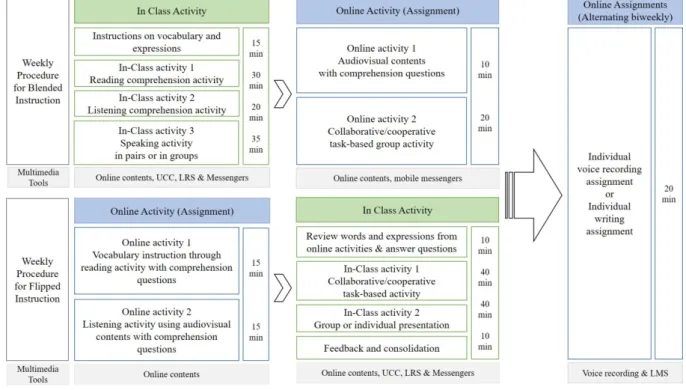
Figure 1. Procedures for BL and FL classes
The procedures for the BL and FL groups can be seen in Figure 1. For the BL group, online content and Learner Response System (LRS) were used in face-to-face class for vocabulary, grammar points, listening, and reading instructions, followed by individual activities. Online activities following the face-to-face instruction for BL group were video contents with comprehension questions and task-based activities involving small group cooperation and collaboration using a local mobile messenger called KakaoTalk.
For the FL group, the instruction on vocabulary, reading, and listening was provided via online instructional videos and contents preceding the face-to-face class. The participants were to watch the video and carry out individual learning activities then come to the class. A quick review was provided during the class, and then they engaged in task-based speaking activities in groups followed by presentation and feedback.
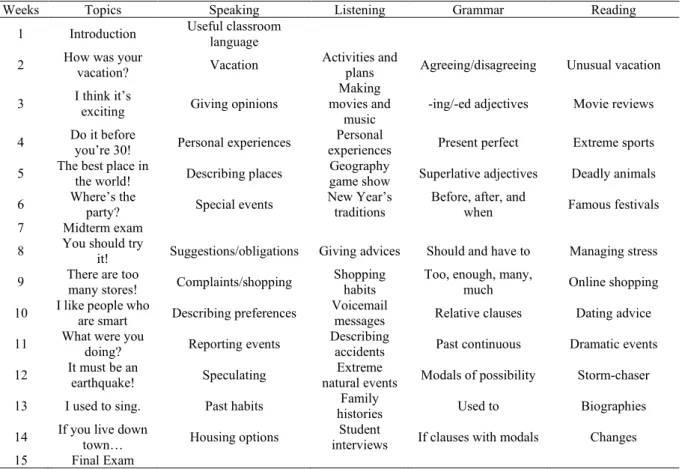
The topics addressed during the study are presented in Table 1. Cooperative and collaborative activities were both used in BL and FL groups. Cooperative activities included group presentation, group interview, and problem-solving activities, and collaborative activities included jigsaw, think-pair-share, and peer feedback.
Table 1. Topics for the Class
Weeks Topics Speaking Listening Grammar Reading
1 Introduction Useful classroom language 2 How was your
vacation? Vacation Activities and
plans Agreeing/disagreeing Unusual vacation 3 I think it’s
exciting Giving opinions Making
movies and
music -ing/-ed adjectives Movie reviews 4 Do it before
you’re 30! Personal experiences Personal
experiences Present perfect Extreme sports 5 The best place in
the world! Describing places Geography
game show Superlative adjectives Deadly animals 6 Where’s the
party? Special events New Year’s
traditions Before, after, and
when Famous festivals 7 Midterm exam
8 You should try
it! Suggestions/obligations Giving advices Should and have to Managing stress 9 There are too
many stores! Complaints/shopping Shopping
habits Too, enough, many,
much Online shopping
10 I like people who
are smart Describing preferences Voicemail
messages Relative clauses Dating advice 11 What were you
doing? Reporting events Describing
accidents Past continuous Dramatic events 12 It must be an
earthquake! Speculating Extreme
natural events Modals of possibility Storm-chaser
13 I used to sing. Past habits Family
histories Used to Biographies
14 If you live down
town… Housing options Student
interviews If clauses with modals Changes 15 Final Exam
3.3 Data Collection Instrument and Analysis
For the study, both quantitative and qualitative data were collected. Questionnaires on learner autonomy, independence, and attitudes from on previous research by Sharle and Szabó (2000), the descriptors of dynamic model of learner autonomy by Tassinari (2012) were adapted and revised, then translated into Korean to ensure accurate responses. The questionnaire used for the study consisted of 31 items using five-scale Likert-type questions (1: not at all, 2: not likely, 3: Somewhat likely, 4: Quite likely, 5: Very likely) twice to investigate changes in learner perspectives. The first was conducted on week 1 to investigate the initial perspectives of the
participants, and then the second was administered in week 14 to examine differences in their perspectives. All 114 participants completed and turned in the questionnaire. The data gathered from the questionnaire were analyzed using SPSS for frequency, ANOVA, and Chi-square for multiple response analysis on the participants’
perspectives on learner autonomy. The significance level was set at 0.05 (p < 0.05) to test the null hypothesis of no association and difference among majors in terms of their responses, and the Tukey test was used for post-hoc. The Cronbach's alpha values for the questionnaire were over .919, showing high reliability for the items in the questionnaire.
Data sources for the qualitative data included interviews and classroom observation. A semi-structured interview was conducted in week 15 based on the items on the questionnaire, and three interviewees were chosen randomly from each group on volunteer basis. Questions for the semi-structured interview were 1) what aspect of the class fostered learner autonomy/independence? 2) how do you feel about your learning experience? 3) and what elements of the class did you find helpful in developing learner autonomy? The interviews were transcribed and translated, then presented descriptively. The in-class and online observation was conducted in weeks 3 to 6 and weeks 9 to 12 during in-class activities and the BL group’s mobile messenger discussions. Learner participation and interactions were observed and logged. The data from the observation is presented descriptively.
4. Results and Discussions
4.1 Learner Autonomy
In order to explore learner perspectives on blended learning and flipped learning, all participants were given a questionnaire on learner perspectives regarding learner autonomy, learner independence, and learner attitudes. A paired t-test was performed to investigate changes in the participant’s perspectives. Then ANOVA was conducted to investigate whether any significant difference existed amongst the three groups.
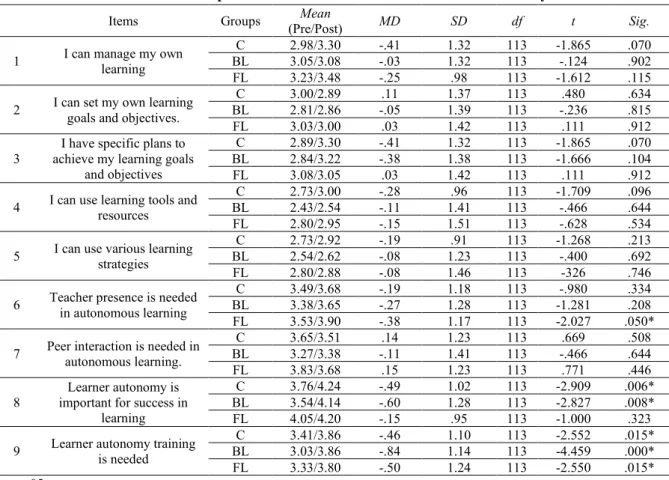
The results for perspectives on learner autonomy are presented in Table 2 below. It appears that the participants displayed positive responses from the beginning of the study. There was a general increase in perspectives except C and FL groups in item 2, FL group in items 3 and 7, although not statistically significant.
Significant differences in perspectives were found in the FL group for item 6, ‘Teacher presence is needed in autonomous learning.’ The FL group responded more positively at the end of the study on the need for teacher presence. Their online assignments included engaging in online learning before the offline classrooms, and it seemed they felt the need for actual teacher presence. According to Morrison, Ross, Kalman and Kemp (2011), in flipped learning, teachers should play multiple roles. They should be content experts, instructional designers, and media developers. Furthermore, teachers need to guide their students and interact with them. The findings of this study also showed the need for teacher presence in the FL group. An interviewee from the FL group confirmed that although watching video lectures on their own can help them to manage their own learning, the lack of teacher presence made them feel uncertain when they did not fully understand. Also, it was observed that participants in the FL class were likely to stay after class and ask individual questions and confirm what they understood. On the other hand, those in the BL and the C group asked questions during the class or asked their friends but did not seek individual attention from the instructor.
Additionally, significant differences were found in item 8, ‘Learner autonomy is important for success in learning.’ The C and BL groups’ perspectives on the relationship between autonomy and success in learning increased. On the other hand, it can be observed that their perspective was highly positive from the beginning of the study than C and BL groups, which may explain why the FL group did not show a significant increase.
Previous studies, including Zhou and Deci (2009), claimed that learner autonomy improves EFL learners’
academic achievement. Indeed, learner autonomy has been viewed as a characteristic of successful learners in EFL
contexts (Yoon 2016). In particular, previous scholars (Banditvilai 2016, Han 2015, Hung, 2015, Wong and Chu 2014) asserted that the two online-based instructional designs – either blended or flipped learning – can enhance EFL students’ learner autonomy, which can lead to academic success. In accordance, the findings of the study revealed that the BL group more understood the importance of learner autonomy for their success in learning after engaging in blended learning. However, it is noted that the FL group’s perspective did not change significantly.
During the interview, it was mentioned by two of the FL interviewees that when they understood the FL design, they thought that if they fail to pace their own learning, their grades would suffer. It seems that upon entering the study, the FL participants mentally prepared themselves for receiving instruction via video at home without teacher presence, and it caused them to be more aware of the relationship between learner autonomy and academic success. The amount of increase in the mean value for the FL group may not be significant, but regardless, the perspectives for this item at the end of the study were all highly positive across the three groups.
Table 2. Descriptive Data and t-test Results for Learner Autonomy
Items Groups Mean
(Pre/Post) MD SD df t Sig.
1 I can manage my own learning
C 2.98/3.30 -.41 1.32 113 -1.865 .070
BL 3.05/3.08 -.03 1.32 113 -.124 .902
FL 3.23/3.48 -.25 .98 113 -1.612 .115
2 I can set my own learning goals and objectives.
C 3.00/2.89 .11 1.37 113 .480 .634
BL 2.81/2.86 -.05 1.39 113 -.236 .815
FL 3.03/3.00 .03 1.42 113 .111 .912
3 I have specific plans to achieve my learning goals
and objectives
C 2.89/3.30 -.41 1.32 113 -1.865 .070
BL 2.84/3.22 -.38 1.38 113 -1.666 .104
FL 3.08/3.05 .03 1.42 113 .111 .912
4 I can use learning tools and resources
C 2.73/3.00 -.28 .96 113 -1.709 .096
BL 2.43/2.54 -.11 1.41 113 -.466 .644
FL 2.80/2.95 -.15 1.51 113 -.628 .534
5 I can use various learning strategies
C 2.73/2.92 -.19 .91 113 -1.268 .213
BL 2.54/2.62 -.08 1.23 113 -.400 .692
FL 2.80/2.88 -.08 1.46 113 -326 .746
6 Teacher presence is needed in autonomous learning
C 3.49/3.68 -.19 1.18 113 -.980 .334
BL 3.38/3.65 -.27 1.28 113 -1.281 .208
FL 3.53/3.90 -.38 1.17 113 -2.027 .050*
7 Peer interaction is needed in autonomous learning.
C 3.65/3.51 .14 1.23 113 .669 .508
BL 3.27/3.38 -.11 1.41 113 -.466 .644
FL 3.83/3.68 .15 1.23 113 .771 .446
8 Learner autonomy is important for success in
learning
C 3.76/4.24 -.49 1.02 113 -2.909 .006*
BL 3.54/4.14 -.60 1.28 113 -2.827 .008*
FL 4.05/4.20 -.15 .95 113 -1.000 .323
9 Learner autonomy training is needed
C 3.41/3.86 -.46 1.10 113 -2.552 .015*
BL 3.03/3.86 -.84 1.14 113 -4.459 .000*
FL 3.33/3.80 -.50 1.24 113 -2.550 .015*
* p < .05
As for item 9, the need for learner autonomy training, all three groups showed a significantly positive increase in their perspectives at the end of the study compared to the beginning. Lengkanawati (2016) suggested training EFL students with learning autonomy strategies claiming that the students should be taught to develop their learner autonomy skills in class in the first place. While some teachers in EFL settings are more concerned with increasing students’ awareness of learner autonomy by talking to the students about its importance, others care more about its know-how by training students in autonomous learning strategies. Nonetheless, the author noted a lack of student training opportunities for learner autonomy in EFL contexts (Lengkanawati 2016). Findings of the current study are also in line with the previous study, showing the students’ need for learner autonomy training
It is interesting to note that all groups, including the C group, showed the desire for learner autonomy training.
According to the interview with participants, this phenomenon appears to be due to the changes in the academic paradigm from high school to university. The following transcript from the interview with group BL shows the changes in perspective and why they felt the need for someone to show them how to be autonomous.
People keep saying that college is different than high school, and you have to study on your own. I didn’t really know what that meant. I thought it just meant that I had to do homework by myself, lol. I know now that being autonomous is not just studying by yourself, but setting my own goals and planning, pacing myself. And knowing what I don’t know and finding ways to learn it. I never reflected on my work before, either.
It should be note that among the three groups, the BL group showed the highest increase. As mentioned above, the FL group began the study with learner autonomy in mind, and the C group did not need to engage in online collaborative and cooperative group interaction without teacher presence. On the other hand, the BL group had to complete task-based activities in groups in an online environment, and it may have caused an increase in their perspective toward learner training on autonomy.
In an effort to ascertain whether the results of the questionnaire are statistically significant amongst groups, one-way ANOVAs for the group comparative analysis was run. ANOVA results for learner autonomy among the C, BL, and FL groups indicate that there were no significant differences found, showing an overall increase in the participants’ perspectives on learner autonomy for all three groups.
4.2 Learner Independence
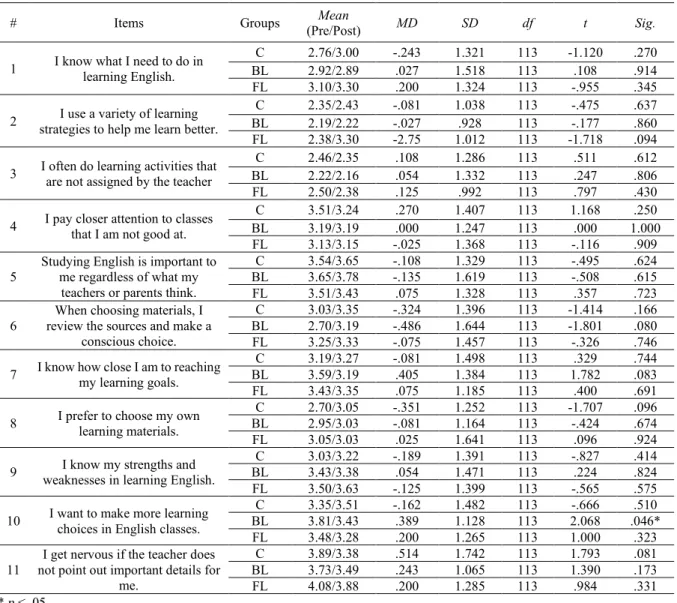
Changes in perspectives on learner independence concerning C, BL, and FL models are investigated, and the results are presented in Table 3. While the responses were generally positive or neutral, there are several findings worthy of attention. The item with the lowest mean value in the post-test was item 3, ‘I often do learning activities that are not assigned by the teacher, and the average of the three groups was 2.29. Although items on the need to study, such as items 5 and 10 were positive, the participants were not likely to independently seek out learning activities to compensate for any lack thereof. Similarly, the response for item 2, ‘I use a variety of learning strategies to help me learn better’ was negative for both pre and post in the C and BL group. FL group shows an increase of 2.75, but it was not statistically significant. So it seems that while students feel the need to study English, and it is important to them, they have not gone out of their way to do so. Relatedly, item 11, ‘I get nervous if the teacher does not point out important details for me,’ had an average post mean value of 3.58, which was the highest. It shows that the students in this study were dependent on the teacher, and preferred for the teacher to emphasize the focal information rather than to make conscientious learning decisions. It seems that the previously discussed response for item 9 in learner autonomy may be associated with this finding. Considering that the participants think they need training in being autonomous, they may not be aware of what learning activities are available, how to find them, what learning strategies they can use, etc.
Table 3. Descriptive Data and t-test Results for Learner Independence
# Items Groups Mean
(Pre/Post) MD SD df t Sig.
1 I know what I need to do in learning English.
C 2.76/3.00 -.243 1.321 113 -1.120 .270
BL 2.92/2.89 .027 1.518 113 .108 .914
FL 3.10/3.30 .200 1.324 113 -.955 .345
2 I use a variety of learning strategies to help me learn better.
C 2.35/2.43 -.081 1.038 113 -.475 .637
BL 2.19/2.22 -.027 .928 113 -.177 .860
FL 2.38/3.30 -2.75 1.012 113 -1.718 .094
3 I often do learning activities that are not assigned by the teacher
C 2.46/2.35 .108 1.286 113 .511 .612
BL 2.22/2.16 .054 1.332 113 .247 .806
FL 2.50/2.38 .125 .992 113 .797 .430
4 I pay closer attention to classes that I am not good at.
C 3.51/3.24 .270 1.407 113 1.168 .250
BL 3.19/3.19 .000 1.247 113 .000 1.000
FL 3.13/3.15 -.025 1.368 113 -.116 .909
5 Studying English is important to me regardless of what my
teachers or parents think.
C 3.54/3.65 -.108 1.329 113 -.495 .624
BL 3.65/3.78 -.135 1.619 113 -.508 .615
FL 3.51/3.43 .075 1.328 113 .357 .723
6 When choosing materials, I review the sources and make a
conscious choice.
C 3.03/3.35 -.324 1.396 113 -1.414 .166
BL 2.70/3.19 -.486 1.644 113 -1.801 .080
FL 3.25/3.33 -.075 1.457 113 -.326 .746
7 I know how close I am to reaching my learning goals.
C 3.19/3.27 -.081 1.498 113 .329 .744
BL 3.59/3.19 .405 1.384 113 1.782 .083
FL 3.43/3.35 .075 1.185 113 .400 .691
8 I prefer to choose my own learning materials.
C 2.70/3.05 -.351 1.252 113 -1.707 .096
BL 2.95/3.03 -.081 1.164 113 -.424 .674
FL 3.05/3.03 .025 1.641 113 .096 .924
9 I know my strengths and weaknesses in learning English.
C 3.03/3.22 -.189 1.391 113 -.827 .414
BL 3.43/3.38 .054 1.471 113 .224 .824
FL 3.50/3.63 -.125 1.399 113 -.565 .575
10 I want to make more learning choices in English classes.
C 3.35/3.51 -.162 1.482 113 -.666 .510
BL 3.81/3.43 .389 1.128 113 2.068 .046*
FL 3.48/3.28 .200 1.265 113 1.000 .323
11 I get nervous if the teacher does not point out important details for
me.
C 3.89/3.38 .514 1.742 113 1.793 .081
BL 3.73/3.49 .243 1.065 113 1.390 .173
FL 4.08/3.88 .200 1.285 113 .984 .331
* p < .05
The mean values for item 10 show that the BL group’s response significantly decreased from the pre to post, showing that they do not wish to make more learning choices. The same goes for the FL group, although their values are not significant. The concepts of learner independence have drawn attention to the student-oriented approach to language pedagogy and emphasized its importance (Çelik, Arkin and Sabriler 2012). According to Dickinson (1991), learner independence does not mean a learner is isolated, but rather an active participant in learning. In particular, given that technology has provided a wealth of resources to independent learners (Çelik, Arkin and Sabriler 2012), both BL and FL groups might have too many things to do by themselves. During the interview, both BL and FL groups mentioned a lot of homework, and the BL group especially felt so due to online interaction with classmates. This can explain why the BL group’s response significantly decreased from the pre to post. Another aspect to consider is that the FL group’s online activity involved individually watching lectures and doing activities that can be done in a given amount of time. On the other hand, the BL group’s online activities involved group task-based activities and interaction, and students seemed to engage in online group discussions for a more extended period of time. An interview with a BL group’s student is provided below.
Online activities were fun, especially those involving group discussion on KakaoTalk. But even though professor told us we should spend approximately 15 minutes for teach, we spent more than twice as much. I think we had fun talking to each other so we lost track of time. But sometimes, spending too much time was tough for me.
ANOVA results for learner independence among the C, BL, and FL groups indicate no significant differences found, showing an overall increase in the participants’ perspectives on learner independence for all three groups.
According to Lin (1996), learner independence is highly desirable, and every teacher wants to see this acquired by their students as the link between learner independence and effective learning is inevitable. That is, successful learners tend to show a high level of learner independence. Lengkanawati (2016) also added that independent learning should be instilled in EFL students. Therefore, teachers need to set tasks that require their students to do more on their own. Considering the responses from all three groups, a balanced combination of learning activities may encourage learners to engage in learning and, in turn, develop learner independence by making mindful learning choices for themselves.
4.3 Learner Attitudes
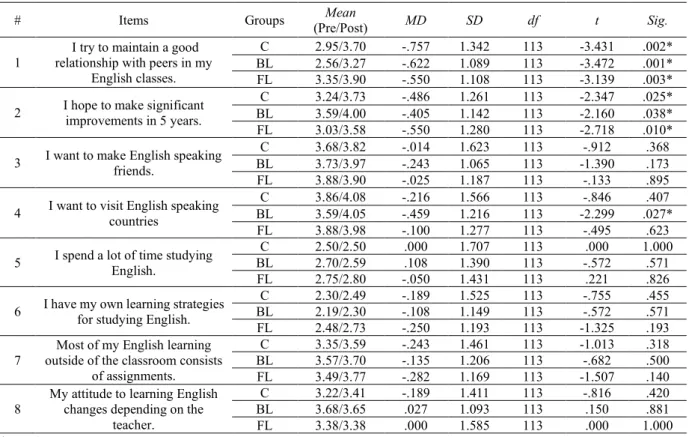
The impact of instructional models on EFL learner’s change in attitudes towards learning English is presented in Table 4. It seems the participants had positive perspectives for English itself and circumstances that would require using English. For example, items 3 and 4 both showed positive perspectives for both pre and post results.
Participants in all three groups showed interest in English speaking culture and people in general. BL group showed a significant increase in perspective for item 4, ‘I want to visit English speaking countries.’ Still, theredoes not seem to be much value in discussing in detail, considering that both pre and post are positive.
Items with statistically significant changes for all groups were items 1, ‘I try to maintain a good relationship with peers in my English classes.’ All three groups showed a significant increase, but the C and BL groups’ perspectives changed from negative to positive. Pair and group discussions were part of all three groups, although required at different times and environments, and continued interaction with peers seem to cause this change. It was observed for both C and BL groups that in-class group discussions brought students together during the study, and students could bond with one another. Interviews confirmed that peer interaction had a positive influence on them, and an interviewee in group C mentioned that she had the chance to get to know people outside of her major in English class, which she appreciated.
Item 2, ‘I hope to make significant improvements in 5 years,’ also showed a significant increase across all groups, but both pre and post mean values were positive. It can be inferred that the participants wanted to become better in English in 5 years, and by the end of the study, they strongly felt that they want to be better. During the interview, a student mentioned that 5 years would mean that they are out of college, and English is one thing they need to have prepared before graduation. Consequnetly, the desire to make improvement in English was seen for all groups.
In 5 years, I am going to be either fresh out of college or close to graduating. I want to make a lot of improvement because I need to speak English well when I get a job. Also I want to travel to different countries and enjoy other cultures after I graduate. For that reason, I need to study English now and prepare for the future.
The current study proves the positive impact of flipped learning on students’ motivation. According to Bergmann and Sams (2015), a flipped course can increase students’ motivation and engagement and help them to take more independence for their learning. Strayer (2012) also claimed that the flipped model improves learning motivation. Likewise, given that there is a positive increase in motivation in the BL group, the present study’s
finding can support the previous findings suggesting that the various high-tech learning tools can boost EFL students’ motivation in learning (Kim 2017). Notably, findings of the present study are in accordance with Murday, Ushida and Chenoweth (2008), emphasizing the importance of student motivation in blended learning, which can result in their academic progress.
On the other hand, while they want to get better, the BL group responded that they are not putting the necessary effort into achieving their goals. Items 5, ‘I spend a lot of time studying English’ had negative average mean values for all groups for both pre (2.65) and post (2.63), indicating that they did not feel that they invest a lot of time in studying English. Item 6, ‘I have my own learning strategies for studying English,’ also showed negative mean values for the whole were 2.32 for pre and 2.52 for post 2.51. From these results, it can be assumed that while students want to make improvements, they do not have the knowledge and skills to proceed, which reinforces the need for learner training on how to become autonomous.
Table 4. Descriptive Data and t-test Results for Learner Attitudes
# Items Groups Mean
(Pre/Post) MD SD df t Sig.
1 I try to maintain a good relationship with peers in my
English classes.
C 2.95/3.70 -.757 1.342 113 -3.431 .002*
BL 2.56/3.27 -.622 1.089 113 -3.472 .001*
FL 3.35/3.90 -.550 1.108 113 -3.139 .003*
2 I hope to make significant improvements in 5 years.
C 3.24/3.73 -.486 1.261 113 -2.347 .025*
BL 3.59/4.00 -.405 1.142 113 -2.160 .038*
FL 3.03/3.58 -.550 1.280 113 -2.718 .010*
3 I want to make English speaking friends.
C 3.68/3.82 -.014 1.623 113 -.912 .368
BL 3.73/3.97 -.243 1.065 113 -1.390 .173
FL 3.88/3.90 -.025 1.187 113 -.133 .895
4 I want to visit English speaking countries
C 3.86/4.08 -.216 1.566 113 -.846 .407
BL 3.59/4.05 -.459 1.216 113 -2.299 .027*
FL 3.88/3.98 -.100 1.277 113 -.495 .623
5 I spend a lot of time studying English.
C 2.50/2.50 .000 1.707 113 .000 1.000
BL 2.70/2.59 .108 1.390 113 -.572 .571
FL 2.75/2.80 -.050 1.431 113 .221 .826
6 I have my own learning strategies for studying English.
C 2.30/2.49 -.189 1.525 113 -.755 .455
BL 2.19/2.30 -.108 1.149 113 -.572 .571
FL 2.48/2.73 -.250 1.193 113 -1.325 .193
7 Most of my English learning outside of the classroom consists
of assignments.
C 3.35/3.59 -.243 1.461 113 -1.013 .318
BL 3.57/3.70 -.135 1.206 113 -.682 .500
FL 3.49/3.77 -.282 1.169 113 -1.507 .140
8 My attitude to learning English changes depending on the
teacher.
C 3.22/3.41 -.189 1.411 113 -.816 .420
BL 3.68/3.65 .027 1.093 113 .150 .881
FL 3.38/3.38 .000 1.585 113 .000 1.000
* p < .05
Table 5. Post-hoc Results for Learner Attitudes
Source df F p Post-hoc
I hope to make significant improvements in 5 years.
Between Groups 2
3.165 .046 BL > FL Within Groups 112
Total 114
I try to maintain good relationship with peers in my
English classes.
Between Groups 2
5.875 .004 BL < FL Within Groups 112
Total 114
* p < .05
One-way ANOVA for the group comparative analysis was run, and there were some significant differences observed. As shown in Table 5, significant differences were observed in item 2, ‘I hope to make significant improvements in 5 years.’ and item 1, ‘I try to maintain a good relationship with peers in my English classes.’ The post-hoc tests on these two items reached the .05 significance level. The results indicate that BL group’s mean score for item 2 was significantly higher than that of the FL group, meaning that the BL group had a more positive attitude for making long-term improvements than the FL group. Likewise, the perspectives of the FL group were also significantly higher than that of the BL group regarding item 3. Considering that both groups had positive perspectives for items 2 and 3, the differences do not seem to be worthy of in-depth discussion.
5. Conclusion
Technology has been popularly used in the educational world (King 2008), and various pedagogical models have been introduced to promote technology-assisted learning. Among them, blended learning has been claimed as one of the most important educational advances in recent years (Thorne 2003). Grgurović (2011) asserted that there is a close connection between future language learning and blended learning. Apart from blended learning, flipped learning has also been regarded as one of the best learning models (Hamdan, McKnight, McKnight and Arfstrom 2013), and according to Ekmekci (2017), it is the most widely used instructional design in the EFL settings. In particular, the two online-based instructional designs – blended and flipped learning – are known to enhance EFL students’ learner autonomy, which has been viewed as a feature of successful learners (Banditvilai 2016, Han 2015, Hung 2015, Wong and Chu 2014, Yoon 2016).
Nonetheless, the existing blended learning studies have concentrated on its development and effectiveness.
According to Yoon (2016), there is a lack of an in-depth investigation of the impacts of blended learning on learner autonomy. Furthermore, there is also a need for empirical evidence regarding flipped learning. Particularly in EFL classes, little research has supported incorporating the flipped model (Mehring 2016). In this context, the current study intended to explore the effects of blended and flipped learning on EFL students’ learner autonomy. Based on the previous research (Sharle and Szabó 2000, Tassinari 2012, Yoon 2016), the students’ learner autonomy was examined concerning their autonomy, independence, and attitudes.
The major findings are as follows: In learner autonomy, a significant difference was found in the FL group in relation to the need for teacher presence. The FL group responded more positively at the end of the study on item 6,
‘Teacher presence is needed in autonomous learning.’ The BL group also showed a significant mean difference regarding learner autonomy. Compared to the beginning of the study, the BL group responded more positively at the end of the study on item 8, ‘Learner autonomy is important for success in learning.’ In terms of item 9, ‘Learner autonomy training is needed,’ both groups showed a significantly positive increase in their perspectives from the pre to post, supporting the previous research (Lengkanawati 2016), showing the students’ need for learner autonomy training. ANOVA results for learner autonomy among the C, BL, and FL groups revealed no significant differences, showing the overall increase in students’ perspectives on learner autonomy for all three groups.
When it comes to learner independence, there was a significant difference observed in the BL group for item 10
‘I want to make more learning choices in English classes.’ The BL group’s response significantly decreased at the end of the study, showing that they do not want to make more learning choices in comparison to the beginning.
ANOVA for the group comparative analysis was run, but the results for learner independence show no significant differences among the C, BL, and FL groups, suggesting an overall increase in the participants’ perspectives on learner autonomy for all three groups.
In terms of learner attitude, there were statistically significant changes for all groups in items 2, ‘I try to maintain a good relationship with peers in my English classes.’ Both BL and FL groups showed a significant increase from pre to post, suggesting that in-class group discussions and peer interactions might positively influence them. Item 3,
‘I hope to make significant improvements in 5 years,’ showed a significant increase across all groups, showing that both groups wanted to become better in English in near future. Regarding item 5, ‘I want to visit English speaking countries,’ only the BL group showed a significant increase at the end of the study, suggesting that they had positive perspectives for circumstances that would require using English. ANOVA results revealed some significant differences among the groups. The mean score of the BL group for item 2 was significantly higher than that of the FL group, indicating that the BL group had a more positive attitude for making long term improvements.
On the other hand, the FL group’s perspectives were significantly higher than that of the BL group regarding item 3, meaning that the FL group wanted to maintain a good relationship with peers more than the BL group did.
Overall, it should be noted that language instruction can impact learners in positive ways, as seen in increases found in all groups. However, the FL group specifically showed the need for teacher presence to improve their learner autonomy. On the other hand, the BL group recognized the importance of learner autonomy for their success in learning but wanted less learning choices. Both BL and FL groups felt the need for autonomy training and showed a positive attitude toward learning. No group differences were found in learner autonomy and learner independence. Although learner attitude showed mean differences regarding two items, both groups had positive perspectives for the items, and it does not seem to be worthy of in-depth discussion.
From the findings of the current study, it can be said that the teacher presence should be emphasized in flipped learning. As Morrison, Ross, Kalman and Kemp (2011) pointed out, teachers should play multiple roles as content experts, instructional designers, and media developers and guide their students and interact with them. In blended learning, teachers should encourage their students to use technology to become autonomous learners, as Bañados (2006) claimed. However, a balanced combination of learning activities and mindful learning choices are needed to develop the students’ learner independence. In addition, autonomy training sessions are necessary for both blended and flipped learning. As Lengkanawati (2016) suggested, the students should be taught learning autonomy strategies to develop their learner autonomy skills. Lastly, given that positive learner attitudes are important to enhance learner autonomy (Pichugova, Stepura and Pravosudov 2016) and learner independence (Mariani 1992), the teachers also need to encourage their students to have a positive attitude towards both blended and flipped instructional designs. One single model cannot be a perfect fit for all educational settings (Chowdhury 2019).
Conventional, blended, and flipped learning have all positively influenced learner perspectives regarding autonomy, independence, and attitudes.
The limitations of the studies are: 1) the scope of the research does not address the relationship between learner autonomy, learner independence, and learner attitude are not addressed, and 2) the learner perspectives on blended learning, flipped learning, and conventional learning are not examined due to the parameter set for the study. It can be suggested that the extended follow-up research to be carried out to examine the impact of instructional designs and their effectiveness in various settings and their relationship to learner autonomy, independence, and attitude. In addition, the relationship between learner autonomy, independence, and attitude and their impact on each other in different instructional designs can be investigated. Also, considering that the current study was conducted in the Korean EFL context, different findings can be obtained in different learning environments. Furthermore, students have various knowledge backgrounds with mixed language abilities. They also have diverse goals and a different range of motivation with various learning needs. As learning is complex with many variations (Garrison and Kanuka 2004), more studies on blended and flipped learning with the students from varied backgrounds are suggested for effective EFL teaching and learning.
References
Aksenova, N. V., D. V. Shepetovsky, V. E. Mironova, S. N. Stepura and L. L. Pichugova. 2015. Developing students’ motivation to learn foreign language in tertiary classroom and beyond. Mediterranean Journal of
Social Sciences 6(5), 240-247.
Alebaikan, R. and S. Troudi. 2010. Blended learning in Saudi universities: Challenges and perspectives. ALT-J Research in Learning Technology 18(1), 49-59.
Asuman, A. 2010. Misconceptions on learner autonomy: A methodological and conceptual renewal. Ekev Academic Review 14(43), 141-153.
Bañados, E. 2006. A blended-learning pedagogical model for teaching and learning EFL successfully through an online interactive multimedia environment. CALICO Journal 23(3), 533-550.
Banditvilai, C. 2016. Enhancing students’ language skills through blended learning. Electronic Journal of e-Learning 14(3), 220-229.
Benson, P. 2001. Teaching and Researching Autonomy in Language Learning. London: Longman.
Bergmann, J., J. Overmyer and B. Wilie. 2013. The flipped class: What it is and what it is not. The Daily Riff.
Retrieved from http://www.thedailyriff.com/articles/the-flipped-class-conversation-689.php
Bergmann, J. and A. Sams. 2012. Flip the Classroom. Washington, DC: International Society for Technology in Education.
Bormann, J. 2014. Affordances of Flipped Learning and Its Effects on Student Engagement and Achievement.
Unpublished master’s thesis, University of Northern Iowa, Cedar Falls, IA.
Boud, D. 1988. Developing Student Autonomy in Learning. London: Kogan Page.
Çelik, S., E. Arkin and D. Sabriler. 2012. EFL learners’ use of ICT for self-regulated learning. The Journal of Language and Linguistic Studies 8(2), 98-118.
Chowdhury, F. 2019. Blended learning: How to flip the classroom at HEIs in Bangladesh? Journal of Research in Innovative Teaching and Learning. Retrieved from https://www.emerald.com/insight/content/doi/
10.1108/JRIT-12-2018-0030/full/html
Cotterall, S. and D. Crabbe. 1999. Learner Autonomy in Language Learning: Defining the Field and Effecting Change. Frankfurt: Peter Lang.
Dang, T. T. 2010. Learner autonomy in EFL studies in Vietnam: A discussion from sociocultural perspective.
English Language Teaching 3(2), 3-9.
Dam, L., R. Eriksson, D. Little, J. Miliander and T. Trebbi. 1990. Towards a definition of autonomy. In T. Trebbi, ed., Third Nordic Workshop on Developing Autonomous Learning in the FL Classroom, 96-103. Bergen:
University of Bergen.
Dickinson, L. 1995. Autonomy and motivation a literature review. System 23(2), 165-174.
Eagly, A. H. and S. Chaiken. 1993. The Psychology of Attitudes. Fort Worth, TX: Harcourt, Brace, Jovanovich.
Ekmekci, E. 2014. Flipped Writing Class Model with a Focus on Blended Learning. Unpublished doctoral dissertation, Gazi University Graduate School of Educational Sciences, Ankara, Turkey.
Fakeye, D. 2010. Students’ personal variables as correlates of academic achievement in English as a second language in Nigeria. Journal of Social Sciences 22, 205-211.
Finch, A. 2002. Autonomy: Where are we? Where are we going? In A. S. Mackenzie and E. McCafferty, eds., Developing Autonomy, 15-42. Tokyo: The Japan Association for Language Teaching College and University Educators Special Interest Group.
Grgurovic, M. 2011. Blended learning in an ESL class: A case study. CALICO Journal 29(1), 100-117.
Han, Y. J. 2015. Successfully flipping the ESL classroom for learner autonomy. NYS TESOL Journal 2(1), 98-109.
Hamdan, N., P. McKnight, K. McKnight and K. M. Arfstrom. 2013. The Flipped Learning Model: A White Paper based on the Literature Review titled “A Review of Flipped Learning.” Arlington, VA: Flipped Learning Network.
Harrington, M. A. 2010. Problematizing the hybrid classroom for ESL/EFL students. The Electronic Journal for English as a Second Language 14(3), 1-13
Holec, H. 1981. Autonomy in Foreign Language Learning. Oxford: Pergamon
Hung, H. 2015. Flipping the classroom for English language learners to foster active learning. Computer Assisted Language Learning 28(1), 81-96.
Kim, N.-Y. 2017. Effects of types of voice-based chat on EFL students’ negotiation of meaning according to proficiency levels. English Teaching 72(1), 159-181.
Lengkanawati, N. S. 2016. Teachers’ beliefs about learner autonomy and its implementation in Indonesian EFL settings. Language learner autonomy, In R. Barnard and J. Li, eds., Language Learner Autonomy:
Teachers’ Beliefs and Practices in Asian Contexts, 134-149. Phnom Penh, Cambodia: CAMTESOL.
Lin, L. Y. 1996. Learner training towards learner independence. In L. Dickinson, ed., Autonomy 2000: The Development of Learning Independence in Language Learning, 116-123. Bangkok: King Mongkut’s Institute of Technology Thonburi/The British Council.
Little, D. 1996. The politics of learner autonomy. Language Learning 2(4), 7-10.
Little, D. 2003. Learner Autonomy and Second/Foreign Language Learning. Southampton, UK: The Higher Education Academy.
Mariani, L. 1992. Language awareness/learning awareness in a communicative approach: A key to learner independence. Journal of TESOL 18(2). Retrieved from http://www.learningpaths.org/papers/
paperawareness.htm
Means, B., Y. Toyama, R. Murphy, M. Bakia and K. Jones. 2009. Evaluation of Evidence based Practices in Online Learning: A Meta-analysis and Review of Online Learning. Washington, DC: U.S. Department of Education.
Mehring, J. 2016. Present research on the flipped classroom and potential tools for the EFL classroom. Computers in the Schools 33(1), 1-10.
Morrison, G., S. Ross, H. Kalman and J. Kemp. 1998. Designing Effective Instruction. New Jersey: Prentice Hall.
Mulcahy, R. F. (1991). Developing autonomous learners. Alberta Journal of Educational Research 37(4), 385-397 Murday, K., E. Ushida and A. Chenoweth. 2008. Learners’ and teachers’ perspectives on language online.
Computer Assisted Language Learning 21(2), 125-142.
Pichugova, I. L., S. N. Stepura and M. M. Pravosudov. 2016. Issues of promoting learner autonomy in EFL context.
SHS Web of Conferences 28, 1-4.
Sharle, Á. and A. Szabó. 2000. Learner Autonomy: A Guide to Developing Learner Responsibility. Cambridge, UK: Cambridge University Press.
Soliman, N. A. 2016. Teaching English for academic purposes via the flipped learning approach. Procedia-Social and Behavioral Sciences 232, 122-129.
Strayer, J. F. 2012. How learning in an inverted classroom influences cooperation, innovation and task orientation.
Learning Environments Research 15, 171-193.
Sung, K. 2015. A case study on a flipped classroom in an EFL content course. Multimedia-Assisted Language Learning 18(2), 159-187.
Tassinari, M. G. 2012. Evaluating learner autonomy: A dynamic model with descriptors. Studies in Self-Access Learning Journal 3(1), 24-40.
Thanasoulas, D. 2000. What is learner autonomy and how can it be fostered? The Internet TESL Journal 6(11).
Retrieved from http://iteslj.org/Articles/Thanasoulas-Autonomy.html
Tilfarlioglu, F. Y. and F. S. Ciftci. 2011. Supporting self-efficacy and learner autonomy in relation to academic success in EFL classrooms. Theory and Practice in Language Studies 1(10), 1284-1294.
Thorne, K. 2003. Blended Learning: How to Integrate Online and Traditional Learning. London: Kogan Page.
Waterhouse, P. 1990. The curriculum. In I. Gathercole, ed., Autonomy in Language Learning, 4-6. London: CILT.
Webb, M. and E. Doman. 2016. Does the flipped classroom lead to increased gains on learning outcomes in ESL/EFL contexts? CATESOL Journal 28(1), 39-67.
Wong, K. and D. W. Chu. 2014. Is the flipped classroom model effective in the perspectives of students’
perceptions and benefits? In S. K. S. Cheung, J. Fong, J. Zhang, R. Kwan and L. F. Kwok, eds., Hybrid Learning: Theory and Practice, 93-104. Chennai, India: Springer International Publishing.
Wu, J. and W. Liu. 2013. An empirical investigation of the critical factors affecting students’ satisfaction in EFL blended learning. Journal of Language Teaching and Research 4(1), 176-185.
Yoon, S. Y. 2016. Exploring learner perspectives on learner autonomy for blended learning in EFL conversation classes. STEM Journal 17(1), 197-220.
Yoon, S. Y. and N.-Y. Kim. 2020. To flip or not to flip: A comparative study on flipped, blended, and conventional learning in EFL Korean context. The Journal of Asia TEFL 17(4), 1363-1376.
Zhou, M., W. J. Ma and E. L. Deci. 2009. The importance of autonomy for rural Chinese children’s motivation for learning. Learning and Individual Difference 19, 492-498.
Examples in: English
Applicable Languages: English Applicable Level: All