Tracking Control of 3-Wheels Omni-Directional Mobile Robot Using Fuzzy Azimuth Estimator
Sangdae Kim
1and Seungwoo Kim
1*1Department of Electrical and Robotic Engineering, Soonchunhyang University
퍼지 방위각 추정기를 이용한 세 개의 전 방향 바퀴 구조의 이동로봇시스템의 개발
김상대
1, 김승우
1*1순천향대학교 전기로봇공학과
Abstract Home service robot are not working in the fixed task such as industrial robot, because they are together with human in the same indoor space, but have to do in much more flexible and various environments.
Most of them are developed on the base of the wheel-base mobile robot in the same method as a vehicle robot for factory automation. In these days, for holonomic system characteristics, omni-directional wheels are used in the mobile robot. A holonomicrobot, using omni-directional wheels, is capable of driving in any direction. But trajectory control for omni-directional mobile robot is not easy. Especially, azimuth control which sensor uncertainty problem is included is much more difficult. This paper develops trajectory controller of 3-wheels omni-directional mobile robot using fuzzy azimuth estimator. A trajectory controller for an omni-directional mobile robot, which each motor is controlled by an individual PID law to follow the speed command from inverse kinematics, needs a precise sensing data of its azimuth and exact estimation of reference azimuth value.
It has imprecision and uncertainty inherent to perception sensors for azimuth. In this paper, they are solved by using fuzzy logic inference which can be used straightforward to perform the control of the mobile robot by means of the fuzzy behavior-based scheme already existent in literature. Finally, the good performance of the developed mobile robot is confirmed through live tests of path control task.
요 약 서비스 로봇은 사람이 생활하는 환경에서 동작한다. 이런 환경에서는 일반적인 휠베이스 모빌러티(Mobility) 방식의 이동로봇은 동적인 장애물과 정적인 장애물에 둘러싸여 있으므로 로봇의 움직임에 있어 자유로운 주행에 제 약을 받게 된다. 이것은 소위 비홀로노믹(Non-Holonomic) 시스템 특성으로 주행 중인 이동로봇은 장애물을 만나면 별 도의 조향장치를 사용하거나 차동 휠 구조 로봇의 회전 과정을 수행한 후 이동하고자 하는 방향으로 진행할 수 있다. 이런 장애물을 신속하게 회피하려면 홀로노믹(Holonomic) 시스템 특성이 필요하다. 홀로노믹 시스템은 별다른 회전과 정 없이 단순히 좌우로 이동만 하면 된다. 이러한 특성으로 민첩하게 주행할 수 있고 좁은 공간에서 비홀로노믹 로봇 보다 효율적이고 자유로운 주행이 가능하다. 그러므로 본 논문에서는 세 개의 옴니휠(Omni-wheels)을 사용한 홀로노
믹 이동로봇 시스템을 개발한다. 세 개의 옴니휠을 사용한 이동로봇의 동역학과 모터 비선형 운동방정식을 고려한 정
밀한 비선형 동역학 모델을 유도하여 제시한다. 유도된 식을 통해 각각의 모터 속도를 계산하고. 기본 속도제어기로 는 PID방식을 사용한다. 그런데, 옴니휠을 이용한 홀로노믹 이동로봇의 추적제어는 정확한 방위각 센싱 데이터와 기 준값(Reference Value)을 필요로 한다. 방위각 센싱은 부정확성과 불확실성(Uncertainty)을 갖는다. 부정확성은 센서 시 스템의 노이즈와 얼라이어싱(Aliasing)으로 인하여 발생하고, 불확실성은 모바일 로봇의 왜란(Disturbance)과 미끄러짐 (Slip)으로 발생한다. 본 논문에서는 퍼지 논리 추론에 의한 퍼지 방위각 추정기(Estimator)를 개발하여 방위각 제어의 새로운 개념을 제시한다. 끝으로, 퍼지 방위각 추정을 이용한 세 개의 전 방향 바퀴 구조의 이동로봇이 실시간으로
제어되는 실험을 통하여 이동로봇 시스템의 성능을 분석한다.
Key Words : Omni-Directional Mobile Robot, Holonomic System, Azimuth, Fuzzy Inference, Gyro-Sensor
This research was financially supported by the Ministry of Education, Sciences Technology (MEST) and Korea Institute for Advancement of Technology (KIAT) through the Human Resource Training Project for Regional Innovation.
*Corresponding Author : Kim, Seung-Woo ([email protected])
Received August 16, 2010 Revised October 1, 2010 Accepted October 15, 2010
1. Introduction
Mobile robot has great applicable potential in human society in the future. The functions will no longer be restricted to accomplish tasks in assembly and manufacturing at a fixed position. In order to accomplish practical tasks, a mobile robot has to be navigated smoothly in the real world wherein unexpected changes take place. Conventional wheeled mobile robot(WMR) is restricted in their motion because they cannot move sideways without a preliminary maneuvering. Various mechanisms have been developed to improve the maneuverability of WMR. But they have never made the conventional WMR overcome the problem of non-holonomic system. For example, a differential drive design which has two motors mounted in fixed positions on the left and right side of the robot. Then, the differential wheel drive has a kind of deficiency. It cannot drive in all possible direction. For this reason, this robot is called 'non-holonomic'. In contrast, a holonomic robot, using omni-directional wheels, is capable of driving in any direction. In the last few years, Swedish omni- directional wheeled mobile robot (OWMR) has received growing attention among the mobile robotics researchers.
[1,2,3] In this paper, a Swedish OWMR is, with a proposal of new control algorithm, developed as a holonomic mobile robot.
The trajectory control of OWMR is so difficult because it has much more uncertainty than conventional WMR.
The dynamic equation is nonlinear and time-varying in the extreme. Thus, this paper presents accurate trajectory control method of 3-wheels omni-directional mobile robot using fuzzy azimuth estimator. The OWMR of this paper has three omni-directional wheels, arranged 120 degree apart. Each wheel is driven by a DC motor installed with an optical shaft encoder. A gyro sensor is used for the perception of azimuth. It is controlled by independent PID law for each motor to follow the speed command from inverse kinematics without considering the coupled nonlinear dynamics explicitly in the controller design. A trajectory controller for an omni-directional mobile robot needs a precise sensing data of its azimuth and exact estimation of reference azimuth value. It has imprecision and uncertainty inherent to perception sensors for azimuth. The imprecision is made by sensor noise and
aliasing. The uncertainty consists of disturbance and slip of mobile robot. In this paper, they are solved by using fuzzy logic inference which can be used straightforward to perform the control of the mobile robot by means of the fuzzy behavior-based scheme already existent in literature. An azimuth estimator is designed by Mamdani-typed fuzzy inference method. Also, it is perfectly implemented on the 3-wheels OWMR developed in this paper.
The paper is organized as follows: the kinematics model for a 3 Swedish-wheeled mobile robot is derived in the Section II. The tracking control algorithm and the fuzzy azimuth estimator are explained in Section III.
Experimental rim whs of the trajectory controller are reported and live test rim whs of 3-wheels ODMR are given, in Section IV. At last, some concluding remarks are addressed in Section V.
2. Dynamics of OWMR
As a first step to develop a robot controller, the equations of robot motion need to be derived. Several simplifying assumptions are made. For example, it is assumed that there is no slip in all the three wheels, and the friction force is simplified to be represented by a viscous friction coefficient. Electrical time constant of the motor is also neglected. It is expected that the feedback controller based on this simplified model can compensate the unmodeled dynamics. There are two coordinate frames used in the modeling: the body frame and the world frame.
[Fig. 1] Force Analysis and Nomenclature
The body frame is fixed on the moving robot with the origin in the center of chassis, the world frame is fixed on the play ground, and symbols used in OWMR dynamic model is listed, as shown in Fig. 1.[3]
In the body frame and by Newton's law, we can have
(1)
From the force analysis in the body frame, we have
∙
(2)
Where,
From geometry of 3-wheels OWMR in Fig. 1, we have
(3)
The dynamics of each DC motor can be described as equation (4) and (5).
(4)
(5)
, , , is the applied armature voltage, the armature current, the armature inductance, the armature resistance, in the order named. is the back emf constant and is the motor torque constant. is the combined inertia of the motor, gear train and wheel referred to the motor shaft and is the viscous friction
coefficient.
Because the electrical time constant of the motor is very small comparing to the mechanical time constant, we can neglect dynamics of the motor electric circuit, which leads to
and
. From those, we can derive the dynamics of the three identical motors.
(6)
From combination of the upper equations, we get the dynamic model of the mobile robot in the body frame with the applied motor voltage , , as shown in equation (7).
∙
×
∙
(7)
Where,
3. Tracking Controller
This section represents accurate trajectory control method of 3-wheels omni-directional mobile robot using fuzzy azimuth estimator. The OWMR of this paper has three omni-directional wheels, arranged 120 deg apart.
Each wheel is driven by a DC motor installed with an optical shaft encoder. A gyro sensor is used for the perception of azimuth. It is controlled by independent PID law for each motor to follow the speed command from inverse kinematics without considering the coupled nonlinear dynamics explicitly in the controller design. The controller structure using fuzzy azimuth estimator is shown in the Fig. 2.
[Fig. 2] The Tracking Control Structure
The state and output equations (6) and (7) are described in the absolute coordinate system. It should be noted, however, that the control input is the quantity in the moving coordinate system. Therefore, the control input in the absolute coordinate system must be transformed into the control input for each assembly, i.e., signal expressed in the moving coordinate system, if the control input is designed in the absolute coordinate system. Then, the transformation for each input can be derived from kinematics as follows.
(8)
A trajectory controller for an omni-directional mobile robot needs a precise sensing data of its azimuth and exact estimation of reference azimuth value. It has imprecision and uncertainty inherent to perception sensors for azimuth. The imprecision is made by sensor noise and aliasing. The uncertainty consists of disturbance and slip of mobile robot. As we can see in Fig. 2, they are solved by using fuzzy logic inference which can be used straightforward to perform the control of the mobile robot by means of the fuzzy behavior-based scheme already existent in literature. The new enhancement azimuth is derived as equation (9).
′
(9) is the kth azimuth angle computed from trajectory planning, is the kth output of gyro sensor and ′ is new value of the th
azimuth. Its gain is in real-time tuned by fuzzy azimuth tuner of Fig. 3.
[Fig. 3] Fuzzy Azimuth Tuner
Mamdani's inference engine is used in fuzzy azimuth tuner. Input signal is change rate of error between desired azimuth and gyro/encoder sensors. Output is gain of azimuth estimator KFG. Fuzzy rule base of linguistic variables is given in Table 1.
[Table 1] Fuzzy Rule Base Change Rate
of Error
ψgė
NE ZE PE
ψeė
NE PB PS NS
ZE PS ZE NS
PE PS NS NB
Premise and consequent membership functions are designed through partitioning technique of experimental data from gyro and encoder sensors. They are shown in Fig. 4 and Fig. 5.
[Fig. 4] Premise Membership Functions
[Fig. 5] Consequent Membership Functions
4. Experiment and Result
A mobile robot with three omni-directional wheels is developed as Fig. 6. The DC motor which the rated torque is 31Kg·cm is used for driving the omni- directional wheeled mobile robot. The diameter of omni-directional wheel is 79mm and the distance from center point of robot to wheel is 198mm.
[Fig. 6] The 3-Wheels OWMR
[Fig. 7] The Outer Appearance of OWMR
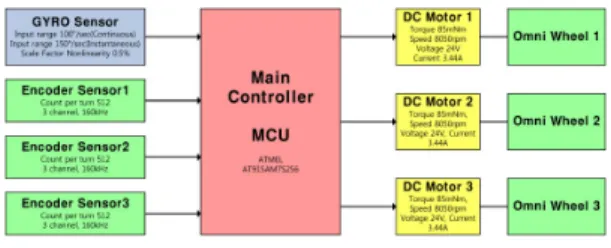
The configuration of tracking control system is given in the Fig. 8. The encoder sensors are used for the measurement of the rotation speed of DC motors and Gyro sensor measures the posture angle of OWMR.
[Fig. 8] Configuration of Control System
The tracking control results are shown in the Fig. 9.
Fig. 9.a shows the tracking result from the starting moving angle 30°to the ending moving angle -150°
without self-rotation. Fig. 9.b and Fig. 9.c show the same results as Fig. 9.a on different moving angles. We can confirm the good performance of the tracking control using fuzzy estimator through the experimental results of the designed OWMR.
a. Moving Angle : 30° - 150°
b. Moving Angle : 45° - 135°
c. Moving Angle : 60° - 120°
[Fig. 9] Tracking Control without Self Rotation
The results of tracking control with self rotation are shown in the Fig. 10. The precise movement control with self-rotation guarantees the holonomic characteristics of OWMR. Through the below results, we can confirm the good performance of a holonomic system.
a. Moving from front to right with self rotation
b. Moving from back to left with self rotation
[Fig. 10] Tracking Control with Self Rotation
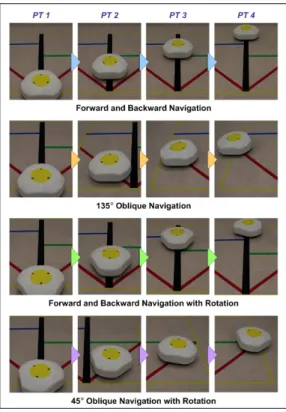
Fig. 11 is image clips which 3-wheels OWMR controls the path tracking. The first row images show forward and backward tracking of a straight line. The second row images show tracking of an oblique line. The third row images show forward and backward tracking of a straight line with self rotation. Final row images show tacking of an oblique line with self rotation. The linear speed of OWMR in tracking control without self rotation is 12 cm/sec. the linear speed in tracking control with self rotation is 8 cm/sec. Through the image clips, we can know that this 3-wheels OWMR is perfectly controlled in both holonomic and nonholonomic path tracking.
[Fig. 11] Image Clips of OWMR' Navigation
5. Conclusion
A holonomic mobile robot using 3 omni-directional wheels is developed in this paper. Its tracking controller, which each motor is, on the base of posture, controlled by an individual PID law to follow the speed command from inverse kinematics without considering the coupled nonlinear dynamics explicitly in the controller design, and fuzzy azimuth estimator, which is used straightforward to perform the control of the mobile robot by means of the fuzzy behavior-based scheme already existent in literature, are presented in this paper. Also, the good performance of the developed mobile robot is confirmed through live tests of path control task.
References
[1] A. Ashmore and N. Barnes, "Omni-drive Robot Motion on Curved Paths: The Fastest Path between Two Points Is Not a Straight-Line", AI 2002: Advances in Artificial
Intelligence, vol. 2557, pp. 225-236, 2002.
[2] T.A. Baede, "Motion control of an omni directional mobile robot", Traineeship report DCT 2006, 2006.
[3] Y. Liu, X. Wu, J. Zhu and J. Lew, "Omni-directional mobile robot controller design by trajectory linearization", in: Proceedings of the American Control Conference, vol. 4, pp. 3423-3428, 2003.
[4] Y. Liu, J.J. Zhu, R.L. Williams and J. Wu,
"Omni-directional mobile robot controller based on trajectory lineariztion, Robotics and Autonomous Systems", vol. 56, pp. 461-479, 2008.
[5] T.K. Nagy, P. Ganguly and R. D'Andrea, "Real-time trajectory generation for omnidirectional vehicles", in:
Proceedings of the American Control Conference, vol.
1, pp. 286-291, 2002.
[6] K. Watanabe, "Control of an omnidirectional mobile robot", in: Proceedings of 1998 Second International Conference on Knowledge-Based Intelligent Electronic Systems, vol. 1, pp. 51-60 , 1998.
[7] K. Watanabe, Y. Shiraishi, S.G. Tzafestas and J. Tang,
"Feedback Control of an Omnidirectional Autonomous Platform for Mobile Service Robots", Journal of Intelligent and Robotic System, vol.22, no. 3-4, pp.
315-330, 1998.
[8] J. Wu, "Dynamic path planning of an omni-directional robot in a dynamic environment", Ph.D. Dissertation, Ohio University, Athens, OH, 2005.
[9] R.P.A. van Heandel, "Design of an omnidirectional universal mobile platform", Internal report DCT 2005, p. 117, 2005.
[10] Kawamura, K. Pack, R. T., Bishay, M., Iskarous, M.
"Design philosophy for service robots", Journal of Robotics and Autonomous Systems, 18, pp.109-116, 1996.
[11] Maeyama, S., Yuta, S., Hararda, A. "Experiments on a Remote Appreciation Robot in an Art Museum"
Proceedings of IROS 2000, pp. 1008-1013, 2000.
[12] Hyun-Koo Cha, Seungwoo Kim. "A Study on Implementation of Ubiquitous Home Mess-Cleanup Robot" Journal of Control, Automation, and Systems Engineering, Vol. 11, No 12, pp. 1011-1019, 2005.
[13] Baker, R. "Human Navigation and the Sixth Sense", Simon and Schuster, New York , 1981
[14] Dong Sung Kim, Hyun Chul Lee, Wook Hyun Kwon.
"Geometric Kinematics Modeling of Omni-directional Autonomous Mobile Robot aee, ts Applications"
Proceedings of the IEEE, Wook Hyun Kwon.
"GeometrRobotics and Automation 2000, pp. 2033-2038,
2000.
[15] Hardt, V. D., Arnould, P., Wolf, D., Dufaut, M.
"Method of mobile robot localisation by fusion of odometric and magnetometric data" International Journal of Advanced Manufacturing Technology, vol 9 no. 1, pp. 65-69, 1994.
Seung-Woo Kim
[Regular member]• Feb. 1987 : Yonsei Univ., Dept. of Electronic Eng., Bachelor
• Feb. 1994 : Yonsei Univ., Dept.
of Electronic Eng., MS
• Feb. 1994 : Yonsei Univ., Dept.
of Electronic Eng., PhD
• 1998 ~ 1999 : CWRU Post-Doctoral Program in Robotics
• Jan. 1987 ~ Aug. 1989 : Samsung Advanced Institute of Technology, Researcher
• Feb. 1994 ~ current : Soonchunhyang Univ., Dept. of Electrical Information Eng., Professor
<Research Interests>
Service Robot, Mobile Robot, Entertainment Robot, Fuzzy Control
Sang-Dae Kim
[Regular member]• Feb. 2009 : Soonchunhyang Univ., Electrical Electronic Eng., Bachelor
• Feb. 2009 ~ current :
Soonchunhyang Univ., Dept. of Electrical Robotics Eng., Course of MS
<Research Interests>
Mobile Robot, Service Robot, Omni-Wheeled System