The Effect of Empowerment and Internal Service Quality
Management in an Airline on Customer Orientation
Han-Young Yoon1, Jong-Bin Lim2, Kang-Sung Park2, Wan-Kyu Park2, Sung-Sik Park3*
1Division of Comprehensive Aviation Studies, Hanseo University
2Graduate School of Global Convergence, Korea National University of Transportation
3Department of Flight Operation, Korea National University of Transportation
항공사의 구성원들에 대한 임파워먼트와 내부서비스 품질 관리가
고객지향성 향상에 미치는 영향
윤한영1, 임종빈2, 박강성2, 박완규2, 박성식3*
1한서대학교 항공융합학부, 2한국교통대학교 글로벌융합대학원, 3한국교통대학교 항공운항학과
Abstract As the service industry develops, service quality, customer satisfaction, and human resource management are considered priorities in modern management to maintain a company's growth.
Therefore, understanding the strategic importance of service marketing is an essential task for modern companies. This study examined the relationship between the internal service quality of employees in the organization and customer orientation through organizational effectiveness. In the case of an airline, a service can be defined as an interaction between an external customer and an internal customer service provider. This interaction significantly affects the behavior and attitude of the employees. Based on the results, empowerment has a significant influence on the internal service quality, but it has no significant effect on customer orientation. As the relationship between department and employees improved, the more confident staff showed an improved ability to perform their work. Therefore, it is important that the organizational structure and the reporting system are as concise and clear as possible to allow employees to accurately recognize the authorities and responsibilities assigned to them and have autonomy and discretion in the framework.
요 약 본 연구는 서비스 회사의 조직구성원들에 대한 서비스 마케팅에 있어서 내부서비스 품질에 대한 조직 구성원들의 인식을 살펴보고 이러한 인식이 조직효과성을 매개로 하여 고객지향성에 어떠한 영향을 미치는 지 실증 분석하고자 하였 다. 최근 들어 한국의 항공시장 수요가 급증하면서 항공운송산업자인 항공사들은 치열한 고객 유치활동 전개를 통하여 서비스 산업에 있어서 가장 대표적인 산업으로 자리매김하였다. 국내 항공사에 소속된 조직구성원들을 표본으로 한 실증 분석 결과 조직구성원들에 대한 임파워먼트가 증가할수록 그들이 인식하는 내부서비스 품질은 향상하는 것으로 나타났 다. 하지만 이러한 조직구성원들에 대한 임파워먼트는 고객지향성에 직접적으로 아무런 유의한 영향을 미치지 않았다.
다시 말해서 항공사 내 부서와 직원 간 관계성이 개선될수록 직원들에게 부여되는 임파워먼트는 증진되면서 이러한 임파 워먼트는 내부서비스품질 향상에 기여한 것이다. 향상된 내부서비스 품질은 직무만족도와 조직충성도를 향상시켜 궁극 적으로 승객에 대한 고객지향성 개선에 긍정적인 영향을 주는 것으로 판명되었다. 항공사의 서비스 제공이 성공하기 위 해서는 고객만족을 유발하는 고객지향성이 필수불가결하다. 이러한 고객지향성을 유발하기 위해서는 내부서비스 품질 향상이 뒷받침되어야 한다. 내부서비스 품질 향상을 위해서는 부서와 직원 간 소통 그리고 자신의 역량을 십분 발휘할 수 있는 업무환경 조성이 필요할 것이다.
Keywords : Internal Service Quality, Empowerment, Airline, Organization Effectiveness, Customer Orientation
*Corresponding Author : Sung-Sik Park(Korea National University of Transportation) email: [email protected]
Received June 5, 2019 Revised July 2, 2019 Accepted July 5, 2019 Published July 31, 2019
1. Introduction
1.1 Research BackgroundAs the service industry develops, service quality, customer satisfaction, and human resource management are considered priorities in modern management to maintain the company’s growth.
Therefore, understanding the strategic importance of service marketing is an essential task for modern companies. Service is characterized by simultaneous production and consumption and service quality is formed by the interaction between the firm, who produces and maintains the service, and the customer, who is the beneficiary of the service, and is determined by the perception of the customer at the service quality level. Therefore, companies should recognize the importance and necessity of management of internal service quality and give employees possible empowerment. If the internal customer service is expanded and the internal service quality of the company is improved, the job satisfaction of the employees becomes higher.
Rapid changes in corporate management under the rapidly changing global competition environment require rapid organizational adaptation. In addition to business management, the role of employees and their organizational behavior are becoming important factors for companies to apply to environmental change. In particular, problems such as the internal service quality of an organization in terms of organizational behavior, expanding job competence, and expanding empowerment are important. This management problem is recognized as one of the new management techniques for human resource management as a means for companies to adapt to complex business environments[1].
In the past, in terms of organization, it was important for a fragmented organization to show efficient performance. The economy is growing, but as the pace slows, companies are trying to
escape the crisis by reorganizing. Nevertheless, it is rare for organizations to achieve the expected results through reorganization. For organizational restructuring to be successful, it is necessary to redefine the organizational structure and establish a clear strategy. Effective organizational structure can be achieved only by strengthening internal capacity in consideration of linkage, authority, and compensation of the people who comprise the organization. Dynamics within organizations are very important in explaining organizational innovation and change[2].
1.2 Purpose of research
To survive in the competitive service industry, customer satisfaction must be realized. That is, the direction of organizational development to secure customer satisfaction is customer orientation;
organizational effectiveness (job satisfaction, organizational commitment) should be increased to achieve this goal. Thus, this study attempted to examine the relationship between the internal service quality of employees in the organization and customer orientation through organizational effectiveness.
In the case of a service company such as an airline, a service could be defined as an interaction between an external customer and an internal customer service provider. This interaction significantly affects the behavior and attitude of the employees. Thus, this study aims to investigate the effect of empowerment and internal service quality on customer orientation.
2. Theoretical backgrounds
2.1 Internal service qualityEmployees working at the service level in a company could be defined as internal customers.
Their service functions are regarded as internal products. To meet the organizational goals of
meeting the needs and desires of the external customer, the internal customer must first provide the desired high-quality internal product[3]. That is, the internal customer is not only the employees at the contact points with external customers, but also those who are served by other departments or people as subjects of internal marketing activities. This has expanded as the relationship between vertical and horizontal relationships between organizational members has changed. In addition to interacting with departments that are directly related to consumers, the company conducts a series of actions that are provided to internal customers based on Total Quality Management, which is a management method that establishes strategies for quality management throughout the company.
It was found that internal service quality is a prerequisite for external service quality[4]. They also defined internal services as the attitudes people have toward each other and how to treat each other within the organization. To provide good service to external customers, the needs of internal customers should first be satisfied.
Internal service quality is defined as the attitude of people toward each other and how people provide each other in the organization[5].
Internal service quality is how an employee treats another employee as a service customer within an organization[6]. Within the organization, internal customers can achieve good results only through close interaction between departments.
Therefore, the concept of internal service quality is essential to examine the organizational structure. It was demonstrated that the role of internal service quality plays an important role in determining an organization’s success in today's competitive environment. Therefore to strengthen the organization's goals through the development of external service quality, the internal situation must be improved[7].
2.2 Empowerment
Empowerment theory deals with organizational innovation and effectiveness and is believed to be important in terms of individual and organizational capacity building[8]. It is derived from power, which is expressed in various ways, such as capacity enhancement and authority transfer depending on the application field.
Empowerment was applied to the service sector and defined four organizational elements rather than a single dimension[9]. Spreitzer(1995) also assigned tasks to specific goals pursued by members of the organization in four dimensions [10]. The first dimension is semantically consistent with the individual's role demands and beliefs regarding work. The second is the personal belief in performance at work, which is consistent with the concept of self-efficacy[11]. The third is the self-determination power that emphasizes the autonomous choice of individuals in business operations. Finally, it is the influence that is voluntarily received from individual work results.
Empowerment drives organizational performance while simultaneously motivating its members [12]. The results of this study are as follows.
Delegation of authority is to provide employees who are directly providing services the greatest possible decision-making power so that they can confidently challenge their employees when confronted with special tasks. Rapid decision making can be a tool to cope with a rapidly changing environment [13], and it also means the importance of attitudes to solve problems rather than fear that employees will be blamed if things go wrong. The main purpose of empowerment is to increase productivity through employee motivation, improve service to customers, and perform market-oriented activities more effectively. Delegation of authority to frontline employees has a significant influence on employee attitudes and behaviors that induce changes in employees' attitudes and behavior, increase job satisfaction, reduce role burden and role ambiguity, and service levels provided to
external customers [14].
Delegation of authority gives employees who are directly providing services the greatest possible decision-making power so that they can confidently challenge employees when they face special problems. Given the current situation, rapid decision-making through delegation of authority can be a useful tool to cope with the rapidly changing environment[10][11]. Thus empowerment is likely to play a role in improving the internal service quality of a service company. This study proposes the following hypothesis.
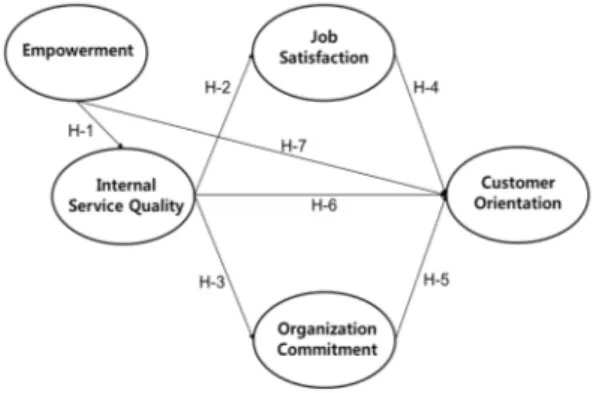
H-1 : Empowerment of employees in an airline can significantly improve internal service quality.
2.3 Job satisfaction
Mobley(1977) emphasized the importance of the individual's psychological state in the job should be a positive and friendly emotional state arising from the evaluation result or the information that the individual acquires during the work[15].
Job satisfaction was defined as a set of attitudes to factors related to job comprising cognitive, emotional, and behavioral tendencies. That is, it refers to emotional states such as desires, values, attitudes, and beliefs related to job satisfaction, which is a multidimensional concept and is associated with various organizational factors[16].
Job satisfaction can be interpreted in the same sense as job satisfaction, if the job satisfaction is defined not only as a satisfaction with the job itself, but also the satisfaction with all things generated through the job. Jang(2001) reported that attitudes and behaviors differ according to the emotional state of organization members[17].
In terms of organization members and companies, it is the most important variable to grasp the emotional state of the organization
members. From the standpoint of the company, job satisfaction is important because it is directly related to the performance of the company[18].
In the case of individuals, it is possible to maintain satisfactory human relationships due to job satisfaction if the work itself is not a simple form of recognition as a means of livelihood but also provides a high sense of accomplishment. As service firms play a decisive role in the performance of the company, the satisfaction level of the service should be achieved to improve the service quality and customer orientation[19].
2.4 Organizational commitment
An organization can’t be psychologically committed because it is not a sentient body.
Psychological attachment consists of adaptive behavior, identification behavior, and internalization of organizational values[20].
Organizational commitment is reported as loyalty to the organization to help the success of the organization. It is largely divided into behavioral commitment and attitudinal commitment.
Behavioral commitment refers to the process of being restricted to the organization so that individuals cannot leave the organization, and attitudinal commitment is a positive tendency such as trust, acceptance, will, desire regarding the organization. This enhances confidence among stakeholders that make up the organization[21].
Saeed and Wang(2013) described organizational commitment as the relative strength of an individual in identifying and contributing to the organization[22]. Conceptually, commitment to trust and acceptance of the organization’s goals and values is defined as the desire to remain as a member of the organization, that is, to accept the goal of the organization and to do the best for the organization, and to express a sense of unity and the attitude to remain as a member of the organization[23]. In addition, it can be seen as representing loyalty. The organizational
commitment of an individual varies according to what he or she sees in the organization, and the degree of commitment is high in some aspects of the organization and low in others[24]. As a result, a positive relationship between perception of internal service quality, job satisfaction, and organizational commitment can be hypothesized.
Consequently, this study formulates the following two hypotheses.
H-2 : A higher level of internal service quality in an airline can lead to a higher level of job satisfaction.
H-3 : A higher level of internal service quality in an airline can lead to a higher level of organizational commitment.
2.5 Customer orientation
Customer orientation was defined as the fulfillment of customer needs at the level of interaction between employees and customers[25].
Customer orientation has been viewed as a marketing activity at the individual service provider and customer level[26]. Customer orientation refers to attitudes that customers want to do, prompt responses to customer inquiries, and employee friendliness. It is also defined as a collective set of beliefs that prioritize customer interests without excluding owners, managers, employees, and all stakeholders to develop a long-term profitable enterprise[27]. In addition, customer orientation prioritizes customer interests in the absence of other stakeholder interests to ensure long-term returns[28].
Previous studies regarding customer orientation can be categorized into several areas such as sales, relationships, and service quality.
Regarding service quality, previous studies were conducted focusing on service marketing[25].
That is, the essence of the service requires contact with the customer, so the customer's experience or perception of the service will
satisfy or dissatisfy the customer. As a result, it leads to customers' re-visit and repurchase, which increases sales and directly affects the performance of service marketing practitioners.
Therefore, customer orientation as a customer satisfaction dimension is a top priority value to be pursued by a service company, which plays a decisive role in service performance. Based on these insights, this study proposes the following hypothesis.
H-4 : A higher level of job satisfaction in an airline can lead to a higher level of customer orientation.
H-5 : A higher level of organizational commitment in an airline can lead to a higher level of customer orientation.
H-6 : A higher level of internal service quality in an airline can lead to a higher level of customer orientation.
H-7 : Empowerment of employees in an airline can lead to a higher level of customer orientation.
3. Conceptual model and survey design
3.1 Conceptual modelA conceptual model with five variables is suggested as below in Fig 1.
Fig 1. Conceptual model
Latent variable Observed variable Squared multiple
correlation Loading (C.R.) Standard
coefficient Internal
service quality (ISQ)
ISQ4 0.598 1.227(12.664) 0.774
ISQ3 0.539 1.000(Fixed) 0.734
ISQ2 0.752 1.352(14.21) 0.867
ISQ1 0.644 1.119(13.16) 0.803
Empowerment (EMP)
EPM1 0.593 1.000(Fixed) 0.770
EPM2 0.592 0.952(16.102) 0.770
EPM3 0.695 1.051(15.112) 0.834
EPM4 0.700 1.099(15.182) 0.837
EPM5 0.800 1.166(16.522) 0.895
EPM6 0.787 1.128(16.35) 0.887
Job satisfaction (JOS)
JOS5 0.608 1.000(Fixed) 0.780
JOS4 0.485 0.925(17.132) 0.696
JOS3 0.613 0.875(13.7) 0.783
JOS2 0.728 0.986(14.883) 0.853
JOS1 0.700 1.056(14.88) 0.837
Organizational commitment
(OCT)
OCT1 0.761 1.000(Fixed) 0.872
OCT2 0.901 1.061(25.131) 0.949
OCT3 0.923 1.073(25.925) 0.961
OCT4 0.897 1.032(24.986) 0.947
Customer orientation
(CUO)
CUO1 0.756 1.000(Fixed) 0.869
CUO2 0.884 1.058(22.52) 0.940
CUO3 0.789 1.001(20.563) 0.888
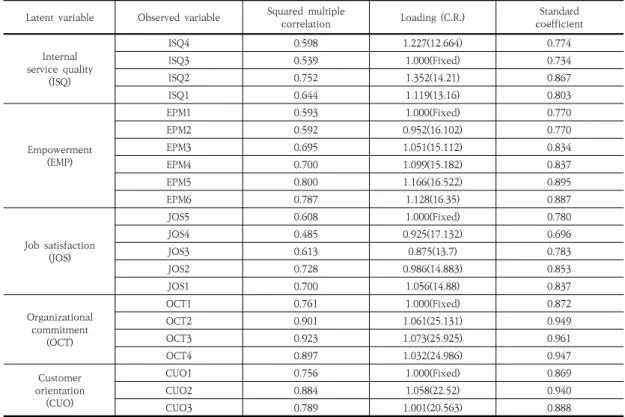
Table 1. Confirmatory factor analysis
Customer orientation is considered to result from a internal service quality, job satisfaction and organizational commitment. In a conceptual model, both job satisfaction and job commitment played a mediating role while the internal service quality affected by empowerment of employees was a independent variables
3.2 Survey design
The closed structured questionnaire used to measure each variable presented in this research model was composed according to the definition of variables mentioned above with reference to previous studies. The questions were modified according to the airline’s service environment and validity and reliability were measured based on previous research. A nominal scale was used for general and demographic characteristics, and all other questions consisted of a seven-point
Likert scale.
To examine the variables that affect the customer orientation of the airline staff, this study selected members working in the FSC (Full Service Carrier). The self-administered survey method was used to directly complete the questionnaire. A total of 350 questionnaires were distributed, and 300 were collected. A total of 280 valid responses were used in the empirical analysis.
4. Empirical analysis
4.1 Demographics of sampleTo analyze the general demographics of sample, frequency test was conducted to analyze the demographics and the general characteristics of the respondents. According to the demographic analysis, there were 164 women (58.6%) and 116
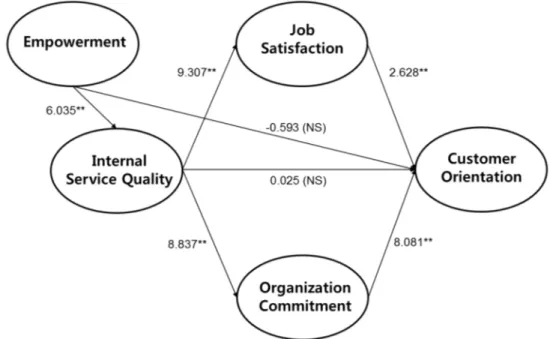
Fig. 2. Path analysis (NS : not supported) men (41.4%) in the gender distribution of the sample. Regarding ranks of respondents, 24 (8.6%) were staff, 190 (67.9%) were junior manager, 45 (16.1%) were senior manager / deputy director.
Among the sample, 21 (7.5%) were director. Moreover, 120 staff (42.9%) reported their monthly income was about three to four million KRW. 72 employees (25.7%) also responded their monthly income was about two to three million KRW.
4.2 Confirmatory factor analysis
Before validating the hypothesis of this study, confirmatory factor analysis was conducted to verify the validity and reliability of questionnaire items. Table 1 shows the results of the analysis.
The regression coefficients for all measured variables were statistically significant. Most of the measured variables showed a standardized regression coefficient with acceptable level of 0.7 or more except JOS4. The results of the fit analysis showed that fit index was acceptable as χ2 = 613.971, df = 323, CMIN / DF = 1.901, P = 0.000 GFI = 0.870, AGFI = 0.836, RMSEA = 0.057, CFI = 0.956, TLI = 0.949 and NFI = 0.930. The
value of χ2 was found to be significantly different, and CMIN / DF was found to be below 2 in the acceptance level. The absolute fit indexes GFI and AGFI are slightly below the recommended acceptance level of 0.9, but show fairly close values, and the incremental fit indices CFI, TLI, and NFI both fit the recommended level of acceptance. The fit was judged acceptable and hypothesis tests were conducted.
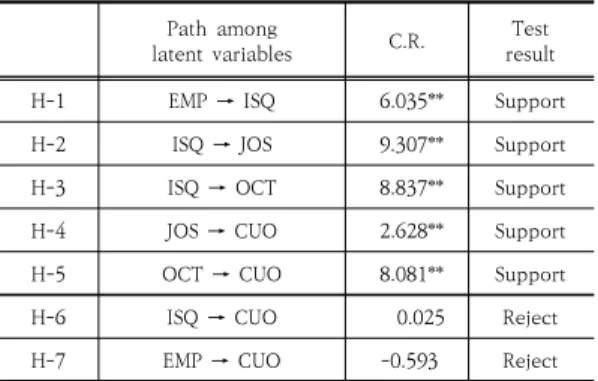
4.3 Path analysis and hypothetical test The path analysis model showed the final results of empirical research model as shown in Fig 2. Through this model, this empirical study examined the hypothesis by analyzing the structural equation model. As a result, the fitness index of the model was χ2=738. 274, df=332, p<0.001, GFI=0.844, AGFI=0.810, CFI=0.939, TLI=0.930, IFI=0.939, NFI=0.895, RMSEA=0.066, indicating that it is suitable for the recommended level of acceptance. This means that the structural model presented in this study is suitable. The results of the hypothesis testing of the path analysis model for the airline staff are shown in table 2.
Path among
latent variables C.R. Test result
H-1 EMP → ISQ 6.035** Support
H-2 ISQ → JOS 9.307** Support
H-3 ISQ → OCT 8.837** Support
H-4 JOS → CUO 2.628** Support
H-5 OCT → CUO 8.081** Support
H-6 ISQ → CUO 0.025 Reject
H-7 EMP → CUO .-0.593 Reject
Table 2. Hypothetical test
To sum up, path analysis results showed either empowerment or internal service quality had no significant effect on improving customer orientation. However, due to moderating effect of job satisfaction and organizational commitment, internal service quality had indirect effect on increasing customer orientation.
According to path analysis, seven hypothesis set up in chapter 2 were tested as shown in table 2. It was proven the empowerment of employees in an airline had a positive effect on improving internal service quality of the organization. Thus, H-1 was supported. The enhanced internal service qulaity, on the other hands, had also positive effect on both such mediating variables as job staisfaction and job commitment. H-2 and H-2 were both supported.
Those variables, as expected, played a mediating role in increasing customer orientation of employees. Therefore, it was found out H-4 and H-5 were all supported following the path analysis results. Moreover, H-6 and H-7 were rejectred since either empowerment or internal service quality had any effect on dependant variable.
5. Conclusion
As mentioned in the introduction, the purpose of this study is to investigate the effect of
internal service quality with empowerment on customer orientation through job satisfaction and organizational commitment. As a result, it was proven to be a suitable research model for measuring and analyzing organizational structure of an FSC in South Korea.
Based on the results, empowerment has a significant influence on internal service quality, but it had no direct significant effect on customer orientation. The better the relationship between department and employees, the more confidence staff were found to have in their ability to perform their work. Therefore, it is important that the organizational structure and the reporting system are as concise and clear as possible to allow employees to accurately recognize the authorities and responsibilities assigned to them and have autonomy and discretion in the framework.
In addition, internal service quality has a significant influence on organizational commitment and job satisfaction. To provide good quality service to customers, the satisfaction of the airline staff is important. Thus, to improve job satisfaction in an airline, it is necessary to improve the internal service quality A working environment that enables communication between departments and employees should be created. Both job satisfaction and organizational commitment have a significant effect on customer orientation. This result is similar to those of the previous study. To improve customer orientation, it may be necessary to consider improving the welfare and working conditions of airline staff to enhance job satisfaction and organizational commitment.
References
[1] P. Joshi, S. K. Chadha. “Measuring internal service quality in business schools”, International Journal of Services and Standards Vol. 11, No. 4, pp.357-379, 2016.
DOI: https://doi.org/10.1504/IJSS.2016.082434 [2] B. Alistair, S. Rhian. “Measuring internal service quality:
comparing the gap-based and perceptions-only approaches’, International Journal of Operations &
Production Management, Vol. 30, No. 12, pp.1291–
1318, 2010.
DOI: https://doi.org/10.1108/01443571011094271 [3] P. Angelos, M. Panagiotis. ‘The impact of internal
service quality and learning organization on clinical leaders’ job satisfaction in hospital care services’, Leadership in Health Services, Vol. 26, No. 1, pp.34–
49, 2013.
DOI: https://doi.org/10.1108/17511871311291714 [4] V. Bellou, A. Andronikidis. “The impact of internal
service quality on customer service behaviour:
Evidence from the banking sector”, International Journal of Quality and Reliability Management, Vol.
25, No. 9, pp.943-954.
DOI: https://doi.org/10.1108/02656710810908098 [5] O. J. Osahon, O. Kingsley. “Statistical Approach to the
Link between Internal Service Quality and Employee Job Satisfaction: A Case Study” American Journal of Applied Mathematics and Statistics Vol. 4, No. 6, pp.178-184, 2016.
DOI: https://doi.org/10.12691/ajams-4-6-3
[6] K. Singh. “Influence of Internal Service Quality on Job Performance: A Case Study of Royal Police Department”, Procedia - Social and Behavioral Sciences Vol. 224, No. 15, pp.28-34, 2016.
DOI: https://doi.org/10.1016/j.sbspro.2016.05.396 [7] M. Sandada, D. Pooe. “Strategic Planning And Its
Relationship With Business Performance Among Small And Medium Enterprises In South Africa”, International Business & Economics Research Journal Vol. 13, No. 3, pp.659-670, 2014.
DOI: https://doi.org/10.19030/iber.v13i3.8602 [8] G. M. Spreitzer. “Psychological Empowerment in the
Workplace: Dimensions, Measurement, and Validation”, Academy of Management Vol. 38, No. 5, pp.1442-1465.
DOI: https://doi.org/10.5465/256865
[9] D. E. Bowen, E. E. Lawler. “The empowerment of service workers: what, why, how, and when”, Sloan Management Review, Vol. 33, No. 3, pp.31-39, 1992.
[10] G. M. Spreitzer. “Social Structural Characteristics of Psychological Empowerment”, Academy of Management Journal, Vol. 39, pp.483-504, 1995.
DOI: http://www.jstor.org/stable/256789
[11] D. E. Bowen, E. E. Lawler. “Empowering Service Employees”, Sloan Management Review, Vol. 36, pp.73-84, 1995.
[12] Y. Melhem. “The antecedents ofcustomer-contact employees’empowerment”, Empolyee Relations, Vol.
26, No. 1, pp.72-76, 2004.
DOI: https://doi.org/10.1108/01425450410506913 [13] J. A. Conger, R. N. Kanungo, “The Empowerment
Process : Integrating Theory and Practice”, Academy of Management Review, Vol. 13, pp.471-482, 1988.
DOI: https://doi.org/10.2307/258093
[14] J. F. Nielsen, C. P. Pedersen, “The Consequences and Limits of Empowerment in Financial Services”, Scandinavian Journal of Management, Vol. 19, pp.63-83.
DOI: https://doi.org/10.1016/S0956-5221(01)00032-X [15] W. H. Mobley, “Intermediate linkages in the
relationship between job satisfaction and employee turnover”, Journal of Applied Psychology, Vol. 62, No.
2, pp.237-240, 1977.
DOI: http://dx.doi.org/10.1037/0021-9010.62.2.237 [16] N. Valaei, S. Rezaei, “Job satisfaction and organizational
commitment: An empirical investigation among ICT-SMEs”, Management Research Review, Vol. 39, No. 12, pp.1663-1694, 2016.
DOI: https://doi.org/10.1108/MRR-09-2015-0216 [17] H. S. Jang, “Difference of Life Purpose according to
ob Satisfaction and Meaning of Work”, Journal of Student Guidance Research, Vol. 33, No. 1, pp.137-158, 2001.
[18] Y. W. Chang, “Employee Performance Appraisal in a Logistics Company”, Open Journal of Social Sciences, Vol. 3, pp.47-50, 2015.
DOI: https://doi.org/10.4236/jss.2015.37008
[19] B. M. A. Khadar, “The Impact of Organizational Culture on Employee’s Satisfaction at the Jordanian Company of Investments Safeway”, American Journal of Industrial and Business Management, Vol.8 No.1, pp.13-26, 2018.
DOI: https://doi.org/10.4236/ajibm.2018.81002 [20] F. Rakahshanimehr, H. Jenaabadi, “Relationship of
Workaholism with Teachers’ Organizational Commitment and Organizational Citizenship Behavior”, Vol. 6, No.
12, Psychology, pp.1469-1477, 2015.
DOI: https://doi.org/10.4236/psych.2015.612144 [21] K. Bodjrenou, M. Xu, K. Bomboma, “Antecedents of
Organizational Commitment: A Review of Personal and Organizational Factors”, Journal of Social Sciences, Vol. 7, NO. 5, pp.276-289, 2019.
DOI: https://doi.org/10.4236/jss.2019.75024
[22] B. B. Saeed, W. Wang, “The Art of Organizational Diagnosis: Pathogens and Remedies”, Vol. 5, No. 2, pp.55-58, 2013.
DOI: https://doi.org/10.4236/ib.2013.52006
[23] B. B. Saeed, W. Wang, “Sustainability Embedded Organizational Diagnostic Model”, Vol. 5, No. 4, pp.424-431, 2014.
DOI: https://doi.org/10.4236/me.2014.54041 [24] G. M. Mwai, J. M. Namada, P. Katuse, “Influence of
Organizational Resources on Organizational Effectiveness”, American Journal of Industrial and Business Management, Vol. 8, No. 6, pp. 1634-1656, 2018.
DOI: https://doi.org/10.4236/ajibm.2018.86109 [25] R. Saxe, B. A. Weitz, “The SOCO Scale: A Measure of
the Customer Orientation of Salespeople”, Journal of Marketing Research, Vol. 19, No. 3, pp. 343-351, 1982.
DOI: https://doi.org/10.2307/3151568
[26] K. Daniel, D. N. Darby, "A dual perspective of customer orientation: a modification, extension and application of the SOCO scale", International Journal of Service Industry Management, Vol. 8, No. 2, pp.131-147, 1997.
DOI: https://doi.org/10.1108/09564239710166254 [27] V. Howe, K. D. Hoffman, D. W. Hardigree, “The
relationship between ethical and customer-oriented service provider behaviors”, Journal of Business Ethics, Vol. 13, No. 7, pp.497-506, 1994.
DOI: https://doi.org/10.1007/BF00881295
[28] R. M. Stock, W. D. Hoyer, “Leadership Style as Driver of Salespeoples' Customer Orientation”, Journal of Market-Focused Management Vol. 5, No. 4, pp.355-376, 2002.
DOI: https://doi.org/10.1023/B:JMFM.0000008074.24518.ea
Han-Young Yoon [Regular Member]
• Feb. 1988 ∼ Jun. 1999 : Korea Airport Corporation.
• Jun. 1999 ∼ Mar. 2018 : Incheon Int'l Airport Corporation
• Feb. 2004 : M.S. in Aviation Business Administration, Korea Aerospace University
• Feb. 2012 : pd.D. in Aviation Business Administration, Korea Aerospace University
• Apr. 2018 ∼ Current : Associate professor of Comprehensive Aviation Study, Hanseo University
<Research Areas of Interest>
Aviation Management, Airport Operation, Airport Service
Jong-Bin Lim [Regular Member]
• Feb. 2011 : M.S. in Business Administration, Graduate school of Global Convergence, Korea National Univ. of Transportation
• Feb. 2014 : Completion of Course work in ph.D., Graduate school of Global Convergence, Korea National Univ. of Transportation
• Mar, 2014 ~ Current : Banking of Nonghyup at Boobal office
<Research Areas of Interest>
Production Process, Quality Management, Human Resource
Kang-Sung Park [Regular Member]
• Feb. 2010 : M.S. in Business Administration, Graduate school of Global Convergence, Korea National Univ. of Transportation
• Feb. 2014 : Completion of Course work in ph.D., Graduate school of Global Convergence, Korea National Univ. of Transportation
<Research Areas of Interest>
Service Quality, Service Management, Marketing
Wan-Kyu Park [Regular Member]
• Feb. 2010 : M.S. in Business Administration, Graduate school of Global Convergence, Korea National Univ. of Transportation
• Feb. 2013 : Completion of Course work in ph.D., Graduate school of Global Convergence, Korea National Univ. of Transportation
• Mar, 2013 ~ Current : CEO of YesOne Construction Inc.
<Research Areas of Interest>
Operation Management, Service Quality, Production Process
Sung-Sik Park [Regular Member]
• Dec. 2003 : M.S. in Accounting, University of Illinois, Urbana- Champaign
• May 2007 ~ March, 2014 : Incheon Int'l Airport Corporation
• Mar. 2014 ~ Current : Associate Professor of Dept.
of Flight Operation, Korea National Univ. of Transportation
<Research Areas of Interest>
Air Transport Industry, Airport Operation, Aviation Safety