Isolation and Characterization of Acetobacter Species from a Traditionally Prepared Vinegar
Kang WookLee1, Jae Min Shim2, Gyeong Min Kim3, Jung-Hye Shin3, and Jeong Hwan Kim1,2*
1Institute of Agriculture & Life Science, 2Division of Applied Life Science (BK21 Plus), Graduate School, Gyeongsang National University, Jinju 660-701, Republic of Korea
3Garlic Research Institute, Namhae 668-812, Republic of Korea
Received: April 27, 2015 / Revised: July 10, 2015 / Accepted: July 14, 2015
Introduction
Acetic acid bacteria (AAB) are Gram-negative, non-spore forming, catalase-positive, and strictly aerobic bacteria [1].
AAB oxidize ethanol to acetic acid and thus they are the key microorganisms for vinegar production [10, 14]. Vine- gars are popular fermented foods produced by AAB and traditionally, vinegar fermentations have been carried out by AAB present in natural environments [8]. Natural fer- mentation results in vinegars with diverse metabolites, especially different amount of acetic acid depending upon the major AAB involved for the fermentation [20]. Unique flavor and taste of many traditional vinegars are the com- bined results from natural fermentations. In recent years, vinegars are consumed not just as a seasoning but also a health drink [5]. Due to the increased interests in health- promoting effects of vinegars, diverse vinegar products
have been produced from many different raw materials (fruits, vegetables, and cereals) and different types of microorganisms have been involved for fermentations [5, 21]. Naturally fermented vinegars often have good flavor and tastes [21]. Controlled fermentation is preferred when vinegars with uniform qualities are required or vinegars with higher concentration of acetic acid are desired in a short period of time. Vinegars have been produced at Namhae county, Gyeongnam, Republic of Korea, by traditional ways. But no report has been made on the quality of Nam- hae vinegar nor the microorganisms involved in the fermen- tation known. In this study, we isolated 3 Acetobacter strains from a Namhae vinegar, and examined the optimal cultivation conditions for the isolates to produce acetic acid.
This report is the first step to understand the AAB present in Namhae vinegar and to improve the quality of Namhae vin- egar in the future.
Materials and Methods
Bacterial strains and culture conditions
A vinegar prepared by traditional ways at Namhae Acetic acid bacteria (AAB) were isolated from vinegar fermented through traditional methods in Namhae county, Gyeo- ngnam, the Republic of Korea. The isolated strains were Gram negative, non-motile, and short-rods. Three selected strains were identified as either Acetobacter pasteurianus or Acetobacter aceti by 16S rRNA gene sequencing. A. pasteur- ianus NH2 and A. pasteurianus NH6 utilized ethanol, glycerol, D-fructose, D-glucose, D-mannitol, D-sorbitol, L-glutamic acid and Na-acetate. A. aceti NH12 utilized ethanol, n-propanol, glycerol, D-mannitol and Na-acetate. These strains grew best at 30oC and an initial pH of 3.4. They were tolerant against acetic acid at up to 3% of initial concentration (v/v). The opti- mum conditions for acetic acid production were 30oC and pH 3.4, with an initial ethanol concentration of 5%, resulting in an acetic acid concentration of 7.3−7.7%.
Keywords: Vinegar, acetic acid bacteria, Acetobacter pasteurianus, Acetobacter aceti
*Corresponding author
Tel: +82-55-772-1904; Fax: +82-55-772-1909 E-mail: [email protected]
© 2015, The Korean Society for Microbiology and Biotechnology
county, Gyeongnam, Republic of Korea, in the fall of 2014 was used as the source for AAB. Makgeolli (traditional Korean rice wine, 6% alcohol) was stored at room tempera- ture for 4−6 days and then inoculated with mother vinegar (10%, v/v). Acetic acid fermentation (AAF) was carried out for 30 days at room temperature statically. Vinegar was serially diluted with 0.1% peptone water and diluted sam- ples were spreaded on GYC agar plates (3% glucose, 0.5% yeast extract, 1.0% CaCO3, 3% (v/v) ethanol, and 1.5% agar) and YCM agar plates (0.5% yeast extract, 2.5%
mannitol, 1.0% CaCO3, 3% (v/v) ethanol, and 1.5% agar) [21]. Plates were incubated at 30oC. The AAB cultures were cultivated in GYC broth (3% glucose, 0.5% yeast extract, 3% (v/v) ethanol) and YCM broth (0.5% yeast extract, 2.5% mannitol, 3% (v/v) ethanol) at 30oC with vigor- ous shaking (220 rpm).
Identification of isolated strains
Isolates were identified by 16S rRNA gene sequencing.
The universal primers were used to amplify 16S rRNA gene fragments from 3 isolates. The primer sequences are as follows: 9F (5'-GAGTTTGATCCTGGCTCAG-3'), 337 F (5'-GACTCCTACGGGAGGCWGCAG-3'), 1100R (5'- GGGTTGCGCTCGTTG-3') and 1492R (5'-GGTTAC CTTGTTACGACTT-3'). PCR reactions were done using a MJ Mini personal thermal cycler (BioRad, Hercules, CA, USA) and the PCR conditions were as follows:
denaturation at 94oC for 5 min, followed by 30 cycles of 94oC for 30 s, 55oC for 30 s, and 72oC for 2 min. Amplified fragments were purified from an agarose gel using a PCR purification kit (FavorPrep PCR purification mini kit, Favorgen, Ping-Tung, Taiwan). DNA sequences were determined at Cosmogenetech (Seoul, Korea) and ana- lyzed by BLAST provided by National Center for Biotech- nology Information (NCBI, Bethesda, MD, USA) and EZ_TAXON database (http://www.ezbiocloud.net/eztaxon) for similarity searches. The morphologies of the isolates were examined by a microscope, and Gram staining was performed using a kit (BD Diagnostic, Franklin Lakes, NJ, USA). To observe the motility, the hanging-drop method was used [18].
Culture-independent method for detection of AAB from a Namhae vinegar
Total DNA was prepared from a Namhae vinegar sample
using a EZ-10 spin column soil DNA miniprep kit (Bio Basic Inc., Markham, ON, Canada). The primer set, 337F and 800R (5'-TACCAGGGTATCTAATCC-3'), was used to amplify 16S rRNA genes. PCR products were purified by using a gel extraction kit (ExpinTM Gel SV kit, GeneAll Bio- technology, Seoul, Korea), ligated with pGEM T-easy vec- tor (Promega, Madison, WI, USA), and then introduced into E. coli DH5α competent cells by electroporation. Five white colonies were selected randomly from LB plates with ampi- cillin (50 µg/ml) and X-Gal (5-bromo-4-chloro-3-indoyl-β-D- galactoside, 40 μg/ml). Nucleotide sequences of the inserts were determined at Cosmogenetech (Seoul, Korea), and analyzed by BLAST program.
Growth of Acetobacter strains
A. pasteurianus NH2 and NH6 were cultivated in GYC broth and A. aceti NH12 was cultivated in YCM broth at 30oC with vigorous shaking. Utilization of various carbon sources was tested as described previously [13]. Each Acetobacter strain was first propagated in 10 ml GYC or YCM broth for 3 days at 30oC and then used to inoculate fresh culture broth (0.5% yeast extract and 1% acetic acid) with a carbon source (methanol, ethanol, n-propanol, glycerol, D-fructose, D-glucose, D-mannitol, D-sorbitol, L- arginine, L-glutamic acid, L-lysine and Na-acetate, 2%, w/v or v/v). Methanol, ethanol, and n-propanol were filter sterilized and added to the sterile broth to a final concen- tration of 2% (v/v). Inoculated cultures were incubated at 30oC for 7 days.
A. pasteurianus NH2 and NH6 were cultivated in GYC broth and A. aceti NH12 was cultivated in YCM broth for 2 days at 30oC with vigorous shaking, and then 0.5 ml of each culture was used to inoculate 50 ml GYC and YCM broth with different conditions. Growth was examined at dif- ferent temperature (15, 20, 25, 30, and 37oC), different ini- tial pH (2.0, 2.4, 2.7, 3.0, 3.4, adjusted by 1N HCl), different acetic acid content (1, 3, 5, and 7%, v/v), and different etha- nol concentration (0, 3, 5, 7, 9, and 12%, v/v). The culture broth for optimal ethanol concentration was composed of 3% glucose, 0.5% yeast extract and 1% acetic acid (for NH2 and NH6) or 0.5% yeast extract, 2.5% mannitol and 1% acetic acid (for NH12). Inoculated cultures were incu- bated for 6 days and the OD600 values were measured. The amount of acetic acid was determined by measuring the titratable acidity (TA) of culture.
Results and Discussion
Isolation of Acetobacter species from a Namhae vinegar
AAB were isolated from a vinegar fermented by tradi- tional methods at Namhae county, Gyeongnam, Republic of Korea, during 2014. Vinegar samples were spreaded on GYC and YCM agar plates containing CaCO3. After incu- bation, colonies surrounded by clear halo zones were obtained. The isolates were tested for their abilities of etha- nol tolerance. Finally, three isolates (NH2, NH6, and NH12) were selected for further studies. In general, isolation and cultivation of AAB, especially from fermented beverages such as vinegar, have been described to be problematic, often resulting in underestimation of microbial species rich- ness when culture-dependent methods are applied [6]. Low recovery of species is explained partially due to the pres- ence of organisms which are viable but in non-culturable state [4]. Limitations of culturing were in part overcome by the formulation of appropriate media, which allowed the cul- tivation of slowly growing organisms. A number of conven- tional culture media to isolate AAB from different sources are reported in literature, where carbon sources are mainly glucose, mannitol, and ethanol.
Three isolates were identified by 16S rRNA gene sequencing. The universal primer set (9F and 1492R) was used to amplify 16S rRNA genes from NH2 and NH6 and a primer set (337F and 1100R) was used to amplify 16S rRNA gene from NH12. A 16S rRNA gene from NH12 was not amplified when the primer set (9F and 1492R) was used, indicating some mismatches in the primer binding sites. Sequence analyses by NCBI blast confirmed that two strains, NH2 and NH6, were Acetobacter pasteurianus and their 16S rRNA gene sequences (1,350 bp) showed 99%
homology with the 16S rRNA gene from Acetobacter pas- teurianus HSZ3-21 (KJ095003.1). The other strain, NH12, was Acetobacter aceti and its 16S rRNA gene sequence (421 bp) showed 100% homology with that of Acetobacter aceti LMG1496 (JF793948.1). Sequence analyses by EZ_TAXON also confirmed that 2 strains (NH2 and NH6) were Acetobacter pasteurianus subsp. pasteurianus, and the sequences showed 99.7% similarity with the 16S rRNA gene from Acetobacter pasteurianus subsp. pasteurianus LMG1262 (BACG01000075). NH12 strain was Acetobacter aceti and its sequence showed 99.52% similarity with that of Acetobacter aceti NCIMB8621 (X74066). From these
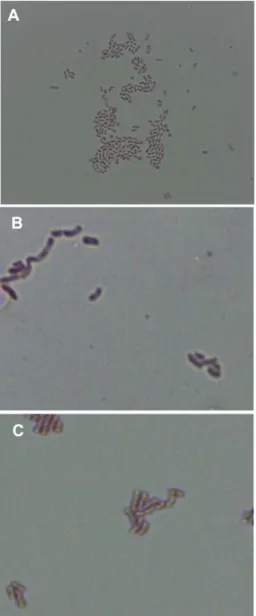
results, NH2 and NH6 were identified as A. pasteurianus, and NH12 was identified as A. aceti. Acetobacter species are Gram-negative, non-motile, and short-rod (Fig. 1). Gen- bank accession numbers for the 16S rRNA genes are KR150440, KR150441, and KR150442 for A. pasteurianus NH2, A. pasteurianus NH6, and A. aceti NH12, respec- tively.
Culture-independent method for detection of AAB Among the 5 randomly selected clones, 3 were 100%
matched with the 16S rRNA gene of A. pasteurianus/A.
Fig. 1. Microscopic images of isolated 3 AAB. (A) A. pas- teurianus NH2 (×400), (B) A. pasteurianus NH6 (×1000), (C) A.
aceti NH12 (×1000).
pomorum and two were 100% matched with that of A.
aceti/A. sicerae (Table 1). The results agreed well with the results from culture-dependent methods described above.
Culture-independent methods can complement culture- dependent methods for the more accurate detection of AAB from vinegars [19]. Clearly, A. pasteurianus and A.
aceti are the main AAB for the vinegar sample prepared at Namhae county. Both species are used for vinegar fermen- tation worldwide and also occur in beer as spoilers [7, 16].
A. pasteurianus has been reported as the dominant AAB among rice vinegar (Komesu) and unpolished rice vinegar (Kurosu) in Japan [8].
Growth of Acetobacter strains
Utilization of various carbon sources by 3 Acetobacter isolates are summarized in Table 2. A. pasteurianus NH2 and NH6 utilized ethanol, glycerol, D-fructose, D-glucose, D- mannitol, D-sorbitol, L-glutamic acid, and Na-acetate. A.
aceti NH12 utilized ethanol, n-propanol, glycerol, D-manni-
tol, and Na-acetate. Most A. pasteurianus strains are known to produce acid from ethanol, n-butanol, and n-pro- panol [14]. But A. pasteurianus NH2 and NH6 did not grow on n-propanol. Most A. pasteurianus strains require growth factors in the presence of D-mannitol, and a few strains grow on L-alanine, L-glutamine, L-glutamic acid and L-pro- line as a sole nitrogen source in the presence of D-mannitol [14]. A. pasteurianus NH2 and NH6 grew on L-glutamic acid without D-mannitol. A. pasteurianus DSM3509 from beer utilized ethanol, glycerol, D-fructose, D-glucose, D- mannitol and D-sorbitol, but the strain was unable to grow on L-glutamic acid [15]. Seven A. pasteurianus (LMG 1262, 1555, 1629, 1630, 1658, 1659, 1686) strains were reported not able to grow on methanol, and some of them were not able to grow on glycerol [3]. All A. aceti strains are known to acidify ethanol, n-propanol, n-butanol, D-xylose, D-man- nose, and D-glucose. A. aceti strains also utilize glycerol, D- mannitol, and Na-acetate as carbon sources for growth [14]. A. aceti NH12 grew well on ethanol, glycerol, D-manni- tol and Na-acetate. Other A. aceti (LMG1496, 1504T, 1531 and 1535) strains were able to grow on glycerol but not on methanol, and the result was similar with A. aceti NH12 [3].
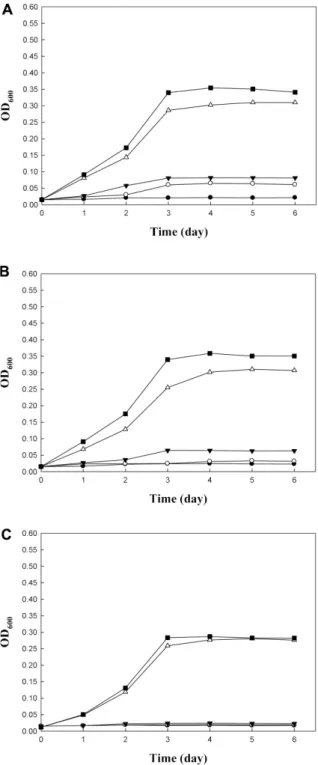
Three Acetobacter strains were grown for 6 days at dif- ferent temperatures (Fig. 2). All strains grew at 25 and 30oC, entered into stationary phase (OD600 = 0.28−0.35) in 3 days. But they did not grow at 15, 20 and 37oC in 6 days.
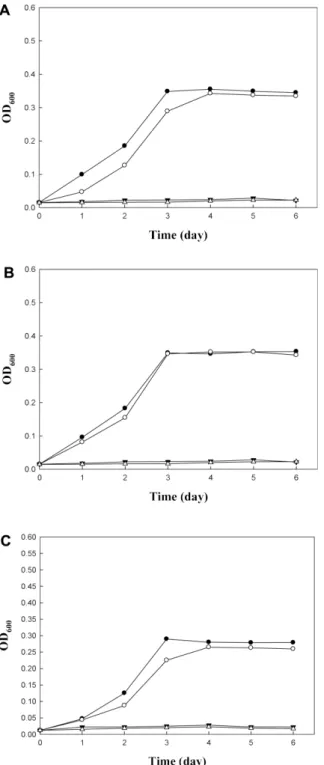
The effect of initial pH of broth on the growth was examined during 6 days cultivation at 30oC (Fig. 3). All strains grew well at the initial pH of 3.0−3.4, reaching the OD600 value of 0.25−0.35 in 3 days. But they did not grow at the initial pH of 2.0, 2.4 and 2.7. Vinegar is obtained by a two-stage fer- mentation process. In the first step (alcohol fermentation, AF), fermentable sugars are converted into ethanol by yeasts. In the second step (acetic acid fermentation, AAF), AAB oxidize the ethanol to acetic acid. Both stages occur by spontaneous fermentation, and the optimum tempera- ture for AAF is 25−30oC [2, 17]. The vinegar used for this Table 1. Identification of AAB using culture-independent method.
No Size (bp) The most matched organism Identity (%)
1 421 Acetobacter aceti/Acetobacter sicerae 100
2 415 Acetobacter pasteurianus/Acetobacter pomorum 100
3 421 Acetobacter aceti/Acetobacter sicerae 100
4 415 Acetobacter pasteurianus/Acetobacter pomorum 100
5 416 Acetobacter pasteurianus/Acetobacter pomorum 100
Table 2. Growth of AAB on GYC or YCM broth containing a different carbon source.
Carbone source
A. pasteurianus NH2
A. pasteurianus NH6
A. aceti NH12
Ethanol + + +
Methanol − − −
Propanol − − +
D-glucose + + −
D-fructose + + −
D-mannitol + + +
Sorbitol + + −
Na-acetate + + +
L-arginine − − −
L-glutamic acid + + −
L-lysine − − −
Glycerol + + +
work was prepared by natural fermentation and fermented at room temperature.
Generally, the optimum pH for the growth of AAB is 5.0− 6.5, while they can grow at lower pHs (3.0−4.0) [11]. And
their optimum temperature is in the range of 28−30oC although some species are recognized as thermotolerant [9, 11].
Three Acetobacter strains were tolerant against acetic Fig. 2. Growth of AAB at different temperatures. (A) A. pas-
teurianus NH2, (B) A. pasteurianus NH6, (C) A. aceti NH12. ●, 15oC; ○, 20oC; ▼, 25oC;△, 30oC; ■, 37oC.
Fig. 3. Growth of AAB at different initial pH. (A) A. pasteur- ianus NH2, (B) A. pasteurianus NH6, (C) A. aceti NH12. ●, pH 2.0; ○, pH 2.4; ▼, pH 2.7; △, pH 3.0; ■, pH 3.4.
acid up to 3% of initial concentration (v/v) (Fig. 4). A. pas- teurianus NH2 and NH6 were more tolerant and the OD600
values reached 0.35 in 3 days at 1% acetic acid. For A.
aceti NH12, the OD600 value reached 0.28 in 3 days at 1%
acetic acid. At 3% initial acetic acid concentration, A.
pasteurianus NH2 and A. aceti NH12 grew slowly than in 1% acetic acid concentration. Most strains are unable to grow at 5 and 7% initial acetic acid concentrations. Acetic acid is produced from ethanol by two successive catalytic reactions by membrane-bound alcohol dehydrogenase and aldehyde dehydrogenase [14]. Thus, the ability to oxidize ethanol into acetic acid and the ability to tolerate higher concentration of acetic acid are both required for Aceto- bacter species to produce acetic acid in large quantity.
Effect of ethanol concentration
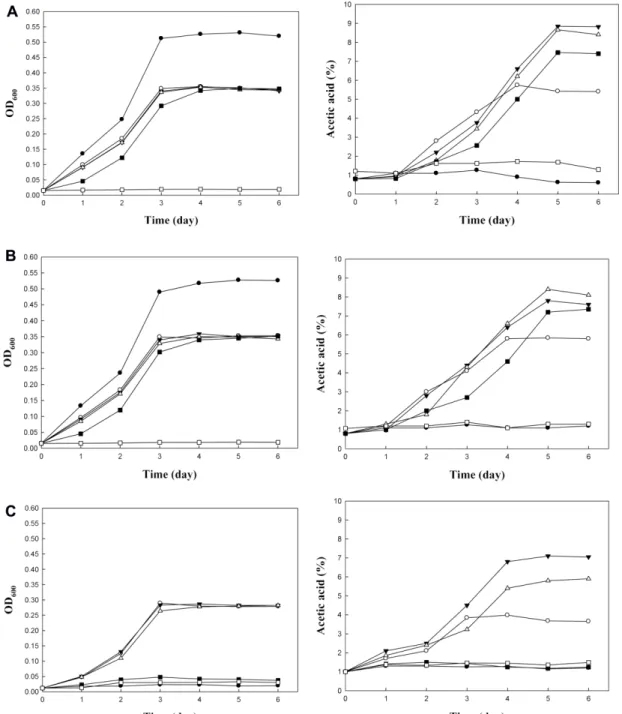
Effect of initial ethanol concentration on the production of acetic acid was examined (Fig. 5). For A. pasteurianus NH2 and NH6, the OD600 values reached 0.35 in 3 days at the initial ethanol concentration of 3, 5, 7 and 9%. For A. aceti NH12, the OD600 value reached 0.28 in 3 days at the initial ethanol concentration of 3, 5 and 7%. A. pasteurianus NH2 and NH6 grew rapidly in the absence of ethanol, and the OD600 values reached 0.52−0.55 in 3 days. But A. aceti NH12 was unable to grow in 6 days.
A. pasteurianus NH2 produced acetic acid in the highest amount (7.72%) with an initial ethanol concentration of 5%
in 5 days followed by A. pasteurianus NH6 (7.30%) with an initial ethanol concentration of 7% and A. aceti NH12 (5.95%) with an initial ethanol concentration of 5%. Gener- ally, A. pasteurianus strains oxidize ethanol to acetic acid.
Some A. pasteurianus strains can produce acetic acid not only from ethanol, but also from glucose [12]. This might be the reason why more than 7% acetic acid was produced from 5% initial ethanol concentration because the media (GYC) contained glucose (3%, w/v).
The optimum culture conditions for acetic acid production by A. pasteurianus strains were 30oC and pH 3.4 with an initial ethanol concentration of 5%, resulting in acetic acid concentration of 7.3−7.7%. In other report, a A. pasteur- ianus strain was cultured in RAE (1% yeast extract, 1%
peptone, 4% glucose, 0.3% Na2HPO4·2H2O, 0.2% citric acid, w/v) broth with different ethanol concentration (0− 10%, v/v), and the optimal ethanol concentration was 4%
(v/v) [1]. Identification of the major AAB involved in Namhae vinegar fermentation is the first step and further studies on their roles for the quality of vinegar are required. Use of iso- lated strains as starters for vinegar fermentation should be done and the quality of vinegar should be compared with naturally fermented vinegars.
Fig. 4. Growth of AAB at different initial acetic acid con- centration. (A) A. pasteurianus NH2, (B) A. pasteurianus NH6, (C) A. aceti NH12. ●, 1%; ○, 3%; ▼, 5%; △, 7%.
Acknowledgments
This work was supported by a grant from Namhae County, Gyeongnam, Republic of Korea, through the Namhae Garlic Research Center. JM. Shim was supported by BK21 (plus) pro- gram from MOE, Republic of Korea.
References
1. Andrés-Barrao C, Saad MM, Chappuis ML, Boffa M, Perret X, Ortega Pérez R, et al. 2012. Proteome analysis of Aceto- bacter pasteurianus during acetic acid fermentation. J. Pro- teomics 75: 1701−1717.
Fig. 5. Growth and TA of AAB at different initial ethanol concentration. (A) A. pasteurianus NH2, (B) A. pasteurianus NH6, (C) A. aceti NH12.
2. Cho KM, Shin JH, Seo WT. 2013. Production of Korean domestic wheat (keumkangmil) vinegar with Acetobacter pas- teurianus A8. Korean J. Food Sci. Technol. 45: 252−256.
3. Cleenwerck I, Vandemeulebroecke K, Janssens D, Swings J.
2002. Re-examination of the genus Acetobacter, with descrip- tions of Acetobacter cerevisiae sp. nov. and Acetobacter malorum sp. nov. Int. J. Syst. Evol. Microbiol. 52: 1551−1558.
4. Jara C, Mateo E, Guillamón J-M, Mas, Torija M-J. 2013. Anal- ysis of acetic acid bacteria by different culture-independent techniques in a controlled superficial acetification. Ann. Micro- biol. 63: 393−398.
5. Jeong Y-J. 2009. Current trends and future prospects in the Korean vinegar industry. Food Sci. Indus. 42: 52−59.
6. Kittelmann M, Stamm WW, Follmann H, Trüper HG. 1989. Iso- lation and classification of acetic acid bacteria from high per- centage vinegar fermentations. Appl. Microbiol. Biotechnol.
30: 47−52.
7. Matsutani M, Nishikura M, Saichana N, Hatano T, MasuD-Tip- payasak U, et al. 2013. Adaptive mutation of Acetobacter pas- teurianus SKU1108 enhances acetic acid fermentation ability at high temperature. J. Biotechnol. 165: 109−119.
8. Nanda K, Taniguchi M, Ujike S, Ishihara N, Mori H, Ono H, et al. 2001. Characterization of acetic acid bacteria in traditional acetic acid fermentation of rice vinegar (komesu) and unpol- ished rice vinegar (kurosu) produced in Japan. Appl. Environ.
Microbiol. 67: 986−990.
9. Saeki A, Theeragool G, Matsushita K, Toyama H, Lotong N, Adachi O. 1997. Development of thermotolerant acetic acid bacteria useful for vinegar fermentation at higher tempera- tures. Biosci. Biotechnol. Biochem. 61: 138−145.
10. Saichana N, Matsushita K, Adachi O, Frébort I, Frébortová J.
2014. Acetic acid bacteria: A group of bacteria with versatile biotechnological applications. Biotechnol. Adv. doi: 10.1016/
j.biotechadv. 2014.12.001.
11. Sengun IY, Karabiyikli S. 2011. Importance of acetic acid bac-
teria in food industry. Food Control 22: 647−656.
12. Sharafi SM, Beheshti-Maal K, Rasooli I. 2010. Isolation, char- acterization and optimization of indigenous acetic acid bacte- ria and evaluation of their preservation methods. Iran. J.
Microbiol. 2: 38−45.
13. Shirling EB, Gottlieb D. 1966. Methods for characterization of Streptomyces species. Int. J. Syst. Bacteriol. 16: 313−340.
14. Sievers M, Swings J. 2005. Acetobacteraceae, pp. 41-54. In Brenner DJ, Krieg NR, Staley JT, Garrity GM (eds), Bergeys’s Manual of Systematic Bacteriology. 2nd ed. Springer, New York.
15. Sokollek SJ, Hertel C, Hammes WP. 1998. Description of Acetobacter oboediens sp. nov. and Acetobacter pomorum sp. nov., two new species isolated from industrial vinegar fer- mentations. Int. J. Syst. Bacteriol. 48: 935−940.
16. Steiner P, Sauer U. 2001. Proteins induced during adaptation of Acetobacter aceti to high acetate concentrations. Appl.
Environ. Microbiol. 67: 5474−5481.
17. Sung N-H, Woo S-M, Kwon J-H, Yeo S-H, Jeong Y-J. 2014.
Quality characteristics of high acidity apple vinegar manufac- tured using two stage fermentation. Korean Soc. Food Sci.
Nutr. 43: 877−883.
18. Tittsler RP, Sandholzer LA. 1936. The use of semi-solid agar for the detection of bacterial motility. J. Bacteriol. 31: 575−580.
19. Yetiman A, Kesmen Z. 2015. Identification of acetic acid bac- teria in traditionally produced vinegar and mother of vinegar by using different molecular techniques. Int. J. Food Microbiol.
204: 9−16.
20. Yoon H-N. 1998. Simultaneous gas chromatographic analysis of ethanol and acetic acid in vinegar. Korean J. Food Sci.
Technol. 30: 1247−1251.
21. Yoon SR, Kim GR, Lee JH, Lee SW, Yeo SH, Jeong YJ, et al.
2010. Properties of organic acids and volatile components in brown rice vinegar prepared using different yeasts and fer- mentation methods. Korean J. Food Preserv. 17: 733−740.
국문초록
전통방식으로제조한식초로부터 Acetobacter 종들분리및특성조사 이강욱1, 심재민2, 김경민3, 신정혜3, 김정환1,2*
1경상대학교농업생명과학원
2경상대학교대학원응용생명과학부(BK21+)
3남해마늘연구소
경남남해군에서전통방식으로제조한식초에서초산균들을분리하였다. 분리균주들은그램음성, 비운동성, 단간균으로이중선발 된 3 균주는 16S rRNA 유전자염기서열분석결과Acetobacter pasteurianus 혹은Acetobacter aceti로동정되었다. A. pasteurianus NH2와A. pasteurianus NH6는 ethanol, glycerol, D-fructose, D-glucose, D-mannitol, D-sorbitol, L-glutamic acid, 그리고 Na-acetate를이 용하였다. A. aceti NH12는 ethanol, n-propanol, glycerol, D-mannitol과 Na-acetate를이용하였다. 이들은 30oC, 초기 pH 3.4에서가장 잘자랐고초기초산농도 3% (v/v)까지는생육하였다. 초산생산을위한최적조건은 30oC, pH 3.4, 초기 ethanol 농도 5%로이경우 초산을 7.3−7.7% 생성하였다.