Original Article: Bioactive Materials
Flavonoids from the Leaves of Ailanthus altissima Swingle and their Antioxidant Activity
Min-Kyung Lee · Su-Yeon Kim · Ji-Hae Park · Do-Gyeong Lee · Dae-Young Lee · Geum-Soog Kim · Yong-Bum Kim · Dae-Seok Han · Chang-Ho Lee ·
Nam-In Baek*
Received: 13 March 2013 / Accepted: 1 July 2013 / Published Online: 31 December 2013
© The Korean Society for Applied Biological Chemistry 2013
Abstract Phytochemical studies on the leaves of Ailanthus altissima (Simaroubaceae) have not been reported previously.
Thus, the authors isolated and identified secondary metabolites from A. altissima. Dried and powdered leaves were extracted with 80% aqueous methanol, and the concentrated extract was successively partitioned with ethyl acetate, n-butanol, and water.
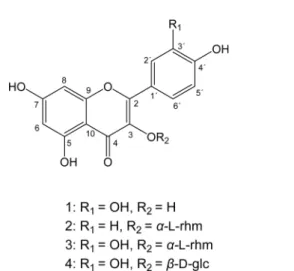
Four flavonoids were isolated from the ethyl acetate fraction through repeated silica gel and octadecyl silica gel column chromatography. Spectroscopic data including NMR, MS, and IR allowed for identification of the chemical structures as quercetin (1), afzelin (2), quercitrin (3), and isoquercitrin (4). This is the first report of the isolation of these compounds from A. altissima. The four isolated flavonoids 1–4 as well as solvent fractions (ethyl acetate, n-butanol, and water), were evaluated for DPPH radical scavenging activity.
Keywords afzelin · Ailanthus altissima · DPPH assay · isoquercitrin · quercetin · quercitrin
Introduction
Ailanthus altissima Swingle (Simaroubaceae), also known as tree- of-heaven, is a deciduous tree distributed mainly in China, Mongolia, Japan, and Korea (Feo et al., 2005). The diameter of a mature A. altissima tree is about 50 cm with stems grows up to 30 m. The upper sides of the leaves of A. altissima are dark green, while the under side is dark red. Flowers of A. altissima appear beginning from the end of June and the seeds is included in flower inside of the propeller shape. A. altissima has been used in Chinese traditional medicine as a bitter aromatic drug for the treatment of colds and gastric diseases (Feo et al., 2003; 2005).
Some compounds isolated from the root and bark of the plant have been reported to have insecticidal (Kraus et al., 1994), antimalarial (O’Neill et al., 1986; Bray et al., 1987), antitumor (Casinovi et al., 1983), antitubercular (Rahman et al., 1997), nervous depressant (Crespi-Perellino et al., 1988), antiproliferative (Hwang et al., 2002), anti-Epstein-Barr virus (Kubota et al., 1997), alleropathy (Heisey et al., 1990; 1996), anti-inflammatory (Jin et al., 2009), and antioxidant activities (Okunade et al., 2003; Lee et al., 2005; Tamura et al., 2006; Zhang et al., 2007; Rahman et al., 2009). There have been some reports on the isolation of secondary metabolites from the cortex and roots of A. altissima. However, there are only a few studies that have evaluated the leaves of A.
altissima with respect to their biological and phytochemical properties. In addition, DPPH assay performed with an alcohol extract of A. altissima leaves showed significant activity. Therefore, this study was initiated to identify the principal antioxidant compounds from A. altissima leaves.
Antioxidants are useful chemical materials for preventing oxidative deterioration of biomolecules and are widely applicable as ingredients of food supplements, cosmetics, and medicines.
Many plants contain substantial amounts of antioxidants such as vitamin C, vitamin E, carotenoids, flavonoids and tannins that can be utilized to scavenge excess free radicals from the human body.
Indeed, many researchers have found efficient antioxidants in plants.
M. -K. Lee · S. -Y. Kim · J. -H. Park · D. -G. Lee · N. -I. Baek
Graduate School of Biotechnology & Department of Oriental Medicinal Materials and Processing, Kyung Hee University, Yongin 446-701, Republic of Korea
D. -Y. Lee · G. -S. Kim
Department of Herbal Crop Research, National Institute of Horticultural and Herbal Science, RDA, Eumseong 369-873, Republic of Korea Y. -B. Kim
Technology Services Division, National Institute of Horticultural and Herbal Science, RDA, Suwon 440-706, Republic of Korea
D. -S. Han · C. -H. Lee
Division of Matabolism and functionality Research, Korea Food Research Institute Korea Food Research Institute, Sungnam 463-746, Republic of Korea
*Corresponding author (N. -I. Baek: [email protected])
This paper describes the isolation of compounds from the leaves of A. altissima using silica gel (SiO2) and octadecyl silica gel (ODS) open column and flash column chromatography. For structure determination, the authors used NMR, MS, and IR spectroscopic methods. In addition, the antioxidant activity of each fraction and the isolated compounds were evaluated on the basis of their scavenging activity for stable DPPH.
Materials and Methods
Plant materials. Leaves of Ailanthus altissima Swingle were purchased at Daegu traditional herbal market in Daegu, Korea and identified by Prof. Dae-Keun Kim of Woosuk University, Jeonju, Korea. A voucher specimen (KHU20090515) is reserved at the Laboratory of Natural Products Chemistry, Kyung Hee University, Yongin, Korea.
Reagents. Column chromatography (c.c.) was carried out using SiO2, Kiesel gel 60 (Merck, Germany), ODS, and LiChroprep RP- 18 (Merck). Flash column chromatography was carried out using SNAP Cartridge KP-Sil (Biotage, Sweden). TLC analysis was carried out using Kiesel gel 60 F254 and RP-18 F254S (Merck) and was detected using UV lamp Spectroline Model ENF-240 C/F (Spectronics Corporation, USA) and 10% H2SO4 solution. Deuterium solvents were purchased from Merck and Sigma-Aldrich (USA).
Instrumentation. Optical rotations were measured with a JASCO P-1010 digital polarimeter (JASCO, Japan). EI-MS and FAB-MS were recorded on a JEOL JMSAX 505-WA (JEOL, Japan) and JEOL JMS-700 (JEOL), respectively. IR spectra were obtained with a Perkin Elmer Spectrum One FT-IR spectrometer (Perkin Elmer, England). 1H-NMR (400 MHz) and 13C-NMR (100 MHz) spectra were taken on a Varian Unity Inova AS 400 FT-NMR spectrometer (Varian, USA). DPPH radical scavenging activity was measured with a spectrophotometer (Sunrise, USA).
Isolation of flavonoids from the EtOAc fraction. Dried leaves of A. altissima (5.0 kg) were extracted three times with 80%
aqueous methanol (MeOH, 10 L×3) for 24 h at room temperature.
The filtrates were concentrated under reduced pressure to yield a MeOH extract of 355 g. The resulting extract was then successively partitioned with water (2 L), ethyl acetate (EtOAc, 2 L×2) and n- butanol (n-BuOH, 2 L×2). The concentrated EtOAc extract (AAE, 47 g) was subjected to the Flash c.c. (SNAP Cartridge KP-sil, 100 g) and eluted with n-hexane-EtOAc (7:1, 1000 mL) and chloroform (CHCl3)-methanol (MeOH, 10:1→5:1, each of 2000 mL) monitored by TLC to produce 17 fractions (AAE1−AAE17).
AAE13 [1.9 g, elution volume/total volume (Ve/Vt) 0.706–0.824]
was subjected to the Flash c.c. (SNAP Cartridge KP-Sil, 100 g) and eluted with n-hexane-EtOAc (5:1, 1000 mL) and CHCl3- MeOH (10:1, 1300 mL) to produce nine fractions (AAE13-1− AAE13-9). AAE13-7 (620 mg, Ve/Vt 0.667–0.889) was applied to SiO2 c.c. (3×10 cm) and eluted with n-hexane-CHCl3-EtOAc (10:1:1, 1200 mL) to give seven fractions (AAE13-7-1−AAE13- 7-7). AAE13-7-2 (250 mg, Ve/Vt 0.143–0.429) was subjected to ODS c.c. (3×4 cm) and eluted with MeOH-H2O (7:1, 1000 mL) to
give compound 1 [AAE13-7-2-11, 11 mg, Ve/Vt 0.084−0.175, TLC (60 F254) Rf 0.26, n-hexane-CHCl3-EtOAc = 5:2:1]. AAE-16 (11 g, Ve/Vt 0.941–0.992) was applied to Flash c.c. (SNAP Cartridge KP-Sil, 100 g) and eluted with CHCl3-MeOH (7:1→5:1, 1700 mL) to produce seven fractions (AAE16-1−AAE16-7). AAE16-3 (2.04 g, Ve/Vt 0.125–0.251) was chromatographied by the flash c.c. (SNAP Cartridge KP-Sill, 100 g; n-hexane-EtOAc=1:1 CHCl3-MeOH = 10:1→5:1, 3200 mL) to produce six fractions (AAE16-3-1−AAE16-3-6). AAE16-3-2 (300 mg, Ve/Vt 0.167–
0.188) was subjected to ODS c.c. (3.5×4 cm, MeOH-H2O=1:1
→3:1, 1400 mL) to give eight fractions (AAE16-3-2-1−AAE16- 3-2-8), one of which was compound 2 [AAE16-3-2-4, 28 mg, Ve/
Vt 0.375–0.625, TLC (RP-18 F254S) Rf 0.50, MeOH-H2O = 2:1].
AAE16-3-3 (80 mg, Ve/Vt 0.333–0.667) was subjected to ODS c.c. (3×2 cm, MeOH-H2O=1:1, 700 mL) to give eight fractions (AAE-16-3-3-1−AAE-16-3-3-8) and afforded compound 3 [AAE16-3-3-2, 18 mg, Ve/Vt 0.112–0.298, TLC (RP-18 F254S) Rf 0.60, MeOH-H2O = 2:1]. AAE16-5 (2.3 g, Ve/Vt 0.571–0.857) was subjected to Flash c.c. (SANP Cartridge KP-Sil, 100 g; n- hexane-EtOAc = 1:1→CHCl3-MeOH = 10:1→5:1, 4200 mL) to produce five fractions (AAE16-5-1−AAE16-5-5). AAE16-5-3 (720 mg, Ve/Vt 0.411–0.832) was purified using ODS c.c.
(3×3 cm) and eluted with MeOH-H2O (1:1, 1500 mL) to produce seven fractions (AAE-16-5-3-1−AAE-16-5-3-7) including compound 4 [AAE16-5-3-3, 12 mg, Ve/Vt 0.251-0.496, TLC (RP-18 F254S) Rf 0.62, MeOH-H2O = 2:1].
Compound 1. yellow powder; IR νmax (KBr, cm−1) 3446, 1666, 1518, 1496; neg. FAB/MS m/z 301 [M-H]−; 1H-NMR (400 MHz, CD3OD, δH) 7.78 (1H, d, J=2.0 Hz, H-2'), 7.67 (1H, dd, J=8.8, 2.0 Hz, H-6'), 6.92 (1H, d, J=8.8 Hz, H-5'), 6.42 (1H, d, J=2.4 Hz, H-8), 6.22 (1H, d, J=2.4 Hz, H-6); 13C-NMR (100 MHz, CD3OD, δC) 174.6 (C-4), 165.4 (C-7), 162.3 (C-5), 158.1 (C-2), 158.0 (C-9), 148.9 (C-4'), 146.1 (C-3'), 137.1 (C-3), 124.0 (C-1'), 121.5 (C-6'), 116.1 (C-2'), 115.8 (C-5'), 104.4 (C-10), 99.1 (C-6), 94.3 (C-8).
Compound 2. yellow crystals; −104o (c=0.1, MeOH); IR νmax (KBr, cm-1) 3417, 1627, 1479; neg. FAB/MS m/z 431 [M-H]−;
1H-NMR (400 MHz, CD3OD, δH) 7.75 (2H, d, J=8.8 Hz, H-3', 5'), 6.92 (2H, dd, J=8.8, 1.6 Hz, H-2', 6'), 6.35 (1H, br s, H-8), 6.18 (1H, br s, H-6), 5.37 (1H, d, J=1.6 Hz, H-1"), 0.90 (3H, d, J=6.0 Hz, H-6"); 13C-NMR (100 MHz, CD3OD, δC) 181.5 (C-4), 163.5 (C-5), 161.4 (C-4'), 158.4 (C-2, 9), 136.0 (C-3), 131.7 (C- 2', 6'), 122.5 (C-1'), 116.4 (C-3', 5'), 105.9 (C-10), 103.2 (C-1''), 100.0 (C-6), 95.7 (C-8), 73.1 (C-4"), 72.0 (C-5"), 71.9 (C-3"), 71.8 (C-2"), 17.7 (C-6").
Compound 3. yellow powder; −96o (c=0.1, MeOH); IR νmax (KBr, cm−1) 3432, 1660, 1445; neg. FAB-MS m/z 447 [M-H]−,
1H-NMR (400 MHz, CD3OD, δH) 7.29 (1H, d, J=2.0 Hz, H-2'), 7.26 (1H, dd, J=2.0, 8.0 Hz, H-6'), 6.87 (1H, d, J=8.0 Hz, H-5'), 6.29 (1H, br s, H-8), 6.13 (1H, br s, H-6), 5.32 (1H, d, J=1.2 Hz, H-1"), 0.92 (3H, d, J=6.0 Hz, H-6"); 13C-NMR (100 MHz, CD3OD, δC) 179.3 (C-4), 165.5 (C-7), 162.8 (C-5), 158.9 (C-2), 158.2 (C-9), 149.5 (C-4'), 146.1 (C-3'), 136.0 (C-3), 122.8 (C-1', 6'), 116.8 (C-2'), 116.2 (C-5'), 105.7 (C-10), 103.3 (C-1"), 99.7 (C-
α [ ]D26
α [ ]D27
6), 94.6 (C-8), 73.1 (C-4"), 72.0 (C-5"), 71.9 (C-3"), 71.8 (C-2"), 17.7 (C-6").
Compound 4. yellow powder; −5.2° (c=0.10, MeOH);
IR vmax (KBr, cm−1) 3345, 1662, 1498; neg. FAB-MS m/z 463 [M- H] −; 1H-NMR (400 MHz, CD3OD, δH) 7.70 (1H, d, J=2.4 Hz, H- 2'), 7.57 (1H, dd, J=2.4, 7.6 Hz, H-6'), 6.85 (1H, d, J=7.6 Hz, H- 5'), 6.36 (1H, br s, H-8), 6.17 (1H, br s, H-6), 5.24 (1H, d, J=7.2 Hz, H-1"); 13C-NMR (100 MHz, CD3OD, δC) 179.2 (C-4), 166.0 (C-7), 162.8 (C-5), 158.8 (C-2), 158.2 (C-9), 149.7 (C-4'), 145.7 (C-3'), 135.5 (C-3), 123.1 (C-1'), 122.9 (C-6'), 119.4 (C-5'), 115.9 (C-2'), 105.3 (C-10), 104.2 (C-1"), 99.9 (C-6), 94.7 (C-8), 78.3 (C-3"), 78.0 (C-5"), 75.7 (C-2"), 71.1 (C-4"), 62.5 (C-6").
Evaluation of solvent fractions and flavonol glycosides for DPPH radical scavenging activity. Antioxidant activities of the solvent fractions (EtOAc, n-BuOH, H2O) and purified compounds 1−4 were measured on the basis of scavenging activity for the stable 1,1-diphenyl-2-picrylhydrazyl (DPPH) free radical as described previously (Masuda et al., 2001). The fractions, compounds 1−4, and positive control butylated hydroxyanisole (BHA) were diluted in methanol to prepare sample solutions (100, 50, 10µg/mL). The solvents were then added to 100µL of a 2×10⁻⁴ M DPPH solution, and the mixture was shaken vigorously. After 30 min, absorbance of the methanolic DPPH tincture was measured with a spectrophotometer at 517 nm. The radical scavenging effect was calculated as follows: Radical scavenging activity (%) = (Ao–Ae)/
Ao×100, where Ao is the absorbance of the negative control (DPPH plus methanol), and Ae is the absorbance of the sample (DPPH plus sample) (She et al., 2010).
Results and Discussion
When the methanol extract of the A. altissima leaves was developed by silica gel TLC, spots showed UV absorbance and yellow (1) and dark yellow (2, 3, 4) colorization after spaying with a 10% H2SO4 solution and heating indicated the presence of flavonoids. The methanol extract was then successively applied to EtOAc, n-BuOH and H2O solvents for fractionation. Repeated SiO2 and ODS column chromatography of the EtOAc fractions resulted in isolation of four flavonoids 1−4.
Compound 1 was obtained as yellow powder and produced a molecular ion peak [M-H] − at m/z 301 in negative FAB/MS, thus, molecular weight of 1 was determined to be 302. The IR spectrum (KBr) showed absorbance bands consistent with hydroxyl groups (3446 cm−1), conjugated ketones (1666 cm−1), and double bonds (1518 cm−1). In the 1H-NMR spectrum, three olefin methine proton signals [(δH 7.78, d, J=2.0 Hz, H-2'), (δH 7.67, dd, J=2.0, 8.8 Hz, H-6'), (δH 6.92, d, J=8.8 Hz, H-5')] of a 1,2,4-trisubstitution benzene ring and two aromatic methine proton signals [(δH 6.42, d, J=2.4 Hz, H-8), (δH 6.22, d, J=2.4 Hz, H-6)] of a typical meta- coupled pattern due to a 1,2,3,5-tetrasubstitution benzene ring were observed. Accordingly, compound 1 was assumed to be quercetin, a well-known flavonol. A multiplicity of fifteen carbon signals observed in the 13C-NMR spectrum was determined through
distortionless enhancement of polarization transfer (DEPT) experiments. The carbon signals in the low magnetic field region indicated the presence of conjugated ketone (δC 174.6, C-4), seven oxygenated olefin quaternary carbons [δC 165.4 (C-7), 162.3 (C- 5), 158.1 (C-2), 158.0 (C-9), 148.9 (C-4'), 146.1 (C-3'), 137.1 (C- 3)], two olefin quaternary carbons [δC 124.0 (C-1'), 104.4 (C-10)], and five olefin methines [δC 121.5 (C-6'), 116.1 (C-2'), 115.8 (C- 5'), 99.1 (C-6), 94.3 (C-8)]. Compound 1 was identified as quercetin by comparison with published spectroscopic data (Li et al., 2009).
Compound 2, yellow powder, showed the molecular ion peak [M-H]- at m/z 431 in negative FAB/MS. The IR spectrum (KBr) showed the absorbance bands consistent with a hydroxyl group (3417 cm−1), conjugated ketones (1627 cm−1), and double bonds (1479 cm−1). 1H-NMR spectrum identified four olefin methine proton signals [(δH 7.75, 2H, d, J=8.8 Hz, H-3', 5'), (δH 6.92, 2H, dd, J=8.8, 1.6 Hz, H-2', 6')] of a para-disubstitution benzene ring and two olefin methines [(δH 6.35, br s, H-8), (δH 6.18, br s, H- 6)] of a typical meta-coupled pattern due to a 1,2,3,5-tetrasubstitution benzene ring. Furthermore, proton signals for one anomer proton (δH 5.37, d, J=1.6 Hz, H-1''), four oxygenated methines (δH 3.33− 4.21, 4H, overlapped, H-2'', 3'', 4'', 5''), and one methyl proton (δH
0.90, 3H, d, J=6.0 Hz, H-6'') were also observed indicating the presence of a 6-deoxysugar. Accordingly, compound 2 was assumed to be a flavonol mono-glycoside. A total of twenty one carbon signals observed in the 13C-NMR spectrum indicated compound 2 to be a flavonol 6-deoxysugar. In the low magnetic field region, signals consistent with a conjugated ketone (δC 181.5, C-4), six oxygenated olefin quaternary carbons [δC 169.5 (C-7), 163.5 (C-5), 161.4 (C-4'), 158.4 (C-2, 9), 136.0 (C-3)], two olefin quaternary carbons [δC 122.5 (C-1'), 105.9 (C-10)], and six olefin methane carbons [δC 131.7 (C-2', 6'), 116.4 (C-3', 5'), 100.0 (C-6), 95.7 (C-8)] were observed. The chemical shifts of other glycosidic carbon signals [δC 73.1 (C-4''), 72.0 (C-5''), 71.9 (C-3''), 71.8 (C- 2''), 17.7 (C-6'')] suggested the presence of an α-rhamnopyranosyl moiety. The connection between the anomer proton signal (H-1'', α
[ ]D23
Fig. 1 Chemical structures of the flavonoids from the Ailanthus altissima leaves.
δH 5.37) of the rhamnopyranosyl unit and the oxygenated olefin quaternary carbon signal (C-3, δC 136.0) of the aglycone was verified by a cross-peak observed in the gHMBC spectrum. Thus, compound 2 was identified as kaempferol-3-O-α-L-rhamnopyranoside (afzelin), confirmed through the comparison of several physical and spectroscopic data with those of literature (Seo et al., 1978).
Compound 3, yellow powder, showed the molecular ion peak [M-H]- at m/z 447 in the negative FAB/MS. The IR spectrum (KBr) showed absorbance bands consistent with a hydroxyl group (3432 cm−1), conjugated ketones (1660 cm−1), and double bonds (1445 cm−1). Thus, Compound 3 was assumed to be a monoglycoside of quercetin (1) based on spectroscopic data such as MS, 1H-NMR and 13C-NMR. Proton signals for one anomeric proton (δH 5.32, d, J=1.2 Hz, H-1''), four oxygenated methines (δH 3.33~4.21, 4H, overlapped, H-2'', 3'', 4'', 5''), and one methyl proton (δH 0.92, 3H, d, J=6.0 Hz, H-6'') were also observed. The chemical shifts of glycosidic carbon signals [δC 73.1 (C-4''), 72.0 (C-5''), 71.9 (C-3''), 71.8 (C-2''), 17.7 (C-6'')] and the coupling constant of the anomer proton (J=1.2 Hz) suggested the presence of an α-rhamnopyranosyl moiety. The connection between the anomer proton signal (H-1'', δH 5.32) of the rhamnopyranosyl unit and the oxygenated olefin quaternary carbon signal (C-3, δC 136.0) of the aglycone was verified by the cross-peak observed in the gHMBC spectrum.
Therefore, compound 3 was identified as quercetin-3-O-α-L- rhamnopyranoside, quercitrin (Seo et al., 1978).
Compound 4, yellow powder, showed the molecular ion peak [M-H]- at m/z 463 in the negative FAB/MS. The IR spectrum (KBr) showed the absorbance bands consistent with a hydroxyl group (3345 cm−1), conjugated ketones (1662 cm−1), and double bonds (1498 cm−1). Compound 4 was almost identical with compound 3 with the exception of a sugar moiety. Proton signals for one hemiacetal proton (δH 5.24, d, J=7.2 Hz, H-1''), 13C-NMR signals of a sugar moiety [δC 71.1 (C-4''), 78.0 (C-5''), 78.3 (C-3''), 75.7 (C-2''), 62.5 (C-6'')], and the coupling constant of the anomer proton (J=7.2 Hz) suggested the presence of a β-glucopyranosyl group. The connection between anomer proton signal (H-1'', δH
5.24) of the glucopyranosyl unit and the oxygenated olefin quaternary carbon (C-3, δC 135.5) of the aglycone was verified by the cross-peak observed in the gHMBC spectrum. Compound 4 was identified as quercetin-3-O-β-D-glucopyranoside (isoquercitrin), by comparison of spectroscopic data with those of literatures (Seo et al., 1978; Lee et al., 2007).
Dried leaves of A. altissima were extracted with 80% aqueous methanol because the methanol extract of the leaves showed very
strong DPPH radical scavenging activity in a previous screening study. The extract was separated into three fractions (EtOAc- soluble, n-BuOH, and H2O-soluble fractions) by a solvent partition method. The DPPH radical scavenging activities of the solvents fractions were compared with BHA as a positive control.
BHA, exhibited a DPPH radical scavenging activity of 90.1±1.52% at 100µg/mL, while EtOAc, n-BuOH, and H2O fractions showed 97.0±0.15%, 96.5±0.08%, and 4.47±0.75%, respectively, at the same concentration.
The EtOAc and n-BuOH fractions exhibited higher antioxidant activities compared to the positive control BHA. As a result, the EtOAc fraction was selected for further fractionation. The EtOAc- soluble fraction was subjected to SiO2 column chromatography with stepwise gradient elution, affording 17 fractions. The obtained fractions were assayed by the described method, and fractions 2, 3, 7, 9, 10, 12, 13, 14, 15, 16, and 17 were selected as antioxidative fractions. Finally, fractions 2, 3, 7, 13, and 16 were subjected to column chromatography using SiO2 and ODS, affording the purified flavonoids 1-4 as major compounds.
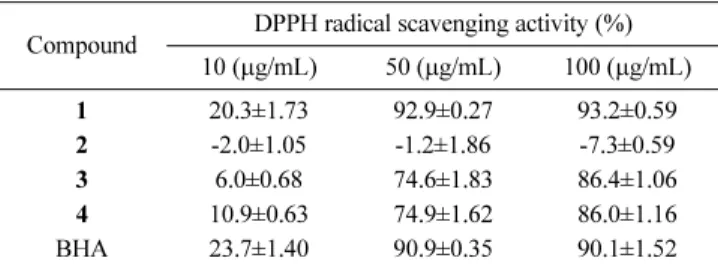
Compounds 1, 3, and 4 had radical scavenging activity of 93.2±0.59%, 86.4±1.06%, and 86.0±1.16% at 100µg/mL, respectively. Compound 1 (quercetin) showed very strong radical scavenging activity, with efficiencies similar to that of BHA. In contrast, compounds 3 (quercitrin) and 4 (isoquercitrin) had a somewhat weaker than BHA which may have been due to glycosidation at the 3-position (Burda and Oleszek, 2001).
Conversely, compound 2 had an antioxidant activity of −7.3±
0.59% at 100µg/mL. Quercetin-type flavonol glycosides 3 and 4 were stronger than kaempferol type ones because of the presence of hydroxyl groups at the B-ring C-3´ position (Bruda et al., 2001).
Antioxidant activity is tends to correlate with various bioactivities, and compounds with strong antioxidant activity have been shown to be strong effective against several diseases related to oxidative stress. In the present study, the isolated principal compounds had comparatively high DPPH radical scavenging activity, suggesting that the leaves of A. altissima and the isolated flavonols may be widely applicable as a source of new drugs and functional foods.
Acknowledgment This study was supported by a grant from the Korea Food Research Institute (Project No.20120525U0054101S000100).
References
Bray DH, Boardman P, and O’Nell NJ (1987) Plants as a source of antimalarial durgs. 5. Activities of Ailanthus altissima stem constituents and of some related quassinoids. Phytother Res 1, 22–4.
Burda S and Oleszek W (2001) Antioxidant and antiradical activities of flavonoids. J Agri Food Chem 49, 2774–9.
Casinovi GC, Ceccherelli P, Fardella G, and Grandolini G (1983) Isolation and structure of a quassinoids from Ailanthus glandulosa. Phytochem 22, 2871–3.
Crespi-Perellino N, Guicciardi A, Minghetti A, and Speroni E (1988) Comparison of biological activity induced by Ailanthus altissima plant or cell cultures extracts. Pharmacol Res Commun 20, 45–8.
Feo VD, Martino LD, Quaranta E, and Pizza C (2003) Isolation of phytotoxic
Table 1 DPPH radical scavenging activity of compounds 1-4 Compound DPPH radical scavenging activity (%)
10 (µg/mL) 50 (µg/mL) 100 (µg/mL)
1 20.3±1.73 92.9±0.27 93.2±0.59
2 -2.0±1.05 -1.2±1.86 -7.3±0.59
3 6.0±0.68 74.6±1.83 86.4±1.06
4 10.9±0.63 74.9±1.62 86.0±1.16
BHA 23.7±1.40 90.9±0.35 90.1±1.52
compounds from Tree-of-Heaven (Ailanthus altissima Swingle). J Agric Food Chem 51, 1177–80.
Feo VD, Martino LD, Santoro A, Leone A, Pizza C, Franceschelli S et al.
(2005) Antiproliferative effects of Tree-of-Heaven (Ailanthus altissima Swingle). Phytother Res 19, 226–30.
Heisey RM (1990) Evidence for allelopathy by Tree-of-Heaven (Ailanthus altissima Swingle). J Chem Ecol 16, 2039–55.
Heisey RM (1996) Identification of an allelopathic compound from Ailanthus altissima (Simaroubaceae) and characterization of its herbicidal activity.
Am J Bot 83, 192–200.
Hwang SG, Lee HC, and Kim CK (2002) Effect of Ailanthus altissima water extract on cell cycle control genes in Jurkat T lymphocytes. Yakhak Hoechi 46, 18–23.
Jin M, Bae KH., Chang HW, and Son JK (2009) Anti-inflammatory compounds from the leaves of Ailanthus altissima. Biomol Ther 17, 86–
91.
Kraus M, Koll-Weber M, Maile R, Wunder T, and Vogler B (1994) Biologically active constituents of tropical and subtropical plants. Pure Appl Chem 66, 2347–52.
Kubota K, Fukamiya N, Tokuda H, Nishino H, Tagahara K, Lee KH et al.
(1997) Quassinoids as inhibitors of Epstein-Barr virus early antigen activation. Cancer Lett 113, 165–8.
Lee JH, Lee BW, Kim JH, Seo WD, Jang KC, and Park KH (2005) Antioxidant effects of isoflavones from the stem bark of Cudrania tricuspidata. Agric Chem Biotechnol 48, 193–7.
Lee DY, Lyu HN, Kwak HY, Jung L, Lee YH, Kim DK et al. (2007) Isolation of flavonoids from the fruits of Cornus kousa Burg. J Appl Biol Chem 50, 144–7.
Li L, Henry GE, and Seeram NP (2009) Identification and bioactivities of
resveratrol oligomers and flavonoids from Carex folliculate seeds. J Agric Food Chem 57, 7282–7.
Masuda T, Iritani K, Yonemori S, Oyama Y, and Takeda Y (2001) Isolation and antioxidant activity of galloyl flavonol glycosides from the seashore plant Pemphis acidula. Biosci Biotechnol Biochem 65, 1302–9.
O’Neill MJ, Bray DH, Boardman P, Phillipson JD, Warhurst DC, Peters W et al. (1986) Plants as sources of antimalarial drugs: in vitro antimalarial activities of some quassinoids. Antimicrob Agents Chemother 30, 101–4.
Okunade AL, Bikoff RE, Casper SJ, Oksman A, Goldberg DF, and Lewis WH (2003) Antiplasmodial activity of extracts and quassinoids isolated from seedlings of Ailanthus altissima (Simaroubaceae). Phytother Res 17, 675–7.
Rahman S, Fukamiya N, Okano M, Tagahara K, and Lee KH (1997) Antitubercolosis activity of quassinoids. Chem Pharm Bull 45, 1527–9.
Rahman A, Kim EL, and Kang SH (2009) Antibacterial and antioxidant properties of Ailanthus altissima Swingle leaves extract to reduce foodborne pathogens and spoiling bacteria. J Food Safety 29, 499–510.
Seo S, Tomita Y, Tori K, and Yoshimure Y (1978) Determination of the absolute configuration of a secondary hydroxyl group in a chiral secondary alcohol using glycosidation shift in carbon-13 nuclear magnetic resonance spectroscopy. J Am Chem Soc 100, 3331–9.
She GM, Xu C, Liu B, and Shi RB (2010) Polyphenolic acids from mint (the aerial of Mentha haplocalyx Briq.) with DPPH radical scavenging activity. J Food Sci 75, 359–62.
Tamura S, Fukamiya N, Okano M, and Koike K (2006) A new quassinoid, ailantinol H from Ailanthus altissima. Nat Prod Res 20, 1105–09.
Zhang LP, Wang JY, Wang W, Cui YX, and Cheng DL (2007) Two new alkaloidal glycosides from the root bark of Ailanthus altissima. J Asian Nat Prod Res 9, 253–9.