
Printed in the Republic of Korea
http://dx.doi.org/10.5012/jkcs.2012.56.2.212
The Kinetics and Mechanism for the Oxidation of Nicotinic Acid by Peroxomonosulfate in Acidic Aqueous Medium
Anju Agrawal, Riya Sailani*, Beena Gupta, C. L. Khandelwal, and P. D. Sharma Department of Chemistry, University of Rajasthan, Jaipur-302055 (India)
*Email: [email protected]
(Received February 2, 2012; Accepted March 21, 2012)
ABSTRACT. The kinetics of oxidation of nicotinic acid by peroxomonosulfate (PMS) has been studied in acetate buffers.
Stoichiometry of the reaction corresponds to the reaction of one mole of the oxidant with a mole of nicotinic acid. N→O prod- uct has been confirmed both by UV visible and IR spectroscopy. The reaction is second order viz. first order with respect to each reactant. Activation parameters have also been evaluated. A plausible reaction mechanism is mentioned and the derived kinetic rate law accounts for experimental observations.
Key words: Kinetics, Mechanism, Oxidation, Nicotinic acid, Peroxomonosulfate
INTRODUCTION
Peroxomonosulfate (heretofore written as PMS) in aque- ous solution to be HSO5- is an active ingredient of oxone.
Oxone is a commercial name of this triple salt of potas- sium (2KHSO5·KHSO4·K2SO4). Oxone is a versatile and environmentally benign oxidant with wide applications such as bleaching, cleaning and disinfection agent.1 It has also been employed as an oxidant to degrade the pollut- ants. Co2+ is the most efficient catalyst of peroxomonosulfate to generate sulfate free radicals.2 The catalytic decomposi- tion of PMS in the presence of transition metal ions such as Mn2+, Cu2+, Fe3+ Co2+ and biomimetic catalyst like iron- porphyrin complex are also reported.3,4
Peroxomonosulfuric acid - a derivative of hydrogen per- oxide when one of the hydrogens of the latter is replaced by sulfuric acid group.5-7 Thus it is this weak peroxide linkage (-O-O-) that undergoes cleavage during electron transfer reactions.8-15 However, such peroxocompounds are exceptionally sensitive to the traces of metal-ions as has been observed in trace metal-ion catalysis in large number of reactions of peroxo acids.16
The structure of peroxomonosulfate is consistent with one proton being ionised and other proton undergoes hydrolysis. Edwards et al.17,18 studied decomposition of peroxomonosulfate over a limited pH range. Robson et al.19 reported similar kinetics of uncatalysed decomposi- tion of peroxoaromatic compounds as well as peroxomono- sulfate and suggested nucleophilic attack of SO5-2 on the sulphur atom of HSO5-. Peroxomonosulfuric acid20-22 as nucleophile in oxidation of various organic compounds
has also been reported.
These were the studies that stimulated our interest to explore kinetics of oxidation of nicotinic acid by PMS to understand its reducing properties which are hitter to least known. It is expected that its reactivity pattern in aqueous acid medium can provide additional information about the chemistry of this organic acid in particular and perox- omonosulfate in general.
EXPERIMENTAL Materials and Methods
Materials:
Peroxomonosulfate (Aldrich) was employed as received.
The solution of peroxomonosulfate was prepared by dis- solving its potassium salt (K2SO5·KHSO4·K2SO4) in dou- bly distilled water. The solution of PMS was standardized both iodometrically and ceremetrically respectively and an impurity owing to KHSO4 or K2SO4 or both did not exceed more than 4%. However, the kinetic results were not affected by such an impurity. Efforts were also made to purify the salt but were not successful. Other reagents were either of AnalaR or guaranteed reagent grade and were employed as received. Doubly distilled water was employed throughout the study; second distillation was from alkaline permanganate solution in an all glass appa- ratus. Nevertheless, a few reactions were also carried out in tripply distilled water (redistilling of double distilled water in the presence of edta) to check trace metal-ion catalysis. Since trace metal-ion catalysis is reported in reactions of per-acid. However, catalysis of this type was
not observed in this reaction under experimental condi- tions of the kinetics.
Kinetic Procedure
All the ingredients of the reaction except peroxomono- sulfate were taken in glass stoppered Corning glass ves- sels which were suspended in a water-bath thermostated at ±0.1oC unless specified otherwise. The reaction was initiated by adding temperature pre-equilibrated PMS solution into reaction mixture and the time of initiation was recorded when pipette was half emptied. The kinet- ics of the reaction was monitored iodometrically by withdrawing an aliquot (5 cm3) of the reaction mixture periodically and then discharging it in to ice-cold potas- sium iodide solutions (~10%). The liberated iodine was titrated against sodium thiosulfate solution using starch as an indicator.
Initial rates (ki, mol dm-3s-1) were computed employing plane mirror method. Pseudo first order plots were also made (Nic Acid is heretofore written for the nicotinic acid) wherever reaction conditions were such as [Nic.
Acid] >> [PMS]. Results in triplicate were reproducible to within ±6%.
Stoichiometry
The stoichiometry of the reaction was determined by allowing reactions in a thermostated water bath for Ca.12h at 35oC. The excess concentration of peroxomonosul- fate was determined iodometrically. These stoichiomet- ric results correspond to the reaction of one mole of nicotinic acid to a mole of peroxomonosulfate as represented by eqn (1)
-OOC-C5H5N + HSO5- -OOC-C5N5N→O + HSO4-
(1) Product Analysis
The oxidation product to be N-oxide of nicotinic acid to be N-Oxide was identified by U.V.-visible spectrophoto- metric (Fig. 1) where observed λmax at 254 nm is char- acteristic of N→O product of nicotinic acid. The IR spectrum (Fig. 2) of the reaction mixture in KRS cell shows strong peak in the 1640-1680 cm-1 conforming the product. Thus the stoichiometric, UV-visible and IR spec- tral results confirm conversion of nicotinic acid to N→O form of nicotinic acid. Such a product is not unique in the light of the fact that the hydrogen peroxide being rela- tively much weaker oxidizing agent than PMS has limited conversion of tertiary amines to their N-oxides.23
RESULTS
Peroxomonosulfate (PMS) and Nicotinic Acid (Nic.Acid) Dependence
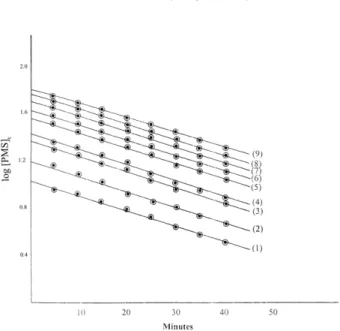
The concentration of peroxomonosulfate was varied at constant concentrations of [Nic acid]=2.0×10⁻², 3.0×10⁻², 4.0×10⁻² and 5.0×10⁻² mol dm-3 respectively, pH 4.02 and 35oC. Pseudo first order plots were made (Fig. 3) and evaluated pseudo first order rate constants (k', s-1) from these plots were found to be independent of gross initial concentrations of the oxidant conforming first order with respect to peroxomonosulfate (Table 1).
The concentration of nicotinic acid was varied at fixed concentrations of other reaction ingredients and [PMS] = Fig. 1. U.V.-visible spectrum of N-Oxide nicotinic acid in a reac- tion of nicotinic acid and peroxomonosulphate in acetate buffers.
Fig. 2. N-Oxide nicotinic acid IR spectrum in a reaction of nic- otinic acid and peroxomonosulphate in acetate buffers.
2.0×10⁻³ and 3.0×10⁻³ mol dm-3 respectively, pH 4.02 and 35oC.
Initial rates (ki, mol dm-3 s-1) were computed employing plane mirror method.24 The plot of ki versus concentration of nicotinic acid yielded a straight line passing through the origin conforming first order dependence with respect to the substrate. Further, pseudo first order plots were also made and a plot of pseudo first order rate constants (k', s-1) against the concentration of nicotinic acid also yields a straight line passing through the origin confirming first order with respect to nicotinic acid.
Since the reaction is second order viz. first order with respect to each reactant, second order plots of log [PMS]t/ [Nic Acid]t or log [Nic Acid]t/[PMS]t versus time were also made and the second order rate constants obtained from such plots were found in agreement with the second order rate constants obtained from initial rates and pseudo first order rate constants respectively (Table 1).
The pH variation was made by changing the composi- tion of acetate buffers at fixed concentration of sodium acetate and also keeping concentrations of other reaction ingredients constant at 30, 35 and 45oC respectively. The pH of the reaction mixture was checked employing digital pH meter prior to and after the reaction. The maximum change in pH was of 0.01 units. The rate, however, increases with increasing pH of the reaction.
The effect of temperature on the rate was studied at 30, 35 and 40oC respectively and pH, 4.02 keeping constant
concentrations of other reaction ingredients.
The energy and entropy of activation were calculated to be (50±3.0) kJ mol-1 (-98±7) JK-1 mol-1 respectively in a conventional manner. The experimental energy of activation is of the same order as is usually found in second order reactions. Such a (–)ve entropy of activation is generally assigned to more rigid associative transition state.
DISCUSSION
The overall reaction is second order exhibiting first order with respect to oxidant and substrate respectively.
Since the rate is retarded by hydrogen ion concentration, the salient feature of the reaction is to co-relate hydrogen ion concentration either to the oxidant or substrate or both.
Peroxomonosulfate in aqueous solution is governed by equilibrium (2)
HSO5- SO52- + H+ (2)
pK1 and pK2 of PMS, if, taken into account, HSO5- spe- cies is predominant at pH < 0 whereas SO52- species exhibits its predominance only at pH > 9. Therefore if pK1 and pK2 are any guide, the pH effect can not be co-related to PMS and SO52- species. Since, nicotinic acid is proto- Fig. 3. Pseudo first order plot in the reaction of nicotinic acid
and peroxomonosulphate. [Nic acid] = 5.0×10⁻³ mol dm-3; pH=
4.02 and 35oC. [PMS] = 1.0×10⁻³ (1); 1.5×10⁻³ (2); 2.0×10⁻³ (3);
2.5×10⁻³ (4); 3.0×10⁻³ (5); 3.5×10⁻³ (6); 4.0×10⁻³ (7); and 5×10⁻³ mol dm-3 (8).
Table 1. Initial rate constants (ki, mol dm-3 s-1) pseudo first order rate constants (k', s-1) and second order rate constants (k, dm3 mol-1 s-1) in the reaction of nicotinic acid by peroxomonosulphate in acid medium. pH=4.02 and 35oC
103 [PMS]
(mol dm-3)
102 [Nic acid]
(mol dm-3)
104[k']
(s-1)
102 [k]
(dm3 mol-1 s-1)
1.0 2.0 2.11 1.0±0.1 (1.0±0.1)
2.0 2.0 2.11 1.0±0.1 (1.0±0.1)
1.0 3.0 3.26 1.0±0.1 (1.1±0.1)
2.0 3.0 3.26 1.0±0.1 (1.1±0.1)
3.0 3.0 3.26 1.1±0.1 (1.1±0.1)
1.0 4.0 4.22 1.0±0.1 (1.0±0.1)
2.0 4.0 4.22 1.1±0.1 (1.1±0.1)
3.0 4.0 4.22 1.0±0.1 (1.0±0.1)
4.0 4.0 4.22 1.0±0.1 (1.0±0.1)
1.0 5.0 5.3 1.0±0.1 (1.0±0.1)
2.0 5.0 5.3 1.0±0.1 (1.0±0.1)
3.0 5.0 5.3 1.0±0.1 (1.1±0.1)
4.0 5.0 5.3 1.1±0.1(1.1±0.1)
5.0 5.0 5.3 1.0±0.05(1.1±0.1)
2.0 20.0 2.11 1.1±0.1 (1.1±0.1)
2.0 30.0 3.26 1.1±0.15(1.1±0.15)
2.0 40.0 4.22 1.0±0.1 (1.1±0.1)
2.0 50.0 5.3 1.0±0.1 (1.0±0.1)
Figures in parentheses were obtained from pseudo first order rate constants.
nated under experimental conditions as in equilibrium (3), hydrogen ion dependence can be co-related to nicotinic acid and as such nicotinic acid appears to be the reactive species. Thus considering HSO5– and molecular form of nicotinic acid to be the reactive forms of oxidant and sub- strate respectively, the following reaction mechanism consisting of steps (3)-(5) can be envisaged to account for the experimental results.
(3)
(4)
k'
[Adduct]# Products (5)
The loss of peroxomonosulfate leads to the rate law (6) or (7)
(6) Where [Nic acid] and [PMS] are the gross analytical concentrations of nicotinic acid and peroxomonosulfate respectively.
or
(7) Where ‘k’ is an observed second order rate constant (Table 1). The double reciprocal of equation (7) yields equation (8).
(8) A plot of 1/k versus [H+] was made from eqn. (8) that yielded a straight line with non-zero intercept (Fig. 4).
'K1' was calculated from the ratio of intercept and slope to be 2.5×10⁻⁵, 2.0×10⁻⁵ and 1.6×10⁻⁵ at 30, 35 and 40oC respectively.
Since these values are of the order of pK1 6, which is expected for such a weak acid like that of nicotinic acid.
The reaction species HSO5- is more reactive than SO52-
species; the former is more electrophilic than the latter species. This involves nucleophilic attack of the nitrogen lone pair on the electrophilic peroxo oxygen of perox- omonosulfate species similar to SN2 type transition state as suggested earlier.14,16-18
CONCLUSIONS
The reaction of nicotinic acid and peroxomonosulfate at acidic pH yields N→O nicotinic acid based on stoichio- metric results and product analysis both by UV and IR spectral analysis.
The oxidation of nicotinic acid by peroxomonosulfate in acid medium exhibits second order viz. first order with respect to each reactant. Hydrogen ion retards the rate of the reaction and such retardation can be assigned to acid- d PMS[ ]
---dt
– k′K2[Nic acid] PMS[ ] K1+[ ]H+ ---
=
k k′K2 K1+[ ]H+ ---
=
1 k--- K1
k′K2 --- [ ]H+
k′K2 --- +
=
~–
Fig. 4. A plot of (k)-1 versus [H+]. [Nic Acid] = 4×10⁻²; [PMS] = 3×10⁻³; [NaNO3]0.5×10⁻³ mol dm-3; , 30oC; , 35oC; , 40oC.
base equilibrium of nicotinic acid. The proposed mech- anism accounts for the experimental observations and the rate law.
REFERENCES
1. Ermer, O.; Robke, C. Helv. Chim. Acta 2003, 86, 2908.
2. Chen, X.; Qiao, X.; Wang, D.; Lin, J.; Chen, J. Chemo- sphere 2007, 67, 802.
3.Fukushima, M.; Ichikawa, H.; Kawasaki, M.; Sawada, A.;
Morimoto, K.; Tatsumi, K. Environ. Sci. Technol. 2003, 37, 386.
4. Fernandez, J.; Maruthamuthu, P.; Kiwi, J. J. Photochem.
Photobiol A: Chem. 2004, 161, 185.
5. Spiro, M. Electrochim. Acta 1979, 24, 313.
6. Ball, D. L.; Edwards, J.O. J. Am. Chem. Soc. 1956, 78, 1125.
7. Kolthoff, I. M.; Miller, I. K. J. Am. Chem. Soc. 1951, 73, 3055.
8. Madhavan, J.; Maruthamuthu, P.; Murugesan, S. Ashok- Kumar, M. Appl. Catal., A General 2009, 368, 35.
9. Murugavelu, M.; Andal, P.; Shailaja, S.; Ramachandran, M. S. J. Mol. Catal. A: Chem. 2009, 306, 1.
10. Mehrotra, M.; Mehrotra, R. N. Polyhedron 2008, 27, 2151.
11. Lente, G.; Fabian, J. J. Chem. Soc. Daltan Trans. 2007,
38, 4268.
12. Dubey, S.; Hemkar, S.; Khandelwal, C. L.; Sharma, P. D.
Inorg. Chem. Commun. 2002, 5, 903.
13. Balakrishnan, T.; Damodarkumar, S. J. Appl. Polymer Science 2000, 76, 1564.
14. Rani, S. K.; Easwaramoorthy, D.; Bilal, I. M.; Palani- chamy, M. Appl. Catal., A General 2009, 369, 1.
15. Khalid, M. A. A. Arabian J. Sciences and Engin. 2008, 33, 199.
16. Edwards, J. O., Ed. Peroxide Reaction Mechanisms;
Interscience: New York, 1962; pp 67-106.
17. Koubek, E.; Levey, G.; Edwards, J. O. Inorg. Chem. 1964, 3, 1331.
18. Curci, R.; Edwards, J. O. In Organic Peroxides: Swern, D., Ed.; Wiley Intersciences: New York, 1970; Vol. 1, pp 199-264.
19. Goodman, J. F.; Robson, P. J. Chem. Soc. 1963, 2871.
20. Jameel, A. A.; Maruthamuthu, P. J. Ind. Chem. Soc. 1998, 75, 368.
21. Panda, R. S.; Panigrahi, A. K.; Patnaik, C. P.; Sahu, S. K.;
Mahapatra, S. K. Bull. Chem. Soc. Jpn. 1988, 61, 1363.
22. Panda, R. S.; Patnaik, C. P.; Mohapatro, S. N.; Panigrahi, A. K. Bull. Chem. Soc. Jpn. 1987, 60, 3391.
23. Payne, G. B.; Deming, P. H.; Williams, P. H. J. Org.
Chem. 1961, 26, 659.

![Fig. 4. A plot of (k) -1 versus [H + ]. [Nic Acid] = 4×10 -2 ; [PMS] = 3×10 -3 ; [NaNO 3 ]0.5×10 -3 mol dm -3 ; , 30 o C; , 35 o C; , 40 o C.](https://thumb-ap.123doks.com/thumbv2/123dokinfo/5299210.154448/4.892.466.807.156.560/fig-plot-versus-nic-acid-pms-nano-mol.webp)
