• 검색 결과가 없습니다.

Obesity Fact Sheet in Korea, 2019: Prevalence of Obesity and Abdominal Obesity from 2009 to 2018 and Social Factors

N/A
N/A
Protected

Academic year: 2021

Share "Obesity Fact Sheet in Korea, 2019: Prevalence of Obesity and Abdominal Obesity from 2009 to 2018 and Social Factors"

Copied!
9
0
0

로드 중.... (전체 텍스트 보기)

전체 글

(1)

Obesity Fact Sheet in Korea, 2019: Prevalence of Obesity and Abdominal Obesity from 2009 to 2018 and Social Factors

Ga Eun Nam

1

, Yang-Hyun Kim

1,

*, Kyungdo Han

2

, Jin-Hyung Jung

3

, Eun-Jung Rhee

4

, Seong-Su Lee

5

, Dae Jung Kim

6

, Kwan-Woo Lee

6

, Won-Young Lee

4,

*, on behalf of the Taskforce Team of the Obesity Fact Sheet of the Korean Society for the Study of Obesity

1

Department of Family Medicine, Korea University College of Medicine, Seoul;

2

Department of Statistics and Actuarial Science, Soongsil University, Seoul;

3
Department of Biostatistics, College of Medicine, The Catholic University of Korea, Seoul;

4

Division of Endocrinology and Metabolism, Department of Internal Medicine, Kangbuk Samsung Hospital, Sungkyunkwan University School of Medicine, Seoul;

5

Division of Endocrinology and Metabolism, Department of Internal Medicine, Bucheon St. Mary’s Hospital, College of Medicine, The Catholic University of Korea, Bucheon;

6

Department of Endocrinology and Metabolism, Ajou University School of Medicine, Suwon, Korea

Background: The prevalence of obesity has rapidly increased in countries across the world in recent decades.

The 2019 Obesity Fact Sheet released by the Korean Society for the Study of Obesity addressed the prevalence of obesity and abdominal obesity during the period of 2009 to 2018 and obesity-related social factors.

Methods: Data from the Korean National Health Insurance Service health checkup database between 2009 and 2018 and the Korea National Health and Nutrition Examination Survey between 2010 and 2017 were ana- lyzed. The prevalence of obesity and abdominal obesity was calculated after standardizing for age and sex based on the 2010 population and housing census.

Results: From 2009 to 2018, the prevalence of obesity and abdominal obesity increased to 35.7% and 23.8%, respectively, in 2018. Upward trends in the prevalence of obesity and abdominal obesity was observed among both sexes and nearly all age groups. The prevalence of obesity and abdominal obesity was higher among indi- viduals with lower education and household income levels. Among occupations, managers exhibited the high- est prevalence of obesity and abdominal obesity. Further, the prevalence of obesity and abdominal obesity be- came higher among individuals working longer hours and split and night shift workers.

Conclusion: The 2019 Obesity Fact Sheet provides information on changes in obesity dynamics during the past decade and obesity-related social factors in the Korean adult population. This report might constitute a cor- nerstone by which to establish targets for future interventions for reversing the rise in the prevalence of obesity and reducing the burden of obesity in Korea.

Key words: Obesity, Abdominal obesity, Prevalence, Social factors, Fact sheet, National Health Insurance Service

Received June 4, 2020 Reviewed June 13, 2020 Accepted June 21, 2020

* Corresponding author Won-Young Lee

https://orcid.org/0000-0002-1082-7592 Division of Endocrinology and Metabolism, Department of Internal Medicine, Kangbuk Samsung Hospital, Sungkyunkwan University School of Medicine, 29 Saemunan-ro, Jongno-gu, Seoul 03181, Korea

Tel: +82-2-2001-2579 Fax: +82-2-2001-1588 E-mail: [email protected]

*Co-Corresponding author Yang-Hyun Kim

https://orcid.org/0000-0003-3548-8758 Department of Family Medicine, Korea University College of Medicine, 73 Goryeodae-ro, Seongbuk-gu, Seoul 02841, Korea

Tel: +82-2-920-5104 Fax: +82-2-928-8083 E-mail: [email protected]

Copyright © 2020 Korean Society for the Study of Obesity

This is an Open Access article distributed under the terms of the Creative Commons Attribution Non-Commercial License (https://creativecommons.org/licenses/by-nc/4.0/) which permits unrestricted non-commercial use, distribution, and reproduction in any medium, provided the original work is properly cited.

eISSN 2508-7576

2017-03-16 https://crossmark-cdn.crossref.org/widget/v2.0/logos/CROSSMARK_Color_square.svg

Original Article

(2)

Obesity Fact Sheet in Korea, 2019: Prevalence of Obesity and Abdominal Obesity from 2009 to 2018 and Social Factors

Ga Eun Nam

1

, Yang-Hyun Kim

1,

*, Kyungdo Han

2

, Jin-Hyung Jung

3

, Eun-Jung Rhee

4

, Seong-Su Lee

5

, Dae Jung Kim

6

, Kwan-Woo Lee

6

, Won-Young Lee

4,

*, on behalf of the Taskforce Team of the Obesity Fact Sheet of the Korean Society for the Study of Obesity

1

Department of Family Medicine, Korea University College of Medicine, Seoul;

2

Department of Statistics and Actuarial Science, Soongsil University, Seoul;

3
Department of Biostatistics, College of Medicine, The Catholic University of Korea, Seoul;

4

Division of Endocrinology and Metabolism, Department of Internal Medicine, Kangbuk Samsung Hospital, Sungkyunkwan University School of Medicine, Seoul;

5

Division of Endocrinology and Metabolism, Department of Internal Medicine, Bucheon St. Mary’s Hospital, College of Medicine, The Catholic University of Korea, Bucheon;

6

Department of Endocrinology and Metabolism, Ajou University School of Medicine, Suwon, Korea

Background: The prevalence of obesity has rapidly increased in countries across the world in recent decades.

The 2019 Obesity Fact Sheet released by the Korean Society for the Study of Obesity addressed the prevalence of obesity and abdominal obesity during the period of 2009 to 2018 and obesity-related social factors.

Methods: Data from the Korean National Health Insurance Service health checkup database between 2009 and 2018 and the Korea National Health and Nutrition Examination Survey between 2010 and 2017 were ana- lyzed. The prevalence of obesity and abdominal obesity was calculated after standardizing for age and sex based on the 2010 population and housing census.

Results: From 2009 to 2018, the prevalence of obesity and abdominal obesity increased to 35.7% and 23.8%, respectively, in 2018. Upward trends in the prevalence of obesity and abdominal obesity was observed among both sexes and nearly all age groups. The prevalence of obesity and abdominal obesity was higher among indi- viduals with lower education and household income levels. Among occupations, managers exhibited the high- est prevalence of obesity and abdominal obesity. Further, the prevalence of obesity and abdominal obesity be- came higher among individuals working longer hours and split and night shift workers.

Conclusion: The 2019 Obesity Fact Sheet provides information on changes in obesity dynamics during the past decade and obesity-related social factors in the Korean adult population. This report might constitute a cor- nerstone by which to establish targets for future interventions for reversing the rise in the prevalence of obesity and reducing the burden of obesity in Korea.

Key words: Obesity, Abdominal obesity, Prevalence, Social factors, Fact sheet, National Health Insurance Service

Received June 4, 2020 Reviewed June 13, 2020 Accepted June 21, 2020

* Corresponding author Won-Young Lee

https://orcid.org/0000-0002-1082-7592 Division of Endocrinology and Metabolism, Department of Internal Medicine, Kangbuk Samsung Hospital, Sungkyunkwan University School of Medicine, 29 Saemunan-ro, Jongno-gu, Seoul 03181, Korea

Tel: +82-2-2001-2579 Fax: +82-2-2001-1588 E-mail: [email protected]

*Co-Corresponding author Yang-Hyun Kim

https://orcid.org/0000-0003-3548-8758 Department of Family Medicine, Korea University College of Medicine, 73 Goryeodae-ro, Seongbuk-gu, Seoul 02841, Korea

Tel: +82-2-920-5104 Fax: +82-2-928-8083 E-mail: [email protected]

INTRODUCTION

Over the last several decades, the prevalence of obesity has rap- idly increased in populations across the world. The World Health Organization (WHO) declared the rising levels of obesity as a global epidemic almost 20 years ago. In 2016, approximately more than 39% (1.9 billion) and 13% (650 million) adults worldwide were reported to be overweight and obese, respectively, with the obesity prevalence exceeding 50% in many countries.

1-3

Obesity is known to substantially increase the risk of various chronic diseases including metabolic, cardiovascular, musculoskeletal, neurodegen- erative, and psychiatric diseases and several types of cancer.

4

In ad- dition, abdominal obesity is an independent risk factor for metabol- ic and cardiovascular morbidity and mortality.

5,6

Moreover, obesity is a leading cause of reduced quality of life, disability, and social dis- advantages while being closely correlated with various social factors.

4

In this regard, obesity is currently recognized as a chronic progres- sive disease beyond only being a risk factor for other diseases.

The Korean Society for the Study of Obesity (KSSO) has devot- ed time and resources to investigating recent trends in obesity, its related comorbidities, and social factors contributing to it, aiming ultimately to improve obesity-related health outcomes in Korea.

The KSSO has published Obesity Fact Sheets every year since 2015 to report on the national obesity status and its impacts and to pro- vide obesity-related statistics for the establishment of national health policies for improving obesity under a memorandum of understand- ing with the Korean National Health Insurance Corporation (NHIC) in 2015. The 2019 Obesity Fact Sheet focused on recent trends in the prevalence of obesity and abdominal obesity and obesity-relat- ed health risks in young adults. The prevalence of obesity and ab- dominal obesity by social factors was also analyzed.

7

Herein, we re- ported and discussed the prevalence of obesity and abdominal obe- sity among Korean adults from 2009 to 2018 and obesity-related social factors based on the 2019 Obesity Fact Sheet.

METHODS Data sources and study participants

This study analyzed data from the national health checkup data- base provided by the Korean National Health Insurance Service

(NHIS) managed by the Korean NHIC. The NHIS is a nonprofit, single-payer system that offers universal medical coverage for all Ko- rean residents and reimburses health care providers based on a fee- for-service system. In addition, the Korean NHIC provides health checkups for all ensured people at least every 2 years. Hence, the NHIS possesses health information of nearly the entire Korean pop- ulation, including data on demographics, disease diagnosis and med- ical treatments according to the International Classification of Dis- eases 10th revision codes, and health examinations. Comprehensive information from the NHIS database has been presented elsewhere.

8,9

Using this database, data on individuals aged 20 years or older who had undergone at least one health checkup provided by the Korean NHIC between January 1, 2009 and December 31, 2018 were as- sessed. For determining the prevalence of obesity and abdominal obesity according to social factors, we used data from participants aged 20 years or older gathered by the Korea National Health and Nutrition Examination Survey (KNHANES) from the first year (2010) of the fifth stage to the second year (2017) of the seventh stage. The study protocol was approved by the Institutional Review Board of Korea University Anam Hospital (IRB No. 2019AN0199).

Definitions of obesity and abdominal obesity

Participants’ height, body weight, and waist circumference (WC) were measured by trained staff members. Body mass index (BMI) was calculated by dividing the body weight in kilograms by the square of the height in meters. Obesity was defined as a BMI ≥ 25 kg/m

2

, according to the Asia-Pacific criteria of the WHO guidelines.

10

Ab- dominal obesity was defined as a WC ≥ 90 cm in males and ≥ 85 cm in females in accordance with the definition of the KSSO.

10

Definition of social factors

Participants’ household income levels were categorized as quartile

groups and education levels were categorized as elementary school

graduate or less, middle school graduate, high school graduate, and

university graduate or more. The classification of occupation was

based on the standard classification of occupation for employed

people, excluding the armed forces. We categorized the weekly

working hours as less than 40, 40 to 60, 60 to 80, and 80 or more

hours, respectively, and flexible working types as day-, evening-,

night-, day and night regular-, 24-hour-, and split-shift, respectively.

(3)

Statistical analysis

The prevalence was presented using the data of NHIS and the KNHANES, with values standardized for age and sex based on the 2010 population and housing census of Statistics Korea. We con- ducted statistical analyses using SAS version 9.4 (SAS Institute Inc., Cary, NC, USA).

RESULTS Prevalence of obesity from 2009 to 2018

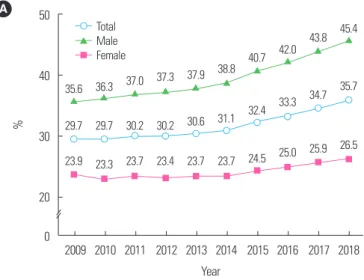
The prevalence of obesity has continuously increased over 10 years between 2009 and 2018 in the total population; for example, it was 29.7% in 2009, 31.1% in 2014, and 35.7% in 2018, respec- tively. The prevalence of obesity has increased prominently in males from 35.6% in 2009 to 45.4% in 2018; meanwhile, it in- creased also in females from 23.9% in 2009 to 26.5% in 2018 (Fig.

1A). From 2009 to 2018, the prevalence of obesity increased across all age groups, especially in the 20s, 30s, and 80s or older. In 2018, the prevalence among all study participants was 28.5% in those in their 20s, 40.5% in those in their 30s, 38.3% in those in their 40s, 38.0% in those in their 50s, 40.1% in those in their 60s, 39.8% in those in their 70s, and 31.6% in those in their 80s or older, respec- tively. Obesity prevalence among males were increased in all age groups, especially in those who were in their 20s and 30s. In 2018, the prevalence of obesity in males was 51% in those in their 30s, which was the highest (Fig. 2A). Meanwhile, the obesity preva-

lence in females was increased in those in their 20s, 30s, and 80s or older. Furthermore, the prevalence was increased particularly among women in their 20s and 80s, whereas it was decreased in those in their 50s and 60s (Fig. 2C).

Prevalence of abdominal obesity from 2009 to 2018

The prevalence of abdominal obesity has increased over the past 10 years, ranging from 19.0% in 2009 and 20.2% in 2014 to 23.8%

in 2018. The increase in the prevalence of abdominal obesity was most prominent in males, with rates of 20.7% in 2009 and 28.1% in 2018, respectively, reported. In females, the prevalence of abdomi- nal obesity increased from 16.2% in 2009 to 18.2% in 2018 (Fig.

1B). From 2009 to 2018, the prevalence of abdominal obesity was increased in all age groups, except among individuals in their 60s.

The highest increase in the prevalence of abdominal obesity during the 10 years was observed among those in their 30s, increasing from 15.8% in 2009 to 24.5% in 2018. In 2018, the prevalence of abdominal obesity were 15.2% in those in their 20s, 24.5% in those in their 30s, 22.3% in those in their 40s, 23.4% in those in their 50s, 29.6% in those in their 60s, 36.1% in those in their 70s, and 35.1%

in those in their 80s or older. In males, the prevalence of abdominal obesity was increased across all age groups, including prominently among those in their 20s and 30s. The prevalence in males in their 20s was 13.1% in 2009 but 21.8% in 2018, while that among males in their 30s was 18.9% in 2009 but 30.8% in 2018, respectively (Fig.

2B). In females, the prevalence of abdominal obesity was increased

Figure 1. Prevalence of obesity (A) and abdominal obesity (B) from 2009 to 2018.

7

A 50

40

30

20

0

%

2009 2010 2011 2012 2013 2014 2015 2016 2017 2018 Year

35.6 36.3 37.0 37.3 37.9 38.8 40.7 42.0 43.8 45.4

29.7 29.7 30.2 30.2 30.6 31.1 32.4 33.3 34.7 35.7

23.9 23.3 23.7 23.4 23.7 23.7 24.5 25.0 25.9 26.5 Total

Male Female

B 30

25

20

15

%

2009 2010 2011 2012 2013 2014 2015 2016 2017 2018 Year

20.7 20.8 21.4 21.4 22.4 22.9 24.7

25.7 26.9

28.1

19.0 18.8 19.2 19.2

20.0 20.2 21.5

22.2 23.0 23.8

16.2 15.8 16.0 15.9 16.4 16.5 17.3 17.7 18.0 18.2 Total

Male

Female

(4)

in their 20s, 30s, and 80s or older, including particularly among those in their 30s and 80s or older, respectively. Separately, the prevalence among females in their 30s was 7.3% in 2009 but 11.9%

in 2018 and that in females in their 80s or older was 33.6% in 2009 but 38.5% in 2018. Conversely, the prevalence of abdominal obesi- ty has decreased in females in their 50s and 60s (Fig. 2D).

Prevalence of obesity and abdominal obesity by social factors

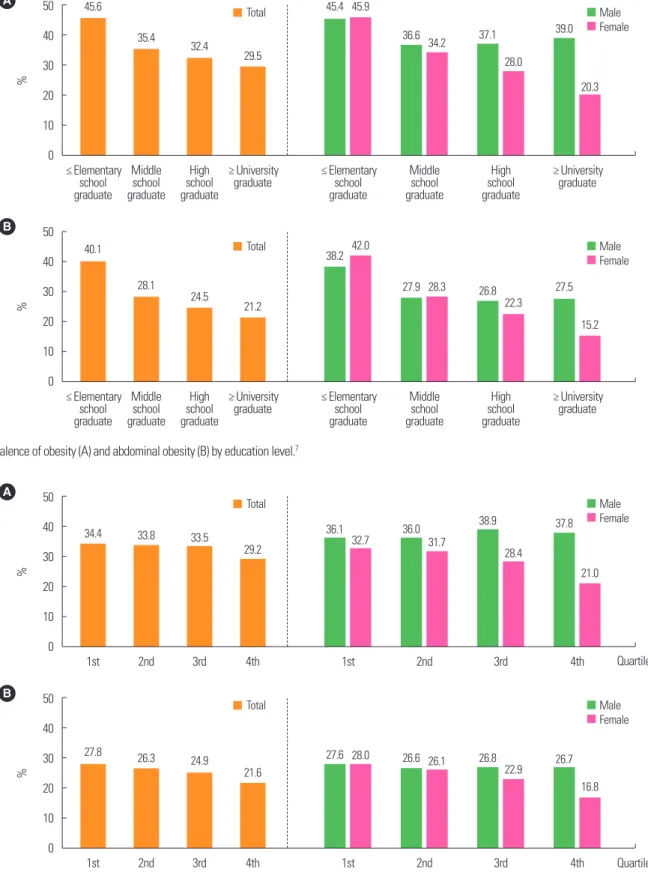
The prevalence of obesity was higher among individuals with lower education levels. This association was shown to be more prominent in females (Fig. 3A). The prevalence of obesity was higher in lower-household-income groups within the total popula- tion, especially among females (Fig. 4A). The prevalence of ab- dominal obesity increased as the education level decreased within the total population. This trend was observed more prominently in

females (Fig. 3B). In lower-household-income groups, the preva- lence of abdominal obesity was higher within the total population, particularly among females (Fig. 4B). As for occupational classifica- tion, the prevalence of obesity was the highest at 42.6% among managers and was the second highest among workers participating in crafts and related trades at 36.2% (Fig. 5A). The prevalence of abdominal obesity was the highest among managers at 28.8% and was the second highest among skilled agricultural, forestry, and fishery workers at 28.1%, respectively (Fig. 5B). The prevalence of obesity was higher as the number of working hours per week in- creased. Specifically, the prevalence of obesity was 31.4% among individuals working less than 40 hours per week and 38.9% among those working 80 hours or more per week. The prevalence of ab- dominal obesity was also increased in individuals with more work- ing hours per week at 24% among individuals working less than 40 hours per week but 29.2% among those working 80 hours or more Figure 2. Age-specific prevalence of obesity and abdominal obesity in males (A, B) and females (C, D) from 2009 to 2018.

7

A 50

40

30

20 55

15

%

2009 2010 2011 2012 2013 2014 2015 2016 2017 2018 Year

Obesity in males

51.0 39.2

49.7

38.9 45.2

41.6 34.9

40.5

29.4

36.3

27.4 27.5

18.5 38.4

20–29 30–39 40–49 50–59

60–69 70–79 ≥ 80 B

35 30 25 20 15 10

%

2009 2010 2011 2012 2013 2014 2015 2016 2017 2018 Year

Abdominal obesity in males

30.8

20.7

29.1

18.9

27.6 30.0 27.7

21.8

13.1

32.5

27.3

30.4

23.2 24.4

20–29 30–39 40–49 50–59 60–69 70–79 ≥ 80

D 40 35 30 25 20 15 10 5 0

%

2009 2010 2011 2012 2013 2014 2015 2016 2017 2018 Year

Abdominal obesity in females

11.0 11.9 14.1

7.3

19.0 32.8 29.2

8.1 4.4

38.4 39.4

33.6 38.5

19.9

20–29 30–39 40–49 50–59 60–69 70–79 ≥ 80

C 50 40 30 20 10 0

%

2009 2010 2011 2012 2013 2014 2015 2016 2017 2018 Year

Obesity in females

23.0 14.0 41.4

8.6 38.7 26.0 32.7

19.2 24.5 30.6 38.7

15.4

42.9

34.4

20–29 30–39 40–49 50–59

60–69 70–79 ≥ 80

(5)

Figure 3. Prevalence of obesity (A) and abdominal obesity (B) by education level.

7

A 50

40 30 20 10 0

%

≤ Elementary school graduate

≤ Elementary school graduate Middle

school graduate

Middle school graduate High

school graduate

High school graduate

≥ University

graduate ≥ University

graduate 45.6

35.4 32.4

29.5

45.4

36.6 37.1 39.0

45.9

34.2

28.0

20.3

Total Male

Female

B 50

40 30 20 10 0

%

≤ Elementary school graduate

≤ Elementary school graduate Middle

school graduate

Middle school graduate High

school graduate

High school graduate

≥ University

graduate ≥ University

graduate 40.1

28.1 24.5

21.2

38.2

27.9 26.8 27.5

42.0

28.3

22.3

15.2

Total Male

Female

Figure 4. Prevalence of obesity (A) and abdominal obesity (B) by household income level.

7

A 50

40 30 20 10 0

%

1st 2nd 3rd 4th 1st 2nd 3rd 4th

34.4 33.8 33.5

29.2

36.1 36.0 38.9 37.8

32.7 31.7

28.4

21.0

Total Male

Female

B 50

40 30 20 10 0

%

1st 2nd 3rd 4th 1st 2nd 3rd 4th

27.8 26.3 24.9

21.6

27.6 28.0 26.6 26.1 26.8 26.7

22.9

16.8

Total Male

Female Quartiles

Quartiles

(6)

per week (Fig. 5C). In comparison with day-shift workers, split- shift workers and night-shift workers had higher prevalence of both obesity and abdominal obesity (Fig. 5D).

DISCUSSION

In this study, we found that the prevalence of obesity and ab- dominal obesity in the South Korean adult population has in-

creased from 2009 to 2018. In 2018, the prevalence of obesity and abdominal obesity was 35.7% and 23.8%, respectively. Increasing trends in the prevalence of obesity were observed in both sexes and all age groups. Meanwhile, the prevalence of abdominal obesity tended to increase in both sexes and all age groups except the 60s.

The prevalence of obesity and abdominal obesity was higher in correlation with lower levels of education and household income.

Managers, when considering occupational classification, showed Figure 5. Prevalence of obesity and abdominal obesity by occupational condition. Prevalence of obesity (A) and abdominal obesity (B) by occupational classification. Preva- lence of obesity and abdominal obesity by the number of working hours per week (C) and by working type (D).

7

Obesity A 50

40 30 20 10 0

%

Manager 42.6

Craft and related trade

worker 36.2

Skilled agricultural and fishery worker

35.8

Sales worker 35.3

Plant and machine operator and

assembler 34.1

Elementary worker

32.9

Economically inactive population

32.1

Service worker

31.5

Professional and worker in

related area 30.5

Administrative officer

29.1

Abdominal obsity B 50

40 30 20 10 0

%

Manager 28.8

Craft and related trade

worker 28.1

Skilled agricultural and fishery worker

26.0

Sales worker 25.6

Plant and machine operator and

assembler 25.6

Elementary worker

25.4

Economically inactive population

24.9

Service worker

24.9

Professional and worker in

related area 24.7

Administrative officer

23.5

C 50

40 30 20 10 0

%

< 40 40–60 60–80 ≥ 80

31.4 31.6 36.2 38.9

24.0 22.6

27.8 29.2

Weekly working hour Obesity

Abdominal obsity

D 50

40 30 20 10 0

%

Day shift 32.2

23.8

Evening shift 29.6

23.5

Night shift 37.5

31.2

Day and night regular shift

28.9 20.6

24-hour shift 26.2

19.2

Spilt shift 39.6

30.6 Obesity

Abdominal obsity

(7)

the highest prevalence of both obesity and abdominal obesity, while those working more hours per week presented similar in- creases. In addition, split-shift workers and night-shift workers had higher prevalence of obesity and abdominal obesity relative to day- shift workers. Based on these findings, the 2019 obesity fact sheet offers information on obesity dynamics over a recent decade and social factors related to obesity in the Korean adult population and might constitute a cornerstone by which to establish targets for fu- ture interventions to reverse the rise in the prevalence of obesity and reduce the burden from obesity in Korea.

The global prevalence of obesity has increased to pandemic pro- portions. It is expected that two billion individuals will be over- weight and one billion individuals will be obese by 2030.

11

Al- though the obesity rate in Korean adults is lower when with the Organisation for Economic Co-operation and Development stan- dard,

12

based on our findings, it has steadily increased in recent years. Changes in the global food system combined with the con- duct of sedentary behaviors are widely accepted as the main causes of the rise in obesity prevalence worldwide.

13,14

According to these trends, the main driver of the obesity epidemic in Korea seems to be the Westernization of lifestyles in the country.

15,16

Over the past several decades, the obesity prevalence in Korea has increased si- multaneously alongside reduced home-cooking, a greater prefer- ence for convenient but relatively unhealthy foods and snacks, and less physical activity and more leisure time entertainment. This rapid Westernization of lifestyles might have led to a more rapid in- crease in the obesity rate because there has not been enough time to adapt. Actually, the rise in obesity prevalence appears to be ac- celerated worldwide in middle-income countries.

4

The fundamental cause of obesity is an imbalance between en- ergy intake and expenditure. Complex causal factors including per- sonal and environmental elements and their interrelationships play a role in the development of obesity.

17

Behavioral changes in per- sonal levels focusing on increases in healthy eating and physical ac- tivity should be promoted by policies implemented in society.

14

Meanwhile, the heterogeneity in obesity rates between countries might imply that social and other factors and their disparities are associated with obesity status.

18

The increases in obesity prevalence began initially in high-income countries, followed by in middle-in- come and then low-income countries. The increasing rate of obesi-

ty has been accompanied by an improved economy, particularly in several developing countries; the obesity prevalence increases first- ly among individuals with a higher socioeconomic status and then shifts to a lower socioeconomic status in accordance with the im- proving economy.

15,19

Socioeconomic factors have been reported to impact the incidence of cardiovascular disease and the degrees of their effect on health status vary between males and females.

20,21

Numerous studies have examined the association between socio- economic status and the cardiovascular disease-related health status and they showed income and education levels are associated with obesity and abdominal obesity.

21,22

Our findings support that indi- viduals with lower income and education levels have higher rates of obesity and abdominal obesity, including especially in females. Sim- ilar to our findings, a study using data from the NHIS database iden- tified a sex difference in the prevalence and odds ratio of obesity and abdominal obesity in workers: those with a lower income or rural residence were correlated with obesity and abdominal obesity among female workers.

22

This study explained that this difference can be attributed to variations in health behaviors between males and fe- males. In addition, the disparity in obesity prevalence according to socioeconomic status observed in our study appeared to be more prominent when compared with findings from a previous study.

23

Studies on obesity among worker groups have been insufficient.

Obese workers may tend to be less productive and to be more like-

ly to suffer from injuries.

24,25

In our analysis based on the occupa-

tion classification, managers presented the highest prevalence of

obesity and abdominal obesity. A study using the KNHANES data

from 1998 to 2015 reported that the prevalence of obesity in-

creased steadily among male manual workers but decreased among

female sales/services workers.

26

Although the study design and oc-

cupation classification were different than in our study, this re-

search also reported a higher proportion of obesity was found in

nonmanual workers, especially males. Although the caloric intake

was not carefully considered in our analysis, less physical work and

energy expenditure might have led to the higher rates of obesity

and abdominal obesity in this group. In addition, we found that

longer working hours, split-shift work, and shift work at night were

associated with higher prevalence of obesity and abdominal obesi-

ty. Working long hours may be associated with reduced efforts

made to ensure a good diet and adequate exercise for weight con-

(8)

trol and may exacerbate chronic stress and poor sleeping habits.

27,28

Considerable reports have found that people engaged in shift work appear to gain more weight than those who follow a more typical work schedule. Shift work is associated with increased risks of obe- sity, diabetes mellitus, and cardiovascular disease as a result of met- abolic disturbances from physiological maladaptation to sleeping and eating at chronically abnormal circadian times.

29

Our study has several limitations. We only assessed the prevalence of obesity and abdominal obesity; thus, our data cannot provide con- crete information on any factor in the obesity epidemic in Korea.

However, this study included the overall adult population of Korea and provides valuable data on national health statistics on obesity and abdominal obesity after standardizing for age and sex. Moreover, we considered various social factors with regard to obesity prevalence.

In conclusion, from the findings of the 2019 Obesity Fact Sheet, the prevalence of obesity and abdominal obesity increased from 2009 to 2018. Individuals with a lower socioeconomic status, occu- pations similar to being a manager, longer working hours, and split- shift work had higher prevalence of obesity and abdominal obesity.

A better understanding of the obesity epidemic and the remarkable differences in social factors in relation to obesity in Korea based on our findings will be helpful for identifying obesity trends and social causes of obesity and to provide potential intervention strategies.

CONFLICTS OF INTEREST

The authors declare no conflict of interest.

ACKNOWLEDGMENTS

This work was partially supported by the Korean Society for the Study of Obesity. This study was supported by a grant from the Korean Health Technology and R&D project, Ministry of Health

& Welfare, Republic of Korea (HC16C2285).

We cordially thank the National Health Insurance Service and the Korean Society for the Study of Obesity for their sincere support.

AUTHOR CONTRIBUTIONS

Study concept and design: GEN, YHK, KH, JHJ, and WYL; ac-

quisition of data: GEN, YHK, KH, JHJ, and WYL; analysis and in- terpretation of data: all authors; drafting of the manuscript: GEN, YHK, and WYL; critical revision of the manuscript: all authors;

statistical analysis: KH and JHJ; and study supervision: YHK and WYL.

REFERENCES

1. NCD Risk Factor Collaboration (NCD-RisC). Worldwide trends in body-mass index, underweight, overweight, and obe- sity from 1975 to 2016: a pooled analysis of 2416 population- based measurement studies in 128·9 million children, adoles- cents, and adults. Lancet 2017;390:2627-42.

2. Ng M, Fleming T, Robinson M, Thomson B, Graetz N, Mar- gono C, et al. Global, regional, and national prevalence of overweight and obesity in children and adults during 1980- 2013: a systematic analysis for the Global Burden of Disease Study 2013. Lancet 2014;384:766-81.

3. World Health Organization. Obesity and overweight [Internet].

Geneva: World Health Organization; 2020 [cited 2020 Jun 24].

Available from: http://www.who.int/news-room/fact-sheets/

detail/obesity-and-overweight

4. Blüher M. Obesity: global epidemiology and pathogenesis. Nat Rev Endocrinol 2019;15:288-98.

5. Sahakyan KR, Somers VK, Rodriguez-Escudero JP, Hodge DO, Carter RE, Sochor O, et al. Normal-weight central obesity:

implications for total and cardiovascular mortality. Ann Intern Med 2015;163:827-35.

6. Nam GE, Kim YH, Han K, Jung JH, Park YG, Lee KW, et al.

Obesity fact sheet in Korea, 2018: data focusing on waist cir- cumference and obesity-related comorbidities. J Obes Metab Syndr 2019;28:236-45.

7. Korean Society for the Study of Obesity. Obesity fact sheet [Internet]. Seoul: Korean Society for the Study of Obesity [cited 2020 Jun 24]. Available from: http://www.kosso.or.kr/

popup/obesity_fact_sheet.html

8. Song SO, Jung CH, Song YD, Park CY, Kwon HS, Cha BS, et

al. Background and data configuration process of a nationwide

population-based study using the Korean National Health In-

surance System. Diabetes Metab J 2014;38:395-403.

(9)

9. Kim YH, Han K, Son JW, Lee SS, Oh SW, Kwon HS, et al.

Data analytic process of a nationwide population-based study on obesity using the national health information database pre- sented by the National Health Insurance Service 2006-2015. J Obes Metab Syndr 2017;26:23-7.

10. Seo MH, Lee WY, Kim SS, Kang JH, Kang JH, Kim KK, et al.

2018 Korean Society for the Study of Obesity guideline for the management of obesity in Korea. J Obes Metab Syndr 2019;

28:40-5.

11. Lee M. Research trends in obesity & obesogenic environments in Korea. Nutr Res Pract 2019;13:461-72.

12. Organisation for Economic Co-operation and Development.

OECD obesity update 2017 [Internet]. Paris: OECD; 2017 [cited 2020 Jun 24]. Available from: http://www.oecd.org/

health/obesity-update.htm

13. Wardle J, Boniface D. Changes in the distributions of body mass index and waist circumference in English adults, 1993/

1994 to 2002/2003. Int J Obes (Lond) 2008;32:527-32.

14. Silventoinen K, Jelenkovic A, Sund R, Hur YM, Yokoyama Y, Honda C, et al. Genetic and environmental effects on body mass index from infancy to the onset of adulthood: an indi- vidual-based pooled analysis of 45 twin cohorts participating in the COllaborative project of Development of Anthropo- metrical measures in Twins (CODATwins) study. Am J Clin Nutr 2016;104:371-9.

15. GBD 2015 Obesity Collaborators, Afshin A, Forouzanfar MH, Reitsma MB, Sur P, Estep K, et al. Health effects of overweight and obesity in 195 countries over 25 years. N Engl J Med 2017;

377:13-27.

16. Swift DL, McGee JE, Earnest CP, Carlisle E, Nygard M, Jo- hannsen NM. The effects of exercise and physical activity on weight loss and maintenance. Prog Cardiovasc Dis 2018;61:

206-13.

17. Teixeira PJ, Carraça EV, Marques MM, Rutter H, Oppert JM, De Bourdeaudhuij I, et al. Successful behavior change in obe- sity interventions in adults: a systematic review of self-regula- tion mediators. BMC Med 2015;13:84.

18. Thornton LE, Cameron AJ, McNaughton SA, Worsley A, Crawford DA. The availability of snack food displays that may trigger impulse purchases in Melbourne supermarkets. BMC

Public Health 2012;12:194.

19. Block JP, Scribner RA, DeSalvo KB. Fast food, race/ethnicity, and income: a geographic analysis. Am J Prev Med 2004;27:

211-7.

20. Ali MK, Bhaskarapillai B, Shivashankar R, Mohan D, Fatmi ZA, Pradeepa R, et al. Socioeconomic status and cardiovascular risk in urban South Asia: The CARRS Study. Eur J Prev Car- diol 2016;23:408-19.

21. Gamlath L, Nandasena S, Hennadige Padmal de Silva S, Lin- hart C, Ngo A, Morrell S, et al. Differentials in cardiovascular risk factors and diabetes by socioeconomic status and sex in Kalutara, Sri Lanka. Asia Pac J Public Health 2017;29:401-10.

22. Ryu H, Moon J, Jung J. Sex differences in cardiovascular dis- ease risk by socioeconomic status (SES) of workers using na- tional health information database. Int J Environ Res Public Health 2020;17:2047.

23. Koo BK, Kim SW, Yi KH, Moon MK. Low economic status is identified as an emerging risk factor for diabetes mellitus in Korean men aged 30 to 59 years in Korean National Health and Nutrition Examination Survey 2008 to 2010. Diabetes Metab J 2015;39:137-46.

24. Tremmel M, Gerdtham UG, Nilsson PM, Saha S. Economic burden of obesity: a systematic literature review. Int J Environ Res Public Health 2017;14:435.

25. Trogdon JG, Finkelstein EA, Hylands T, Dellea PS, Kamal-Bahl SJ. Indirect costs of obesity: a review of the current literature.

Obes Rev 2008;9:489-500.

26. Lee JY, Lee YR, Kim HR, Myong JP, Kang MY. Trends in obe- sity prevalence by occupation based on Korean National Health and Nutrition Examination Survey from 1998 to 2015. Saf Health Work 2020;11:97-102.

27. Maruyama S, Morimoto K. Effects of long workhours on life- style, stress and quality of life among intermediate Japanese managers. Scand J Work Environ Health 1996;22:353-9.

28. Kim BM, Lee BE, Park HS, Kim YJ, Suh YJ, Kim JY, et al. Long working hours and overweight and obesity in working adults.

Ann Occup Environ Med 2016;28:36.

29. Antunes LC, Levandovski R, Dantas G, Caumo W, Hidalgo

MP. Obesity and shift work: chronobiological aspects. Nutr

Res Rev 2010;23:155-68.

수치

Figure 1. Prevalence of obesity (A) and abdominal obesity (B) from 2009 to 2018. 7A504030200%   2009 2010 2011 2012 2013 2014 2015 2016 2017 2018Year35.6 36.337.0 37.3 37.938.840.742.043.845.429.7 29.7 30.2 30.2 30.631.132.433.3 34.735.723.9 23.3 23.7 23.4
Figure 3. Prevalence of obesity (A) and abdominal obesity (B) by education level. 7A50403020100%≤ Elementary school graduate ≤ Elementary school graduateMiddle school graduate Middle school  graduateHigh school graduate High  school  graduate≥ University g

참조

관련 문서

The “Asset Allocation” portfolio assumes the following weights: 25% in the S&amp;P 500, 10% in the Russell 2000, 15% in the MSCI EAFE, 5% in the MSCI EME, 25% in the

1 John Owen, Justification by Faith Alone, in The Works of John Owen, ed. John Bolt, trans. Scott Clark, &#34;Do This and Live: Christ's Active Obedience as the

Therefore, this study aims to identify the relations between gastroesophageal reflux disease and body mass index, and waist measurement as indexes of obesity.. For the

Therefore, this study aims to analyze the effects of Soru massage therapy on the following variables: fatigue, stress, and obesity-related indexes including weight, waist girth

Comparison of the prevalence of Malnutrition and Overweight, Obesity between South Korean families and North Korean refugees families 15 Table 5.. Comparison of the

As for the relationship of obesity level to clothing shopping orientation, the underweight boys made up the largest brand-oriented group, and the

The purpose of this study is to research prevalence of nonnutritive sucking for Korean preschool children, evaluate the relation of contributing factors

There was no significant difference between the groups in problems of eating habits, but the obesity group considered overeating as a problem while the normal