229
Milnacipran의 섬유근통 증후군치료에 대한 연구 검토
이경은 보스턴메디컬센터
(2010년 10월 8일 접수·2010년 10월 29일 수정·2010년 11월 4일 승인)
Milnacipran for Treatment of Fibromyalgia: A Review of Clinial Trials
Kyung Eun Lee
Boston Medical Center, One Boston Medial Center Place, Boston, MA 02118, USA (Received October 8, 2010·Revised October 29, 2010·Accepted November 4, 2010)
섬유근통 증후군은 만성 전신 통증을 나타내며 피곤, 두통, 우울증, 수면장애등을 동반하는 질환이다. 주로 30-50대의 여 성에게서 많이 나타나며 미국에서 2-4%, 한국에서 2%의 발병률을 보이고 있다. 정확한 원인과 기전이 밝혀져 있지않아 서 진단과 치료에 많은 논란과 어려움이 있다. 현재는 증상치료에 목표를 두고 삼환계항우울약을 많이 사용하고 있으나 심각한 부작용의 문제가 있다. 이러한 문제때문에 최근에는 selective serotonin reuptake inhibitor (SSRI) 또는 serotonin- norepinephrine reuptake inhibitor (SNRI)를 빈번히 사용하고 있다. 본 연구는 SNRI의 하나인 milnacipran의섬유근통 증 후군 치료에 대한 효능 및 안정성을 알아보기 위해, MEDLINE에 등재된 논문을 기한없이 milnacipran과 fibromyalgia로 검색하여 무작위 배정 및 이중맹검 임상연구자료들을 선별하였다. 선별된 6개의 임상연구 결과, milnacipran를 사용했을때 일관된 효능성과 안정성이 관찰되었고 섬유근통증후군 치료와 그에 수반되는 여러증상에 효과적인것으로 나타났다.
□ Key words - Milnacipran, Fibromyalgia, Serotonin-norepinephine reuptake inhibitor
Fibromyalgia (FM), also called fibromyalgia syndrome (FMS) is a chronic systemic disorder characterized by widespread pain in joint and muscle leading to variety of other symptoms including profound fatigue, multiple ten- der points, stiffness, cognitive dysfunction, sleep distur- bances and decreased physical function. The presence of fibromyalgia is more common in women then in man and affects 2.2% of Korean population.1-4) Fibromyalgia is often misdiagnosed because of the difficulty of under- standing the disease and nonspecific symptoms. It is unknown why fibromyalgia develops or what causes its symptoms. However, there is a hypothesis that individu-
als who develop fibromyalgia may have a associated genetic, biochemical and environmental conditions.5) American College of Rheumatology (ACR) established classification criteria of fibromyalgia in 1990 for the pur- pose of standardizing clinical trial populations. These cri- teria require that an individual to have chronic widespread pain in all four quadrants of the body for at least 3 months and also to present 11 of 18 standardized tender points on palpable examination.6) The pathophysi- ology of fibromyalgia is not well understood but increas- ing evidence suggests abnormalities of pain processing in central nervous system resulting in central pain sensitiza- tion.7-8) Treatment can be difficult because of unknown etiology of fibromyalgia, For such reason nonpharmaco- logic or complementary therapies such as exercise, mas- sage, chiropractic, acupuncture, biofeedback therapy or cognitive behavior therapy are broadly used. Tricyclic
Correspondence to : Kyung Eun Lee
Boston Medical Center, One Boston Medial Center Place, Boston, MA 02118, USA Tel: +1-617-875-0652, Fax: +1-617-638-7685 E-mail: [email protected]
antidepressants (TCA) and selective serotonin reuptake inhibitors (SSRI) have been used for fibromyalgia as off labeled indication.9-10) Pregabalin is the first drug to be approved by US Food and Drug Administration (FDA) for the management of fibromyalgia in June 2007.
Duloxetine is a serotonin and norepinephrine reuptake inhibitor (SNRI) that was approved in June 2008 for the same manner. Milnacipran, another SNRI, became the third FDA approved drug for the management of fibro- myalgia in January 2009.11-12) SNRIs have shown anal- gesic effects in animal model which suggest that these neurotransmitters are of importance in pain modula- tion.13-14)
Milnacipran is marketed for the treatment of major depressive disorder in over 45 countries worldwide.
Milnacipran has the unique property over other dual reuptake inhibitors by its three times greater potency for norepinephrine over serotonin in vitro. It is similar to TCAs in its ability to inhibit both norepinephrine and serotonin but does not interact with muscarinic, dopam- inergic, histaminergic, or α- or β-adrenergic receptors, therefore have favorable tolerability profile. Pharmaco- kinetically, milnacipran shows 85-90% bioavailability following oral administration which is not affected by food. Its high bioavailability is influenced by a large volume of distribution (400 L) and a weak protein bind- ing (13%). Milnacipran is not metabolized by cyto- chrome P450 contributing to less possible drug-drug interactions. These kinetic properties may be beneficial in fibromyalgia patients who also have other disease conditions or have developed polypharmacy. The termi- nal elimination half-life of milnacipran is 6-8 hours and 55% is excreted unchanged into the urine. Patients with moderate renal impairment (estimated creatine clear- ance 30-49 mL/min) need close monitoring and patients with severe renal impairment (estimated creatine clear- ance 5-29 mL/min) require dose adjustment. Safety and efficacy of milnacipraninfibromylagia patients under 17 years of age have not been established therefore, mil- nacipran is not recommended in pediatric patients.15-18)
DATA SOURCES
A comprehensive MEDLINE search was performed with no restriction on year for clinical trials published in English using the MeSH terms fibromyalgia and mil- nacipran. Clinical trials evaluating the efficacy and safety of milnacipran were selected and reviewed.
CLINICAL TRIALS
Evaluation of the efficacy and safety of milnacipran in the treatment of fibromyalgia has been reported in 6 randomized, double-blind trials ranging from 3 months to 1 year up to date.19-24) Participants in the studies were primarily white women between 40 and 50 years of age with 4 to 11 years of history of fibromyalgia.
Inclusion and exclusion criteria were similar among the studies. Age of the patients ranged between 18 and 70 years old, except the extension trial by Goldenberg et al.,22) which included 71 years old patients. American College of Rheumatology (ACR) diagnostic criteria for fibromylagia was used to include patients defined by history of widespread pain for at least three months and pain in 11 of 18 tender point sites on digital palpation. Key exclusion criteria were severe psychiatric illness, current major depressive episode, significant risk of suicide, alcohol or other drug abuse, a history of significant cardiovascular, respiratory, endocrine, genitourinary, liver, or kidney dis- ease, autoimmune disease, systemic infection, cancer or cur- rent chemotherapy, significant sleep apnea, active peptic ulcer or inflammatory bowel disease. All centrally act- ing therapies including antidepressants, sedative-hyp- notics, muscle relaxants, benzodiazepines, centrally acting analgesics were stopped during the washout period between 1-4 weeks. However acetaminophen, aspirin, and stable doses of nonsteroidalantiinflamma- tory agents (NSAID) were allowed. Primary outcome measures were identical in three studies by Clauw et al.,20)Mease et al.,21) and Arnold et al.23) with the same definition of response rate. Those studies had 2 com-
posite outcomes: 1) a 2-measure composite includes a visual analog scale (VAS) and a Patient Global Impres- sion of Change (PGIC) score. 2) A 3-measure compos- ite had the Medical Outcome Study Short-Form 36 (SF- 36) Physical Component Summary (PCS) in addition to the 2-measure composite. Response rates accounted for
≥30% pain improvement from baseline on the VAS pain score, a rating of “very much improved” (score=1) or
“much improved” (score=2) on the PGIC, and a ≥6-point improvement from baseline in physical function as mea- sured by the SF-36 PCS. Other three studies19,22,24) did not use composite outcome measures but used measures to evaluate the same domain.
3 months trial of Gendreau et al. study revealed different analgesic effect in milnacipran 100 mg BID and 200 mg QD.19) 2-week average daily pain scores (0-20) were col- lected for the reduction of pain as a primary outcome. In total of 13 pain measure collected, BID milnacipran reached statistical significance for 9 measures compared to none of the measures reached statistical significance for QD mil- nacipran. Secondary outcome measures assessed were Patient Global Improvement Change (PGIC), Fibromyalgia Impact Questionnaire (FIQ), Medical Outcomes Study Short Form-36 (SF-36), Jenkins sleep scale, and Arizona Sexual Experiences Scale (ASEX). Both BID and QD dosing showed superiority to placebo on PGIC (73% BID, 77%
QD, 38% placebo; p= 0.013 for BID vs placebo, p= 0.008 for QD vs placebo). Total FIQ scores, SF-36 scores and ASEX scores were focused on BID milnacipran but did not reach statistical significance in all 3 measures.19)
Clauw et al. performed a large 15 week trial to evalu- ate the efficacy and tolerability of milnacipran 100 mg (50 mg BID), 200 mg (100 mg BID) versus placebo.20) Fibromyalgia (FM) composite responder rate (3-mea- sure composite) and FM pain composite responder rate (2-measure composite) were the primary outcome eval- uated at week 15. Outcomes on secondary measures include time weighted averages calculated for the indi- vidual components of the composite responder analysis.
Baseline-observation-carried-forward (BOCF) analyses were used to handle missing data for the primary end points. Last-observation-carried- forward (LOCF) and
observed-cases (OC) analyses were also conducted for sensitivity of the study. Composite responder rates for both fibromyalgia (BOCF analysis: p= 0.01 for 100 mg/
d, p = 0.02 for 200 mg/d) and fibromyalgia pain (BOCF analysis: p = 0.03 for 100 mg/d, 0.004 for 200 mg/d) revealed statistical significance. The time-weighted averages of the weekly palm-based e-diary pain scores and PGIC scores indicated significant differences between both milnacipran doses and placebo (p < 0.001 for both scores). Both doses of milnacipran appeared significant improvements in multiple secondary out- comes including physical functioning, global improve- ment, and fatigue.20)
Long term study by Mease et al. used same primary out- comes from the previous clinical trial comparing milnacip- ran 100 mg/d, 200 mg/d with placebo for 6 months.21) At 15 weeks, FM composite responder rates were significantly high in both dosing group compared to placebo (p = 0.017 for 200 mg/d, p = 0.028 for 100 mg/d). FM pain composite responder rates were statistically significant in milnacipran 200 mg/d (p = 0.032), however did not reach statistical sig- nificance in milnacipran 100 mg/d as compared to placebo (p = 0.056). At 27 weeks, only 200 mg/d group achieved statistical significance compared to placebo in fibromyalgia pain.21)
Goldenberg et al. study22) is an extension trial from Mease et al. study.21) 87.7% of patients from the lead- study were enrolled in this 6-month extension study.
Patients originally receiving 200 mg/d were continued while patients originally on placebo or 100 mg/d were re- randomized to either 100 mg/d or 200 mg/d. Primary parameters were consistent with the lead-in study includ- ing VAS 24-hour or 7-day pain recall, PGIC and FIQ total score and Physical Function subscale score. Pain improvement maintained in additional 6 months for patients on milnacipran 200 mg/d. For patients switched from placebo or 100 mg/d from lead-in study to 200 mg/d also represented additional improvements in pain compared to placebo group in the lead-in study (22.8% and 7.1%
improvement in pain, respectively). Further improvement in FIQ total score was achieved for both patient groups switched from placebo or 100 mg/d to 200 mg/d. In
terms of PGIC scores, patients on milnacipran 100 mg/d and 200 mg/d showed improvement over placebo. The limitation of this study is that no p values were provided for results and it cannot be directly compared with other clinical trials owing to the methods used to evaluate and present the data.22)
Arnold et al. evaluated efficacy and safety of mil- nacipran 100 mg/d in patients with fibromyalgia.23) Patient had longer flexible dose escalation period of 4-6 weeks compared to 2-week period from Mease et al.
and Clauw et al. studies. Patients intolerant of 100 mg/d of milnacipran were excluded from the study. For pri- mary outcome the 2-measure composite and 3-measure composite responder definitions were used. Patient on milnacipran 100 mg/d showed significant improvement versus placebo assessed using 2- and 3-measure com- posite responder rates (p < 0.001). The mean pain scores of the patient on milnacipran reached significant reduction compared with the placebo in dose-escalation phase and this improvement maintained throughout the treatment period (p < 0.001). The proportion of patients with PGIC scores ≤ 2 and SF-36 PCS scores with ≥ 6- point improvement from baseline were statistically sig- nificantly improved (p < 0.001). Additional secondary outcome measures including SF-36 MCS and FIQ total scores were observed to show significant improvements over placebo group (p < 0.001). Fatigue was measured with Multidimensional Fatigue Inventory (MFI) total score and energy/vitality domain of SF-36 which also showed significant improvement in patients treated with milnacipran. These results are positive findings in con- trast to the mixed results of previous trials suggesting the benefit of milnacipran beyond pain relief including improvements in function and quality of life. The limi- tation existed in this trial is that only the graphical data of results are shown without the actual points values.23)
Another clinical trial was conducted by Branco et al. in 13 European countries for milnacipran 200 mg/d in treatment of fibromyalgia for 17 weeks.24) A stepwise primary effi- cacy criterion was used to assess its efficacy. Patients with positive results in 2-measure composite response (VAS and PGIC) were added with FIQ score as a third measure. At
week 16, 2-measure composite response rate in full analysis set (FAS) was observed achieving significantly greater improvement with milnacipran 200 mg/d compared to pla- cebo (OR 1.90, 95% CI 1.34 to 2.68, p = 0.0003). FIQ scores were also found to be statistically significantly improved compared to placebo (p = 0.009). Other efficacy endpoints including SF-36 scores, MFI scores, Multiple Ability Self-Report Questionnaire (MASQ) total scores have shown significant improvements. The results from this study are coherent with the findings from previous US stud- ies showing the efficacy and safety of milnacipran 200 mg/d in treating fibromyalgia pain and overall function.24)
Throughout the clinical trials, most commonly observed adverse event was nausea accounting for the main reason for study discontinuation.19-24) Nausea have shown to occur more frequently in patients with milnacipran 200 mg/d but resolved after 1-2 weeks of continued therapy.21) Cardiovas- cular adverse events caused by milnacipran are mild to moderate increases in pulse rates and slight increase in blood pressure.20-24) Therefore baseline assessment of blood pressure and heart rate before starting milnacipran and throughout the treatment should be performed. Other adverse reactions include constipation, dizziness, hot flash, sweating, vomiting, and headaches.19-24)
CONCLUSION
Based on 6 clinical trials, milnacipran has been dem- onstrated to have efficacy in the treatment of fibromyal- gia pain and improved various functional measures of patients with fibromyalgia in rather mixed results. Mil- nacipran was generally well tolerated and the safety profile data has shown consistency with the most com- mon adverse event being nausea. Unfortunately, clinical trials have limitations of limited patient population without comorbid disorders and some study results can- not be directly compared with other studies. Therefore further studies with variable dosages and larger number of general patient populations are needed to support the use of milnacipran in clinical practice. Drug selection for fibromyalgia needs to be individualized for patients on drug characteristics, patient preference, previous
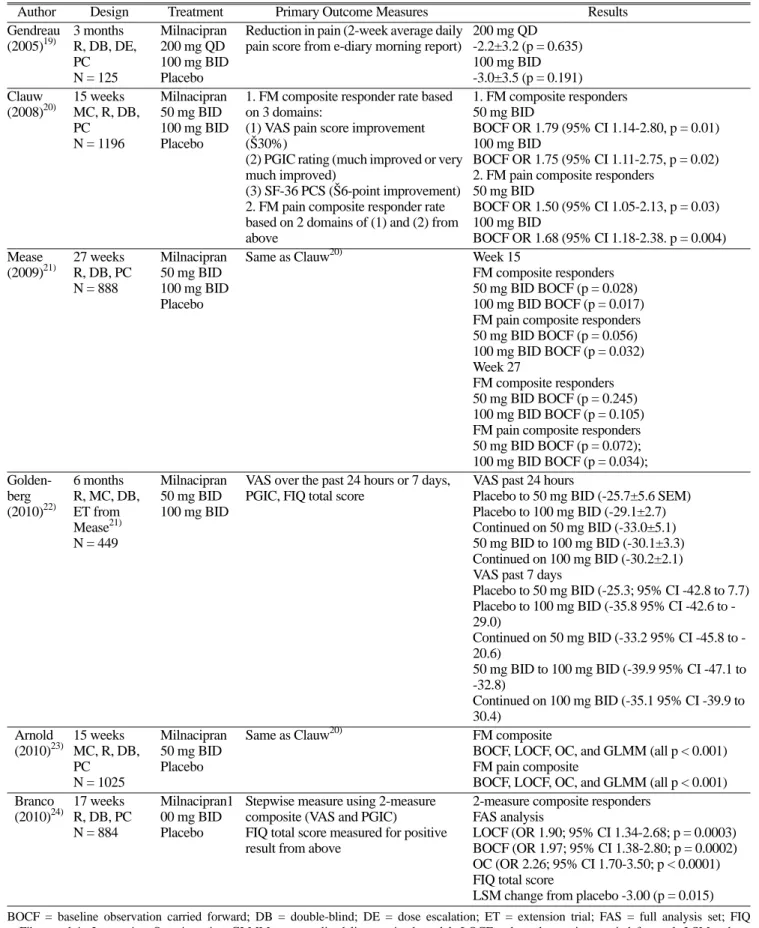
Table 1. Summary of Clinical Trials
Author Design Treatment Primary Outcome Measures Results
Gendreau (2005)19)
3 months R, DB, DE, PC N = 125
Milnacipran 200 mg QD 100 mg BID Placebo
Reduction in pain (2-week average daily pain score from e-diary morning report)
200 mg QD -2.2±3.2 (p = 0.635) 100 mg BID -3.0±3.5 (p = 0.191) Clauw
(2008)20)
15 weeks MC, R, DB, PC
N = 1196
Milnacipran 50 mg BID 100 mg BID Placebo
1. FM composite responder rate based on 3 domains:
(1) VAS pain score improvement (Š30%)
(2) PGIC rating (much improved or very much improved)
(3) SF-36 PCS (Š6-point improvement) 2. FM pain composite responder rate based on 2 domains of (1) and (2) from above
1. FM composite responders 50 mg BID
BOCF OR 1.79 (95% CI 1.14-2.80, p = 0.01) 100 mg BID
BOCF OR 1.75 (95% CI 1.11-2.75, p = 0.02) 2. FM pain composite responders
50 mg BID
BOCF OR 1.50 (95% CI 1.05-2.13, p = 0.03) 100 mg BID
BOCF OR 1.68 (95% CI 1.18-2.38. p = 0.004) Mease
(2009)21)
27 weeks R, DB, PC N = 888
Milnacipran 50 mg BID 100 mg BID Placebo
Same as Clauw20) Week 15
FM composite responders 50 mg BID BOCF (p = 0.028) 100 mg BID BOCF (p = 0.017) FM pain composite responders 50 mg BID BOCF (p = 0.056) 100 mg BID BOCF (p = 0.032) Week 27
FM composite responders 50 mg BID BOCF (p = 0.245) 100 mg BID BOCF (p = 0.105) FM pain composite responders 50 mg BID BOCF (p = 0.072);
100 mg BID BOCF (p = 0.034);
Golden- berg (2010)22)
6 months R, MC, DB, ET from Mease21) N = 449
Milnacipran 50 mg BID 100 mg BID
VAS over the past 24 hours or 7 days, PGIC, FIQ total score
VAS past 24 hours
Placebo to 50 mg BID (-25.7±5.6 SEM) Placebo to 100 mg BID (-29.1±2.7) Continued on 50 mg BID (-33.0±5.1) 50 mg BID to 100 mg BID (-30.1±3.3) Continued on 100 mg BID (-30.2±2.1) VAS past 7 days
Placebo to 50 mg BID (-25.3; 95% CI -42.8 to 7.7) Placebo to 100 mg BID (-35.8 95% CI -42.6 to - 29.0)
Continued on 50 mg BID (-33.2 95% CI -45.8 to - 20.6)
50 mg BID to 100 mg BID (-39.9 95% CI -47.1 to -32.8)
Continued on 100 mg BID (-35.1 95% CI -39.9 to 30.4)
Arnold (2010)23)
15 weeks MC, R, DB, PC
N = 1025
Milnacipran 50 mg BID Placebo
Same as Clauw20) FM composite
BOCF, LOCF, OC, and GLMM (all p < 0.001) FM pain composite
BOCF, LOCF, OC, and GLMM (all p < 0.001) Branco
(2010)24)
17 weeks R, DB, PC N = 884
Milnacipran1 00 mg BID Placebo
Stepwise measure using 2-measure composite (VAS and PGIC)
FIQ total score measured for positive result from above
2-measure composite responders FAS analysis
LOCF (OR 1.90; 95% CI 1.34-2.68; p = 0.0003) BOCF (OR 1.97; 95% CI 1.38-2.80; p = 0.0002) OC (OR 2.26; 95% CI 1.70-3.50; p < 0.0001) FIQ total score
LSM change from placebo -3.00 (p = 0.015) BOCF = baseline observation carried forward; DB = double-blind; DE = dose escalation; ET = extension trial; FAS = full analysis set; FIQ
= Fibromyalgia Impression Questionnaire; GLMM = generalized linear mixed model; LOCF = last observation carried forward; LSM = least squre mean; MC = multicenter; OC = observed cases; OR = odd ratio; PC = placebo-controlled; PGIC = Patient Global Impression of Change;
SF-36 PCS = Short Form 36 Physical Component Summary; R = randomized; VAS = visual analog scale;
treatments, comorbidities, and cost.
REFERENCES
1. American College of Rheumatology. Patient education for fibromyalgia. www.rheumatology.org/public/factsheets/
diseases_and_conditions/fibromyalgia.asp?aud=pat (accessed July 25, 2010).
2. Wolfe F, Ross K, Anderson J, et al., The prevalence and characteristics of fibromyalgia in the general population.
Arthritis Rheum 1995; 38: 19-28.
3. Kim SH, Bae GR, Lim HS. Prevalence and risk factors of fibromyalgia syndrome and chronic widespread pain in two communities in Korea - First report in Korean. J Korean Rheumatism Assoc 2006; 13: 18-25.
4. Wolfe F, Ross K, Anderson J, et al., Aspects of fibromyalgia in the general population: sex, pain threshold, and fibromyalgia symptoms. J Rheumatol 1995; 22: 151-6.
5. Navarro RP. Contemporary management strategies for fibromyalgia. Am J Manag Care 2009; 15: S197-218.
6. WolfeF, Smythe H, Yunus M, et al., The American College of Rheumatology 1990 criteria for the classification of fibromyalgia. Report of the Multicenter Criteria Committee.
Arthritis Rheum 1990; 33: 160-172.
7. Bennett R. Fibromyalgia: present to future. CurrRheumatol Rep 2005; 7: 371-376.
8. Abeles AM, Pillinger MH, Solitar BM, et al., Narrative review:the pathophysiology of fibromyalgia. Ann Intern Med 2007; 146: 726-734.
9. Goldenberg DL. Pharmacological treatment of fibromyalgia and other chronic musculoskeletal pain. Best Pract Res ClinRheumatol 2007; 21: 499-511.
10. Abeles M, Solitar BM, Pillinger MH, et al., Update on fibromyalgia therapy. Am J Med 2008; 121: 555-561.
11. Savella. Clinical Pharmacology [database online]. Tampa, FL: Gold Standard, Inc; expires 2010 Dec 31 (accessed July 26, 2010).
12. Forest Laboratories, Inc. Forest Laboratories, Inc. and Cypress Bioscience, Inc. announce commercial availability ofSavella. www.frx.com/news/ PressRelease. aspx/ (accessed July 26, 2010)
13. Jones CK, Eastwood BJ, Need AB, et al., Analgesic effects of serotonergic, noradrenergic or dual reuptake
inhibitors in the carrageenan test in rats: Evidence for synergism between serotonergic and noradrenergic reuptake inhibition. Neuropharmacology 2006; 51: 1172-1180.
14. Obata H, Saito S, Koizuka S, et al., The monoamine- mediated antiallodynic effects ofintrathecally administered milnacipran, a serotonin noradrenaline reuptake inhibitor, in a rat model of neuropathic pain. AnesthAnalg 2005;
100: 1406-1410.
15. Product information. Savella (milnacipran). New York, NY: Forest Pharmaceuticals, Inc., December 2009.
16. Puozzo C. Lens S, Reh C, et al., Lack of interaction of milnacipran with the cytochrome P450 isoenzymes frequently involved in the metabolism of antidepressants.
ClinPharmacokinet 2005; 44: 977-988.
17. Puozzo C, Panconi E, Deprez D. Pharmacology and pharmacokinetics of milnacipran. IntClinPsychopharmacol 2002; 17(Suppl 1): S25-S35.
18. Vaishnavi SN, Nemeroff CB, Plott SJ, et al., Milnacipran:
A comparative analysis of human monoamine uptake and transporter binding affinity. Biol Psychiatry 2004; 55: 320- 322.
19. Gendreau RM, Thorn MD, Gendreau JF, et al., Efficacy of milnacipran in patients with fibromyalgia. J Rheumatol 2005; 32: 1975-1985.
20. Clauw DJ, Mease P, Palmer RH, et al., Milnacipran for the treatment of fibromyalgia in adults: a 15-week, multicenter, randomized, double-blind, placebo-controlled, multiple-dose clnical trial. ClinTher 2008; 30: 1988-2004.
21. Mease PJ, Clauw DJ, Gendreau RM, et al., The efficacy and safety of milnacipran for the treatment of fibromyalgia.
A randomized, double-blind, placebo-controlled trial. J Rheumatol 2009; 36: 398-409.
22. Goldenberg DL, Clauw DJ, Palmer RH, et al., Durability of therapeutic response to milnacipran treatment for fibromyalgia.
Results of a randomized, double-blind, monotherapy 6-month extension study. Pain Med 2010; 11: 180-194.
23. Arnold LM, Gendreau RM, Palmer RH, et al., Efficacy and safety of milnacipran 100 mg/day in patients with fibromyalgia: results of a randomized, double-blind, placebo- controlled trial. Arthritis Rheum 2010; 62: 2745-2756.
24. Branco JC, Zachrisson O, Perrot S, et al., A European multicenter randomized double-blind placebo-controlled monotherapy clinical trial of milnacipran in treatment of fibromyalgia. J Rheumaol 2010; 37: 851-9.