■
성길희, 황윤태
1, 박지원, 신화경
■
대구가톨릭대학교 의료과학대학 물리치료학과,
1강릉영동대학 물리치료과
The effects of brake pedaling speed on onset time of muscle contraction in the lower extremity during driving task Gil‐Hee Sung, PT, BSc; Yoon‐Tae Hwang, PT, PhD
1; Ji‐Won Park, PT, PhD; Hwa‐Kyung Shin, PT, PhD
Department of Physical Therapy, College of Medical Science, Catholic University of Daegu;
1Department of Physical Therapy, Gangneung Yeongdong College
Purpose: Driving is essential to maintain independent living status in modern times. Many patientswant to know when they can drive again, but it's only possible if they have the ability to control lower extremity muscles. In this study, we comparedthe effects of velocity on onset time of lower extremity muscles during driving tasks.
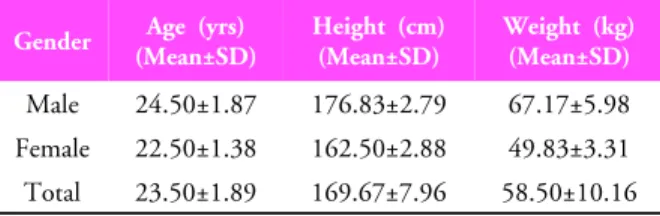
Methods: Twelve participants (5 male, 7 female) were enrolled. EMGs were used to test the onset time of lower extremity muscles; tibialis anterior, soleus, rectus femoris. To analyze the data, we used two way ANOVA.
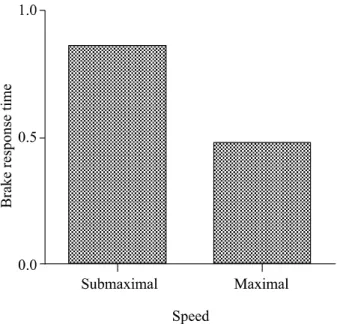
Results: According to brake pedaling velocity, there was a significant difference in brake response time (p<0.05).
Further, when comparing the lower extremity muscles, there was a significant difference in onset time (p<0.05). The order of muscle recruitment was tibialis anterior, rectus femoris, and soleus for achieving maximal velocity, but the order was rectus femoris, tibialis anterior, soleus for achieving submaximal velocity.
Conclusion: Brake pedaling velocity has significant effects on onset time of muscle contractions in the lower extremities. We suggested that a future study needs more subjects and more detailed research such as evaluations of visuo‐motor coordination and fine motor dexterity.
Keywords: Brake response time, Driving, Electromyography, Onset time 논문접수일: 2010년 7월 15일
수정접수일: 2011년 2월 7일 게재승인일: 2011년 2월 11일 교신저자: 신화경, [email protected]
The Journal Korean Society of Physical Therapy