• 검색 결과가 없습니다.

Reverse V-Shape Kinking of the Left Lower Lobar Bronchus after a Left Upper Lobectomy and Its Surgical Correction

N/A
N/A
Protected

Academic year: 2021

Share "Reverse V-Shape Kinking of the Left Lower Lobar Bronchus after a Left Upper Lobectomy and Its Surgical Correction"

Copied!
4
0
0

로드 중.... (전체 텍스트 보기)

전체 글

(1)

ISSN: 2233-601X (Print) ISSN: 2093-6516 (Online)

− 483 −

Department of Thoracic and Cardiovascular Surgery, Seoul National University Hospital, Seoul National University College of Medicine Received: January 3, 2014, Revised: February 6, 2014, Accepted: February 10, 2014, Published online: October 5, 2014

Corresponding author: In Kyu Park, Department of Thoracic and Cardiovascular Surgery, Seoul National University Hospital, Seoul National University College of Medicine, 101 Daehak-ro, Jongno-gu, Seoul 110-744, Korea

(Tel) 82-2-2072-2342 (Fax) 82-2-764-3664 (E-mail) [email protected]

C

The Korean Society for Thoracic and Cardiovascular Surgery. 2014. All right reserved.

CC
This is an open access article distributed under the terms of the Creative Commons Attribution Non-Commercial License (http://creative- commons.org/licenses/by-nc/3.0) which permits unrestricted non-commercial use, distribution, and reproduction in any medium, provided the original work is properly cited.

Reverse V-Shape Kinking of the Left Lower Lobar Bronchus after a Left Upper Lobectomy and Its Surgical Correction

Min-Seok Kim, M.D., Yoohwa Hwang, M.D., Hye-seon Kim, M.D., In Kyu Park, M.D., Chang Hyun Kang, M.D., Young Tae Kim, M.D.

A 76-year-old male underwent a left upper lobectomy with wedge resection of the superior segment of the left lower lobe using video-assisted thoracoscopic surgery (VATS) for non-small-cell lung cancer of the left upper lobe.

He presented with shortness of breath, fever, and leukocytosis. Chest radiography showed atelectasis at the re- maining left lower lobe. Bronchoscopy revealed narrowing of the left lower bronchus with purulent secretion, and computed tomography showed downward kinking of the left lower lobar bronchus. He underwent exploratory VATS, and intraoperative findings showed an inferiorly kinked left lower lobar bronchus with upward displacement of the left lower lobe. After adhesiolysis, the kinked bronchus was straightened, and bronchopexy was performed to the pericardium to prevent the recurrence of bronchial kinking. Also, the inferior pulmonary ligament was reattached to prevent upward displacement. Postoperative follow-up bronchoscopy revealed no evidence of residual bronchial ob- struction, and chest radiography showed no atelectasis thereafter.

Key words: 1. Airway obstruction

2. Video-assisted thoracic surgery (VATS) 3. Complications of surgery

CASE REPORT

A 76-year-old male underwent a left upper lobectomy with en bloc wedge resection of the superior segment of the left lower lobe using video-assisted thoracoscopic surgery (VATS) for non-small-cell lung cancer of the left upper lobe.

Systematic dissection of the pulmonary and mediastinal lymph nodes was performed. The operation and immediate postoperative course were uneventful. The patient presented poor bronchial toileting and required supplementary oxygen.

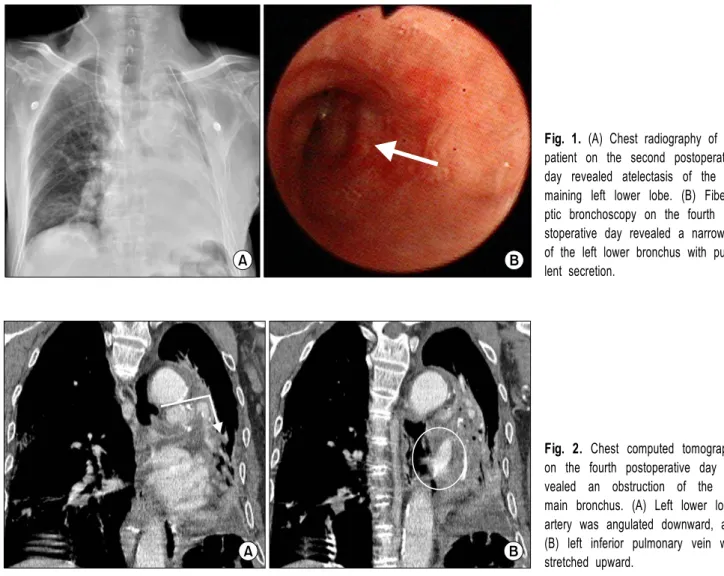
Chest radiography on the second postoperative day revealed atelectasis at the remaining left lower lobe, which was not re- solved despite vigorous chest physiotherapy (Fig. 1A). The

patient had a mild fever and leukocytosis. In addition, a high-sensitivity C-reactive protein (CRP) test revealed an ele- vated CRP level. Fiberoptic bronchoscopy on the fourth post- operative day revealed narrowing of the left lower bronchus with purulent secretion (Fig. 1B). Computed tomography showed an obstruction of the left lower lobar bronchus asso- ciated with acute angulation at the distal main bronchus. The left lower lobar artery showed right-angle angulation, and the left inferior pulmonary vein was stretched upward (Fig. 2).

Perfusion to the pulmonary parenchyma was intact. The pa- tient underwent exploratory VATS under the impression of bronchial kinking. The intraoperative findings showed an in- feriorly kinked left lower lobar bronchus accompanied by an

Korean J Thorac Cardiovasc Surg 2014;47:483-486 □ Case Report □

http://dx.doi.org/10.5090/kjtcs.2014.47.5.483

(2)

Min-Seok Kim, et al

− 484 −

Fig. 1. (A) Chest radiography of the patient on the second postoperative day revealed atelectasis of the re- maining left lower lobe. (B) Fibero- ptic bronchoscopy on the fourth po- stoperative day revealed a narrowing of the left lower bronchus with puru- lent secretion.

Fig. 2. Chest computed tomography on the fourth postoperative day re- vealed an obstruction of the left main bronchus. (A) Left lower lobar artery was angulated downward, and (B) left inferior pulmonary vein was stretched upward.

excessively upwardly displaced left lower lobe (Fig. 3A). The left lower lobe was consolidated without congestion. After adhesiolysis, the kinked bronchus was straightened. There was no malacia at the kinked portion of the bronchus. In addition, there was no supportive structure around the main bronchus and lower lobar bronchus due to extensive lymph node dissection. Thus, bronchopexy was performed to the pericar- dium with two interrupted monofilament sutures to prevent recurrence of bronchial kinking (Fig. 3B). The inferior pul- monary ligament was reattached to prevent excessive upward displacement. Postoperative follow-up bronchoscopy revealed an elliptical bronchial lumen without obstruction, and chest radiography showed no atelectasis of the left lung thereafter.

However, pneumonia developed in the contralateral lung. The patient underwent a mechanical ventilation treatment for 1

month and was discharged on the 80th postoperative day with a tracheostomy. The tracheostomy tube was removed at an outpatient clinic 2 months after discharge. Chest radiography revealed no specific findings (Fig. 4).

DISCUSSION

Bronchial kinking after an upper lobectomy has rarely been reported and has not been well described because of the diffi- culty of diagnosis [1]. However, it was recently reported that bronchial kinking occasionally develops after an upper lobec- tomy and subsequently exacerbates shortness of breath [1].

Bronchial kinking is commonly caused by the upward dis-

placement of the remaining lower lobe and can be diagnosed

by computed tomography [1,2]. Usually, bronchial kinking af-

(3)

Reverse V-Shape Kinking of the Bronchus after a Left Upper Lobectomy

− 485 −

Fig. 3. (A) Thoracoscopic findings showed reverse V-shape kinking of the left lower lobar bronchus without pulmonary congestion. (B) To prevent recurrent bronchial kinking, broncho- pexy was performed to the pericar- dium.

Fig. 4. (A) Postoperative follow-up bronchoscopy revealed an elliptical bronchial lumen without obstruction, and (B) chest radiography taken 7 months after the surgery showed patent left bronchus and full ex- panded left lung.

ter an upper lobectomy is a chronic manifestation and has an upward V-shape. In the present case, however, the patient showed an acute course and downward bronchial kinking (reverse V-shape). Bronchial kinking caused by a downward kink of the left lobar bronchus after a left upper lobectomy has not been reported thus far. Three predisposing factors can be suggested as causes of reverse V-shaped kinking. The first potential cause is an extensive dissection of lymph nodes around the lower lobar bronchus and the inferior pulmonary vein, which results in a skeletonized long segment of the bronchus. In such circumstances, the bronchus would be more susceptible to kinking because of the lack of supporting and anchoring structures. The second possibility is the wedge re- section of the superior segment and the displacement of the left lower lobar bronchus. As the hilum of the lower lobe as- cends excessively and nears the main hilum, the excessively long bronchus can become folded due to a pushing force. In

the present case, the left lower lobar bronchus ascended high- er than the left upper bronchial stump, while the remaining left lower lobe rotated counterclockwise. This condition might have exacerbated the upward displacement of the remaining lung after wedge resection. In addition, the right-angled upper lobar stump against the main and lower lobar bronchus might have facilitated the kinking. The third possibility is the de- tachment of the inferior pulmonary ligament. If the ligament is not detached, excessive upward displacement of the lower lobe can be prevented.

Shortness of breath, leukocytosis, and elevated inflamma- tory markers may trigger a suspicion of bronchial kinking.

However, it is difficult to differentiate bronchial obstruction from pneumonia on the basis of clinical symptoms and signs;

therefore, it is essential to diagnose bronchial obstruction by

bronchoscopy. Computed tomography is helpful for the differ-

entiation of bronchial kinking from lung torsion in a patient

(4)

Min-Seok Kim, et al

− 486 − with bronchial obstruction. The final diagnosis can be made during the operation by an inspection of the lung paren- chyma. In a patient with severe congestion or definitive gan- grene, treatment should be directed to the treatment of lung torsion. Early diagnosis is the most important for the treat- ment of bronchial kinking or lung torsion. Thus, broncho- scopy should be performed as soon as possible, whenever there are clinical signs of bronchial obstruction to rule out bronchial kinking or lung torsion.

Bronchial obstruction due to bronchial kinking can be treat- ed with a stent [3]. Intrabronchial stent insertion might be simpler than surgical correction. However, more serious com- plications such as bronchial wall perforation, stent migration, granuloma formation, and bacterial colonization may occur [4]. Surgical correction is the definitive treatment, and surgi- cal diagnosis is one of the important roles of surgery. When obstructive pneumonia is combined, protection of the con- tralateral lung while positioning the patient in a lateral decu- bitus position is warranted during surgery.

In the present case, we decided on VATS exploration and surgical correction because an intraoperative diagnosis of con- gestion or gangrene formation was necessary. Repositioning of the lower lobe was necessary and effective in relieving bronchial kinking. By repositioning, we could also restore the pulmonary artery and vein to a more neutral position.

Bronchopexy was also effective in maintaining a normal shape of the bronchus after resolving the kinking. Reatta-

chment of the pulmonary ligament was done to prevent ex- cessive displacement of the lower lobe. To prevent bronchial kinking during the initial operation, reattachment of the pul- monary ligament after pulmonary ligament lymph node dis- section would be helpful. Less extensive dissection of lymph nodes around the lower lobar bronchus may prevent acute re- verse V-shaped bronchial kinking.

In conclusion, given that bronchial kinking can occur after an upper lobectomy, bronchial kinking should be one of the differential diagnoses in patients with signs of bronchial obstruction. Further, surgical exploration and correction should be considered in patients with bronchial kinking.

CONFLICT OF INTEREST

No potential conflict of interest relevant to this article was reported.

REFERENCES

1. Ueda K, Tanaka T, Hayashi M, Tanaka N, Li TS, Hamano K. Clinical ramifications of bronchial kink after upper lobectomy. Ann Thorac Surg 2012;93:259-65.

2. Mueller DK, Foiles SR. Right mainstem bronchial kink after right upper lobectomy. Ann Thorac Surg 2007;84:1401.

3. Van Leuven M, Clayman JA, Snow N. Bronchial obstruction after upper lobectomy: kinked bronchus relieved by stenting.

Ann Thorac Surg 1999;68:235-7.

4. Ibrahim E. Bronchial stents. Ann Thorac Med 2006;1:92-7.

수치

Fig. 1. (A) Chest radiography of the  patient on the second postoperative  day revealed atelectasis of the  re-maining left lower lobe
Fig. 3. (A) Thoracoscopic findings  showed reverse V-shape kinking of  the left lower lobar bronchus without  pulmonary congestion

참조

관련 문서

Postoperative adhesion formation and reproductive outcome using interceed ® after ovarian surgery: a randomized trial in the rabbit model.. Adhesion reformation

(C-D) The hip anterioposterior and lateral radiograph shows bone ingrowth without subsidence or osteolysis after 62 months follow up after

Higher power view of the box area of the left figure showed poor new-bone formation around the implant (asterisk) and low BIC. Villanueva

Pilot Confirm runway 09 left for landing. ATC gives you further instructions to turn right heading 310. On the radar display, there was an area to avoid which requires a

• The supply and demand curves cross at the equilibrium price and quantity.. • You can read off approximate equilibrium values

systemic circulation, in the right ventricle and oxygenated blood from the lungs, or pulmonary circulation, in the left ventricle, as in birds and mammals.. Two vessels,

Chest X-ray: Posterio-anterior (PA) View - Left Anterior Oblique

core exercise program showed not only increasing peak torque of the right leg, left leg in Hip Extension of exercise group but also increasing peak torque of the right leg, left