Influence of nano alumina coating on the flexural bond strength between zirconia and resin cement
Canan Akay1*, Merve Çakırbay Tanış2, Emre Mumcu1, Mehmet Ali Kılıçarslan3, Murat Şen4
1Department of Prosthodontics, Faculty of Dentistry, Osmangazi University, Eskişehir, Turkey
2Ministry of Health Karapürçek Oral and Dental Health Clinics, Ankara, Turkey
3Department of Prosthodontics, Faculty of Dentistry, Ankara University, Ankara, Turkey
4Department of Chemistry, Polymer Chemistry Division, Hacettepe University, Beytepe, Ankara, Turkey
PURPOSE. The purpose of this in vitro study is to examine the effects of a nano-structured alumina coating on the adhesion between resin cements and zirconia ceramics using a four-point bending test. MATERIALS AND METHODS. 100 pairs of zirconium bar specimens were prepared with dimensions of 25 mm × 2 mm × 5 mm and cementation surfaces of 5 mm × 2 mm. The samples were divided into 5 groups of 20 pairs each. The groups are as follows: Group I (C) – Control with no surface modification, Group II (APA) – airborne-particle-abrasion with 110 μm high-purity aluminum oxide (Al2O3) particles, Group III (ROC) – airborne-particle-abrasion with 110 μm silica modified aluminum oxide (Al2O3 + SiO2) particles, Group IV (TCS) – tribochemical silica coated with Al2O3 particles, and Group V (AlC) – nano alumina coating. The surface modifications were assessed on two samples selected from each group by atomic force microscopy and scanning electron microscopy. The samples were cemented with two different self-adhesive resin cements. The bending bond strength was evaluated by mechanical testing. RESULTS. According to the ANOVA results, surface treatments, different cement types, and their interactions were statistically significant (P<.05). The highest flexural bond strengths were obtained in nano- structured alumina coated zirconia surfaces (50.4 MPa) and the lowest values were obtained in the control group (12.00 MPa), both of which were cemented using a self-adhesive resin cement. CONCLUSION. The surface modifications tested in the current study affected the surface roughness and flexural bond strength of zirconia.
The nano alumina coating method significantly increased the flexural bond strength of zirconia ceramics. [J Adv Prosthodont 2018;10:43-9]
KEYWORDS: Surface modification; Zirconia; Nano-structured alumina coating; Four-point bending
INTRODUCTION
The use of zirconia in dentistry has increased in recent times.1 Zirconia is used in dentistry for crowning, fixed par- tial dentures, implants, posts, cores, orthodontic brackets, and as a nanoparticle filler in composite resins.2,3 Its mechanical properties are similar to metals and, at the same time, its color is similar to that of natural teeth.4 The excel- lent strength, high fracture toughness, excellent abrasion resistance, toughness, fatigue resistance, and aesthetic prop- erties of zirconia are the reason for it being labeled as
“ceramic steel”. These properties are considered to be the ideal set of characteristics required of a material used in dental applications. However, the nonreactive surfaces of zirconia exhibit low adhesion with other substrates.2 Regardless of the manufacturing process, zirconia surfaces
Corresponding author:
Canan Akay
Department of Prosthodontics, Faculty of Dentistry, University of Osmangazi, Meşelik Campüs, Eskişehir, 26480, Turkey
Tel. +90530333862: e-mail, [email protected]
Received April 4, 2017 / Last Revision June 24, 2017 / Accepted July 4, 2017
© 2018 The Korean Academy of Prosthodontics
This is an Open Access article distributed under the terms of the Creative Commons Attribution Non-Commercial License (http://creativecommons.
org/licenses/by-nc/3.0) which permits unrestricted non-commercial use, distribution, and reproduction in any medium, provided the original work is properly cited.
This research was supported by Osmangazi University Scientific Research Projects and assigned Project Code no: 2015-816.
need to be pretreated because mechanical bonding, which is dependent on mechanical locking, is provided by the micro- retentions and chemical bonds on the surface. Zirconium ceramics are aesthetically acceptable, mechanically resistant, and biologically more compatible. However, the adhesion ability of zirconium ceramics is still controversial.5
As described earlier, several surface treatment methods have been tried, including roughening the surface with dia- mond rotary systems, airborne-particle-abrasion, surface fluorination, nano alumina coating, hydrofluoric acid etch- ing after fused glass-ceramic application, hot chemical etch- ing, selective infiltration etching, laser irradiation, and modi- fying the surface through a silica coating.6-10 Of all these methods, airborne-particle-abrasion, which creates micro- retentions, is the most commonly used surface roughening technique.11
Alternative technologies have been developed to increase the surface roughness of high-strength zirconium materials in order to obtain surfaces with more surface retentions.
Thus far, no consensus has been reached on the best sur- face roughening method to obtain the highest bond strength in zirconia. Depending upon the surface treatment applied, various short and long term results have been reported on the resin cement bond strength. In the present study, we used a new noninvasive method to improve the resin cement connection. This method is based on the development of a large surface area and good wettability by the application of a nano alumina coating on the zirconia surface. Using this method, micro-mechanical interlocking may be achieved.
Luting zirconia ceramics with traditional cements pro- vides sufficient initial clinical stability. Adhesive cementation exhibits suitable stability, marginal adaptation, good aesthet- ic appearance, and fracture resistance.12-14 Compared to oth- er adhesives, resin cements have shown better bonding with zirconia because of their wettability, composition, and flow- ability.15 Therefore, adhesive cements are considered as the first choice for ceramic restorations.16,17
It is difficult to accurately predict the state of pure stress in any dental system. Besides, the bending of the fixed pros- thesis pontics causes tractive forces that are more pro- nounced and also occlusal forces on the terminal edges of the restorations. The bending test example is very similar to the stress state in the load axis direction. Therefore, it may provide a suitable model for mimicking the intraoral loading conditions.18
In fact, the bending strength test is widely used and rec- ommended for testing ceramics.19 However, the symmetrical four-point mode has not been used to analyze the bending strength of zirconia ceramics modified with nano-struc- tured alumina coatings thus far.
This study was designed to compare the bonding poten- tial of a nano alumina coating with other conventional sur- face treatments using the four-point bending test on zirco- nia surfaces.
MATERIALS AND METHODS
A total of 100 pairs of bar shaped zirconia specimens (ICE Zirkon, Zirkonzahn, Bruneck, Italy) were used in this study.
The dimensions of the samples were (25 mm ± 0.4 mm) × (5 mm ± 0.4 mm) × (2 mm ± 0.4 mm). The specimen dimensions were decided according to previously published literature on the four-point bending method.6,19-21All the samples were ground-finished with 600-, 800-, 1000-, and 1200grit rotating silicon carbide abrasives (3M ESPE, St.
Paul, MN, USA) under water rinsing on a polishing machine (Metkon Gripo 2V, Bursa, Turkey).
Just prior to the surface modification treatment, the samples were cleaned for 15 minutes with 96% ethanol and for 15 minutes with distilled water to ensure the removal of any particulate residues. The specimens were then air-dried.
Depending on the type of surface modification, the samples were divided into five groups. Each group consist- ed of 20 pieces for n = 10 cemented samples. A brief description of the groups is given below.
Group I: control (C) group. The specimens in this group were not subjected to any surface treatment.
Group II: airborne-particle-abrasion (APA). The surface was abraded with aluminum oxide (Al2O3) particles (Rocatec pre, lot number 372623, 3M ESPE, Seefeld, Germany) approximately 110 µm in size at a pressure of 2.8 bar for 15 seconds. The surfaces of the zirconia samples were mount- ed at a distance of 10 mm from the end of the air abrasion unit, which was equipped with a 5 mm diameter nozzle (Rocatec Junior, 3M ESPE, Seefeld, Germany).
Group III: airborne-particle-abrasion with silica coated aluminum oxide particles (ROC). A tribochemical coating was applied on the microblasted zirconia surface using 110 µm sized silica coated aluminum oxide (Al2O3 + SiO2) parti- cles (Rocatec plus, lot number 582363, 3M ESPE, Seefeld, Germany) for 10 seconds at 2.8 bar from a distance of 10 mm from the end of the air abrasion unit.
Group IV: abraded with tribochemical silica coated with Al2O3 particles (TCS). The surface was abraded with 30 μm sized silica coated aluminum oxide particles (CoJet Sand, lot number: 619274, 3M-ESPE, Seefeld, Germany) for 10 sec- onds at a pressure of 2.8 bar from a distance of 10 mm using an intraoral sandblaster.
Group V: nano alumina coating (AlC). The aluminum nitride (AlN) powder (Grade C; H.C. Starck, Berlin, Germany) used for the adhesive coating had a particle size of 1.2 μm, a surface area of 6 m2/g, and an oxygen content of 2.5 wt.%. A dilute solution of 3 wt.% AlN was prepared by dispersing 7.5 g of the AlN powder in 250 mL of demineralized water; later, this solution was preheated to 75°C. As soon as the AlN powder dissolved, zirconia sam- ples were immersed in the solution for 15 minutes. Prior to exposure to hot water, the dispersed AlN powder started decomposing, resulting in the formation of a nano-struc- tured boehmite coating on the surface of the immersed samples. The coated surfaces were subsequently dried in a hot air oven for 2 hours at 110°C. They were then thermally
treated by heating in an electric heater at 900°C for 1 hours.
The heating rate was maintained at 10°C/min.5
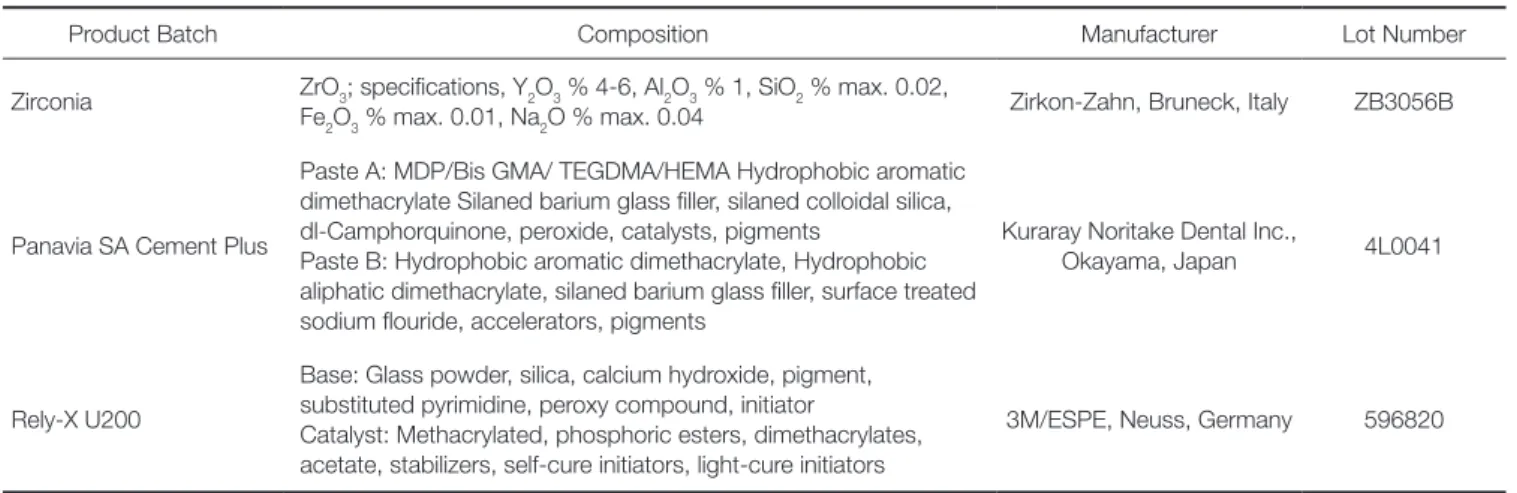
Zirconia specimens were cemented endwise on the treat- ed surfaces (5 mm × 2 mm) with either the 10-methacryloy- loxydecyl dihydrogen phosphate (MDP) containing self- adhesive resin cement (Panavia SA Cement Plus, Kuraray, Okayama, Japan) or the Rely-X self-adhesive resin cement (Rely-X U 200, 3M ESPE, Neuss, Germany) (Table 1). A special stainless steel mold was used to regularize the cement thickness to 0.1 mm. The application of resin cement was carried out to meet the producers’ demands.
Each resin cement was mixed with a base paste and a cata- lyst paste for 20 seconds using a spatula to create a homoge- nous mixture. During the mixing process, we took care to avoid the formation of air bubbles. Zirconia samples were placed in the mold endwise and the resin cement was applied to one end of each sample using a sponge pellet;
excess cement was removed before polymerization. The samples were then light-cured for 20 seconds from two opposite sides (Blue Lex LD-105, Monitex Industrial Co., Taipei, Taiwan) to avoid motion; they were held in a fixed position without any movement for 5 minutes to achieve self-curing.
The zirconia bars were centrally mounted between the cement interface upper load points. The load was applied through 2.0 mm radius rods at a crosshead speed of 1 mm/
minutes on a universal testing machine (Lloyd-LRX, Lloyd Instruments, Fareham, UK). The distance between the cen- ters of the loading rollers was 20.0 mm and the distance between the centers of the supporting rollers was 40.0 mm.
To analyze their morphological features, the surface modified zirconia samples from each group were cleaned with 96% ethanol and air-dried, mounted on metallic stubs, sputter coated with gold or palladium, and observed under a scanning electron microscope (SEM; QUANTA 400F Field Emission SEM) at 10,000× magnification.
In addition to SEM, atomic force microscopy (AFM, Veeco MultiMode V) was also used to analyze the morphol- ogy of the surface modified zirconia specimens. The views were captured in normal room conditions. The observations were carried out under the tapping mode using a 1 - 10 Ω cm phosphorus (n) doped Si tip. Depending on the vertical position of the probe tip, the heights of the surfaces were recorded as either bright or dark in the generated images.
The type of sample, continuous along the amplitude of oscillation, is held in a fixed position. A single operator measured the mean value of the surface roughness (Ra) of the zirconia specimens after surface modification. These values were expressed quantitatively with the help of deter- mined software. Four measurements were carried out on each pre-processed zirconia sample using a regularized rect- angular spot.
All the measurements were reviewed using the Statistical Package for the Social Sciences, version 16.0 (SPSS Inc., Chicago, IL, USA). The differences in the flexural strengths of the tested groups were evaluated by two-way analysis of variance (ANOVA). The Anderson-Darling test was execut- ed to confirm that the flexural strength values were normal- ly distributed. The statistical analyses were executed at a sig- nificance level of 0.05. Multiple comparisons of different surface modification methods were performed using the Holm-Sidak method.
RESULTS
The mean flexural bond strengths and standard deviations resulting from the experimental protocols are listed in Table 2. Application of the surface nano alumina coating increased the resin bond strength with the Rely-X U 200 resin cement.
The AIC Rely-X group was observed to possess the highest flexural strength. However, no significant differences were detected between the AIC Rely-X, ROC RelyX, AIC
Table 1. Experimental materials and their characteristics
Product Batch Composition Manufacturer Lot Number
Zirconia ZrO3; specifications, Y2O3 % 4-6, Al2O3 % 1, SiO2 % max. 0.02,
Fe2O3 % max. 0.01, Na2O % max. 0.04 Zirkon-Zahn, Bruneck, Italy ZB3056B
Panavia SA Cement Plus
Paste A: MDP/Bis GMA/ TEGDMA/HEMA Hydrophobic aromatic dimethacrylate Silaned barium glass filler, silaned colloidal silica, dl-Camphorquinone, peroxide, catalysts, pigments
Paste B: Hydrophobic aromatic dimethacrylate, Hydrophobic aliphatic dimethacrylate, silaned barium glass filler, surface treated sodium flouride, accelerators, pigments
Kuraray Noritake Dental Inc.,
Okayama, Japan 4L0041
Rely-X U200
Base: Glass powder, silica, calcium hydroxide, pigment, substituted pyrimidine, peroxy compound, initiator
Catalyst: Methacrylated, phosphoric esters, dimethacrylates, acetate, stabilizers, self-cure initiators, light-cure initiators
3M/ESPE, Neuss, Germany 596820
The four-point bending test is recommended for analyzing dental materials because it can simulate intraoral loading conditions, and thus more realistic data can be obtained.22
Panavia, and APA Rely-X groups (P > .05). The AIC Rely-X group had a significantly higher flexural strength than the APA Panavia, ROC Panavia, TCS Panavia, TCS Rely-X, C Panavia, and C RelyX groups.
During the experimental process, a few samples debond- ed spontaneously in the AIC Rely-X, Panavia, and APA Panavia groups.
The SEM images of the zirconia surfaces after surface modification are shown in Fig. 1. Upon evaluating the SEM
images, prominent topographical changes could be observed. A highly irregular surface was detected after the nano alumina coating. The nano alumina coating exhibited good coverage on the zirconia surface; it could be observed that the surface was covered with nano-structured alumina lamellae.
The AFM images of the surface modified zirconia speci- mens are shown in Fig. 2. The results of the surface area and surface roughness calculations are presented in Table 3.
Table 2. Mean values of flexural bond strength test (in MPa)
Group N Min Max Mean SD
I Rely-X 10 6.10 25.94 12.00 E 6.76
Panavia 10 6.41 24.41 16.70 D,E 5.08
II Rely-X 10 24.72 46.23 35.62 A,B,C 8.60
Panavia 8 24.49 41.50 33.75 B,C 5.24
III Rely-X 10 13.43 69.27 47.88 AB 18.95
Panavia 10 27.77 40.74 33.09 C 4.07
IV Rely-X 10 19.53 42.57 30.82 C,D 7.73
Panavia 10 18.77 40.89 31.21 C 7.98
V Rely-X 8 33.11 66.53 50.40 A 12.51
Panavia 9 28.23 52.79 39.50 A,B,C 8.67
*Different superscript letters describe statistical differences in flexural bond strength test (P < .05).
Fig. 1. SEM images of zirconia samples after surface treatments.(×10,000, bar 10 μm): (A) airborne-particle abrasion with 110 μm aluminum oxide particles (B) air- borne-particle abrasion with 110 μm silica-modified aluminum oxide particles (C) airborne-particle abrasion with 30 μm silica-coated aluminum oxide particles (D) nano-structured alumina coating.
A B
C D
Fig. 2. AFM images of zirconia samples after different surface treatments. (A) airborne-particle abrasion with 110 μm aluminum oxide particles (B) airborne-particle abrasion with 110 μm silica-modified aluminum oxide particles (C) airborne-particle abrasion with 30 μm silica- coated aluminum oxide particles (D) nano-structured alumina coating. Differences in zirconia surface texture were evident according to the conditioning treatment performed. A more retentive surface was evident coated with nano-structured alumina.
A B
C D
The highly irregular and heterogeneous surface is due to the application of the nano-structured alumina coating.
Among the surface-treated samples, the lowest surface roughness (Ra) values were obtained in the APA group (157 nm) while the highest Ra values were obtained in the ROC group (378 nm).
DISCUSSION
In the current study, under temperature controlled laborato- ry conditions, we have shown that a high surface area enhances the resin cement’s micro-mechanical connection with zirconia. Our flexural bond resistance sequences dem- onstrated that the resin bond strength is increased by coat- ing nano-structured alumina on the surfaces of zirconia specimens.23
Zirconia ceramics can contain 5 - 15% silica or glass, which becomes dense and homogeneous during sintering;
however, conventional cementation techniques do not work on such dense and homogeneous surfaces.24 Resin cements used routinely in the clinic provide mechanical retention that is acceptable on rough surfaces. However, groups with phosphate monomers are advised for zirconia ceramics because they are hydrolytically consistent over a long period of time. This is because the chemical interactions between the phosphate ester monomers and the hydroxyl groups on zirconia surface are strong.25
However, the film thickness of the resin cement includ- ing MDP is two times more than that of the conventional resin cements. This is an issue that has to be overcome before MDP resin cements can be adapted for cementing zirconia surfaces.26 In this study, self-adhesive luting resin cements, Rely-X U200 and Panavia SA, were used. The bonding ability of Rely-X U 200 to zirconia has been found to be much higher than that of Panavia SA.
The original standard load area cannot be reached and this behavior cannot be controlled. In the shear bond tests, parasitic stresses occur, which cannot be prevented, mea- sured, or controlled, even though all possible precautions are taken during experimentation. These stresses cannot be prevented because the material cannot be twisted.27
Four-point bending tests are recommended for analyz- ing the bending strength of heterogeneous materials while micro-tensile and three-point bending tests are advised for homogeneous materials.6 It is clear that during the adhesive
strength test, the adhesive interface should be pressurized appropriately.28 Shear tests can theoretically be applied to illustrate the mode of failure; however, their application has not been demonstrated yet. Nevertheless, shear tests have several problems, including the homogeneity of the stressed area, obvious stress concentrations, and parasitic stresses.29 Alternatively, it has been said that interfacial tension is favored.30 Application of a direct stress faces problems in sample fixation, alignment, and preparation of samples.
Furthermore, depending upon the material characteristics, there might be a tendency for non-homogeneous stress dis- tribution. However, flexural strength tests do not have these limitations and are easy to set up; moreover, sample fixation problems can be avoided.5
Kim et al.31 investigated the bonding properties of nano- structured alumina coated zirconia surfaces. The shear bond strengths were measured before and after thermocycling.
The results indicated that the treatment of zirconia with nano-structured alumina can significantly increase the shear bond strength. The flexural bond strengths observed in the current study are in accordance with this report.
The proposed method offers many advantages over con- ventional surface modifications. Above all, it does not reveal any surface imperfections that might degrade the strength of the zirconia surface.5
The creation of microscopic cracks during airborne-par- ticle-abrasion is attributed to the mechanical effect of the abrading grains on the zirconia surfaces. On the basis of this phenomenon, airborne-particle-abrasion reduces32 or increases33 zirconia bending strength, depending on the size of the sanded grains and the tack, applied air pressure, and zirconia surface conditions. Qeblawi et al.34 reported that the use of 30 µm sized silica coated aluminum trioxide grains at a pressure of 3.0 bar did not result in any significant increase in the flexural strengths of the zirconia specimens.
Xible et al.35 reported a strengthening effect by tribochemi- cal airborne-particle-abrasion using larger particles at 2.8 bar. Smaller grains are less effective at inducing a tetragonal to monoclinic phase transformation on the zirconia surface.
In addition, some studies have also reported that there was no difference in the bending strengths obtained with different surface modification treatments.36,37 In the present study, three different abrasion materials were used for air- borne-particle-abrasion: 110 µm Al2O3 particles (Rocatec pre), 110 µm silica coated aluminum oxide (Al2O3 + SiO2) particles (Rocatec plus), and 30 μm tribochemical silica coated aluminum oxide particles. The flexural bending strengths of ROC Rely-X, APA Rely-X, APA Panavia, and ROC Panavia are 47.9, 35.6, 33.8, and 33.1 MPa, respective- ly. These findings are in good agreement with previous reports.5,6,8,38
It has been proposed that a combination of mechanical and chemical adhesive systems provides better bonding between ceramics with high crystallinity and cements. In this case, the purpose of the silica coating systems was to create a large adhesion surface area and to add a silica layer to the zirconia surfaces.38,39 Upon analyzing the resultant Table 3. AFM roughness and surface area analysis of the
zirconia ceramics after different surface treatment methods
APA TCS ROC AIC
Ra (nm) 157 216 378 195
Rq 196 280 490 246
roughness values, it could be concluded that blasting with ROC led to the highest mean roughness value (378 nm), which is higher than the roughness values obtained with all other treatments. In addition, as shown by the AFM images, the generated roughness pattern was very regular. Airborne- particle-abrasion of a zirconia specimen increased its sur- face area and resulted in a micro-retentive surface topogra- phy, which in turn increased the wettability of these surfac- es.40
Furthermore, it could be deduced from the AFM mea- surements that the nano alumina layer on the zirconia sur- face was 195 nm thick. This layer does not hinder the instal- lation of zirconia cover on teeth. On the other hand, a strong cementation bond alone is not sufficient to increase the transport ability of zirconia.
CONCLUSION
Within the limitations of this in vitro study, we conclude that treating zirconia surfaces with a nano alumina coating is a promising surface modification treatment for resin cementa- tion of zirconia. Coating with nano-structured alumina is a relatively simple and effective method for creating microre- tention and thus is a favorable method for resin bonding of zirconia ceramics. Furthermore, this study also provides practical and scientific information on the development of modified zirconia surfaces, their aesthetics, and the bending strength capacities of zirconia restorative structures in pros- thetic dentistry. The application of the symmetrical four- point bending test for evaluating the adhesive strength is simple and can overcome the currently known adhesion test problems.
ORCID
Canan Akay https://orcid.org/0000-0003-2781-8710
Merve Çakırbay Tanış https://orcid.org/0000-0001-5698-8220 Mehmet Ali Kılıçarslan https://orcid.org/0000-0002-8619-957X REFERENCES
1. Zhang S, Kocjan A, Lehmann F, Kosmac T, Kern M. Influence of contamination on resin bond strength to nano-structured alumina-coated zirconia ceramic. Eur J Oral Sci 2010;118:
396-403.
2. Piascik JR, Swift EJ, Braswell K, Stoner BR. Surface fluorina- tion of zirconia: adhesive bond strength comparison to com- mercial primers. Dent Mater 2012;28:604-8.
3. Hjerppe J, Närhi TO, Vallittu PK, Lassila LV. Surface rough- ness and the flexural and bend strength of zirconia after dif- ferent surface treatments. J Prosthet Dent 2016;116:577-83.
4. Manicone PF, Rossi Iommetti P, Raffaelli L. An overview of zirconia ceramics: basic properties and clinical applications. J Dent 2007;35:819-26.
5. Jevnikar P, Krnel K, Kocjan A, Funduk N, Kosmac T. The ef- fect of nano-structured alumina coating on resin-bond strength to zirconia ceramics. Dent Mater 2010;26:688-96.
6. Şanlı S, Çömlekoğlu MD, Çömlekoğlu E, Sonugelen M, Pamir T, Darvell BW. Influence of surface treatment on the resin- bonding of zirconia. Dent Mater 2015;31:657-68.
7. Cheung GJ, Botelho MG. Zirconia surface treatments for res- in bonding. J Adhes Dent 2015;17:551-8.
8. Tanış MÇ, Akay C, Karakış D. Resin cementation of zirconia ceramics with different bonding agents. Biotechnol Biotechnol Equip 2015;29:363-7.
9. Akay C, Çakırbay Tanış M, Şen M. Effects of hot chemical etch- ing and 10-metacryloxydecyl dihydrogen phosphate (MDP) monomer on the bond strength of zirconia ceramics to resin- based cements. J Prosthodont 2016 Feb 4.
10. Casucci A, Osorio E, Osorio R, Monticelli F, Toledano M, Mazzitelli C, Ferrari M. Influence of different surface treat- ments on surface zirconia frameworks. J Dent 2009;37:891-7.
11. de Oyagüe RC, Monticelli F, Toledano M, Osorio E, Ferrari M, Osorio R. Influence of surface treatments and resin ce- ment selection on bonding to densely-sintered zirconium-ox- ide ceramic. Dent Mater 2009;25:172-9.
12. Ozcan M, Kerkdijk S, Valandro LF. Comparison of resin ce- ment adhesion to Y-TZP ceramic following manufacturers’
instructions of the cements only. Clin Oral Investig 2008;12:
279-82.
13. Atsu SS, Kilicarslan MA, Kucukesmen HC, Aka PS. Effect of zirconium-oxide ceramic surface treatments on the bond strength to adhesive resin. J Prosthet Dent 2006;95:430-6.
14. Menani LR, Farhat IA, Tiossi R, Ribeiro RF, Guastaldi AC.
Effect of surface treatment on the bond strength between yt- tria partially stabilized zirconia ceramics and resin cement. J Prosthet Dent 2014;112:357-64.
15. Yun JY, Ha SR, Lee JB, Kim SH. Effect of sandblasting and various metal primers on the shear bond strength of resin ce- ment to Y-TZP ceramic. Dent Mater 2010;26:650-8.
16. Thompson JY, Stoner BR, Piascik JR, Smith R. Adhesion/ce- mentation to zirconia and other non-silicate ceramics: where are we now? Dent Mater 2011;27:71-82.
17. Wolfart M, Lehmann F, Wolfart S, Kern M. Durability of the resin bond strength to zirconia ceramic after using different surface conditioning methods. Dent Mater 2007;23:45-50.
18. Song HY, Yi YJ, Cho LR, Park DY. Effects of two prepara- tion designs and pontic distance on bending and fracture strength of fiber-reinforced composite inlay fixed partial den- tures. J Prosthet Dent 2003;90:347-53.
19. Carter CB, Norton MG. Ceramic materials: science and engi- neering. Springer; 2007 p. 297-8.
20. Jones DW, Jones PA, Wilson HJ. The relationship between transverse strength and testing methods for dental ceramics. J Dent 1972;1:85-91.
21. ASTM International. Designation: C1674-11. Standard test- method for flexural strength of advanced ceramics withengi- neered porosity (Honeycomb Cellular Channels) atambient temperatures. West Conshohocken, PA, USA: ASTM International;
2011.
22. Inokoshi M, Zhang F, Vanmeensel K, De Munck J, Minakuchi S, Naert I, Vleugels J, Van Meerbeek B. Residual compressive surface stress increases the bending strength of dental zirco- nia. Dent Mater 2017;33:e147-e154.
23. Srikanth R, Kosmac T, Della Bona A, Yin L, Zhang Y.
Effects of cementation surface modifications on fracture re- sistance of zirconia. Dent Mater 2015;31:435-42.
24. Blatz MB, Chiche G, Holst S, Sadan A. Influence of surface treatment and simulated aging on bond strengths of luting agents to zirconia. Quintessence Int 2007;38:745-53.
25. Dias de Souza GM, Thompson VP, Braga RR. Effect of met- al primers on microtensile bond strength between zirconia and resin cements. J Prosthet Dent 2011;105:296-303.
26. Casucci A, Osorio E, Osorio R, Monticelli F, Toledano M, Mazzitelli C, Ferrari M. Influence of different surface treat- ments on surface zirconia frameworks. J Dent 2009;37:891-7.
27. Placido E, Meira JB, Lima RG, Muench A, de Souza RM, Ballester RY. Shear versus micro-shear bond strength test: a finite element stress analysis. Dent Mater 2007;23:1086-92.
28. Valandro LF, Ozcan M, Amaral R, Vanderlei A, Bottino MA.
Effect of testing methods on the bond strength of resin to zirconia-alumina ceramic: microtensile versus shear test. Dent Mater J 2008;27:849-55.
29. Jin J, Takahashi H, Iwasaki N. Effect of test method on flex- ural strength of recent dental ceramics. Dent Mater J 2004;23:
490-6.
30. Ban S, Anusavice KJ. Influence of test method on failure stress of brittle dental materials. J Dent Res 1990;69:1791-9.
31. Kim DW, Lee JJ, Kim KA, Seo JM. Influence of nano-struc- tured alumina coating treatment on shear bond strength be- tween zirconia ceramic and resin cement. J Korean Acad Prosthodont 2016;54:354-63.
32. Ozcan M, Melo RM, Souza RO, Machado JP, Felipe Valandro L, Botttino MA. Effect of air-particle abrasion protocols on the biaxial flexural strength, surface characteristics and phase transformation of zirconia after cyclic loading. J Mech Behav Biomed Mater 2013;20:19-28.
33. Scherrer SS, Cattani-Lorente M, Vittecoq E, de Mestral F, Griggs JA, Wiskott HW. Fatigue behavior in water of Y-TZP zirconia ceramics after abrasion with 30 μm silica-coated alu- mina particles. Dent Mater 2011;27:e28-42.
34. Qeblawi DM, Muñoz CA, Brewer JD, Monaco EA Jr. The ef- fect of zirconia surface treatment on flexural strength and shear bond strength to a resin cement. J Prosthet Dent 2010;
103:210-20.
35. Xible AA, de Jesus Tavarez RR, de Araujo Cdos R, Bonachela WC. Effect of silica coating and silanization on flexural and composite-resin bond strengths of zirconia posts: An in vitro study. J Prosthet Dent 2006;95:224-9.
36. Fonseca RG, Abi-Rached Fde O, da Silva FS, Henriques BA, Pinelli LA. Effect of surface and heat treatments on the biax- ial flexural strength and phase transformation of a Y-TZP ce- ramic. J Adhes Dent 2014;16:451-8.
37. Egilmez F, Ergun G, Cekic-Nagas I, Vallittu PK, Lassila LV.
Factors affecting the mechanical behavior of Y-TZP. J Mech Behav Biomed Mater 2014;37:78-87.
38. Silva GAF, da Luz EC, dos Reis Goyata F, da Silva Concilio LR, Neves ACC, Vitti RP, Cunha LG. Influence of surface treatments on topography and bond strength of densely-sin- tered zirconium-oxide ceramic. Ceramics Int 2016;42:8136-9.
39. Valandro LF, Della Bona A, Antonio Bottino M, Neisser MP.
The effect of ceramic surface treatment on bonding to dense- ly sintered alumina ceramic. J Prosthet Dent 2005;93:253-9.
40. Inan O, Acar A, Halkaci S. Effects of sandblasting and elec- trical discharge machining on porcelain adherence to cast and machined commercially pure titanium. J Biomed Mater Res B Appl Biomater 2006;78:393-400.