982 서 론
고혈압, 당뇨, 이상지방혈증, 비만 등 관상동맥질환의 위 험요인이 되는 질환들이 군집되어 나타나는 것을 대사증후 군이라 정의하는데,1 인슐린 매개성 포도당 흡수장애로 인 한 인슐린저항성에 따른 2차적 고인슐린혈증 및 교감신경 계의 과활성이 대사증후군의 기본병태생리를 이룬다.1-3 2005년 우리나라의 한 역학조사에 의하면 대사증후군의 유 병률이 남자 34.2%, 여자 38.7%로 여자에서도 높은 유병률 을 보이는 것으로 나타났고, 이는 식습관 및 생활습관의 서 구화, 고령화로 인해 증가하는 추세를 보인다.4-6
남성의 배뇨장애는 전립선비대증에 의한 이차적 방광출 구폐색에 의한 경우가 많으며 유병률, 병리기전, 치료법 등 이 비교적 명확히 밝혀져 있지만, 그에 반해 신경인성 방광, 요실금, 과민성 방광 등으로 대표되는 여성의 배뇨장애는 정의, 기전, 치료법 등이 아직 명확히 확립되지 않은 실정이 고,7 유병률도 6.8-61.7%로 다양하게 보고된 바 있으며 대사 증후군, 연령의 증가와 함께 증가하는 것으로 나타났다.8-10 인슐린 저항성이나 고인슐린혈증은 교감신경 활성도를 증가시켜 하부요로에 영향을 미쳐 배뇨증상을 일으키고,11 대사증후군의 가장 중요한 요소인 인슐린저항성 당뇨는 여 성의 배뇨장애와 밀접한 관련을 보이며 동시 발병하는 경 우가 많고 (25-87%), 배뇨증상이 심할수록 당뇨를 동반할
Voiding Dysfunction of Women Associated with Metabolic Syndrome
Jae Hun Kim, Bong Suk Shim, Young Sun Hong1
From the Departments of Urology and 1Internal Medicine, College of Medicine, Ewha Womans University, Seoul, Korea
Purpose: The occurrence of coronary artery disease is rising with the recent changes in diet and the westernization of lifestyle. In 1998, the World Health Organization (WHO) defined “metabolic syndrome” as a condition in which all the risk factors of coronary artery disease exist in an elderly individual. We investigated the relationship between metabolic syndrome and voiding difficulty of women.
Materials and Methods: In 2004, we investigated 66 female out-patients who visited the endocrinology department and health care center between the months of March and October. We divided the patients into two groups: one which corresponded to the metabolic syndrome criteria (n=42, 56.0±5.6 years old) and one which did not (n=24, 55.7±5.2 years old), and we compared the voiding factors of these two groups.
Results: When comparing the components of metabolic syndrome in the patient study group to that in the control study group, the metabolic syndrome patients scored poorly for all the metabolic syndrome com- ponents in comparison to the control group (p<0.05). On comparing the voiding factors of metabolic syndrome patients to that of the control group, the metabolic syndrome patient group scored substantially lower than the control group for all voiding factors (p<0.05).
Conclusions: We proved that metabolic syndrome and voiding difficulty of women were related based on the results of this study. Therefore, performing more active investigation for metabolic syndrome in the pa- tients who are admitted with voiding difficulty, earlier diagnosis of metabolic syndrome would be possible. (Korean J Urol 2006;47:982-986) ꠏꠏꠏꠏꠏꠏꠏꠏꠏꠏꠏꠏꠏꠏꠏꠏꠏꠏꠏꠏ
Key Words: Metabolic syndrome X, Urination disorders
대한비뇨기과학회지 제 47 권 제 9 호 2006
이화여자대학교 의과대학
비뇨기과학교실, 1내과학교실
김재헌․심봉석․홍영선1
접수일자:2006년 2월 1일 채택일자:2006년 7월 31일
교신저자: 심봉석
이대동대문병원 비뇨기과 서울시 종로구 종로6가 70 ꂕ 110-783
TEL: 02-760-5136 FAX: 02-3672-0953 E-mail: bonstone@
ewha.ac.kr
확률이 높다.12
노년기 여성에서 나타나는 배뇨증상의 기전으로는 신경 학적, 내분비적, 정신적 요소 등이 중요한 역할을 하는 것으 로 알려져 있지만7, 대사증후군에서 보이는 교감신경 과활 성, 당뇨, 비만 등의 요인들도 하부요로증상의 발현에 연관 이 있을 것으로 보인다. 이에 저자들은 50대 이후의 여성들 을 대상으로 대사증후군에서 나타나는 배뇨장애를 조사하 여 서로 연관이 있는지를 알아보고자 하였다.
대상 및 방법
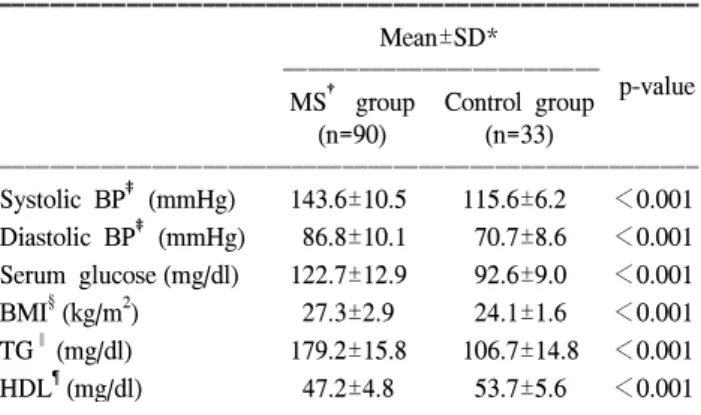
2004년 3월부터 7월까지 내분비내과 및 종합검진센터에 내원한 여자환자 66명을 대상으로 하였고, 이들을 대사증 후군의 조건에 부합하는 군 42명과 부합하지 않는 대조군 24명으로 분류하였고 각 군의 평균연령은 56.0±5.6세와 55.7±5.2세로 유의한 차이는 없었다 (p=0.102). 각 군의 국 제전립선증상지수 (International Prostate Symptom Score; IPSS), 요실금 점수, 삶의 질 점수 (quality of life; QoL), 최대요속, 잔뇨량 등의 배뇨요소를 비교하였다. 대사증후군 환자군과 대조군의 대사증후군 관련요소를 비교한 결과, 대사증후군 환자군에서 대조군에 비해 모든 대사증후군 관련요소가 유 의하게 악화된 소견을 보였다 (p<0.05) (Table 1).
대사증후군의 진단기준은 2001년 5월 미국에서 발표된 제 3차 콜레스테롤관리지침 (National Cholesterol Education Programme Adult Treatment Panel III; NCEP-ATP III)13의 정 의에 따라 1) 고혈압 (수축기 혈압이 130mmHg 이상 혹은 이완기혈압이 85mmHg 이상), 2) 고혈당 (공복 시 혈당이 110mg/dl 이상), 3) 비만 (허리 둘레가 80cm 이상이거나 신
체질량지수가 25kg/m2 이상), 4) 저HDL-콜레스테롤혈증 (50mg/dl 미만), 5) 고중성지방혈증 (150mg/dl 이상)에서 세 가지 이상을 만족하는 경우로 하였다. 비만에 대한 기준 중 신체질량지수는 1998년 WHO14에서 제시한 대사증후군 중 비만에 대한 기준이고, 허리둘레, 체질량지수 모두 2000년 아시아 태평양 지역에서 제시한 수치로 수정한 것이다.15 본 연구에서는 측정의 편의성을 고려해 허리둘레 대신 신체질 량지수를 대사증후군의 진단기준으로 이용하였다.
그리고 내당능장애 혹은 인슐린 저항성에 의한 제2형 당 뇨가 대사증후군의 기본적인 병태생리임에 근거하여, 대사 증후군 환자군을 제2형 당뇨병의 유무, 당뇨의 기간 (5년 미 만과 5년 이상)에 따라 분류하여 배뇨요소를 비교하였다.
모든 수치 비교에서 통계분석은 SPSS 프로그램 (version 10.0) 을 이용하여 Student's t-test를 시행하였으며 p 값이 0.05 미 만일 때 통계학적으로 유의하다고 판단하였다.
결 과
대사증후군 환자군과 대조군의 배뇨요소 비교 결과 각각 IPSS는 14.5±4.1점과 7.1±2.5점이었으며 (p<0.001), QoL 점수는 4.5±1.2점과 3.8±1.2점 (p<0.001), 최대요속은 10.6
±4.3ml/sec와 25.6±8.7ml/sec (p<0.001), 잔뇨는 36.3±13.8 ml와 17.6±11.7ml (p<0.001), 요실금 점수는 2.5±1.0점과 1.1±0.5점 (p=0.006)으로 대사증후군 환자군에서 대조군에 비해 모든 배뇨요소가 유의하게 악화된 소견을 보였다 (Table 2).
대사증후군 환자군 42명을 제2형 당뇨병 관련요소에 따라 분류하여 배뇨요소들을 비교하였다. 제2형 당뇨병이 있는 군 (n=29명)과 없는 군 (n=13명)의 비교에서 각각 IPSS는 15.6±4.0점과 11.0±3.6점 (p<0.001), QoL 점수는 4.7±1.2 Table 1. Comparison of the factors of metabolic syndrome between
the metabolic syndrome group and the control group
ꠚꠚꠚꠚꠚꠚꠚꠚꠚꠚꠚꠚꠚꠚꠚꠚꠚꠚꠚꠚꠚꠚꠚꠚꠚꠚꠚꠚꠚꠚꠚꠚꠚꠚꠚꠚꠚꠚꠚꠚꠚꠚꠚꠚꠚꠚꠚꠚꠚꠚꠚꠚꠚꠚꠚ Mean±SD*
ꠏꠏꠏꠏꠏꠏꠏꠏꠏꠏꠏꠏꠏꠏꠏꠏꠏꠏꠏꠏꠏꠏꠏꠏꠏ p-value MS† group Control group
(n=90) (n=33)
ꠏꠏꠏꠏꠏꠏꠏꠏꠏꠏꠏꠏꠏꠏꠏꠏꠏꠏꠏꠏꠏꠏꠏꠏꠏꠏꠏꠏꠏꠏꠏꠏꠏꠏꠏꠏꠏꠏꠏꠏꠏꠏꠏꠏꠏꠏꠏꠏꠏꠏꠏꠏꠏꠏꠏ Systolic BP‡(mmHg) 143.6±10.5 115.6±6.2 <0.001 Diastolic BP‡(mmHg) 86.8±10.1 70.7±8.6 <0.001 Serum glucose (mg/dl) 122.7±12.9 92.6±9.0 <0.001 BMI§(kg/m2) 27.3±2.9 24.1±1.6 <0.001
TG∥(mg/dl) 179.2±15.8 106.7±14.8 <0.001
HDL¶(mg/dl) 47.2±4.8 53.7±5.6 <0.001 ꠏꠏꠏꠏꠏꠏꠏꠏꠏꠏꠏꠏꠏꠏꠏꠏꠏꠏꠏꠏꠏꠏꠏꠏꠏꠏꠏꠏꠏꠏꠏꠏꠏꠏꠏꠏꠏꠏꠏꠏꠏꠏꠏꠏꠏꠏꠏꠏꠏꠏꠏꠏꠏꠏꠏ
*SD: standard deviation, †MS: metabolic syndrome, ‡BP: blood pressure, §BMI: body mass index, ∥TG: triglyceride, ¶HDL: high density lipoprotein
Table 2. Voiding factors of the metabolic syndrome group and the control group
ꠚꠚꠚꠚꠚꠚꠚꠚꠚꠚꠚꠚꠚꠚꠚꠚꠚꠚꠚꠚꠚꠚꠚꠚꠚꠚꠚꠚꠚꠚꠚꠚꠚꠚꠚꠚꠚꠚꠚꠚꠚꠚꠚꠚꠚꠚꠚꠚꠚꠚꠚꠚꠚꠚꠚ Mean±SD*
ꠏꠏꠏꠏꠏꠏꠏꠏꠏꠏꠏꠏꠏꠏꠏꠏꠏꠏꠏꠏꠏꠏꠏꠏ p-value MS† group Control group
(n=42) (n=24)
ꠏꠏꠏꠏꠏꠏꠏꠏꠏꠏꠏꠏꠏꠏꠏꠏꠏꠏꠏꠏꠏꠏꠏꠏꠏꠏꠏꠏꠏꠏꠏꠏꠏꠏꠏꠏꠏꠏꠏꠏꠏꠏꠏꠏꠏꠏꠏꠏꠏꠏꠏꠏꠏꠏꠏ
IPSS‡ 14.5±4.1 7.1±2.5 <0.001
QoL§ score 4.5±1.2 3.8±1.2 <0.001
Maximal flow rate (ml/sec) 10.6±4.3 25.6±8.7 <0.001 Residual urine (ml) 36.3±13.8 17.6±11.7 <0.001 Incontinence score 2.5±1.0 1.1±0.5 0.006 ꠏꠏꠏꠏꠏꠏꠏꠏꠏꠏꠏꠏꠏꠏꠏꠏꠏꠏꠏꠏꠏꠏꠏꠏꠏꠏꠏꠏꠏꠏꠏꠏꠏꠏꠏꠏꠏꠏꠏꠏꠏꠏꠏꠏꠏꠏꠏꠏꠏꠏꠏꠏꠏꠏꠏ
*SD: standard deviation, †MS: metabolic syndrome, ‡IPSS: Inter- national Prostate Symptom Score, §QoL: quality of life
점과 4.2±0.9점 (p=0.009), 최대요속은 9.4±4.1ml/sec와 12.5
±4.0ml/sec (p<0.001), 잔뇨는 37.9±13.8ml와 31.9±13.0ml (p<0.001)로 유의한 차이를 보였으며, 요실금 점수만 2.5±
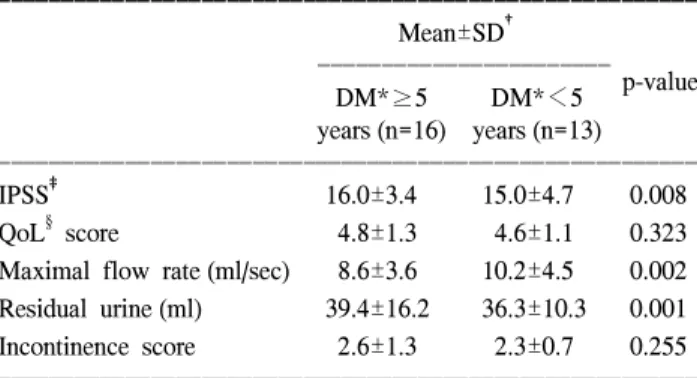
1.1점과 2.7±1.0점 (p=0.326)으로 유의한 차이를 보이지 않 았다 (Table 3). 제2형 당뇨병을 포함한 대사증후군 환자 29 명에서 당뇨의 기간에 따라 배뇨요소를 비교한 결과, 5년 이상 (n=16명)과 5년 미만 (n=13명) 환자군에서 각각 IPSS 는 16.0±3.4점과 15.0±4.7점 (p=0.008), 최대요속은 8.6±
3.6ml/ sec와 10.2±4.5ml/sec (p=0.002), 잔뇨는 39.4±16.2ml 와 36.3±10.3ml (p=0.001)로 제2형 당뇨병을 5년 이상 앓은 환자군에서 유의하게 악화되어 있는 소견을 보였고, 요실 금 점수는 2.6±1.3점과 2.3±0.7점 (p=0.255), QoL 점수는 4.8±1.3점과 4.6±1.1점 (p=0.323)으로 두 군 간의 유의한 차이를 보이지 않았다 (Table 4). 대사증후군 환자군의 IPSS 를 각 항목별로 분석해본 결과 (각 항목의 점수가 3점 이상 인 경우에 해당 증상을 호소한다고 가정) 가장 많이 호소하 는 배뇨증상은 잔뇨감 (61.5%)이었으며 이어 빈뇨 (57.3%) 와 절박뇨 (49.8%)를 호소하는 환자들이 많은 것으로 나타 났다.
고 찰
관상동맥질환의 위험인자들의 군집성을 1988년 Reaven1 은 ‘X 증후군 (Syndrome X)’ 혹은 ‘인슐린저항성증후군’이 라고 명명하였으며, 1998년 세계보건기구 (World Health Organization; WHO)에서는 ‘대사증후군’으로 정의하고 실 제적인 진단기준을 제시하였다. 이번 연구에서는 2001년 NCEP-ATP III에서 제시한 대사증후군 진단기준을 이용하 였고, 이 중 비만에 대한 기준은 NCEP-ATP III에서 제시한 허리둘레 대신 1998년 WHO14에서 제시한 신체질량지수를
이용하였다. 그리고 비만에 대한 기준은 인종 간의 차이가 비교적 크게 날 수 있기 때문에 2000년 아시아 태평양 지역 에 맞게 제시된 비만의 기준으로 수정하여 이용하였다.15 2003년 미국에서 발표된 보고에 의하면 60세 이상의 미 국인구 중 43.5%가 대사증후군에 이환되어 있고,16 우리나 라는 30세 이상 인구에서 남자 34.2%, 여자 38.7%의 높은 이환율을 보이고 있다.6 관상동맥질환으로 인한 사망률도 급격히 증가하고 있는데 1990년 인구 십만명당 10.4명에서 2000년 21.5명으로 2배 이상 증가하였다.17
대사증후군의 기본병태생리는 인슐린 매개성 포도당 흡 수의 장애로 인해 발생하는 인슐린 저항성에 의한 이차적 고인슐린혈증으로 알려져 있다.1-3 고인슐린혈증에 의한 인 슐린 증가는 시상하부의 교감신경계 활성을 조절하는 배쪽 내측핵 (ventromedial nucleus)에 영향을 미쳐 혈중 및 조직 내 카테콜아민 (catecholamine)을 증가시키는 작용을 하며,18 또한 말초 교감신경계도 자극을 받아 교감신경계의 항진을 일으킴으로써 대사증후군을 발생시킨다.19
Stanton 등8은 여성의 배뇨장애를 최대요속 15ml/sec, 잔뇨 200ml 이상으로 나타나는 것으로, 배뇨 시 방광을 쉽게 완 전히 비우지 못하는 상태라고 정의하였고, 여성 배뇨장애 의유병률은 6.8-61.7%로 보고된 바 있으며, 연령의 증가와 함께 유병률이 증가하는 것으로 나타났다.8-10
여성의 배뇨장애와 가장 밀접하고 대사증후군의 근간이 되는 제2형 당뇨는 자율신경계에 영향을 미쳐 배뇨작용에 중요한 역할을 하는 부교감 혹은 교감신경계의 이상반응을 일으키면서 배뇨근 작용의 장애를 초래하여 요속 감소 등 의 배뇨근 장애와 관련된 증상뿐 아니라,12 방광 출구 저항 의 조절에 중요한 역할을 하는 평활근의 α1-교감신경 수용 체의 이상반응에도 관여하여 다량의 잔뇨, 배뇨지연 등의 방광 출구 폐색 증상도 일으킨다.20 또한 제2형 당뇨 환자에 Table 3. Voiding factors of the type II DM* group and the
non-type II DM* the group of metabolic syndrome patients ꠚꠚꠚꠚꠚꠚꠚꠚꠚꠚꠚꠚꠚꠚꠚꠚꠚꠚꠚꠚꠚꠚꠚꠚꠚꠚꠚꠚꠚꠚꠚꠚꠚꠚꠚꠚꠚꠚꠚꠚꠚꠚꠚꠚꠚꠚꠚꠚꠚꠚꠚꠚꠚꠚꠚ
Mean±SD† ꠏꠏꠏꠏꠏꠏꠏꠏꠏꠏꠏꠏꠏꠏꠏꠏꠏꠏꠏꠏꠏꠏꠏ
p-value DM* group Non-DM*
(n=29) group (n=13)
ꠏꠏꠏꠏꠏꠏꠏꠏꠏꠏꠏꠏꠏꠏꠏꠏꠏꠏꠏꠏꠏꠏꠏꠏꠏꠏꠏꠏꠏꠏꠏꠏꠏꠏꠏꠏꠏꠏꠏꠏꠏꠏꠏꠏꠏꠏꠏꠏꠏꠏꠏꠏꠏꠏꠏ
IPSS‡ 15.6±4.0 11.0±3.6 <0.001
QoL§ score 4.7±1.2 4.2±0.9 0.009 Maximal flow rate (ml/sec) 9.4±4.1 12.5±4.0 <0.001 Residual urine (ml) 37.9±13.8 31.9±13.0 <0.001 Incontinence score 2.5±1.1 2.7±1.0 0.326 ꠏꠏꠏꠏꠏꠏꠏꠏꠏꠏꠏꠏꠏꠏꠏꠏꠏꠏꠏꠏꠏꠏꠏꠏꠏꠏꠏꠏꠏꠏꠏꠏꠏꠏꠏꠏꠏꠏꠏꠏꠏꠏꠏꠏꠏꠏꠏꠏꠏꠏꠏꠏꠏꠏꠏ
*DM: diabetes mellitus, †SD: standard deviation, ‡IPSS: Inter- national Prostate Symptom Score, §QoL: quality of life
Table 4. Voiding factors of the patient group with type II DM*
for ≥5 years and the patient group with type II DM* for <5 years ꠚꠚꠚꠚꠚꠚꠚꠚꠚꠚꠚꠚꠚꠚꠚꠚꠚꠚꠚꠚꠚꠚꠚꠚꠚꠚꠚꠚꠚꠚꠚꠚꠚꠚꠚꠚꠚꠚꠚꠚꠚꠚꠚꠚꠚꠚꠚꠚꠚꠚꠚꠚꠚꠚꠚ
Mean±SD† ꠏꠏꠏꠏꠏꠏꠏꠏꠏꠏꠏꠏꠏꠏꠏꠏꠏꠏꠏꠏꠏꠏꠏ
p-value
DM*≥5 DM*<5
years (n=16) years (n=13) ꠏꠏꠏꠏꠏꠏꠏꠏꠏꠏꠏꠏꠏꠏꠏꠏꠏꠏꠏꠏꠏꠏꠏꠏꠏꠏꠏꠏꠏꠏꠏꠏꠏꠏꠏꠏꠏꠏꠏꠏꠏꠏꠏꠏꠏꠏꠏꠏꠏꠏꠏꠏꠏꠏꠏ
IPSS‡ 16.0±3.4 15.0±4.7 0.008
QoL§ score 4.8±1.3 4.6±1.1 0.323
Maximal flow rate (ml/sec) 8.6±3.6 10.2±4.5 0.002 Residual urine (ml) 39.4±16.2 36.3±10.3 0.001 Incontinence score 2.6±1.3 2.3±0.7 0.255 ꠏꠏꠏꠏꠏꠏꠏꠏꠏꠏꠏꠏꠏꠏꠏꠏꠏꠏꠏꠏꠏꠏꠏꠏꠏꠏꠏꠏꠏꠏꠏꠏꠏꠏꠏꠏꠏꠏꠏꠏꠏꠏꠏꠏꠏꠏꠏꠏꠏꠏꠏꠏꠏꠏꠏ
*DM: diabetes mellitus, †SD: standard deviation, ‡IPSS: Interna- tional Prostate Symptom Score, §QoL: quality of life
서 나타나는 2차적 고인슐린혈증은 요료감염의 가장 흔한 원인균인 대장균의 요로점막 유착성을 강화시키고, 면역반 응에도 이상을 일으켜 요로계의 interleukin-8과 interleukin- 6의 생성을 저하시키고 백혈구의 감소로 이어진다.21 따라 서 제2형 당뇨 환자에서는 비당뇨 환자군에 비해 높은 요로 감염 유병률을 보이고 이에 따른 하부요로증상도 많이 겪 게 된다.21
여성에서 복부비만은 복압상승, 교감신경계 과활성 등의 기전으로 하부요로증상을 악화시킬 수 있다.22,23 동맥경화 증 등의 순환기계 질환은 방광의 혈류를 감소시켜 부교감 신경계의 만성변형을 초래한다.24 부교감신경계의 만성 변 형은 배뇨근의 부교감신경 자극 반응을 저하시켜 배뇨근의 수축력을 약화시키면서 이와 관련된 배뇨장애를 일으킨 다.24 이를 근거로 대사증후군과 여성의 배뇨장애의 연관성 에 대해 분석한 저자들의 연구에서도 대조군에 비해 대사 증후군 환자군에서 모든 배뇨 요소들이 악화되어 있는 것 으로 나타나 대사증후군이 배뇨증상의 악화와 관련이 있다 는 것을 보여주었다. 또한 제2형 당뇨는 대사증후군의 근간 을 이루며 인슐린 저항성에 따른 이차적 고인슐린혈증이 원인이 되는 질환인데, 이번 연구에서 대사증후군 환자 중 에서도 제2형 당뇨를 포함한 환자군이 포함하지 않은 환자 군에 비해 전립선용적을 제외한배뇨 요소들이 악화되어 있 는 소견을 보였고, 당뇨의 기간이 긴 환자군에서도 전립선 용적 및 잔뇨를 제외한 배뇨요소가 악화된 소견을 보였다.
이는 대사증후군 구성요소 중에서도 제2형 당뇨가 여성의 하부요로증상 악화와 가장 밀접한 관계를 가지고 있다는 것을 보여주었다.
여성의 배뇨장애의 치료법으로 여러 가지 방법 및 약제 가 사용되고 있지만 아직 명확한 기준이 확립된 바가 없으 며, 현재까지 치료의 일차적인 목표는 증상의 완화 및 합병 증의 예방에 초점이 맞추어져 있다. 여성의 배뇨장애 치료 중 약물치료의 중요한 요소 중 하나인 알파차단제는 방광 경부의 교감신경계 활성을 억제하여 하부요로증상의 개선 에 도움을 준다.7 현재 여성의 하부요로증상의 치료는 약물 치료 및 수술치료에 의존하는 경향이 높지만, 향후 대사증 후군의 치료에 적용되는 적정한 운동, 채식 위주의 식생활, 체중감량 등의 생활습관 교정을 병행하면 고혈압 환자의 혈압을 강하시키고, 전반적인 지질 분포를 호전시키며 당 불내성이 당뇨병으로 진행하는 것을 지연 및 억제하고 당 뇨병의 인슐린저항성을 감소시킴으로써 전반적인 대사 위 험요인을 줄여 여성의 하부요로증상의 개선에도 큰 도움이 될 것으로 생각한다.17
결 론
여성의 배뇨장애와 대사증후군은 밀접한 관계가 있는 것 으로 생각되며, 임상적으로 대사증후군으로 진단된 환자에 서는 배뇨장애 원인질환의 가능성을 파악해야 할 것이다.
또한 대사증후군의 관리와 함께 하부요로증상의 조기진단 및 적절한 치료가 병행되어야 한다.
REFERENCES
1. Reaven GM. Banting lecture 1988. Role of insulin resistance in human disease. Diabetes 1988;37:1595-607
2. DeFronzo RA, Ferrannini E. Insulin resistance. A multifaceted syndrome responsible for NIDDM, obesity, hypertension, dys- lipidemia, and atherosclerotic cardiovascular disease. Diabetes Care 1991;14:173-94
3. Rett K, Wicklmayr M, Mehnert H. New aspects of insulin re- sistance in hypertension. Eur Heart J 1994;15(Suppl C):78-81 4. Wilson PW, D’Agostino RB, Levy D, Belanger AM, Silver-
shatz H, Kannel WB. Prediction of coronary heart disease using risk factor categories. Circulation 1998;97:1837-47 5. Fuster V, Pearson TA. 27th Bethesda Conference. Matching
the intensity of risk factor management with the hazard for coronary disease events. J Am Coll Cardiol 1996;27:957-1047 6. Choi SH, Ahn CW, Cha BS, Chung YS, Lee KW, Lee HC, et al. The prevalence of the metabolic syndrome in Korean adults: comparison of WHO and NCEP criteria. Yonsei Med J 2005;46:198-205
7. Olujide LO, O'Sullivan SM. Female voiding dysfunction. Best Pract Res Clin Obstet Gynaecol 2005;19:807-28
8. Stanton S, Ozsoy C, Hilton P. Voiding difficulties in the fe- male: prevalence, clinical and urodynamic review. Obstet Gy- necol 1983;61:144-7
9. Groutz A, Gordon D, Lessing JB, Wolman I, Jaffa A, David MP. Prevalence and characteristics of voiding difficulties in women: are subjective symptoms substantiated by objective urodynamics data? Urology 1999;54:268-72
10. Farrar DJ, Osborne JL, Stephenson TP, Whiteside CG, Weir J, Berry J, et al. A urodynamic view of bladder outflow obs- truction in the female: factors influencing the results and treat- ment. Br J Urol 1976;47:815-22
11. Hammarsten J, Hogstedt B. Hyperinsulinaemia as a risk factor for developing benign prostatic hyperplasia. Eur Urol 2001;39:
151-8
12. Lee WC, Wu HP, Tai TY, Liu SP, Chen J, Yu HJ. Effects of diabetes on female voiding behavior. J Urol 2004;172:989-92 13. Expert panel on detection, evaluation, and treatment of high
blood cholesterol in adults. Excutive summary of the third re- port of the national cholesterol education program (NCEP)
expert panel on detection, evaluation, and treatment of high blood cholesterol in adults (adult treatment panel III). JAMA 2001;285:2486-97
14. Alberti KG, Zimmet PZ. Definition, diagnosis and classifica- tion of diabetes mellitus and its complications. Part 1: diagno- sis and classification of diabetes mellitus provisional report of a WHO consultation. Diabet Med 1998;15:539-53
15. Western pacific regional office of the world health organiza- tion, the international obesity task force. The Asia-Pacific per- spective: redefining obesity and its treatment. Sydney: health communications Australia, 2000. http://www.obesityasiapac- ific.com
16. Nugent AP. The metabolic syndrome. BNF Nutr Bull 2004;
29:36-43
17. Lym YL, Hwang SW, Shim HJ, Oh EH, Chang YS, Cho BL.
Prevalence and risk factors of the metabolic syndrome as defined by NCEP-ATP III. J Korean Acad Fam Med 2003;24:
135-43
18. Landsberg L. Diet, obesity and hypertension: an hypothesis involving insulin, the sympathetic nervous system, and adap- tive thermogenesis. Q J Med 1986;61:1081-90
19. Berne C, Pollare T, Fagius J. The sympathetic outflow in vaso- constrictor nerve fascicles to muscle is increased during euglycacemic hyperinsulinemia. Diabetologia 1989;32(Suppl):
465A
20. Michel MC, Mehlburger L, Schumacher H, Bressel HU, Goe- pel M. Effect of diabetes on lower urinary tract symptoms in patients with benign prostatic hyperplasia. J Urol 2000;163:
1725-9
21. Hoepelman AI, Meiland R, Geerlings SE. Pathogenesis and management of bacterial urinary tract infections in adult pa- tients with diabetes mellitus. Int J Antimicrob Agents 2003;
22(Suppl 2):35-43
22. Elia G, Dye TD, Scariati PD. Body mass index and urinary symptoms in women. Int Urogynecol J Pelvic Floor Dysfunct 2001;12:366-9
23. Dahle SE, Chokkalingam AP, Gao YT, Deng J, Stanczyk FZ, Hsing AW. Body size and serum levels of insulin and leptin in relation to the risk of benign prostatic hyperplasia. J Urol 2002;168:599-604
24. Saito M, Ohmura M, Kondo A. Effect of ageing on blood flow to the bladder and bladder function. Urol Int 1999;62:93-8