유방암 감염성 림프부종 환자에서 성상신경절 블록이 미치는 영향
이윤영, 박학수, 이연실, 유승희, 이희승, 김원중
이화여자대학교 의과대학 마취통증의학교실
The Effect of Stellate Ganglion Block on Breast Cancer-Related Infectious Lymphedema
Youn Young Lee, M.D., Hahck Soo Park, M.D., Ph.D., Yeon Sil Lee, M.D., Seung Hee Yoo, M.D., Heeseung Lee, M.D., Ph.D. and Won Joong Kim, M.D., Ph.D.
Department of Anesthesiology and Pain Medicine, Ewha Womans University College of Medicine, Seoul, Korea
Breast cancer related lymphedema (BCRL) is one of the most intractable complications after surgery. Patients suffer from physical impairment, as well as psychological depression.
Moreover, a recent study revealed that cellulitis significantly increased the risk of BCRL, and cellulitis has been suggested as a risk factor of BCRL development. We describe a pa- tient treated with stellate ganglion blocks (SGBs) without steroid for relief of symptoms and reduction of the arm circumference of breast cancer-related infectious lymphedema in a month. We measured the arm circumference at four locations; 10 cm and 5 cm above and below the elbow crease, numeric rating scale (NRS) score, lymphedema and breast cancer questionnaire (LBCQ) score on every visit to the pain clinic. A serial decrease of the arm circumference and pain score were observed after second injection. In the middle of the process, cellulitis recurred, we performed successive SGBs to treat infectious lymphedema.
The patient was satisfied with the relieved pain and swelling, especially with improved shoulder range of motion as it contributes to better quality of life. This case describes the effects of SGB for infectious BCRL patients. SGB could be an alternative or ancillary treat- ment for infectious BCRL patients.
Key Words: Lymphedema, Stellate ganglion, Breast neoplasms, Breast cancer lymphedema
Received June 27, 2018 Revised September 17, 2018 Accepted November 1, 2018
Correspondence to Hahck Soo Park
Department of Anesthesiology and Pain Medicine, Ewha Womans University College of Medicine, 1071 Anyangcheon-ro, Yangcheon-gu, Seoul 07985, Korea
Tel: +82-2-2650-5285 Fax: +82-2-2655-2924 E-mail: [email protected] pISSN 1229-1285•eISSN 2287-6189
This is an Open Access article distributed under the terms of the Creative Commons Attribution Non-Commercial License (http://creativecommons.org/licenses/by-nc/4.0/) which permits unrestricted non-commercial use, distribution, and reproduction in any medium, provided the original work is properly cited.
Copyright © 2018 by Korean Society for Hospice and Palliative Care
INTRODUCTION
Despites there has been remarkable surgical techniques im- provement in breast cancer patients, lymphedema is one of the most intractable complications after surgery. Furthermore it is known that the risk of lymphedema is higher after axillary lymph node dissection than sentinel node biopsy (1). Patients
with lymphedema may suffer chronic pain, heaviness, and physically impaired arm function with a limited range of mo- tion (2). It could impedes social activities, decreases quality of life in breast cancer patients leading to depression or social isolation.
In this report, we describe the patient treated with stellate ganglion blocks (SGBs) for relieving symptoms and reduc-
ing the arm circumference of breast cancer related infectious lymphedema.
CASE PRESENTATION
The patient was a 66-year-old woman with right arm ede- ma, cellulitis who had a right breast modified radical mastec- tomy with axillary lymph node dissection three years earlier.
Before she visited to our outpatient clinic, she had admission in rehabilitation medicine department for lymphedema treatment that IV antibiotics therapy with physical therapy such as com-
pression bandages. Her first admission day, her arm circum- ference was 36.4 cm, 32.3 cm on 10 cm, 5 cm above the elbow crease and 32.1 cm, 30.2 cm below the elbow crease. After 6-days-IV antibiotics treatment in the hospital, the infection lab became normal and fever was subsided but her pain was not improved. Therefore she was referred to our outpatient clinic 4 days after discharge of rehabilitation medicine depart- ment.
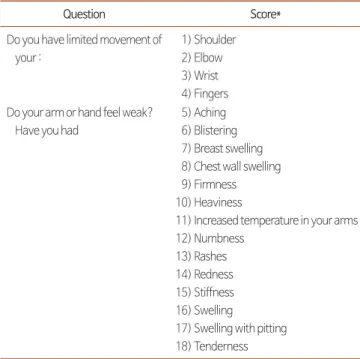
On the day of her first visit, the arm circumferences were 36.0 cm, 32.3 cm on 10 cm, 5 cm above the elbow crease and 31.6 cm, 30.1 cm below the elbow crease (Figure 1). She was suffered from severe pain and discomfort, her pain score was numeric rating scale (NRS) 8. The lymphedema and breast cancer questionnaire (LBCQ) score was 10 (Table 1). The LBCQ consists 19 questions which is a self-administered sur- vey, the higher score means the more severe symptoms (3,4).
Also lymphedema classification was accessed according to the skin condition and severity of swelling (Table 2) (5). Her stage was 2, moderate lymphedema. A right SGB was done with 3 mL of 0.33% lidocaine by palpating the anterior transverse process from the C6 vertebra. We did not use steroid because she had cellulitis treatment few days ago. We measured the arm circumference at four points, NRS pain score and LBCQ score at every visits.
During the follow-up two days later, the arm measured 34.3 and 32.6 cm above the elbow crease, 30.8 and 28.3 cm below the elbow crease. She was still suffered from severe pain, but Figure 1. The arm circumference (right) before SGB treatment.
SGB: stellate ganglion block.
Table 1. Lymphedema and Breast Cancer Questionnaire (LBCQ) Score.
Question Score*
Do you have limited movement of your :
1) Shoulder 2) Elbow 3) Wrist 4) Fingers Do your arm or hand feel weak?
Have you had
5) Aching 6) Blistering 7) Breast swelling 8) Chest wall swelling 9) Firmness 10) Heaviness
11) Increased temperature in your arms 12) Numbness
13) Rashes 14) Redness 15) Stiffness 16) Swelling
17) Swelling with pitting 18) Tenderness
*Patients replied to question, yes/no answers above symptom before and after thoracic sympathetic ganglion block. The number of items answered ‘yes’ is the score.
Table 2. Lymphedema Stage.
Stage Signs and symptoms
0: Latent (subclinical) lymphedema
No visible edema No pitting
Sensations of local heaviness or tightness may be present for months or years before overt swelling occurs
1: Early lymphedema Visible edema, with or without pitting 2: Moderate lymphedema Visible edema, usually with pitting
Hardened, thickened skin and tissue Pitting may disappear as fibrosis worsens 3: Severe lymphedema Visible edema
No pitting
Enlargement of the affected area Hardened, thickened skin and tissue Lymph leaking through damaged skin
she felt firmness and swelling was improved. Her NRS score was 6, and LBCQ score was 8. The right SGB was done in succession.
Five-days-later on her third visit, the warmth and stiffness were markedly improved, her arm measured 34.0 and 32.0 cm above the elbow crease, 30.5 and 26.8 cm below the elbow crease (Figure 2). She felt much better, her NRS score was 5, Her LBCQ score was 8. The third right SGB was done in the same way.
The next day of her third visit, she had right supraclavicle lymph node dissection under general anesthesia, because there a 3 cm malignant metastatic carcinoma on supraclavicle lymph node was detected by sono-guided biopsy. She discharged on POD #3, her arm measured 34.0 and 32.1 cm above the elbow crease, 30.0 and 27.0 cm below the elbow crease. Even though the warmth and stiffness of arm were still existing, her pain score was decreased, NRS 2.
Seven days after discharged, she was admitted again for complain of recurring pain and edema with pitting. Infection lab was increased CRP 5.74, WBC 17×103. General surgery department started cellulitis treatment with IV antibiotics and gave a consultation to pain clinic for relieving symptoms.
Her arm measured 35.5 and 33.4 cm above the elbow crease, 31.5 and 29.7 cm below the elbow crease. She was suffered from relapsed aching pain and stiffness with impaired shoul- der range of motion. Her NRS was 7, LBCQ score was 8. A right SGB was done without steroid. Two days after, her pain was reduced NRS 2 and firmness and heaviness was markedly reduced. At the first time recurring infectious lymphedema surgeons considered lymphatico-venous anastomosis surgery, however her outcome was getting better after successive SGBs, the surgery was hold. Her arm measured 32.9 and 30.7 cm above the elbow crease, 30.2 and 28.0 cm below the elbow
crease. She was satisfied with the outcome, she could able to do daily activities, her pain score was NRS 1, LBCQ score was 4. Especially her range of motion, stiffness, edema were ex- tremely improved.
DISCUSSION
This report is about the effect of SGB with infectious breast cancer related lymphedema (BCRL) in a month follow up.
Even though she had repeated cellulitis on the arm with lymphedema, we decided to treat her lymphedema with SGB injections. Recent study revealed that cellulitis significantly increased the risk of BCRL (6). In this prospective study, they suggested that the axillary lymph node dissection, regional lymph node irradiation, body mass index (BMI≥25), cellu- litis may increase risk of developing BCRL using multivariate analysis. Thus, cellulitis may increase the risk for developing BCRL, and vice versa (6,7).
At the first time she visit our clinic we considered thoracic sympathetic ganglion block (TSGB), but she was not able to positioning in prone because of severe pain on right chest wall.
Previously Choi et al (4) reported that TSGB is an effective method for treating BCRL patients, especially to high stage of lymphedema patients. During her treatment we take ac- count of permanent neurolysis with alcohol or radiofrequency ablation, but she had exceeding improvement on upper arm circumference throughout 5 successive SGBs in a month. Early studies described that the breast cancer related lymphedema is caused by harm to axillary lymphatic system during surgery or radiotherapy (7). Our patient had right breast modified radical mastectomy with axillary lymph node dissection three years ago, it could be the possible reason for the lymphedema with cellulitis. Axillary lymph node dissection (ALND) has considered as an independent risk factor for the development of BCRL (8). When the lymphatic system is disturbed, excess interstitial fluid accumulation starts with increasing interstitial proteins. This leads chronic tissue changes, such as fibrosis, hypertrophy of adipose tissue, and inflammation, contributing to make symptom worse (7).
Several treatments were suggested to treat BCRL including complex decongestive therapy (CDT), manual lymph drain- age (MLD), compression bandages, intermittent pneumatic Figure 2. The arm circumference (right) after third sequential SGBs treatment.
SGBs: stellate ganglion blocks.
compression, pharmacotherapy, and surgical treatments (9,10).
Moreover surgical treatments could be available management for BCLR patients such as vascularized lymph node transfer, lymphaticovenous anastomosis and suction-assisted protein lumpectomy (11). However, our patient had infectious BCRL, there was a limitation to adjust available treatments mentioned above.
Stellate ganglion block (SGB) is a method that injecting an anesthetic drug around the cervical sympathetic trunk. SGB is used treat complex regional pain syndrome (CRPS), post herpetic neuralgia, and hot flush (12,13). The therapeutic use of an SGB for the breast cancer related lymphedema was in- troduced by Swedborg et al. (14). Previous studies reported that the effects of SGB in lymphedema. Kim et al. (15) re- ported that the reduction of circumferences of the upper arm and forearm in BCRL patients by using ultrasonography and subjective assessment after 3 consecutive SGBs using 1% lido- caine 4 mL and 40 mg triamcinolone. Also there was a study about additive effect of corticosteroid in SGB. Park et al. (16) reported that the upper arm circumference was more reduced in 0.5% bupivacaine 4 mL+40 mg of triamcinolone group than only bupivacaine group and 0.5% bupivacaine 4 mL+20 mg of triamcinolone group. Moreover Choi et al. (4) reported that TSGB is more appropriate outcome for blocking the der- matomal thoracic sympathetic nerve. They used 5 mL of 4%
lidocaine without steroid, the arm circumference and LBCQ score were ≥50% decreased in 2 months follow up. Our pa- tient’s arm circumference was markedly decreased, pain (NRS) and LBCQ score was decreased more than 50%, especially her range of motion, stiffness, edema were extremely improved in a serial follow-up in a month.
The mechanism of SGB in BCRL is still unclear. One pos- sible mechanism is that SGB could autoregulate peripheral lymphatic vessels. Collecting lymphatic vessels are innervated by sympathetic and parasympathetic nerve fibers (17). The sympathetic nerve fibers in collecting lymphatic vessels release neurotransmitters to contract lymphatic vessels using smooth muscle cells (18). This autoregulation of lymphatic vessel by SGB could reduce a symptom in infectious BCRL patients.
Another possible mechanism is that SGB may increase ve- nous flow. The SGB leads to reduce vessel resistance, increase systemic volume and interstitial perfusion. Previous reports
showed that the clinical improvement with SGB treatment to patients who are suffering from gynecologic cancer-related lymphedema (19).
Moreover, SGB is known to affect the immune system of the arm (20), such as reduction of chronic inflammatory response and raising skin temperature (21). SGB can modulate the dis- tribution of lymphocytes and NK cells, it leads to manipula- tion of the immune system (20).
In conclusion SGBs can be an alternative option for infec- tious BCRL patients. Especially cellulitis is suggested as a risk factor of BCRL development (6), close monitoring in cellulitis patients after breast cancer surgery can leads subclinical detec- tion and screening. Furthermore early treatment of SGBs could provide better outcomes for infectious BCRL patients. How- ever, it is insufficient to prove the relation between cellulitis and BCRL until now, further evaluations would be necessary in the future.
요약
유방암에 의한 림프부종은 유방암 수술 이후 생기는 치료하기 힘든 부작용 중 하나로 여겨져 왔다. 환자들은 림프부종에 의한 신체적인 기능저하뿐만 아니라 삶의 질 저하로 인한 정신적인 우울감을 호소 한다. 최근의 연구에서는 봉와직염이 유방암에 의한 림프부종의 위 험성을 현저히 높인다는 결과가 있었고, 봉와직염 자체가 유방암에 의한 림프부종을 일으키는 위험 인자로 제시되어 왔다. 본 증례에서 는 1달간의 성상신경절 블록으로 유방암에 의한 염증성 림프부종 환 자의 증상 완화 및 팔 둘레의 현저한 감소에 대해 기술 하고자 한다.
우리는 환자의 팔 둘레를 4군데에서 측정하였는데 각각 팔꿈치를 기 준으로 위 아래 5 cm, 10 cm에서 측정이 이루어졌다. 또한 통증 점 수(NRS) 와 breast cancer questionnaire (LBCQ) 점수를 외래 방문 마다 측정하였다. 두 번의 연속적인 성상신경절 블록 이후 환자의 통 증 점수 및 팔 둘레는 감소하였고, 치료 중간에 봉와직염이 재발하 여 다시 입원하여 항생제 치료와 병행하여 연속적인 성상신경절 블 록을 시행하였고 환자는 시술의 결과에 대해 매우 만족하였다. 특히 환자는 통증 및 붓기의 완화와 어깨 관절의 움직임 개선에 큰 만족을 보였고, 결과적으로 환자의 삶의 질을 높이는데 기여하였다. 본 증례 는 유방암에 의한 염증성 림프부종에 대한 성상신경절 블록의 효과 에 대한 연구로, 스테로이드를 사용하지 않는 성상신경절 블록이 치 료하기 힘든 염증성 림프부종 환자의 대체적이면서 보조적인 치료 방법으로 제시 될 수 있다는 것을 보여준다.
중심단어: 림프부종, 성상신경절, 유방암, 유방암 림프부종
REFERENCES
1. DiSipio T, Rye S, Newman B, Hayes S. Incidence of unilateral arm lymphedema after breast cancer: A systematic review and meta-analysis.
Lancet Oncol 2013;14:500-15.
2. Smoot B, Wong J, Cooper B, Wanek L, Topp K, Byl N, et al. Upper extremity impairments in women with or without lymphedema following breast cancer treatment. J Cancer Surviv 2010;4:167-78.
3. Armer J, Fu MR, Wainstock JM, Zagar E, Jacobs LK. Lymphedema following breast cancer treatment, including sentinel lymph node biopsy.
Lymphology 2004;37:73-91.
4. Choi E, Nahm FS, Lee PB. Sympathetic Block as a New Treatment for Lymphedema. Pain Physician 2015;18:365-72.
5. International Society of Lympology. The diagnosis and treatment of peripheral lymphedema, 2009 Concensus Document of the Interna- tional Society of Lymphology. Lymphology 2009;42:51-60.
6. Ferguson CM, Swaroop MN, Horick N, Skolny MN, Miller CL, Jammallo LS, et al. Impact of ipsilateral blood draws, injections, blood pressure measurements, and air travel on the risk of lymphedema for patients treated for breast cancer. J Clin Oncol. 2016;34:691-8.
7. Bennett Britton TM, Wallace SM, Wilkinson IB, Mortimer PS, Peters AM, Purushotham AD. Sympathetic nerve damage as a potential cause of lymphedema after axillary dissection for breast cancer. Br J Surg 2009;96:865-9.
8. Sayegh HE, Asdourian MS, Swaroop MN, Brunelle CL, Skolny MN, Salama L, et al. Diagnostic Methods, Risk Factors, Prevention, and Man- agement of Breast Cancer-Related Lymphedema: Past, Present, and Future Directions. Curr Breast Cancer Rep 2017;9:111-21.
9. Warren AG, Brorson H, Borud LJ, Slavin SA. Lymphedema: a comprehensive review. Ann Plast Surg 2007;59:464-72.
10. Paskett ED, Dean JA, Oliveri JM, Harrop JP. Cancer-related lymphedema risk factors, diagnosis, treatment, and impact: a review. J Clin Oncol 2012;30:3726-33.
11. Granzow JW, Soderberg JM, Kaji AH, Dauphine C. An effective system of surgical treatment of lymphedema. Ann Surg Oncol 2014;21:1189- 94.
12. Yucel I, Demiraran Y, Ozturan K, Degirmenci E. Complex regional pain syndrome type I: Efficacy of stellate ganglion blockade. J Orthop Trau- matol 2009;10:179-83.
13. Makharita MY, Amr YM, El-Bayoumy Y. Effect of early stellate ganglion blockade for facial pain from acute herpes zoster and incidence of postherpetic neuralgia. Pain Physician 2012;15:467-74.
14. Swedborg I, Arner S, Meyerson BA. New approaches to sympathetic blocks as treatment of postmastectomy lymphedema. Report of a suc- cessful case. Lymphology 1983;16:157-63.
15. Kim HG, Kim KW, Seo HG, Im CY, Kim TU, Chung SG, et al. Clinical outcomes of cervical stellate ganglion block in patients with secondary lymphedema: a pilot study. J Korean Acad Rehab Med 2009;33:297-303.
16. Park JH, Min YS, Chun SM, Seo KS. Effects of stellate ganglion block on breast cancer-related lymphedema: comparison of various injec- tates. Pain Physician 2015;18:93-9.
17. Mignini F, Sabbatini M, Coppola L, Cavallotti C. Analysis of nerve supply pattern in human lymphatic vessels of young and old men. Lymphat Res Biol 2012;10:189-97.
18. Planas-Paz L, Lammert E. Mechanical forces in lymphatic vascular development and disease. Cell Mol Life Sci 2013;70:4341-54.
19. Woo JH, Park HS, Kim SC, Kim YH. The effect of lumbar sympathetic ganglion block on gynecologic cancer-related lymphedema. Pain Phy- sician 2013;16:345-52.
20. Yokoyama M, Nakatsuka H, Itano Y, Hirakawa M. Stellate ganglion block modifies the distribution of lymphocyte subsets and natural-killer cell activity. Anesthesiology 2000; 92:109-15.
21. Kim SH, Kim KN, Lee DG, Chae WS, Kim YI. Follow-up evaluation of the effect of stellate ganglion block using thermography. Korean J Pain 2006;19:115-8.