http://dx.doi.org/10.5369/JSST.2014.23.2.73 pISSN 1225-5475/eISSN 2093-7563
Si PIN Radiation Sensor with CMOS Readout Circuit
Yu-mi Kwon, Hee-Sung Kang, Jung-Hee Lee, and Yong Soo Lee
+Abstract
Silicon PIN diode radiation sensors and CMOS readout circuits were designed and fabricated in this study. The PIN diodes were fab- ricated using a 380-μm-thick 4-inch n+ Si (111) wafer containing a 2-kΩ·cm n- thin epitaxial layer. CMOS readout circuits employed the driving and signal processes in a radiation sensor were mixed with digital logic and analog input circuits. The primary functions of readout circuits are amplification of sensor signals and the generation of the alarm signals when radiation events occur. The radiation sensors and CMOS readout circuits were fabricated in the Institute of Semiconductor Fusion Technology (ISFT) semiconductor fab- rication facilities located in Kyungpook National University. The performance of the readout circuit combined with the Si PIN diode sensor was demonstrated.
Keywords: Si PIN diode, Si epitaxy wafer, Radiation sensor, CMOS readout circuit, Fast response
1. INTRODUCTION
The detection of excessive radiation has attracted world-wide attention since the occurrence of nuclear plant accidents such as Japan’s Fukushima nuclear crisis. Some radiation energy is very fatal and can seriously damage human organisms and/or electronic systems. Therefore, for quick detection and establishment of countermeasures against radiation incidents, a compact and portable radiation detection system used on-chip technology must be developed.
Radiation detection systems are typically used in harsh environments such as space shuttles, x-ray generators, aircrafts, weapon systems, and medical systems. Radiation sensors have been taken advantage of semiconductors as the basic materials [1-3]. Moreover, the detection efficiencies of both compound semiconductors and Si devices have been studied extensively [4-7]. Because compound semiconductors have variable bandgaps, diverse wavelength sensing applications are available [8,9]. Moreover, space charge accumulation and charge-carrier trapping that lower optical responsivity in compound
semiconductor sensors can be mitigated by using silicon [6, 10].
Therefore, in this study, we adopted a Si PIN diode for a radiation sensor connected to CMOS ROIC (readout circuit).
Different analog and digital readout circuit signals transferring diode signals to subsequent signal process steps have been developed. In this study, we employed a fast signal processing circuit and low-power consumption logic for the successful operation of the readout circuit. The CMOS ROICs were fabricated in ISFT CMOS fabrication facilities of Kyungpook National University.
2. EXPERIMENTAL
2.1 Si PIN diode fabrication
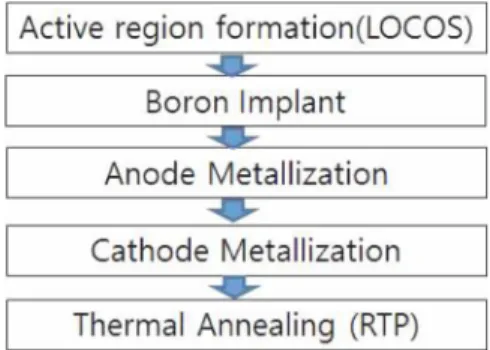
The fabrication process flow of a PIN diode is shown in Fig. 1.
PIN diodes were fabricated using a 380-um-thick 4-inch n+
Si(111) wafer having a resistivity of 0.004~0.008 Ω·cm and containing a 2-kΩ·cm n- thin epitaxial layer. Masks used for diode fabrication consist of LOCOS, ion implantation for p+ and guard- ring regions, and contact open processes for metallization.
Initially, active region isolation between devices was performed using the LOCOS process. Subsequently, boron ions were implanted in the p+ and guard-ring regions at 50 KeV with a dose of 1 ×10
15cm
−2. A 300-nm-thick SiO
2film was subsequently deposited using TEOS to prevent the out-diffusion of implanted ions, and then, the samples were activated at 1000
oC for 2 hrs in N
2ambient. After the annealing process, the TEOS layers were School of Electronics Engineering, Kyungpook National University
80 Daehakro,Bukgu, Daegu, 702-701,Korea
+