Measurement of Quality of Life of Breast Cancer Patient With Arm Lymphedema Using the SF-36 (Korean version)
Sung-jung Kim, M.Sc., P.T.
Dept. of Physical Therapy, Youngdong University
Abstract
1)The purpose of this study was to compare the quality of life (QOL) between breast cancer patients with lymphedema and without using the SF-36 (Korean version). Fifty-three consecutive, unselected pa- tients who underwent treatment for breast cancer patients with lymphedema and 37 patients without lym- phedema from August 4, 2004 to October 13, 2005 were interviewed and asked to complete the SF-36.
These data were used to test the hypothesis that breast cancer patients with lymphedema experience im- paired quality of life relative to their control group. The lymphedema group scored poorer than the control group on six of the eight subscales as well as the physical component summary scale of the SF-36 (p<.05). Only bodily pain didn't show statistical difference (p>.05). Breast cancer patients with lymphede- ma appear to experience problems in multiple quality of life domains compared with without lymphedema group. These findings demonstrate the need for interventions to improve the quality of life in breast can- cer patients with lymphedema.
Key Words: Breast cancer; Lymphedema; SF-36; Quality of life.
Introduction
Breast cancer-related lymphoedema, due to im- paired lymphatic drainage from the arm secondary to axillary surgery and/or radiotherapy, is one of the common complication. Although disease management has improved and leading to the well-published re- cent decline in breast cancer deaths (Peto et al, 2000), breast cancer-related lymphedema occur in around 24 % of cases (Mortimer et al, 1996) so, greater emphasis has been placed upon the side-ef- fects of cancer treatment (Pain et al, 2003).
The condition of lymphedema is chronic because it is not possible to reverse the damage that has caused the swelling. Affected patients have an un- sightly, uncomfortable arm, prone to repeated epi- sodes of infections, with the rare, but potentially fa- tal, complications of secondary lymphangiosarcoma (Foldi, 1998). The aim of treatment is not cure but reduction of limb size, usually with the use of man- ual lymphatic drainage (MLD), skin care, remedial
exercise, compression garments, pneumatic pump, mercury compression, oral and topical benzopyrones, elevation, microwave and laser therapy (Foldi, 1998).
There are several physical and emotional factors related to lymphedema (Passik and McDonald, 1998), such as increased weight of the edematous limb with restricted motion aggravated by fibrosis and joint contracture, and altered sensitivity and embarrass- ment during social interactions, but most studies evaluating lymphedema emphasis on the physical as- pects using volumetric measurements of the limb as the primary tool (Didem et al, 2005; Liao et al, 2004)
Accordingly, a broader clinical approach in terms of quality of life (QOL) during diagnosis and fol- low-up would likely benefit theses patients (Pereira et al, 2002). Evaluation of QOL has increasingly be- come an important issue in breast cancer patients with lymphedema. Topics of study have included the emotional, social, psychological, and sexual effects of breast cancer treatment (Ganz, 1997; Lee, 1997;
Moyer, 1997). Though there has been a great deal of Corresponding author: Sung-jung Kim [email protected]
research aimed at understanding the quality of life of breast cancer patients, most of the research has fo- cused on the various types of lymphedema (Moffatt et al, 2003; Pereira de Bodoy et al, 2002; Sitzia and Sobrido, 1997; Weiss and Spray, 2002) or without matched control group (Carter, 1997; Johansson, 2003;
Launois and Megnigbeto, 2001; Woods, 1995).
It seems clear that chronic edema does have im- plications for patients' QOL. Patients with edema experience a wide range of psychological and phys- ical difficulties, including poor body image, anxiety, depression, embarrassment, impaired limb movement, impaired physical mobility and pain. However, the methodological issues have hardly been explored (Sitzia and Sobrido, 1997).
The range of concerns identified in these stud- ies suggests that the The SF-36 (Medical Outcome Study 36-Short-Form) is a potentially useful instrument to evaluate the QOL in breast cancer with lymphedema. The SF-36 served as the primary measure of Quality of life. This measure contains eight subscales relevant to the general health of the individual: physical function- ing (PF), role-physical (RP), role-emotional (RE), mental health (MH), bodily pain (BP), general health (GH), vitality (VT), and social functioning (SF). All scores are standardized so that the worst possible score is 0 and the best possible score is 100 (ie, the optimal level of health in that domain). The reliability and validity of the SF-36 as a measure of health-related quality of life is well established (Ware et al, 2004).
Although the SF-36 has been chosen by the National Adjuvant Surgical Brest and Bowel Project (NSABP) as the quality of life instrument in their breast cancer prevention trial (Ganz et al, 1995) and the reliability and validity of it is well established (Ware et al, 2004). A literature search found few studies of the QOL between brest cancer with lym- phedema and breast cancer without lymphedema us- ing SF-36.
The purpose of this study was to determine the
physical and psychological effect on the quality of life between breast cancer patients with clinically apparent lymphedema and breast cancer patients without lymphedema using the SF-36 (Korean ver.).
Methods
Subjects
Data was collected from two samples: breast cancer patients who has had lymphedema and without lymphedema (control group) within 5 years after cancer-related treatment. Criteria for inclusion for the lymphedema group were patients who were physician-referred for lymphedema treatment to 3 outpatient physical therapy clinic in South Korea between August 4, 2004 and October 14, 2005. In addition, these women had to 1) be 19 years or older, 2) have no known neurological disorder that would interfere with completion of the measures, 3) can speak and read, 4) have no history of treatment for other types of cancer, 4) have no known untreated or unstable medical con- ditions, 5) have no edema in lower limb. 6) had to have completed adjuvant chemotherapy, radiation and surgical treatment for breast cancer a mini- mum of 3 months and a maximum of 5 years pre- viously, 7) have no evidence of disease recurrence at the most recent follow-up visit. 58 patients met all eligibility criteria. 5 of these patients refused to participate, complete data were obtained from the remaining 53 eligible patients (91.4%).
A control group was also recruited. Criteria for inclusion was same with lymphedema group but they have no history of lymphedema. of 45 patients who met all eligibility criteria, 8 did not answer the ques- tionnaire packet completely. complete date were ob- tained from the remaining 37 breast cancer patients without lymphedema (82.2%).
Procedures
After clinical examination and documentation, an informed consent of the purpose of the study was
Characteristic Lymphedema group (n1=53) Control group (n2=37) Test result Age(years)
Mean (SD) Range
52.0(8.1) 35.0~69.0
49.1(7.6) 35.0~72.0
Not significant
BMI
Mean (SD) Range
24.6(2.3) 19.2~31.5
23.8(2.5) 19.2~29.3
Not significant
Education
Elementary school 2 1
Middle school 5 2
High school 28 21 X²=.6, p=.89
College or above 18 13
Religion
Yes No
32 25 X²=.49, p=.496
21 12
Occupation Yes No
42 28 X²=.16, p=.689
11 9
Economic status
High 19 11
Moderate 29 24 X²=1.08, p=.58
Low 5 2
Marital status
Married 47 33 X²=.21, p=.65
Unmarried 6 3
Cancer-related treatment Surgery only Radiotherapy only Surgery and radiotherapy
16 1 36
16 0 21
X²=2.17, p=.34
Time since urgery/radiotherapy (years) Mean (SD)
Range
2.6(1.3) .4~4.8
2.0(1.2)
.5~4.9 Not significant
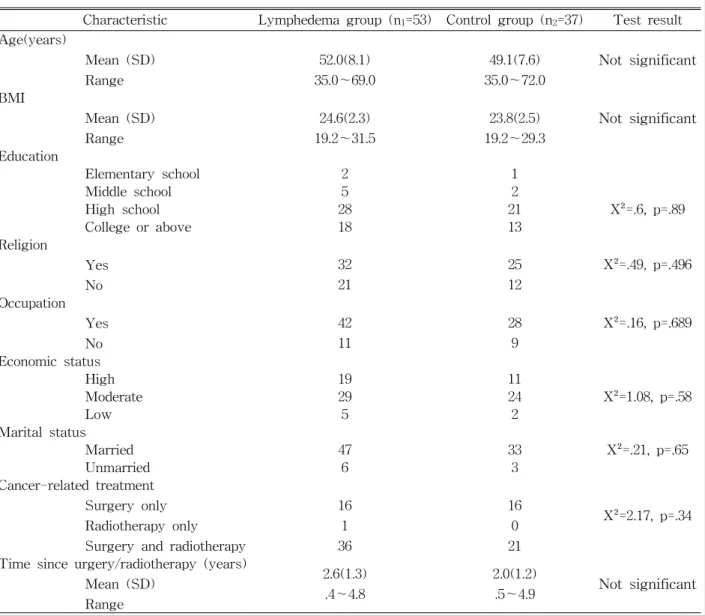
Table 1. Demographics on lymphedema group and control group characteristics (N=90) obtained in each patient to study the QOL. Each pa-
tient was sent to a physical therapist for lymphede- ma treatment and was asked to complete a generic questionnaire SF-36 (Korean Ver.). A control group, consisting of 37 patients without lymphedema, sim- ilarly completed the questionnaire.
The data were analysed using SPSS for windows.
The differences between lymhedema group and con- trol group were examined using the chi square test (for categorical data, such as types of cancer-related treatment) and the t-test (for continuous data, such as age). The two-sample test was used for statistical analysis with a p-value <.05 taken as significant.
Results
Demographics on lymphedema group and control group are shown in Table 1. A total of 90 patients were studied. The lymphedema group consisted of 53 patients, with an average age of 52.0±8.1 years. BMI was from 19.2~31.5 (M=24.6; SD=2.3). A majority of these women were married (88.7%), and currently working (79.2%). 52.8% indicated they were high school graduates. Fifty-four percent of lymphedema group reported economic status were moderate. The average length of time since surgery/radiotherapy was from .4~4.8 years (M=2.6; SD=1.3). With regard
Lymphedema group (n1=53) Control group (n2=37) p Funcional status
Physical functioning 65.5±22.8a 76.6±16.0 .012
Social functioning 65.1±22.2 78.0±20.9 .007
Role limitation-physical 26.4±32.3 55.4±41.30 .00
Role limitation-emotional 33.3±35.2 58.6±41.9 .003
Well-being
Mental health 55.5±20.1 72.0±20.7 .000
Vitality 38.96±19.7 66.1±22.7 .000
Bodily pain 65.0±23.7 73.6±19.7 .073
Overall evaluation of health 51.2±21.3 63.1±17.5 .006
aMean±SD.
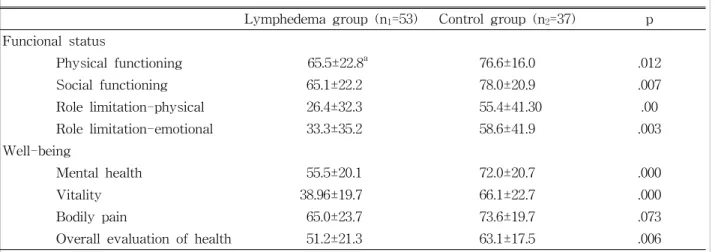
Table 2. Comparison of lymphedema group and control group (N=90)
to their cancer-related treatment, 36 women (67.9%) had surgery and radiotherapy.
The control group consisted of 37 patients, with an average age of 49.1±7.6 years. BMI was from 19.2~31.5 (M=23.8; SD=2.5). A majority of these women were married (89.2%), and currently working (75.7%). 56.8% indicated they were high school graduates. sixty-four percent of lymphede- ma group reported economic status were moderate. The average length of time since sur- gery/radiotherapy was from .4~4.8 years (M=2.6;
SD=1.3). With regard to their cancer-related treatment, 21 women (56.8%) had surgery and radiotherapy.
There was no statistically significant difference in the average age between lymphedema group and control group.
Table 2 presents the mean scores of all domains of the SF-36 for each group of patients. There was a statistically significant difference in all scores:
Physical functioning (p=.012); Social functioning (p=.007); Role limitation-physical (p=.00); Role limi- tation-emotional (p=.003); Mental health (p=.000);
Vitality (p=.000); Overall evaluation of health (p=.006). Only bodily pain didn't show statistical significance (p=.073).
Discussion
The perception of the state of health and the QOL of patients, as well as impact of the breast cancer and its modern treatment, are widely recognized as important issues in epidemiological research (Velanovich and Szymnanski, 1999). QOL outcomes have also served as endpoints in studies of treatment.
Psychometric techniques are utilized in the evaluation of the QOL. Generic scales and specific disease tests are two instruments most frequently used to measure the main aspects of QOL (TASC, 2000).
Wapnir et al (1996) demonstrated superior QOL in patients undergoing breast conservation versus those treated with mastectomy. Broeckel et al (2000) showed that the postchemotherapy group scored poorer than the noncancer comparison group. Dow et al (1996) reported that breast cancer survivors expe- rienced long-term changes after completion of treat- ment which affected overall quality of life. Another recent study demonstrated that Bloom et al (2004) report that young breast cancer survivors in five years after diagnosis who remained cancer-free en- joyed good health and improved quality of life. What these studies clearly demonstrate is that breast can- cer treatments have an important impact on quality of life and this impact cannot be ignored.
One of the ways breast cancer treatment affects
quality of life is lymphedema. In fact, the impetus to use selective ALND (Velanovich, 1998) or to as- sessed lymph node involvement using sentinel lymph node biopsy (Albertini et al, 1996) instead of com- plete ALND is to avoid lymphedema. Fortunately, the incidence of lymphedema has decrease as operations have become less radical (Horsley and Styblo, 1991).
but because of increase of breast cancer. lots of pa- tients suffered from lymphedema after treatment of breast cancer.
This study demonstrates that when breast cancer patients with lymphedema occurs, it can be a debili- tating problem. we hypothesized that QOL would be poorer in women who had lymphedema after treat- ment of brest cancer than in a comparison group of women with no lymphedema after that. All eight ares covered in the test were cited as less than sat- isfactory in the breast cancer patients with lymphe- dema indicating deterioration in the QOL of these individuals when compared with control group. we found the largest differences between lymphedema group and control group on measures assessing limi- tations in PF, SF, RP, RE, MH, Vitality, GH and problems with work or other daily activities. In con- trast, the smallest differenced between groups were on measures assessing pain and problems with work or other daily activities due to bodily pain. The physical aspect directly relates to impairment of the lymphedematous limb. Pain, which normally is not considered a major symptom of lymphedema does, in fact, does not interfere in the QOL. The symptom probably relates to tightness or ongoing overt or la- tent inflammation and represents a nagging incon- venience in lifestyle. Overall health and vitality were also less than optimal with a constant uncomfortable feeling in the swollen upper limb. Mental health was also adversely affected suggesting that physical im- pairment interferes with mental well-being. In this setting, deteriorating social and emotional health as- pects were not surprising.
The results reported here are inconsistent with previous report (Velanovich, 1998) that compared the
SF- 36 of lymphedema patients with non-lymphede- ma patient. The discrepancy between these findings and those from the current study in the bodily pain domain may be accounted for by differences in dem- ographic characteristics and number of study samples. The present study include women with lymphedema treated with various combinations of surgery, radiotherapy, hormonal therapy and/or che- motherapy, wheres the previous study was limited to women who underwent brest surgery and/or ALND
These data highlight the importance of broadening care to treat these patients more than just the phys- ical ramification of lymphedema. It also suggests, however, that the more effectively one can treat the physical condition, the more the emotional and social aspects are likely to improve. Nonetheless, a mul- tu-disciplinary team is desirable if the QOL of a pa- tient with lymphedema is to be optimized.
Conclusion
The most important outcome for patient with lym- phedema is QOL. Measurement of health-related QOL is based on the assessment of the individual's perception regarding physical, mental, and social functioning. The lymphedema group scored poorer than the control group on six of the eight subscales as well as the physical component summary scale of the SF-36 (p<.05). Only bodily pain didn't show statistical difference (p>.05). Further research, sup- ported by larger patient populations, may be required to determine which treatment method best improves QOL of patients with varying characteristics and sites of lymphedema.
References
Albertini JJ, Lyman GH, Cox C, et al. Lymphatic mapping and sentinal node biopsy in the patient with breast cancer. JAMA. 1996;276:1818-1822.
Broeckel JA, Jacobsen PB, Balducci L, et al. Quality of life after adjuvant chemotherapy for breast cancer. Breast Cancer Res Treat.
2000;62:141-151.
Bloom JR, Stewart SL, Chang S, et al. Then and now: Quality of life of young breast cancer survivors. Psychooncology. 2004;13(3):147-160.
Carter BJ. Women's experiences of lymphedema.
Oncol Nurs Forum. 1997;24(5):875-82.
Didem K, Ufuk YS, Serdar S, et al. .The comparison of two different physiotherapy methods in treat- ment of lymphedema after breast surgery.
Breast Cancer Res Treat. 2005;93(1):49-54.
Dow KH, Ferrell BR, Leigh S, et al. An evaluation of the quality of life among long-term survivors of breast cancer. Breast Cancer Res Treat.
1996;39(3):261-273.
Foldi E. Treatment of lymphedema and patient rehabilitation. Anticancer Res. 1998;18:2211-2212.
Ganz PA. Sexual functioning after breast cancer: A conceptual framework for future studies. Ann Oncol. 1997;8:105-107.
Ganz PA, Day R, Ware JE Jr, et al. Baseline quality of life assessment in the National Surgical Adjuvant Breast and Bowel Breast Cancer Prevention Trial. J Natl Cancer Inst.
1995;87:1372-1382.
Horsley JS, Styblo T. Lymphedema in the post- mastectomy patient. In: Bland KI, Copeland EM
Ⅲ, eds. The Breast, Philadelphia, WB Saunders, 1991:701-706.
Johansson K, Holmstrom H, Nilsson I, et al. Breast cancer patients' experiences of lymphoedema.
Scand J Caring Sci. 2003;17(1):35-42.
Launois R, Megnigbeto A, LeLay K, et al. A specific quality of life scale in upper limb lymphoedema:
The ULL-27 questionnaire. Value Health.
2001;4(6):407-408.
Liao SF, Huang MS, Li SH, et al. Complex decon- gestive physiotherapy for patients with chronic cancer-associated lymphedema. J Formos Med Assoc. 2004;103(5):344-348.
Lee CO. Quality of life and breast cancer survivors.
Psychosocial and treatment issues. Cancer Pract.
1997;5:309-316.
Moffatt CJ, Franks PJ, Doherty DC, et al.
Lymphoedema: An underestimated health problem. Q J Med. 2003;96(10):731-738.
Mortimer PS, Bates DO, Brassington HD, et al. The prevalence of arm oedema following treatment for breast cancer. Q J Med. 1996;89:377-380.
Moyer A. Psychosocial outcomes of breast-conserv- ing surgery versus mastectomy: A meta-ana- lytic review. Health Psychol. 1997;16:284-298.
Pain SJ, Vowler SL, Purushotham AD. Is physical function a more appropriate measure than vol- ume excess in the assessment of breast can- cer-related lyumphoedema (BCRL)? Eur J Cancer. 2003;39:2168-2172.
Passik SD, McDonald MV. Psychosocial aspects of upper extremity lymphedema in women treated for breast carcinoma. Cancer. 1998;83(12 Suppl Am):2817-2820.
Pereira de Godoy JM, Braile DM, de Fatima Godoy M, et al. Quality of life and peripheral lymphedema. Lymphology. 2002;35:72-35.
Peto R, Boreham J, Clarke M, et al. UK and USA breast cancer deaths down 25% in year 2000 at ages 20-69 years. Lancet. 2000;355:1822
Sitzia J, Sobrido L. Mesurement of health-related quality of life of patients receiving conservative treatement for limb lymphoedema using Nottingham Health Profile. Qual Life Res.
1997;6:373-384
TASC (Management of Peripheral Arterial Disease (PAD). A3 Outcome Assessment Methodology in Peripheral Disease. J Vasc Surg. 2000:S40-S42.
Velanovich V. Axillaury lymph node dissection for breast cancer: A decision analysis of T1 lesions.
Ann Surg Oncol. 1998;5:131-139.
Velanovich V, Szymanski W. Quality of life of breast cancer patients with lymphedema. Am J Surg.
1999;177(3):184-187.
Wapnir IL, Cody RP, Greco RS. Superior quality of
This article was received October 15, 2006, and was accepted October 30, 2006.
life following lumpectomy-axillay dissection in patients with stage Ⅰ and stage Ⅱ breast cancer. Surg Forum. 1996;47:635-637.
Ware JE, Kosinski M, Gandek B. SF-36 Health Survey: Manual and interpretation guide.
Lincoln, RI: QualityMetric Incorporated, 2004.
Weiss JM, Spray BJ. The effect of complete decon- gestive therapy on the quality of life of patients with peripheral lymphoedema. Lymphology 2002;35(2):46-58.
Woods M. Sociological factors and psychosocial im- plications of lymphoedema. Int J Palliat Care.
1995;1(1):17-20.