• 검색 결과가 없습니다.

Fabrication and Characterization of Carbon Nanotube/Carbon Fiber/Polycarbonate Multiscale Hybrid Composites

N/A
N/A
Protected

Academic year: 2021

Share "Fabrication and Characterization of Carbon Nanotube/Carbon Fiber/Polycarbonate Multiscale Hybrid Composites"

Copied!
7
0
0

로드 중.... (전체 텍스트 보기)

전체 글

(1)

Paper

Fabrication and Characterization of Carbon Nanotube/Carbon Fiber/Polycarbonate Multiscale Hybrid Composites

Beom-Gon Cho*, Sang-Ha Hwang*, Young-Bin Park*

ABSTRACT: Multiscale hybrid composites, which consist of polymeric resins, microscale fibers and nanoscale reinforcements, have drawn significant attention in the field of advanced, high-performance materials. Despite their advantages, multiscale hybrid composites show challenges associated with nanomaterial dispersion, viscosity, interfacial bonding and load transfer, and orientation control. In this paper, carbon nanotube(CNT)/carbon fiber(CF)/

polycarbonate(PC) multiscale hybrid composite were fabricated by a solution process to overcome the difficulties associated with controlling the melt viscosity of thermoplastic resins. The dependence of CNT loading was studied by varying the method to add CNTs, i.e., impregnation of CF with CNT/PC/solvent solution and impregnation of CNT- coated CF with PC/solvent solution. In addition, hybrid composites were fabricated through surfactant-aided CNT dispersion followed by vacuum filtration. The morphologies of the surfaces of hybrid composites, as analyzed by scanning electron microscopy, revealed the quality of PC impregnation depends on the processing method. Dynamic mechanical analysis was performed to evaluate their mechanical performance. It was analyzed that if the position of the value of tan δ is closer to the ideal line, the adhesion between polymer and carbon fiber is stronger. The effect of mechanical interlocking has a great influence on the dynamic mechanical properties of the composites with CNT- coated CF, which indicates that coating CF with CNTs is a suitable method to fabricate CNT/CF/PC hybrid composites.

Key Words: Multiscale hybrid composite, Carbon fiber, Carbon nanotube, Vacuum filtration, Mechanical properties

1. INTRODUCTION

In recent years, carbon fiber reinforced plastics (CFRPs) modified with carbon nanotubes (CNTs), known as “multi- scale hybrid composites” have been extensively researched in many fields, such as aerospace, automobiles, marine, railway, and sporting goods industries [1,2]. The multifunctional com- posites and nanocomposites have many properties, such as light weight, structural reinforcement, electrical and thermal conductivities, EMI shielding and radar absorption, fire retar- dancy, sensing and energy harvesting, etc. Meanwhile, the multiscale hybrid composites have drawn significant attention in the field of advanced, high-performance materials [3]. The significant advantages of multiscale hybrid composites are high aspect ratio, high chemical stability, high conductivity and low mass density. On the other hand, the multiscale

hybrid composites have several challenges in relation to dis- persion, viscosity, interfacial bonding and load transfer, and orientation control [4]. As these terms are changed, the prop- erties of the composites will be markedly controlled. In par- ticular, the first of these challenges is the difficulty associated with fiber volume fraction control. Second, the high melting viscosity of thermoplastic resins causes them difficult to infil- trate into the fibers. Recently, thermoplastic resins are spot- lighted because of higher processibility and recyclability, but their high melting viscosity makes the impregnation difficult [5,6]. The third issue is poor out-of-plane properties for FRPs (e.g. delamination) [6,7].

Several researches have been reported on impregnation of CNTs into carbon fibers (CFs): infusion/impregnation of a CNT-resin mixture into the primary fiber assembly [8,9], direct growth of CNTs on reinforcement fiber surface through

Received 10 August 2016, received in revised form 31 October 2016, accepted 31 October 2016

* *

Department of Mechanical Engineering, UNIST

Department of Mechanical Engineering, UNIST, Corresponding author (E-mail: [email protected])

(2)

chemical vapor deposition (CVD) [10,11], direct placement of CNTs between layers of the preform [12], electrophoretic deposition onto the surface of fiber [13,14], electrostatic assembly of oxidized CNTs onto functionalized fiber [15] and coating of fiber with CNT-containing sizings [16-20]. Espe- cially, the first and the third methods are widely used due to the easiness of application. The addition of CNTs generally overcomes the difficulties in fiber volume fraction control and poor out-of-plane properties for FRPs, and also improves the thermo-mechanical properties of the composite, increasing the glass transition temperature (Tg) of the matrix and decreasing its coefficient of thermal expansion [21]. Infusing CNT-resin mixture into the fiber, which is the mainly per- formed method, is a solution-based process that eliminates the need to consider the melting viscosity of thermoplastic resin [22]. Solution-based method provides an advantage for low viscosity which facilitate mixing and dispersion of the CNTs.

In this paper, CNT/CF/PC multiscale hybrid composites are fabricated by a solution process to overcome the difficulty of controlling the melt viscosity of thermoplastic resin. Further- more, the amount of CNT added to polymer solution is varied to understand its effect on the mechanical properties of the composites. High-energy sonication was used to achieve uni- form dispersion of CNTs in the polymer solution. Types of sonication used are horn sonication and bath sonication included in ultrasonication which is a very effective method of dispersion and deagglomeration of CNTs, as ultrasonic waves of high-intensity ultrasound generated cavitation in liquids [3, 22]. The stirred solution was impregnated to CF by vacuum filtration to investigate the effect of impregnation for resin as compared with current widely used method to impregnate (e.g. spraying). Furthermore, the fiber coated with CNTs to detect difference of mechanical properties of specimens fab- ricated by solution process. Dynamic mechanical analysis (DMA) was performed to evaluate their mechanical perfor- mances by estimating from “rule of mixtures” for an ideal composite and scanning electron microscopy (SEM) was employed to examine the micro-scale morphologies of surface of fiber, the uniformity of impregnation of polymer into fiber and state of CNTs coated on fiber.

2. EXPERIMENTAL

2.1 Materials

MWCNTs (CM-250, Hanwha Chemical, Korea) with a purity rating of >95%, 5-10 nm inner diameter, 60-100 nm outer diameter were used as additives to improve the prop- erties of hybrid composites. The polymer solution was created by dissolving polycarbonate (PC, Honam Petrochemical, Korea), which is a particular group of thermoplastic polymers that can be easily worked, molded, and thermoformed, in chloroform (CHCl

3

, Daejung Chemicals & Metals, Korea) as solvent and dimethylformamide (DMF, Samchun Pure Chem-

icals, Korea) was added to the polymer solution as co-solvent.

Plain-woven carbon fiber was used to reinforce conventional micron-sized advanced fiber. The surfactant, Triton X-100, was purchased from OCI, Korea.

2.2 Composite fabrication

First, 50 g of PC was weighed and dissolved in 500 mL of CHCl

3

, and the solution was impregnated to neat carbon fiber fabric. The same procedure was applied to impregnation of 2- ply woven fabrics with polymer solution. In this study, two impregnation methods were used: (1) impregnation of CNT/

PC/CHCl

3

solution to neat CF fabrics; and (2) impregnation of PC/CHCl

3

solution to CF fabrics coated with CNTs. The moti- vation behind these methods was to overcome the difficulties associated with controlling the melting viscosity of thermo- plastic resins and fiber volume fractions. Pre-calculated amounts of CNTs and PC were dissolved and mixed in CHCl

3

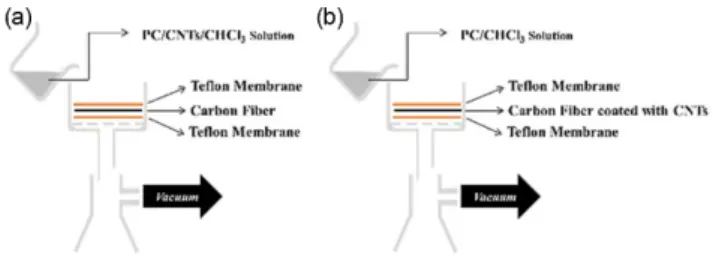
, such that the weight fraction of CNTs for PC were varied as 0.5 wt.% (0.25 g), 1 wt.% (0.5 g), and 3 wt.% (1.55 g). The weight of PC was 50 g for each sample. After 6 h of stirring and 2 h of dispersing in a bath-type sonicator, the stirred solu- tion was impregnated into woven fabrics by vacuum filtration through a Teflon membrane (0.45 μm pore size, Airtech). The infiltrated fabrics were placed in a vacuum oven and dried at room temperature for 12 h before being separated from the membrane (Fig. 1(a)). In the other method, 0.5 mL of sur- factant and 400 mL of co-solvent were dissolved in 500 mL of CHCl

3

and 0.02 wt.% as 10 mg of CNTs for 50 g of PC were dispersed in surfactant/co-solvent/CHCl

3

solution. After 6 h of stirring and 1.5 h of horn sonication, the solutions were fur- ther dispersed for 1 h with a bath-type sonicator. The carbon nanomaterial suspension was filtered through a Teflon mem- brane and carbon fiber fabrics were coated with CNTs. The fabrics were washed with methanol to remove residual sur- factant and dried at room temperature in vacuum oven for 12 h.

As shown in Fig. 1(b), the CF fabrics coated with CNTs were placed between two Teflon membrane filters and vacuum infiltrated with 500 mL of PC/CHCl

3

solution (100 g/L). Sub- sequently, the PC-impregnated CF fabrics were dried at room temperature in vacuum oven for 12 h.

2.3 Characterization

The mechanical properties of PC-impregnated CF were

Fig. 1. Schematic diagram of PC impregnation with (a) solution

process and (b) coating process

(3)

obtained by using a dynamic mechanical analyzer (DMA, TA Instruments Q800) under tension mode, operated in fre- quency sweep mode at room temperature, from which storage modulus (E'), loss modulus (E'') and tan δ were measured. The samples were cut into 38 mm by 5.5 mm rectangles, and thick- ness was varied from 380 to 550 μm. The gage length was 15 mm, and the tensile load was applied at a rate of 2 mm/min.

Five specimens were tested for each of 5 samples with varying amounts of CNTs added to polymer solution and types of impregnation of CNTs to CF fabrics. In addition, the viscos- ities of PC/CHCl

3

and CNT/PC/CHCl

3

solutions were obtained by using a viscometer (DV-E, Brookfield).

The morphologies of surface of CF fabrics coated with CNTs and impregnated with PC were observed using a scan- ning electron microscope (SEM, FEI Nanonova 230) after being coated with platinum.

3. RESULTS AND DISCUSSION

3.1 Microstructure and morphology

The morphological characterization of CNT-reinforced composites is normally obtained by using an SEM, which pro- vides information of state of carbon fiber fabrics surface coated with CNTs and impregnation of PC and some sub- sequent analysis to interfacial strength between polymer and carbon nanomaterials as well as the wetting of the fibers by the matrix [5,23].

As shown in Table 1, the fiber volume fractions (V

f

) of each samples were calculated using the following equation:

(1) where, ρ

m

, ρ

f

mean the density of matrix and fiber, and W

m

,

W

f

indicate the weight of matrix and fiber. There is need for the density of PC and CF to calculate the V

f

. We used these

V

f

= ρ

m

W

f

/ ( ρ

f

W

m

+ ρ

m

W

f

)

Table 1. Fiber volume fraction of each sample CNT weight

(impregnation before/after

(g))

PC weight (impregnation

before/after (g))

CNT content

(wt.%)

Method (as to CNTs)

Fiber volume fraction (%)

- 50 /0.8 - - 69.26

0.25 /0.005 50/1 0.5 Solution process 64.31 0.5 /0.012 50/1.2 1 Solution process 60.03 1.55 /0.039 50/1.3 3 Solution process 58.09 0.01 /0.00016 50/0.78 0.02 Coating process 69.79

Fig. 2. Digital photographs of samples fabricated: (a) by solution process and (b) by coating process

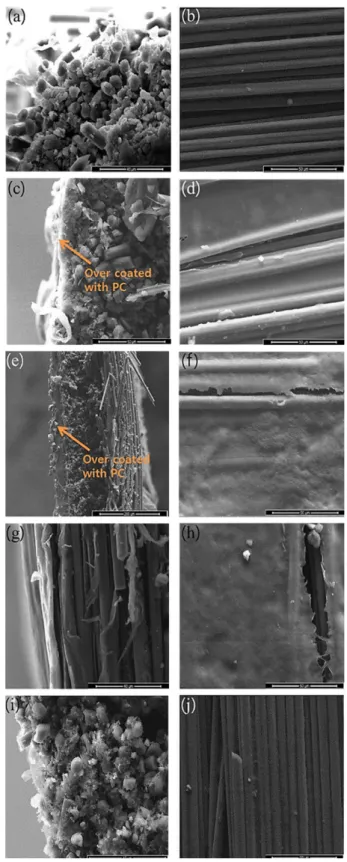
Fig. 3. SEM images of surfaces of PC-impregnated CF: no CNT (a)

cross, (b) top and dispersed CNTs of (c), (d) 0.5 wt.% -cross,

top and (e), (f ) 1 wt.% -cross, top and (g), (h) 3 wt.% -cross,

top and coated with CNTs of (i), (j) 0.02 wt.% -cross, top

(4)

values of 1.21 g/cm

3

of PC and 1.41 g/cm

3

of CF which are widely used. Then, it is possible to determine the V

f

using the weight of CF and PC obtained from experiments (Table 1). In the case of a solution process where CNTs were dispersed in a polymer solution, V

f

decreased as 64.31, 60.03, 58.09%, but in the other method coating process, V

f

maintained a value, 69.79%, similar to the sample containing no CNTs, 69.26%.

When filtrating CNT/PC/CHCl

3

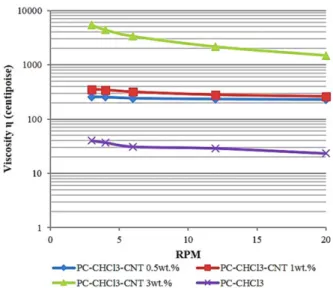
solution through CF fabrics, PC was not impregnated in CF fabrics well but it was over- coated on the surface of CF fabrics (Fig. 3(c-h)) because of high viscosity of the CNT/PC solution, which was verified using a viscometer. As shown in Fig. 4, the viscosity of CNT/

PC/CHCl

3

solution is higher than that of PC/CHCl

3

solution.

In the former solution, viscosity increased from 227.4 to 1478 cP at 20 rpm, as the CNT content increased from 0.5 to 3 wt.%. The viscosity of PC/CHCl

3

solution was 23.4 cP at 20 rpm. Therefore, the fiber volume fraction decreased as the CNT content increased from 0.5 to 3 wt.% due to over-coating of CF fabrics. On the other hand, when filtrating PC/CHCl

3

solution through the CF fabrics coated with CNTs, impreg- nation of polymer was better than the former case because of the lower viscosity of the PC/CHCl

3

solution as compared to the CNT/PC/CHCl

3

solution (Fig. 3(i-j) and Fig. 4). Therefore, the fiber volume fraction is higher than those of solution pro- cess.

The morphologies of the fracture surfaces of PC-impreg- nated CF fabrics reinforced with CNTs, as analyzed using SEM, are shown in Fig. 3. The images of neat-PC-impregnated CF fabrics are shown in Fig. 3(a and b). The fiber surface is very smooth and coated with PC very well. On the other hand, the images of CNTs-added cases by solution process and coat- ing process with the content of CNTs varied as 0.5, 1, 3 wt.%

and 0.02 wt.% are shown in Fig. 3(c-j). The qualities of impregnation of polymer are different from fiber volume frac-

tion as varied with contents of CNTs by process of adding CNTs.

Now, we discuss which is the better method to improve the mechanical properties - solution process or coating process - by using DMA and correlating them to fiber volume fraction and tan δ as CNT content and the method to add them are varied using the “rule of mixtures.” Results from these studies are presented in Sections 3.2 and 3.3.

3.2 Estimation of tan δ with fiber volume fraction We calculated tan δ with fiber volume fraction and mechan- ical modulus for being confirmed the relation between tan δ and frequency by using DMA. The value of tan δ can be cal- culated from the “rule of mixtures” as suggested by Nielsen [23,24], that is,

(2)

where, tan δ

c

is the tan δ of composite and tan δ

m

is for matrix.

Furthermore, ϕ

f

means the fiber volume fraction. Meanwhile, the value of tan δ is obtained from a simple equation as fol- lows:

(3)

In Eq. (3), E'' is the viscous portion factor that causes loss of energy, and E' is the elastic portion factor that can store energy without loss. Therefore, the value of tan δ is called loss factor or damping factor, and the lower the value, the better the mechanical properties. As shown in Fig. 5, tan δ decreases in general as the frequency increases from 0.1 to 10 Hz. There are some interesting points in regard to the relationship between the estimated tan δ and fiber volume fraction. The reason is the “rule of mixtures” (Eq. (2)) that fiber volume fraction is inversely proportional to tan δ. In other words, the tan δ of the sample fabricated by coating process has a decreasing ten- dency that shows the lowest value of 0.027 at 10 Hz as com-

tan δ

c

= ( 1 – ϕ

f

)tan δ

m

tan δ

c

= E ″/E′

Fig. 4. Viscosity at 20

o

C of polymer solution with rpm as varied with added content of CNTs

Fig. 5. Variation of tan δ with frequency compared to CF/PC

composite

(5)

pared to 0.032 for a neat sample. However, the samples fabricated by solution process show an increasing tendency from 0.0417 (CNT 0.5 wt.%), 0.0351 (CNT 1 wt.%), 0.0378 (CNT 3 wt.%) at 10 Hz as compared to the neat case. The tan δ can be also determined by the ratio of loss factor to elastic fac- tor as shown in Eq. (3). Accordingly, this ratio for the sample (CNT 0.5 wt.%) was the highest of all, respectively, having the higher tan δ than that of any samples at 10 Hz. Furthermore, the decrement of tan δ with increases of frequencies can be also affected by the ratio. Hence, the high decrement of tan δ indicates that the loss factor meaning viscous property can affect to tan δ dominantly than the elastic factor. For this rea- son, the sample (CNT 0.5 wt.%) have high decrement of tan δ by the large reduction of E'', however, in the case of CNT 3 wt.%, the decrement was lower showing the gradual slop than the other case by the slight reduction of E'' (Fig. 5 and

Fig. 8(b)). These results show that the viscosity of polymer solution notably affected tan δ for solution process, indicating the viscosity of CNT/PC/CHCl

3

solution is higher than that of PC/CHCl

3

solution. On the other hand, in the case of coating process, it is considered that the elastic portion of samples coated with CNTs affected tan δ.

Fig. 6 shows that estimated the values of tan δ with E'' and E' by applying Eq. (3) are placed at the upper position of the ideal line. If the position of the value of tan δ is closer to ideal line, the adhesion of polymer to CF surface is improved due to improvement of interfacial properties. In addition, the plot obtained from Fig. 6 shows that the method to impregnate PC/

CHCl

3

to CF fabrics coated with CNTs is better than the impregnation of CNT/PC/CHCl

3

to CF fabrics from the aspect of surface adhesion because the values as estimated by Eq. (3) by coating process is closer to the ideal line than that of solution process.

3.3 Dynamic mechanical behavior of PC-impregnated carbon fiber fabrics

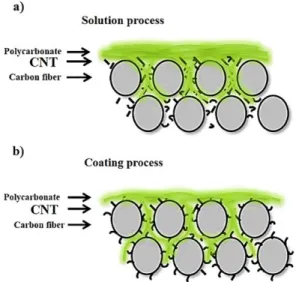
CF fabrics are essentially porous materials, and conse- quently impregnating with polymer allows filling of the pores, effectively reinforcing and toughening the fabrics [22]. As shown in Fig. 7, when CNTs were low in content at 0.02 wt.%, some holes of CF fabrics were coated with CNTs sparsely, therefore, infiltrated polymers piled up at the surface of the fiber, but some polymers were impregnated to fiber internally.

In particular, each carbon fiber was surrounded by CNTs con- tributing to strong interface or good adhesion between poly- mer and fiber, which is known as mechanical interlocking (Fig. 7(b)). On the contrary, when CNTs were dispersed in polymer solution, most of the holes of CF fabrics were covered with CNTs, and CNTs were dispersed randomly in empty space in fiber fabrics because of high viscosity of stirred solu- tion. The filtrated polymers piled up on the surface of the fiber, and impregnating the fabrics with polymer, such as PC, was not performed well (Fig. 7(a)). To further investigate these phenomena, in Fig. 8(a), E' increases slightly for all samples but E'' decreases with frequency up to 10 Hz. Especially, E' for composite coated with CNTs is about 10 GPa, which is twice as high as the value for a neat case (i.e., without CNTs). The reason for this is the effect of mechanical interlocking, which is a type of adhesion mechanisms between two surfaces. For mechanical interlocking, adhesion is promoted mechanically by a large interfacial area, that is, surface roughness, friction interlocking and dovetail interlocking [25]. Therefore, the mechanical properties, such as elasticity and stiffness, of sam- ples fabricated by coating process were improved remarkably.

On the other hand, when CNTs were mixed in polymer solu- tion, as CNT concentration increased gradually, the polymer layers accumulate on the surface of the fabrics (Fig. 3(c-h)). As a result, E' for composites fabricated by solution process increase from 5 to 13.5 GPa as CNT content varied from 0.5 to Fig. 6. Plot of tan δ with storage modulus (E') and loss modulus

(E'') of each sample at 10 Hz and ideal value with “rule of mixtures” presented linear negatively

Fig. 7. Schematic of PC-impregnation behavior with varying

methods of CNTs-add as (a) solution process and (b) coat-

ing process

(6)

3 wt.% allowing improvement of mechanical properties. The values of E'' with frequency are shown in Fig. 8(b). In the case of samples fabricated by solution process, the composite with 3 wt.% of CNTs has the highest E'' of 0.5 GPa at 10 Hz as com- pared 0.16 GPa at 10 Hz for CF/PC composites, whereas the composite coated with 0.02 wt.% CNTs has E'' of 0.3 GPa. The results support the viscosity of polymer solution with dis- persed CNTs is higher than the other case because E'' is a vis- cous portion factor.

4. CONCLUSIONS

The microstructure and mechanical properties of PC- impregnated CF fabrics have been reported. In particular, the effect of adding carbon nanomaterials, such as CNTs, has been investigated, comparing solution-based and pre-coating pro- cesses. The solution process was performed to overcome the

difficulty of controlling the melt viscosity of thermoplastic res- ins. The multiscale hybrid composites were prepared by the vacuum-filtration method, and the amount of CNTs added to polymer solution was varied to analyze their effects on the mechanical properties of composites. High-energy sonication was used to achieve uniform dispersion of CNTs in the poly- mer solution.

SEM analysis of samples fabricated by solution process showed that impregnating CF fabrics with CNT/PC/CHCl

3

solution was not as effective as pre-coating CF fabrics with CNTs. The reason is that the former method is limited by aggregation of CNTs and increase in solution viscosity caused by CNTs.

The value of tan δ with fiber volume fraction was calculated using “rule-of-mixtures” and not every composite was in good agreement with the calculated value because of poor surface adhesion between CF and matrix. Only the PC-impregnated carbon fiber coated with CNTs approached to the ideal value of tan δ, which suggests that coating process is a more effective method to increase surface adhesion of hybrid composites, as compared to the simple mixing process. In addition, tan δ of the sample coated with CNTs showed the lowest of all samples, indicating higher mechanical properties than other samples because tan δ represents the loss factor or damping factor.

The mechanical behavior of hybrid composites was char- acterized using DMA. In the case of impregnation with poly- mer solution into fiber fabrics coated with CNTs, the composites coated with CNTs at 0.02 wt.% led to optimum mechanical properties due to mechanical interlocking between CNTs and fibers.

ACKNOWLEDGEMENTS

This work was supported by the “Carbon Valley Program”

through the Ministry of Trade, Industry and Energy (MOTIE) and Korea Institute for Advancement of Technology (KIAT) (Project No. A0061 00067).

REFERENCES

1. Kim, M., Park, Y.-B., Okoli, O.I., and Zhang, C., “Processing, Characterization, and Modeling of Carbon Nanotube-rein- forced Multiscale Composites,” Composites Science and Tech- nology, Vol. 69, No. 3-4, 2009, pp. 335-342.

2. Zhou, Y., Pervin, F., Lewis, L., and Jeelani, S., “Fabrication and Characterization of Carbon/epoxy Composites Mixed with Multi-walled Carbon Nanotubes,” Materials Science and Engi- neering: A, Vol. 475, No. 1-2, 2008, pp. 157-165.

3. Hwang, S.-H., Park, Y.-B., Yoon, K.-H., and Bang, D.-S., “Smart Materials and Structures Based on Carbon Nanotube Compos- ites,” in: Siva, Y (ed.), Carbon Nanotubes-Synthesis, Character- ization, Application, InTech, 2011, pp. 371-396.

4. Bekyarova, E., Thostenson, E.T., Yu, A., Kim, H., Gao, J., Tang, Fig. 8. Variation of (a) storage modulus (E') and (b) loss modulus

(E'') with frequency

(7)

J., Hahn, H.T., Chou, T.-W., Itkis, M.E., and Haddo, R.C., “Mul- tiscale Carbon Nanotube-Carbon Fiber Reinforcement for Advanced Epoxy Composites,” Langmuir, Vol. 23, No. 7, 2007, pp. 3970-3974.

5. Díez-Pascual, A.M., Naffakh, M., Marco, C., Gómez-Fatou, M.A., and Ellis, G.J., “Multiscale Fiber-reinforced Thermoplas- tic Composites Incorporating Carbon Nanotubes: A Review,”

Current Opinion in Solid State and Materials Science, Vol. 18, 2013, pp. 62-80.

6. Biron, M., “Thermoplastic Composites,” 2013, pp.769-829.

7. Uematsu, Y., Kitamura, T., and Ohtani, R., “Delamination Behavior of a Carbon-fiber-reinforced Thermoplastic Polymer At High Temperatures,” Composites Science and Technology, Vol. 53, 1994, pp. 333-341.

8. Qiu, J., Zhang, C., Wang, B., and Liang, R., “Carbon Nanotube Integrated Multifunctional Multiscale Composites,” Nanotech- nology, Vol. 18, No. 27, 2007, pp. 275708.

9. Gojny, F.H., Wichmann, M.H.G., Fiedler, B., Bauhofer, W., and Schulte, K., “Influence of Nano-modification on the Mechani- cal and Electrical Properties of Conventional Fibre-reinforced Composites,” Composites Part A: Applied Science and Manufac- turing, Vol. 36, No. 11, 2005, pp. 1525-1535.

10. Rahmanian, S., Thean, K.S., Suraya, A.R., Shazed, M.A., Mohd Salleh, M.A., and Yusoff, H.M., “Carbon and Glass Hierarchical Fibers: Influence of Carbon Nanotubes on Tensile, Flexural and Impact Properties of Short Fiber Reinforced Composites,”

Materials & Design, Vol. 43, 2013, pp. 10-16.

11. Garcia, E., Wardle, B., Johnhart, A., and Yamamoto, N., “Fab- rication and Multifunctional Properties of a Hybrid Laminate with Aligned Carbon Nanotubes Grown In Situ,” Composites Science and Technology, Vol. 68, No. 9, 2008, pp. 2034-2041.

12. Abot, J.L., Song, Y., Schulz, M.J., and Shanov, V.N., “Novel Car- bon Nanotube Array-reinforced Laminated Composite Mate- rials with Higher Interlaminar Elastic Properties,” Composites Science and Technology, Vol. 68, No. 13, 2008, pp. 2755-2760.

13. Qian, H., Greenhalgh, E.S., Shaffer, M.S.P., and Bismarck, A.,

“Carbon Nanotube-based Hierarchical Composites: A Review,”

Journal of Materials Chemistry, Vol. 20, No. 23, 2010, pp. 4751.

14. Lee, S.-B., Choi, O., Lee, W., Yi, J.-W., Kim, B.-S., Byun, J.-H., Yoon, M.-K., Fong, H., Thostenson, E.T., and Chou, T.-W.,

“Processing and Characterization of Multi-scale Hybrid Com- posites Reinforced with Nanoscale Carbon Reinforcements and Carbon Fibers,” Composites Part A: Applied Science and Man- ufacturing, Vol. 42, No. 4, 2011, pp. 337-344.

15. Zhang, L., Su, D., Jin, L., and Li, C., “Polyamide 6 Composites Reinforced with Glass Fibers Modified with Electrostatically Assembled Multiwall Carbon Nanotubes,” Journal of Materials Science, Vol. 47, No. 14, 2012, pp. 5446-5454.

16. Rausch, J., and Mäder, E., “Health Monitoring in Continuous Glass Fibre Reinforced Thermoplastics: Tailored Sensitivity and Cyclic Loading of CNT-based Interphase Sensors,” Composites Science and Technology, Vol. 70, No. 13, 2010, pp. 2023-2030.

17. Rausch, J., and Mäder, E., “Health Monitoring in Continuous Glass Fibre Reinforced Thermoplastics: Manufacturing and Application of Interphase Sensors Based on Carbon Nano- tubes,” Composites Science and Technology, Vol. 70, No. 11, 2010, pp. 1589-1596.

18. Mäder, E., Rausch, J., and Schmidt, N., “Commingled Yarns – Processing Aspects and Tailored Surfaces of Polypropylene/

glass Composites,” Composites Part A: Applied Science and Manufacturing, Vol. 39, No. 4, 2008, pp. 612-623.

19. Barber, A.H., Zhao, Q., Wagner, H.D., and Baillie, C.A., “Char- acterization of E-glass–polypropylene Interfaces Using Carbon Nanotubes as Strain Sensors,” Composites Science and Technol- ogy, Vol. 64, No. 13-14, 2004, pp. 1915-1919.

20. Agnihotri, P., Basu, S., and Kar, K.K., “Effect of Carbon Nano- tube Length and Density on the Properties of Carbon Nano- tube-coated Carbon Fiber/polyester Composites,” Carbon, Vol. 49, No. 9, 2011, pp. 3098-3106.

21. Warrier, A., Godara, A., Rochez, O., Mezzo, L., Luizi, F., Gor- batikh, L., Lomov, S.V., VanVuure, A.W., and Verpoest, I., “The Effect of Adding Carbon Nanotubes to Glass/epoxy Compos- ites in the Fibre Sizing and/or the Matrix,” Composites Part A:

Applied Science and Manufacturing, Vol. 41, No. 4, 2010, pp.

532-538.

22. Hwang, S.-H., Park, H.W., Park, Y.-B., Um, M.-K., Byun, J.-H., and Kwon, S., “Electromechanical Strain Sensing Using Poly- carbonate-impregnated Carbon Nanotube–graphene Nano- platelet Hybrid Composite Sheets,” Composites Science and Technology, Vol. 89, 2013, pp. 1-9.

23. Nielsen, L.E., and Landel, R.F., “Mechanical Properties of Poly- mers and Composites,” Second ed., CRC Press, 1993.

24. Dong, S., and Gauvin, R., “Application of DMA for Multiscale Composites,” Polymer Composites, Vol. 14, 1993.

25. Liao, K., and Li, S., “Interfacial Characteristics of a Carbon

Nanotube–polystyrene Composite System,” Applied Physics Let-

ters, Vol. 79, No. 25, 2001, pp. 4225.

수치

Fig. 1. Schematic diagram of PC impregnation with (a) solution process and (b) coating process
Table 1. Fiber volume fraction of each sample CNT weight  (impregnation  before/after  (g)) PC weight  (impregnation before/after (g)) CNT  content (wt.%) Method  (as to CNTs) Fiber  volume fraction(%) - 50 /0.8 - - 69.26 0.25 /0.005 50/1 0.5 Solution  pro
Fig. 4. Viscosity at 20 o C of polymer solution with rpm as varied with added content of CNTs
Fig. 7. Schematic of PC-impregnation behavior with varying methods of CNTs-add as (a) solution process and (b)  coat-ing process

참조

관련 문서

In an effort to develop a new method to remove nitrogen, this study examined the effects of C/N ratio, carbon source and nitrogen concentration on

- the right side : to move deoxygenated blood that is loaded with carbon dioxide from the body to the lungs - the left side : to receive oxygenated blood that has.. had most

Effect of pain control and improve function of knee joint applied to osteoarthritis by carbon surface-heating... Diagram of

-another type of stereoisomer when Compound having carbon (chiral carbon) with 4 different groups attached carbon (chiral carbon) with 4 different groups

However, the short beam strength of the basalt fiber reinforced composites was higher than those of the glass fiber reinforced composites in the case of the Vacuum

- The basic materials were Reinforced Carbon-Carbon, Low- and High-Temperature Reusable Surface Insulation tiles, and Felt Reusable Surface Insulation blankets.. -

A representative material, carbon fiber reinforced composite material, has not only high strength of carbon fiber, high elastic modulus, high thermal conductivity, low

The hydrogen containing amorphous carbon, which is known as diamond-like carbon (DLC), is deposited by positively charged hydrogenated clusters. 5 Similarly, in the silicon