• 검색 결과가 없습니다.

Influence of Organomodified Nanoclay on the Mechanical and Flammability behavior of Jute Fabric/Vinyl Ester Nanocomposites

N/A
N/A
Protected

Academic year: 2021

Share "Influence of Organomodified Nanoclay on the Mechanical and Flammability behavior of Jute Fabric/Vinyl Ester Nanocomposites"

Copied!
7
0
0

로드 중.... (전체 텍스트 보기)

전체 글

(1)

Vol. 30, No. 5, 303-309 (2017)

DOI: http://dx.doi.org/10.7234/composres.2017.30.5.303 ISSN 2288-2103(Print), ISSN 2288-2111(Online) Paper

Influence of Organomodified Nanoclay on the Mechanical and Flammability behavior of Jute Fabric/Vinyl Ester Nanocomposites

M. Latif *, M. N. Prabhakar*, Gi-Beop Nam*, Dong-Woo Lee*, Jung-Il Song*

ABSTRACT: Organo-montmorillonite (OMMT) has attracted much attention for fiber-reinforced polymer composites as a filler material due to high aspect ratio and low charge density. The present study focused on the fabrication of nanocomposites using Vinyl ester and Jute fabric as matrix and reinforcement respectively. The OMMT was uniformly dispersed in vinyl ester resin at 1, 2 and 3 wt%, loading through high speed mechanical stirrer at room temperature and further nanocomposites were manufactured through vacuum assisted resin infusion (VARI) technique. Effects of OMMT on the mechanical properties of vinyl ester/Jute composites were carefully investigated through tensile, bending and Izod impact tests, which revealed significant improvement in mechanical properties. The morphology of the nanocomposites after tensile test was investigated by SEM which affirmed that OMMT filled nanocomposites has improved interactions with the host matrix than the pure composites. Based on the nature and flame retardancy mechanism, the OMMT slightly improved the flammability property which was clearly explained by horizontal burning test.

Key Words: OMMT, Vinyl ester, Jute fabric, Mechanical properties

1. INTRODUCTION

Composite materials, consisting of two or more constituents namely the matrix and reinforcement, exhibits unique prop- erties. Normally, the matrix holds the reinforcement in its set place is less stiffer and stronger [1,2]. Natural fibers like jute, abaca, sisal, bamboo and flax have drawn great attention as reinforcement in polymer composites due to their easy pro- cessing, light weight and low cost [3,4]. However, weak inter- facial bonding, compatibility and poor wetting of natural fiber reinforced composites (NFRC) are the main drawbacks which lead in the reduction of mechanical properties of the com- posites [5]. In order to overcome the above mentioned draw- backs various techniques i.e incorporation of nano-fillers and modification of fibers through physical and chemical treat- ments, have been reported [6]. The use of inorganic nano sized fillers such as nanoclay, nano silica and nanotubes in polymer composites have shown improvement in thermal, barrier, physical and mechanical properties due to effective

polymer and filler interaction [7].

Ganguly et al. studied the effect of montmorillonite (MMT) on rubber based nanocomposites and concluded that with the addition of 3 wt% MMT, the tensile strength and modulus increased up to 33% and 57% respectively [8]. Jo et al. reported the increase in tensile properties and also in glass transition temperature with the addition of MMT up to 5 wt% into unsaturated polyester [9]. Madaleno et al. also reported the improvement in mechanical and thermal properties due to the addition of MMT to vinyl chloride [10]. Vishnu Mahesh et al.

studied the effect of MMT on the mechanical, flammability and thermal properties of glass/Vinyl ester composites [11]. Ji et al. also studied the effect of nanoclay on the mechanical, thermal and flammability properties of vinyl ester based nano- composites [12]. Wang et al. reported the flame retardancy behavior of OMMT filled polymer composites [13].

The present study also focused on Organo-modified mont- morillonite (OMMT) as it possesses a high aspect ratio, low surface charge density of 0.25-0.5 equiv. mol

-1

and large sur-

Received 15 August 2017, received in revised form 25 October 2017, accepted 28 October 2017

*

*

Department of Mechanical Engineering, Changwon National University, Changwon 51140, Korea

Department of Mechanical Engineering, Changwon National University, Changwon 51140, Korea, Corresponding author

(E-mail: [email protected] )

(2)

face area of about 750 m

2

/g [14,15]. The OMMT is hydro- phobic in nature and is chemically compatible with matrix.

The layers of MMT can be separated by chemically modified through ion exchange reactions, which consequently improve the thermal as well as mechanical properties of the host mate- rial [16,19].

In this work, the Jute/VE composites filled with different percentages of OMMT were prepared through Vacuum assisted resin infusion (VARI) technique. A comparative study was performed to analyze the effect of OMMT on the tensile, flexural and impact properties. The flammability properties of OMMT dispersed Jute/VE composites were also investigated through horizontal burning test.

2. EXPERIMENTATION

2.1 Materials

The Jute woven fabric (density = 1.4 g/cm

3

) was purchased from Dae-Ha trading in Korea. OMMT contains 0.5-5 wt%

aminopropyltriethoxysilane, 15-35 wt% octadecyl amine was obtained from Sigma-Aldrich (USA). Vinyl ester (viscosity = 150 cps and specific gravity = 1.03), Methyl Ethyl Ketone Per- oxide (hardener), Cobalt Naphthalate (accelerator) and Fre- kote 700-NC (releasing agent) was purchased from CCP composites, Korea.

2.2 Composite Manufacturing

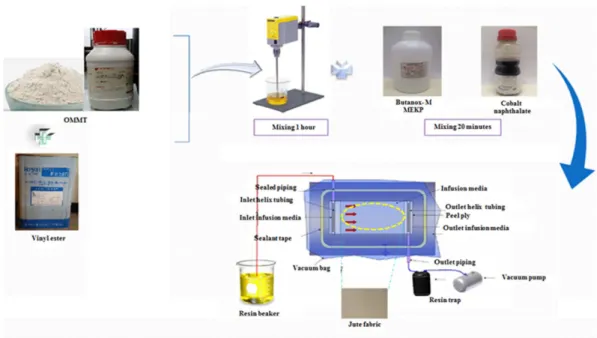
The hybrid nanocomposites were prepared by VARI tech- nique. Firstly the OMMT was uniformly mixed in vinyl ester resin at 1, 2 and 3 wt% through high speed mechanical stirrer at 600 rpm at room temperature for 1 hour. The hardener and accelerator were added and the solution was again mechan-

ically stirred for 20 minutes for homogenous mixing of the system. The homogenous mixture was kept undisturbed for few minutes to allow the air bubbles to pass out. After remov- ing air bubbles from the resin system, the resin was infused into the eight jute fabric layers through VARI technique and dried for 24 hours at room temperature for proper curing of the composites. Pure Jute fabric/VE composites were also fab- ricated by the same method to make comparative study. The fiber volume fraction was calculated as 25%.

3. TESTING AND CHARACTERIZATION

3.1 Mechanical Properties 3.1.1 Tensile test

Tensile test was performed to evaluate the tensile strength and elastic modulus of OMMT filled Jute/VE composites at room temperature. It was done as per ASTM D3039 on MTS tensile test machine using MTS 97 KN load cell with a cross- head speed of 3 mm/min.

3.1.2 Flexural test

Flexural test was performed to analyze flexural strength and flexural modulus of the Jute/VE composite specimens at room temperature according to ASTM D790 standards. Universal testing machine of R&B Unitech 50 KN load cell at 3 mm/min cross head speed was used.

3.1.3 Izod impact test

Izod impact test was done at room temperature using an Izod impact testing machine of model QC-639F supplied by Cometech, Korea. The specimen size was 75 × 12.7 × 2.2 mm and was done according to ASTM D256-88 specifications.

Fig. 1. Schematic diagram of present research study

(3)

Influence of Organomodified Nanoclay on the Mechanical and Flammability behavior of Jute Fabric/Vinyl Ester Nanocomposites 305

Mean value of five specimens is reported in J/cm

2

.

3.1.4 Morphological Analysis

The surface morphology of OMMT filled Jute/VE nano- composites were carried out using scanning electron micro- scope (SEM) (CZ/MIRA I LMH 1.5 nm). Dried composite sample was mounted on metal stub using double sticky carbon tape. After that gold was coated on the sample for conductivity.

These samples were mounted on SEM instrument at an accel- erating voltage of 5~8 kV. The micrographs were taken at dif- ferent magnification.

3.1.5 Horizontal burning test

The test was carried out to know the burning time and burning rate of OMMT filled Jute/VE composites and it was performed as per ASTM UL-94 standards. A specimen of size 125 × 13 × 2.2 mm was clamped horizontally at one end and the other end of specimen was kept free. The specimen was marked at three different points as A = 25 mm, B = 100 mm and C = 125 mm from the free end. After that flame was applied on free end of specimen for 30s, then the burner was taken away and specimen was allowed to burn, when the flame reached mark ‘A’, time was noted by a stop watch. The time was noted until the flame reached mark ‘B’. The time taken to burn the specimen from 25 to 100 mm was con- sidered as “burning time”.

4. RESULTS AND DISCUSSIONS

4.1 Tensile properties

The tensile test was performed to analyze the tensile strength and modulus of the pure and OMMT filled jute fab- ric/VE composites. The tensile data of pure and OMMT filled composites are shown in Fig. 2. From the results, it can be observed that the tensile strength of pure, 1% filled OMMT, 2% filled OMMT and 3% filled were 48 MPa, 54.5 MPa, 58.12 MPa and 55.45 MPa respectively. The tensile strength of

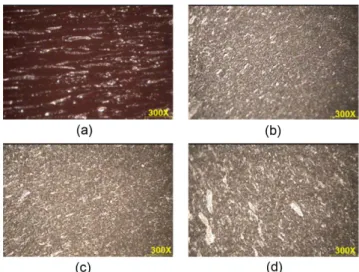
OMMT filled composites was significantly improved in com- parison to the pure composite. The similar results were also reported by Sridhar et al. [20]. The uniformly dispersed OMMT layers and Jute fabrics behaved as hindrance to defor- mation. When force was applied to the specimen, the polymer matrix transferred force to the reinforced nanoclay that aligned into the load direction and reduced the chances of crack propagation because OMMT was hydrophobic in nature and it improved the compatibility between polymer matrix and OMMT as shown in Fig. 3 [19, 21]. The increase in tensile strength of OMMT filled nanocomposites was mainly because of exfoliation of modified nanoclay in resin system [20]. Many researchers observed the improvement in tensile strength at as low as 1 and 2 wt% of OMMT [22]. The tensile modulus of nanocomposites increased as the amount of OMMT increased from 1% to 3%. The pure Jute/VE composite has tensile mod- ulus of 5.48 and at 2% loading of OMMT, it increased up to 6.99 GPa. The tensile strength decreased at 3 wt% OMMT loading which is speculated to be due to the formation of agglomeration and entrapment of air bubbles within the OMMT filled nanocomposites as shown in Fig. 5. These agglomeration and air bubbles could not withstand the load and starts cracking the sample at early stage which results in low tensile strength. The tensile modulus of the pure and nanocomposites are shown in Fig. 2.

From figure it can be observed that the tensile moduli of OMMT filled composites are higher than the pure composites.

By increasing the amount of OMMT, the tensile modulus increased due to the exfoliation of the OMMT in resin. More- over, the adhesion between the OMMT, Jute fabric and matrix increased which resisted the crack propagation.

The OMMT played an important role in improving the ten- sile strength by increasing the adhesion between jute fabric Fig. 2. Tensile strength and Modulus of pure and nanocompos-

ites

Fig. 3. Microscopic images of Pure Vinyl ester (a), 1% OMMT

filled Vinyl ester specimens (b), 2% OMMT filled Vinyl

ester specimens (c) 3% OMMT filled Vinyl ester specimens

(d)

(4)

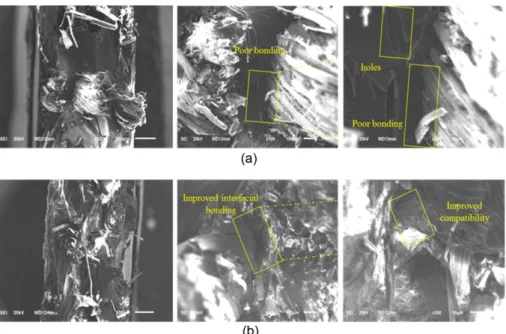
and matrix as confirmed by the SEM micrographs in Fig. 4.

For the pure Jute/VE composite, it’s clear from the micro- graphs that the adhesion between the matrix and fabric is weak as micro gaps can be observed in the interfaces. These micro gaps correspond to the incompatibility between the matrix and fabric due to a difference in polarity of their chem- ical structures [23]. However, in case of OMMT filled Jute/VE composites, an improved interfacial bonding was seen at the fracture surfaces. Because of this improved interfacial bonding between fabric and matrix, the mechanical properties were improved as compared to the pure Jute/VE composites.

4.2 Flexural properties

The flexural test was performed to evaluate the flexural strength and modulus of Pure and OMMT dispersed Jute/VE composites. Fig. 6 shows the influence of OMMT addition on the flexural strength and modulus of OMMT filled Jute/VE composites. From the results obtained, it can be seen that the flexural strength of pure Jute/VE composite was 85.4 MPa and that of OMMT dispersed Jute/VE composites are as follows:

1% OMMT Jute/VE = 106.8 MPa, 2% OMMT Jute/VE = 130 MPa and 3% OMMT Jute/VE = 138.85 MPa. The flexural strength of 3 wt% OMMT dispersed Jute/VE composite increased by 62.58% in comparison with the pure Jute/VE composite. This is attributed to the improvement of interfacial bonding between fabric and matrix due to the presence of OMMT, which inhibited the crack initiation. From the SEM images of pure and OMMT filled composites, it was observed that the pure Jute/VE composites possessed poor interaction between the matrix and fabric. Therefore, when load was applied to the composites it broke easily because of low inter- facial interaction. The surface of the pure Jute/VE composites

was very rough and contained voids as compared to nano- composites. Due to the hydrophobic nature of OMMT (because of the attachment of silane groups), it increased the interaction between the fillers and matrix as shown in Fig. 3, which results in strong interfacial bonding and therefore played a significant role in load transfer [21]. Similar results have also been reported by Sridhar et al. and Ji et al. [20,12].

Previous results have held the exfoliation of the OMMT in matrix, responsible for the improvement in flexural strength [20].

The flexural modulus of pure Jute/VE composite was 2.6 GPa and that of 1%, 2% and 3% of OMMT jute/VE were 2.9, 4.3, 4.6 GPa respectively. The flexural modulus of 3 wt%

OMMT Jute/VE composites showed 55% increase in com- parison with pure composites. These OMMT layers act as Fig. 4. SEM micrographs of (a) Pure Jute/VE composites (b) 2% OMMT filled nanocomposites

Fig. 5. Microscopic images of voids within the composites (a, b),

OMMT dispersed within the composites (c)

(5)

Influence of Organomodified Nanoclay on the Mechanical and Flammability behavior of Jute Fabric/Vinyl Ester Nanocomposites 307

nano entities which contribute to stress sharing during load applications. Modulus of composites depends on the aspect ratio of the fillers. As aspect ratio increased, stress sharing between the fillers and host material also increased which con- sequently increased the stiffness.

4.3 Izod impact properties

The Izod impact test was performed to investigate the impact energy of Pure and OMMT nanocomposites. The impact energy of the composites is shown in Fig. 7. From the figure, it can be observed that the impact energy of pure Jute/

VE composite was 125 J/cm

2

and that of OMMT filled Jute/VE composites are as follow: 1% OMMT Jute/VE = 143.63 J/cm

2

, 2% OMMT Jute/VE = 151.51 J/cm

2

and 3% OMMT Jute/VE = 161.42 J/cm

2

. The Izod impact energy of 3 wt% OMMT filled Jute/VE composite increased by 29% in comparison with the pure Jute/VE composite because of the aspect ratio increased due to the presence of OMMT. This increase in the Izod impact energy can be attributed to the improved boding between matrix and reinforcement in the presence of OMMT in matrix. Similar results have also been reported by Aru-

mugam Thiagarajan et al. and Phani Mylavarapu et al. [24-26].

The technical reasons are same as mentioned in flexural and tensile test section.

4.4 Flammability properties

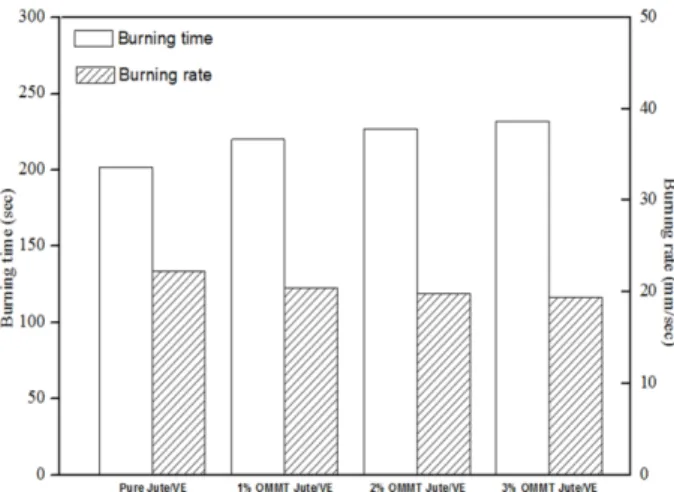
Horizontal burning test (HBT) was carried out to investigate the burning time and rate of the pure and OMMT filled Jute/

VE composites. The HBT test results are shown in Fig. 9. From the figure, it can be observed that the burning time of pure Jute/VE composite was 202 sec and for 1, 2 and 3 wt% of OMMT Jute/VE composites were 220 sec, 227 sec and 232 sec respectively. Also, an increase in the burning time of nano- composites was observed with the increase in percentage of OMMT, which indicates an improvement in the flame retar- dant properties.

The rate of burning for pure and OMMT dispersed Jute/VE composites were also shown in Fig. 9. From figure, it can be observed that by increasing the percentage of OMMT, the burning rate was decreased as compared to pure Jute/VE com- posites. The burning rate for pure Jute/VE composites was 22.27 mm/sec and for 1, 2 and 3 wt% of OMMT Jute/VE com- posites were 20.45, 19.82 and 19.39 mm/sec respectively. The OMMT filled composites achieved the UL 94 V-1 require- ments. The improvement in the retardant properties may be attributed to the formation of carbonaceous silicate char on the surface during burning and also due to the presence of silane coupling agents [27].

Fig. 6. Flexural strength and modulus of pure and OMMT filled nanocomposites

Fig. 7. Izod impact energy of Pure and nanocomposites

Fig. 8. Specimens after HBT of Pure VE/Jute fabric composites (a), 3% OMMT filled VE/Jute fabric composites

Fig. 9. Burning time and rate of Pure and nanocomposites

(6)

5. CONCLUSION

The influence of addition of OMMT to vinyl ester on the mechanical and flammability properties of Jute/VE compos- ites was investigated based on dispersion of OMMT. Tensile, flexural and impact properties of OMMT dispersed Jute/VE composites showed improvement up to 21%, 62.58% and 29%

respectively as compared to pure composite. Composites hav- ing organically modified MMT reveal better interaction and compatibility with the reinforced materials as after modifica- tion it becomes hydrophobic, which result in improved tensile, flexural and impact strength of the composites. SEM micro- graphs evidenced that OMMT improved the interfacial bond- ing between matrix and fabric. With the addition of OMMT, the flammability properties improved by 14% as compared to pristine one because during burning it form a carbonaceous- silicate char over the surface which resist the flame to spread.

ACKNOWLEDGEMENT

This work was supported by the National Research Foun- dation of Korea(NRF) grant funded by the Korea government (MSIP) (No. 2017R1A2B2011730).

REFERENCES

1. Razak, N.W.A., and Kalam, A., “Effect of OPEFB Size on the Mechanical Properties and Water Absorption behaviour of OPEFB/PPnanoclay/PP Hybrid Composites”, Procedia Engi- neering, Vol. 41, 2012, pp. 1593-1599.

2. Braga, R.A., and Magalhaes Jr, P.A.A., “Analysis of the Mechan- ical and Thermal Properties of Jute and Glass Fiber as Rein- forcement Epoxy Hybrid Composites”, Materials Science &

Engineering. C, Materials for Biological Applications, Vol. 56, 2015, pp. 269-73.

3. Alavudeen, A., Rajini, N., Karthikeyan, S., Thiruchitrambalam, M., and Venkateshwaren, N., “Mechanical Properties of Banana/

kenaf Fiber-reinforced Hybrid Polyester Composites: Effect of Woven Fabric and Random Orientation”, Materials and Design, Vol. 66, 2015, pp. 246-257.

4. Ahmed, K.S., and Vijayarangan, S., “Tensile, Flexural and Inter- laminar Shear Properties of Woven Jute and Jute-glass Fabric Reinforced Polyester Composites,” Journal of Materials Process- ing Technology, Vol. 207, 2008, pp. 330-335.

5. Dhawan, V., Singh, S., and Singh, I., “Effect of Natural Fillers on Mechanical Properties of GFRP Composites”, Journal of com- posites, Vol. 2013, 2013, pp. 8.

6. Luo, X., Li, J., Feng, J., Yang, T., and Lin, X., “Mechanical And Thermal Performance of Distillers Grains Filled Poly(butylene succinate) Composites”, Mater. Des., Vol. 57, 2014, pp. 195-200.

7. Ridzuan, M.J.M., Abdul Majid, M.S., Afendi, M., Azduwin, K., Amin, N.A.M., Zahri, J.M., et al. “Moisture Absorption and Mechanical Degradation of Hybrid Pennisetum Purpureum/

glass-epoxy Composites”, Composite Structures, Vol. 141, 2016,

pp. 110-116.

8. Ganguly, A., Maiti, M., and Bhowmick, A.K., “Structure-prop- erty Relationship of Specialty Elastomer-clay Nanocomposites”, Bulletin of Materials Science, Vol. 31, 2008, pp. 455-459.

9. Jo, B.-W., Kook, S., Kim, P., and Keun, D., “Mechanical Prop- erties of Nano-MMT Reinforced Polymer Composite and Poly- mer Concrete”, Construction and Building Materials, Vol. 22, 2008, pp. 14-20.

10. Madaleno, L., and Schjodt-Thomsen, J., “Morphology, Thermal and Mechanical Properties of PVC/MMT Nanocomposites Prepared by Solution Blending and Solution Blending β Melt Compounding”, Composites Science and Technology, Vol. 70, 2010, pp. 804-814.

11. Vishnu Mahesh, K.R., Narasimha Murthy, H.N., Kumaras- wamy, B.E., Sridhar, R., Krishna, M., and Sherigara, B.S., “The Influence of Montmorillonite on Mechanical, Thermal and Fire Retardation Properties of Vinylester/glass Composites”, Journal of Composite Materials, Vol. 47, 2012, pp. 2163-2178.

12. Ji, G., and Li, G., “Effects of Nanoclay Morphology on the Mechanical, Thermal, and Fire-retardant Properties of Vinyl Ester Based Nanocomposites”, Materials Science and Engineer- ing A, Vol. 498, 2008, pp 327-334.

13. Wang, L., He, X., and Wilkie, C.A., “The Utility of Nanocom- posites in Fire Retardancy”, Materials, Vol. 3, 2010, pp. 4580- 4606.

14. Uddin, F., “Clays, Nanoclays, and Montmorillonite Minerals”, Metallurgical and Materials Transactions A, Vol. 39, 2008, pp.

2804-2814.

15. Alateyah, A.I., Dhakal, H.N., and Zhang, Z.Y., “Processing, Properties, and Applications of Polymer Nanocomposites Based on Layer Silicates: A Review”, Advances in Polymer Tech- nology, Vol. 32, 2013.

16. Wang, L., Wang, K., Chen, L., Zhang, Y., and He, C., “Prepa- ration, Morphology and Thermal/mechanical Properties of Epoxy/nanoclay Composite,” Composites-Part A: Applied Sci- ence and Manufacturing, Vol. 37, 2006, pp. 1890-1896.

17. Chandradass, J., Kumar, M.R., and Velmurugan, R., “Effect of Nanoclay Addition on Vibration Properties of Glass Fibre Rein- forced Vinyl Ester Composites”, Materials Letters, Vol. 61, 2007, pp. 4385-4388.

18. Alateyah, A.I., Dhakal, H.N., and Zhang, Z.Y., “Mechanical and Thermal Properties Characterization of Vinyl Ester Matrix Nanocomposites Based on Layered Silicate,” International Jour- nal of Mechanical, Aerospace, Industrial and Mechatronics Engi- neering, Vol. 7, 2013, pp. 701-708.

19. Chiu, C.W., Huang, T.K., Wang, Y.C., Alamani, B.G., and Lin, J.J., “Intercalation Strategies in Clay/polymer Hybrids,” Progress in Polymer Science, Vol. 39, 2014, pp. 443-485.

20. Sridhar, R., Narasimha Murthy, H.N., Pattar, N., Vishnu Mahesh, K.R., and Krishna, M., “Parametric Study of Twin Screw Extrusion for Dispersing MMT in Vinyl Ester Using Orthogonal Array Technique and Grey Relational Analysis”, Composites: Part B, Vol. 43, 2012, pp. 599-608.

21. Mittal, G., Dhand, V., Ryu, J.I., Rhee, K.Y., Kim, H.-J., and Jung,

D.H., “Fabrication of Modified MMT/Glass/Vinylester Multi-

(7)

Influence of Organomodified Nanoclay on the Mechanical and Flammability behavior of Jute Fabric/Vinyl Ester Nanocomposites 309

scale Composites and Their Mechanical Properties”, Journal of Nanomaterials, Vol. 2015, pp. 9.

22. Haque, A., Hossain, F., Dean, D., and Shamsuzzoha, M., “S2- Glass/vinylester Polymer Nanocomposites: Manufacturing, Structures, Thermal and Mechanical Properties”, Journal of Composite Materials, Vol. 37, 2002, pp. 1821-1837.

23. Kornmann, X., Lindberg, H., and Berglund, L.A., “Synthesis of Epoxy-clay Nanocomposites: Influence of the Nature of the Clay on Structure”, Polymer, Vol. 42, 2001, pp. 1303-1310.

24. Thiagarajan, A., Palaniradja, K., and Mathivanan, N.R., “Effect of Nanoclay on the Impact Properties of Glass Fiber-Reinforced Polymer Composites,” Polymer-Plastics Technology and Engi-

neering, Vol. 51, 2012, pp. 1403-1410.

25. Sivasaravanan, S., and Bupesh Raja, V.K., “Impact Properties of Epoxy/glass Fiber/nano Clay Composite Materials”, Journal of Mechanical and Civil Engineering, 2014, pp. 39-41.

26. Mylavarapu, P., and Woldesenbet, E., “Effect of Nanoclay Incor- poration on the Impact Properties of Adhesively Bonded Com- posite Structures”, Journal of Adhesion Science and Technology, Vol. 24, 2010, pp. 389-405.

27. Ray, S.S., and Okamoto, M., “Polymer/layered Silicate Nano-

composites: A Review from Preparation to Processing”, Progress

in Polymer Science, Vol. 28, 2003, pp. 1539-1641.

수치

Fig. 1. Schematic diagram of present research study
Fig. 3. Microscopic images of Pure Vinyl ester (a), 1% OMMT filled Vinyl ester specimens (b), 2% OMMT filled Vinyl ester specimens (c) 3% OMMT filled Vinyl ester specimens (d)
Fig. 5. Microscopic images of voids within the composites (a, b), OMMT dispersed within the composites (c)
Fig. 8. Specimens after HBT of Pure VE/Jute fabric composites (a), 3% OMMT filled VE/Jute fabric composites

참조

관련 문서

Noorul Haq : Effect of friction welding parameters on mechanical and metallurgical properties of ferritic stainless steel, The international journal of

This study the changes in structure and mechanical characteristics by the analysis on mechanical characteristics of the welding part and the post weld

Melt lamination process, depending on the characteristics Floor laminate Out-of-Plane so the mechanical properties of the products according to the angle

Table 7 Structural design results using flax fabric/vinyl ester

Various studies have been performed to improve properties of material, electrical and mechanical properties of railway train according to the increase of the speed in the

Summerscales, "An investigation into the effects of fabric architecture on the processing and properties of fibre reinforced composites produced by resin

In the present study, the behavior of Mg sheet with strain rates will be observed and the effect of microstructure, texture and PB treatment on high rate tensile

1 John Owen, Justification by Faith Alone, in The Works of John Owen, ed. John Bolt, trans. Scott Clark, "Do This and Live: Christ's Active Obedience as the