1
Management of Locally Advanced Non-small Cell Lung Cancer
Locally advanced Non-small cell lung cancer (NSCLC) is a commonly encountered diagnosis. Historically the treatment of locally advanced NSCLC has involved radiation therapy. Clinical trials have shown a benefit to the addition of chemotherapy. In recent years studies have further defined the role of chemotherapy by provided data showing the benefit of concurrent chemotherapy and radiation therapy followed by consolidation with more chemotherapy. Technological advances in radiation therapy have made dose escalation feasible and the current treatment paradigm is now evolving further as dose escalation data becomes available. (J Lung Cancer 2009;8(1):17)
Key Words: Non-small cell lung cancer, Combined modality therapy
Paul DeRose, M.D.
Jaeho Cho, M.D., Ph.D. and Hak Choy, M.D.
Department of Radiation Oncology, UT Southwestern Medical Center at Dallas, Dallas, USA
Received: April 18, 2009 Accepted: May 13, 2009 Address for correspondence Hak Choy, M.D.
Department of Radiation Oncology, The University of Texas Southwestern Medical Center at Dallas, 5801 Forest Park Rd., Dallas, Texas 75390-9183, USATel: 1-214-645-7600
Fax: 1-214-645-7622
E-mail: Hak.Choy@UTSouthwestern.
edu
INTRODUCTION
Lung cancer is the leading cause of cancer related deaths worldwide (1). It is estimated that 215,000 new cases will be diagnosed for 2009 in the United States alone. Approximately 80% of diagnosed lung cancers are non-small cell lung cancer (NSCLC). Upon initial presentation, less than one-half of patients will have surgically resectable lung cancer with the potential for surgical cure. Approximately one-third of patients will present with locally advanced disease involving either the ipsilateral mediastinal/subcarinal lymph nodes (American Joint Committee on Cancer [AJCC] Tl-3 N2 MO, Stage IIIA) or any contralateral mediastinal, hilar or ipsilateral or contralateral scalene or supraclavicular nodes (AJCC Tl-2 N3 MO, Stage IIIB) without evidence of extrathoracic metastases. A smaller number of patients will have a centrally located primary tumor involving mediastinal structures (AJCC T4 Nx MO, Stage IIIB). Traditionally, these patients are generally not considered
candidates for surgical resection, and have been treated with other therapeutic modalities.
Prior to the 1990’s, patients with locally advanced NSCLC were treated with radiation therapy alone. Unfortunately, the radiation therapy technique and dose used produced dismal survival rates of 40%, 15% and 5% at 1, 2 and 5 years respectively. Since that time, several advances have occurred in the treatment of locally advanced NSCLC. A number of phase III clinical trials have established the importance of combining chemotherapy with radiation therapy in the treatment of locally advanced NSCLC. Clinical trials have also provided data that demonstrates surgery is unlikely to offer improvement in outcome over other modalities for this group of patients.
Concurrent chemoradiation is now widely accepted as standard of care. Recently technological advances in radiation therapy have shown promise in further improving the outcome for patients with locally advanced NSCLC. These advances have shown that it may be possible to increase delivered radiation dose. Preliminary data suggest that these techniques may
improve survival with acceptable levels of toxicity.
The Evolution of Combined Modality Therapy
During the 1990’s a shift occurred in the treatment of locally advanced NSCLC from radiotherapy alone to concurrent chemoradiation. A number of randomized phase II/III trials each played a role in the evolution of therapy to the current standard of concurrent chemoradiation. The process began with the development of sequential chemotherapy followed by radiation therapy.
Sequential Chemotherapy
A series of clinical trials investigating the use of sequential chemotherapy and radiation therapy were performed in the mid to late 1980’s. The rationale of these trials was based on the premise that full doses of chemotherapy and radiation therapy could successfully be administered sequentially. They hypo- thesized that the chemotherapy would act to eliminate un- detectable systemic micrometastatic disease while radiation therapy would act as a potent local treatment.
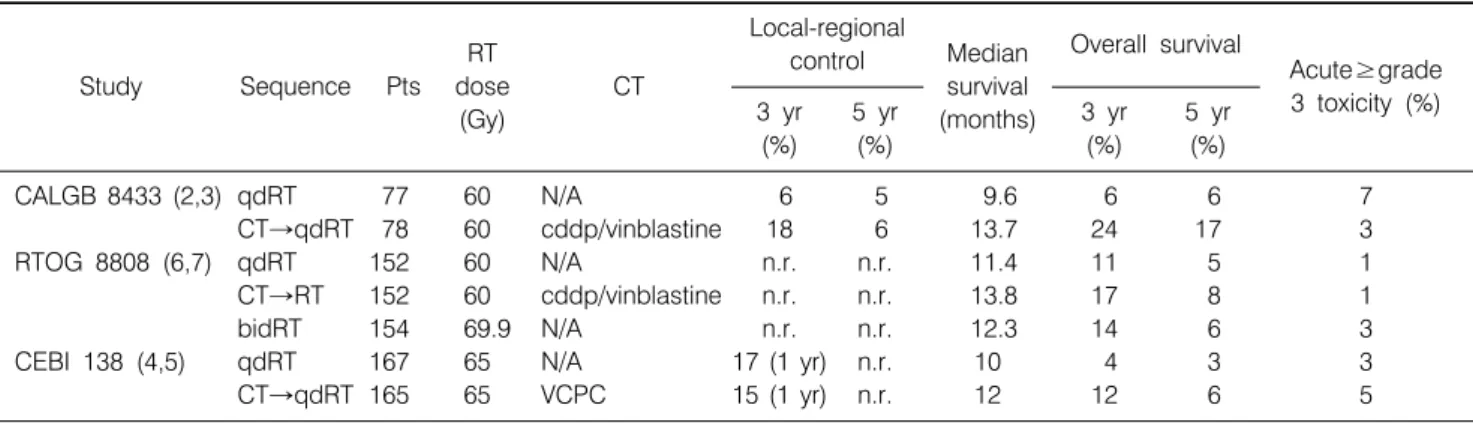
The Cancer and Leukemia Group B (CALGB) 8433 trial, also sometimes referred to as the Dillman trial, is notable for being an early trial that established the importance of the addition of chemotherapy in locally advanced NSCLC. The trial enrolled 155 patients with clinical stage III NSCLC. Patients were randomized to receive induction chemotherapy with cisplatin/vinblastine or no induction chemotherapy (2,3). All patients were also treated with conventionally fractionated radiation therapy to a total dose of 60 Gy. Analysis of the study showed a statistically significant improvement in the median survival of 13.7 months over 9.6 months (p=0.012) with se- quential chemoradiation over radiation alone. The 5 year sur- vival rate tripled with combined modality therapy over radiation alone (17% vs. 6%). It is also important to note that the sequen- tial treatment regimen was not associated with an increase in clinically significant toxicity.
The CEBI 138 trial by Le Chevalier et al. (also known as IGR or French trial) randomized 353 patients to one of two arms. Those in the first arm received a conventionally frac- tionated course of thoracic radiotherapy to a total dose of 65 Gy. Patients in the other arm received induction and consoli-
dation chemotherapy. The chemotherapy arm schedule con- sisted of 3 monthly cycles of induction chemotherapy con- sisting of vindesine, cyclophosphamide, cisplatin, and lomustine (VCPC), followed by a course of thoracic radiotherapy, then followed by 3 additional monthly cycles of VCPC (4,5). The results of this trial were similar to those of the Dillman trial with a statistically significant benefit in 3 year survival rate with sequential chemoradiation over radiation alone (12% vs.
4%). One interesting result was that there appeared to be a 50%
relative risk reduction of distant metastases in the chemotherapy arm, supporting the hypothesis that chemotherapy could reduce micrometastatic disease.
The benefit of sequential chemotherapy was further con- firmed by an intergroup trial (RTOG 88-08, ECOG 4588, S8892) performed by Radiation Therapy Oncology Group (RTOG), Eastern Cooperative Oncology Group (ECOG), and Southwest Oncology Group (SWOG) reported by Sause and colleagues (6,7). The design of this trial was somewhat different from the prior trials mentioned because it had a three arm randomization. The trial enrolled 452 patients with unresectable NSCLC (although it should be noted that it included a small number of stage II patients) to one of two radiation alone arms (daily to 60 Gy or twice-daily to 69.6 Gy) or to the third arm of induction with cisplatin and vinblastine followed by a daily radiotherapy to 60 Gy, in the same manner as the CALGB 8433 trial. The trial was designed to test if the results of the CALGB trial could be confirmed and also to test the possible benefit of hyperfractionated radiation therapy. Of the three arms, the sequential chemotherapy and radiation arm had superior results with a statistically significant improvement in overall and median survival, thus adding further confirmation to the benefit offered by the addition of chemotherapy.
These randomized trials established the importance of the addition of chemotherapy in the treatment of locally advanced NSCLC. The addition of induction chemotherapy reduced distant relapse and improved survival (Table 1). However, after the completion of these trials, questions still remained regarding the optimal timing of chemotherapy in combination with radiation therapy.
Concurrent Chemotherapy and Radiation Therapy Despite the therapeutic improvement that was observed with
Table 1. Multicenter Phase III Randomized Controlled Trials Comparing Sequential Chemoradiation vs. Radiation Alone
Study Sequence Pts
RT dose
(Gy)
CT
Local-regional
control Median survival (months)
Overall survival
Acute≥grade 3 toxicity (%) 3 yr
(%)
5 yr (%)
3 yr (%)
5 yr (%) CALGB 8433 (2,3)
RTOG 8808 (6,7)
CEBI 138 (4,5)
qdRT CT→qdRT qdRT CT→RT bidRT qdRT CT→qdRT
77 78 152 152 154 167 165
60 60 60 60 69.9 65 65
N/A
cddp/vinblastine N/A
cddp/vinblastine N/A
N/A VCPC
6 18 n.r.
n.r.
n.r.
17 (1 yr) 15 (1 yr)
5 6 n.r.
n.r.
n.r.
n.r.
n.r.
9.6 13.7 11.4 13.8 12.3 10 12
6 24 11 17 14 4 12
6 17 5 8 6 3 6
7 3 1 1 3 3 5 RT: radiotherapy, CT: chemotherapy, n.r.: not reported, qd: daily, bid: twice daily, cddp: cisplatin, VCPC: vindesine, cyclo- phosphamide, cisplatin, and lomustine, Pts: number of patients
the addition of induction chemotherapy, the prognosis of locally advanced NSCLC remained relatively poor. This was due to both continued problems with distant recurrence and also poor local control. In an effort to improve local control, trials were performed to evaluate the possible benefit of concurrent chemotherapy and radiation. The hypothesis of these trials was that the chemotherapy would act as a radiosensitizer. The possible mechanisms of chemotherapeutic radiosensitization are thought to be direct inhibition of repair of radiation-induced damage, elimination of radioresistant, chemosensitive clones, and/or suppression of inter-fraction tumor repopulation (8-10).
The following phase III randomized trials have shown a statistically significant improvement in clinical outcomes including survival with the concurrent approach.
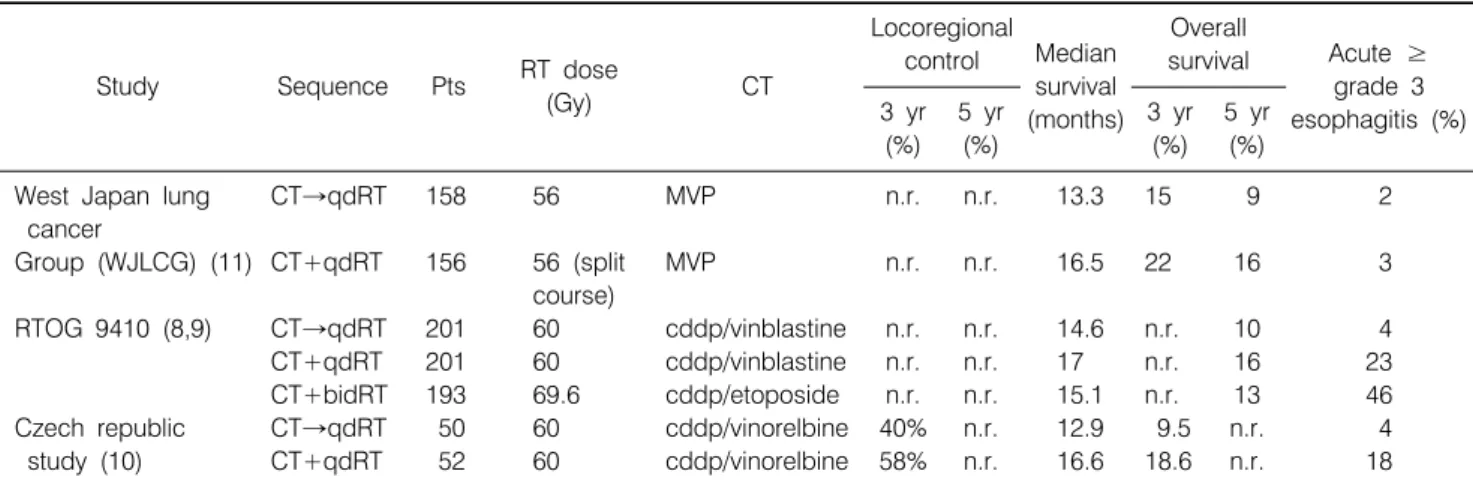
The first key trial to evaluate concurrent chemoradiation was the West Japan Lung Cancer Group (WJLCG) trial. This study enrolled 314 patients with locally advanced NSCLC who were randomized to receive either concurrent or sequential chemo- radiation therapy (11). The chemotherapy used in the study was mitomycin, vindesine, and cisplatin (MVP). A split course of 56 Gy of radiation therapy was used in the concurrent arm while 56 Gy was given continuously in the sequential arm. The trial revealed a statistically significant improvement in median survival (16.5 vs. 13.3 months), 5-year survival (15.8% vs.
8.9%), and response rate (84% vs. 66%). Interestingly, the trial seemed to support the hypothesis that local control could be improved by concurrent therapy. In the concurrent arm local-failure free survival was significantly greater (30 vs. 11 months) while the rate of distant failure was similar between
both arms. This result was achieved in the context of split course radiation therapy, which is now widely considered to be an inferior approach. The only significance in toxicity between the two arms was an increase in myelosuppression in the concurrent arm.
The RTOG 9410 was a phase III randomized trial of 610 patients with unresectable stages II/III NSCLC (8,9). The trial was designed to investigate both a possible benefit of concur- rent therapy and hyperfractionation. Patients were randomized to three arms: sequential chemotherapy and daily radiation, concurrent chemotherapy and daily radiation, or twice-daily radiation treatments. There was a statistically significant impro- vement in median survival (17.0 vs. 14.6 months; p=0.0038) and 4 year survival rate (21% vs. 12%; p=0.046) in the con- current daily arm over the sequential arm. It was also sig- nificantly better than the twice-daily treatment arm. Acute toxicity rated grade 3 or higher was increased in the concurrent daily arm over that of the sequential arm (55% vs. 35%).
Another significant study was performed in the Czech Re- public by Zatloukal et al. The trial included 102 patients who were randomized to cisplatin/vinorelbine given either as in- duction to or concurrent with 60 Gy (10). The study revealed that concurrent therapy resulted in significant improvement in median survival (16.6 vs. 12.9 months) and time to progression (11.9 vs. 8.5 months). There was also a significant improve- ment in overall response rate of 80% vs. 47% with the con- current approach. Consistent with other studies, there was increased toxicity associated with the concurrent arm. Speci- fically, there were increases in leukopenia (53% vs. 19%), nau-
Table 2. Multicenter Phase III Randomized Controlled Trials Comparing Concurrent with Sequential Chemoradiotherapy
Study Sequence Pts RT dose
(Gy) CT
Locoregional
control Median survival (months)
Overall
survival Acute ≥ grade 3 esophagitis (%) 3 yr
(%) 5 yr
(%)
3 yr (%)
5 yr (%) West Japan lung
cancer
Group (WJLCG) (11)
RTOG 9410 (8,9)
Czech republic study (10)
CT→qdRT
CT+qdRT
CT→qdRT CT+qdRT CT+bidRT CT→qdRT CT+qdRT
158
156
201 201 193 50 52
56
56 (split course) 60 60 69.6 60 60
MVP
MVP
cddp/vinblastine cddp/vinblastine cddp/etoposide cddp/vinorelbine cddp/vinorelbine
n.r.
n.r.
n.r.
n.r.
n.r.
40%
58%
n.r.
n.r.
n.r.
n.r.
n.r.
n.r.
n.r.
13.3
16.5
14.6 17 15.1 12.9 16.6
15
22
n.r.
n.r.
n.r.
9.5 18.6
9
16
10 16 13 n.r.
n.r.
2
3
4 23 46 4 18 RT: radiotherapy, CT: chemotherapy, qd: daily, bid: twice daily, MVP: mitomycin, vindesine, and cisplatin, cddp: cisplatin, n.r.: not reported, Pts: number of patients
sea/vomiting (39% vs. 15%), and esophagitis (17.6% vs. 4.2%).
The results of these studies provide compelling evidence that an approach using concurrent chemoradiation results in superior clinical outcome when compared to sequential therapy (Table 2). This improvement is associated with an increase in local control thought to result from radiosensitization. However, it is important to note that this improvement in local control comes at the cost of increased toxicity. Each of these randomized trials consistently demonstrated that more acute toxicity occurs when concurrent therapy is administered. These trials established concurrent chemoradiation as standard of care, but with time the role of chemotherapy has been further defined.
Concurrent Chemoradiation with Induction or Consolidation
Sequential chemoradiation improved clinical outcomes by providing better systemic control, while concurrent chemoradi- ation seems to improve locoregional control. A logical hy- pothesis is that combining both of these approaches could improve efficacy through better local and systemic control.
Indeed, this hypothesis led phase II/III trials designed to combine concurrent chemoradiation with either induction or consolidation chemotherapy.
SWOG S9019 was a phase II trial that confirmed the feasibility of full-dose chemotherapy consisting of cisplatin and etoposide given concurrent with and after 61 Gy radiotherapy (12). Fifty patients were enrolled with pathologically confirmed
stage IIIB NSCLC. The study resulted in a median survival of 15 months and 3-year survival of 17%. The results were encouraging enough that a follow-up study, S9504, was conducted. S9504 included 83 patients stage IIIB NSCLC who were treated with concurrent chemoradiation followed by consolidative chemotherapy (13,14). In a recent update, median follow-up was 71 months with a median progression free survival (PFS) of 16 months, median survival time (MST) of 26 months, and 5-year survival of 29%. The results of these SWOG studies indicated that consolidation chemotherapy was feasible and may be of additional benefic to concurrent che- moradiation.
The American College of Radiology (ACR) 427 trial, also known as LAMP (Locally Advanced Multimodality Protocol), was a phase II trial that randomized 256 patients with unresected stage III NSCLC to one of three arms to determine the optimal sequencing of carboplatin/paclitaxel chemotherapy and daily radiation to 63 Gy (15). Randomization arms were as follows: (A) chemotherapy followed by radiotherapy alone (sequential), (B) chemotherapy followed by concurrent che- moradiation (induction/concurrent), and (C) concurrent che- moradiation followed by chemotherapy (concurrent/consoli- dation). Unfortunately, the trial was open during a period when the superiority of concurrent therapy was being established and the sequential arm closed early with poor accrual as a result.
However, the trial is significant because it compares induction chemotherapy to consolidation chemotherapy in the setting of concurrent chemoradiation. At a median follow-up of 39.6
months, the median overall survival was 13.0, 12.7, and 16.3 months, respectively, favoring the concurrent/consolidation arm.
It is important to note that there was increased toxicity in the concurrent/consolidation arm. Despite this, the authors con- cluded that the concurrent/consolidation arm had superior cli- nical outcomes.
Though there is no phase III data addressing the question of consolidation chemotherapy, the SWOG 9504 (13,14) and LAMP (15) trials suggest a benefit of consolidation chemo- therapy in the setting of concomitant chemoradiation and this is a common clinical practice.
Surgery for Stage IIIA
The development of concurrent chemoradiation with con- solidation chemotherapy has improved outcomes for patients with locally advanced lung cancer. Despite this, the outcome for these patients is still unacceptably poor. One of the proposed ways of continuing to improve the outcome of these patients, specifically those with stage IIIA disease, is the addition of surgery to improve local control. In the late 1990’s two important trials were designed and opened to address this question.
The first trial to directly test the role of surgery in stage IIIA disease was the North American Intergroup trial 0139 (RTOG 9309). This study enrolled 396 patients with stage IIIA NSCLC, good performance status and technically resectable disease (16). Patients initially received chemotherapy with ci- splatin and etoposide along with concurrent thoracic radio- therapy to 45 Gy. Patients were then randomized to receive either additional radiotherapy to a total of 61 Gy or to have surgical resection. The updated results of the trial do show a small improvement in median progression free survival for the arm that included surgery (12.9 vs. 10.5 months, p=0.017), but this failed to result in an increase in overall survival. Another important result to note from this trial was the high rate of operative mortality for patients requiring a pneumonectomy for surgical resection.
The EORTC also organized a trial to investigate the role of surgery in stage IIIA NSCLC (EORTC 08941). The study included 579 patients with stage IIIA-N2 NSCLC who were treated with platinum based chemotherapy. Of these patients, 332 (57%) had at least a minimal response and were
randomized (17). Patients then went on to have surgical resec- tion or received chemoradiation to a total dose of at least 60 Gy. Patients in the surgery arm were eligible for post-operative radiation therapy if there were positive surgical margins. This resulted in 39% of patients going on to receive post-operative radiation therapy. Interestingly, there was no difference in either progression free survival or overall survival between the two arms. Consistent with the results of the Intergroup 0139 trial, patients who were treated by pneumonectomy had especially poor outcomes with high post-operative mortality.
The results of the Intergroup 0139 and EORTC 08941 unfortunately fail to demonstrate any significant benefit to surgical resection for patients with stage IIIA NSCLC. Due to this demonstrated lack of benefit, concurrent chemoradiation and consolidation chemotherapy largely remain the treatment program of choice for patients with locally advanced NSCLC.
Attempts to improve the treatment of locally advanced NSCLC are now focused on enhancing radiation therapy and chemo- therapy.
Radiation Dose
Approximately 35 years ago the RTOG conducted a trial which established 60 Gy as the optimal standard radiation dose for locally advanced NSCLC (RTOG 73-01) (18). Based on this trial, doses from 55∼66 Gy are still used today as demonstrated by the doses used in the studies already discussed in this review. It is important that the dose of 60 Gy was established as optimal before the advent of modern imaging and 3-D radiation therapy techniques. These more modern techniques include CT-based treatment planning, conformal radiation therapy, positron emission tomography (PET), and knowledge of tumor motion during radiation delivery. Another major shift in treatment strategy was the irradiation of gross disease without prophylactic/elective nodal irradiation. There were several reasons for this philosophy. The dose of radiation commonly employed (60 Gy/30 fractions) was not enough to sterilize bulky epithelial tumors. Simply increasing the dose delivered to the large volumes of the chest included when irradiating lymph nodes prophylactically was believed to cause unacceptable toxicity. Additionally, irradiating clinically unin- volved nodal areas prophylactically did not appear rational when the gross tumor was infrequently controlled. The impro-
vement in technology and change in treatment volumes have made it feasible to attempt dose escalation in the treatment of locally advanced NSCLC. Due to the sub-optimal local control that is achieved with the current standard of concurrent che- moradiation, there has been inquiry into the hypothesis that increased radiation dose will improve local control.
A number of groups have performed radiation dose escalation trials for locally advanced NSCLC and reported encouraging results. The following studies demonstrate the feasibility and potential efficacy of increased radiation dose.
RTOG 0117 trial is a phase I/II radiation dose escalation protocol (19). The treatment protocol also includes concurrent chemotherapy. The phase I portion enrolled 17 patients and began at a dose level of 75.25 Gy in 2.15 Gy daily fractions along with weekly carboplatin and paclitaxel. Three of the eight patients treated to 75.25 Gy developed dose-limiting pulmonary toxicity leading to a dose de-escalation to 74 Gy in 2 Gy daily fractions. Nine additional patients accrued and the maximum tolerated dose was determined to be 74 Gy. There is data available on 24 patients from the phase II portion and thus far the median survival is 21.6 months (median follow-up for all patients: 8.9 months; median follow-up for live patients: 7.3 months).
The NCCTG conducted a phase I trial of a radiation dose escalation with concurrent chemotherapy. Results were pre- sented at ASTRO 2005 (NCCTG 0028). Carboplatin, pacli- taxel and 3-D radiotherapy with no elective nodal radiation were used to treat 13 patients (20). Similar to the findings of RTOG 0117, the MTD of N0028 was determined to be 74 Gy.
With a median follow-up of 28 months, the median survival time was 37 months.
The University of North Carolina investigators reported a phase I/II study that escalated radiation dose to 74 Gy from a starting dose of 60 Gy (21,22). Chemotherapy consisted of induction carboplatin and paclitaxel and, in contrast to other studies it was administered as induction for two cycles followed by concurrent chemoradiation with the same agents. Modern 3-D planning was used to escalate to the following doses: 60 Gy, 66 Gy, 70 Gy, and 74 Gy. With a median follow-up of 43 months, the median survival was 24 months. The overall survival rate was 50% at two years and 38% at three years.
Based on this study, 74 Gy was judged to be safe in the setting of concurrent chemotherapy consistent with other trials.
The currently accepted standard of care for patients with inoperable stage III NSCLC is concurrent chemoradiation the- rapy, but there is still a need to improve clinical outcome. The accepted standard radiation dose is 63∼66 Gy, but phase I/II trials have demonstrated a maximum tolerated dose of 74 Gy (RTOG, NCCTG, and North Carolina) with encouraging median survivals. The RTOG is conducting a phase III trial to test two hypotheses. First, higher radiation doses lead to better survival for patients with unresectable stage II-III non-small- cell lung cancer (NSCLC). Second, in addition to overall sur- vival, median survival, disease-free survival, and local/regional tumor control will be assessed. The study RTOG 0617 also includes a 2×2 design which will also test the possible benefit of an antibody to the epidermal growth factor receptor (EGFR), cetuximab.
Advances in the treatment of locally advanced lung cancer have led to the current standard of concurrent chemoradiation with consolidation chemotherapy. Continued advances in tech- nology now make is possible to escalate radiation doses even higher. The addition of new chemotherapeutic or targeted agents may also further enhance therapy. The results of the current phase III dose escalation trial offer the promise of exciting advancement in the treatment of locally advanced NSCLC.
REFERENCES
1. World cancer report: International Agency for Research on Cancer, Edited by BW Stewart and P Kleihues, 2003 WHO Publications Center Geneva Swiss.
2. Dillman RO, Seagren SL, Propert KJ, et al. A randomized trial of induction chemotherapy plus high-dose radiation versus radiation alone in stage III non-small-cell lung cancer. N Engl J Med 1990;323:940-945.
3. Dillman RO, Herndon J, Seagren SL, Eaton WL Jr, Green MR. Improved survival in stage III non-small-cell lung cancer:
seven-year follow-up of cancer and leukemia group B (CALGB) 8433 trial. J Natl Cancer Inst 1996;88:1210-1215.
4. Le Chevalier T, Arriagada R, Quoix E, et al. Radiotherapy alone versus combined chemotherapy and radiotherapy in nonresectable non-small-cell lung cancer: first analysis of a randomized trial in 353 patients. J Natl Cancer Inst 1991;83:
417-423.
5. Le Chevalier T, Arriagada R, Tarayre M, et al. Significant effect of adjuvant chemotherapy on survival in locally advanced non-small-cell lung carcinoma. J Natl Cancer Inst 1992;84:58.
6. Sause WT, Scott C, Taylor S, et al. Radiation Therapy
Oncology Group (RTOG) 88-08 and Eastern Cooperative Oncology Group (ECOG) 4588: preliminary results of a phase III trial in regionally advanced, unresectable non-small-cell lung cancer. J Natl Cancer Inst 1995;87:198-205.
7. Sause W, Kolesar P, Taylor S IV, et al. Final results of phase III trial in regionally advanced unresectable non-small cell lung cancer: Radiation Therapy Oncology Group, Eastern Cooperative Oncology Group, and Southwest Oncology Group. Chest 2000;117:358-364.
8. Curran W, Scott C, Langer C. Phase III comparison of sequential vs. concurrent chemo-radiation for patients with unresected stage III non-small cell lung cancer (NSCLC):
report of Radiation Therapy Oncology Group (RTOG) 9410.
Proc Am Soc Clin Oncol 2000;19:A1891.
9. Curran WJ Jr, Scott C, Langer C, et al. Long-term benefit is observed in a phase III comparison of sequential vs concurrent chemo-radiation for patients with unresected stage III NSCLC:
RTOG 9410. Proc Am Soc Clin Oncol 2003;22:A621.
10. Zatloukal P, Petruzelka L, Zemanova M, et al. Concurrent versus sequential chemoradiotherapy with cisplatin and vinorelbine in locally advanced non-small cell lung cancer: a randomized study. Lung Cancer 2004;46:87-98.
11. Furuse K, Fukuoka M, Kawahara M, et al. Phase III study of concurrent versus sequential thoracic radiotherapy in com- bination with mitomycin, vindesine, and cisplatin in unrese- ctable stage III non-small-cell lung cancer. J Clin Oncol 1999;17:2692-2699.
12. Albain KS, Crowley JJ, Turrisi AT 3rd, et al. Concurrent cisplatin, etoposide, and chest radiotherapy in pathologic stage IIIB non-small-cell lung cancer: a Southwest Oncology Group phase II study, SWOG 9019. J Clin Oncol 2002;20:3454-3460.
13. Gandara DR, Chansky K, Albain KS, et al. Consolidation docetaxel after concurrent chemoradiotherapy in stage IIIB non-small-cell lung cancer: phase II Southwest Oncology Group Study S9504. J Clin Oncol 2003;21:2004-2010.
14. Gandara DR, Chansky K, Gaspar LE, Albain KS, Lara PN Jr, Crowley J. Long term survival in stage IIIB non-small cell lung cancer (NSCLC) treated with consolidation docetaxel following concurrent chemoradiotherapy (SWOG S9504). Proc Am Soc Clin Oncol 2005;23:A7059.
15. Belani CP, Choy H, Bonomi P, et al. Combined chemoradio- therapy regimens of paclitaxel and carboplatin for locally advanced non-small-cell lung cancer: a randomized phase II locally advanced multi-modality protocol. J Clin Oncol 2005;
23:5883-5891.
16. Albain KS, Rusch VW, Crowley JJ, et al. Concurrent cisplatin/
etoposide plus chest radiotherapy followed by surgery for stages IIIA (N2) and IIIB non-small cell lung cancer: mature results of Southwest Oncology Group phase II study 8805. J Clin Oncol 1995;13:1880-1892.
17. van Meerbeeck JP, Kramer G, van Schil PE, et al. A ran- domized trial of radical surgery (S) versus thoracic radio- therapy (TRT) in patients (pts) with stage IIIA-N2 non-small cell lung cancer (NSCLC) after response to induction che- motherapy (ICT) (EORTC 08941). Proc Am Soc Clin Oncol 2005;23:A7015.
18. Perez CA, Pajak TF, Rubin P, et al. Long-term observations of the patterns of failure in patients with unresectable non-oat cell carcinoma of the lung treated with definitive radiotherapy:
report by the Radiation Therapy Oncology Group. Cancer 1987;59:1874-1881.
19. Bradley JD, Graham M, Suzanne S, at al. Phase I results of RTOG 0117: a phase I/II dose intensification study using 3DCRT and concurrent chemotherapy for patients with inoperable non-small cell lung cancer. Proc Am Soc Clin Oncol 2005;23:A7063.
20. Schild SE, McGinnis WL, Graham D, et al. Results of a Phase I trial of concurrent chemotherapy and escalating doses of radiation for unresectable non-small-cell lung cancer. Int J Radiat Oncol Biol Phys 2006;65:1106-1111.
21. Socinski MA, Morris DE, Halle JS, et al. Induction and concurrent chemotherapy with high-dose thoracic conformal radiation therapy in unresectable stage IIIA and IIIB non- small-cell lung cancer: a dose-escalation phase I trial. J Clin Oncol 2004;22:4341-4350.
22. Lee CB, Socinski MA, Lin L, et al. High-dose 3D chemo- radiotherapy trials in stage III non-small cell lung cancer (NSCLC) at the University of North Carolina: Long-term follow up and late complications. Proc Am Soc Clin Oncol 2006;24:A7145.