Journal of Bacteriology and Virology 2014. Vol. 44, No. 3 p.269 – 273 http://dx.doi.org/10.4167/jbv.2014.44.3.269
Human Adenovirus Type 5 as a Delivery Vector is Not Neutralized in Field Serum Samples of Cattle, Pig, and Goat of Republic of Korea
Su-Mi Kim*, Hyang-Sim Lee, Kwang-Nyeong Lee, Jong-Hyeon Park, Young-Joon Ko and Byounghan Kim
Foot-and-Mouth Disease Division, Animal and Plant Quarantine Agency, Ministry of Agriculture, Food and Rural Affairs, Gyeonggi-do, Korea
Human adenovirus type 5 (hAd5) vectors have been demonstrated to be useful vehicles for gene expressions in animals.
However, it has not been reported whether hAd5 transduction might be hampered in the sera of livestock animals in Republic of Korea. We collected 205 samples of livestock animals, such as pig (n=84), cattle (n=84), and goat (n=37) in Korea. The neutralizing antibody (NAb) titers to hAd5 virus were less than 15 in most of samples. Only 8% of goat samples had a NAb titer of 15 or 30. Thus, we showed that hAd5 virus was not neutralized in sera from cattle, pig, and goat, and suggest that the hAd5 vector could be used for the effective delivery of vaccines or proteins in livestock animals in the field.
Key Words: Human adenovirus type 5, Antibody, Serum, Korea
INTRODUCTION
Human adenovirus (hAd) based vectors have been demon- strated to act as excellent vehicles for gene expressions, including vaccines (1). Among these, human adenovirus type 5 (hAd5) is most widely used as a vector. The effectiveness of recombinant human adenovirus-delivered vaccines against human infectious diseases such as human immunodeficiency virus (HIV) and human hepatitis B has been demonstrated in animal models and in clinical trials on humans (2, 3). However, the practical usefulness of the hAd5 vector is hampered by the wide prevalence of preexisting adenoviral immunity in mice, primates, and humans (4~6). For this reason, several alternatives, such as
genetic engineering of the Ad vector, nasal delivery, and use of non-human adenoviruses have been suggested (7~9). A study on non-human adenoviral vectors showed that bovine adenovirus and porcine adenovirus was not significantly neutralized in human serum samples (10), which indicated that porcine and bovine adenovirus - based vectors could be alternatives employed to prevent immunity in humans.
The previous studies have reported that hAd5 vector could be promising in animals. Human Adenovirus type 5 vector mediated delivery attributed to its broad host range has been applied on vaccines or antiviral agents against animal diseases, such as foot-and-mouth disease (FMD), influenza, vesicular stomatitis virus (VSV) and classical swine fever (CSF) (11~16). In addition, porcine adenovirus or bovine adenovirus vector-specific rabbit antibodies were not cross-
Received: July 1, 2014/ Revised: August 23, 2014/ Accepted: August 25, 2014
*Corresponding author: Su-Mi Kim. Foot-and-Mouth Disease Division, Animal and Plant Quarantine Agency, Ministry of Agriculture, Food and Rural Affairs, 175 Anyang-ro, Manan-gu, Anyang-si, Gyeonggi-do, 430-757, Korea.
Phone: +82-31-463-4552, Fax: +82-31-467-1730, e-mail: [email protected]
**This work was supported by the Animal and Plant Quarantine and Inspection Agency (QIA), Republic of Korea.
○CCThis is an Open Access article distributed under the terms of the Creative Commons Attribution Non-Commercial License (http://creativecommons.org/license/by-nc/3.0/).
Communication
269
neutralized with hAd5 (8) and that Ad antibody prevalence was very low in Belgian cattle (17). However, it has not been reported whether hAd5 transduction was hampered in sera of livestock animals in Republic of Korea because preexisting adenovirus antibodies has not been determined.
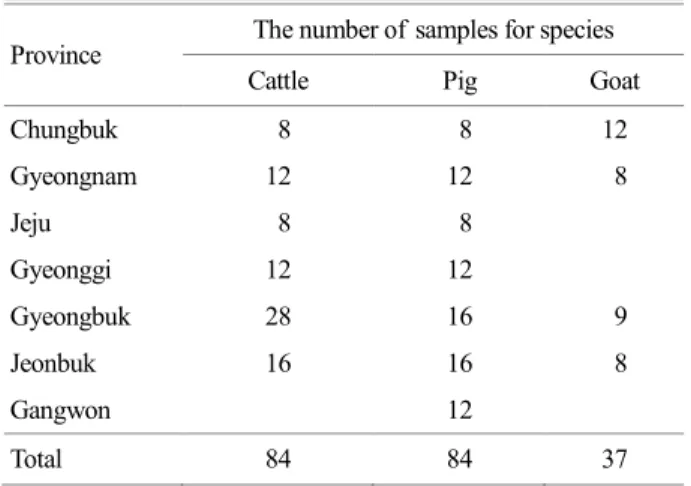
As this could interrupt the effective delivery of hAd vector for field animal trials, we performed a virus neutralization test in serum samples of farm animals such as pig, cattle, and goat. The 205 serum samples of pig, cattle, and goat were collected from seven nationwide provinces from the Republic of Korea. Our study showed that hAd5 virus was not neutralized in the sera of cattle, pig, and goat, and on the basis of our finding. We propose that the hAd5 vector could be used as an effective delivery method for vaccines or proteins for livestock animals in the field.
MATERIALS AND METHODS
Human embryonic kidney cells, including human adeno- virus type 5 E1 DNA (293A cells) were propagated in Dulbecco's modified Eagle's medium (DMEM) supple- mented with 10% fetal bovine serum (FBS; pH 7.4) at 37℃
with 5% CO2. Recombinant adenovirus type 5 expressing the lacZ was produced as previously described (18). The titer of adenovirus was determined in 293A cells and the 50% tissue culture infective dose (TCID50) was calculated using the formula of Reed and Muench (19). A total of 205 serum samples [cattle (n = 84), pig (n = 84) and goat (n = 37)] were collected randomly from 47 farms [cattle (n = 21), pig (n = 17) and goat (n = 9)] from seven provinces of the Republic of Korea (Table 1). Adenovirus neutralization assays were performed as described previously (17). The serum was incubated at 56℃ for 30 minutes and then diluted in DMEM in two-fold increments starting from 1:15 dilution in 96 well plates. One hundred microliters of each dilution was mixed with 200 TCID50 of recombinant adenovirus type 5 expressing lacZ and incubated for 1 hour at 37℃. The rabbit polyclonal antibody to the adenovirus type 5 (Abcam ab6982, USA) was used as a positive serum control, after which 104 of 293A cells were added into each well and incubated at 37℃ for 7 days. The virus neutralizing
antibody titer was estimated from the reciprocal of the highest serum dilution that completely prevented the devel- opment of a cytopathic effect (CPE).
RESULTS AND DISCUSSION
In this study, we examined whether preexisting neutral- izing antibodies (NAb) would cross-neutralize hAd5 in 205 field serum samples of cattle, pig, and goat using a virus- neutralization test. We enhanced representativeness of the samples by random sampling in a nationwide collection from Korea (Table 1). In the virus neutralization assay, hAd5 virus was neutralized by NAb titer > 100 of the positive serum control and had completes CPE in no treatment wells.
And the titers higher than 15 were scored as positive for the presence of hAd5-specific NAb in this study (20). The hAd5-specific NAb titers were less than 15 in 100% of serum samples from cattle (n = 84) and pig (n = 84) (Fig.
1). Even though most of goat samples also had the NAb titer of less than 15, 8% of the goat serum samples showed NAb titer of more than 15, two samples had a titer of 15 in Gyeongbuk and Jeonbuk province, and one sample in Jeonbuk province had a titer of 30. We suggested that the level of NAb titers of cattle, pig, and goat in the fields might not affect transduction of human adenoviral vector and only some of the goat samples could have low levels of titer for cross-neutralization.
Table 1. Serum samples of cattle, pig, and goat used in this study
Province The number of samples for species
Cattle Pig Goat
Chungbuk 8 8 12
Gyeongnam 12 12 8
Jeju 8 8
Gyeonggi 12 12
Gyeongbuk 28 16 9
Jeonbuk 16 16 8
Gangwon 12
Total 84 84 37
Cattle, pig, and goat are major livestock animals in many countries, including the Republic of Korea. The adenoviral vectors could be promising delivery systems for vaccines and antiviral agents against infectious diseases such as foot-and-mouth disease (FMD), classical swine fever (CSF), and porcine productive and respiratory syndrome (PRRS) in cattle, pig, and goat (12, 21, 22). However, in more than 90% of instances of ovine adenovirus and bovine adeno- virus, prevalence of NAb has been reported in sheep and cattle in the US (23). Occurrences of 89.5% and 92.3% of bovine adenovirus type 1 and 3 antibodies have been reported in Turkey (24) and an 18.3% prevalence of swine adenovirus antibody has been reported in 1983, in the US (25). The prevalence of antibodies for bovine, porcine, or ovine adenovirus was expected to be high in Korea as well, and the possibility that preexisting adenovirus antibodies might act as blocking factors in the effective delivery of the hAd vector for field animal trials could not be ruled out. Therefore, the virus-neutralization test for hAd5 was necessary for the study of a large set of animal serum samples from several farms.
Adenoviruses, including human adenovirus, bovine adenovirus, porcine adenovirus, and ovine adenovirus are hypothesized to have evolved with their hosts (26). Natural infection is known to be restricted to single or related host species, although some adenoviruses used as delivery vectors could be used to infect a broad range of hosts (27). Pre- viously, it was reported that bovine adenovirus and porcine adenovirus were not significantly cross-neutralized by NAb to human adenovirus (NAb<4) (10). Another study sug- gested that virus-neutralizing epitopes differ significantly in human adenovirus 5, bovine adenovirus 3, and porcine adenovirus 3 (8). The study also showed that porcine adenovirus- or bovine adenovirus- specific rabbit antibodies significantly neutralized porcine and bovine adenovirus but did not cross-neutralize hAd5. Thus, our study was based on the findings that the efficiency of porcine and bovine adenovirus - based vectors could be significantly decreased on neutralization by preexisting immunity in cattle and pigs.
Furthermore, we anticipated that the human adenovirus - based vectors could serve as more effective delivery systems for animals owing to circumvention of preexisting host- specific adenovirus immunity.
In conclusion, we confirmed that there was no hindrance in the use of hAd5-based virus in the sera of cattle, pig, and goat, and suggest that the hAd5-based vector could be used effectively for the field trials of livestock animals in many countries, including the Republic of Korea. Moreover, we also suggest that the human adenovirus-based vectors are more effective than the bovine or porcine adenovirus-based vectors in the study of livestock animals.
REFERENCES
1) Graham FL. Adenoviruses as expression vectors and recombinant vaccines. Trends Biotechnol 1990;8:85-7.
2) Barouch DH, Nabel GJ. Adenovirus vector-based vaccines for human immunodeficiency virus type 1.
Hum Gene Ther 2005;16:149-56.
3) Lubeck MD, Davis AR, Chengalvala M, Natuk RJ, Morin JE, Molnar-Kimber K, et al. Immunogenicity and efficacy testing in chimpanzees of an oral hepatitis Figure 1. Distribution of serum samples from cattle, pig and
goat according to neutralizing antibody to human adenovirus type 5 virus (hAd5). The virus neutralizing antibody titer was estimated from the reciprocal of the highest serum dilution that completely prevented the development of a cytopathic effect (CPE).
The percent of serum samples that display hAd5-specific neutrali- zation titers of <15, 15~50, 50~100, and >100 are shown. The rabbit polyclonal antibody to adenovirus type 5 virus (Abcam ab6982, USA) was used as a positive serum control.
B vaccine based on live recombinant adenovirus. Proc Natl Acad Sci U S A 1989;86:6763-7.
4) Casimiro DR, Chen L, Fu TM, Evans RK, Caulfield MJ, Davies ME, et al. Comparative immunogenicity in rhesus monkeys of DNA plasmid, recombinant vaccinia virus, and replication-defective adenovirus vectors expressing a human immunodeficiency virus type 1 gag gene. J Virol 2003;77:6305-13.
5) Kobinger GP, Feldmann H, Zhi Y, Schumer G, Gao G, Feldmann F, et al. Chimpanzee adenovirus vaccine protects against Zaire Ebola virus. Virology 2006;346:
394-401.
6)Papp Z, Babiuk LA, Baca-Estrada ME. The effect of pre-existing adenovirus-specific immunity on immune responses induced by recombinant adenovirus expressing glycoprotein D of bovine herpesvirus type 1. Vaccine 1999;17:933-43.
7) Croyle MA, Patel A, Tran KN, Gray M, Zhang Y, Strong JE, et al. Nasal delivery of an adenovirus-based vaccine bypasses pre-existing immunity to the vaccine carrier and improves the immune response in mice. PLoS One 2008;3:e3548.
8) Moffatt S, Hays J, HogenEsch H, Mittal SK. Circum- vention of vector-specific neutralizing antibody response by alternating use of human and non-human adeno- viruses: implications in gene therapy. Virology 2000;
272:159-67.
9)Seregin SS, Amalfitano A. Overcoming pre-existing adenovirus immunity by genetic engineering of adenovirus-based vectors. Expert Opin Biol Ther 2009;
9:1521-31.
10) Bangari DS, Shukla S, Mittal SK. Comparative trans- duction efficiencies of human and nonhuman adenoviral vectors in human, murine, bovine, and porcine cells in culture. Biochem Biophys Res Commun 2005;327:960 -6.
11) Braucher DR, Henningson JN, Loving CL, Vincent AL, Kim E, Steitz J, et al. Intranasal vaccination with replication-defective adenovirus type 5 encoding in- fluenza virus hemagglutinin elicits protective immunity to homologous challenge and partial protection to heterologous challenge in pigs. Clin Vaccine Immunol 2012;19:1722-9.
12) Kim SM, Lee KN, Lee SJ, Ko YJ, Lee HS, Kweon CH,
et al. Multiple shRNAs driven by U6 and CMV promoter enhances efficiency of antiviral effects against foot-and-mouth disease virus. Antiviral Res 2010;87:
307-17.
13) Perez-Martin E, Weiss M, Diaz-San Segundo F, Pacheco JM, Arzt J, Grubman MJ, et al. Bovine type III interferon significantly delays and reduces the severity of foot-and-mouth disease in cattle. J Virol 2012;86:
4477-87.
14)Prevec L, Schneider M, Rosenthal KL, Belbeck LW, Derbyshire JB, Graham FL. Use of human adenovirus- based vectors for antigen expression in animals. J Gen Virol 1989;70:429-34.
15) Sun Y, Li HY, Zhang XJ, Chang TM, He F, Wang XP, et al. Comparison of the protective efficacy of recombinant adenoviruses against classical swine fever. Immunol Lett 2011;135:43-9.
16)Toro H, van Ginkel FW, Tang DC, Schemera B, Rodning S, Newton J. Avian influenza vaccination in chickens and pigs with replication-competent adeno- virus-free human recombinant adenovirus 5. Avian Dis 2010;54:224-31.
17) Gogev S, Lemaire M, Thiry E. Prevalence of antibodies to human adenovirus type 5 in Belgian cattle. Vet Rec 2001;148:752-4.
18) Kim SM, Lee KN, Park JY, Ko YJ, Joo YS, Kim HS, et al. Therapeutic application of RNA interference against foot-and-mouth disease virus in vitro and in vivo. Antiviral Res 2008;80:178-84.
19)Reed LJ, Muench H. A simple method of estimating fifty percent end points. Am J Hygiene 1938;27:493-7.
20) Ersching J, Hernandez MI, Cezarotto FS, Ferreira JD, Martins AB, Switzer WM, et al. Neutralizing antibodies to human and simian adenoviruses in humans and New-World monkeys. Virology 2010;407:1-6.
21) Brockmeier SL, Lager KM, Grubman MJ, Brough DE, Ettyreddy D, Sacco RE, et al. Adenovirus-mediated expression of interferon-alpha delays viral replication and reduces disease signs in swine challenged with porcine reproductive and respiratory syndrome virus.
Viral Immunol 2009;22:173-80.
22) Sun Y, Yang Y, Zheng H, Xi D, Lin M, Zhang X, et al.
Co-expression of Erns and E2 genes of classical swine fever virus by replication-defective recombinant adeno-
virus completely protects pigs against virulent challenge with classical swine fever virus. Res Vet Sci 2013;94:
354-60.
23)Lehmkuhl HD, Cutlip RC, Brogden KA. Seroepide- miologic survey for adenovirus infection in lambs. Am J Vet Res 1993;54:1277-9.
24)Yeşilbağ K, Güngör B. Antibody prevalence against respiratory viruses in sheep and goats in North-Western Turkey. Trop Anim Health Prod 2009;41:421-5.
25) Elazhary MA, Dea S, Mittal KR, Higgins R. Prevalence
of Antibodies to Swine Influenza Virus, Porcine Adeno- virus Type 4 and Haemophilus pleuropneumoniae in Quebec Pig Farms with Respiratory Problems. Can Vet J 1985;26:190-2.
26) Harrach B, Benko M. Phylogenetic analysis of adeno- virus sequences. Methods Mol Med 2007;131:299-334.
27) W Woods L. Adenoviral diseases. In IKB Elizabeth S, Williams. ed. Infectious diseases in wild mammals. LA:
Iowa State University Press; 2001. p. 202-13.