© 2013 Korean Breast Cancer Society. All rights reserved. http://ejbc.kr | pISSN 1738-6756
INTRODUCTION
Radiotherapy (RT) is an important treatment modality in breast cancer management. Multiple clinical trials have dem- onstrated long-term RT-related mortality benefits in patients with breast cancer [1-4]. The Early Breast Cancer Trialists’
Collaborative Group (EBCTCG) performed a meta-analysis to determine the effects of RT after breast-conserving surgery (BCS). In this analysis, RT reduced the 15-year risk of breast cancer death from 25.2% to 21.4%, an absolute reduction of 3.8% (95% confidence interval [CI], 1.6–6.0; p=0.00005) [4].
Several important trials have evaluated the effects of postmas-
tectomy RT. The Danish Breast Cancer Cooperative Group (DBCG) protocols 82b and 82c, the British Columbia trial, and the EBCTCG meta-analysis showed that postmastectomy RT was associated with a significant improvement in overall survival [1,3,5,6]. Taken together, these results suggest that RT-induced locoregional control can result in improved over- all survival.
The human epidermal growth factor receptor 2 (HER2) is amplified or overexpressed in 20% to 25% of patients with breast cancer [7,8]. Recent reports suggest that HER2 expres- sion is associated with a high rate of locoregional recurrence [9-11]. Although the relationship between HER2 status and treatment failure is generally accepted, the exact mechanism is not entirely understood. Some preclinical studies showed that HER2 plays a major role in the modulation of radiation sensi- tivity [12-14]. Breast cancer cells develop resistance to RT when transfected with the HER2 gene [12,14]. Further, specif- ic inhibition of HER2 mRNA by siRNA increased the radio- sensitivity of HER2(+) SKBR3 breast cancer cells [13]. How-
Association of Human Epidermal Growth Factor Receptor 2 with Radiotherapy Resistance in Patients with T1N0M0 Breast Cancer
Hyun-Ah Kim, Eun-Kyu Kim, Min-Soo Kim, Jong-Han Yu1, Mi-Ri Lee2, Hae Kyung Lee3, Young-Jin Suh4, Woo Chul Noh, Korean Breast Cancer Society
Department of Surgery, Korea Cancer Center Hospital, Korea Institute of Radiological and Medical Sciences, Seoul; 1Department of Surgery, Asan Medical Center, University of Ulsan College of Medicine, Seoul; 2Department of Surgery, Dong-A University Medical Center, Busan; 3Department of General Surgery, Cheil General Hospital & Women’s Healthcare Center, Seoul; 4Department of Surgery, St. Vincent’s Hospital, The Catholic University of Korea College of Medicine, Suwon, Korea
ORIGINAL ARTICLE
Purpose: Preclinical studies have shown that human epidermal growth factor receptor 2 (HER2) status is associated with resis- tance to radiotherapy (RT). In this study, we evaluated the overall survival of a T1N0M0 breast cancer cohort in Korea according to the use of RT and the HER2 status. Methods: We analyzed data collected from 11,552 patients with invasive breast cancer who were enrolled in the Korean Breast Cancer Society Registration Program between 1999 and 2007. Data on the TNM stage, es- trogen receptor status, progesterone receptor status, HER2 sta- tus, operation method, and the use of RT were analyzed. Re- sults: The median follow-up period was 51 months. A significant improvement in overall survival after RT was observed only in the HER2(-) group. In this group, the 10-year overall survival rate
was 95.5% for patients who did not receive RT and 96.3% for patients who received RT (p=0.037). In contrast, in the HER2(+) group, RT was not associated with a survival benefit (p=0.887).
Multivariate analysis showed that RT was significantly associat- ed with a reduction in mortality in the HER2(-) group (hazard ra- tio, 0.738; 95% confidence interval, 0.549–0.993; p=0.045).
Conclusion: We found that postoperative RT was not associated with a survival benefit in HER2(+) breast cancer patients, sug- gesting that HER2(+) breast cancers could be RT resistant.
Key Words: Breast neoplasms, Human epidermal growth factor receptor 2, Radiotherapy, Survival
Correspondence to: Woo Chul Noh
Department of Surgery, Korea Cancer Center Hospital, Korea Institute of Radiological and Medical Sciences, 75 Nowon-ro, Nowon-gu, Seoul 139-709, Korea
Tel: +82-2-970-1221, Fax: +82-2-970-1221 E-mail: [email protected]
Received: March 25, 2013 Accepted: June 18, 2013
Cancer
ever, few clinical studies on this subject have been reported.
The DBCG conducted a subgroup analysis of overall survival according to molecular subtype in high-risk patients who par- ticipated in trials based on the DBCG protocols 82b or 82c [15]. In this analysis, patients with hormone receptor (HR)(-)/
HER2(+) status did not show any survival improvement after treatment with total mastectomy plus partial axillary dissec- tion and RT. Although the participants were high-risk pa- tients, this analysis suggested that HER2(+) tumors are possi- bly resistant to RT.
To evaluate the effects of RT on survival according to the HER2 status in early breast cancer patients, we retrospectively analyzed data from the nationwide Korean breast cancer pa- tient cohort.
METHODS
Patients
The Korean Breast Cancer Society (KBCS) registry database was used to identify node-negative patients with newly diag- nosed invasive breast cancer with a tumor less than ≤2 cm
between January 1999 and December 2007. The KBCS regis- try has prospectively collected nationwide breast cancer data since 1996 [16-19]. The Online Korean Breast Cancer Regis- tration Program was launched in 2001. Physicians personally enter clinicopathological data of newly diagnosed biopsy- proven primary breast cancer patients into the web-based da- tabase. The database contains information regarding the pa- tients’ sex and age, the surgical method used, the histologic findings, status of biologic markers (including HER2 status), adjuvant treatment, and cancer stage (according to the sixth American Joint Committee on Cancer classification). Patient survival data, including the dates and causes of death, were obtained from the Death Certification of the Korean National Statistical Office and the Korean Central Cancer Registry of the Ministry of Health and Welfare. The Korean Central Can- cer Registry is linked to the Korea National Statistical Office, which has recorded complete death statistics by using a unique identification numbers that are assigned to all Korean resi- dents [16-19]. Between January 1999 and December 2007, 52,185 patients were registered in this database. The database includes more than 40% of the incidence data from The Korea
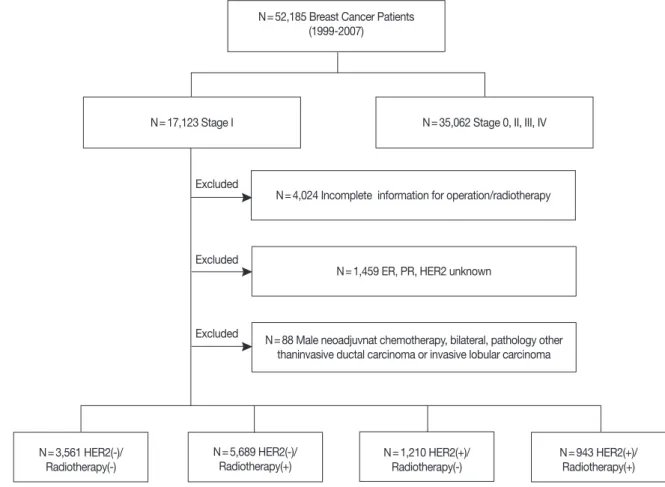
Figure 1. Patient selection flow chart.
ER=estrogen receptor; PR=progesterone receptor; HER2=human epidermal growth factor receptor 2.
N=52,185 Breast Cancer Patients (1999-2007)
N=17,123 Stage I N=35,062 Stage 0, II, III, IV
N=4,024 Incomplete information for operation/radiotherapy
N=1,459 ER, PR, HER2 unknown Excluded
Excluded
Excluded N=88 Male neoadjuvnat chemotherapy, bilateral, pathology other thaninvasive ductal carcinoma or invasive lobular carcinoma
N=3,561 HER2(-)/
Radiotherapy(-)
N=5,689 HER2(-)/
Radiotherapy(+) N=1,210 HER2(+)/
Radiotherapy(-)
N=943 HER2(+)/
Radiotherapy(+)
National Cancer Incidence Database (KNCID), and the com- pleteness of the KNCID for 2009 was 97.2%, as determined by the Ajiki method [20]. Detailed information on the KBCS registry has been provided elsewhere [16-20]. The last date of follow-up was December 31, 2008. This study was approved by the Institutional Review Board of the Korea Cancer Center Hospital (approval number: K-1305-002-017).
Of the 52,185 patients identified, we excluded those patients with incomplete information regarding estrogen receptor (ER) status, progesterone receptor (PR) status, HER2 status, oper- ation method, and use of RT and male patients. Patients with bilateral disease, malignant phyllodes tumor, lymphoma, sar- coma, squamous cell carcinoma, prior malignancy, and prior treatment with neoadjuvant chemotherapy were also exclud- ed. Thus, a total of 11,552 patients were included in this analy- sis (Figure 1).
HER2 and hormone receptor status
HER2 positivity was defined as a rating of 3+ on immuno- histochemistry (IHC) and/or gene amplification on fluores- cence in situ hybridization (FISH). ER and PR status was de- fined as positive or negative by physicians according to each institution’s standard methods and cutoff values. Tumors that were ER or PR positive were defined as hormone receptor (HR) positive, and tumors that were ER and PR negative were defined as HR negative.
Statistical analysis
Data analysis was performed using SPSS version 14.0 (SPSS Inc., Chicago, USA). The chi-square test was used to assess differences in the clinicopathological factors between the groups. Survival rates were estimated using the Kaplan–Meier method, and survival curves were compared using the log- rank test. The Cox proportional hazards model was used to perform multivariate analyses. Statistical significance was ac- cepted for p-values of less than 0.05.
RESULTS
Patient characteristics
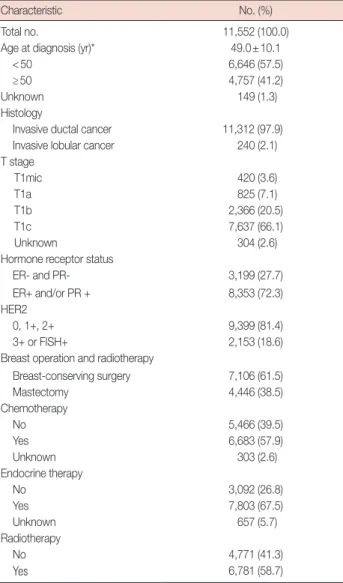
Patient and tumor characteristics and data on the adjuvant systemic treatment received are summarized in Table 1. The mean age of the patients was 49.0±10.1 years, and 6,646 pa- tients (57.5%) were younger than 50 years. Of the 11,552 pa- tients, 18.6% had HER2(+) disease and 72.3% had HR(+) dis- ease. RT had been administered to 6,781 patients (58.7%). The proportion of patients who had undergone BCS was 61.5%, and 92.6% of these patients had received postoperative RT.
Among the patients who had undergone mastectomy, only
201 (4.5%) had received postoperative RT. Further, 57.9% of the patients had received adjuvant chemotherapy, and 67.5%
had received endocrine therapy. Five patients (0.2%) with HER2(+) tumors had been treated with adjuvant trastuzumab therapy. No patients had received adjuvant lapatinib therapy.
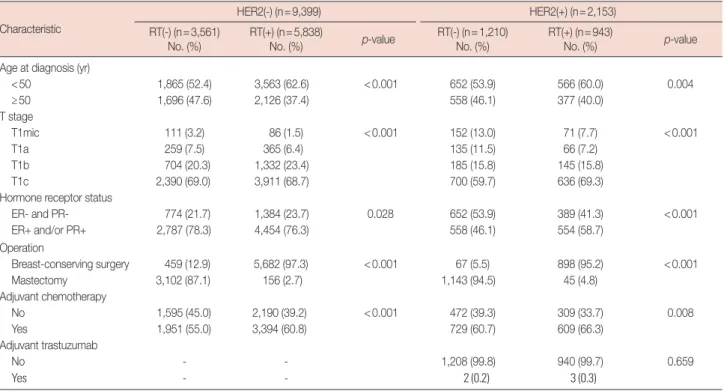
Table 2 summarizes the clinicopathological characteristics according to the use of RT and HER2 status. In the HER2(-) group, 61.5% of the patients had received RT. The HER2(-)/
RT(+) group had a larger proportion of patients younger than 50 years (p<0.001), a larger number of patients with HR(-) disease (p=0.028), and fewer patients who were treated with adjuvant chemotherapy than the HER2(-)/RT(-) group. In the HER2(+) group, 943 patients (43.8%) had received RT. The HER2(+)/RT(-) group had a larger proportion of younger pa- tients (p=0.004), fewer patients with HR(-) disease, and a Table 1. Clinicopathologic characteristic of patients
Characteristic No. (%)
Total no. 11,552 (100.0)
Age at diagnosis (yr)* 49.0±10.1
<50 6,646 (57.5)
≥50 4,757 (41.2)
Unknown 149 (1.3)
Histology
Invasive ductal cancer 11,312 (97.9)
Invasive lobular cancer 240 (2.1)
T stage
T1mic 420 (3.6)
T1a 825 (7.1)
T1b 2,366 (20.5)
T1c 7,637 (66.1)
Unknown 304 (2.6)
Hormone receptor status
ER- and PR- 3,199 (27.7)
ER+ and/or PR + 8,353 (72.3)
HER2
0, 1+, 2+ 9,399 (81.4)
3+ or FISH+ 2,153 (18.6)
Breast operation and radiotherapy
Breast-conserving surgery 7,106 (61.5)
Mastectomy 4,446 (38.5)
Chemotherapy
No 5,466 (39.5)
Yes 6,683 (57.9)
Unknown 303 (2.6)
Endocrine therapy
No 3,092 (26.8)
Yes 7,803 (67.5)
Unknown 657 (5.7)
Radiotherapy
No 4,771 (41.3)
Yes 6,781 (58.7)
ER=estrogen receptor; PR=progesterone receptor; HER2=human epider- mal growth factor receptor 2; FISH=fluorescence in situ hybridization.
*Mean±SD.
higher frequency of treatment with adjuvant chemotherapy than the HER2(+)/RT(+) group. Operation methods accord- ing to RT were significantly imbalanced in both the HER2(-) and HER2(+) groups.
A total of 181 death events occurred during a median fol- low-up period of 51 months (range, 1–140 months). The 10- year overall survival rate was 96.0% (Figure 2A). Overall sur- vival did not differ significantly between patients with HER2(+) tumors and those with HER2(-) tumors (p=0.208), as shown in Figure 2B. The operation method used was not associated with overall survival (p=0.201) (Figure 2C). In contrast, overall survival differed significantly between pa- tients treated with RT and those not treated with RT. The pa- tients treated with RT had a significantly better overall surviv- al (p=0.040) (Figure 2D).
Univariate survival analyses according to HER2 status and the use of radiotherapy
Among patients with HER2(-) disease, the 10-year overall survival rate was higher in those younger than 50 years (96.5%
vs. 95.4%, p=0.029), in those with HR(+) disease (97.1% vs.
92.6%, p<0.001), and in those treated with RT (96.3% vs.
95.5%, p=0.037). No significant difference in overall survival was found between patients treated with adjuvant chemother- apy and those treated without adjuvant chemotherapy.
In contrast, among HER2(+) patients, no significant differ-
ence was found among patients with regard to various risk factors, including the age at diagnosis, HR status, adjuvant chemotherapy, and the use of RT. The 10-year overall survival rate in the HER2(+) patient group was 95.7% for patients who did not receive RT and 95.3% for those who received RT (p=
0.887) (Table 3, Figure 3).
Overall survival was analyzed according to the molecular subtype and RT use. Among patients with HR(+)/HER2(-) disease, the 10-year overall survival rate was greater in those treated with RT than in those not treated with RT (97.6% vs.
96.5%, p=0.021). However, no significant difference was found in overall survival between patients treated with RT and those treated without RT among patients with HR(+)/HER2 (+) disease (93.9% vs. 96.8%, p=0.182), HR(-)/HER2(+) dis- ease (97.8% vs. 94.6%, p=0.087), or HR(-)/HER2(-) disease (93.2% vs. 92.0%, p=0.372).
Multivariate survival analysis in patients with HER2(-) tumors To identify the factors that predict overall survival in the subgroup of patients with HER2(-) tumors, multivariate analy- sis was performed. Variables that were statistically significant in univariate analysis were included in multivariate analysis.
These were age at diagnosis, HR status, mass size, and use of RT. Multivariate analysis showed that the use of RT could pre- dict overall survival in patients with HER2(-) disease (hazard ratio [HR], 0.738; 95% CI, 0.549–0.993; p=0.045) (Table 4).
Table 2. Clinicopathologic characteristics according to radiation therapy based on HER2 status Characteristic
HER2(-) (n=9,399) HER2(+) (n=2,153)
RT(-) (n=3,561)
No. (%) RT(+) (n=5,838)
No. (%) p-value RT(-) (n=1,210)
No. (%) RT(+) (n=943)
No. (%) p-value
Age at diagnosis (yr)
<50 1,865 (52.4) 3,563 (62.6) <0.001 652 (53.9) 566 (60.0) 0.004
≥50 1,696 (47.6) 2,126 (37.4) 558 (46.1) 377 (40.0)
T stage
T1mic 111 (3.2) 86 (1.5) <0.001 152 (13.0) 71 (7.7) <0.001
T1a 259 (7.5) 365 (6.4) 135 (11.5) 66 (7.2)
T1b 704 (20.3) 1,332 (23.4) 185 (15.8) 145 (15.8)
T1c 2,390 (69.0) 3,911 (68.7) 700 (59.7) 636 (69.3)
Hormone receptor status
ER- and PR- 774 (21.7) 1,384 (23.7) 0.028 652 (53.9) 389 (41.3) <0.001
ER+ and/or PR+ 2,787 (78.3) 4,454 (76.3) 558 (46.1) 554 (58.7)
Operation
Breast-conserving surgery 459 (12.9) 5,682 (97.3) <0.001 67 (5.5) 898 (95.2) <0.001
Mastectomy 3,102 (87.1) 156 (2.7) 1,143 (94.5) 45 (4.8)
Adjuvant chemotherapy
No 1,595 (45.0) 2,190 (39.2) <0.001 472 (39.3) 309 (33.7) 0.008
Yes 1,951 (55.0) 3,394 (60.8) 729 (60.7) 609 (66.3)
Adjuvant trastuzumab
No - - 1,208 (99.8) 940 (99.7) 0.659
Yes - - 2 (0.2) 3 (0.3)
HER2=human epidermal growth factor receptor 2; RT=radiation therapy; ER=estrogen receptor; PR=progesterone receptor.
In addition, an age of ≥50 years at diagnosis (HR, 1.410; 95%
CI, 1.044–1.904; p=0.025) and HR(+) status (HR, 0.351; 95%
CI, 0.260–0.472; p<0.001) retained statistical significance as
Figure 2. (A) Overall survival for all patients. (B) Overall survival according to human epidermal growth factor receptor 2 (HER2) status. (C) Overall sur- vival according to operation methods. (D) Overall survival according to whether radiotherapy (RT) or not.
BCS=breast-conserving surgery.
HER2(-)
BCS RT
HER2(+)
No RT Mastectomy
p=0.208
p=0.201 p=0.040
C
Cumulative survival rate
1.00
0.99
0.98
0.97
0.96
0.95
B
Cumulative survival rate
1.00
0.99
0.98
0.97
0.96
0.95
A
Cumulative survival rate
Time (mo)
Time (mo)
Time (mo)
Time (mo) 0 20 40 60 80 100 120 140 160
0 20 40 60 80 100 120 140 160
0 20 40 60 80 100 120 140 160
0 20 40 60 80 100 120 140 160 1.00
0.99
0.98
0.97
0.96
0.95
D
Cumulative survival rate
1.00
0.99
0.98
0.97
0.96
0.95
Figure 3. Effect of radiotherapy (RT) on breast cancer mortality after curative operation (A) in the human epidermal growth receptor 2 (HER2) (-) group and (B) in the HER2(+) group.
p=0.887
B
Cumulative survival rate
1.00
0.99
0.98
0.97
0.96
0.95
A
Cumulative survival rate
Time (mo) Time (mo)
0 20 40 60 80 100 120 140 160 0 20 40 60 80 100 120 140 160 1.00
0.99
0.98
0.97
0.96
0.95
RT
No RT No RTRT
predictors of overall survival. In the HER2(+) group, no fac- tors were found to significantly predict overall survival in uni- variate analysis. Therefore, multivariate analysis was not per-
formed for this group.
DISCUSSION
In the present study, we showed that breast cancer patients with HER2(+) disease do not obtain an overall survival benefit from postoperative RT, unlike those with HER2(-) disease. To our knowledge, this is the first large-scale clinical analysis to show that HER2(+) tumors display a tendency for RT resis-
tance in patients with T1N0M0 breast cancer. This result has clinical relevance because the use of RT after BCS is increasing with the trend in the general use of screening mammography.
Although some preclinical data support the hypothesis that the HER2 status is positively associated with RT resistance, the available clinical data on this subject are limited. The DBCG conducted a subgroup analysis of 1,000 patients from the DBCG studies based on protocols 82b and 82c, in which the inclusion criteria were positive lymph nodes and/or tu- mors of >5 cm in size and/or tumor invasion of the skin or pectoralis muscle fascia [15]. All patients had received total mastectomy, axillary dissection, and 8 cycles of CMF (cyclo- phosphamide, methotrexate, and fluorouracil) as adjuvant chemotherapy. In subgroup analysis, IHC staining was used to evaluate the ER, PR, and HER2 statuses, and tissue micro- arrays were used for FISH analyses of HER2 expression. The median follow-up time was 17 years. The 4 subgroups were defined according to ER, PR, and HER2 expression: HR(+)/
HER2(-), HR(+)/HER2(+), HR(-)/HER2(-), and HR(-)/
HER2(+). Postmastectomy RT did not improve overall sur- vival for the HR(-)/HER2(+) subtype, whereas it significantly improved overall survival for the HR(+)/HER2(-) subtype. In the present nationwide analysis of T1N0M0 patients, we found that no RT-related survival benefits were observed in the HER2(+) group, whereas RT conferred survival benefits in the HER2(-) group. This result closely agrees with those of the DBCG subgroup analyses based on the 82b and 82c pro- tocols, although these analyses were conducted on very differ- Table 4. Multivariate analysis of factors associated with overall survival
on patients with HER2 negative tumor
Risk factor HR 95% CI
p-value
Lower Upper
Age at diagnosis (yr)
<50 1.0
≥50 1.410 1.044 1.904 0.025
Hormone receptor status
ER- and PR- 1.0
ER+ and/or PR+ 0.351 0.260 0.472 <0.001 T stage
T1mic 1.0 0.008
T1a 4,824.651 0 2.727
T1b 5,477.907 0 3.087
T1c 11,046.499 0 6.220
Radiotherapy
No 1.0
Yes 0.738 0.549 0.993 0.045
HER2 =human epidermal growth factor receptor 2; HR =hazard ratio;
CI=confidence interval; ER=estrogen receptor; PR=progesterone receptor.
Table 3. Univariate analysis of factors associated with overall survival based on HER2 status and radiation therapy use Risk factor
HER2(-) HER2(+)
No. of
patients No. of
death 5-year
survival (%) 10-year
survival (%) p-value No. of
patients No. of
death 5-year
survival (%) 10-year survival (%) p-value Age at diagnosis (yr)
<50 5,428 88 98.1 96.5 0.029 1,218 33 97.1 95.5 0.853
≥50 3,822 91 97.3 95.4 935 22 96.9 95.5
T stage
T1mic 197 0 100.0 100.0 <0.001 223 3 98.1 - 0.180
T1a 624 5 98.8 - 201 1 99.5 99.5
T1b 2,036 21 98.4 98.4 330 7 97.4 95.6
T1c 6,301 150 97.3 95.1 1,336 42 96.5 94.8
Hormone receptor status
ER- and PR- 2,158 86 95.0 92.6 <0.001 1,041 26 96.7 95.7 0.990
ER+ and/or PR+ 7,241 95 98.6 97.1 1,112 29 97.4 95.5
Adjuvant chemotherapy
No 3,785 60 98.2 96.5 0.078 781 23 96.8 94.2 0.301
Yes 5,345 117 97.4 95.6 1,338 30 97.2 96.6
Radiotherapy
No 3,561 88 97.4 95.5 0.037 1,210 33 96.8 95.7 0.887
Yes 5,838 93 97.9 96.3 943 22 97.4 95.3
HER2=human epidermal growth factor receptor 2; ER=estrogen receptor; PR=progesterone receptor.
ent populations. In contrast to the present study and the DBCG subgroup analyses based on the 82b and 82c protocols, Rozan et al. [21] reported that HER2 overexpression was not associated with RT use in a neoadjuvant setting. The authors evaluated tumor responses to FAC (5-fluorouracil, doxorubi- cin, and cyclophosphamide) chemotherapy or RT. Of 329 pa- tients, 156 were assigned to the neoadjuvant RT group, in which HER2 expression was not significantly associated with tumor response. However, the small number of patients limits the utility of these results; only 26 patients (16.7%) had tu- mors that were strongly positive for HER2.
Previous reports have suggested that breast cancer subtypes were associated with the risk of local and regional recurrence or survival [4,9,11,22,23]. However, the mechanism by which HER2 positivity predicts a poor prognosis is unknown. To evaluate the relationship between the use of RT and survival, the patients evaluated must not have pre-existing distant mi- crometastatic disease [24]. Therefore, the target population should include patients with very early-stage disease. In the present study, only patients with T1N0M0 disease were in- cluded in the analysis. Despite the relatively short follow-up period and the generally low number of death events in this population, the survival rate differed significantly between the HER2(-)/RT(+) and HER2(-)/RT(-) groups.
The study presented herein was a retrospective analysis, and therefore, it has several limitations. First, a clinical and patho- logical imbalance existed between the groups. Second, the op- eration method was excluded from multivariate analysis be- cause it was an intervening variable of RT. However, it is well established that the operation method does not affect the overall survival of patients with early breast cancer. Veronesi et al. [25] found that after 20 years of follow-up, the long-term survival rate of patients who underwent BCS did not differ from that of patients who underwent radical mastectomy. In the National Surgical Adjuvant Breast and Bowel Project B-06, 1,851 patients were assigned randomly to one of several treat- ment groups: total mastectomy, lumpectomy only, or lumpec- tomy, and breast irradiation. The findings reported after 20 years showed no significant differences between the groups with regard to disease-free survival, distant disease-free sur- vival, and overall survival [26]. In accordance with these pro- spective randomized trials, the data from the present study also showed that overall survival was not affected by the oper- ation method (p=0.201). A third limitation of our study was that locoregional recurrence was not analyzed. Because the recurrence data were entered freely by the physicians at each institute, data were incomplete in several cases. In contrast with the recurrence data, the Korean Breast Cancer Society online registry database contains complete and accurate data
on death events that are obtained biannually from the Korean National Statistical Office and the Korean Central Cancer Registry of the Ministry of Health and Welfare according to unique identification numbers. Finally, according to the EBCTCG meta-analysis, on average, approximately 1 breast cancer death was avoided by year 15 for every 4 recurrences that were avoided by year 10 as a result of RT [4]. Thus, the median follow-up time of 51 months in our study is a relative- ly short time with which to provide definitive answers regard- ing the absolute survival benefits of RT.
Our data showed that HER2 positivity was related to RT re- sistance in patients with T1N0M0 breast cancer. These results suggest that HER2-targeted therapies are potentially useful as radiosensitizers for patients with HER2(+) tumors. However, the relatively short follow-up period and lack of locoregional recurrence data should be considered when interpreting these findings. In a preclinical study, RT resistance induced by HER2 gene transfection was overcome by trastuzumab both in in vitro and in vivo studies [12]. Inhibition of PI3K-Akt- mTOR signaling (HER2 pathway) has been shown to increase radiosensitivity in HER2(+) breast cancer cell lines [13,27]. In addition, lapatinib, a small molecule tyrosine kinase inhibitor of HER1 and HER2, acts as a radiosensitizer in HER2(+) breast cancer xenografts [28]. Unfortunately, clinical informa- tion regarding the radiosensitization effects of HER2-targeted therapy is currently unavailable. At present, trastuzumab and lapatinib are commonly used in clinical practice as standard therapies for the treatment of HER2(+) breast cancer. Howev- er, the optimal sequence for RT and trastuzumab in an adju- vant setting for breast cancer treatment is not yet established.
Phase II trials showed that concurrent therapy with trastu- zumab and RT was well tolerated [29,30]. A large prospective randomized clinical trial might provide insight into whether the combination of RT and HER2-targeted therapy could im- prove the survival of patients with HER2(+) tumors.
CONFLICT OF INTEREST
The authors declare that they have no competing interests.
REFERENCES
1. Overgaard M, Jensen MB, Overgaard J, Hansen PS, Rose C, Andersson M, et al. Postoperative radiotherapy in high-risk postmenopausal breast-cancer patients given adjuvant tamoxifen: Danish Breast Cancer Cooperative Group DBCG 82c randomised trial. Lancet 1999;
353:1641-8.
2. Danish Breast Cancer Cooperative Group, Nielsen HM, Overgaard M, Grau C, Jensen AR, Overgaard J. Study of failure pattern among high- risk breast cancer patients with or without postmastectomy radiothera-
py in addition to adjuvant systemic therapy: long-term results from the Danish Breast Cancer Cooperative Group DBCG 82 b and c random- ized studies. J Clin Oncol 2006;24:2268-75.
3. Overgaard M, Hansen PS, Overgaard J, Rose C, Andersson M, Bach F, et al. Postoperative radiotherapy in high-risk premenopausal women with breast cancer who receive adjuvant chemotherapy. Danish Breast Cancer Cooperative Group 82b Trial. N Engl J Med 1997;337:949-55.
4. Early Breast Cancer Trialists’ Collaborative Group (EBCTCG), Darby S, McGale P, Correa C, Taylor C, Arriagada R, et al. Effect of radiotherapy after breast-conserving surgery on 10-year recurrence and 15-year breast cancer death: meta-analysis of individual patient data for 10,801 women in 17 randomised trials. Lancet 2011;378:1707-16.
5. Ragaz J, Olivotto IA, Spinelli JJ, Phillips N, Jackson SM, Wilson KS, et al.
Locoregional radiation therapy in patients with high-risk breast cancer receiving adjuvant chemotherapy: 20-year results of the British Colum- bia randomized trial. J Natl Cancer Inst 2005;97:116-26.
6. Clarke M, Collins R, Darby S, Davies C, Elphinstone P, Evans E, et al.
Effects of radiotherapy and of differences in the extent of surgery for early breast cancer on local recurrence and 15-year survival: an over- view of the randomised trials. Lancet 2005;366:2087-106.
7. Slamon DJ, Clark GM, Wong SG, Levin WJ, Ullrich A, McGuire WL.
Human breast cancer: correlation of relapse and survival with amplifi- cation of the HER-2/neu oncogene. Science 1987;235:177-82.
8. Owens MA, Horten BC, Da Silva MM. HER2 amplification ratios by fluorescence in situ hybridization and correlation with immunohisto- chemistry in a cohort of 6556 breast cancer tissues. Clin Breast Cancer 2004;5:63-9.
9. Voduc KD, Cheang MC, Tyldesley S, Gelmon K, Nielsen TO, Kennecke H. Breast cancer subtypes and the risk of local and regional relapse. J Clin Oncol 2010;28:1684-91.
10. Millar EK, Graham PH, O’Toole SA, McNeil CM, Browne L, Morey AL, et al. Prediction of local recurrence, distant metastases, and death after breast-conserving therapy in early-stage invasive breast cancer us- ing a five-biomarker panel. J Clin Oncol 2009;27:4701-8.
11. Nguyen PL, Taghian AG, Katz MS, Niemierko A, Abi Raad RF, Boon WL, et al. Breast cancer subtype approximated by estrogen receptor, progesterone receptor, and HER-2 is associated with local and distant recurrence after breast-conserving therapy. J Clin Oncol 2008;26:2373- 8.
12. Pietras RJ, Poen JC, Gallardo D, Wongvipat PN, Lee HJ, Slamon DJ.
Monoclonal antibody to HER-2/neureceptor modulates repair of radi- ation-induced DNA damage and enhances radiosensitivity of human breast cancer cells overexpressing this oncogene. Cancer Res 1999;
59:1347-55.
13. No M, Choi EJ, Kim IA. Targeting HER2 signaling pathway for radio- sensitization: alternative strategy for therapeutic resistance. Cancer Biol Ther 2009;8:2351-61.
14. Pirollo KF, Tong YA, Villegas Z, Chen Y, Chang EH. Oncogene-trans- formed NIH 3T3 cells display radiation resistance levels indicative of a signal transduction pathway leading to the radiation-resistant pheno- type. Radiat Res 1993;135:234-43.
15. Kyndi M, Sørensen FB, Knudsen H, Overgaard M, Nielsen HM, Over- gaard J, et al. Estrogen receptor, progesterone receptor, HER-2, and re- sponse to postmastectomy radiotherapy in high-risk breast cancer: the Danish Breast Cancer Cooperative Group. J Clin Oncol 2008;26:1419-
26.
16. Ahn SH, Son BH, Kim SW, Kim SI, Jeong J, Ko SS, et al. Poor outcome of hormone receptor-positive breast cancer at very young age is due to tamoxifen resistance: nationwide survival data in Korea: a report from the Korean Breast Cancer Society. J Clin Oncol 2007;25:2360-8.
17. Lee JA, Kim KI, Bae JW, Jung YH, An H, Lee ES, et al. Triple negative breast cancer in Korea-distinct biology with different impact of prog- nostic factors on survival. Breast Cancer Res Treat 2010;123:177-87.
18. The Korean Breast Cancer Society. Survival analysis of Korean breast cancer patients diagnosed between 1993 and 2002 in Korea: a nation- wide study of the cancer registry. J Breast Cancer 2006;9:214-29.
19. Han W, Kang SY; Korean Breast Cancer Society. Relationship between age at diagnosis and outcome of premenopausal breast cancer: age less than 35 years is a reasonable cut-off for defining young age-onset breast cancer. Breast Cancer Res Treat 2010;119:193-200.
20. Jung KW, Park S, Kong HJ, Won YJ, Lee JY, Seo HG, et al. Cancer statis- tics in Korea: incidence, mortality, survival, and prevalence in 2009.
Cancer Res Treat 2012;44:11-24.
21. Rozan S, Vincent-Salomon A, Zafrani B, Validire P, De Cremoux P, Bernoux A, et al. No significant predictive value of c-erbB-2 or p53 ex- pression regarding sensitivity to primary chemotherapy or radiotherapy in breast cancer. Int J Cancer 1998;79:27-33.
22. Albert JM, Gonzalez-Angulo AM, Guray M, Sahin A, Strom EA, Teref- fe W, et al. Estrogen/progesterone receptor negativity and HER2 posi- tivity predict locoregional recurrence in patients with T1a,bN0 breast cancer. Int J Radiat Oncol Biol Phys 2010;77:1296-302.
23. Wang Y, Yin Q, Yu Q, Zhang J, Liu Z, Wang S, et al. A retrospective study of breast cancer subtypes: the risk of relapse and the relations with treat- ments. Breast Cancer Res Treat 2011;130:489-98.
24. Buchholz TA. Radiotherapy and survival in breast cancer. Lancet 2011;378:1680-2.
25. Veronesi U, Cascinelli N, Mariani L, Greco M, Saccozzi R, Luini A, et al.
Twenty-year follow-up of a randomized study comparing breast-con- serving surgery with radical mastectomy for early breast cancer. N Engl J Med 2002;347:1227-32.
26. Fisher B, Anderson S, Bryant J, Margolese RG, Deutsch M, Fisher ER, et al. Twenty-year follow-up of a randomized trial comparing total mas- tectomy, lumpectomy, and lumpectomy plus irradiation for the treat- ment of invasive breast cancer. N Engl J Med 2002;347:1233-41.
27. Liang K, Lu Y, Jin W, Ang KK, Milas L, Fan Z. Sensitization of breast cancer cells to radiation by trastuzumab. Mol Cancer Ther 2003;2:1113- 20.
28. Sambade MJ, Kimple RJ, Camp JT, Peters E, Livasy CA, Sartor CI, et al.
Lapatinib in combination with radiation diminishes tumor regrowth in HER2+ and basal-like/EGFR+ breast tumor xenografts. Int J Radiat Oncol Biol Phys 2010;77:575-81.
29. Horton JK, Halle J, Ferraro M, Carey L, Moore DT, Ollila D, et al. Ra- diosensitization of chemotherapy-refractory, locally advanced or locally recurrent breast cancer with trastuzumab: a phase II trial. Int J Radiat Oncol Biol Phys 2010;76:998-1004.
30. Caussa L, Kirova YM, Gault N, Pierga JY, Savignoni A, Campana F, et al.
The acute skin and heart toxicity of a concurrent association of trastu- zumab and locoregional breast radiotherapy including internal mam- mary chain: a single-institution study. Eur J Cancer 2011;47:65-73.