Aneurysm of the Posterior Meningeal Artery Embedded Within a Dorsal Exophytic Medullary Hemangioblastoma:
Surgical Management and Review of Literature
Kunal P. Raygor1, Nathan C. Rowland1, Daniel L. Cooke2, David A. Solomon3, Michael C. Huang1
1UCSF Center for Stroke and Cerebrovascular Disease, Department of Neurological Surgery, University of California, San Francisco, CA, United States
2Neuro-Interventional Section, Department of Radiology, University of California, San Francisco, CA, United States
3Department of Pathology, University of California, San Francisco, CA, United States
Hemangioblastomas are World Health Organization (WHO) Grade I neo- plasms of the hindbrain and spinal cord, whose management can be complicated by preoperative hemorrhage. We report on a case of a young female in extremis with posterior fossa hemorrhage following rup- ture of a fusiform posterior meningeal artery aneurysm embedded within a medullary hemangioblastoma. We discuss management options, includ- ing operative staging and embolization, and review similar cases of he- mangioblastoma associated with aneurysm.
J Cerebrovasc Endovasc Neurosurg.
2014 September;16(3):293-298 Received : 26 May 2014
Revised : 1 July 2014 Accepted : 11 August 2014 Correspondence to Michael C. Huang 1001 Potrero Ave, Building 1, San Francisco, CA 94143-0112, United States
Tel : 1-415-206-8300 Fax : 1-415-353-2889
E-mail : [email protected] ORCID : http://orcid.org/0000-0003-3101-6745
This is an Open Access article distributed under the terms of the Creative Commons Attribution Non- Commercial License (http://creativecommons.org/li- censes/by-nc/3.0) which permits unrestricted non- commercial use, distribution, and reproduction in any medium, provided the original work is properly cited.
Keywords Aneurysm, Hemangioblastoma, Embolization, Posterior fossa hemorrhage
INTRODUCTION
Hemangioblastomas are highly vascularized central nervous system (CNS) neoplasms with a predilection for the cerebellum, brainstem, and spinal cord.1) Clinical presentation typically occurs in the fifth decade for sporadic cases and as early as the third decade for pa- tients with a diagnosis of von Hippel-Lindau (VHL) disease.7)20) These tumors are rarely found in children.3) Symptoms correlate with regional compression of cer- ebrospinal fluid (CSF) flow or eloquent tissue and can include cerebellar signs and symptoms, cranial nerve deficits and weakness and spasticity, among other findings. Despite extensive literature describing the diagnosis, treatment, and prognosis of these lesions,6)
individual cases still present a surgical quandary giv- en their frequently eloquent location and high degree of vascularity. We report on a case of a young female with focal posterior fossa hemorrhage from an un- known vascular lesion. We detail our surgical man- agement in the context of similarly rare cases.
CASE REPORT
The patient was a 23 year-old female with no known medical history presenting with a Glasgow Coma Score (GCS) of 3 and reactive pupils after being found down without signs of head trauma or intoxication. A non-contrast head computed tomog- raphy (CT) scan showed a subarachnoid hemorrhage
A B
C D
Fig. 1. Preoperative imaging showing a posterior fossa subarachnoid hemorrhage and a hypervascular mass. (A) Axial non-contrast computed tomography (CT) image showing hemorrhage in the subarachnoid space of the posterior fossa. (B) Axial non-contrast CT scan showing extension of hemorrhage into the third and lateral ventricles. (C) Sagittal contrast-enhanced CT scan showing a hyper- vascular mass, measuring 1.8 cm, below the cerebellum. (D) Axial T1-weighted magnetic resonance imaging (MRI) with gadolinium enhancement showing a heterogenously enhancing mass associated with the dorsal aspect of the medullary-cervical junction.
(SAH) in the posterior fossa (Fig. 1A) with extension into the third, fourth, and lateral ventricles (Fig. 1B).
A 2 cm vascular lesion below the cerebellar margin was observed following contrast administration (Fig.
1C). An external ventricular drain (EVD) was inserted
into the right frontal horn of the lateral ventricle to relieve early hydrocephalus (level set at 20 cm H2O with clear CSF return), and a diagnostic cerebral an- giogram was planned. However, less than one hour following ventriculostomy placement, acute hemor-
A B C
Fig. 2. Digital subtraction angiography. (A) Preoperative angiogram, right vertebral artery (VA) injection, lateral view, demonstrating a prominent vascular tumor and an embedded fusiform posterior meningeal artery aneurysm, which measured 4.5 mm. (B) Pre-oper- ative angiogram, right VA injection, antero-posterior view, showing multiple dissections (white arrows) of the cervical segment of the right VA as well as the aneurysm (black arrow). (C) Post-operative angiogram, right VA injection, lateral view, showing no residual tumor or aneurysm.
rhage was observed within the EVD tubing, and in- tracranial pressures (ICP) rose beyond 100 cm H2O.
The patient was taken to the operating room emergently for posterior fossa decompression. Intraoperatively, following a wide suboccipital craniectomy, C1 lam- inectomy, and posterior fossa dural opening, a firm, well-circumscribed, highly vascular mass was found below the obex at the craniocervical junction. Manipulation of the mass led to brisk hemorrhage and attempts to dissect circumferentially around the mass were lim- ited due to significant swelling of the cerebellar hemispheres. Given the primary objective of posterior fossa decompression and the unclear anatomy of the lesion, the decision was made to stage the operation after performance of magnetic resonance imaging (MRI) and angiography in order to further character- ize the lesion.
Interval MRI showed a homogeneously enhancing, dorsal exophytic mass at the medullary-cervical junc- tion (Fig. 1D). T2-weighted imaging showed numer- ous, large flow voids and an abnormal cord signal throughout the cervico-medullary junction, without evidence of syrinx formation. A four-vessel catheter angiogram confirmed a hypervascular mass centered at the foramen magnum, compressing the posterior medulla, and supplied by an enlarged posterior me- ningeal artery (PMA) branching from the right prox-
imal intradural vertebral artery segment. The tumor was also supplied by the contralateral PMA and col- lateral branches off the ipsilateral posterior inferior cerebellar artery (PICA). A 4.5 mm fusiform aneur- ysm of the right PMA branch was embedded within the mass (Fig. 2A). In addition, multiple dissections were observed in the cervical segment of the right vertebral artery (Fig. 2B). Transarterial embolization of the right PMA was unsuccessful, as no branch could be safely catheterized and potentially occluded without risking the blood supply to the brainstem or cerebellum.
The patient returned to the operating room two days later for definitive tumor resection and aneur- ysm clipping. A right far lateral approach was uti- lized in order to obtain proximal control of the right vertebral artery. The cerebellar hemispheres remained swollen, preventing circumferential dissection of the tumor despite additional bone resection and CSF drainage. Clip placement did not reduce tumor vascu- larity; therefore, feeding vessels on the tumor surface were coagulated and disconnected. As the tumor was internally debulked, the collapsed right PMA aneur- ysm was visualized in the anterior and inferior capsu- le wall of the tumor. The aneurysm wall was separated from the tumor capsule, so that it was trapped and removed along with all visible tumor. Postoperative
Fig. 3. Histopathology of hemangioblastoma. Hematoxylin and eosin (H&E) stained tissue section from the initial tumor re- section, demonstrating a rich capillary network with intervening neoplastic stromal cells with clear foamy cytoplasm diagnostic of hemangioblastoma (400x).
imaging showed no residual evidence of aneurysm or tumor (Fig. 2C). Pathologic review of the surgical tumor specimen was diagnostic of hemangioblastoma, WHO grade I (Fig. 3). Post-operatively the patient transiently displayed finger and proximal extremity movement to command. However, she returned to a comatose state and thereafter remained EVD-dependent. After two months of little clinical improvement, she was transi- tioned to comfort care at her family's request. She ex- pired on post-operative day 53. No autopsy or fur- ther testing for VHL was performed.
DISCUSSION
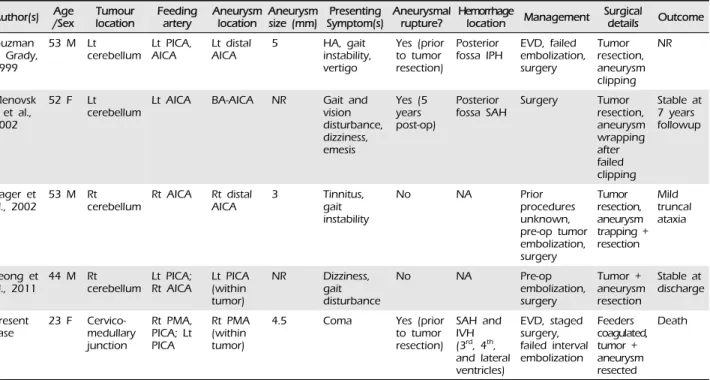
Hemangioblastoma associated with a coexisting feeding artery aneurysm is extremely rare (Table 1).11)12)17)21) One report described an aneurysm directly embedded within the tumor capsule, similar to our case.17) In addition, although two cases have been as- sociated with aneurysm rupture,11)12) only one oc- curred prior to tumor removal.11) The case presented here is the first in which coma was the presenting symptom and acute re-hemorrhage compounded the
surgical complexity of the case.
Aneurysms of the posterior circulation are less common than those of the anterior circulation, and involvement of the posterior meningeal artery is even more unusual. Previous reports have implicated trauma, anomalous origin from PICA, dural arterio- venous fistula, and PICA thrombosis leading to collat- eralized PMA as causes of true PMA aneurysms and pseudoaneurysms.2)4)10)14)16) In general, the etiology of fusiform aneurysms is also poorly understood, al- though numerous causes, including atherosclerosis and dissection, have been proposed.8) To the best of our knowledge, this is the first reported case of a fusi- form PMA aneurysm associated with a brain tumor.
The patient's tumor was supplied not only by the right PMA but also by collaterals from the ipsilateral PICA and contralateral PMA, consistent with previous reports of congenital and acquired PMA-PICA collateralization.4)15)18)19) In this way, increased hemo- dynamic flow from collaterals and associated wall shear stress may have contributed to this patient's multiple posterior circulation dissections and, possibly, formation of the hemangioblastoma-fusiform PMA aneurysm complex.
The successful approach to and removal of tu- mor-aneurysm complexes benefit from preoperative planning in a number of ways. First, preoperative em- bolization can be performed prior to surgery to re- duce intraoperative bleeding. Embolization via par- ticles is safe and effective but is associated with high- er rates of post-embolization hemorrhage in cerebellar compared to spinal cord masses (50% vs. 5%, re- spectively) because larger capillary diameters in cer- ebellar hemangioblastomas allow entry of small par- ticles, which occlude the venous network, leading to retrograde hypertension.5)13)17) This risk is minimized with use of liquid agents, which penetrate deep into the capillary bed of the tumor without entering the venous compartment.9)17) Occasionally, however, em- bolization is not possible due to the tortuosity of the vessel involved,11) or, as with our patient, due to con- cerns for perfusion to other vital structures.
Author(s) Age
/Sex Tumour
location Feeding
artery Aneurysm
location Aneurysm
size (mm) Presenting
Symptom(s) Aneurysmal
rupture? Hemorrhage
location Management Surgical
details Outcome Guzman
& Grady, 1999
53 M Lt
cerebellum Lt PICA,
AICA Lt distal
AICA 5 HA, gait
instability, vertigo
Yes (prior to tumor resection)
Posterior
fossa IPH EVD, failed embolization, surgery
Tumor resection, aneurysm clipping
NR
Menovsk y et al., 2002
52 F Lt
cerebellum Lt AICA BA-AICA NR Gait and vision disturbance, dizziness, emesis
Yes (5 years post-op)
Posterior
fossa SAH Surgery Tumor resection, aneurysm wrapping after failed clipping
Stable at 7 years followup
Zager et
al., 2002 53 M Rt
cerebellum Rt AICA Rt distal
AICA 3 Tinnitus,
gait instability
No NA Prior
procedures unknown, pre-op tumor embolization, surgery
Tumor resection, aneurysm trapping + resection
Mild truncal ataxia
Seong et
al., 2011 44 M Rt
cerebellum Lt PICA;
Rt AICA Lt PICA (within tumor)
NR Dizziness, gait disturbance
No NA Pre-op
embolization, surgery
Tumor + aneurysm resection
Stable at discharge
Present
case 23 F Cervico- medullary junction
Rt PMA, PICA; Lt PICA
Rt PMA (within tumor)
4.5 Coma Yes (prior
to tumor resection)
SAH and IVH (3rd, 4th, and lateral ventricles)
EVD, staged surgery, failed interval embolization
Feeders coagulated, tumor + aneurysm resected
Death
AICA = anterior inferior cerebellar artery; BA = basilar artery; EVD = external ventricular drain; HA = headache; IPH = intraparenchymal hemorrhage;
IVH = intraventricular hemorrhage; Lt = left; NA = not applicable; NR = not reported; PICA = posterior inferior cerebellar artery; PMA = posterior meningeal artery; Rt = right; SAH = subarachnoid hemorrhage
Table 1. Previous cases of hemangioblastoma associated with feeding-artery aneurysms
Second, the surgical approach can be carefully de- signed to achieve both tumor resection and decom- pression of the vascular lesion. In this case, the bi- lateral suboccipital craniectomy and C1 laminectomy were required for posterior fossa decompression, and ultimately this approach would likely have been suffi- cient for tumor resection. However, proximal control of the right vertebral artery would still have required skeletonization of the vertebral artery via a far lateral approach (i.e., widening of the foramen magnum and partial condylectomy), which we believe could be achieved in a single stage. Thus, although the active bleeding within hours of presentation did not permit performance of an initial angiogram, staging the pro- cedure allowed for further diagnostic workup, and re- direction of our approach, and allowed us to achieve definitive resection of both the aneurysm and tumor.
Finally, a case can be argued for no intervention at all, given the patient's poor presentation and eventual grave prognosis. However, we felt that, given the
acuity of her symptoms and her young age, she might possess enough physiological reserve to overcome her brainstem injury.
CONCLUSION
We report on the occurrence of a fusiform posterior meningeal artery aneurysm embedded within a dorsal exophytic brainstem hemangioblastoma. Although the etiology of this association is not completely under- stood, it is likely that the combination of histopatho- logical features and hemodynamic properties brought these two entities in conjunction. Our experience with this complex case confirms the importance of early di- agnosis and intervention with special consideration of available treatment options once the acute phase of the disease has been addressed.
Disclosure
The authors report no conflict of interest concerning the materials or methods used in this study or the
findings specified in this paper. The authors have no funding sources to disclose.
Previous presentation
No work resembling the enclosed article has been published or is being submitted for publication elsewhere. We certify that we have each made a sub- stantial contribution so as to qualify for authorship as detailed at the end of the manuscript. We have dis- closed all financial support for our work and other potential conflicts of interest.
REFERENCES
1. Aldape KD, Plate KH, Vortmeyer AO, Zagzag D, Neumann HPH. Hemangioblastoma, in Louis DN, Ohgaki H, Wiestler OD, Cavenee WK (eds). WHO Classification of tumours of the central nervous system. 4th ed. Lyon: International agency for research on cancer (IARC), 2007. p. 184-6.
2. Aronson JP, Murray PJ, Ogilvy CS. Rupture of a pseu- doaneurysm of the posterior meningeal artery at its anomalous origin from the posteroinferior cerebellar ar- tery: case report. Neurosurgery. 2008 Sep;63(3):E608; dis- cussion E608.
3. Campos WK, Linhares MN. Sporadic intramedullary spinal cord hemangioblastoma in a newborn. Pediatr Neurosurg.
2010 Nov;46(5):385-9.
4. Chang SW, Kakarla UK, Sharma GK, Spetzler RF. Posterior inferior cerebellar artery origin thrombosis with aneur- ysm of collateralized posterior meningeal artery presenting as subarachnoid hemorrhage: case report. Neurosurgery.
2009 Oct;65(4):E818-9.
5. Cornelius JF, Saint-Maurice JP, Bresson D, George B, Houdart E. Hemorrhage after particle embolization of hemangioblastomas: comparison of outcomes in spinal and cerebellar lesions. J Neurosurg. 2007 Jun;106(6):994-8.
6. Cushing H, Bailey P. Tumors arising from blood vessels in the brain: angiomatous malformations and hemangioblastomas.
Springfield, IL: Charles C Thomas, 1928.
7. de San Pedro JR, Rodríguez FA, Níguez BF, Sánchez JF, López-Guerrero AL, Murcia MF, et al. Massive hemor- rhage in hemangioblastomas Literature review. Neurosurg Rev. 2010 Jan;33(1):11-26.
8. Drake CG, Peerless SJ. Giant fusiform aneurysms: re- view of 120 patients treated surgically from 1965 to 1992. J Neurosurg. 1997 Aug;87(2):141-62.
9. Elhammady MS, Wolfe SQ, Ashour R, Farhat H, Moftakhar R, Lieber BB, et al. Safety and efficacy of vascular tumor embolization using Onyx: is angiographic devascularization sufficient? J Neurosurg. 2010 May;112(5) :1039-45.
10. Goetz F, Lanfermann H, Nakamura M, Krauss JK, Hong B. Life-threatening hemorrhage from a traumatic aneurysm of the posterior meningeal artery: treatment with coil embolization. Cent Eur Neurosurg. 2011 Aug;72(3):162-5.
11. Guzman R, Grady MS. An intracranial aneurysm on the feeding artery of a cerebellar hemangioblastoma. Case report. J Neurosurg. 1999 Jul;91(1):136-8.
12. Menovsky T, André Grotenhuis J, Bartels RH. Aneurysm of the anterior inferior cerebellar artery (AICA) asso- ciated with high-flow lesion: report of two cases and re- view of literature. J Clin Neurosci. 2002 Mar;9(2):207-11.
13. Montano N, Doglietto F, Pedicelli A, Albanese A, Lauretti L, Pallini R, et al. Embolization of hemangioblastomas. J Neurosurg. 2008 May;108(5):1063-4.
14. Muro K, Adel JG, Gottardi-Littell NR, Getch CC, Batjer HH. True aneurysm on the posterior meningeal artery associated with a dural arteriovenous fistula: case report.
Neurosurgery. 2010 Sep;67(3):E876-7.
15. Ogawa T, Fujita H, Inugami A, Shishido F, Higano S, Uemura K. Anomalous origin of the posterior inferior cerebellar artery from the posterior meningeal artery.
AJNR Am J Neuroradiol. 1991 Jan-Feb;12(1):186.
16. Okuno S, Touho H, Ohnishi H, Karasawa J. Ruptured aneurysm at the bifurcation of the posterior meningeal artery from the proximal posterior inferior cerebellar artery. Acta Neurochir (Wien). 1998 Jul;140(6):629-30.
17. Seong Eom K, Won Kim D, Sung Choi S, Ha Choi K, Young Kim T. Preoperative embolization of a cerebellar hemangioblastoma using Onyx: case report and literature review. Neurol Neurochir Pol. 2011 May-Jun;45(3):292-6.
18. Tanohata K, Maehara T, Noda M, Katoh H, Sugiyama S, Okazaki A. Anomalous origin of the posterior me- ningeal artery from the lateral medullary segment of the posterior inferior cerebellar artery. Neuroradiology. 1987 Jan;29(1):89-92.
19. Tsutsumi M, Kazekawa K, Aikawa H, Iko M, Kodama T, Nii K, et al. Development of unusual collateral channel from the posterior meningeal artery after endovascular proximal occlusion of the posterior inferior cerebellar artery. Neurol Med Chir (Tokyo). 2007 Nov;47(11):503-5.
20. Vates GE, Berger MS. Hemangioblastomas of the central nervous system, in Winn HR (eds). Youmans Neurological Surgery. 5th ed. Philadelphia: Saunders, 2004. p. 1053-66.
21. Zager EL, Shaver EG, Hurst RW, Flamm ES. Distal an- terior inferior cerebellar artery aneurysms. Report of four cases. J Neurosurg. 2002 Sep;97(3):692-6.