85
치열교정치료시 교정환자의 만족도에 영향을 미치는 요인
이가연
†·고은정
1춘해보건대학 치위생과, 1진주보건대학 치위생과
Factors of Influencing Satisfaction with Orthodontic Treatment in Orthodontic Patients
Ka-Yean Lee
†and Eun-Jeong Go
1Department of Dental Hygiene, Choonhae Health College, Ulsan 689-784, Korea
1
Department of Dental Hygiene, Jinju Health College, Jinju 660-757, Korea
Abstract
The purpose of this study was to research into the satisfaction with orthodontic treatment and the psychologically satisfactory condition to be expected, and to offer information in order to enhance medical-treatment service, by surveying the influential factors upon satisfaction with treatment targeting patients who receive orthodontic treatment. Targeting 382 patients who are under treatment at S dental clinic in Gyeonggi Province, B dental clinic in Daegu Metropolitan City, and Y dental clinic in Busan Metropolitan City, which specialize in orthodontic treatment, it carried out the direct interview survey of using the structured questionnaire from January 20, 2009 to February 28. The collected data was analyzed by using SPSSWIN 17.0 K. The following conclusions were obtained. 1. In the satisfaction with orthodontic treatment according to aesthetic factor, the group with bad aesthetic health condition was higher than the group with good health condition(p<0.05). As for the factor of tooth alignment, a case of good health condition was indicated to have higher(p<0.05) satisfaction than a case of being bad. 2. As for satisfaction according to necessity for orthodontic treatment, the satisfaction was high in a case of recognizing necessity much and of understanding medical- treatment contents much, and in a case of being well adjusted to the progression of orthodontic treatment. As for a psychological change after orthodontic treatment, the satisfaction was high in a case with a positive change(p<0.001). 3.
The factors of influencing satisfaction with orthodontic treatment had significant influence in order of necessity for orthodontic treatment(p<0.001), adjustment to progression of orthodontic treatment(p<0.001), psychological change after orthodontic treatment(p<0.01), expectation level of dental health after orthodontic treatment(p<0.01), and understanding about treatment contents(p<0.01). As a result of research, the satisfaction with orthodontic treatment in patients with orthodontics is indicated to be relatively high. Thus, the careful consideration is considered to be probably necessary on qualitative part in medical treatment and on patients' expectation by grasping patents' mentally psychological condition.
Key words
Orthodontic patients, Orthodontic treatment, Orthodontic treatment satisfaction
서 론
치열교정환자는부정교합의원인인교합을개선하고저 작기능
,
발음등구강의복합적인 문제를해소하는것을목적으로 한다
.
교정치료는 치료 과정 중에 일어나는 여 러가지치료부분이다른일반치과치료와달리구강내 특별한구내 . 외장치를해야한다는점에서치료를결정 하는데쉽지않다.
또한치료과정에서 받는복합적인 고충을 견뎌냈을 경우에얻어지는 치료결과이므로 자신의
미적기준의요구와가치는치과의료진이생각하는것보 다훨씬더높게나타나는것은당연한일이다
.
교정치료가가져오는유익으로입술주변의형태를자연 스럽게만들어주는등의외적인변화뿐만아니라심리 적 변화 또한치열교정치료에 많은영향을 주어1)교정치 료가 단순한치료 목적이아닌 개인의만족과 행복을성 취하는 데 중요한요인으로 인식되어지고 있다
.
또한 보 다 적극적인사회생활의 참여와 대인관계의 자신감을 위 해 더 개선된 안모를가지려는 요구가높아지고 있어치 과 의료진들은 치열교정환자들의 특징및 관심사를 이해 하고,
이에대처하는자세를갖는것은 매우중요한일로여겨지고있다2)
.
이는단순히치료성과(treatment outcome)
에 대한 연구나 치료결과
(result)
의 효과(effectiveness)
만의†
Corresponding author Tel: 052-270-0297 Fax: 052-270-0297
E-mail: [email protected]
평가가 아니라 치료기간동안 투입된 노력
(effort)
과 과정(process)
의 평가까지 포괄하는 효율성(efficiency)
의 평가를 포함하여야 하며3)이 과정에서환자의협조도를 미리 예상하고그 행동적특성을파악한다면
,
치료방향과장치 의 결정에도 참고가될 것이며,
향후 일어날 수 있는 문 제의발생을미연에방지하고 환자및보호자와의원만한 관계유지에도도움이될것이다4).
치열교정환자의시간의경과에따르는불쾌감을평가한 연구에서치료 첫날이가장심하고
, 7
일 후에는거의없었다고하였으며5)
, Jones
는 교정치료초기에가하여진 교정력으로인한불편함은오랜시간이경과한경우에도많 은 예들에서 통증과 불쾌감을 호소하고 있고
,
이러한 증상은특히 야간에더욱 심해진다고 하여6)교정력으로 인 한 통증이환자로 하여금심한 스트레스가 되는것을 알 수 있다
.
이로 인한 부정교합의 치료에서 치료포기의 주요한요인이되는교정장치의장착으로인한지속적인통 증과불쾌감은이를극복하고자하는개인의심리적특성 과밀접한관계가있다고할수있다7)
.
EI-Mangoury
는 성취동기가 높을수록,
치료의 동기가내재적일수록 좋은 협조도를 나타낸다고 보고하였으며8)
,
교정치료에있어서환자의좋은협조도는치료과정에필 수적인요소이며 이러한협조도는 치아를 청결히유지하 는 것
,
장치를 잘 간수하며 지시받는 대로 사용하는 것,
약속기일을잘지키는것등의포괄적이고도전반적인면 에서 모두 연관이있다고 할 수 있다9)
.
특히 부정교합에 대한환자의태도나부정교합을제거하고싶은열망을고 려하지 않음으로써 치료하는데 환자의 비협조적인 태도 로 나타날 수 있어10) 치료시작전 복합적인 환자심리상 태를파악하는것이무엇보다도중요하다.
치열교정환자의 치료에 대한 만족도에 관련한 연구는 김 등7)의 연구
,
구 등11)의 연구와김 등4)의 연구,
이12)의연구에서 치열교정환자의 치료에 대한 내 . 외 통재소재 및 치료협조도
,
인식변화 등을 연구한 결과 최근의 달라진 교정치료의 전반적인 인식변화로 인해 치열교정치료 환자의양적증대를가져온것을알수있다
.
치열교정환자가 교정치료에 대하여 적극적으로 지속적 인 긍정적 태도를 보인다는 것은 치료과정 중에 진료에 대한확신및 신뢰
,
자신이교정치료를 하고자하는목적 과 결과의 기대치가매우 높다는 것을 알 수 있다.
또한 자신의치열교정치료와 관련하여 교정치료의 이행 및 구 강청결상태를향상된상태로유지,
관리한다는것은치료 결과의외적인심미적인안모개선과심리적인내적성격 의 긍정심을 상승시키는 효과를 줄 것이다.
또한 치열교 정환자의 교정치료에 대한 진료과정의 이해나심리적 변 화등은교정치료에있어서고려되어야하는중요한문제 이다.
일반적으로 치과의료질향상을위한서비스에대한연 구는 폭넓게 개발되어지고
,
향상되는 편이나 교정치료의특성상장기간치료와관리를고려한환자의심리적인치 료 상황 만족도 개선은 적극적이지 못한 점을 착안하여
,
본 연구에서는 치열교정환자의 교정치료만족도 영향요 인으로 치료의 필요성과 치료진행과정에서의 적응
,
치료 후 심리적 변화,
치료 후 치아 건강의 기대정도 및 치료 내용에 대한 이해정도를 파악하는데 기초자료로 제공하 고자한다.
연구대상 및 방법 1. 연구대상
교정치료를전문으로 하는경기도
S
치과의원,
대구광역시
B
치과의원,
부산광역시Y
치과의원의3
곳에서 교정치 료중인환자와보호자를대상으로조사하였다.
조사방법은구조화된설문지를이용한직접면담조사였 으며
,
회수된390
부의 설문지중 면담거부8
부를 제외한382
부를최종분석대상으로하였으며,
조사기간은2009
년
1
월20
일부터2
월28
일까지였다.
2. 연구방법
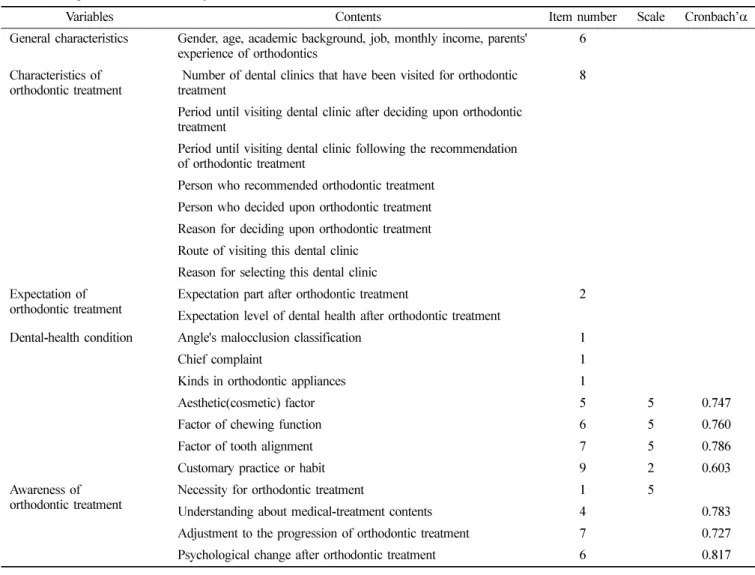
본연구는치아교정치료만족도영향요인을파악하기 위하여교정환자의일반적특성
,
교정치료특성,
교정치료의기대도
,
치아건강상태,
교정치료에대한인식,
치료의만족도를조사하였다
.
교정환자의 일반적 특성은 성별
,
연령,
학력,
직업,
월 소득,
부모의치아교정경험등6
문항이며,
교정치료의특성은 교정치료를 받기 위해 방문한 치과의원의 수
,
교정 치료결정 후치과방문까지기간,
교정치료 권유후 치과방문까지 기간
,
교정치료 권유한 사람,
교정치료 결정한 사람,
교정치료 결정이유,
치과의원방문경로,
치과의원선택이유등
8
문항으로구성되어있다(Table 1).
교정치료 기대도는 교정치료후 기대되는 부분
,
교정치 료 후치아건강기대 정도로이루어져있으며,
치아 건강상태는
Angle
씨의부정교합, chief complaint,
교정장치의종류가 각각
1
문항과심미적(
미용)
요인5
문항,
저작기능요인
6
문항,
치아배열 요인7
문항,
버릇이나 습관요인9
문항으로 구성되어있다
.
심미적(
미용)
요인,
저작기능요인
,
치아배열 요인은5
점 척도(‘
전혀 그렇지 않다’ 1
점,
‘
그렇지 않다’ 2
점, ‘
보통이다’ 3
점, ‘
그렇다’ 4
점, ‘
매우그렇다
’ 5
점)
이고버릇이나 습관요인은2
점척도(
버릇이 있으면1
점,
없으면0
점)
로구성되어있으며,
점수가높을 수록 치아 건강상태가 좋지 않다는 것을 의미한다.
심미적
(
미용)
요인의 신뢰도는Cronbach'
α=0.747
이며,
저작기능 요인
0.760,
치아배열 요인0.786,
버릇이나 습관0.603
이었다.
교정치료 기대도의 설문내용은 교정환자의심리적특성을고려하여연구자가연구한것이다
.
교정치료에 대한 인식은모두
5
점 척도이고점수가높 을수록 교정치료에 대한 인식이 좋다는 것을 의미한다.
진료내용에대한이해의신뢰도는
Cronbach'
α=0.783
이며
,
교정치료 진행과정 적응0.727,
교정 치료 후심리적변화
0.817
이었다.
3. 통계분석
총
390
부의 설문지가 회수 되었으나 응답방법에 오류가 있거나 무응답이 많은
8
부를 제외한382
부를 대상으 로분석하였으며,
수집된자료는SPSS WIN 17.0K
를 이 용하여분석하였다.
연구대상자의일반적특성은빈도분석과기술통계를이 용하였으며
,
각 요인에 따른 교정치료 만족도는t-test,
ANOVA
분석을 실시하였다.
특히,
치아건강상태 중 심미적
(
미용)
요인,
저작기능 요인,
치아배열 요인,
버릇이나 습관과 교정치료에 대한 인식은 각 요인별 평균을 구한 다음평균이상집단과평균미만집단의2
집단으로분류한후
t-test
를실시하였다.
교정치료 만족도 영향 요인을파악하기 위해 교정치료 만족도를종속변수로하고각요인을독립변수로하는다 중회귀분석을실시하였다
.
결 과
1. 조사대상자의 일반적 특성
성별로는 여자가
275
명(72.0%)
으로 남자의107
명(28.0%)
보다 많았으며,
연령으로는15
세~19
세가29.6%,
10
세~14
세가25.9%
의 순이고연령의범위는9
세에서37
세
,
평균 연령은19
세였다.
직업은 학생이71.7%
로 가장많고 전문관리직이
11.0%
의 순이었으며,
월 소득은400
만원 이상이
34.9%, 300~399
만원 이하가23.8%
의 순이었다
.
학력으로는 대학교 졸업자가31%
로 가장많고,
고등학교 졸업자가
25.7%,
중학교 졸업자20.2%
순이었다.
부모의 치아교정 경험은부모 모두 교정치료 경험이없
는 비율이
95.3%
였고,
부모 중1
분이상 교정경험이있는대상자는
4.7%
였다(Table 2).
2. 일반적 특성에 따른 교정치료 만족도
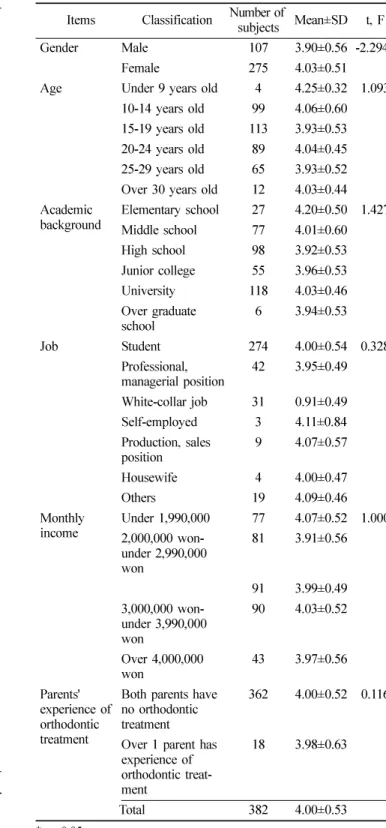
교정치료만족도는
5
점만점에평균4.00
점으로비교적만족 정도가 높은 것으로 나타났으며
,
성별로는 여자가4.03
점으로 남자의3.90
점보다 만족도가 높았다.
대상자Table 1.
Composition and credibility in measurement tool
Variables Contents Item number Scale Cronbach’ α
General characteristics Gender, age, academic background, job, monthly income, parents'
experience of orthodontics 6
Characteristics of
orthodontic treatment Number of dental clinics that have been visited for orthodontic
treatment 8
Period until visiting dental clinic after deciding upon orthodontic treatment
Period until visiting dental clinic following the recommendation of orthodontic treatment
Person who recommended orthodontic treatment Person who decided upon orthodontic treatment Reason for deciding upon orthodontic treatment Route of visiting this dental clinic
Reason for selecting this dental clinic Expectation of
orthodontic treatment Expectation part after orthodontic treatment 2 Expectation level of dental health after orthodontic treatment
Dental-health condition Angle's malocclusion classification 1
Chief complaint 1
Kinds in orthodontic appliances 1
Aesthetic(cosmetic) factor 5 5 0.747
Factor of chewing function 6 5 0.760
Factor of tooth alignment 7 5 0.786
Customary practice or habit 9 2 0.603
Awareness of
orthodontic treatment Necessity for orthodontic treatment 1 5
Understanding about medical-treatment contents 4 0.783
Adjustment to the progression of orthodontic treatment 7 0.727
Psychological change after orthodontic treatment 6 0.817
의 연령
,
학력,
직업,
월 소득에 따른 교정치료 만족도는 통계적으로유의한차가없었다(Table 3).
3. 교정치료 특성에 따른 교정치료 만족도
교정치료를 받기위해방문한치과의원의수에따른교
정치료만족도는
1
곳을방문한경우가4.03
점으로3
곳이상의
3.96
점, 2
곳의3.90
점 보다높았으나유의하지는 않았다
(Table 4).
또한
,
교정치료 결정 후 치과방문까지 기간,
교정치료 권유받은 후 치과방문까지 기간,
교정치료 권유한 사람,
교정치료 결정한 사람
,
교정치료 결정 이유,
본 치과의원방문경로
,
본 치과의원 선택이유에따른교정치료만족 도도유의한차가없었다.
Table 2.
General characteristics in survey subjects
Items Classification Frequency %
Gender Male 107 28.0
Female 275 72.0
Age Under 9 years old 4 1.0
10-14 years old 99 25.9
15-19 years old 113 29.6
20-24 years old 89 23.3
25-29 years old 65 17.0
Over 30 years old 12 3.1
Range 9 ~ 37 years old
Mean±standard deviation 19.00±5.73 Academic
background Elementary school 27 7.1
Middle school 77 20.2
High school 98 25.7
Junior college 55 14.4
University 118 31.0
Over graduate school 6 1.6
Job Student 274 71.7
Professional, managerial
position 42 11.0
White-collar job 31 8.1
Self-employed 3 0.8
Production, sales position 9 2.4
Housewife 4 1.0
Others 19 5.0
Monthly income Under 1,990,000 77 20.2
2,000,000 won-under
2,990,000 won 81 21.2
3,000,000 won-under
3,990,000 won 91 23.8
Over 4,000,000 won 133 34.9 Parents' experi-
ence of orthodon- tic treatment
Both parents have no
orthodontic treatment 362 95.3 Over 1 parent has
experience of orthodontic treatment
18 4.7
Total 382 100.0
1)
Exclusion of interview rejection
Table 3.
Satisfaction with orthodontic treatment according to characteristics in general
Items Classification Number of subjects Mean±SD t, F
Gender Male 107 3.90±0.56 -2.294*
Female 275 4.03±0.51
Age Under 9 years old 4 4.25±0.32 1.093 10-14 years old 99 4.06±0.60 15-19 years old 113 3.93±0.53 20-24 years old 89 4.04±0.45 25-29 years old 65 3.93±0.52 Over 30 years old 12 4.03±0.44 Academic
background Elementary school 27 4.20±0.50 1.427 Middle school 77 4.01±0.60
High school 98 3.92±0.53
Junior college 55 3.96±0.53
University 118 4.03±0.46
Over graduate
school 6 3.94±0.53
Job Student 274 4.00±0.54 0.328
Professional,
managerial position 42 3.95±0.49 White-collar job 31 0.91±0.49
Self-employed 3 4.11±0.84
Production, sales
position 9 4.07±0.57
Housewife 4 4.00±0.47
Others 19 4.09±0.46
Monthly
income Under 1,990,000 77 4.07±0.52 1.000 2,000,000 won-
under 2,990,000 won
81 3.91±0.56
91 3.99±0.49
3,000,000 won- under 3,990,000 won
90 4.03±0.52 Over 4,000,000
won 43 3.97±0.56
Parents' experience of orthodontic treatment
Both parents have no orthodontic treatment
362 4.00±0.52 0.116 Over 1 parent has
experience of orthodontic treat- ment
18 3.98±0.63
Total 382 4.00±0.53
*: p<0.05
4. 교정치료 후 교정치료의 만족도와 치아건강의 기 대도
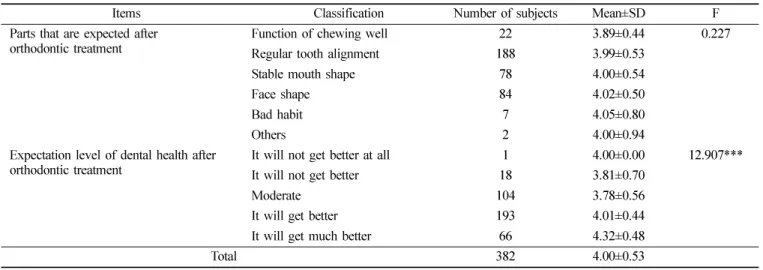
교정치료 후 교정치료 만족도는 안좋은 습관이라고 응
답한경우가
4.05
점으로얼굴모양4.02
점,
가지런한 치아배열
3.99
점,
잘씹는기능3.89
점보다높았으나유의하지않았다
(Table 5).
교정치료 후치아건강에대한기대정도에따라서는 좋
아지거나 매우좋아질것이라고 응답한경우가각각
4.01
점
, 4.32
점으로보통이거나 좋아지지않을 것이라고 응답한경우의
3.78
점, 3.81
점보다유의하게높은것으로나타났다
(p<0.001).
5. 치아건강 상태에 따른 교정치료 만족도
Angle
씨의 부정교합이II
급인 경우 만족도가4.02
점으Table 4.
Satisfaction with orthodontic treatment according to characteristics in orthodontic treatment
Items Classification Number of
subjects Mean±SD t, F
Number of dental clinics of having been vis-
ited in order to get orthodontic treatment 1 place 250 4.03±0.55 2.224
2 places 77 3.90±0.53
Over 3 places 55 3.96±0.40
Period until visiting dental clinic after
deciding upon orthodontic treatment Within 6 months 337 3.99±0.52 0.361
After 6 months 45 4.02±0.60
Period until visiting dental clinic after being
recommended orthodontic treatment Immediately after consulting 329 4.00±0.53 0.591
After 1 month 53 3.96±0.48
Person who recommended
orthodontic treatment Person in question 180 4.01±0.51 0.477
Except the person in question 202 3.98±0.54 Person who decided upon
orthodontic treatment Person in question 209 4.02±0.50 0.960
Except the person in question 173 3.97±0.55 Reason for deciding upon
orthodontic treatment Cosmetic(aesthetic) 4.02±0.52 0.397
Inconvenience of chewing 25 4.04±0.61
Incorrect pronunciation 7 4.05±0.56
Irregular tooth alignment 100 3.93±0.51
Complex in social life 25 4.00±0.50
Others 15 4.02±0.57
Route of visiting this dental clinic Because of close distance 34 4.03±0.56 0.257
Through internet and masscom 19 4.05±0.45
After hearing about a rumor of
operating well 157 3.98±0.53
After seeing signboard 3 4.11±0.19
With introduction of medical staff
and employee 48 3.99±0.51
With recommendation of family 62 3.95±0.56
Others 57 4.04±0.52
Reason for selecting this dental clinic Because a doctor's ability is
superior 31 4.18±0.55 1.347
With introduction of medical staff
and employee 42 3.95±0.50
After hearing about a rumor of
operating well 143 3.98±0.54
Staff's kindness 19 4.07±0.49
Latest medical device and
equipment 1 4.67±0.00
Hospital environment and
convenient facilities 7 3.90±0.32
Introduction of the neighborhood 105 3.92±0.54
Because of close distance 24 4.11±0.44
Others 9 4.19±0.47
Total 382 4.00±0.53
로가장 높고
III
급4.00
점,
급3.91
점의 순이었으나유의하지 않았고
, chief complaint
와 교정장치의 종류에 따른만족도도유의한차가없었다
(Table 6).
심미적
(
미용)
요인에따른 교정치료의 만족도는심미적 건강상태의 평균이 나쁜 집단이4.07
점으로 건강상태가좋은 집단의
3.93
점보다 높았으며(p<0.05),
치아배열 요인에 따라서는 건강상태가 좋은 경우가
4.04
점으로 나쁜경우의
3.93
점보다 만족도가 높은 것으로 나타났다(p<0.05).
저작기능요인과 버릇이나 습관 요인에 따른교정치료만족도는유의한차가없었다
.
Table 5.
Satisfaction with orthodontic treatment according to expectation of orthodontic treatment
Items Classification Number of subjects Mean±SD F
Parts that are expected after
orthodontic treatment Function of chewing well 22 3.89±0.44 0.227
Regular tooth alignment 188 3.99±0.53
Stable mouth shape 78 4.00±0.54
Face shape 84 4.02±0.50
Bad habit 7 4.05±0.80
Others 2 4.00±0.94
Expectation level of dental health after
orthodontic treatment It will not get better at all 1 4.00±0.00 12.907***
It will not get better 18 3.81±0.70
Moderate 104 3.78±0.56
It will get better 193 4.01±0.44
It will get much better 66 4.32±0.48
Total 382 4.00±0.53
***: p<0.001
Table 6.
Satisfaction with orthodontic treatment according to dental-health condition
Items Classification Number of
subjects Mean±Standard deviation t, F
Angle's malocclusion Classification Class I 212 4.02±0.53 0.919
Class II 113 4.00±0.50
Class III 56 3.91±0.54
Chief Complaint Crowding 212 3.99±0.52 1.222
Space 18 4.31±0.57
Under bite 25 4.04±0.48
Open bite 20 3.90±0.43
Bone abnormality 27 4.01±0.66
An impacted tooth 2 3.67±0.47
Prosthetic orthodontics 2 3.83±0.71
Others 69 3.99±0.49
Kinds in aligners Removable appliance 27 4.07±0.49 1.392
Fixed appliance 342 3.99±0.53
Retainer 10 4.07±0.60
Patient with cyclic Observation 2 3.33±0.47
Others 1 3.33±0.00
Aesthetic(cosmetic) factor Over average(bad health) 184 4.07±0.55 2.576*
Under average(good health) 198 3.93±0.49
Factor of the chewing function Over average(bad health) 208 4.00±0.53 0.242
Under average(good health) 174 3.99±0.52
Factor of tooth alignment Over average(bad health) 221 4.04±0.51 1.970*
Under average(good health) 161 3.93±0.54
Customary practice or habit Over average(bad health) 200 3.96±0.54 -1.520
Under average(good health) 181 4.04±0.51
Total 382 4.00±0.53
*: p<0.05
6. 교정치료 인식에 따른 교정치료 만족도
교정치료의 필요성에따른교정치료만족도는필요성을
많이인식하고있는경우가
4.37
점으로필요성을적게인식하고 있는 집단의
3.90
점 보다 만족도가 높았다(p<
0.001)(Table 7).
진료내용에대한이해에따라서도내용을많이이해하
고있는경우가
4.24
점으로그렇지않은경우의3.82
점보다 만족도가 높았으며
(p<0.001),
교정치료 진행 과정에대한 적응을 잘 하고있는 경우가
4.23
점으로 그렇지않은경우의
3.74
점보다만족도가높았다(p<0.001).
교정치료후심리적변화에따라서는심리적으로긍정적으로변
한경우의만족도가
4.23
점으로그렇지못한경우의3.80
점보다유의하게만족도가높았다
(p<0.001).
7. 교정치료 만족도 영향 요인
교정치료 만족도 영향 요인을 파악하기위해 교정치료
Table 7.
Satisfaction with orthodontic treatment according to awareness of orthodontic treatment
Items Classification Number of subjects Mean±Standard deviation t
Necessity for orthodontic treatment Over average 80 4.37±0.48 7.606***
Under average 302 3.90±0.49
Understanding about
medical-treatment contents Over average 159 4.24±0.44 8.454***
Under average 223 3.82±0.51
Adjustment to progression in
orthodontic treatment Over average 201 4.23±0.43 10.224***
Under average 181 3.74±0.52
Psychological change after
orthodontic treatment Over average 175 4.23±0.45 8.788***
Under average 207 3.80±0.50
Total 382 4.00±0.53
***: p<0.001
Table 8.
Influence of general characteristics upon period of orthodontic treatment
Independent variable
1)Coefficient of regression(B) β t
Gender 0.050 0.043 1.046
Age 0.000 -0.003 -0.057
Job 0.068 0.058 1.020
Income -0.017 -0.016 -0.370
Parents' experience of orthodontics 0.132 0.053 1.343
Number of dental clinics of having been visited in order to
get orthodontic treatment -0.010 -0.015 -0.360
Period until visiting dental clinic after deciding upon
orthodontic treatment 0.017 0.011 0.270
Period until visiting dental clinic after being recommended
orthodontic treatment 0.033 0.021 0.508
Person who recommended orthodontic treatment -0.023 -0.022 -0.494
Person who decided upon
orthodontic treatment 0.042 0.039 0.825
Expectation level of dental health after orthodontic treatment 0.084 0.126 3.031**
Aesthetic(cosmetic) factor -0.066 -0.088 -1.897
Factor of the chewing function 0.025 0.033 0.662
Factor of tooth alignment 0.053 0.065 1.318
Customary practice or habit -0.017 -0.061 -1.479
Necessity for orthodontic treatment 0.234 0.269 6.351***
Understanding about
medical-treatment contents 0.141 0.140 2.794**
Adjustment to progression in orthodontic treatment 0.348 0.312 6.126***
Psychological change after orthodontic treatment 0.142 0.153 3.044**
F=17.217***, R
2=0.477
*: p<0.05, **: p<0.01, ***: p<0.001
1)
Gender[0=male, 1=female], Job[0=except student, 1=student], Income[0=under 3,000,000 won, 1=over 3,000,000 won], Parents' experience of orthodon-
tics[0=both parents have no experience of orthodontics, 1=over 1 parent has experience of orthodontics], Period until visiting dental clinic after deciding
upon orthodontic treatment[0=over 6 months, 1=under 6 months], Period until visiting dental clinic after being recommended orthodontic treatment[0=except
immediately, 1=immediately], Person who recommended orthodontic treatment[0=except the person in question, 1=person in question], Person who decided
upon orthodontic treatment[0=except the person in question, 1=person in question]
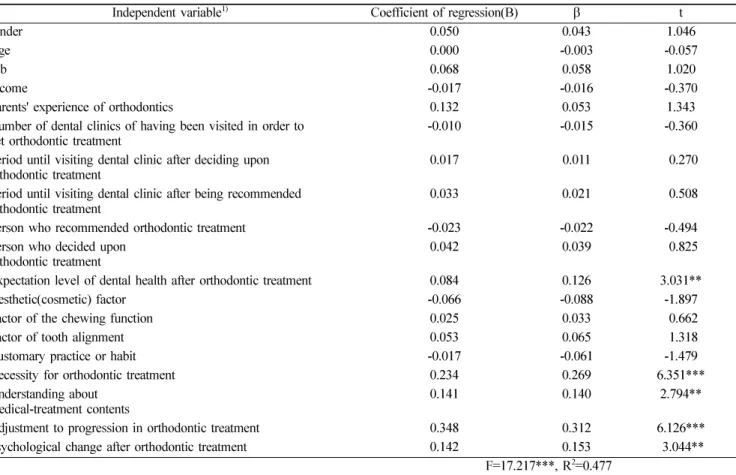
만족도를종속변수로다중회귀분석을실시한결과교정치 료의필요성
(p<0.001),
교정치료진행과정적응(p<0.001),
교정치료 후 심리적변화
(p<0.01),
교정치료 후치아 건강 기대정도
(p<0.01),
진료 내용에 대한 이해(p<0.01)
의순으로 유의한 영향을 미치고 있었다
(Table 8).
즉,
교정치료에대한필요성을많이인식하고있을수록
,
교정치료진행 과정에 대한 적응을 잘하고 있을수록
,
교정치료 후 심리적변화가긍정적일수록,
교정치료 후치아건강에 대한 기대정도가 높을수록 교정치료에 대한 만족도가높게 나타났으며
,
이들독립변수의교정치료 만족도에 대한설명력은
47.7%
였다.
고 찰
치열교정치료는 치과치료에서 장기적 치료기간이 요구 되므로처음치료때환자가갖는기대나욕구등을많은 시간에걸쳐치료종료까지좋은협조도와만족도를유지 하기란 어려운 일이다
.
또한 좋은 협조도를얻었다고 할 지라도치료에 대한 기대도와 만족도가 환자가 기대하는 만큼미치지못했다면환자의반응에치과의료진은당혹 스러울것이다.
이러한환자의기대치와 만족도를최대한만족시킬수있는방법은환자자신의복합적인 문제점과 한계점을 잘 파악하고있는지 치과 의료진은 계속적으로 파악할필요가있다
.
즉환자의행동적특성을잘파악한 다면향후 일어날 수있는 문제의발생을 미연에방지하 고 환자및 보호자와의 원만한 관계유지에 도움이될 것 이다13).
따라서 본 연구는 치열교정환자들의 교정치료 만족도 영향요인을파악하여교정치료시환자의심리상태와진 료이해정도를알고치과의료진과의원만한관계를증진 시키고긍정적으로 교정치료 이행할뿐 아니라 교정치료 의만족도를높이기위함이다
.
본 연구는 여자가
72.0%
으로 남자의28.0%
보다 많아타 연구2,14-16)의교정치료시 복합적문제 중 심미적치료
경향과욕구등17)이여자가더민감하게 받아들여교정치
료 내원률이 높은 것으로 사료되며
, Holmes
18)의 연구에서도 청소년기에 있어여자와 남자가비슷한 부정교합일 때 여자가 치열이 심미적이지 못하다는 자각이 더 크며 교정치료를 받고자하는 욕구도더 높다고 보고하여치과 의료기관은 여자를 고려한 치료방향을 모색하고 개선하 여야할 것이다19)
.
또한 연령으로는15
세~19
세가29.6%,
10
세~14
세가25.9%
의순으로학생이대부분이었다.
특히청소년기 교정환자가 많은 부분 차지하고있어 청소년기 에 겪게되는 심리적발달단계에 의한 영향과독특한 특 성으로치료기간에 적합한 치료계획을 세우는것이 중요 하며20) 특히 치열교정치료로 인한 스트레스를 많이 받지 않도록치과의료진들의세심한관리가필요하다
.
교정치료 후치아건강에대한기대정도에따라서는 좋
아지거나 매우좋아질것이라고 응답한경우가각각
4.01
점
, 4.32
점으로보통이거나 좋아지지않을 것이라고 응답한경우의
3.78
점, 3.81
점보다유의하게높은것으로나타났다
.
이는 치료 중에 환자에게치과 의료진들의 구강건 강교육 및 관리에대한 확신을 계속적으로 지도함으로서 기대정도가달라진다고볼 수있다. Feliu
21)은교정치료가끝난 환자는 치료를 받지 않은 동일한 연령의 환자보다 구강위생상태가 좋았으며
,
구강위생에 관한 관심도와 인식이높아진것이교정치료의장점이라할수있다
.
진료내용에대한이해도는많이이해하고있는경우가
4.24
점으로 그렇지 않은 경우의3.82
점보다 만족도가 높았으며
,
교정치료 진행과정의적응을잘하고있는 경우가
4.23
점으로 그렇지 않은 경우의3.74
점보다 만족도가높았다
.
교정치료후 심리적변화는긍정적으로변한경우의만족도가
4.23
점으로그렇지못한경우의3.80
점보다 유의하게만족도가 높았다
.
이는 치료의 내용이나과 정의 설명을치과 의료진이얼마나 이해시키는가에 따라 서 만족도가달라지므로 적극적인 환자교육과 설명이필 요한것을알수있다.
치료동안에비협조적인태도는심리적인스트레스가현 존하고 있거나발생되고 있다는 것을 반영하고구강위생 관리에 대한 반복적인 지시보다는 심리적인 스트레스가 무엇인지를 찾아내는 것이 중요하다22)
.
또한 이23)의 연구 에서 내적통제소재를 지닌환자에는 더욱적극적으로 치 료과정이나 원리에 대해설명하고 납득시켜야 하며 외적 통제소재의성향이강한환자는오히려의연한권위로치 료에임하며환자에게치료의확신을심어주는것이도움 이 된다고 한다.
그러므로 지시적이고 명령적인 언어나행동보다는 협조를 요구하는 형식의 권유나약속의 형태 를 취하는 것이 치료 동기나 기대심리에 도움이 된다고 볼수있다
.
교정환자의 심리적 특성상 심미적측면은 치아나 치주 건강
,
교합등의기능적요소보다도중요시된다는것은24)주요 만족 부분이얼굴부분의 변화이다
.
즉 돌출감과전 치부치아배열이심리적으로큰영향을미쳐자존감또한 저하된다는 것이다25).
심미적요인에따른 교정치료의만 족도는 심미적 건강상태가 나쁜 경우4.07
점으로 심미적건강상태가좋은집단의
3.93
점보다높았고,
정등26)의연 구에서도 자신감이나 심미적개선에 대한만족도가 가장 높은 것으로 나타났다.
또한,
치아배열 요인에 따라서도 건강상태가 좋은 경우가4.04
점으로 나쁜 경우의3.93
점보다 만족도가 높은 것으로 나타났다
. Jenny
27)의 심리학연구에의하면치열이가지런하여즐거운표정을짓는사 람들은 사회에서능동적인반면에 불규칙하고 전돌된치 아를 가진 사람들은 수동적인 편이라고 보고하여 치아의 건강상태에따른개개인의반응은삶의질에많은영향을 미친다고볼수있다
.
이상을 종합하여 교정치료 만족도영향 요인은 교정치
료의필요성
,
교정치료 진행과정 적응,
교정 치료후 심리적변화
,
교정치료후치아건강기대정도,
진료내용에 대한이해의순으로유의한영향을미치고있었다.
즉,
교정치료에대한 필요성을많이인식하고 있을수록
,
교정치 료 진행 과정에 대한 적응을 잘하고 있을수록,
교정치료 후심리적변화가긍정적일수록,
교정치료후 치아건강에대한 기대정도가 높을수록교정치료에 대한 만족도가 높 게나타났다
.
본 연구는 특정지역에 분포되어 있는 치열교정환자를 대상으로 연구하여 일반화하는데 한계점이 있으나 치열 교정환자라는 특정진료의 심리적특징과 기대와욕구 등 을 파악함으로써 치열교정환자 치료 시 고려할 수 있는 유용한정보라사료된다
.
요 약
본 연구는치열교정치료를 받는 환자를 대상으로치료 만족도영향 요인을 조사하여 기대하는 치료만족도와 심 리적 만족상태에 관하여연구하고 진료서비스 향상을 위 한 정보를제공하고자
2009
년1
월20
일부터2
월28
일까 지 치열교정치료를 전문으로 하는 경기도S
치과의원,
대구광역시
B
치과의원,
부산광역시Y
치과의원에서치료중 인382
명의 환자와 보호자를 대상으로 구조화된 설문지를 이용한 직접면담조사를 실시하였다
.
수집된 자료는SPSS WIN 17.0K
를 이용하여 분석하여 다음과 같은 결론을얻었다
.
1.
심미적(
미용)
요인에따른 교정치료의만족도는심미적 건강상태가 나쁜 집단이
4.07
점으로 건강상태가좋은 집단보다 높았으며
(p<0.05),
치아배열 요인에따라서도 건강상태가 좋은 경우가
4.04
점으로 나쁜경우의
3.93
점보다 만족도가 높은 것으로 나타났다(p<0.05).
2.
교정치료의 필요성에 따른 만족도는 필요성을 많이 인식하고,
진료 내용의 이해도 많은 경우,
교정치료진행 과정의 적응을 잘하고 있는 경우에 만족도가 높았으며
,
교정 치료 후 심리적 변화는 긍정적으로변한경우만족도가높았다
(p<0.001).
3.
교정치료 만족도에 영향을 미치는 요인은 교정치료의 필요성
(p<0.001),
교정치료 진행 과정 적응(p<0.001),
교정 치료 후 심리적 변화(p<0.01),
교정치료 후 치아 건강 기대정도
(p<0.01),
진료 내용에대한 이해
(p<0.01)
의 순으로 유의한 영향을 미치고있었다
.
이러한 연구결과로 치열교정환자의 교정치료의 만족도 는 비교적높은 것으로 나타나므로 환자의정신심리상태 를파악하여진료의질적인부분과환자의기대부분에세 심한배려가필요할것으로사료된다