Repeat liver resection versus salvage liver transplant for recurrent hepatocellular carcinoma: A propensity score-adjusted and -matched comparison analysis
Yuxin Guo1, Ek-Khoon Tan1, Nicholas L. Syn1, Thinesh-Lee Krishnamoorthy2, Chee-Kiat Tan2, Reina Lim2, Ser-Yee Lee1, Chung-Yip Chan1, Peng-Chung Cheow1,
Alexander Y. F. Chung1, Prema Raj Jeyaraj1, and Brian K. P. Goh1,3
Departments of 1Hepatopancreatobiliary and Transplant Surgery, and 2Gastroenterology and Hepatology, Singapore General Hospital, 3Duke-National University of Singapore (NUS) Medical School, Singapore
Backgrounds/Aims: Repeat liver resection (RLR) and salvage liver transplantation (SLT) are viable treatment options for recurrent hepatocellular carcinoma (HCC). With possibly superior survival outcomes than RLR, SLT is however, limited by liver graft availability and poses increased perioperative morbidity. In this study, we seek to compare the outcomes of RLR and SLT for patients with recurrent HCC. Methods: Between 1999 and 2018, 94 and 16 consecutive patients who underwent RLR and SLT respectively were identified. Further retrospective subgroup analysis was con- ducted, comparing 16 RLR with 16 SLT patients via propensity-score matching. Results: After propensity-score adjusted analyses, SLT demonstrated inferior short-term perioperative outcomes than RLR, with increased major morbidity (57.8%
vs 5.4 %, p=0.0001), reoperations (39.1% vs 0, p<0.0001), renal insufficiency (30.1% vs 3%, p=0.0071), bleeding (19.8% vs 2.2%, p=0.0289), prolonged intensive care unit stay (median=4 vs 0 days, p<0.0001) and hospital stay (median=
19.8 vs 7.1days, p<0.001). However, SLT showed significantly lower recurrence rate (15.4% versus 70.3%, p=0.0005) and 5-year cumulative incidence of recurrences (19.4% versus 68.4%, p=0.005). Propensity-matched subgroup analysis showed concordant findings. Conclusions: While SLT offers potentially reduced risks of recurrence and trended towards improved long-term survival outcomes relative to RLR, it has poorer short-term perioperative outcomes. Patient se- lection is prudent amidst organ shortages to maximise allocated resources and optimise patient outcomes. (Ann Hepatobiliary Pancreat Surg 2019;23:305-312)
Key Words: Hepatocellular carcinoma; Salvage liver transplantation; Repeat liver resection; Tumour recurrence; Survival analysis; Propensity score
Received: January 2, 2019; Revised: June 25, 2019; Accepted: July 4, 2019 Corresponding author: Brian K. P. Goh
Department of Hepatopancreatobiliary and Transplant Surgery, Singapore General Hospital, 20 College Road, 169608, Singapore Tel: +65-63265564, Fax: +65-62209323, E-mail: [email protected]
Copyright Ⓒ 2019 by The Korean Association of Hepato-Biliary-Pancreatic Surgery
This is an Open Access article distributed under the terms of the Creative Commons Attribution Non-Commercial License (http://creativecommons.org/
licenses/by-nc/4.0) which permits unrestricted non-commercial use, distribution, and reproduction in any medium, provided the original work is properly cited.
Annals of Hepato-Biliary-Pancreatic Surgery ∙ pISSN: 2508-5778ㆍeISSN: 2508-5859
INTRODUCTION
Tumour recurrence remains a pertinent issue in the management of hepatocellular carcinoma (HCC), with re- currence rates of up to 76%.1-3 As HCC recurrences com- promise patient survival outcomes, it is imperative that these patients receive prompt treatment. Curative surgical options for HCC include liver resection and liver trans- plantation. In the case of recurrent tumours, repeat liver resection (RLR) and salvage liver transplantation (SLT) are viable therapeutic options.
Often perceived as the less complicated procedure with-
out limitations imposed by the availability of liver grafts, RLR has been widely adopted in the treatment of HCC recurrence. However, its successes are often limited by in- adequate future liver remnant and exceedingly high post- operative cancer recurrences.3-7 On the other hand, SLT is performed infrequently due to limited liver grafts with strict criteria imposed for transplantation. Several studies have also reported greater perioperative morbidity and mortality associated with the procedure.8-10 Furthermore, patients awaiting SLT are at risk of disease progression while waiting for an available organ, denying patients of curative options.2,11,12 In view of these contentious issues
surrounding the management of recurrent HCC, we re- viewed and compared our institution’s experience with SLT and RLR.
MATERIALS AND METHODS
Between 1999 and 2018, 94 consecutive RLR cases in 84 patients and 16 consecutive SLT were performed at the Singapore General Hospital. Patient details were reviewed from a prospectively maintained database for individuals with HCC. Institutional review board approval was ob- tained beforehand. Some of these patients have been in- cluded in our previous studies.13,14
Patient clinicopathological factors and perioperative survival outcomes were reviewed retrospectively from the computerised clinical and operative databases (Sunrise Clinical Manager version 5.8, Eclipsys Corporation, Atlanta, Georgia, USA and OTM 10, IBM, Armonk, New York, USA), as well as patient charts where necessary. Preopera- tive details were assessed at the point of listing for liver transplant or collected closest to the date of re-resection.
Haematological and biochemical data (complete blood count, renal and liver function tests, coagulation profile and se- rum alpha-fetoprotein (AFP)) and imaging in the form of computed tomography (CT) and/or magnetic resonance imaging (MRI) were retrieved and assessed.
HCC and its recurrences are diagnosed via a combina- tion of imaging, presence of risk factors and/or serum AFP. Certain patients slated for transplant but exceeded the Milan criteria, underwent biopsies to rule out those with poorly differentiated tumours. Postoperative monitor- ing was conducted via regular clinical reviews with liver function tests, serum AFP and surveillance imaging.
Definitions
RLR refers to the surgical removal of the hepatic seg- ment affected by recurrent HCC while SLT involves transplantation of a liver graft following HCC recurrence after previous resection or deterioration in liver function.1,11 Transplantation for tumour recurrences after other treat- ment modalities such as ablation or transarterial chemo- embolization were not considered SLT. Major liver re- section referred to the resection of three or more liver segments.15 Wait time entails the duration between date of documented recurrence to operation date. Any compli-
cation or death within 30 days of surgery or within the same hospitalisation contributed to postoperative morbid- ity and mortality. The Clavien-Dindo classification was used to classify complications into major (grade≥3) and minor (grade≤2) grades.16
Survival analysis
Overall survival (OS) was defined as the time of sur- gery until death. Recurrence-free survival (RFS) was de- fined as the time from surgery until radiologically and clinically-documented recurrence, or death. Time-to-recur- rence (TTR) was calculated as the time from surgery to the first documented recurrence, with death regarded as a competing risk since it precludes the observation of can- cer recurrence. Patients without these events were cen- sored at their last follow-up visit. Accordingly, OS and RFS were analysed using standard Cox regression models, while TTR was analysed using Fine & Gray’s competing risk regression model. Median follow-up for overall sur- vival was calculated using the reverse Kaplan Meier method.17
Propensity score model and analyses
Propensity score (PS) analyses were undertaken to re- duce treatment selection bias and confounding by account- ing for clinical and surgical characteristics which are re- garded to influence a patient’s likelihood of undergoing SLT or RLR. Multiple alternative PS models were devel- oped using semi-automated algorithms and manual se- lection of covariates (Supplementary Table S1). The final PS model was selected on the basis of the Bayesian in- formation criterion (BIC) and adequacy of covariate bal- ancing within the PS-matched patient subset after greedy matching, and took into account the following covariates:
age at surgery, prior re-resection, presence of cirrhosis, and whether patients were within Milan criteria (Supple- mentary Table S2). Goodness-of-fit, calibration and dis- crimination were assessed using the methods of Leme- show and Hosmer and receiver operating curves. The PS model exhibited good calibration (Supplementary Fig. S1) and discrimination (area under the receiver operating curve=0.7953, bias-corrected bootstrapped 95% CI: 0.6496- 0.8987) (Supplementary Fig. S2).
We undertook three PS methodologies for comparing outcomes of patients who underwent SLT versus RLR: (1)
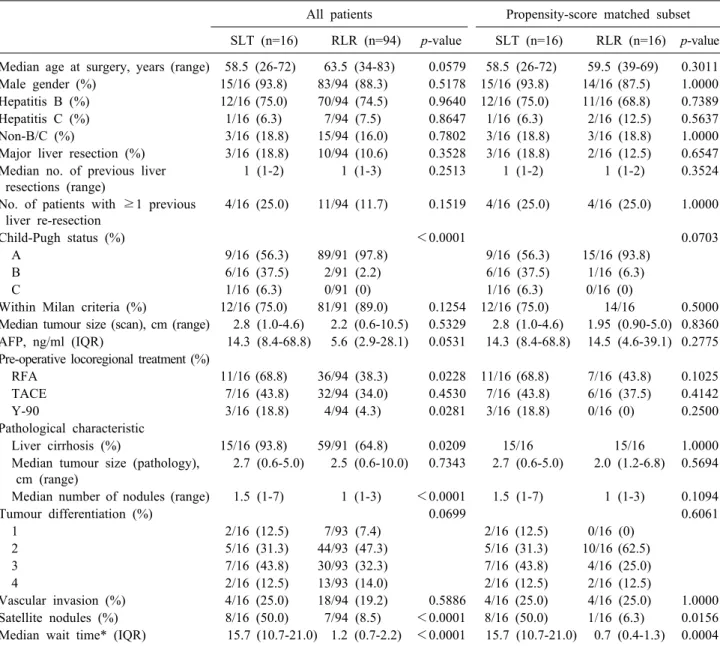
Table 1. Patient characteristics at time of recurrence before salvage transplant or repeat liver resection for recurrent HCC All patients Propensity-score matched subset SLT (n=16) RLR (n=94) p-value SLT (n=16) RLR (n=16) p-value Median age at surgery, years (range) 58.5 (26-72) 63.5 (34-83) 0.0579 58.5 (26-72) 59.5 (39-69) 0.3011 Male gender (%) 15/16 (93.8) 83/94 (88.3) 0.5178 15/16 (93.8) 14/16 (87.5) 1.0000 Hepatitis B (%) 12/16 (75.0) 70/94 (74.5) 0.9640 12/16 (75.0) 11/16 (68.8) 0.7389
Hepatitis C (%) 1/16 (6.3) 7/94 (7.5) 0.8647 1/16 (6.3) 2/16 (12.5) 0.5637
Non-B/C (%) 3/16 (18.8) 15/94 (16.0) 0.7802 3/16 (18.8) 3/16 (18.8) 1.0000
Major liver resection (%) 3/16 (18.8) 10/94 (10.6) 0.3528 3/16 (18.8) 2/16 (12.5) 0.6547 Median no. of previous liver
resections (range)
1 (1-2) 1 (1-3) 0.2513 1 (1-2) 1 (1-2) 0.3524
No. of patients with ≥1 previous liver re-resection
4/16 (25.0) 11/94 (11.7) 0.1519 4/16 (25.0) 4/16 (25.0) 1.0000
Child-Pugh status (%) <0.0001 0.0703
A 9/16 (56.3) 89/91 (97.8) 9/16 (56.3) 15/16 (93.8)
B 6/16 (37.5) 2/91 (2.2) 6/16 (37.5) 1/16 (6.3)
C 1/16 (6.3) 0/91 (0) 1/16 (6.3) 0/16 (0)
Within Milan criteria (%) 12/16 (75.0) 81/91 (89.0) 0.1254 12/16 (75.0) 14/16 0.5000 Median tumour size (scan), cm (range) 2.8 (1.0-4.6) 2.2 (0.6-10.5) 0.5329 2.8 (1.0-4.6) 1.95 (0.90-5.0) 0.8360 AFP, ng/ml (IQR) 14.3 (8.4-68.8) 5.6 (2.9-28.1) 0.0531 14.3 (8.4-68.8) 14.5 (4.6-39.1) 0.2775 Pre-operative locoregional treatment (%)
RFA 11/16 (68.8) 36/94 (38.3) 0.0228 11/16 (68.8) 7/16 (43.8) 0.1025
TACE 7/16 (43.8) 32/94 (34.0) 0.4530 7/16 (43.8) 6/16 (37.5) 0.4142
Y-90 3/16 (18.8) 4/94 (4.3) 0.0281 3/16 (18.8) 0/16 (0) 0.2500
Pathological characteristic
Liver cirrhosis (%) 15/16 (93.8) 59/91 (64.8) 0.0209 15/16 15/16 1.0000
Median tumour size (pathology), cm (range)
2.7 (0.6-5.0) 2.5 (0.6-10.0) 0.7343 2.7 (0.6-5.0) 2.0 (1.2-6.8) 0.5694
Median number of nodules (range) 1.5 (1-7) 1 (1-3) <0.0001 1.5 (1-7) 1 (1-3) 0.1094
Tumour differentiation (%) 0.0699 0.6061
1 2/16 (12.5) 7/93 (7.4) 2/16 (12.5) 0/16 (0)
2 5/16 (31.3) 44/93 (47.3) 5/16 (31.3) 10/16 (62.5)
3 7/16 (43.8) 30/93 (32.3) 7/16 (43.8) 4/16 (25.0)
4 2/16 (12.5) 13/93 (14.0) 2/16 (12.5) 2/16 (12.5)
Vascular invasion (%) 4/16 (25.0) 18/94 (19.2) 0.5886 4/16 (25.0) 4/16 (25.0) 1.0000 Satellite nodules (%) 8/16 (50.0) 7/94 (8.5) <0.0001 8/16 (50.0) 1/16 (6.3) 0.0156 Median wait time* (IQR) 15.7 (10.7-21.0) 1.2 (0.7-2.2) <0.0001 15.7 (10.7-21.0) 0.7 (0.4-1.3) 0.0004 AFP, alpha-fetoprotein; RFA, radiofrequency ablation; TACE, transarterial chemoembolization; Y-90, Yttrium-90 microspheres radioembolization
*Wait time, time from date of recurrence to date of operation covariate adjustment using the linear predictor (log odds) of the PS was used as the primary analysis, and (2) PS-matching and (3) inverse probability of treatment- weighting (IPTW) were conducted as additional sensi- tivity analyses.18
For the primary analysis, baseline characteristics shown in Table 1 were analysed using tests for independent sam- ples. Accordingly, the Mann-Whitney U test and 2 tests were utilised to compare distributions and proportions respectively. The number of previous resections was mod- elled as a count data, and was therefore analysed using
a Poisson model with a time-exposure offset. Differences in peri-operative and oncologic outcomes between the SLT and RLR groups in Table 2 were adjusted using the linear predictor of the propensity scores in multivariable regression models (quantile, logistic, and Cox models for conditional medians, proportions, and time-to-event out- comes respectively). Model-adjusted medians, proportions, and rates were obtained using post-hoc estimation com- mands immediately after fitting regression models.
Next, sensitivity analyses by way of PS matching were conducted to verify the robustness of conclusions from PS
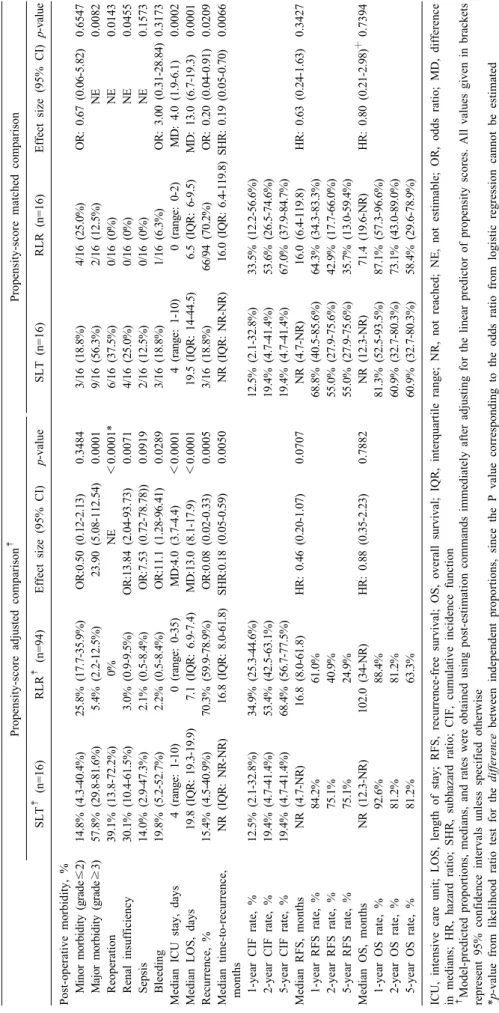
Table 2. Post-operative outcomes of patients with recurrent HCC after salvage liver transplant and repeat liver resection Propensity-score adjusted comparison‡ Propensity-score matched comparison SLT‡ (n=16)RLR‡ (n=94)Effect size (95% CI)p-valueSLT (n=16)RLR (n=16)Effect size (95% CI)p-value Post-operative morbidity, % Minor morbidity (grade≤2)14.8% (4.3-40.4%)25.8% (17.7-35.9%)OR:0.50 (0.12-2.13)0.34843/16 (18.8%)4/16 (25.0%)OR: 0.67 (0.06-5.82)0.6547 Major morbidity (grade≥3)57.8% (29.8-81.6%)5.4% (2.2-12.5%)23.90 (5.08-112.54)0.00019/16 (56.3%)2/16 (12.5%)NE0.0082 Reoperation39.1% (13.8-72.2%)0%NE<0.0001*6/16 (37.5%)0/16 (0%)NE0.0143 Renal insufficiency30.1% (10.4-61.5%)3.0% (0.9-9.5%)OR:13.84 (2.04-93.73)0.00714/16 (25.0%)0/16 (0%)NE0.0455 Sepsis14.0% (2.9-47.3%)2.1% (0.5-8.4%)OR:7.53 (0.72-78.78))0.09192/16 (12.5%)0/16 (0%)NE0.1573 Bleeding19.8% (5.2-52.7%)2.2% (0.5-8.4%)OR:11.1 (1.28-96.41)0.02893/16 (18.8%)1/16 (6.3%)OR: 3.00 (0.31-28.84)0.3173 Median ICU stay, days4 (range: 1-10)0 (range: 0-35)MD:4.0 (3.7-4.4)<0.00014 (range: 1-10)0 (range: 0-2)MD: 4.0 (1.9-6.1)0.0002 Median LOS, days19.8 (IQR: 19.3-19.9)7.1 (IQR: 6.9-7.4)MD:13.0 (8.1-17.9)<0.000119.5 (IQR: 14-44.5)6.5 (IQR: 6-9.5)MD: 13.0 (6.7-19.3)0.0001 Recurrence, %15.4% (4.5-40.9%)70.3% (59.9-78.9%)OR:0.08 (0.02-0.33)0.00053/16 (18.8%)66/94 (70.2%)OR: 0.20 (0.04-0.91)0.0209 Median time-to-recurrence, months NR (IQR: NR-NR)16.8 (IQR: 8.0-61.8)SHR:0.18 (0.05-0.59)0.0050NR (IQR: NR-NR)16.0 (IQR: 6.4-119.8)SHR: 0.19 (0.05-0.70)0.0066 1-year CIF rate, %12.5% (2.1-32.8%)34.9% (25.3-44.6%)12.5% (2.1-32.8%)33.5% (12.2-56.6%) 2-year CIF rate, %19.4% (4.7-41.4%)53.4% (42.5-63.1%)19.4% (4.7-41.4%)53.6% (26.5-74.6%) 5-year CIF rate, %19.4% (4.7-41.4%)68.4% (56.7-77.5%)19.4% (4.7-41.4%)67.0% (37.9-84.7%) Median RFS, months NR (4.7-NR)16.8 (8.0-61.8)HR: 0.46 (0.20-1.07)0.0707NR (4.7-NR)16.0 (6.4-119.8)HR: 0.63 (0.24-1.63)0.3427 1-year RFS rate, %84.2%61.0%68.8% (40.5-85.6%)64.3% (34.3-83.3%) 2-year RFS rate, %75.1%40.9%55.0% (27.9-75.6%)42.9% (17.7-66.0%) 5-year RFS rate, %75.1%24.9%55.0% (27.9-75.6%)35.7% (13.0-59.4%) Median OS, months NR (12.3-NR)102.0 (34-NR)HR: 0.88 (0.35-2.23)0.7882NR (12.3-NR)71.4 (19.6-NR)HR: 0.80 (0.21-2.98)┼ 0.7394 1-year OS rate, %92.6%88.4%81.3% (52.5-93.5%)87.1% (57.3-96.6%) 2-year OS rate, %81.2%81.2%60.9% (32.7-80.3%)73.1% (43.0-89.0%) 5-year OS rate, %81.2%63.3%60.9% (32.7-80.3%)58.4% (29.6-78.9%) ICU, intensive care unit; LOS, length of stay; RFS, recurrence-free survival; OS, overall survival; IQR, interquartile range; NR, not reached; NE, not estimable; OR, odds ratio; MD, difference in medians; HR, hazard ratio; SHR, subhazard ratio; CIF, cumulative incidence function ‡ Model-predicted proportions, medians, and rates were obtained using post-estimation commands immediately after adjusting for the linear predictor of propensity scores. All values given in brackets represent 95% confidence intervals unless specified otherwise *p-value from likelihood ratio test for the difference between independent proportions, since the P value corresponding to the odds ratio from logistic regression cannot be estimated ┼ Estimated hazard ratio may not be valid due to significant deviation from proportional hazards requirement
adjustment analyses. The SLT and RLR patients were paired 1:1 using a greedy algorithm without replacement, and adequacy of matching was assessed using kernel den- sity and histogram plots (Supplementary Figs. S3, S4). In the PS-matched subset of patients, the Wilcoxon sign- ed-rank test and McNemar’s test (or the Cochran Q test when there are more than two levels) were respectively utilized to compare continuous and binary variables shown in Table 1. Mixed-effects quantile regression, McNemar’s test, and stratified Cox regressions taking into account the matched pairs were used to estimate effect sizes and p values for continuous, binary, and time-to-event outcomes in Table 2.
A final sensitivity analysis was undertaken by conduct- ing weighted survival analyses using the inverse proba- bility of treatment-weighting (IPTW) methodology. Statis- tical analyses were performed in STATA version 13.0 (StataCorp) and p<0.05 were regarded to indicate nomi- nal statistical significance.
RESULTS
Comparison of clinicopathologic features between RLR and SLT (Table 1)
The PS model created 2 patient cohorts for comparison with a PS-adjusted group comparing 16 SLT to 94 RLR cases and a PS-matched cohort comparing 16 SLT to 16 RLR cases. Comparisons between all operative cases of RLR and SLT revealed statistically significant differences in Child-Pugh status, preoperative locoregional treatment for radiofrequency ablation (RFA) and Yttrium-90 ther- apy, liver cirrhosis, median number of tumour nodules as well as satellite nodules. Following propensity-score match- ing, our 2 patient groups are comparable with the ex- ception of the SLT cohort having a significantly higher occurrence of satellite nodules (50% vs 6.3%, p=0.0156, Table 1). Other patient characteristics including age, gen- der, underlying aetiology, major hepatic resections and frequency of previous liver resections were similar be- tween the 2 groups. No significant difference was demon- strated for tumour characteristics including tumours within the Milan criteria, median tumour size, AFP, preoperative transarterial chemoembolization (TACE), tumour differ- entiation and vascular invasion. Not unexpectedly, both PS-adjusted and PS-matched SLT groups had significantly
longer median wait times at 15.7 months.
Comparison of post-operative outcomes between RLR and SLT (Table 2)
The SLT group consistently demonstrated higher post- operative major morbidity (Clavien-Dindo grade≥3), re- operation rate and renal insufficiency for both PS-adjusted and PS-matched comparisons. Significantly more SLT pa- tients had longer median intensive care unit (ICU) stay (PS-matched 4 vs 0 days, p=0.0002) and median length of stay (LOS) (PS-matched 19.5 vs 6.5 days, p=0.0001).
In spite of greater perioperative morbidity, there was no statistical difference for postoperative 30-day mortality (SLT=1/16=6.3% vs RLR=3/94=3.2%, p=0.472). One SLT patient died due to hepatic artery thrombosis causing mas- sive liver infarct and consequent failure. Two cases of postoperative liver decompensation with liver failure and one case of acute myocardial infarction contributed to the demise of 3 RLR patients.
Total recurrence was significantly higher in the RLR group (PS-adjusted RLR=70.3% versus SLT=15.4%, p=
0.0005 and PS-matched RLR=70.2% versus SLT=18.8%, p=0.0209), as were the recurrence cumulative incidence rate (CIF) (PS-adjusted RLR 5-year CIF=68.4% versus SLT=19.4%, p=0.005 and PS-matched RLR 5-year CIF=
67% versus SLT=19.4%, p=0.0066). However, 5-year RFS and OS were not shown to be significantly different between RLR and SLT for both PS-adjusted and PS- matched analyses.
The median duration of follow-up from point of initial liver resection to RLR and SLT were 74.3 months (inter- quartile range: 44-133.3) and 94.8 months (interquartile range: 61.1-94.8) respectively.
DISCUSSION
As the second most common cause of cancer-related deaths worldwide,19 there is a need to devise novel meth- ods and/or revise existing treatment strategies to improve survival outcomes for patients with HCCs. A multitude of factors including chronic hepatitis infection, liver cir- rhosis, presence of other liver diseases contribute to the prevalence of disseminated or de novo HCC recurrences.20-23 As such, curative options involve the direct removal of tumour via hepatic resection or elimination of the under-
lying aetiology in the form of a liver transplant. Repeat liver resections are, however, limited by functionality of the liver remnant and high cancer recurrences while trans- plantation depends on liver graft availability and trans- plant expertise. While RLR has become commonplace in the treatment of recurrent HCCS, SLT has gained traction in recent years to maximise the use of scarce liver grafts where appropriate. This study serves to evaluate perioper- ative outcomes of those undergoing RLR and SLT, and improve on treatment strategies for recurrent HCCS.
Liver transplantation is a complex procedure requiring a multidisciplinary team of skilled expertise for its suc- cess. Both primary and SLT are associated with increased mortality and major morbidity risks including bleeding, arterial thrombosis, sepsis and biliary complications.24-28 In contrast, repeated hepatic resections demonstrated low- er risks of mortality and morbidity.29-32 Between SLT and RLR, liver transplantation is regarded as the more techni- cally difficult procedure. The complexities of a liver trans- plant encompass precise dissection in liver mobilisation for total hepatectomy and various intricate anastomoses;
the failure of which frequently results in disastrous com- plications. The hazards of surgery, in combination with patient factors, are likely to account for greater perioper- ative morbidity associated with SLT. Shown in Table 1, SLT patients were more likely to have poor baseline liver function with a greater proportion having a higher Child- Pugh score and liver cirrhosis. Remnant liver function has a direct implication on post-operative outcomes with cir- rhosis, portal hypertension and coagulopathy heightening risks of bleeding, reoperation and renal insufficiency.26,33,34
While bleeding was not a significant complication in the PS-matched cohort, it was the predominant reason for reoperations with other contributions from intra-abdominal sepsis and arterial thrombosis. In the presence of portal hypertension and coagulopathy, the risk of intraoperative bleeding and reoperation increases with consequent com- promise in patient outcomes.26 Together with the high in- cidence of renal insufficiency as a result of nephrotoxic immunosuppressants, sepsis and pre-existing renal dys- function,35-38 one would expect greater perioperative mor- bidity associated with SLT with consequently longer ICU admissions and hospital LOS. Thereby, supporting our significant findings of increased major morbidity, reopera- tion rates and renal insufficiency for individuals under-
going SLT. These figures, along with the trend towards increased risks of sepsis and bleeding are congruent to those reported in the literature,20,24,25,27,39
further establish- ing SLT as a more technically challenging operation with increased short-term morbidity compared to RLR.
Despite greater perioperative risks, SLT patients experi- enced similar survival outcomes with significantly lower tumour recurrences than those undergoing RLR (Table 2).
The SLT cohort in our study also had a higher incidence of tumours with poorer prognostic factors including liver cirrhosis, higher median number of nodules and satellite nodules. While satellite nodules remained the only signi- ficant poor prognosticator after PS-matching, SLT still ex- hibited a trend towards higher 5-year RFS and OS than RLR. Although these figures are not statistically signi- ficant, they are, however, consistent with those reported in other studies; 5-year RFS=29-61% and 5-year OS=41- 66%10,24,25,39,40 for SLT as well as 5-year RFS=10-17%29,41 and 5-year OS=40-69.3%30,31,41-44
for RLR. These findings may therefore, suggest SLT’s substantial role in providing long-term survival and RFS benefit for patients with re- current HCCs.
Several limitations are acknowledged in this study.
While our findings demonstrated results similar to those published in existing literature, it is nonetheless a retro- spective study with small cohort sizes for analyses. Be- sides being inadequately powered, reducing effects of con- founders via propensity score-matching does not eliminate confounding in its entirety compared to a completely randomized study. Of note, the significantly longer wait time depicted in our study for SLT patients may affect disease progression and alter survival outcomes. More- over, the effects of variables including locoregional treat- ment (RFA, TACE, Yttrium-90) are not accounted for, all of which have proven survival benefit.45-47
SLT has been performed in a myriad of patients in a bid to maximise utility of scarce liver grafts. Its sig- nificant perioperative morbidity, however, requires further scrutiny before SLT is proposed as a safe alternative to RLR for recurrent HCCs. The advent of laparoscopic techniques may bolster the results of both SLT and RLR as fewer postoperative complications were depicted in several studies.48-55 Careful patient selection based on sur- vival prognosticators56-63 will also play a greater role in a synergistic treatment framework offering patients the
best survival outcomes in the midst of inevitable tumour recurrences.
In conclusion, SLT may offer superior survival out- comes in view of its trend towards improved OS and RFS relative to RLR. However, its considerable perioperative risks of morbidity and mortality have to be weighed against its supposed benefits. Patient selection is therefore crucial to derive maximal benefit from the scarce resource of liver grafts.
REFERENCES
1. Poon RT, Fan ST, Lo CM, Liu CL, Wong J. Long-term survival and pattern of recurrence after resection of small hepatocellular carcinoma in patients with preserved liver function: implications for a strategy of salvage transplantation. Ann Surg 2002;235:373- 382.
2. Llovet JM, Fuster J, Bruix J. Intention-to-treat analysis of surgi- cal treatment for early hepatocellular carcinoma: resection versus transplantation. Hepatology 1999;30:1434-1440.
3. Yamamoto J, Kosuge T, Takayama T, Shimada K, Yamasaki S, Ozaki H, et al. Recurrence of hepatocellular carcinoma after sur- gery. Br J Surg 1996;83:1219-1222.
4. Shimada M, Takenaka K, Taguchi K, Fujiwara Y, Gion T, Kajiyama K, et al. Prognostic factors after repeat hepatectomy for recurrent hepatocellular carcinoma. Ann Surg 1998;227:80-85.
5. Lee PH, Lin WJ, Tsang YM, Hu RH, Sheu JC, Lai MY, et al.
Clinical management of recurrent hepatocellular carcinoma. Ann Surg 1995;222:670-676.
6. Faber W, Seehofer D, Neuhaus P, Stockmann M, Denecke T, Kalmuk S, et al. Repeated liver resection for recurrent hepato- cellular carcinoma. J Gastroenterol Hepatol 2011;26:1189-1194.
7. Huang ZY, Liang BY, Xiong M, Zhan DQ, Wei S, Wang GP, et al. Long-term outcomes of repeat hepatic resection in patients with recurrent hepatocellular carcinoma and analysis of recurrent types and their prognosis: a single-center experience in China.
Ann Surg Oncol 2012;19:2515-2525.
8. Hu Z, Wang W, Li Z, Ye S, Zheng SS. Recipient outcomes of salvage liver transplantation versus primary liver transplantation:
a systematic review and meta-analysis. Liver Transpl 2012;18:1316- 1323.
9. Ng KK, Lo CM, Liu CL, Poon RT, Chan SC, Fan ST. Survival analysis of patients with transplantable recurrent hepatocellular carcinoma: implications for salvage liver transplant. Arch Surg 2008;143:68-74; discussion 74.
10. Adam R, Azoulay D, Castaing D, Eshkenazy R, Pascal G, Hashizume K, et al. Liver resection as a bridge to transplantation for hep- atocellular carcinoma on cirrhosis: a reasonable strategy? Ann Surg 2003;238:508-518; discussion 518-519.
11. Bhangui P, Allard MA, Vibert E, Cherqui D, Pelletier G, Cunha AS, et al. Salvage versus primary liver transplantation for early hepatocellular carcinoma: do both strategies yield similar out- comes? Ann Surg 2016;264:155-163.
12. Tan EK, Goh BKP, Lee SY, Krishnamoorthy TL, Tan CK, Jeyaraj PR. Liver transplant waitlist outcomes and the allocation of hepatocellular carcinoma model for end-stage liver disease ex- ception points at a low-volume center. Transplant Proc 2018;50:
3564-3570.
13. Guo Y, Tan EK, Krishnamoorthy TL, Tan CK, Tan BH, Tan
TT, et al. Outcomes of salvage liver transplant for recurrent hep- atocellular carcinoma: a comparison with primary liver trans- plant. Ann Hepatobiliary Pancreat Surg 2019;23:1-7.
14. Goh BKP, Syn N, Teo JY, Guo YX, Lee SY, Cheow PC, et al. Perioperative outcomes of laparoscopic repeat liver resection for recurrent HCC: comparison with open repeat liver resection for recurrent HCC and laparoscopic resection for primary HCC.
World J Surg 2019;43:878-885.
15. Bismuth H. Surgical anatomy and anatomical surgery of the liver. World J Surg 1982;6:3-9.
16. Dindo D, Demartines N, Clavien PA. Classification of surgical complications: a new proposal with evaluation in a cohort of 6336 patients and results of a survey. Ann Surg 2004;240:205- 213.
17. Schemper M, Smith TL. A note on quantifying follow-up in studies of failure time. Control Clin Trials 1996;17:343-346.
18. Austin PC. An introduction to propensity score methods for re- ducing the effects of confounding in observational studies. Multi- variate Behav Res 2011;46:399-424.
19. Ferlay J, Soerjomataram I, Dikshit R, Eser S, Mathers C, Rebelo M, et al. Cancer incidence and mortality worldwide: sources, methods and major patterns in GLOBOCAN 2012. Int J Cancer 2015;136:E359-E386.
20. Bruix J, Sherman M; Practice Guidelines Committee, American Association for the Study of Liver Diseases. Management of hepatocellular carcinoma. Hepatology 2005;42:1208-1236.
21. Yang HI, Lu SN, Liaw YF, You SL, Sun CA, Wang LY, et al.;
Taiwan Community-Based Cancer Screening Project Group. He- patitis B e antigen and the risk of hepatocellular carcinoma. N Engl J Med 2002;347:168-174.
22. Takano S, Yokosuka O, Imazeki F, Tagawa M, Omata M. Inci- dence of hepatocellular carcinoma in chronic hepatitis B and C:
a prospective study of 251 patients. Hepatology 1995;21:650-655.
23. Fattovich G, Stroffolini T, Zagni I, Donato F. Hepatocellular car- cinoma in cirrhosis: incidence and risk factors. Gastroenterology 2004;127(5 Suppl 1):S35-S50.
24. Hwang S, Lee SG, Moon DB, Ahn CS, Kim KH, Lee YJ, et al. Salvage living donor liver transplantation after prior liver re- section for hepatocellular carcinoma. Liver Transpl 2007;13:741- 746.
25. Kim BW, Park YK, Kim YB, Wang HJ, Kim MW. Salvage liver transplantation for recurrent hepatocellular carcinoma after liver resection: feasibility of the Milan criteria and operative risk.
Transplant Proc 2008;40:3558-3561.
26. Feltracco P, Brezzi M, Barbieri S, Galligioni H, Milevoj M, Carollo C, et al. Blood loss, predictors of bleeding, transfusion practice and strategies of blood cell salvaging during liver transplantation. World J Hepatol 2013;5:1-15.
27. Duffy JP, Hong JC, Farmer DG, Ghobrial RM, Yersiz H, Hiatt JR, et al. Vascular complications of orthotopic liver trans- plantation: experience in more than 4,200 patients. J Am Coll Surg 2009;208:896-903; discussion 903-905.
28. Sharma S, Gurakar A, Jabbour N. Biliary strictures following liv- er transplantation: past, present and preventive strategies. Liver Transpl 2008;14:759-769.
29. Minagawa M, Makuuchi M, Takayama T, Kokudo N. Selection criteria for repeat hepatectomy in patients with recurrent hep- atocellular carcinoma. Ann Surg 2003;238:703-710.
30. Nakajima Y, Ko S, Kanamura T, Nagao M, Kanehiro H, Hisanaga M, et al. Repeat liver resection for hepatocellular carcinoma. J Am Coll Surg 2001;192:339-344.
31. Neeleman N, Andersson R. Repeated liver resection for recurrent liver cancer. Br J Surg 1996;83:893-901.
32. Sugimachi K, Maehara S, Tanaka S, Shimada M, Sugimachi K.
Repeat hepatectomy is the most useful treatment for recurrent hepatocellular carcinoma. J Hepatobiliary Pancreat Surg 2001;8:
410-416.
33. Wei AC, Tung-Ping Poon R, Fan ST, Wong J. Risk factors for perioperative morbidity and mortality after extended hepatec- tomy for hepatocellular carcinoma. Br J Surg 2003;90:33-41.
34. Yang T, Zhang J, Lu JH, Yang GS, Wu MC, Yu WF. Risk fac- tors influencing postoperative outcomes of major hepatic re- section of hepatocellular carcinoma for patients with underlying liver diseases. World J Surg 2011;35:2073-2082.
35. Gainza FJ, Valdivieso A, Quintanilla N, Errazti G, Gastaca M, Campo M, et al. Evaluation of acute renal failure in the liver transplantation perioperative period: incidence and impact. Trans- plant Proc 2002;34:250-251.
36. Platz KP, Mueller AR, Blumhardt G, Bachmann S, Bechstein WO, Kahl A, et al. Nephrotoxicity following orthotopic liver transplantation. A comparison between cyclosporine and FK506.
Transplantation 1994;58:170-178.
37. Monsour HP Jr, Wood RP, Dyer CH, Galati JS, Ozaki CF, Clark JH. Renal insufficiency and hypertension as long-term complica- tions in liver transplantation. Semin Liver Dis 1995;15:123-132.
38. Bahirwani R, Campbell MS, Siropaides T, Markmann J, Olthoff K, Shaked A, et al. Transplantation: impact of pretransplant renal insufficiency. Liver Transpl 2008;14:665-671.
39. Belghiti J, Cortes A, Abdalla EK, Régimbeau JM, Prakash K, Durand F, et al. Resection prior to liver transplantation for hep- atocellular carcinoma. Ann Surg 2003;238:885-892; discussion 892-893.
40. Del Gaudio M, Ercolani G, Ravaioli M, Cescon M, Lauro A, Vivarelli M, et al. Liver transplantation for recurrent hepato- cellular carcinoma on cirrhosis after liver resection: University of Bologna experience. Am J Transplant 2008;8:1177-1185.
41. Itamoto T, Nakahara H, Amano H, Kohashi T, Ohdan H, Tashiro H, et al. Repeat hepatectomy for recurrent hepatocellular car- cinoma. Surgery 2007;141:589-597.
42. Wu CC, Cheng SB, Yeh DC, Wang J, P'eng FK. Second and third hepatectomies for recurrent hepatocellular carcinoma are justified. Br J Surg 2009;96:1049-1057.
43. Poon RT, Fan ST, Lo CM, Liu CL, Wong J. Intrahepatic re- currence after curative resection of hepatocellular carcinoma:
long-term results of treatment and prognostic factors. Ann Surg 1999;229:216-222.
44. Nagasue N, Kohno H, Hayashi T, Uchida M, Ono T, Yukaya H, et al. Repeat hepatectomy for recurrent hepatocellular car- cinoma. Br J Surg 1996;83:127-131.
45. N'Kontchou G, Mahamoudi A, Aout M, Ganne-Carrié N, Grando V, Coderc E, et al. Radiofrequency ablation of hepatocellular carcinoma: long-term results and prognostic factors in 235 Western patients with cirrhosis. Hepatology 2009;50:1475-1483.
46. Llovet JM, Bruix J. Systematic review of randomized trials for unresectable hepatocellular carcinoma: chemoembolization im- proves survival. Hepatology 2003;37:429-442.
47. Khor AY, Toh Y, Allen JC, Ng DC, Kao YH, Zhu G, et al.
Survival and pattern of tumor progression with yttrium-90 micro- sphere radioembolization in predominantly hepatitis B Asian pa- tients with hepatocellular carcinoma. Hepatol Int 2014;8:395-404.
48. Laurent A, Tayar C, Andréoletti M, Lauzet JY, Merle JC, Cherqui D. Laparoscopic liver resection facilitates salvage liver transplantation for hepatocellular carcinoma. J Hepatobiliary Pan-
creat Surg 2009;16:310-314.
49. Cherqui D, Laurent A, Tayar C, Chang S, Van Nhieu JT, Loriau J, et al. Laparoscopic liver resection for peripheral hepatocellular carcinoma in patients with chronic liver disease: midterm results and perspectives. Ann Surg 2006;243:499-506.
50. Tranchart H, Di Giuro G, Lainas P, Roudie J, Agostini H, Franco D, et al. Laparoscopic resection for hepatocellular carcinoma: a matched-pair comparative study. Surg Endosc 2010;24:1170-1176.
51. Belli G, Fantini C, D'Agostino A, Cioffi L, Langella S, Russolillo N, et al. Laparoscopic versus open liver resection for hep- atocellular carcinoma in patients with histologically proven cir- rhosis: short- and middle-term results. Surg Endosc 2007;21:2004- 2011.
52. Cheung TT, Poon RT, Yuen WK, Chok KS, Jenkins CR, Chan SC, et al. Long-term survival analysis of pure laparoscopic ver- sus open hepatectomy for hepatocellular carcinoma in patients with cirrhosis: a single-center experience. Ann Surg 2013;257:
506-511.
53. Reddy SK, Tsung A, Geller DA. Laparoscopic liver resection.
World J Surg 2011;35:1478-1486.
54. Belli G, Cioffi L, Fantini C, D'Agostino A, Russo G, Limongelli P, et al. Laparoscopic redo surgery for recurrent hepatocellular carcinoma in cirrhotic patients: feasibility, safety, and results.
Surg Endosc 2009;23:1807-1811.
55. Goh BK, Teo JY, Chan CY, Lee SY, Cheow PC, Chung AY.
Review of 103 cases of laparoscopic repeat liver resection for recurrent hepatocellular carcinoma. J Laparoendosc Adv Surg Tech A 2016;26:876-881.
56. Imamura H, Matsuyama Y, Tanaka E, Ohkubo T, Hasegawa K, Miyagawa S, et al. Risk factors contributing to early and late phase intrahepatic recurrence of hepatocellular carcinoma after hepatectomy. J Hepatol 2003;38:200-207.
57. Belghiti J, Panis Y, Farges O, Benhamou JP, Fekete F. Intrahe- patic recurrence after resection of hepatocellular carcinoma com- plicating cirrhosis. Ann Surg 1991;214:114-117.
58. Wu JC, Huang YH, Chau GY, Su CW, Lai CR, Lee PC, et al.
Risk factors for early and late recurrence in hepatitis B-related hepatocellular carcinoma. J Hepatol 2009;51:890-897.
59. Gomez D, Farid S, Malik HZ, Young AL, Toogood GJ, Lodge JP, et al. Preoperative neutrophil-to-lymphocyte ratio as a prog- nostic predictor after curative resection for hepatocellular car- cinoma. World J Surg 2008;32:1757-1762.
60. Mano Y, Shirabe K, Yamashita Y, Harimoto N, Tsujita E, Takeishi K, et al. Preoperative neutrophil-to-lymphocyte ratio is a pre- dictor of survival after hepatectomy for hepatocellular carcino- ma: a retrospective analysis. Ann Surg 2013;258:301-305.
61. Goh BK, Kam JH, Lee SY, Chan CY, Allen JC, Jeyaraj P, et al. Significance of neutrophil-to-lymphocyte ratio, platelet-to- lymphocyte ratio and prognostic nutrition index as preoperative predictors of early mortality after liver resection for huge (≥10 cm) hepatocellular carcinoma. J Surg Oncol 2016;113:621-627.
62. Chan AW, Chan SL, Wong GL, Wong VW, Chong CC, Lai PB, et al. Prognostic nutritional index (PNI) predicts tumor recur- rence of very early/early stage hepatocellular carcinoma after surgical resection. Ann Surg Oncol 2015;22:4138-4148.
63. Yang HJ, Jiang JH, Liu QA, Zhou CM, Du YF, Wu T, et al.
Preoperative platelet-to-lymphocyte ratio is a valuable prognostic biomarker in patients with hepatocellular carcinoma undergoing curative liver resection. Tumour Biol 2017;39:1010428317707375.