ISSN 2234-3806 • eISSN 2234-3814
https://doi.org/10.3343/alm.2019.39.2.158
Impact of Community-Onset Methicillin-Resistant Staphylococcus aureus on Staphylococcus aureus
Bacteremia in a Central Korea Veterans Health Service Hospital
Eunsin Bae, M.D.1, Choon Kwan Kim, M.D.2, Jung-Hyun Jang, M.D.3, Heungsup Sung, M.D.3, YounMi Choi , M.D., Ph.D.1, and Mi-Na Kim , M.D., Ph.D.3
Departments of 1Laboratory Medicine and 2Internal Medicine, Veterans Health Service Medical Center, Seoul, Korea; 3Department of Laboratory Medicine, University of Ulsan College of Medicine and Asan Medical Center, Seoul, Korea
Background: No study has examined the epidemiology of methicillin-resistant Staphylo- coccus aureus (MRSA) bacteremia in Korean veterans’ hospitals. We investigated the mi- crobiological and clinical epidemiology of S. aureus bacteremia at the central Veterans Health Services (VHS) hospital in Korea.
Methods: Patients with S. aureus bacteremia were consecutively enrolled from February to August 2015. Bacteremia was classified as hospital-acquired (HA), community-onset healthcare-associated (COHA), or community-acquired (CA). MRSA bacteremia risk fac- tors were analyzed. Species identification, antimicrobial susceptibility, and presence of luk and tst were tested. Staphylococcal cassette chromosome mec (SCCmec) typing, spa se- quence typing agr polymorphism typing, and multilocus sequence typing were performed.
Biofilm production and δ-hemolysin activity were measured to determine agr function.
Results: In total, 60 patients were enrolled (30 HA, 23 COHA, and seven CA bacteremia);
44 (73.3%) had MRSA bacteremia (26 HA, 16 COHA, and two CA). MRSA bacteremia occurred more frequently in non-CA patients and those who had received antibiotic treat- ment within the past month (P <0.05). The major MRSA strains comprised 24 ST5-agr2- SCCmecII, 11 ST72-agr 1-SCCmecIV, and five ST8-agr1-SCCmecIV strains. Of 26 agr2- SCCmecII strains, including two MSSA strains, 25 were multidrug-resistant, 18 were tst- positive, and 13 were agr-defective, whereas only five of the 18 agr1-SCCmecIV strains were multidrug-resistant, and all were tst-negative and agr-intact. agr1-SCCmecIV and ST8- agr1-SCCmecIV strains were more likely than agr2-SCCmecII strains to be COHA.
Conclusions: MRSA was highly prevalent in both COHA and HA bacteremia. The intro- duction of virulent CA-MRSA strains may be an important cause of increased HA-MRSA bacteremia in VHS hospitals.
Key Words: Community onset, Staphylococcus aureus, Methicillin-resistant Staphylococ- cus aureus, Bacteremia, Healthcare-associated, Veterans hospital, Korea
Received: January 21, 2018 Revision received: May 18, 2018 Accepted: October 4, 2018
Corresponding author: Mi-Na Kim, M.D.
https://orcid.org/0000-0002-4624-6925 Department of Laboratory Medicine, University of Ulsan College of Medicine and Asan Medical Center, 88 Olympic-ro 43 gil, Songpa-gu, Seoul 05505, Korea
Tel: +82-2-3010-4511 Fax: +82-2-3010-4510 E-mail: [email protected]
Co-corresponding author: YounMi Choi, M.D.
https://orcid.org/0000-0002-9188-4272 Department of Laboratory Medicine, Veterans Health Service Medical Center, 53 Jinhwangdo-ro 61 gil, Gangdong-gu, Seoul 05368, Korea
Tel: +82-2-2225-1459 Fax: +82-2-2225-4103
E-mail: [email protected]
© Korean Society for Laboratory Medicine This is an Open Access article distributed under the terms of the Creative Commons Attribution Non-Commercial License (http://creativecom- mons.org/licenses/by-nc/4.0) which permits unrestricted non-commercial use, distribution, and reproduction in any medium, provided the original work is properly cited.
INTRODUCTION
Staphylococcus aureus is a major human pathogen, and methi-
cillin-resistant S. aureus (MRSA) is a leading cause of the global threat of hospital-acquired (HA) multidrug-resistant (MDR) or- ganisms [1, 2]. HA-MRSA and community-acquired (CA)-MRSA
2017-03-16 https://crossmark-cdn.crossref.org/widget/v2.0/logos/CROSSMARK_Color_square.svg
clones are genetically distinct, and their distribution varies mark- edly in different regions [1, 2]. MRSA is expected to become endemic in the community, similar to penicillin-resistant S. au- reus [3]. Over the past decade, the spread of CA-MRSA in the community and subsequently in the healthcare setting has been associated with the dissemination of specific clones such as USA300-sequence type (ST)8, a highly prominent Panton-Val- entine leukocidin (PVL)-positive CA-MRSA in the USA [1, 2, 4].
In Korea, MRSA is highly endemic, constituting 60–81% of clinical S. aureus isolates [5, 6] and 58–64% of bacteremic iso- lates; ST5-SCCmec type II is the most prevalent HA-MRSA [7–
10]. HA-MRSA strains have spread to the community [1, 2]. PVL- negative ST72 MRSA is a major CA-MRSA strain [7, 9], which has also emerged as an important healthcare-associated patho- gen [11-14]. As veterans’ hospitals have long-term cohorts of veterans, they are well-established models for studying HA- and CA-MRSA epidemiology and infection control in the US [15, 16].
However, no study has examined the epidemiology of S. aureus bacteremia in Korean veterans’ hospitals. The Korea Veterans Health Service (VHS), comprising a central hospital and five re- gional hospitals, provides medical services for veterans nation- wide. We investigated the epidemiology and microbiological characterization of S. aureus bacteremia in patients with bacte- remia in the central VHS hospital.
METHODS
Patients and bacterial isolates
This observational case-series study was conducted at the VHS Medical Center, Seoul, Korea, which serves half of the national population of veterans, including metropolitan Seoul. This hos- pital contains 1,000-bed acute- and 400-bed long-term-care fa- cilities. All patients with S. aureus bacteremia were consecutively enrolled from February to August 2015, and S. aureus isolates were collected from their initial blood culture. Patient demogra- phic and clinical findings were retrieved from electronic medical records. The Pitt bacteremia score was used to assess bactere- mia severity [17]. The Medical Review Ethics Committee of the VHS Medical Center approved this study and waived the require- ment for informed consent (Institutional Review Board number:
BOHUN 2015-06-016).
Phenotypic and genotypic analyses
Species identification and antimicrobial susceptibility testing of S. aureus isolated from blood culture were performed using Mi- croScan Pos Breakpoint Combo panel type 28 (PBC28; Beck-
man Coulter, West Sacramento, CA, USA), which included anti- microbial wells for penicillin, amoxicillin/clavulanate, azithromy- cin, clindamycin, daptomycin, erythromycin, fosfomycin, cipro- floxacin, levofloxacin, fusidic acid, gentamicin, imipenem, line- zolid, mupirocin, oxacillin, quinupristin/dalfopristin, rifampin, teicoplanin, tetracycline, trimethoprim-sulfamethoxazole, and vancomycin. Methicillin resistance was determined based on resistance to oxacillin or cefoxitin. For all study isolates, agr op- eron function was measured by δ-hemolysin expression assays using β-hemolysin-producing S. aureus strain RN4220 on blood agar plates, as previously described [18]. agr dysfunction was defined as no enhancement of the β-hemolytic zone. The bio- film assay was performed in polystyrene microtiter plates, as previously described [18]. PCR was conducted for agr polymor- phism typing, staphylococcal cassette chromosome mec (SCC- mec) typing, spa sequence typing, multilocus sequence typing (MLST), and detection of the lukS-PV and lukF-PV genes for PVL and tst gene for toxic shock syndrome toxin (TSST), as pre- viously described [19-21]. spa types were assigned using the RidomStaphType software version 2.2.1 (Ridom GmbH, Mun- ster, Germany) and the SpaServer (http://www.spaserver.ridom.
de). MLST allele name and STs were derived from the MLST database (http://www.mlst.net).
Epidemiological investigation and definitions
Bacteremia was classified as HA if blood cultures taken ≥48 hours after admission were positive and as CA if blood cultures taken in an outpatient setting or <48 hours of hospitalization were positive [22]. It was classified as community-onset health- care-associated (COHA) if the positive cultures were obtained in the CA time frame, but the patient satisfied one or both of the following conditions: 1) a history of hospitalization, surgery, dial- ysis, or residence in a long-term care facility in the previous one year and 2) the presence of a central venous catheter (CVC) within two days prior to the positive blood culture for S. aureus.
Persistent bacteremia was defined as a culture positive for S.
aureus ≥72 hours after the onset of appropriate antimicrobial therapy such as glycopeptide antibiotics [23]. Central line-asso- ciated bloodstream infection (CLABSI) was designated when the source of bacteremia was assumed to be a CVC, according to the criteria of the US Centers for Disease Control and Preven- tion’s National Healthcare Safety Network [24]. MDR was de- fined as the resistance to three or more classes of non-β-lactam antimicrobials based on susceptibility to gentamicin, erythromy- cin, clindamycin, ciprofloxacin, rifampicin, tetracycline, and tri- methoprim/sulfamethoxazole.
Statistical analysis
Continuous variables with normal distribution were summarized as mean±SD; variables with non-normal distribution were sum- marized as median and range or interquartile range (IQR). Cat- egorical variables were expressed as N (%). Differences be- tween MRSA and MSSA were calculated using the chi-square or Fisher’s exact tests for categorical variables and Student t-test or Mann-Whitney test for continuous variables. Odds ratios and 95% confidence intervals (CIs) were calculated to measure the association between an S. aureus ST and HA/COHA/CA. P <0.05 (two-sided) was considered statistically significant. All statistical analyses were performed using MedCalc version 16.4.3 (MedCalc Software, Ostend, Belgium).
RESULTS
Patients and bacterial isolates
In total, 60 patients with S. aureus bacteremia were enrolled.
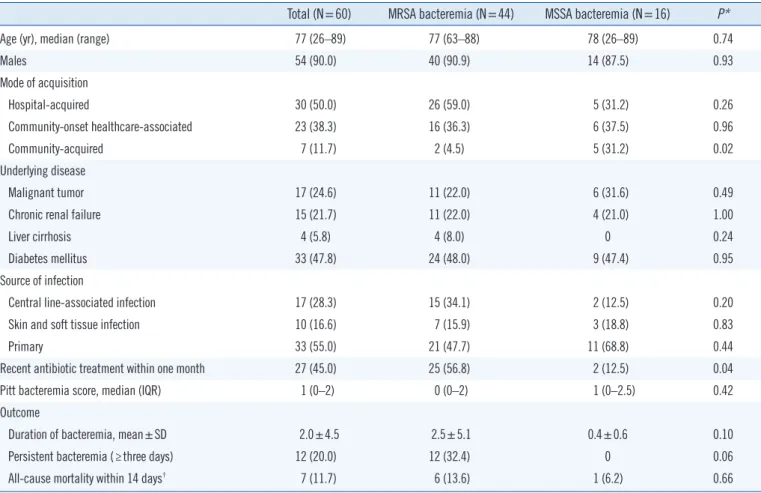
They were categorized as having HA (30 patients), COHA (23 patients), and CA (seven patients) bacteremia (Table 1). All pa- tients, except one, were aged >60 years, and 54 patients were males. Forty-four patients had one or more serious chronic ill- nesses, including diabetes, malignancy, chronic renal failure, and liver cirrhosis. The most frequent sources of bacteremia were an indwelling CVC (N=17, 28.3%) or skin and soft tissue infection (N=10, 16.6%) (Table 1). Forty-four (73.3%) patients had MRSA bacteremia. Fifteen (88.2%) of the 17 CLABSI cases and 12 persistent bacteremia cases were caused by MRSA. MRSA bacteremia was more frequent in patients who underwent anti- biotic treatment within the past month (P <0.05).
Phenotypic and genotypic characteristics
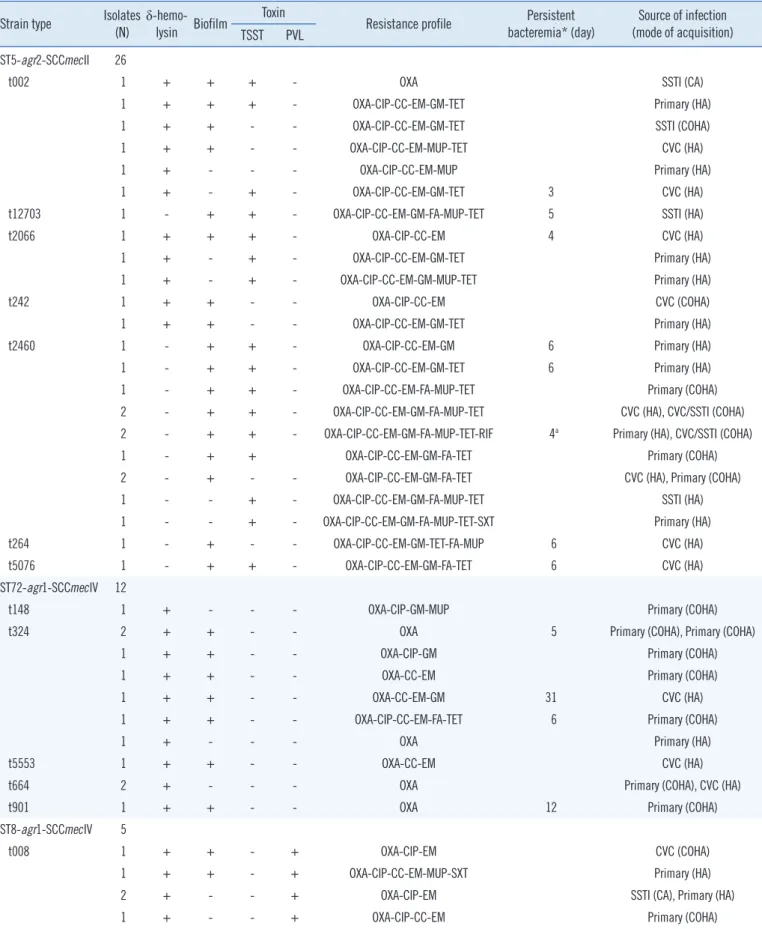
The characteristics of all 60 S. aureus strains are summarized in Table 2. MRSA were grouped into three ST groups: 26 (59%) ST5-agr2-SCCmecII strains comprising 12 t2460, six t002, three t2066, two t242, and three singular types; 12 (27%) ST72-agr1-
Table 1. Comparison of the clinical characteristics of patients with MRSA and MSSA bacteremia
Total (N=60) MRSA bacteremia (N=44) MSSA bacteremia (N=16) P*
Age (yr), median (range) 77 (26–89) 77 (63–88) 78 (26–89) 0.74
Males 54 (90.0) 40 (90.9) 14 (87.5) 0.93
Mode of acquisition
Hospital-acquired 30 (50.0) 26 (59.0) 5 (31.2) 0.26
Community-onset healthcare-associated 23 (38.3) 16 (36.3) 6 (37.5) 0.96
Community-acquired 7 (11.7) 2 (4.5) 5 (31.2) 0.02
Underlying disease
Malignant tumor 17 (24.6) 11 (22.0) 6 (31.6) 0.49
Chronic renal failure 15 (21.7) 11 (22.0) 4 (21.0) 1.00
Liver cirrhosis 4 (5.8) 4 (8.0) 0 0.24
Diabetes mellitus 33 (47.8) 24 (48.0) 9 (47.4) 0.95
Source of infection
Central line-associated infection 17 (28.3) 15 (34.1) 2 (12.5) 0.20
Skin and soft tissue infection 10 (16.6) 7 (15.9) 3 (18.8) 0.83
Primary 33 (55.0) 21 (47.7) 11 (68.8) 0.44
Recent antibiotic treatment within one month 27 (45.0) 25 (56.8) 2 (12.5) 0.04
Pitt bacteremia score, median (IQR) 1 (0–2) 0 (0–2) 1 (0–2.5) 0.42
Outcome
Duration of bacteremia, mean±SD 2.0±4.5 2.5±5.1 0.4±0.6 0.10
Persistent bacteremia (≥three days) 12 (20.0) 12 (32.4) 0 0.06
All-cause mortality within 14 days† 7 (11.7) 6 (13.6) 1 (6.2) 0.66
Values are given as N (%) unless otherwise indicated.
*MRSA bacteremia vs MSSA bacteremia; †Forty-four MRSA bacteremia and 14 MSSA bacteremia cases were followed up.
Abbreviations: MRSA, methicillin-resistant Staphylococcus aureus; MSSA, methicillin-susceptible Staphylococcus aureus; IQR, interquartile range.
Table 2. Microbiological characteristics and epidemiological data of Staphylococcus aureus bacteremia Strain type Isolates
(N) δ-hemo-
lysin Biofilm Toxin
Resistance profile Persistent
bacteremia* (day) Source of infection (mode of acquisition) TSST PVL
ST5-agr2-SCCmecII 26
t002 1 + + + - OXA SSTI (CA)
1 + + + - OXA-CIP-CC-EM-GM-TET Primary (HA)
1 + + - - OXA-CIP-CC-EM-GM-TET SSTI (COHA)
1 + + - - OXA-CIP-CC-EM-MUP-TET CVC (HA)
1 + - - - OXA-CIP-CC-EM-MUP Primary (HA)
1 + - + - OXA-CIP-CC-EM-GM-TET 3 CVC (HA)
t12703 1 - + + - OXA-CIP-CC-EM-GM-FA-MUP-TET 5 SSTI (HA)
t2066 1 + + + - OXA-CIP-CC-EM 4 CVC (HA)
1 + - + - OXA-CIP-CC-EM-GM-TET Primary (HA)
1 + - + - OXA-CIP-CC-EM-GM-MUP-TET Primary (HA)
t242 1 + + - - OXA-CIP-CC-EM CVC (COHA)
1 + + - - OXA-CIP-CC-EM-GM-TET Primary (HA)
t2460 1 - + + - OXA-CIP-CC-EM-GM 6 Primary (HA)
1 - + + - OXA-CIP-CC-EM-GM-TET 6 Primary (HA)
1 - + + - OXA-CIP-CC-EM-FA-MUP-TET Primary (COHA)
2 - + + - OXA-CIP-CC-EM-GM-FA-MUP-TET CVC (HA), CVC/SSTI (COHA)
2 - + + - OXA-CIP-CC-EM-GM-FA-MUP-TET-RIF 4a Primary (HA), CVC/SSTI (COHA)
1 - + + OXA-CIP-CC-EM-GM-FA-TET Primary (COHA)
2 - + - - OXA-CIP-CC-EM-GM-FA-TET CVC (HA), Primary (COHA)
1 - - + - OXA-CIP-CC-EM-GM-FA-MUP-TET SSTI (HA)
1 - - + - OXA-CIP-CC-EM-GM-FA-MUP-TET-SXT Primary (HA)
t264 1 - + - - OXA-CIP-CC-EM-GM-TET-FA-MUP 6 CVC (HA)
t5076 1 - + + - OXA-CIP-CC-EM-GM-FA-TET 6 CVC (HA)
ST72-agr1-SCCmecIV 12
t148 1 + - - - OXA-CIP-GM-MUP Primary (COHA)
t324 2 + + - - OXA 5 Primary (COHA), Primary (COHA)
1 + + - - OXA-CIP-GM Primary (COHA)
1 + + - - OXA-CC-EM Primary (COHA)
1 + + - - OXA-CC-EM-GM 31 CVC (HA)
1 + + - - OXA-CIP-CC-EM-FA-TET 6 Primary (COHA)
1 + - - - OXA Primary (HA)
t5553 1 + + - - OXA-CC-EM CVC (HA)
t664 2 + - - - OXA Primary (COHA), CVC (HA)
t901 1 + + - - OXA 12 Primary (COHA)
ST8-agr1-SCCmecIV 5
t008 1 + + - + OXA-CIP-EM CVC (COHA)
1 + + - + OXA-CIP-CC-EM-MUP-SXT Primary (HA)
2 + - - + OXA-CIP-EM SSTI (CA), Primary (HA)
1 + - - + OXA-CIP-CC-EM Primary (COHA)
(Continued to the next page)
SCCmecIVa strains (including seven t324, two t664, and two singular types); and five (11%) ST8-agr1 strains, all of which were t008 and SCCmecIV. Methicillin-susceptible S. aureus (MSSA) were heterogeneous, consisting of five ST188-t189-agr1 strains, four ST72-agr1 strains (two t324, one t126, and one t148), three ST5-t002-agr2 strains, two ST30-agr2 strains (t012 and t363), one ST15-t279-agr2 strain, and one ST623-t222-agr1 strain.
ST5 MRSA was typically MDR, showing consistent resistance to erythromycin, clindamycin, and ciprofloxacin. ST5-t2460 MRSA was resistant to additional antimicrobials such as gentamicin, fusidic acid, mupirocin, and tetracycline. All strains were com- pletely susceptible to vancomycin with a minimum inhibitory concentration of ≤1 μg/mL. agr1-SCCmecIV MRSA was unlikely to be MDR, and in particular, half of the ST72 MRSA strains were
susceptible to all tested antimicrobials other than β-lactams.
However, one ST834-agr1-SCCmecIV strain was highly MDR. All ST8-agr1 strains were resistant to ciprofloxacin, and one HA strain was resistant to high-level mupirocin and trimethoprim- sulfamethoxazole, as well as β-lactams.
A schematic summary of the genotypic and phenotypic char- acteristics of all 60 strains is presented in Fig. 1 based on spa typing. Regardless of methicillin resistance, the ST5 strains were all PVL-negative and frequently tst-positive (65.5%), whereas the ST72 strains were negative for both PVL and tst. In addition, five ST8 MRSA strains were PVL-positive, all ST30 MSSA strains were tst-positive, and δ-hemolysin-negative agr dysfunction was identified in 15 (57.7%) of the ST5 MRSA strains, mainly t2460.
All MSSA strains were δ-hemolysin-positive, and one ST30 strain Table 2. Continued
Strain type Isolates (N) δ-hemo-
lysin Biofilm Toxin
Resistance profile Persistent
bacteremia* (day) Source of infection (mode of acquisition) TSST PVL
ST834-agr1-SCCmecIV 1
t1379 1 + + - - OXA-CIP-CC-EM-GM-FA-MUP-TET CVC (HA)
ST188-agr1 5
t189 3 + - - - (−) SSTI (COHA), Primary (HA), Primary
(COHA)
1 + - - - FA Primary (COHA)
1 + - - - GM-MUP Primary (HA)
ST72-agr1 4
t126 1 + - - - FA Primary (CA)
t148 1 + + - - CIP-GM Primary (COHA)
t324 1 + + - - (−) SSTI (CA)
1 + - - - (−) SSTI (COHA)
ST5-agr2 3
t002 1 + + + - CIP-CC-EM-TET Primary (CA)
1 + + - - CIP-CC-EM-MUP CVC (COHA)
1 + - - - (−) Primary (CA)
ST30-agr3 2
t012 1 + - + - CIP-CC-EM-GM-TET Primary (HA)
t363 1 + - + - CC-EM Primary (HA)
ST15-agr2 1
t279 1 + - - - (−) Primary (CA)
ST623-agr1 1
t222 1 + + - - CIP-CC-EM-GM-TET CVC (HA)
*Persistent bacteremia was defined as a culture-positive for S. aureus ≥72 hours after the onset of appropriate antimicrobial therapy such as glycopeptides.
Abbreviations: ST, sequence type; SCCmec, staphylococcal cassette chromosome mec; agr, accessory gene regulator; TSST, toxic shock syndrome toxin;
PVL, Panton-Valentine leukocidin; OXA, oxacillin; CIP, ciprofloxacin; CC, clindamycin; EM, erythromycin; FUS, fusidic acid; GM, gentamicin; MUP, mupirocin;
TET, tetracycline; RIF, rifampin; SXT, trimethoprim/sulfamethoxazole; HA, hospital-acquired; COHA, community-onset healthcare-associated; CA, community- acquired; CVC, central venous catheter; SSTI, skin and soft tissue infection.
and two ST5 strains were MDR.
In total, 36 (60.0%) isolates were biofilm-positive, including 20 (76.9%) ST5 MRSA, eight (66.7%) ST72 MRSA, and five (31.3%) MSSA. All non-biofilm-forming strains, except two, were δ-hemolysin-positive, and all biofilm-forming strains, except two ST5 MRSA strains, were δ-hemolysin-defective. However, 22 (50.0%) of the 44 δ-hemolysin-positive strains were also biofilm- forming.
Epidemiological characteristics
The HA/COHA/CA bacteremia distribution among the agrII-SCC- mecII and agr1-SCCmecIV strains was 18 (69.2%)/six (26.9%)/
one (3.8%) and seven (38.9%)/11 (55.6%)/one (5.6%), respec- tively, while in MSSA strains, it was five (31.3%)/six (37.5%)/five (31.3%). Eighteen (69.2%) and six (26.9%) ST5 MRSA strains were isolated from HA- and COHA bacteremia, respectively. One ST5 MRSA was resistant to only oxacillin and isolated from CA bacteremia. Of the five ST8 MRSA strains, four were healthcare- associated, including two HA and two COHA. agr1-SCCmecIV strains were more likely to be COHA than agr2-SCCmecII strains (odds ratio, 3.4; 95% CI, 0.95–12.09) or MSSA (odds ratio, 2.1;
95% CI, 0.52–8.23). In particular, two thirds of the ST72 MRSA strains were isolated from COHA-bacteremia.
All δ-hemolysin-defective strains were healthcare-associated, and 10 of the 15 δ-hemolysin-defective ST5 MRSA strains were HA (Table 2). All CLABSI-causing S. aureus strains, except one,
were biofilm-positive and 11 (64.7%) of those were HA-MRSA.
Nine (75.0%) of 12 persistent bacteremia cases were HA, seven of which were caused by TSST-producing ST5 MRSA. Six of the HA-CLABSI cases resulted in persistent bacteremia, caused by five ST5 MRSA strains and one ST72 MRSA strain. No cases of persistent bacteremia were caused by PVL-producing ST8 MRSA strains.
The ST8-agr1-SCCmecIV strains were consistent with USA300, which were PVL-positive, tst-negative, and δ-hemolysin-positive [25-27]. The patients harboring these ST8 MRSA strains had no history of having travelled abroad in the last decade.
DISCUSSION
MRSA is highly endemic in Korea, regardless of hospital size or complexity; however, MRSA prevalence (73.3%) in this study is much higher than those reported in Korean hospitals previously (51.4–54.3%) [28, 29]. The patient population of the central VHS hospital is unique, comprising predominantly elderly males, with a high percentage of long-term repeat visitors and a high transfer rate from regional veterans’ hospitals or long-term care facilities all over Korea. Therefore, more S. aureus bacteremia cases than usual are likely to be healthcare-associated. The pro- portions of MRSA in HA and COHA bacteremia were not signifi- cantly different as 83.3% and 73.9%, respectively, and were much higher than that of CA bacteremia (28.7%). HA or COHA MRSA accounted for 90% of S. aureus bacteremia cases, clearly contributing to the high prevalence of MRSA in this hospital. In addition, the high prevalence of COHA-MRSA bacteremia indi- cated the possibility of the spread of HA-MRSA into the com- munity and subsequent re-emergence in the healthcare setting via COHA transfer.
The major HA or COHA-MRSA strains in this study were ST5 MRSA, ST72 MRSA, and ST8 MRSA. ST239 was not detected in this study, although it had been previously considered as a representative HA-MRSA strain in Korea [1, 28]. ST72, a typical CA-MRSA strain in Korea over the last decade, displayed CA- MRSA characteristics, such as non-MDR traits and the pres- ence of SCCmecIV; however, all ST72 MRSA strains in this study were from healthcare-associated infections (75% COHA and 25% HA). ST72 MRSA seemed to play a major role in the spread of CA-MRSA to the hospital via COHA transfer. The prevalence of ST239 has recently decreased in Korea [6, 8, 30], and ST72 MRSA has been found to be the most common clone in both CA- and HA-MRSA infections in Korean pediatric patients [13, 31]. The absence of ST239 and the presence of only a few ma- Fig. 1. Cluster analysis based on spa typing of 60 Staphylococcus
aureus strains isolated from blood cultures. The minimum spanning tree was constructed using Bionumerics software (Applied Maths, Sint-Martens-Latem, Belgium). Genotypes determined by using ac- cessory gene regulator (agr) polymorphism and sequence type (ST) correlated well with spa typing clustering. Methicillin susceptibility, δ-hemolysin production, toxic shock syndrome toxin (TSST), and Panton–Valentine leukocidin (PVL) toxin were denoted.
agr3 agr2 agr1
Methicillin-resistant Methicillin-susceptible δ hemolysin-positive TSST-positive PVL-positive
jor MRSA strains in this hospital provide evidence of the clonal spread of MRSA, indicating that a rapid change in MRSA clones is possible in a hospital.
The main ST5 MRSA was ST5-agr2-SCCmecII, which belongs to the New York–Japan clone and is known to be dominant in the adult Korean population [10, 13]. The ST5-t2460 strain is a well-known tst-positive MRSA clone in Korea [8, 9, 14], and it was a main agr-defective strain in the present study. agr-defec- tive strains are associated with high mortality, biofilm formation, prolonged bacteremia, and reduced susceptibility to vancomy- cin [8, 14]. However, the minimum inhibitory concentration of vancomycin for all the isolates in this study was <2 μg/mL, in contrast to previous findings about the New York–Japan clone [32]. Therefore, to our knowledge, this is the first study to dem- onstrate that ST5-t2460-MRSA is a predominant and highly threat- ening pathogen in healthcare-associated bacteremia, with a high virulence in Korea.
ST72 MRSA in the present study was PVL-negative, harbored SCCmecIV, belonged to agr1, and was unlikely to be MDR. PVL- negative ST72-agr1-SCCmecIV, a major CA-MRSA over the last decade, has the advantage of fitness cost in the community be- cause of the small size of SCCmec [33]. However, this clone has recently emerged as a healthcare-associated pathogen in Korea [11-14]. In our study, all of ST72 MRSA bacteremia cases were healthcare-associated, and the high prevalence of ST72 among MRSA bacteremia cases suggests that continuous introduction of COHA-MRSA has contributed to the high prevalence of MRSA bacteremia.
Notably, we revealed that the emergence of PVL-positive ST8- agr1-SCCmecIV strains was responsible for approximately 10%
of MRSA bacteremia cases. This strain is likely to be USA300 clone, which first emerged as CA-MRSA with high virulence and then successfully spread into healthcare settings in the USA [27]. Cases of sporadic USA300 outbreaks have been reported since the first case was imported from Hawaii into Korea in 2007 [9, 25, 26, 34]. This strain was both community- and health- care-associated in our study, consistent with a recent multicenter study [35]; however, it exhibited increased resistance to antimi- crobials. The spread and evolution of this PVL-positive strain should be closely monitored because of its high virulence and ability to spread to both community and healthcare settings.
Among the MSSA strains, ST188, ST72, ST5, and ST30 oc- curred most frequently, consistent with previous findings in Ko- rea [8, 36]. ST188-t198, ST72-t126, and -t324 were linked to agr1 and susceptible to antimicrobials, whereas ST5-t002 and ST30-t012 were linked to agr2 and agr3, respectively, and more
likely to be MDR. One ST5-t002 harbored tst and was MDR, thus having a common trait with ST5 MRSA. These findings suggested cure of methicillin resistance by excision of the mecA gene from ST5-MRSA [37]. All MSSA strains had intact agr function. Alth- ough agr dysfunction in MSSA is rare, one study reported 12.5%
agr dysfunction among MSSA blood isolates in Korea and very high agr dysfunction (89.4%) for ST5 MRSA [8].
This study has important limitations. Because this is the first epidemiological study on S. aureus in Korean VHS hospitals, more longitudinal studies are required to interpret the charac- teristics of high MRSA prevalence and MRSA clonality better.
Furthermore, as this is an observational case-series study, clini- cal and laboratory evaluations were not regulated, and thus, out- come analyses were limited.
In conclusion, we identified the wide spread of ST5-agr2-SC- CmecII, a typical agr-defective HA clone, from hospital to com- munity and of ST72-agr1-SCCmecIV, a typical CA clone, from community to hospital in a Korean VHS hospital. We also con- firmed that the PVL-positive ST8 MRSA strain was prevalent both in the community and the healthcare setting and acquired the MDR character. Clinicians and clinical microbiologists should note that COHA-MRSA is prevalent in S. aureus bacteremia.
Authors’ Disclosures of Potential Conflicts of Interest
No potential conflicts of interest relevant to this article were re- ported.
Acknowledgement
This study was supported by the VHS Medical Center Research Grant, Republic of Korea (grant number: VHSMC15006).
REFERENCES
1. Song JH, Hsueh PR, Chung DR, Ko KS, Kang CI, Peck KR, et al. Spread of methicillin-resistant Staphylococcus aureus between the community and the hospitals in Asian countries: an ANSORP study. J Antimicrob Chemother 2011;66:1061-9.
2. Otter JA and French GL. Community-associated meticillin-resistant Sta- phylococcus aureus strains as a cause of healthcare-associated infec- tion. J Hosp Infect 2011;79:189-93.
3. DeLeo FR, Otto M, Kreiswirth BN, Chambers HF. Community-associat- ed methicillin-resistant Staphylococcus aureus. Lancet 2010;375:1557- 68.
4. Bal AM, Coombs GW, Holden MTG, Lindsay JA, Nimmo GR, Tattevin P, et al. Genomic insights into the emergence and spread of international clones of healthcare-, community- and livestock-associated methicillin-
resistant Staphylococcus aureus: blurring of the traditional definitions. J Global Antimicrob Resist 2016;6:95-101.
5. Kim D, Ahn JY, Lee CH, Jang SJ, Lee H, Yong D, et al. Increasing resis- tance to extended-spectrum cephalosporins, fluoroquinolone, and car- bapenem in gram-negative bacilli and the emergence of carbapenem non-susceptibility in klebsiella pneumoniae: analysis of Korean Antimi- crobial Resistance Monitoring System (KARMS) data from 2013 to 2015.
Ann Lab Med 2017;37:231-9.
6. Kang GS, Jung YH, Kim HS, Lee YS, Park C, Lee KJ, et al. Prevalence of major methicillin-resistant Staphylococcus aureus clones in Korea between 2001 and 2008. Ann Lab Med 2016;36:536-41.
7. Kim ES, Song JS, Lee HJ, Choe PG, Park KH, Cho JH, et al. A survey of community-associated methicillin-resistant Staphylococcus aureus in Korea. J Antimicrob Chemother 2007;60:1108-14.
8. Chong YP, Kim ES, Park SJ, Park KH, Kim T, Kim MN, et al. Accessory gene regulator (agr) dysfunction in Staphylococcus aureus bloodstream isolates from South Korean patients. Antimicrob Agents Chemother 2013;
57:1509-12.
9. Park C, Lee DG, Kim SW, Choi SM, Park SH, Chun HS, et al. Predomi- nance of community-associated methicillin-resistant Staphylococcus aureus strains carrying staphylococcal chromosome cassette mec type IVA in South Korea. J Clin Microbiol 2007;45:4021-6.
10. Park KH, Chong YP, Kim SH, Lee SO, Choi SH, Lee MS, et al. Commu- nity-associated MRSA strain ST72-SCCmecIV causing bloodstream in- fections: clinical outcomes and bacterial virulence factors. J Antimicrob Chemother 2015;70:1185-92.
11. Joo EJ, Choi JY, Chung DR, Song JH, Ko KS. Characteristics of the com- munity-genotype sequence type 72 methicillin-resistant Staphylococcus aureus isolates that underlie their persistence in hospitals. J Microbiol 2016;54:445-50.
12. Park SH, Park C, Yoo JH, Choi SM, Choi JH, Shin HH, et al. Emergence of community-associated methicillin-resistant Staphylococcus aureus strains as a cause of healthcare-associated bloodstream infections in Korea. Infect Control Hosp Epidemiol 2009;30:146-55.
13. Sung JY, Lee J, Choi EH, Lee HJ. Changes in molecular epidemiology of community-associated and health care-associated methicillin-resistant Staphylococcus aureus in Korean children. Diagn Microbiol Infect Dis 2012;74:28-33.
14. Kang CK, Cho JE, Choi YJ, Jung Y, Kim NH, Kim CJ, et al. agr dysfunc- tion affects staphylococcal cassette chromosome mec type-dependent clinical outcomes in methicillin-resistant Staphylococcus aureus bacte- remia. Antimicrob Agents Chemother 2015;59:3125-32.
15. Caffrey AR and LaPlante KL. Changing epidemiology of methicillin-re- sistant Staphylococcus aureus in the Veterans Affairs Healthcare Sys- tem, 2002-2009. Infection 2012; 40:291-7.
16. Stenehjem E, Stafford C, Rimland D. Reduction of methicillin-resistant Staphylococcus aureus infection among veterans in Atlanta. Infect Con- trol Hosp Epidemiol 2013;34:62-8.
17. Roth JA, Tschudin-Sutter S, Dangel M, Frei R, Battegay M, Widmer AF.
Value of the Pitt Bacteraemia Score to predict short-term mortality in Staphylococcus aureus bloodstream infection: a validation study. Swiss Med Wkly 2017;147:w14482.
18. Sakoulas G, Eliopoulos GM, Moellering RC, Wennersten C, Venkatara- man L, Sakoulas G, et al. Accessory gene regulator (agr) locus in geo- graphically diverse Staphylococcus aureus isolates with reduced sus- ceptibility to vancomycin. Antimicrob Agents Chemother 2002;46:1492- 502.
19. Oliveira DC and de Lencastre H. Multiplex PCR strategy for rapid identi- fication of structural types and variants of the mec element in methicil- lin-resistant Staphylococcus aureus. Antimicrob Agents Chemother 2002;
46:2155-61.
20. Enright MC, Day NPJ, Davies CE, Peacock SJ, Spratt BG. Multilocus sequence typing for characterization of methicillin-resistant and methi- cillin-susceptible clones of Staphylococcus aureus. J Clin Microbiol 2000;
38:1008-15.
21. Jarraud S, Mougel C, Thioulouse J, Lina G, Meugnier H, Forey F, et al.
Relationships between Staphylococcus aureus genetic background, vir- ulence factors, agr groups (alleles), and human disease. Infect Immun 2002;70:631-41.
22. Klevens RM, Morrison MA, Nadle J, Petit S, Gershman K, Ray S, et al.
Invasive methicillin-resistant Staphylococcus aureus infections in the United States. JAMA 2007;298:1763-71.
23. Mermel LA, Allon M, Bouza E, Craven DE, Flynn P, O’Grady NP, et al.
Clinical practice guidelines for the diagnosis and management of intra- vascular catheter-related infection: 2009 Update by the Infectious Dis- eases Society of America. Clin Infect Dis 2009;49:1-45.
24. Centers for Disease Control and Prevention and the National Healthcare Safety Network. CDC/NHSN surveillance definitions for specific types of infections. http://www.cdc.gov/nhsn/PDFs/pscManual/17pscNosInfDef_
current.pdf (updated on Jan 2018).
25. Sohn KM, Chung DR, Baek JY, Kim SH, Joo EJ, Ha YE, et al. Post-influ- enza pneumonia caused by the USA300 community-associated methi- cillin-resistant Staphylococcus aureus in Korea. J Korean Med Sci 2012;
27:313-6.
26. Lee H, Kim ES, Choi C, Seo H, Shin M, Bok JH, et al. Outbreak among healthy newborns due to a new variant of USA300-related meticillin-re- sistant Staphylococcus aureus. J Hosp Infect 2014;87:145-51.
27. Carrel M, Perencevich EN, David MZ. USA300 methicillin-resistant Staph- ylococcus aureus, United States, 2000-2013. Emerg Infect Dis 2015;
21:1973-80.
28. Peck KR, Baek JY, Song JH, Ko KS. Comparison of genotypes and en- terotoxin genes between Staphylococcus aureus isolates from blood and nasal colonizers in a Korean hospital. J Korean Med Sci 2009;24:585- 91.
29. Oh TS, Nam YS, Kim YJ, Yang HS, Lee MY, Gu HJ, et al. Trends in blood- stream infections at a Korean university hospital between 2008 and 2013.
Ann Clin Microbiol 2015;18:14-9.
30. Cha HY, Moon DC, Choi CH, Oh JY, Jeong YS, Lee YC, et al. Prevalence of the ST239 clone of methicillin-resistant Staphylococcus aureus and differences in antimicrobial susceptibilities of ST239 and ST5 clones identified in a Korean hospital. J Clin Microbiol 2005;43:3610-4.
31. Park JY, Jin JS, Kang HY, Jeong EH, Lee JC, Lee YC, et al. A compari- son of adult and pediatric methicillin-resistant Staphylococcus aureus isolates collected from patients at a university hospital in Korea. J Mi- crobiol 2007;45:447-52.
32. Mendes RE, Deshpande LM, Smyth DS, Shopsin B, Farrell DJ, Jones RN. Characterization of methicillin-resistant Staphylococcus aureus strains recovered from a phase IV clinical trial for linezolid versus vancomycin for treatment of nosocomial pneumonia. J Clin Microbiol 2012;50:3694- 702.
33. D’Agata EM, Webb GF, Horn MA, Moellering RC Jr, Ruan S. Modeling the invasion of community-acquired methicillin-resistant Staphylococ- cus aureus into hospitals. Clin Infect Dis 2009;48:274-84.
34. Lim S, Chung DR, Baek JY, Kim SH, Peck KR, Lee NY, et al. A third case of USA300 community-associated methicillin-resistant Staphylo- coccus aureus infection in Korea. Korean J Intern Med 2013;28:258- 60.
35. Jung J, Song EH, Park SY, Lee SR, Park SJ, Sung H, et al. Emergence of Panton-Valentine leucocidin-positive ST8-methicillin-resistant Staphy- lococcus aureus (USA300 clone) in Korea causing healthcare-associat-
ed and hospital-acquired bacteraemia. Eur J Clin Microbiol Infect Dis 2016;35:1323-9.
36. Park SH, Kim KJ, Kim BK, Hwang SM. Molecular characterization of community-associated methicillin-resistant and methicillin-susceptible Staphylococcus aureus isolates from children with skin infections in Busan, Korea. J Bacteriol Virol 2015;45:104-11.
37. Shore AC, Rossney AS, O’Connell B, Herra CM, Sullivan DJ, Humphreys H, et al. Detection of staphylococcal cassette chromosome mec-associ- ated DNA segments in multiresistant methicillin-susceptible Staphylo- coccus aureus (MSSA) and identification of Staphylococcus epidermidis ccrAB4 in both methicillin-resistant S. aureus and MSSA. Antimicrob Agents Chemother 2008;52:4407-19.