Effect of Brace to Osteoporotic Vertebral Fracture: A Meta- Analysis
Brace is one of the most commonly used interventions to manage osteoporotic vertebral fracture. However, its authentic effectiveness remains unclear. The aim of this study was to investigate the efficacy of brace in patients with osteoporotic vertebral fractures. We conducted a literature review and meta-analysis following the guideline and handbook of the Cochrane collaboration. Ten published articles were included in this study and data from 4 randomized controlled trials were analyzed. Low quality evidence proved using Spinomed brace could bring large and significant beneficial effect to patients with sub- acute osteoporotic vertebral fractures. Very low quality evidence proved no significant difference between Spinomed orthosis, rigid brace and soft brace when they were used in patients with acute fractures. Therefore, it might be applicable to recommend middle term use of Spinomed orthosis to patients with subacute fracture. In addition, this study emphasized the need for high quality randomized controlled trials.
Keywords: Spine; Osteoporosis; Fracture; Brace; Meta-Analysis
Yuan Zhe Jin1 and Jae Hyup Lee1,21Department of Orthopedic Surgery, College of Medicine, Seoul National University, Seoul, Korea;
2Department of Orthopedic Surgery, SMG-SNU Boramae Medical Center, Seoul, Korea Received: 4 April 2016
Accepted: 12 June 2016 Address for Correspondence:
Jae Hyup Lee, MD
Department of Orthopedic Surgery, Seoul National University College of Medicine, Seoul Metropolitan Government Seoul National University Boramae Medical Center, 20 Boramae-ro 5-gil, Dongjak-gu, Seoul 07061, Korea
E-mail: [email protected]
Funding: This research was supported by Basic Science Research Program through the National Research Foundation of Korea (NRF) funded by the Ministry of Education
(2013R1A1A2061858).
http://dx.doi.org/10.3346/jkms.2016.31.10.1641 • J Korean Med Sci 2016; 31: 1641-1649
INTRODUCTION
Osteoporotic vertebral fracture (OVF) is one of the most severe osteoporotic fractures, which causes severe pain, disability, dys- pnea, deformity and raises the risk of subsequent fracture and death (1,2). Among the conservative treatments to OVF, multi- farious orthoses are used and expected to immobilize the frac- ture site, diminish pain and improve quality of life. However, their authentic effectiveness to patients with OVF remains un- clear (1). Several trials investigated the efficacy of orthoses, but quality of them varied a lot and their outcome parameters were not standardized. Conclusions from previously published sys- tematic reviews had limited generalizability, due to their indi- rectness in participants or limited number of included studies (3,4). Additionally, strength of recommending orthoses to pa- tients with OVF remained inconclusive in reviews or guidelines (5,6).
In order to explore the efficacy of orthoses, we conducted this study through a systematic literature search and meta-anal- ysis. We focused on patients with osteoporotic vertebral fracture and analyzed the outcomes of pain, kyphosis angle and quality of life. Furthermore, we discussed the reasons why some ortho- ses were effective and some were not.
MATERIALS AND METHODS
Data source and searching strategyWe searched electronic databases, including Medline, EMBASE, Central Register of Controlled Trials (CENTRAL) and Web of science, from May, 2015 and updated weekly until March, 2016.
A search strategy included keywords of “clinical trial”, “osteopo- rotic fracture”, “spine”, “orthosis”, and “brace” was used. Details of the search strategy were presented in Supplementary 1. Ref- erence lists of other reviews were also checked for relevant arti- cles.
Study selection
Initially, one author identified the potentially relevant articles by screening titles and abstracts, and then two authors evaluat- ed their eligibility for being included in this study through full text assessment. The evaluation mainly focused on characteris- tics of the studies. English published articles that recruited par- ticipants who had at least one diagnosed OVF and implement- ed orthoses as interventions were included. Trials were exclud- ed if they recruited subjects with traumatic vertebral fractures or pooled participants with and without fracture together but did not separately report their outcomes. Disagreements were solved by discussion between two authors.
Musculoskeletal Disorders
Jin YZ, et al. • Effect of Brace to Osteoporotic Vertebral Fracture
Data extraction
We extracted information with standardized tables which de- scribed characteristics of participants, interventions and out- comes. Unclear information and data in studies was clarified by contacting their authors through e-mails. Outcomes of pain, kyphosis angle and quality of life (Oswestry disability index, Well- being and Functional independence measure-motor score) were statistically analyzed.
Methods used for extracting and handling data were slightly different according to studies. In studies reported outcomes at multiple time points, data from the last visit was extracted; in cross-over designed trials, data before the cross-over procedure was extracted. When synthesized the data from studies with 3 arms, the number of participants in control group was separat- ed evenly, and each compared with one intervention group, with the value of mean and standard deviation (SD) unchanged.
Measurement of risk of bias
We assessed the quality of included randomized controlled tri- als (RCTs) with a method recommended by Cochrane back and neck group (CBN) (7). The method measured the risk of bias in 6 domains: selection, performance, detection, attribution, re- porting and others.
Data synthesis and analysis
We pooled data using the Review Manager (Revman 5.3) and implemented the meta-analysis with the random effect model.
Change value from baseline was used because most trials re- ported outcomes in that data type. If value of SD was not report- ed and needed to be estimated, the formula presented as follows was used,
SDchange = √ (SDbaseline 2 + SDfinal 2 - (2×Corr×SDbaseline×SDfinal)
with an assignment of 0.5 as correlation value. The standard- ized mean difference (SMD) was used to synthesize the out- comes because the measuring scales were different between studies. Some mean values were multiplied by -1 to ensure re- sults from different scales could point in the same direction.
Expression of the magnitude of the results followed the rules of thumb (< 0.2, small effect; 0.2 to 0.8, moderate effect; > 0.8, large effect) (8). Statistical heterogeneity between studies was measured with the chi-squared test. The heterogeneity was considered as significant when P value was not bigger than 0.10 and was recognized as considerable when I
2value was bigger than 75% (7). To explore the heterogeneity, subgroup analysis was conducted. To prove our results were not depended on ar- bitrary decisions on including studies or assigning values, we conducted several sensitivity analyses. The analyses included estimating SD with the different correlation value (0.4), exclud- ing some “dubious” articles and estimating results with the fixed effect model.
Measurement of quality of evidence
To reflect our confidence in truthfulness of the results, we mea- sured quality of evidence with the GRADE approach. The ap- proach measures the limitations of results in 5 domains: study limitation (risk of bias), inconsistency, indirectness, impreci- sion and publication bias. Each item was downgraded 1 or 2 points if the result failed to meet the criteria (9). “Study limita- tion” was downgraded 1 point if 1 to 3 categories of risk of bias were rated as high or unclear. “Inconsistency” was downgraded 1 point if large statistical heterogeneity (P ≤ 0.10, I
2> 80%) ex- isted, downgraded 2 points if both large statistical heterogene- ity and obvious clinical heterogeneity existed. “Indirectness”
was downgraded 1 to 2 points if we detected indirectness in do- mains of population, intervention, comparator, comparison and outcome. “Imprecision” was downgraded 1 point if the to- tal sample size was smaller than 400 and was downgraded 2 points if there were few events and wide confidence intervals (CIs). “Publication bias” was downgraded by 1 point only when we strongly suspected the existence of publication bias.
RESULTS
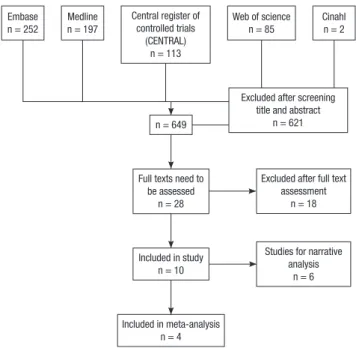
Initially we identified 649 relevant citations and then remained 28 articles for full-text assessment. Eventually, 10 articles were included in this study (10-19) and 4 RCTs, with 281 participants, were included in meta-analysis (10-12,14) (Fig. 1).
Description of included studies
As summarized in Table 1 and 2, 6 RCTs (10-15), 1 non-rando- mized controlled trial (19) and 3 observational studies (16-18)
Fig. 1. Flow diagram of selection process.
Excluded after screening title and abstract
n = 621
Studies for narrative analysis
n = 6 Excluded after full text
assessment n = 18 n = 649
Full texts need to be assessed
n = 28
Included in study n = 10
Included in meta-analysis n = 4 Embase
n = 252
Medline n = 197
Cinahl n = 2 Web of science
n = 85 Central register of
controlled trials (CENTRAL)
n = 113
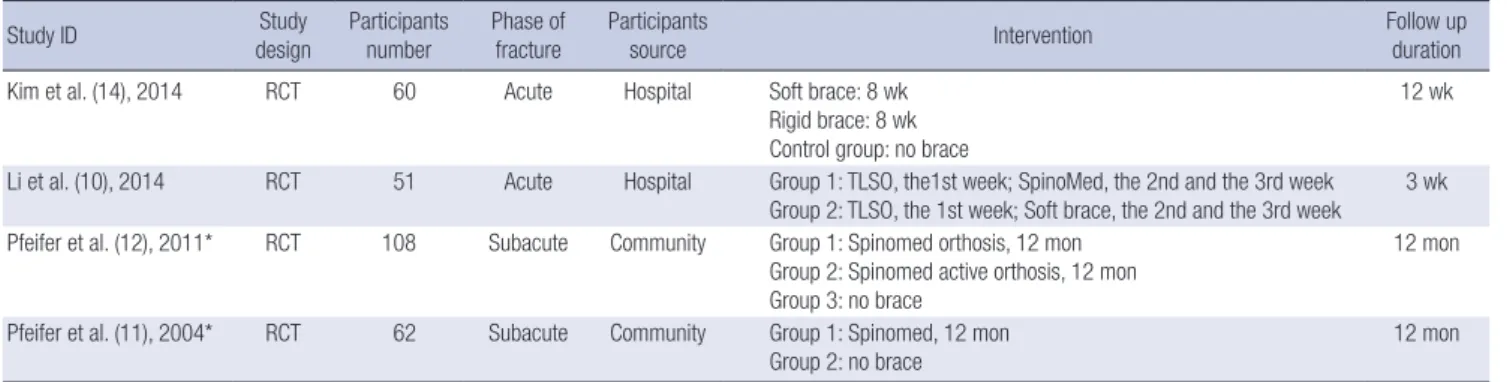
were included. Characteristics of studies varied a lot but all had limited number of participants and only one trial had a sample size merely above 100 (12). Phase of fracture and recruiting sour- ces of participants were different between studies. Participants had acute fractures in 3 trials (10,14,18) while those from an- other 3 trials had sub-acute fractures (11-13). Most of the stud- ies recruited participants in hospital environment (10,13-15,17- 19), while two trials recruited in community environment (11,12).
Most of the trials implemented semi-rigid brace (Spinomed orthosis) and rigid brace for middle to long term. Efficacy of the Spinomed orthosis was investigated in 4 RCTs (10-13) and 1 case series study (16). Three of the 4 RCTs were included in the meta-analysis (10-12) (Table 1), while Dionyssiotis et al.’s study (13) was excluded due to their insufficiently reported data. Effi- cacy of rigid brace was investigated in 2 observational studies (17,18) and 2 controlled trials (14,19), one of which evaluated the efficacy of thoracolumbar sacral orthosis (TLSO) was in- cluded in meta-analysis (14) (Table 1). Implementation and follow-up periods ranged from 1 to 6 months in most studies, except one case series study that immediately measured effect
of the Knight-Taylor brace after it was implemented (17).
Risk of bias of included RCTs
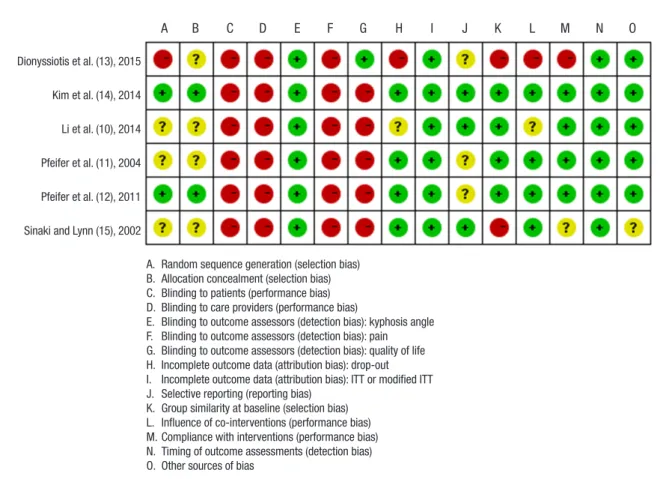
All trials had high risk of bias in at least 1 category (Fig. 2). Most trials had unclear risk of selection bias, due to their briefly re- ported procedures of random sequence generation and alloca- tion concealment. All trials had high risk of performance bias because it was relatively difficult to maintain double blind while implemented braces. Risk of detection bias was evaluated sep- arately in different outcomes, and only the measurement of the kyphosis angle was rated as low risk. Risk of attribution bias was rated as low in 4 trials (11,12,14,15). Risk of reporting bias was rated as unclear in half of the trials (11-13). Risk of other bias was evaluated as low in 5 trials that clarified no conflict of inter- est in conducting and publishing the researches (10-14). We presented the rationales for the judgements of risk of bias in Sup- plementary 2.
Effects of intervention: results from meta-analysis
Three studies investigated the efficacy of braces by comparing
Table 1. Characteristics of studies included in MAStudy ID Study
design Participants
number Phase of
fracture Participants
source Intervention Follow up
duration
Kim et al. (14), 2014 RCT 60 Acute Hospital Soft brace: 8 wk
Rigid brace: 8 wk Control group: no brace
12 wk
Li et al. (10), 2014 RCT 51 Acute Hospital Group 1: TLSO, the1st week; SpinoMed, the 2nd and the 3rd week Group 2: TLSO, the 1st week; Soft brace, the 2nd and the 3rd week
3 wk Pfeifer et al. (12), 2011* RCT 108 Subacute Community Group 1: Spinomed orthosis, 12 mon
Group 2: Spinomed active orthosis, 12 mon Group 3: no brace
12 mon
Pfeifer et al. (11), 2004* RCT 62 Subacute Community Group 1: Spinomed, 12 mon
Group 2: no brace 12 mon
MA, meta-analysis; RCT, randomized controlled trial; TLSO, thoracolumbar sacral orthosis.
*This trial was designed as a cross-over study. We extracted the data before cross-over procedure, on the 6th month.
Table 2. Characteristics of studies included in study but excluded from MA Study ID Study type Participants
number Phase of
fracture Participants
source Interventions Follow up
duration Conclusion
Dionyssiots et al. (13),
2015* RCT 50 Subacute Hospital Group 1: Semi-rigid orthosis
Group 2: Elastic orthosis Group 3: Control group
6 mon Wearing Spinomed orthosis decreased back pain significantly and increased trunk muscle strength significantly.
Sinaki and Lynn (15), 2002
Pilot RCT 7 NA Hospital Group 1: PTS + Exercise Group 2: Exercise
1 mon Subjects who had abnormal balance had the most significant improvement in balance.
Valentin et al. (16),
2014 Case series
study 13 NA NA Spinomed III 3 mon The improvement in the back extensor strength was
significant; but not in pain or physical function.
Talic et al. (19), 2012 N-RCT 59 NA Hospital Group 1: Three-point orthosis Group 2: Plaster corset
1-4 mon Plaster corset offered stability; but patients with orthoses were more mobile.
Duration of immobilization was significantly longer in orthosis group.
Murata et al. (18), 2012 Retrospective
study 55 Acute Hospital Plastic TLSO orthosis 6 mon TLSO promoted the healing of OVF.
Mean kyphosis angle deteriorated from 11.4° to 17.2°.
Liaw et al. (17), 2009 Case series
study 47 NA Hospital Knight-Taylor orthosis Immediately Knight-Taylor brace improved in static and dynamic motor balance but decreased the directional control.
MA, meta-analysis; RCT, randomized controlled trial; PTS, posture training support; NA, not available; TLSO, thoracolumbar sacral orthosis; N-RCT, non-randomized controlled trial.
*The data reported in this article was insufficient to be included in meta-analysis.
Jin YZ, et al. • Effect of Brace to Osteoporotic Vertebral Fracture
Fig. 2. Risk of bias table of included randomized controlled trials. Green represents “low risk of bias”; yellow, “unclear risk of bias”; red, “high risk of bias”.
Fig.2. Risk of bias table of included randomized controlled trials. Green represents “low risk of bias”; yellow, “unclear risk of bias”; red, “high risk of bias”.
A B C D E F G H I J K L M N O
A. Random sequence generation (selection bias) B. Allocation concealment (selection bias) C. Blinding to patients (performance bias) D. Blinding to care providers (performance bias)
E. Blinding to outcome assessors (detection bias): kyphosis angle F. Blinding to outcome assessors (detection bias): pain
G. Blinding to outcome assessors (detection bias): quality of life H. Incomplete outcome data (attribution bias): drop-out
I. Incomplete outcome data (attribution bias): ITT or modified ITT J. Selective reporting (reporting bias)
K. Group similarity at baseline (selection bias) L. Influence of co-interventions (performance bias) M. Compliance with interventions (performance bias) N. Timing of outcome assessments (detection bias) O. Other sources of bias
A. Random sequence generation (selection bias) B. Allocation concealment (selection bias) C. Blinding to patients (performance bias) D. Blinding to care providers (performance bias)
E. Blinding to outcome assessors (detection bias): kyphosis angle F. Blinding to outcome assessors (detection bias): pain G. Blinding to outcome assessors (detection bias): quality of life H. Incomplete outcome data (attribution bias): drop-out I. Incomplete outcome data (attribution bias): ITT or modified ITT J. Selective reporting (reporting bias)
K. Group similarity at baseline (selection bias) L. Influence of co-interventions (performance bias) M. Compliance with interventions (performance bias) N. Timing of outcome assessments (detection bias) O. Other sources of bias
Dionyssiotis et al. (13), 2015 Kim et al. (14), 2014 Li et al. (10), 2014 Pfeifer et al. (11), 2004 Pfeifer et al. (12), 2011 Sinaki and Lynn (15), 2002
A B C D E F G H I J K L M N O
Table 3. Summary of findings (SOF) table of brace vs. no brace
Outcomes Anticipated absolute effects (95% CI) No. of participants (studies) Overall quality of evidence (GRADE)
Pain reduction-pooled data SMD 1.1 fewer (1.61 fewer to 0.59 fewer) 212 (3 studies) ⨁⨁◯◯
LOW*,†
Pain reduction-TLSO SMD 0.57 fewer (1.48 fewer to 0.34 more) 23 (1 study) ⨁◯◯◯
VERY LOW‡,§
Pain reduction-soft brace SMD 0.37 fewer (1.31 fewer to 0.57 more) 19 (1 study) ⨁◯◯◯
VERY LOW‡,§
Pain reduction-Spinomed group SMD 1.46 fewer (1.81 fewer to 1.11 fewer) 170 (2 studies) ⨁⨁◯◯
LOWll,†
Kyphosis angle-pooled data SMD 0.91 fewer (1.21 fewer to 0.61 fewer) 209 (3 studies) ⨁⨁◯◯
LOW¶,†
Kyphosis angle-TLSO SMD 0.72 fewer (1.69 fewer to 0.26 more) 21 (1 study) ⨁◯◯◯
VERY LOW**,§
Kyphosis angle-soft brace SMD 0.38 fewer (1.42 fewer to 0.66 more) 18 (1 study) ⨁◯◯◯
VERY LOW**,§
Kyphosis angle-Spinomed group SMD 0.99 fewer (1.32 fewer to 0.65 fewer) 170 (2 studies) ⨁⨁◯◯
LOW†,††
Quality of life-pooled data SMD 1.24 fewer (2.1 fewer to 0.38 fewer) 212 (3 studies) ⨁◯◯◯
VERY LOW*,†,††
Quality of life-TLSO SMD 0.49 fewer (1.39 fewer to 0.41 more) 23 (1 study) ⨁◯◯◯
VERY LOW‡,§
Quality of life-soft brace SMD 0.2 fewer (1.13 fewer to 0.07 more) 19 (1 study) ⨁◯◯◯
VERY LOW‡,§
Quality of life-Spinomed brace SMD 1.96 fewer (2.34 fewer to 1.58 fewer) 170 (2 studies) ⨁⨁◯◯
LOWll,†
CIs, confidence intervals; SMD, standardized mean difference; RCT, randomized controlled trial; TLSO, thoracolumbar sacral orthosis.
*Serious study limitation: three trials were included, with high risk of performance bias and detection bias; †Serious imprecision: sample size was smaller than 400; ‡Serious study limitation: one trial was included, with high risk of detection bias and performance bias; §Very serious imprecision: sample size was too small and CIs was wide; llSerious study limitation: two trials were included, with high risk of performance bias and detection bias; ¶Serious study limitation: three trials were included, with high risk of performance bias; **Serious study limitation: one trial was included, with high risk of performance bias; ††Serious study limitation: two trials were included, with high risk of performance bias;
‡‡Very serious inconsistency: the statistical heterogeneity was large (I2> 80%) and the clinical heterogeneity existed.
to no brace groups, including 230 participants (11,12,14). We analyzed the outcomes of pain, kyphosis angle and quality of life with subgroup analysis.
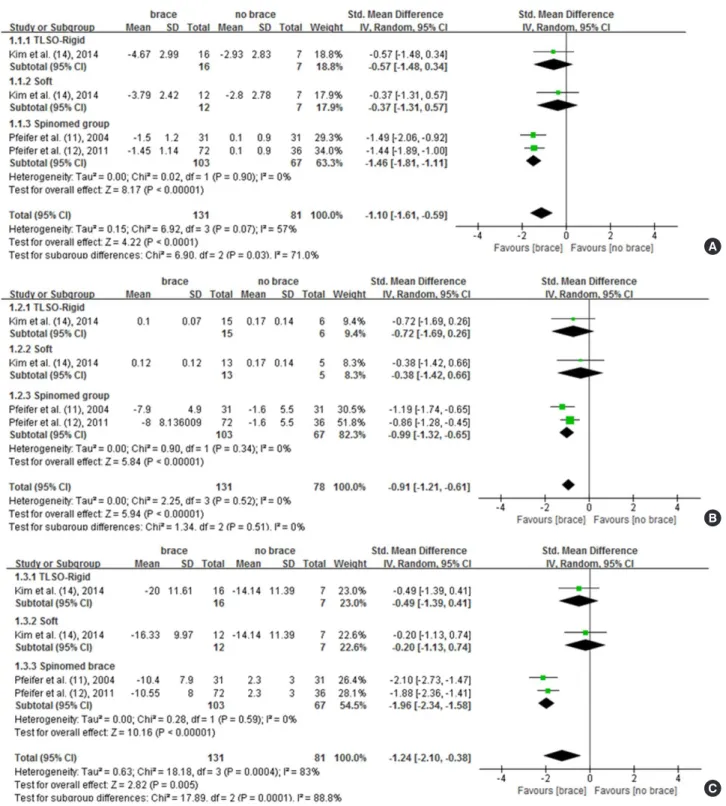
In the outcome of pain, the pooled data showed large and significant beneficial effect brought by using brace (SMD, -1.10;
95% CIs, -1.61 to -0.59; P < 0.001, Fig. 3A). The heterogeneity was significant but its magnitude was acceptable (P = 0.070, I
2= 57%,
Fig. 3A). However, the overall quality of the result was rated as low, due to the serious study limitation and serious imprecision (Table 3). From the subgroup analysis, we noticed only the effi- cacy of Spinomed was significant (P < 0.001, Fig. 3A); and so was the difference between subgroups (P = 0.030, Fig. 3A).
In the outcome of kyphosis angle, pooled data was similar to that of pain: the efficacy brought by brace was large and signifi-
Fig. 3. Forest plot. Comparison between brace group and no brace group. Use of brace showed significant efficacy on pain (A), kyphosis angle correction (B), and quality of life (C).Fig.3. Forest plot.
Comparison between brace group and no brace group. Use of brace showed
significant efficacy on pain (A),
kyphosis angle correction (B), and quality of life (C).
A
B
C
Jin YZ, et al. • Effect of Brace to Osteoporotic Vertebral Fracture
cant (SMD, -0.91; 95% CIs, -1.21 to -0.61; P < 0.001, Fig. 3B).
Still, the overall quality of this evidence was rated as low for the serious study limitation and serious imprecision (Table 3). The difference between subgroups was insignificant (P = 0.510, Fig.
3B), though only the Spinomed orthosis showed significant ef- ficacy (Fig. 3B). The consistency between subgroups might be a result of the similarity in their effect sizes and the relatively well overlapped CIs (Fig. 3B).
Very low quality evidence indicated large and significant ben- eficial effect on quality of life brought by bracing (SMD, -1.24;
95% CIs, -2.10 to -0.38; P = 0.005, Fig. 3C). The heterogeneity and the difference between subgroups were significant (P <
0.001, Fig. 3C). The large magnitude of I2 and the existence of clinical heterogeneity suggested downgrading 2 scores for the inconsistency (Fig. 3). Thus, quality of this evidence was rated as very low, due to the serious study limitation, serious impreci- sion and the very serious inconsistency (Table 3). The untrust- worthy of this outcome was also reflected by the result of sensi- tivity analysis, in which the pooled outcome changed to insig- nificant after excluding one of the two trials that had unclear risk of reporting bias (11) (Fig. 4).
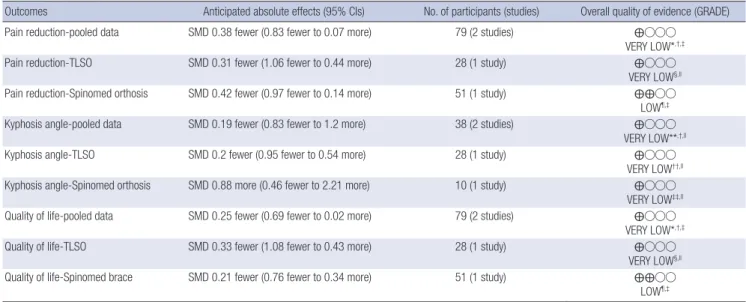
Analysis that compared soft brace with un-soft brace includ- ed two RCTs whose participants had acute vertebral fractures (10,14). The pooled data showed un-soft brace had no signifi-
Fig. 4. Result of the sensitivity analysis of excluding one of the two trials with unclear risk of reporting bias. The outcome of quality of life became insignificant after excluding data of Pfeifer et al., 2004 (A → B).Fig.4. Result of sensitivity analysis of excluding one of the two trials with unclear risk of reporting bias. The outcome of quality of life became insignificant after excluding data of Pfeifer et al., 2004 (AB).
A
B
A
B
cant difference compared with soft brace (Fig. 5). The result was different from the one previously observed, in which Spinomed brace showed significantly better efficacy compared to soft brace (Fig. 3). The quality of evidence of pooled data was rated as very low in all outcomes, due to the serious study limitation and very serious imprecision (Table 4).
Results from narrative analysis
The narrative results were summarized in Table 2. Though most of the results showed benefits from using brace, the strength of them was relatively weak. Two RCTs had limitations in their methodologies: one had high risk of bias (13) and the other one had a small sample size (15). Also, we had limited confidence in conclusions of observational studies, because they might lack the power of proving causal relationship between the utili- zation of orthoses and the benefit.
Publication bias
The publication bias cannot be detected through the funnel plot
because the number of trials included in our meta-analysis was less than 10.
DISCUSSION
We included 10 trials in this study and 4 RCTs in meta-analysis.
All trials had high risk of performance bias and most of them had unclear risk of selection bias. Low to very low quality evi- dence proved that using brace was effective in reducing pain, preventing kyphosis angle deterioration and improving quality of life. However, as observed in the subgroup analyses, only mid- dle term use of Spinomed orthosis could bring significant im- provement to the patients who had subacute fractures. Very low quality evidence indicated there was no significant difference between the efficacy of TLSO, Spinomed and soft brace, when they were implemented to the patients with acute fractures.
The pooled results were difficult to interpret and were rela- tively unreliable due to the limited information. Therefore, rath- er than solving the prescribe questions, current evidence might
Fig. 5. Forest plot. Comparison between un-soft brace group and soft brace group. The results showed no significant difference between braces in pain (A), kyphosis angle (B) and quality of life (C).A
B
C
A
B
C
Jin YZ, et al. • Effect of Brace to Osteoporotic Vertebral Fracture
Table 4. Summary of findings (SOF) table of un-soft brace vs. soft brace
Outcomes Anticipated absolute effects (95% CIs) No. of participants (studies) Overall quality of evidence (GRADE)
Pain reduction-pooled data SMD 0.38 fewer (0.83 fewer to 0.07 more) 79 (2 studies) ⨁◯◯◯
VERY LOW*,†,‡
Pain reduction-TLSO SMD 0.31 fewer (1.06 fewer to 0.44 more) 28 (1 study) ⨁◯◯◯
VERY LOW§,ll
Pain reduction-Spinomed orthosis SMD 0.42 fewer (0.97 fewer to 0.14 more) 51 (1 study) ⨁⨁◯◯
LOW¶,‡
Kyphosis angle-pooled data SMD 0.19 fewer (0.83 fewer to 1.2 more) 38 (2 studies) ⨁◯◯◯
VERY LOW**,†,ll
Kyphosis angle-TLSO SMD 0.2 fewer (0.95 fewer to 0.54 more) 28 (1 study) ⨁◯◯◯
VERY LOW††,ll
Kyphosis angle-Spinomed orthosis SMD 0.88 more (0.46 fewer to 2.21 more) 10 (1 study) ⨁◯◯◯
VERY LOW‡‡,ll
Quality of life-pooled data SMD 0.25 fewer (0.69 fewer to 0.02 more) 79 (2 studies) ⨁◯◯◯
VERY LOW*,†,‡
Quality of life-TLSO SMD 0.33 fewer (1.08 fewer to 0.43 more) 28 (1 study) ⨁◯◯◯
VERY LOW§,ll
Quality of life-Spinomed brace SMD 0.21 fewer (0.76 fewer to 0.34 more) 51 (1 study) ⨁⨁◯◯
LOW¶,‡
CIs, confidence intervals; SMD, standardized mean difference; RCT, randomized controlled trial; TLSO, thoracolumbar sacral orthosis.
*Serious study limitation: two trials were included, with high risk of performance bias and detection bias; †Serious inconsistency: measurement time was different between stud- ies; ‡Serious imprecision: sample size was smaller than 400; §Serious study limitation: one study was included, with high risk of performance bias and detection bias; llVery se- rious imprecision: sample size was too small and CIs was wide; ¶Serious study limitation: one study was included, with high risk of performance and detection bias; **Serious study limitation: two trials were included, with high risk of performing bias; ††Serious study limitation: one study was included, with high risk of performance bias; ‡‡Serious study limitation: one study was included, with high risk of performance and unclear risk of selection bias.
be more proper to find possible explanations or patterns of the efficacy. The result showed Spinomed orthosis could bring large and significant beneficial effects to patients with sub-acute frac- ture, but it was relatively unreliable because of the interference from chance and the limited detective ability in our study. Nev- ertheless, it also might be a result of the special mechanism of this brace. Unlike most of the braces that offer immobilization to the fracture site, the Spinomed orthosis worked with a con- cept of improving the strength of users’ trunk muscle. The stron- ger muscle of the users might subsequently reduce their pain and kyphosis angle deterioration, and improve their quality of life (12).
TLSO is one of the most widely used braces and should have shown beneficial effects in trials, but there was little evidence proving it in our study. The main reason for this contradiction should be the limited detective ability of our study. Other rea- sons might include the inadequate immobilization and the poor compliance of the brace (13,18). The inadequate immobiliza- tion might cause by the skin and soft tissues lie between ortho- sis and skeletal (6); while the poor compliance might cause by inappropriate implementation of the brace or complications like skin ulceration (6).
We noticed improvement in a single outcome cannot guar- antee the improvements in others. Some equipment could re- duce the kyphosis angle by exerting backward force to shoul- ders and forward force in thoracic region. But their efficacy in deformity was not always associated with improvement in mo- bility or quality of life (16,20). Also, the significant improvement in back muscle strength does not always accompany with relief
of pain or improvement in physical function (16).
Two reviews investigated the subject recently, which had mi- nor differences with ours. Newman et al. included osteoporosis and osteopenia participants and stated a descriptive review (3).
Compared with theirs, our study focused on patients with OVF and conducted statistical analysis, which should bring more di- rect conclusions. Rzewuska et al. (4) investigated the efficacy of conservative treatments to OVF patients and included 3 RCTs about orthoses. Compared with them, we included 1 more trial that investigated the efficacy of rigid and soft braces. Also, we had different conclusions in the outcome of functional inde- pendence, while ours was more consistent with that of original article (10). Additionally, we analyzed the outcome of kyphosis angle, which was another critical parameter related to OVF pa- tients. Excluding those differences, our results all revealed the need for high quality clinical trials.
There are several limitations in this study. The existence of publication bias might be covered by the absence of ongoing studies, grey literatures and trials from regional databases. The estimation of the treatment efficacy might be influenced by the language restriction in our inclusion criteria. The generalizabil- ity of results might be diminished by our relatively stringent cri- teria for evaluating the quality of evidence. Besides them, the biggest limitations were the limited number of included trials and the inconsistency between studies. All the limitations raised the difficulty in interpreting the results to some extent and fairly lowered the quality of evidence.
To obtain more dependable evidence, more RCTs with low
risk of bias and big sample size are needed. Authors could low-
er the risk of selection bias through adequate description of the random sequence generation and allocation concealment. A cross-over study might be a proper design to minimize the risk of performance bias, since it might be inevitable for a trial about orthoses (12).
In conclusion, it might be appropriate to recommend middle term use of Spinomed orthoses to patients with subacute frac- tures. The evidence that could prove the efficacy of other brace was insufficient.
DISCLOSURE
The authors have no potential conflicts of interest to disclose.
AUTHOR CONTRIBUTION
Study conception and design: Lee JH. Data acquisition: Jin YZ.
Data analysis, interpretation: Jin YZ, Lee JH. Writing manuscript:
Jin YZ, Lee JH. Revision: all authors. Approval of final manu- script: all authors.
ORCID
Yuan Zhe Jin http://orcid.org/0000-0001-9068-2778 Jae Hyup Lee http://orcid.org/0000-0002-2141-0266
REFERENCES
1. Gerdhem P. Osteoporosis and fragility fractures: vertebral fractures. Best Pract Res Clin Rheumatol 2013; 27: 743-55.
2. Johnell O, Kanis JA, Odén A, Sernbo I, Redlund-Johnell I, Petterson C, De Laet C, Jönsson B. Mortality after osteoporotic fractures. Osteoporos Int 2004; 15: 38-42.
3. Newman M, Minns Lowe C, Barker K. Spinal orthoses for vertebral osteo- porosis and osteoporotic vertebral fracture: a systematic review. Arch Phys Med Rehabil 2016; 97: 1013-25.
4. Rzewuska M, Ferreira M, McLachlan AJ, Machado GC, Maher CG. The efficacy of conservative treatment of osteoporotic compression fractures on acute pain relief: a systematic review with meta-analysis. Eur Spine J 2015; 24: 702-14.
5. Esses SI, McGuire R, Jenkins J, Finkelstein J, Woodard E, Watters WC 3rd, Goldberg MJ, Keith M, Turkelson CM, Wies JL, et al. The treatment of symp- tomatic osteoporotic spinal compression fractures. J Am Acad Orthop Surg 2011; 19: 176-82.
6. Agabegi SS, Asghar FA, Herkowitz HN. Spinal orthoses. J Am Acad Or- thop Surg 2010; 18: 657-67.
7. Furlan AD, Malmivaara A, Chou R, Maher CG, Deyo RA, Schoene M, Bron-
fort G, van Tulder MW; Editorial Board of the Cochrane Back, Neck Group.
2015 updated method guideline for systematic reviews in the Cochrane Back and Neck Group. Spine (Phila Pa 1976) 2015; 40: 1660-73.
8. Higgins JP, Green S. Cochrane handbook for systematic reviews of inter- ventions: version 5.1.0 [Internet]. Available at http://handbook.cochrane.
org/ [updated March 2011; accessed on 2 March 2015].
9. Chaparro LE, Furlan AD, Deshpande A, Mailis-Gagnon A, Atlas S, Turk DC. Opioids compared with placebo or other treatments for chronic low back pain: an update of the Cochrane Review. Spine (Phila Pa 1976) 2014;
39: 556-63.
10. Li M, Law SW, Cheng J, Kee HM, Wong MS. A comparison study on the efficacy of SpinoMed® and soft lumbar orthosis for osteoporotic vertebral fracture. Prosthet Orthot Int 2015; 39: 270-6.
11. Pfeifer M, Begerow B, Minne HW. Effects of a new spinal orthosis on pos- ture, trunk strength, and quality of life in women with postmenopausal osteoporosis: a randomized trial. Am J Phys Med Rehabil 2004; 83: 177- 86.
12. Pfeifer M, Kohlwey L, Begerow B, Minne HW. Effects of two newly devel- oped spinal orthoses on trunk muscle strength, posture, and quality-of- life in women with postmenopausal osteoporosis: a randomized trial.
Am J Phys Med Rehabil 2011; 90: 805-15.
13. Dionyssiotis Y, Trovas G, Thoma S, Lyritis G, Papaioannou N. Prospective study of spinal orthoses in women. Prosthet Orthot Int 2015; 39: 487-95.
14. Kim HJ, Yi JM, Cho HG, Chang BS, Lee CK, Kim JH, Yeom JS. Compara- tive study of the treatment outcomes of osteoporotic compression frac- tures without neurologic injury using a rigid brace, a soft brace, and no brace: a prospective randomized controlled non-inferiority trial. J Bone Joint Surg Am 2014; 96: 1959-66.
15. Sinaki M, Lynn SG. Reducing the risk of falls through proprioceptive dy- namic posture training in osteoporotic women with kyphotic posturing:
a randomized pilot study. Am J Phys Med Rehabil 2002; 81: 241-6.
16. Valentin GH, Pedersen LN, Maribo T. Wearing an active spinal orthosis improves back extensor strength in women with osteoporotic vertebral fractures. Prosthet Orthot Int 2014; 38: 232-8.
17. Liaw MY, Chen CL, Chen JF, Tang FT, Wong AM, Ho HH. Effects of Knight- Taylor brace on balance performance in osteoporotic patients with verte- bral compression fracture. J Back Musculoskeletal Rehabil 2009; 22: 75- 81.
18. Murata K, Watanabe G, Kawaguchi S, Kanaya K, Horigome K, Yajima H, Morita T, Yamashita T. Union rates and prognostic variables of osteopo- rotic vertebral fractures treated with a rigid external support. J Neurosurg Spine 2012; 17: 469-75.
19. Talic A, Kapetanovic J, Dizdar A. Effects of conservative treatment for os- teoporotic thoracolumbal spine fractures. Mater Sociomed 2012; 24: 16- 20.
20. Greig AM, Bennell KL, Briggs AM, Hodges PW. Postural taping decreases thoracic kyphosis but does not influence trunk muscle electromyographic activity or balance in women with osteoporosis. Man Ther 2008; 13: 249- 57.
Jin YZ, et al. • Effect of Brace to Osteoporotic Vertebral Fracture
Supplementary 1. Search strategy for MEDLINE (via PubMed) Randomized controlled trial[pt]
Controlled clinical trial[pt]
Randomized controlled trials[mh]
Random allocation[mh]
Double-blind method[mh]
Single blind method[mh]
Clinical trial[pt]
Clinical trials[mh]) Clinical trial"[tw]
Latin square[tw]) Placebos[mh]
Placebo*[tw]
Random*[tw]
Research design[mh:noexp]
Placebos[mh]
Evaluation studies[mh]
Follow-up studies[mh]
Prospective studies[mh]
Cross-over studies[mh]
Control*[tw]
Prospective*[tw]
Volunteer*[tw]) not ((animal[mh] not human[mh])
#1 Or #2 or #3 or #4 or #5 or #6 or #7 or #8 or #9 or #10 or #11 or #12 or #13 or #14 or #15 or #16 or #17 or #18 or #19 or #20 or #21 or #22 Osteoporosis compression fracture
Osteoporotic fracture
#24 Or #25 Spine Spinal Vertebral Vertebrae
#27 Or #28 or #29 or #30 Brace
Protective gear Protection Orthosis Orthoses Taping
# 32 OR #33 OR #34 OR #35 OR #36 OR #37
#23 AND #26 AND #31 AND #38
Supplementary 2. Rationales for the judgement of the risk of bias
Study ID: Kim, 2014 Level Quote
Random sequence generation (Selection bias)
Low risk
of bias “This randomization was performed using a computer-generated randomization list, which was concealed from the first author (H.-J.K.) before the randomized allocation.”
Criteria quote: A random (unpredictable) assignment sequence. Examples of adequate methods are coin toss (for studies with 2 groups), rolling a dice (for studies with 2 or more groups), drawing of balls of different colors, drawing of ballots with the study group labels from a dark bag, computer-generated random sequence, preordered sealed envelopes, sequentially-ordered vials, telephone call to a central office, and preordered list of treatment assignments.
Allocation concealment
(Selection bias) Low risk
of bias “This randomization was performed using a computer-generated randomization list, which was concealed from the first author (H.-J.K.) before the randomized allocation.”
Criteria quote: Assignment generated by an independent person not responsible for determining the eligibility of the patients. This per- son has no information about the persons included in the trial and has no influence on the assignment sequence or on the decision about eligibility of the patient.
Blinding to patients
(Performance bias) High risk
of bias The character of intervention.
Criteria quote: Index and control groups are indistinguishable for the patients or if the success of blinding was tested among the patients and it was successful.
Blinding to care provider (Performance bias) High risk
of bias The character of intervention.
Criteria quote: Index and control groups are indistinguishable for the care providers or if the success of blinding was tested among the care providers and it was successful.
Blinding to outcome assessors (Detection bias) - kyphosis angle
Low risk
of bias The outcome measurement was objective, which means it was less likely to be influenced by the failure of blinding.
Criteria quote: for outcome criteria that do not suppose a contact with participants (e.g., radiography, magnetic resonance imaging): the blinding procedure is adequate if the treatment or adverse effects of the treatment cannot be noticed when assessing the main outcome.
Blinding to outcome assessors (Detection bias) - pain
High risk
of bias The outcome measurement was subjective and was easily influenced by the failure of blinding.
Criteria quote: for patient-reported outcomes in which the patient is the outcome assessor (e.g., pain, disability): the blinding procedure is adequate for outcome assessors if participant blinding is scored ‘‘yes’’.
Blinding to outcome assessors (Detection bias) - quality of life
High risk
of bias The outcome measurement was subjective and was easily influenced by the failure of blinding.
Criteria quote: for patient-reported outcomes in which the patient is the outcome assessor (e.g., pain, disability): the blinding procedure is adequate for outcome assessors if participant blinding is scored ‘‘yes’’.
Incomplete outcome data (Attribution bias):
drop-out
Low risk
of bias The lost ratio is 13.3%.
Criteria quote: The number of participants who were included in the study but did not complete the observation period or were not included in the analysis must be described and reasons given. If the percentage of withdrawals and drop-outs does not exceed 20%
for short-term follow-up and 30% for long-term follow-up and does not lead to substantial bias a ‘‘yes’’ is scored.
Incomplete outcome data (Attribution bias) - ITT*
or modified ITT
Low risk
of bias “All data were evaluated with use of intention-to treat analysis.”
Criteria quote: All randomized patients are reported/analyzed in the group they were allocated to by randomization for the most important moments of effect measurement (minus missing values) irrespective of noncompliance and co-interventions.
Selective reporting
(Reporting bias)† Low risk
of bias Undetected.
Criteria quote: The study protocol is not available but it is clear that the published reports include all expected outcomes, including those that were pre-specified.
Group similarity at base- line (Selection bias) Low risk
of bias “The baseline characteristics of the participants were similar among the three groups.”
Criteria quote: Groups have to be similar at baseline regarding demographic factors, duration and severity of complaints, percentage of patients with neurological symptoms, and value of main outcome measure(s).
Influence of co-interven- tions (Performance bias)Low risk
of bias “There was no significant difference in opioids use among the three groups at twelve weeks.”
Criteria quote: If there were no co interventions or they were similar between the index and control groups.
Compliance with interven- tions (Performance bias)Low risk
of bias “On the basis of self-reported compliance, one patient in the soft-brace group and one patient in the rigid-brace group admitted to not wearing the brace in the sitting position during the twelve-week follow-up period; however, these patients wore the rigid or soft brace in the standing or walking positions.”
Criteria quote: The reviewer determines if the compliance with the interventions is acceptable, based on the reported intensity, duration, number and frequency of sessions for both the index intervention and control intervention(s). For example, physiotherapy treatment is usually administered for several sessions; therefore it is necessary to assess how many sessions each patient attended. For single- session interventions (e.g., surgery), this item is irrelevant.
Timing of outcome as- sessments (Detection bias)
Low risk
of bias “At the twelve-week assessment, complete data were available for forty-nine (81.7%) of the sixty participants.”
Criteria quote: Timing of outcome assessment should be identical for all intervention groups and for all primary outcome measures.
Other sources of bias Low risk
of bias “The funds were used to pay for salaries and conference expenses. The funder had no role in the study design, data collection and analysis, decision to publish, or preparation of the manuscript.”
Criteria quote:
1. When the outcome measures were not valid. There should be evidence from a previous or present scientific study that the primary outcome can be considered valid in the context of the present.
2. Industry-sponsored trials. The conflict of interest (COI) statement should explicitly state that the researchers have had full posses- sion of the trial process from planning to report without funders with potential COI having any possibility to interfere in the process.
If, for example, the statistical analyses have been done by a funder with a potential COI, usually ‘‘unsure’’ is scored.
ITT, intention to treat.
*Three principles of “intention to treat”: 1. Keep participants in the intervention groups to which they were randomized, regardless of the intervention they actually received, 2.
Measure outcome data on all participants, 3. Include all randomized participants in the analysis. The first one is widely acceptable, the second one is impossible, the third one is contentious. — in our review our criteria for ITT is the trial which fulfill the first principle, which means no matter with or without missing data; †Reporting bias should be ex- amined by comparison between protocol and published article but no protocol was found, so we compared the outcomes in method section with those whose results were re- ported.
Jin YZ, et al. • Effect of Brace to Osteoporotic Vertebral Fracture
Study ID: Li, 2014 Risk of bias Quote
Random sequence generation (Selection bias) Unclear risk of bias Not mentioned.
Allocation concealment (Selection bias) Unclear risk of bias Not mentioned.
Blinding to patients (Performance bias) High risk of bias The character of intervention.
Blinding to care providers (Performance bias) High risk of bias The character of intervention.
Blinding to outcome assessors (Detection bias) - kyphosis angle Low risk of bias The outcome measurement was objective, which means it was less likely to be influenced by the failure of blinding.
Blinding to outcome assessors (Detection bias) - pain High risk of bias The outcome measurement was subjective and easily influenced by the failure of blinding.
Blinding to outcome assessors (Detection bias) - quality of life High risk of bias The outcome measurement was subjective and easily influenced by the failure of blinding.
Incomplete outcome data (Attribution bias): drop-out Unclear risk of bias Kyphosis outcome only reported in 10 subjects.
Incomplete outcome data (Attribution bias) - ITT* or modified ITT Low risk of bias Outcomes of participants were reported as their allocation.
Selective reporting (Reporting bias) Low risk of bias Undetected.
Group similarity at baseline (Selection bias) Low risk of bias “The levels of vertebral fracture were different among patients.” But the difference was deemed tolerable by reviewer.
Influence of co-interventions (Performance bias) Unclear risk of bias Participants were worn TLSO for 1st week and wore soft and Spinomed for the 2nd and the 3rd weeks. Did not mention the compliance of interventions.
Compliance with interventions (Performance bias) Low risk of bias “This study had evaluated the efficacy of SpinoMed® orthosis by a prospective and randomized control trial, with the subjects’ compliance monitored by clinicians in hospital.”
Timing of outcome assessments (Detection bias) Low risk of bias 3 weeks (1 week TLSO, 2 weeks Spinomed orthosis or soft brace).
Other sources of bias Low risk of bias “This research received no specific grant from any funding agency in the public, commercial, or not-for-profit sectors.”
ITT, intention to treat; TLSO, thoracolumbar sacral orthosis.
Study ID: Pfeifer, 2004 Risk of bias Quote Random sequence generation (Selection bias) Unclear risk of bias Not mentioned.
Allocation concealment (Selection bias) Unclear risk of bias Not mentioned.
Blinding to patients (Performance bias) High risk of bias The character of intervention.
Blinding to care providers (Performance bias) High risk of bias The character of intervention.
Blinding to outcome assessors (Detection bias) - kyphosis angle
Low risk of bias The outcome measurement was objective, which means it was less likely to be influenced by the failure of blinding.
Blinding to outcome assessors (Detection bias) - pain High risk of bias The outcome measurement was subjective and was easily influenced by the failure of blinding.
Blinding to outcome assessors (Detection bias) - quality of life
High risk of bias The outcome measurement (questionnaire) was subjective and easily influenced by the failure of blinding.
Incomplete outcome data (Attribution bias): drop-out Low risk of bias No lost data on the 6th month.
Incomplete outcome data (Attribution bias) - ITT* or modified ITT
Low risk of bias The baseline data and change value from baseline on the 6th months was reported according to participants’ initial allocation.
Selective reporting (Reporting bias) Unclear risk of bias Seemed to have identical data with the article published on 2011.
Group similarity at baseline (Selection bias) Low risk of bias “Both groups were comparable concerning age, height, weight, number of vertebral fractures, loss of height since the age of 25, number of non-vertebral fractures, and falls within the previous 2 yrs. In addition, concomitant diseases and concomitant medications were distributed similarly. Specifically, the use of analgesics was sporadic in both groups.”
Influence of co-interventions (Performance bias) Low risk of bias “Specifically, the use of analgesics was sporadic in both groups. Five women in group A took analgesics two or three times a weeks, whereas three women in group B used analgesics two or three times a week.”
Compliance with interventions (Performance bias) Low risk of bias “The overall compliance of the study participants was excellent: all 62 study subjects completed at least 6 mos of intervention each, and another 28 subjects continued for a 12-mo period.”
Timing of outcome assessments (Detection bias) Low risk of bias 6 months.
Other sources of bias Low risk of bias “Medi-Bayreuth had no control over the decision to approve or submit the manuscript for publication.”
ITT, intention to treat.
Study ID: Pfeifer, 2011 Risk of bias Quote
Random sequence generation (Selection bias) Low risk of bias “The randomization of study subjects was performed externally by a statistical consultant bureau.”
Allocation concealment (Selection bias) Low risk of bias “The randomization of study subjects was performed externally by a statistical consultant bureau.”
Blinding to patients (Performance bias) High risk of bias The character of intervention.
Blinding to care providers (Performance bias) High risk of bias The character of intervention.
Blinding to outcome assessors (Detection bias)
- kyphosis angle Low risk of bias The outcome measurement was objective, which means it was less likely to be influenced by the failure of blinding.
Blinding to outcome assessors (Detection bias) - pain High risk of bias The outcome measurement was subjective and easily influenced by the failure of blinding.
Blinding to outcome assessors (Detection bias) - quality of life
High risk of bias The outcome measurement (questionnaire) was subjective and easily influenced by the failure of blinding.
Incomplete outcome data (Attribution bias): drop-out Low risk of bias Data remains intact.
Incomplete outcome data (Attribution bias) - ITT* or modified ITT
Low risk of bias “All study subjects, who were initially randomized and received an orthosis, had been included into the analysis (intention-to-treat analysis).”
Selective reporting (Reporting bias) Unclear risk of bias Seemed to have identical data with article reported on 2004.
Group similarity at baseline (Selection bias) Low risk of bias Concomitant diseases and concomitant medications were distributed similarly.
Influence of co-interventions (Performance bias) Low risk of bias “Specifically, the use of analgesics was sporadic in all groups. Only five women in group A (14%) took analgesics on a daily basis, three women in group B (8%) used analgesics, and five (14%) women in group C took medications for pain relief.”
Compliance with interventions (Performance bias) Low risk of bias “The overall compliance of the study participants was excellent: 105 study subjects completed at least 6 mos of intervention each, and another 100 subjects continued over a 12-mo period.”
Timing of outcome assessments (Detection bias) Low risk of bias 6 months.
Other sources of bias Low risk of bias “Financial disclosure statements have been obtained, and no conflicts of interest have been reported by the authors or by any individuals in control of the content of this article.”
ITT, intention to treat.
Jin YZ, et al. • Effect of Brace to Osteoporotic Vertebral Fracture
Study ID: Dionyssiotis, 2015 Risk of bias Quote
Random sequence generation (Selection bias) High risk of bias “As controls, women who denied wearing the prescribed orthosis were enrolled.”
Allocation concealment (Selection bias) Unclear risk of bias Not mentioned.
Blinding to patients (Performance bias) High risk of bias The character of intervention.
Blinding to care providers (Performance bias) High risk of bias The character of intervention.
Blinding to outcome assessors (Detection bias) - kyphosis angle
Low risk of bias The outcome measurement was objective, which means it was less likely to be influenced by the failure of blinding.
Blinding to outcome assessors (Detection bias) - pain High risk of bias The outcome measurement was subjective and easily influenced by the failure of blinding.
Blinding to outcome assessors (Detection bias) - quality of life
Low risk of bias The computer measuring system minimized the influence caused by failure of blinding.
Incomplete outcome data (Attribution bias): drop-out High risk of bias Only reported part of participants’ data.
Incomplete outcome data (Attribution bias) - ITT* or modified ITT
Low risk of bias Outcomes of participants were reported as their allocation.
Selective reporting (Reporting bias) Unclear risk of bias No protocol found but result was significantly insufficiently reported according to their study design.
Quote: “Our purpose was to repeat a clinical trial using similar methods but various orthoses in order to determine generalizability.”
Group similarity at baseline (Selection bias) High risk of bias “Women of group A (Spinomed) were significantly older, and at the beginning of the study, they felt more pain compared with the control group.”
Influence of co-interventions (Performance bias) High risk of bias “The effect of some drugs on back pain was not analyzed as controls also took drugs.”
Compliance with interventions (Performance bias) High risk of bias “The compliance was highest for Spinomed (90%) followed by Osteomed and Spinomed active (50%), while Spine-X showed the lowest compliance of 30%.”
Timing of outcome assessments (Detection bias) Low risk of bias 6 months.
Other sources of bias Low risk of bias “This research received no specific grant from any funding agency in the public, commercial, or not-for-profit sectors.”
ITT, intention to treat.
Study ID: Sinaki, 2002 Risk of bias Quote
Random sequence generation (Selection bias) Unclear risk of bias Not mentioned.
Allocation concealment (Selection bias) Unclear risk of bias Not mentioned.
Blinding to patients (Performance bias) High risk of bias The character of intervention.
Blinding to care providers (Performance bias) High risk of bias The character of intervention.
Blinding to outcome assessors (Detection bias) - kyphosis angle
Low risk of bias The outcome measurement was objective, which means it was less likely to be influenced by the failure of blinding.
blinding to outcome assessors (Detection bias) - pain High risk of bias The outcome measurement was subjective and easily influenced by the failure of blinding.
Blinding to outcome assessors (Detection bias)
- quality of life Low risk of bias In this study, the clinician performing CDP was blind to the study group assignment of the subjects.
Incomplete outcome data (Attribution bias): drop-out Low risk of bias No lost.
Incomplete outcome data (Attribution bias) - ITT* or
modified ITT Low risk of bias Outcomes of participants were reported as their allocation.
Selective reporting (Reporting bias) Low risk of bias Undetected.
Group similarity at baseline (Selection bias) High risk of bias There was significant difference in important parameters between groups at the baseline.
Influence of co-interventions (Performance bias) Low risk of bias All participants had the exercise.
Compliance with interventions (Performance bias) Unclear risk of bias Not mentioned.
Timing of outcome assessments (Detection bias) Low risk of bias 4 weeks.
Other sources of bias Unclear risk of bias Participation in this study was strictly voluntary, and no remuneration was offered or provided to participants.
ITT, intention to treat; PDP, proprioceptive dynamic posture; CDP, computerized dynamic posturography.