Evaluation of Matrix-Assisted Laser Desorption Ionization-Time of Flight Mass Spectrometry for Identification of Aerobic
Bacteria in a Clinical Microbiology Laboratory
Myungsook Kim, Mi Jung Kwon, Hae-Sun Chung, Yangsoon Lee, Dongeun Yong, Seok Hoon Jeong, Kyungwon Lee, Yunsop Chong Department of Laboratory Medicine and Research Institute of Bacterial Resistance,
Yonsei University College of Medicine, Seoul, Korea Background: Matrix-assisted laser desorption ioniza-
tion-time of flight mass spectrometry (MALDI-TOF MS) has been used for the identification of bacteria world- wide. To our knowledge, the evaluation of MALDI-TOF MS for the identification of bacteria in Korea has not been studied. In this paper we compared the identi- fication results of aerobic bacteria using MALDI-TOF MS to those results using conventional biochemical methods.
Methods: We evaluated the performance of a MALDI- TOF MS system (Bruker Daltonics, Leipzig, Germa- ny) on consecutive aerobic isolates collected from January to February of 2011 which were identified using conventional methods (biochemical testing and commercial identification kits). Either directly smear- ing onto the target plate or protein extraction meth- ods were additionally used if no reliable or dis- cordant results were obtained.
Results: Among 523 isolates tested, 506 (97%) iso- lates had valid scores (≥2.0), 11 (2%) isolates gave
intermediate scores (1.7≤ score <2.0), and 6 (1%) isolates yielded no reliable identification (score
<1.7). Of the 506 valid results (score ≥2.0) by MALDI-TOF MS, the identification matched at the species level in 486 (96%) isloates, matched at the genus level in 17 (3%) isloates, and was discordant at the genus and species levels in 3 (1%) isloates.
Conclusion: The overall matching rate at the species level of MALDI-TOF MS was very high. When MALDI-TOF MS did not yield reliable results by di- rect smear, additional direct smears or protein ex- traction methods could be used to obtain better results. Our results showed that MALDI-TOF MS is a very useful method for the identification of aerobic bacteria isolated in clinical microbiology laboratories.
(Korean J Clin Microbiol 2012;15:60-66)
Key Words: Aerobic bacteria, Matrix-assisted laser de- sorption ionization-time of flight mass spec- trometry, Species identification
Received 13 December, 2011, Revised 19 January, 2012 Accepted 28 February, 2012
Correspondence: Dongeun Yong, Department of Laboratory Medicine and Research Institute of Bacterial Resistance, Yonsei University College of Medicine, 50 Yonsei-ro, Seodaemun-gu, Seoul 120-752, Korea.
(Tel) 82-2-2228-2442, (Fax) 82-2-313-0956, (E-mail) deyong@
yuhs.ac
60 서 론
정확하고 신속한 원인균의 동정은 감염증 진단과 치료에 필 수적인 임상미생물 검사실의 주요 업무이다. 이를 위하여 순수 배양된 세균의 그람 염색성과 형태, 성장 촉진 및 필수 요소, 당발효 혹은 동화 등 생화학적 특성을 이용한 전통적인 방법이 사용되어 왔다[1]. 그러나 노령인구와 면역억제환자의 증가로 과거에는 드물던 세균의 분리가 점차로 증가하고 있어서 세균 의 종 동정이 점차 어려워지고 있다. 또한 전통적인 방법을 이 용하여 균종을 동정하기 위하여는 오랜 교육이 필요하다.
Matrix-Assisted Laser Desorption Ionization-Time of Flight
Mass Spectrometry (MALDI-TOF MS)는 검체를 이온화하여 진공관에서 검출기에 도달하는 시간을 근거로 구성 물질의 질 량을 측정하는 방법이다[2]. 최근 개발된 MALDI Biotyper (Bruker Daltonics, Leipzig, Germany)는 MALDI-TOF MS 기법 을 이용하여 얻은 세균의 단백질 정보를 이미 구축된 각 균종 의 정보와 비교 분석하여 균종을 동정한다. Seng 등[3]의 연구 에 의하면 MALDI-TOF MS 동정 시간은 균주 당 평균 6분이 며, 산출된 동정 비용은 상품화 키트를 포함한 전통적 동정 방 법의 22-32%로 임상 미생물 검사실에서 이용하기에 간편하고 동정에 소요되는 시간이 매우 짧으며 소모 비용이 적다[3-5].
또한 산소성 그람양성 및 음성세균은 물론 결핵균, 무산소성 세균 및 진균 동정에 이용할 수 있고[6-9], 혈액 배양 양성 검체 또는 요 검체 등에서 직접 균종을 동정할 수도 있어서 적용범 위가 넓다[10-12].
MALDI-TOF MS를 이용한 균종 동정은 수년 전에 임상미생
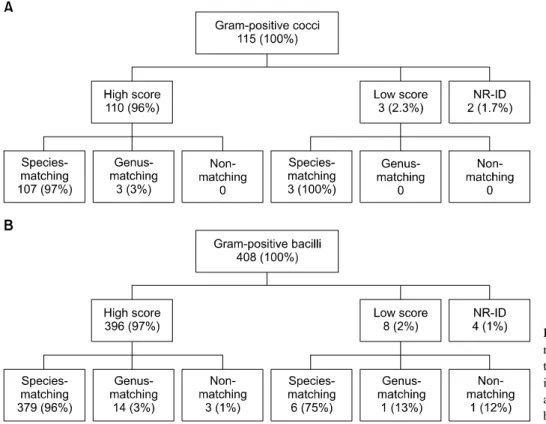
Fig. 1. Comparison of identification results using MALDI-TOF MS with those using conventional methods (A) in 115 aerobic gram-positive cocci and (B) in 408 aerobic gram-negative bacilli.
물 검사실에 도입된 이후로 외국에서는 많은 평가보고가 있어 왔으나 국내에서의 평가는 아직 없었다. 이에 저자들은 국내 대학병원 임상미생물 검사실에서 전통적인 생화학적 방법 혹 은 동정용 키트를 이용한 산소성 세균의 균종 동정결과와 MALDI BioTyper에 의한 동정 결과를 비교 평가하고자 하였 다.
재료 및 방법
1. 대상 균주
2011년 1월부터 2월까지 국내의 한 대학병원 진단검사의학 과 미생물 검사실로 균배양이 의뢰된 일련 검체에서 분리된 산 소성 세균 523주를 대상으로 하였다.
2. 산소성 세균 동정: 전통적 방법(생화학적 방법과 상품화 키 트법)
산소성 세균의 배양은 검체를 혈액한천 또는 MacConkey 배 지에 접종하여 5% CO2, 35oC 항온기에서 24시간 또는 48시간 배양하였다. 증식된 집락은 catalase 시험, oxidase 시험, man- nitol salt agar 반응, DNase 시험, 시험관법 coagulase 시험, Streptococcus faecalis 배지에서의 증식, bile esculin azide agar 반응 및 TSI 배지 성상과 같은 전통적 생화학 시험에 추가하여 VITEK 2 system (bioMerieux, Marcy l'Etoile, France)으로 동정 하였다.
3. 산소성 세균 동정: MALDI-TOF MS 동정
Microflex LT (Bruker Daltonics)와 MALDI-TOF BioTyper (version 2.0)를 이용하여 기기 회사에서 권장하는 직접 도말법 과 단백 추출법으로 균종을 동정하였다.
직접 도말법은 하룻밤 배양한 집락을 나무막대를 이용하여 MSP 96 target plate (Bruker Daltonics)에 도말하였다. 균이 완 전히 마른 후 2 μL의 매트릭스 용액(50% acetonitrile, 2.5%
trifluoroacetic acid에 포화된 α-cyano-4-hydroxycinnamic acid) 을 더하고, 실온에서 건조시킨 후 Microflex LT 장비에 장착하 였다. 동정 결과는 기기회사의 기준을 이용하여 판정하였다.
즉, 동정치(score value)가 2.0 이상이면 균종 동정이, 1.7-<2.0 인 경우 균속 동정이 가능한 것으로 판단하였고 1.7 미만인 경 우 신뢰성이 없는 것(non-reliable, NR)으로 간주하였다.
단백 추출법은 집락을 water-ethanol solution (1 : 2) 1 mL에 부유시킨 후 12,500 rpm에서 2분간 원침하였다. 침사를 70%
formic acid 25 μL와 100% acetonitrile 25 μL에 재부유시킨 후 12,500 rpm에서 2분간 원침하였다. 상청액 1 μL을 MSP 96 tar- get plate 분주하고 실온에서 말린 후 매트릭스 용액 2 μL를 올 려 놓고, 실온에서 건조시킨 후 직접 도말법과 동일한 방법으로 분석하였다.
MALDI-TOF MS의 결과가 NR이거나 전통적 방법과 비교하 여 균종 및 균속명이 일치하지 않았거나, 균속까지만 일치하였
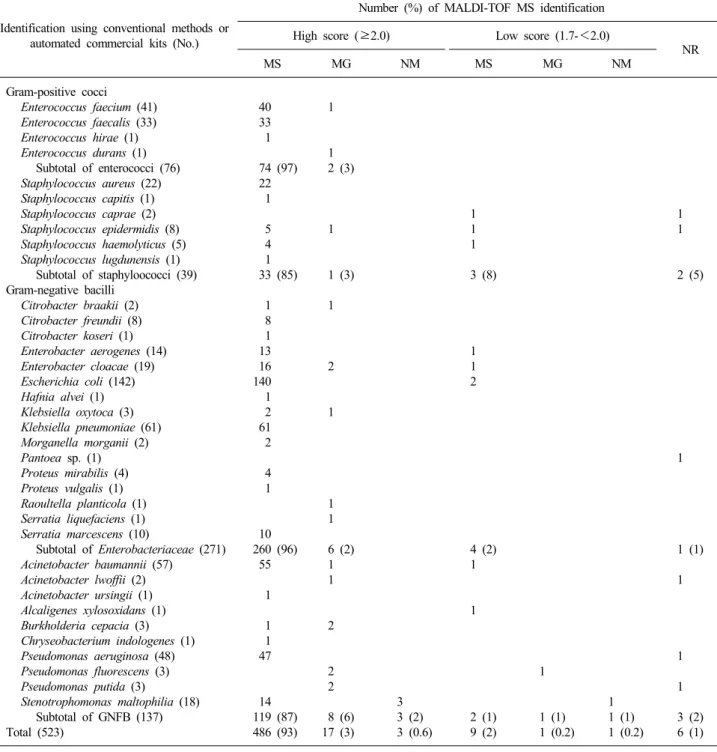
Table 1. Comparison of conventional and MALDI-TOF MS identification for aerobic bacteria
Identification using conventional methods or automated commercial kits (No.)
Number (%) of MALDI-TOF MS identification
High score (≥2.0) Low score (1.7-<2.0)
NR
MS MG NM MS MG NM
Gram-positive cocci Enterococcus faecium (41) Enterococcus faecalis (33) Enterococcus hirae (1) Enterococcus durans (1)
Subtotal of enterococci (76) Staphylococcus aureus (22) Staphylococcus capitis (1) Staphylococcus caprae (2) Staphylococcus epidermidis (8) Staphylococcus haemolyticus (5) Staphylococcus lugdunensis (1)
Subtotal of staphyloococci (39) Gram-negative bacilli
Citrobacter braakii (2) Citrobacter freundii (8) Citrobacter koseri (1) Enterobacter aerogenes (14) Enterobacter cloacae (19) Escherichia coli (142) Hafnia alvei (1) Klebsiella oxytoca (3) Klebsiella pneumoniae (61) Morganella morganii (2) Pantoea sp. (1) Proteus mirabilis (4) Proteus vulgalis (1) Raoultella planticola (1) Serratia liquefaciens (1) Serratia marcescens (10)
Subtotal of Enterobacteriaceae (271) Acinetobacter baumannii (57)
Acinetobacter lwoffii (2) Acinetobacter ursingii (1) Alcaligenes xylosoxidans (1) Burkholderia cepacia (3) Chryseobacterium indologenes (1) Pseudomonas aeruginosa (48) Pseudomonas fluorescens (3) Pseudomonas putida (3)
Stenotrophomonas maltophilia (18) Subtotal of GNFB (137) Total (523)
40 33 1 74 (97) 22 1 5 4 1 33 (85) 1 8 1 13 16 140 1 2 61 2 4 1
10 260 (96) 55 1 1 1 47
14 119 (87) 486 (93)
1
1 2 (3)
1
1 (3) 1
2
1
1 1 6 (2) 1 1
2
2 2 8 (6) 17 (3)
3 3 (2) 3 (0.6)
1 1 1 3 (8)
1 1 2
4 (2) 1
1
2 (1) 9 (2)
1
1 (1) 1 (0.2)
1 1 (1) 1 (0.2)
1 1
2 (5)
1
1 (1) 1
1 1 3 (2) 6 (1) Abbreviations: MS, matching at the species level; MG, matching at the genus level; NM, non-matching; NR, not reliable identification with score <1.7; GNFB, glucose nonfermenting bacilli.
던 균주에서 적절한 동정법을 찾기 위하여 직접 도말법과 단백 추출법을 이용하여 추가로 MALDI-TOF MS 동정을 시도하였 다.
4. 16S rRNA 및 rpoB gene 염기 서열 분석
직접 도말법 또는 단백 추출법에 의한 MALDI-TOF MS 동
정 결과에서도 전통적 동정법의 결과와 균종 및 균속명이 일치 하지 않았거나, 균속까지만 일치하였던 균주는 16S rRNA 혹은 rpoB gene 염기서열을 분석하였다. 16S rRNA는 시발체 (5'-AGA GTT TGA TCC TGG CTC AG-3' 및 5'-AAG GAG GTG ATC CAG CCG CA-3')를, rpoB gene은 시발체 Ac1005F (5'-GTG ATA ARA TGG CBG GTC GT-3') 및 Ac1598R
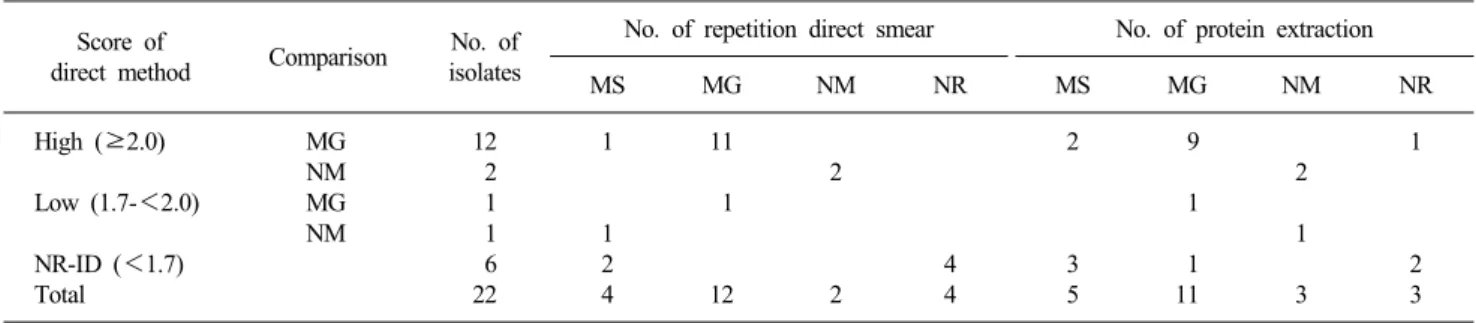
Table 2. Results of MALDI-TOF MS identification after direct smear and protein extraction methods Score of
direct method Comparison No. of isolates
No. of repetition direct smear No. of protein extraction
MS MG NM NR MS MG NM NR
High (≥2.0) Low (1.7-<2.0) NR-ID (<1.7) Total
MG NM MG NM
12 2 1 1 6 22
1
1 2 4
11 1
12
2
2
4 4
2
3 5
9 1 1 11
2 1 3
1
2 3 Abbreviations: MS, matching at the species level; MG, matching at the genus level; NM, non-matching; NR, not reliable identification.
(5'-CGB GCR TGC ATY TTG TCR T-3')를 사용하여 Master- cycler gradient (Eppendorf, Hamburg, Germany)로 16S rRNA 혹은 rpoB 유전자를 증폭시켰다[13]. 분석된 염기서열은 EzTa- xon server 2.1의 type strain data base와 대조하였고[14], CLSI 의 기준[15]을 적용하여 판독하였다.
결과 및 고찰
1. MALDI-TOF MS 동정 결과
그람양성알균 115 균주의 MALDI-TOF MS 결과에서 2.0 이 상의 동정치(score)를 보인 110주 중 107주(97%)는 균종까지 일치, 3주(3%)는 균속까지만 일치하였고, 균종 및 균속까지 불 일치한 군은 없었다(Fig. 1A). 그람음성막대균 408 균주에서 2.0 이상의 높은 동정치를 보인 396주(97%) 중 379주(96%)는 균종까지, 14주(3%)는 균속까지만 일치하였고, 3주(1%)는 균 종 및 균속까지 불일치하였다(Fig. 1B).
주목할 것은 MALDI-TOF MS 결과에서 낮은 동정치(1.7-
<2.0)를 보인 군이 그람양성알균과 그람음성막대균에서 각각 3주(3%)와 8주(2%)로 적었고 이들 중 3주와 6주가 균종까지 일치하였다(Fig. 1). NR군은 각각 2주(1.7%)와 4주(1%)로 적었 다. 이는 MALDI-TOF MS법으로 시행한 균종 1차 동정 결과가 전통적인 동정법과 높은 일치율을 보인다는 것을 알 수 있었 다.
세균별로 MALDI TOF-MS 결과를 분석하여 높은 동정치를 보인(≥2.0) 그람양성세균 중 장알균(enterococci)은 97% (74/76 주), 포도알균(staphylococci)은 85% (33/39주), 그람음성막대균 중 장내세균(Enerobacteriaceae)은 96% (260/271주), 포도당 비 발효 그람음성막대균은 87% (119/137주)가 균종까지 일치하였 다(Table 1). Seng 등[3]은 1,660주의 임상분리 균주에서 84.1%
가, Bizzini 등[4]은 1,371주에서 92.6%가 균종명이 MALDI- TOF MS와 전통적 방법이 일치하였다고 하여서 본 연구와 매 우 유사하였다.
MALDI TOF-MS 이용 시 동정치 1.7 이상인 군에서 전통적 인 방법과의 균종 일치율은 장알균은 97% (74/76주), 포도알균
은 93% (36/39주), 그리고 장내세균은 98% (264/271주)로 매우 높았고, 포도당 비발효 그람음성막대균은 88% (121/137주)로 약간 낮았다. 또한 균속 이상이 일치하였던 비율은 장알균은 100% (76/76주), 포도알균은 95% (37/39주), 장내세균은 99.6%
(270/271주), 그리고 포도당 비발효 그람음성막대균은 95%
(130/137주)로 모두 매우 높았다(Table 1).
이는 실제 임상미생물 검사실에서 MALDI-TOF MS를 이용 하여 균종 동정 업무를 수행할 때 동정치 2.0보다는 1.7 이상을 보이는 결과를 보고하여도 무방할 것임을 시사하는 결과로 판 단하였다.
2. MALDI-TOF MS의 직접 도말법과 단백 추출법 동정 결과 비교
MALDI-TOF MS 동정 중 동정치가 1.7 미만으로 동정 결과 를 신뢰할 수 없었던 6균주와 전통적 방법과 균속까지 일치하 였거나 균종명과 균속명이 모두 불일치하였던 22균주 중 임의 로 16균주를 선택하여 직접 도말법을 재검하고 단백 추출법도 함께 시행하였다.
추가 시험으로 균종명이 일치하게 된 균주는 직접 도말법으 로 4주, 단백 추출법으로 5주이었다(Table 2). 이를 세분하여 분석하면 1차 직접 도말법에서 동정치가 2.0 이상이었던 14주 는 2차 직접 도말법으로 시험한 결과 1주만이 균종 일치로 개 선되었다. 동정치가 1.7-<2.0, 1.7 미만이었던 2주와 6주는 2차 시험에서 각각 1주와 2주가 균종이 일치하였다.
이에 반하여 단백 추출법으로 추가 시험한 결과를 분석하면 1차 직접 도말법에서 동정치가 2.0 이상이었던 14주는 단백 추 출법으로도 2주만이 균종이 일치하게 되었다. 동정치가 1.7-
<2.0이었던 2주는 단백 추출법으로도 개선되지 않았고, 동정 치가 1.7 미만이었던 6주는 단백 추출법으로 3주가 균종 일치 로 개선되었다.
이는 추가 비용이 거의 없는 MALDI-TOF MS의 특성과 직 접 도말법의 간편성, 그리고 단백 추출법의 술식이 복잡한 것 을 고려하면, 임상 미생물 검사실에서 산소성 세균 동정 업무 를 수행할 때 직접 도말법에서 동정치가 1.7-<2.0인 경우 우선
Table 4. Analysis of the no reliable identification results of MALDI-TOF MS
Conventional ID (No. of isolates) MALDI-TOF MS with:
16S sequencing Direct method, 2nd Extraction method
Staphylococcus caprae (1) Staphylococcus epidermidis (1) Acinetobacter lwoffii (1) Pseudomonas aeruginosa (1) Pseudomonas putida (1) Pantoea sp. (1)
S. caprae (1.7-<2.0) S. epidermidis (1.7-<2.0) No reliable identification No reliable identification No reliable identification No reliable identification
S. caprae (≥2.0) S. epidermidis (≥2.0)
Acinetobacter genomospecies (≥2.0) P. aeruginosa (≥2.0)
No reliable identification No reliable identification
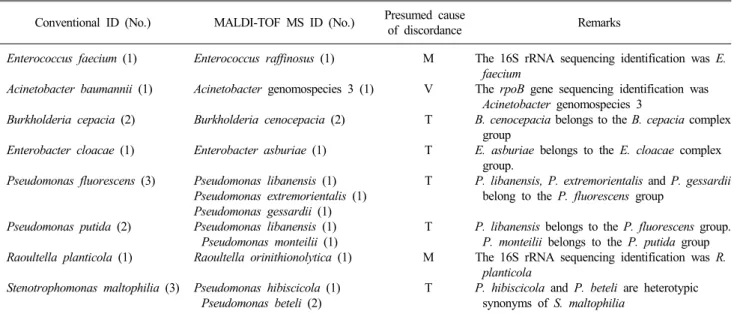
Not tested Not tested A. guillouiae Not tested P. putida Pantoea septica Table 3. Results analysis of the additional test using direct and protein extraction methods in the samples showing matching at genus level or non-matching on the initial analysis
Conventional ID (No.) MALDI-TOF MS ID (No.) Presumed cause
of discordance Remarks
Enterococcus faecium (1) Acinetobacter baumannii (1) Burkholderia cepacia (2) Enterobacter cloacae (1) Pseudomonas fluorescens (3)
Pseudomonas putida (2) Raoultella planticola (1) Stenotrophomonas maltophilia (3)
Enterococcus raffinosus (1) Acinetobacter genomospecies 3 (1) Burkholderia cenocepacia (2) Enterobacter asburiae (1) Pseudomonas libanensis (1) Pseudomonas extremorientalis (1) Pseudomonas gessardii (1) Pseudomonas libanensis (1)
Pseudomonas monteilii (1) Raoultella orinithionolytica (1) Pseudomonas hibiscicola (1)
Pseudomonas beteli (2)
M V T T T
T M T
The 16S rRNA sequencing identification was E.
faecium
The rpoB gene sequencing identification was Acinetobacter genomospecies 3
B. cenocepacia belongs to the B. cepacia complex group
E. asburiae belongs to the E. cloacae complex group.
P. libanensis, P. extremorientalis and P. gessardii belong to the P. fluorescens group
P. libanensis belongs to the P. fluorescens group.
P. monteilii belongs to the P. putida group The 16S rRNA sequencing identification was R.
planticola
P. hibiscicola and P. beteli are heterotypic synonyms of S. maltophilia
Abbreviations: M, MALDI-TOF MS database related; V, Vitek2 database related; T, taxonomical. A discordant isolate might belong to multiple categories.
직접 도말법을 재검하는 것이 신속한 결과 보고에 도움이 될 것으로 판단하였다. 직접 도말법에서 동정치 1.7 미만으로 신 뢰도가 낮은 경우만 단백 추출법을 시행하는 것이 동정 업무 효율 증가에 도움이 될 수 있을 것으로 판단되었다.
3. 전통적 동정법과 MALDI-TOF MS 간의 불일치 결과 분석 산소성 세균 523주 중 2회의 직접도말법 또는 추가 단백 추 출법으로 동정하여도 전통적 동정법과 균속까지만 일치하였거 나 동정 불일치이었던 14주의 원인을 분석하였다(Table 3). V 군은 Vitek 2 system 균종 동정 목록에 포함되어 있지 않아서 Acinetobacter sp. 1주가 A. baumannii로 동정된 경우이었다. M 군은 MALDI-TOF MS에 의한 오류인 경우로 전통적인 동정과 균속까지만 일치하였던 Enterococcus faecium과 Raoultella planticola이었다. T군은 세균명 분류 개정 때문인 경우로 판단 되는 경우 Enterobacter cloacae, Burkholderia cepacia, Pseudo-
monas fluorescens, Pseudomonas putida와 Stenotrophomonas maltophilia이었다.
MALDI-TOF MS 동정이 전통적 방법의 동정과 불일치를 보 인 14균주의 가장 주요한 원인은 균명 분류 개정에 의한 동정 불일치이었다. 최근 세균 동정뿐만 아니라 분류를 위하여 분자 생물학적 방법이 중요하게 이용된다. 특히 산소성 세균 중 포 도당 비발효 그람음성 막대균의 분류는 많은 변화가 있었다 [16,17]. P. fluorescens group에 속하는 P. libanensis, P. ex- tremorientalis 및 P. gessardii와 S. maltophilia의 heterotypic synonym인 P. hibiscicola와 P. beteli 는 Vitek 2 system GN 카 드에서는 감별하지 못하였다. Acinetobacter의 유전적 균종 동 정은 전통적 방법으로는 감별이 어렵고, 16S 염기서열 분석 방 법은 다형성이 충분치 않아 모든 균종을 동정하기 어려우며, RNA polymerase-submit B (rpoB) 유전자 분석으로 대부분의 Acinetobacter spp.의 유전적 균종 동정이 정확하다고 하였다
[18]. Vitek 2 system GN 카드 동정은 A. baumannii이었고, MADI-TOF MS 동정은 Acinetobacter genomospecies인 균주는 rpoB 유전자 분석에서 Acinetobacter pittii로 동정되었다.
4. MALDI-TOF MS 결과를 신뢰할 수 없는 결과군 분석 MALDI-TOF MS에서 동정치가 1.7 미만으로 신뢰도가 낮은 6균주를 직접도말법과 단백 추출법을 추가로 시행하였고, 여전 히 동정치가 낮았던 2균주는 16S 염기서열 분석 방법으로 확인 하였다(Table 4). 전통적인 동정법에서 S. caprae와 S. epi- dermidis인 균주는 2차 직접도말법 재검에서는 동정치가 1.7-
<2.0으로, 단백 추출법에서는 동정치가 2.0 이상으로 균종 일 치로 동정되었다. A. lwoffii 1주와 P. aeruginosa 1주는 2차 직 접도말법에서도 낮은 동정치를 보였으나 단백 추출법으로 Acinetobacter genomospecies와 P. aeruginosa로 동정할 수 있 었다. Bizzini 등[4] 연구에 의하면 단백 추출법은 직접 도말법 에 비해 술식이 복잡하고 소요시간이 길지만 양질의 단백 분획 을 얻을 수 있어서 동정치가 높았고, 동정 일치율이 25% 정도 증가하였다. 본 연구에서도 추가한 단백 추출법으로 동정치가 2.0 이상이 나온 균주는 4주이었고, 이 중 3주는 균종명이, 1주 는 균속명이 일치하였다.
요약하면 MALDI-TOF MS를 이용한 산소성 세균의 동정은 생화학적 성상을 기반으로 하는 전통적 방법, 상품화 kit와 높 은 일치율을 보였다. MALDI-TOF MS는 술식이 간단하였고 매우 신속하게 균종을 동정할 수 있었다. 동정치가 1.7-<2.0으 로 낮은 세균 중 전통적 방법에 의한 동정과 균속 일치 및 불일 치인 경우 직접도말법 재검과 단백추출법 결과는 개선 정도가 유사하였다. 그러나 동정치가 1.7 미만으로 신뢰도가 낮은 경 우는 직접도말법 재검에 단백추출법을 추가하면 대부분 균종 동정 결과를 얻을 수 있었다. 직접도말법 재검 및 단백추출법 추가로도 동정치의 신뢰도가 낮은 소수의 균주(<1%)들은 그 들의 임상적인 중요성을 고려하여 전통적인 동정법과 분자유 전학적 방법을 추가할 필요도 검토되어야 할 것이다. 결론적으 로 MALDI-TOF MS 동정은 임상미생물 검사실에서 통상적으 로 분리되는 산소성 세균의 동정 방법으로 매우 유용할 것으로 판단되었다.
참 고 문 헌
1. Petti CA, Weinstein MP, Carroll KC. Systems for detection and identification of bacteria and yeasts. In: Versalovic J, Carroll KC, et al. eds. Manual of clinical microbiology. 10th ed, Washington, DC; ASM Press, 2011:15-26.
2. Holland RD, Wilkes JG, Rafii F, Sutherland JB, Persons CC, Voorhees KJ, et al. Rapid identification of intact whole bacteria based on spectral patterns using matrix-assisted laser desorp- tion/ionization with time-of-flight mass spectrometry. Rapid Com- mun Mass Spectrom 1996;10:1227-32.
3. Seng P, Drancourt M, Gouriet F, La Scola B, Fournier PE, Rolain JM, et al. Ongoing revolution in bacteriology: routine identification of bacteria by matrix-assisted laser desorption ionization time-of- flight mass spectrometry. Clin Infect Dis 2009;49:543-51.
4. Bizzini A, Durussel C, Bille J, Greub G, Prod'hom G. Performance of matrix-assisted laser desorption ionization-time of flight mass spectrometry for identification of bacterial strains routinely isolated in a clinical microbiology laboratory. J Clin Microbiol 2010;48:
1549-54.
5. Stevenson LG, Drake SK, Shea YR, Zelazny AM, Murray PR.
Evaluation of matrix-assisted laser desorption ionization-time of flight mass spectrometry for identification of clinically important yeast species. J Clin Microbiol 2010;48:3482-6.
6. Verroken A, Janssens M, Berhin C, Bogaerts P, Huang TD, Wauters G, et al. Evaluation of matrix-assisted laser desorption ionization-time of flight mass spectrometry for identification of nocardia species. J Clin Microbiol 2010;48:4015-21.
7. Cherkaoui A, Hibbs J, Emonet S, Tangomo M, Girard M, Francois P, et al. Comparison of two matrix-assisted laser desorption ioniza- tion-time of flight mass spectrometry methods with conventional phenotypic identification for routine identification of bacteria to the species level. J Clin Microbiol 2010;48:1169-75.
8. Stephan R, Ziegler D, Pflüger V, Vogel G, Lehner A. Rapid genus- and species-specific identification of Cronobacter spp. by matrix- assisted laser desorption ionization-time of flight mass spectro- metry. J Clin Microbiol 2010;48:2846-51.
9. van Veen SQ, Claas EC, Kuijper EJ. High-throughput identification of bacteria and yeast by matrix-assisted laser desorption ioniza- tion-time of flight mass spectrometry in conventional medical microbiology laboratories. J Clin Microbiol 2010;48:900-7.
10. Prod'hom G, Bizzini A, Durussel C, Bille J, Greub G. Matrix-assi- sted laser desorption ionization-time of flight mass spectrometry for direct bacterial identification from positive blood culture pellets. J Clin Microbiol 2010;48:1481-3.
11. Ferreira L, Sánchez-Juanes F, González-Avila M, Cembrero- Fuciños D, Herrero-Hernández A, González-Buitrago JM, et al.
Direct identification of urinary tract pathogens from urine samples by matrix-assisted laser desorption ionization-time of flight mass spectrometry. J Clin Microbiol 2010;48:2110-5.
12. Christner M, Rohde H, Wolters M, Sobottka I, Wegscheider K, Aepfelbacher M. Rapid identification of bacteria from positive blood culture bottles by use of matrix-assisted laser desorption- ionization time of flight mass spectrometry fingerprinting. J Clin Microbiol 2010;48:1584-91.
13. Löffler FE, Sun Q, Li J, Tiedje JM. 16S rRNA gene-based detection of tetrachloroethene-dechlorinating Desulfuromonas and Dehalococcoides species. Appl Environ Microbiol 2000;66:1369- 74.
14. Chun J, Lee JH, Jung Y, Kim M, Kim S, Kim BK, et al. EzTaxon:
a web-based tool for the identification of prokaryotes based on 16S ribosomal RNA gene sequences. Int J Syst Evol Microbiol 2007;
57:2259-61.
15. Clinical and Laboratory Standards Institute. Interpretive criteria for identification of bacteria and fungi by DNA target sequencing;
approved guideline MM-18A. Wayne, PA: Clinical and Laboratory Standards Institute, 2007.
16. Ivanova EP, Gorshkova NM, Sawabe T, Hayashi K, Kalinovskaya NI, Lysenko AM, et al. Pseudomonas extremorientalis sp. nov., isolated from a drinking water reservoir. Int J Syst Evol Microbiol 2002;52:2113-20.
17. Anzai Y, Kim H, Park JY, Wakabayashi H, Oyaizu H. Phylo-
genetic affiliation of the pseudomonads based on 16S rRNA sequence. Int J Syst Evol Microbiol 2000;50:1563-89.
18. La Scola B, Gundi VA, Khamis A, Raoult D. Sequencing of the
rpoB gene and flanking spacers for molecular identification of Acinetobacter species. J Clin Microbiol 2006;44:827-32.
=국문초록=
임상미생물 검사실에서 산소성 세균 동정을 위한 Matrix-Assisted Laser Desorption Ionization-Time of Flight Mass Spectrometry의 유용성
연세대학교 의과대학 진단검사의학교실, 세균내성연구소 김명숙, 권미정, 정혜선, 이양순, 용동은, 정석훈, 이경원, 정윤섭
배경: MALDI-TOF MS 기법을 이용한 세균 동정은 외국에서는 많은 평가 보고가 있어왔으나 국내에서는 아직 평가된 바 없었다. 이에 저자들은 국내 대학병원 임상미생물 검사실에서 전통적인 생화학적 방법 혹은 동정용 키트를 이용한 산소성 세균의 균종 동정결과와 MALDI-TOF MS 동정 결과를 비교 평가하고자 하였다.
방법: 2011년 1월부터 2월까지 세브란스병원 진단검사의학과 미생물 검사실에 균배양을 의뢰한 일련 검체에서 분리된 산소성 세균 523주의 전통적 동정법과 MALDI-TOF MS 동정 결과를 비교하였다. MALDI-TOF MS의 직접 도말법으로 동정치가 1.7 미만으로 동정 결과를 신뢰할 수 없었던 균주와 전통적 방법과 균속까지 일치하였거나 균종명과 균속명이 모두 불일치하였던 일부 균주는 직접 도말법 재검과 단백추출법을 추가로 시행하였다.
결과: 산소성 세균 523주 중 506주(97%)는 동정치 2.0 이상, 11주(2%)는 1.7 이상에서 2.0 미만이었다. 동정치가 2.0 이상 인 506주 중 전통정 동정법 결과와 비교하였을 때 균종 일치는 486주(96%), 균속 일치는 17주(3%), 불일치는 3주(1%)이 었다.
결론: MALDI-TOF MS를 이용한 산소성 세균의 동정은 생화학적 성상을 기반으로 하는 상품화 키트를 포함한 전통적 동정 방법과 높은 일치율을 보였다. 동정치가 1.7 미만으로 결과를 신뢰할 수 없는 경우에도 직접도말법과 단백추출법을 추가하면 대부분 균종 동정 결과를 얻을 수 있었다. 따라서 MALDI-TOF MS 동정은 임상미생물 검사실에서 통상적으로 분리되는 산소성 세균의 동정 방법으로 매우 유용할 것으로 판단되었다. [대한임상미생물학회지 2012;15:60-66]
교신저자 : 용동은, 120-752, 서울시 서대문구 연세로 50
연세대학교 의과대학 진단검사의학교실, 세균내성연구소 Tel: 02-2228-2442, Fax: 02-313-0956
E-mail: [email protected]