Yonsei Med J http://www.eymj.org Volume 52 Number 3 May 2011 539
Case Report
DOI 10.3349/ymj.2011.52.3.539pISSN: 0513-5796, eISSN: 1976-2437 Yonsei Med J 52(3):539-542, 2011
The First Experience of Robot Assisted Spleen-Preserving
Laparoscopic Distal Pancreatectomy in Korea
Dong Hyun Kim,
3Chang Moo Kang,
1,2Woo Jung Lee,
1,2and Hoon Sang Chi
1 1Division of Biliopancreas, Department of Surgery, Yonsei University College of Medicine, Seoul; 2Pancreaticobiliary Cancer Clinic, Institute of Gastroenterology, Yonsei University Health System, Seoul;3Department of Surgery, Yonsei University Wonju College of Medicine, Wonju, Korea.
Received: October 23, 2009 Revised: December 30, 2009 Accepted: December 30, 2009
Corresponding author: Dr. Chang Moo Kang, Department of Surgery, Yonsei University College of Medicine, 250 Seongsan-ro, Seodaemun-gu, Seoul 120-752, Korea. Tel: 82-2-2228-2135, Fax: 82-2-313-8289 E-mail: [email protected]
∙ The authors have no financial conflicts of interest.
© Copyright:
Yonsei University College of Medicine 2011
This is an Open Access article distributed under the terms of the Creative Commons Attribution Non-Commercial License (http://creativecommons.org/ licenses/by-nc/3.0) which permits unrestricted non-commercial use, distribution, and reproduction in any medium, provided the original work is properly cited.
Spleen-preservation has recently been emphasized in benign and borderline malig-nant pancreatic diseases requiring distal pancreatectomy. Reports to suggest that laparoscopic distal pancreatectomy is feasible and safe have been increasingly published. Robotic surgical system has been introduced and is expected to provide unique advantages in laparoscopic surgery. However, robot-assisted pancreatic surgery has not yet been performed by many surgeons. A 45-year-old female pa-tient with abdominal discomfort was found to have pancreatic cyst in the body of the pancreas. Mucinous cystic tumor of the pancreas was the most favourable pre-operative diagnosis. She underwent spleen-preserving laparoscopic distal pancre-atectomy by using da Vinci surgical robot system. Splenic artery and vein were so tightly adherent to the pancreatic cyst that segmental resection of splenic vessels was required. Postoperative course was uneventful. She was able to come home in 5 days after surgery. Postoperative follow up color doppler ultrasound scan, taken on 2 weeks after surgery, showed minimal fluid collection around surgical field and no evidence of splenic infarction with good preservation of splenic perfusion. Robot-assisted spleen preserving distal pancreatectomy is thought to be feasible and safe. Several unique advantages of robotic system are expected to enhance safer and more precise surgical performance in near future. More experiences are mandatory to confirm real benefit of robot surgery in pancreatic disease.
Key Words: Robot (da Vinci), laparoscopic, pancreatectomy
INTRODUCTION
Recently, cystic neoplasm of the pancreas has been much more frequently diag-nosed, and its treatment seems to be different depending on the types of cystic
tu-mor.1 The benign or borderline malignant cystic neoplasm of pancreas would be
expected for long-term survival following surgical resection. Therefore, the value of spleen preservation needs to be emphasized because of life time risk of postspe-nectomy overwhelming sepsis as well as postoperative infectious morbidity.2 With
the advance of laparoscopic experiences, technique, and instrument, the feasibility and safety of laparoscopic distal pancreatectomy has been reported since 1996.3,4
Dong Hyun Kim, et al.
Yonsei Med J http://www.eymj.org Volume 52 Number 3 May 2011
540
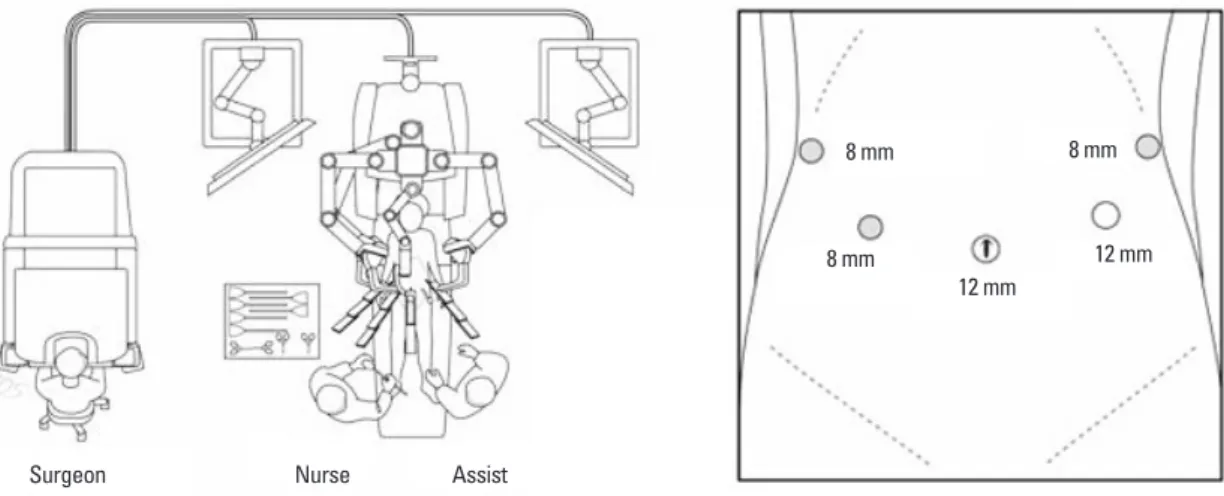
tic tumor between the body and tail of the pancreas (Fig. 1A). There was no mural nodule, no calcification, and no eccentrically located mass within the cystic area. The benign mucinous cystic tumor of the pancreas was the most favor-able preoperative diagnosis. The operation sequence was similar to usual laparoscopic distal pancreatectomy except trocar placement (Fig. 2). The robotic camera arm and oth-er three instrument arms woth-ere then connected to their re-spective ports. At this point, the surgeon sat at the surgical console located about 3 m from the operating table. The as-sistant surgeon was positioned on the patient’s left side for temporary use of laparoscopic instruments through Port 4. In spite of our previous experiences of robot surgical sys-tem, the cystic tumor and the remaining splenic vessels were so closely adherent that bleeding was frequently encoun-tered, and most operation time was spent for this process. The risk of cyst rupture was also considered when we tried to separate and divide the small splenic vessels from pan-creatic cyst (Fig. 1B). Therefore, concomitant segmental re-section of splenic vessels was thought to be necessary for spleen preservation. Total operation took about 480 min-utes, and about 800 mL of blood loss was noted without However, restricted ranges of motion and 2-dimentional
operative field provided by laparoscopic surgery have re-strained rapid spread of laparoscopic pancreatic surgery. However, recent advances in robotic surgical system with multi-articulated, master-slaved, and 3-dimentional surgical field allowed to overcome those obstacles in laparoscopic pancreatic surgery. Surgeons world-wide apparently have performed only a few tele-robotic pancreatic surgeries. Here-in, we report our initial experience of da Vinci surgical ro-bot (Intustive Surgical, Mountain View, CA, USA)-assisted laparoscopic spleen-preserving distal pancreatectomy with segmental resection of splenic vessels in mucinous cystic neoplasm of the pancreas.
CASE REPORT
A 46-year-old female patient was admitted to our depart-ment due to a cystic tumor in pancreatic body and tail. Rou-tine chemistry and tumor marker levels (CA 19-9, CEA, CA 125) were all within normal limits. Abdominal CT scan and EUS showed about 5×4 cm sized, slightly septated
cys-Fig. 1. Perioperative data. Preoperative CT scan (A), Laparoscopic view. After division of pancreas, splenic vessels were noted to be tightly adherent to the pancreas. P, proximal pancreas; dP, distal pancreas; Cy, pancreatic cyst; SV, splenic vein; SA, splenic arery (B), Surgical pathology, About 4 cm sized cystic tumor containing clear mucin was removed by distal pancreatectomy. Pathologic examina-tion revealed that this tumor was benign mucinous cystic tumor (C), and follow up color-doppler ultrasound san showed good perfusion to the spleen without any spleen-related complications (D).
A
B
Robotic Distal Pancreatectomy
Yonsei Med J http://www.eymj.org Volume 52 Number 3 May 2011 541
late, compared with other surgical field. Laparoscopic distal pancreatectomy is accepted as a feasible and safe minimal-ly invasive procedure in benign and borderline malignant disease of the pancreas. Recently, many reports to suggest favorable results of laparoscopic distal pancreatectomy have been published.
Theoretically, robot can greatly increase the ability to deal with small and delicate branches of the splenic vessels due to superior visualization and precision offered by the da Vinci surgical system. Even though both splenic vessels could not be preserved in this case due to severe inflammatory adhe-sion between splenic vessels and pancreatic cyst/pancreas and also due to the risk of cyst rupture, free movement of instrument and 3-dimentional surgical field provided very comfortable laparoscopic environment, compared to con-ventional spleen preserving laparoscopic distal pancreatec-tomy with segmental resection of both splenic vessels.
With regard to managing pancreatic stump in laparoscop-ic distal pancreatectomy, we used endo-GIA because this method is simple, quick and known to be safe alternative to the standard suture closure technique.7 By using robot
sur-gical system, the alternative methods seem to be available as an potential effort to reduce pancreatic leak, such as iso-lation and ligation of main pancreatic duct8,9 and covering
of stapled pancreatic remnants with a jejunal seromuscular patch.10 Therefore, laparoscopic distal pancreatectomy can
be done by the same surgical procedure as done in open distal pancreatectomy with the help of robotic surgical sys-tem, which might lead to lower postoperative morbidity, compared to conventional laparoscopic surgery using endo-GIA only. Further experiences are expected to confirm such possibility in near future.
Several disadvantages of robot surgery were also noted. blood transfusion. The specimen was delivered through the
umbilical port site with small vertical incision after putting into the plastic bag. The patient recovered without compli-cation. She returned to an oral diet on the postoperative sec-ond day. After the drain was removed, she was discharged on the fifth day post-operation. The final pathologic exami-nation revealed that the tumor was benign mucinous cystic neoplasm without any characteristics of malignant potential (Fig. 1C). A color doppler ultrasound scan obtained 14 days after surgery showed no evidence of splenic infarction and well preserved blood flow within the spleen without defini-tive peripancreatic fluid collection (Fig. 1D).
DISCUSSION
Robot assisted pancreatic surgery seems to be rarely per-formed by surgeons world-wide. According to a review of published literatures, robot assisted spleen-preserving distal pancreatectomy is believed to be rare surgical procedure. Since Melvin, et al.5 first reported “robotic resection of
pan-creatic neuroendocrine tumor” in 2003, Giulianotti, et al.6
reported 13 pancreatic resections in his early series. They reported that the average time to spend was 490 minutes (range, 360-660 minutes) for eight robot assisted laparo-scopic pancreaticoduodenectomy and 270 minutes (range, 210-360 minutes) for five left pancreatectomy. Among 5 cases of distal pancreatectomy, only two patients (1 for in-sulinoma and 1 for benign cystic lesion) received a spleen-preserving resection.
Since pancreas is naturally deep seated (retroperitoneal) solid organ with sufficient blood supply from adjacent great vessels, laparoscopic surgery has been launched relatively
Fig. 2. The schema for port placement and operation room.
Surgeon Nurse Assist
8 mm
8 mm
8 mm
12 mm
Dong Hyun Kim, et al.
Yonsei Med J http://www.eymj.org Volume 52 Number 3 May 2011
542
25th, 2008).
REFERENCES
1. Sarr MG, Murr M, Smyrk TC, Yeo CJ, Fernandez-del-Castillo C, Hawes RH, et al. Primary cystic neoplasms of the pancreas. Neo-plastic disorders of emerging importance-current state-of-the-art and unanswered questions. J Gastrointest Surg 2003;7:417-28. 2. Shoup M, Brennan MF, McWhite K, Leung DH, Klimstra D,
Conlon KC. The value of splenic preservation with distal pancre-atectomy. Arch Surg 2002;137:164-8.
3. Sussman LA, Christie R, Whittle DE. Laparoscopic excision of distal pancreas including insulinoma. Aust N Z J Surg 1996;66: 414-6.
4. Gagner M, Pomp A, Herrera MF. Early experience with laparo-scopic resections of islet cell tumors. Surgery 1996;120:1051-4. 5. Melvin WS, Needleman BJ, Krause KR, Ellison EC. Robotic
re-section of pancreatic neuroendocrine tumor. J Laparoendosc Adv Surg Tech A 2003;13:33-6.
6. Giulianotti PC, Coratti A, Angelini M, Sbrana F, Cecconi S, Bal-estracci T, et al. Robotics in general surgery: personal experience in a large community hospital. Arch Surg 2003;138:777-84. 7. Takeuchi K, Tsuzuki Y, Ando T, Sekihara M, Hara T, Kori T, et al.
Distal pancreatectomy: is staple closure beneficial? ANZ J Surg 2003;73:922-5.
8. Bilimoria MM, Cormier JN, Mun Y, Lee JE, Evans DB, Pisters PW. Pancreatic leak after left pancreatectomy is reduced following main pancreatic duct ligation. Br J Surg 2003;90:190-6.
9. Pannegeon V, Pessaux P, Sauvanet A, Vullierme MP, Kianmanesh R, Belghiti J. Pancreatic fistula after distal pancreatectomy: pre-dictive risk factors and value of conservative treatment. Arch Surg 2006;141:1071-6; discussion 6.
10. Oláh A, Issekutz A, Belágyi T, Hajdú N, Romics L Jr. Random-ized clinical trial of techniques for closure of the pancreatic rem-nant following distal pancreatectomy. Br J Surg 2009;96:602-7.
The surgeons who control robot in surgical console can not feel any touch sensation of grasping tissue. They have to rely only on visual feed-back. In our case, easy bleeding was not-ed during grasping or traction of pancreas during the trial of division of small splenic vessels from the pancreas. The rel-atively longer operation time is also potential disadvantage for patients. Surgeons need also an another learning-curve period for adapting themselves to the new surgical system. Another important criticism is higher cost, compared to con-ventional laparoscopic surgery. During the last two decades, surgeons already established safe laparoscopic technique based on their own experiences. Surgeons may already have overcome the limitation of conventional laparoscopic sur-gery. In fact, it may not be exaggerating to state that almost all general surgery could be performed by laparoscopic ap-proach in these days. The pancreatic surgery using surgical robot is an emerging technique. The potential advantages provided by surgical robot system may allow for safe and effective laparoscopic distal pancreatectomy. Nevertheless, it remains to be confirmed whether the real clinical benefit of robot assisted pancreatic surgery does exist in current far advanced laparoscopic era. We need more experiences.
ACKNOWLEDGEMENTS
This case was presented as video presentation, “The Kore-an first experience of Robot assisted spleen-preserving lap-aroscopic distal pancreatectomy in mucinous cystic tumor of the pancreas” in MIRA 2008 held in Rome, Italy (Jan