IS6110-Restriction Fragment Length Polymorphism and
Spoligotyping Analysis of Mycobacterium tuberculosis Clinical Isolates for Investigating Epidemiologic Distribution in Korea
The Beijing family of Mycobacterium tuberculosis has been emerging in the world.
However, there are few nationwide data of genotypic distribution in Korea. This study aimed to identify the genotypic diversity of clinical isolates of M. tuberculosis and to demonstrate the population of Beijing family in Korea. We collected 96 clinical M.
tuberculosis isolates from 11 university hospitals nationwide in Korea from 2008 to 2009. We observed 24 clusters in IS6110-RFLP analysis and 19 patterns in
spoligotyping. Seventy-five isolates were confirmed to be Beijing family. Two isolates of the K strain and 12 isolates of the K family strain were also found. We found that drug resistance phenotypes were more strongly associated with Beijing family than non-Beijing family (P =0.003). This study gives an overview of the distribution of genotypes of M. tuberculosis in Korea. These findings indicate that we have to pay more attention to control of M. tuberculosis strains associated with the Beijing family.
Key Words: Mycobacterium tuberculosis; IS6110-RFLP; Spoligotyping; Beijing Family;
K Strain Go Eun Choi1, Mi Hee Jang1, Eun Ju Song1,
Seok Hoon Jeong2, Jae-Seok Kim3,
Wee Gyo Lee4, Young Uh5, Kyoung Ho Roh6, Hye Soo Lee7, Jong Hee Shin8,
Nam Hee Ryoo9, Young Ree Kim10,
Joseph Jeong11, Jee Hee Kim12, Sun Min Lee1, Jongyoun Yi1, Sang Hyun Hwang1,
Hyung Hoi Kim1, Eun Yup Lee1, Chulhun L. Chang1, Moon-Bum Kim13, and Yeong Dae Kim14,15
Departments of Laboratory Medicine1, Dermatology13, and Thoracic and Cardiovascular Surgery14, School of Medicine, and Medical Research Institute15, Pusan National University, Busan; Department of Laboratory Medicine and Research Institute of Bacterial Resistance2, Yonsei University College of Medicine, Seoul; Department of Laboratory Medicine3, Hallym University College of Medicine, Seoul; Department of Laboratory Medicine4, Ajou University School of Medicine, Suwon; Department of Laboratory Medicine5, Yonsei University Wonju College of Medicine, Wonju; Department of Laboratory Medicine6, Korea University College of Medicine, Seoul; Department of Laboratory Medicine7, Chonbuk National University Medical School, Jeonju; Department of Laboratory Medicine8, Chonnam National University Medical School, Gwangju; Department of Laboratory Medicine9, Keimyung University School of Medicine, Daegu; Department of Laboratory Medicine10, Cheju National University College of Medicine, Jeju; Department of Laboratory Medicine11, Ulsan University Hospital & Ulsan University College of Medicine, Ulsan; Department of Emergency Medical Technology12, Kangwon National University, Samcheok, Korea
Received: 30 April 2010 Accepted: 22 July 2010 Address for Correspondence:
Yeong Dae Kim, M.D.
Department of Thoracic and Cardiovascular Surgery, Pusan National University Hospital, 179 Gudeok-ro, Seo-gu, Busan 602-739, Korea Tel: +82.51-240-7822, Fax: +82.51-243-9389
E-mail: [email protected].
This work was supported by the Korea Research Foundation Grant funded by the Korean Government (Ministry of Education and Human Resources Development, Basic Research Promotion Fund) (KRF-2007- 331-E00209).
DOI: 10.3346/jkms.2010.25.12.1716 • J Korean Med Sci 2010; 25: 1716-1721 Infectious Diseases, Microbiology & Parasitology
INTRODUCTION
Tuberculosis (TB) remains a worldwide healthcare concern, being characterized as an epidemic by the World Health Orga- nization (WHO). In 2008, there were an estimated 8.9–9.9 mil-
lion incident cases of TB, 9.6–13.3 million prevalent cases, 1.1–
1.7 million deaths among HIV-negative people and an addition- al 0.45–0.62 million deaths among HIV-positive people (1). In Korea, the prevalence of TB was estimated to be 123 per 100,000 in 2006 (2). The increasing number of drug-resistant Mycobac-
terium tuberculosis isolates, including multidrug-resistant M.
tuberculosis (MDR-TB) creates serious problems in clinical se- ries and whole-country cohorts (3).
Genotyping has allowed the association of particular strain families of M. tuberculosis with demographic and transmission characteristics (4). The IS6110-based restriction fragment length polymorphism (RFLP) is the most widely applied test and cur- rently the standard method for comparing the genetic related- ness of M. tuberculosis strains. Spoligotyping using the direct repeat locus (DR) is useful for both clinical management and molecular epidemiologic studies of M. tuberculosis (5).
For a long time, the Beijing family which may have been en- demic in China, has been emerging in other parts of the world (6). The Beijing M. tuberculosis strains have highly similar mul- tibanded IS6110-RFLP patterns and identical spoligotyping patterns. The family is highly prevalent in East Asia (7, 8). How- ever, there are few data on the nationwide genotypic distribu- tion in Korea (8, 9).
This study aimed to identify the genotypic diversity of clinical M. tuberculosis isolates and to demonstrate the prevalence of Beijing family strains in Korea using IS6110-RFLP and spoligo- typing methods.
MATERIALS AND METHODS Sample collection and bacterial strains
From 2008 to 2009, we collected 96 clinical M. tuberculosis iso- lates from 11 university hospitals nationwide in Korea (Ajou University Hospital, Cheju National University Hospital, Chon- buk National University Hospital, Chonnam National Universi- ty Hospital, Hallym University Hospital, Keimyung University Hospital, Konyang University Hospital, Pusan National Univer- sity Hospital, Ulsan University Hospital, Yonsei University Sev- erance Hospital, and Wonju Christian Hospital). The number of isolates from a given hospital was roughly proportional to the prevalence of TB in that area, as judged by the annual report on TB patient notification in Korea 2007 (10). The source patients were 58 men and 38 women TB patients with a mean age of 45 yr (range 21-78 yr). There were 82 primary TB infections, and 12 had a history of treatment. In two cases, the status was unknown because of follow-up loss. The sites of infection were not speci- fied. Duplicated isolates from the same patient were excluded.
DNA extraction
Chromosomal DNA was purified by the standardized method from Löwenstein-Jensen (L-J) slant-grown colonies (11). Briefly, lysozyme (1 mg/mL) was added colony-containing tube and the mixture was incubated for 1 hr at 37°C. Next, proteinase K (10 mg/mL) and 70 μL of 10% sodium dodecyl sulfate were added, and incubation was continued for 10 min at 65°C. Then N-ace- tyl-N,N,N-trimethyl ammonium bromide was added, and the
mixture was incubated for 10 min at 65°C. An equal volume of chloroform-isoamyl alcohol (24:1 vol/vol) was added. After centrifugation for 5 min, 0.6 volume of isopropanol was added to the supernatant liquid to precipitate the DNA. After 20 min at -20°C and centrifugation for 15 min, the pellet was washed once with 70% ethanol, and the air-dried pellet was dissolved in 20 μL of 0.1×Tris-EDTA (TE) buffer.
IS6110-RFLP
All isolates were subjected to IS6110-RFLP analysis by an inter- nationally standardized method (12). Briefly, the chromosomal DNA was restricted with PvuII for RFLP analysis. The digested DNA was separated overnight by gel electrophoresis and trans- ferred from the gel to a positively charged nylon membrane (Hybond N1) (Amersham, Buckinghamshire, UK). After hybrid- ization for repetitive elements with labeled DNA probes, the bound probes were detected with an enhanced chemilumines- cence direct nucleic acid system (Amersham) according to the manufacturer’s recommendations. The RFLP patterns were an- alyzed by GelComparII software (Applied Maths, Korthrijk, Belgium) (9).
Spoligotyping
Spoligotyping was carried out using a CombiTM chip spoligotyp- ing kit (GeneIn, Inc., Busan, Korea) according to the manufac- turer’s instructions. Briefly, the DNAs of the whole DR region were amplified, and the amplified DNAs were hybridized with 43 spoligotyping probes as described (13). After the results had been converted with binary and octal code, the spoligotypes were designated as a cluster and assigned a shared internation- al type number (SIT) according to the international database, SpolDB4 (14).
Determination and analysis of Beijing family and K strains We determined Beijing family strains on the basis of several ge- netic characteristics. By definition, they have an IS6110 insertion A1 band in the origin of replication (corresponding to a 3.36-kb band) and show an IS6110 banding pattern similar to that of strain Beijing (copy number range 15-26) (15). They contain nine spacers from 35 to 43 in the spoligotype pattern (16). The Beijing-like family was identified by SpolDB4. K strain (Korean M. tuberculosis strain) was also identified, which was previously defined as a sublineage of the Beijing strain and has a unique ten IS6110 RFLP band pattern (17). The K family was identified by the characteristics that had eight to twelve IS6110 bands, and more than five bands were as same those of as K strains (17).
Drug susceptibility testing
Antibiotic susceptibility testing was performed at the Korean Institute of Tuberculosis by the proportion method using L-J medium against 11 antibiotics: isoniazid (INH), rifampin (RIF),
ethambutol, streptomycin, capreomycin, kanamycin, ofloxacin, prothionamide, cycloserine, p-aminosalicylic acid, and rifabu- tin (18). The drug susceptibility test for pyrazinamide was de- termined using the pyrazinamidase assay (19).
Statistical analysis
Data were analyzed with SPSS 12.0 (SPSS Inc., Chicago, IL, USA).
Categorical variables were compared by Fisher’s exact test. Sig- nificance was defined as a P value of <0.05.
Ethics statement
This research was exempted from full committee review of Insti- tutional Review Board at Pusan National University Hospital be- cause cultured bacterial isolates were used without any identifi- ers linked to the subjects.
RESULTS
IS6110-RFLP patterns of 96 strains
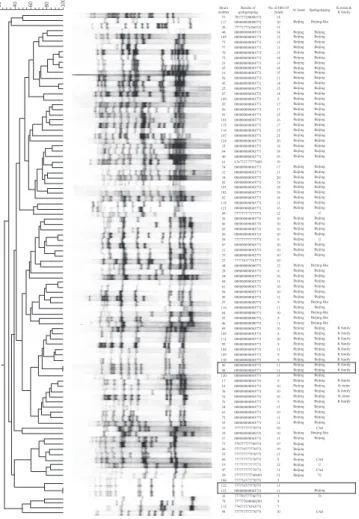
The IS6110 copy numbers ranged from 5 to 21 (mode=10) (Fig. 1).
The majority of the strains (45/96, 46.9%) contained 9-11 cop- ies. With a 60% similarity threshold, 24 clusters were observed in the dendrogram based IS6110-RFLP. A total of 86 isolates (89.6%) displayed one of 14 clusters and 10 isolates (10.4%) dis- played unique patterns. Two pairs of four isolates showed iden- tical IS6110-RFLP patterns in each pair (solid boxes on right in Fig. 1); the source patients for each pair had no epidemiologic linkage.
Spoligotyping patterns of 96 strains
Eighteen spoligotyping patterns were observed. Among the iso- lates, 85 (88.5%) displayed one of 7 spoligotypes and 11 (11.4%) displayed unique spoligotypes. According to the SpolDB4, 85 isolates (88.5%) were classified into nine shared international types (SITs), whereas 11 isolates were not classified. Among the nine clusters identified by SpolDB4 analysis, the SIT1 cluster contained a majority of the isolates (62/96, 64.6%). When con- sidering all spoligotypes, the Beijing, including the SIT1 cluster, was the most prevalent (69/96, 71.9%), followed by seven (7.3%) Beijing-like spoligotypes, four (4.2%) CAS family, three (3.1%) U family, and two (2.1%) T1 family (Table 1).
Distribution of Beijing and K strains
When analyzing IS6110-RFLP patterns, 83 of 96 isolates (86.5%) Table 1. Results of spoligotyping
Spoligotyping octal codes
SpolDB4 analysis No. of strains SIT Label Total A1 band K strain/
K family
000000000003771 1 Beijing 61 61 1/10
000000000003731 190 Beijing 6 5 1/2
000000000003371 265 Beijing 2 2
000000000000771 269 Beijing like
6 6
000000000000731 406 Beijing like
1 1
777777777770771 1,378 CAS 4 2
777777777777771 523 U 3 2
777777777760600 243 T1 1 1
777703777760771 1,223 T1 1
777777777570771 Unclassified 1 1
777777600000200 Unclassified 1
777776777770771 Unclassified 3 1
777776777763771 Unclassified 1
777717776760731 Unclassified 1
774375776563771 Unclassified 1
770777777760731 Unclassified 1 1
703777200000371 Unclassified 1
676773777777600 Unclassified 1
SIT, shared international type from international spoligotype database SpolDB4 (http://
www.pasteur-eloupe.fr:8081/SITVITDemo/); Label, spoligotype families as assigned in SpolDB4; A1 band, the number of isolates including IS6110 insertion A1 band in the origin of replication (corresponding to a 3.36-kb band); K strain, the number of isolates indicating a unique 10 IS6110 RFLP band pattern; K family, the number of isolates having 8 to 12 IS6110 bands and more than five bands in the K strains.
Fig. 1. Results of RFLP and spoligotyping of 96 M. tuberculosis isolates. Two solid boxes indicate that the two pairs of four isolates showed identical IS6110-RFLP patterns in each pair.
that contained the Beijing-specific A1 insertion band were de- termined to be Beijing family. However, 75 of these 86 isolates, and another isolate with no A1 band were confirmed to be Bei- jing family by spoligotyping (Fig. 1). These isolates each had 8 to 21 bands (mode 10). The unique IS6110-RFLP pattern of K strain was found in 2 isolates (2.1%), and 12 isolates (12.5%) closely resembled the K family strain. Of the 76 Beijing family strains, K family strains accounted for 18.4%.
Relation between genotypes and drug resistances
In this study, 21 isolates were resistant to at least one anti-tu- berculosis drug. Nine of these were MDR-TB. Nineteen of 21 isolates resistant to at least one drug and all nine MDR-TB iso- lates belonged to the Beijing family, meaning there is a signifi- cantly higher rate of MDR or any drug resistance in the Beijing family (P=0.003) (Table 2). The differences in the resistance rates between K family and non-K Beijing family were not significant.
Drug resistance rates in the study population were 9.4% (9/96) for MDR-TB and 21.9% (21/96) for at least one drug, including INH and RIF. For primary TB cases, the drug resistance rates were 2.4% (2/82) for MDR-TB and 15.9% (13/82) for at least one drug, including INH and RIF.
DISCUSSION
The Beijing family of M. tuberculosis strains may have been en- demic in China for a long time (6) and is now emerging in other parts of the world. This family is dominant in Asian countries such as China (86%), Mongolia (50%), Japan (73%), Indonesia (34%), Thailand (44%), and Vietnam (54%) (7, 8, 20-22). It also is present in Korea. In a 1995 report, 43% of tested strains (6/14) were the Beijing family (8). In another report, 72% (99/138) were the Beijing family, which was defined by IS6110-RFLP patterns (9). The current study shows a higher rate of the Beijing family (79%), nearly same as the rates in China and Japan. In the first report from Korea (8), the selection criteria for the tested strains were not specified, and the test volume was small. In contrast, the two other studies including the current study, examined strains from several areas in Korea, and the number of tested strains was roughly proportional to the number of TB patients reported from each area. Very recently, one report claimed that nearly all the isolates in one Korean tertiary TB hospital were
Beijing family (23). However, this hospital normally recruits drug- resistant or treatment failure cases from the entire country, so the strain population could be distorted. Therefore, our data appear to represent the genuine distribution of the Beijing fam- ily in Korea. Although isolates were collected from 11 university hospitals throughout the country, we did not find any associa- tion between the Beijing family and region. Also, no correlation between Beijing family and the sex or age of the patients was found. Two pairs of isolates from each of two university hospi- tals showed identical IS6110-RFLP patterns, but we did not find an epidemiological relation between the genotypes of the strains.
That means that identical IS6110-RFLP patterns do not always indicate strains of the same origin.
The Beijing family organisms have multiple copies of IS6110 bands (15 to 26), and therefore, differentiation between strains is not easy (24, 25). Many other characteristics have been dem- onstrated to identify the Beijing family by IS6110-RFLP analy- sis. In the current study, the A1 band in the IS6110 RFLP pattern was used to identify 83 strains presumablely as Beijing family, of which 76 were confirmed as such by spoligotyping. However, 19 Beijing reference strains suggested by Kremer et al. and at least 450 IS6110 profiles reported by the Public Health Research Institute (PHRI) TB Center database were not useful in detect- ing Beijing strains in this study (data not shown) (24, 26). A den- drogram of the IS6110-RFLP band pattern was diverse even within the Beijing family, showing that the 76 strains belonged to 18 clusters. Interestingly, the Beijing family strains tested in this study harbored relatively small numbers of IS6110 bands (8 to 21), indicating that the characteristics of the Beijing family isolated in Korea are different from those isolated in other coun- tries. Mycobacterial interspersed repetitive units (MIRU)-vari- able number of tandem repeats (VNTR), another molecular epidemiologic tool for M. tuberculosis, was introduced to geno- type M. tuberculosis isolates from Korea (4, 27). The MIRU-VN- TR is highly discriminatory and easy to use, and can differenti- ate strains belonged to the Beijing family (4). However, it is not suitable for demonstrating the population of Beijing strains be- cause it cannot provide any information distinguishing Beijing from non-Beijing family strains. In previous studies, the domi- nant M. tuberculosis strains in Korea were defined as the K strain, a sublineage of the Beijing strain (17). According to the defini- tion, two isolates (2.1%) were identified with K strains and 12 isolates (12.5%) with the K family in the current study. These figures are slightly lower than those in the report of Park et al.
(18.8%) from Korea (28). However, these data were developed with strains from one area, Gyeonggi Province; to estimate the population of the K family throughout Korea, a large-scale study using nationwide collection would be necessary.
The effect of Beijing family strains on drug resistance is not clear (29), but the Beijing family is reported to have a higher rate of resistance (25). We also demonstrated that drug resistance Table 2. Spoligotype and drug resistance in 96 M. tuberculosis clinical isolates
Spoligotype No. of isolates (%) MDR (%) Any drug (%) Beijing family 76 (79.1) 9 (11.8)* 20 (26.3)*
Non-Beijing family 20 (20.9) 1 (5.0)
Total 96 (100) 9 (9.4) 21 (21.9)
*MDR and any drug resistance rates are significantly higher in Beijing family than in non-Beijing family.
MDR, multi-drug resistant; Any drug, resistance to at least one drug, including INH and RIF.
was strongly associated with Beijing family strains in Korea. All MDR-TB isolates and the majority (19/21) of the isolates with at least one drug resistance belonged to the Beijing family. One recent study reported interesting data that in one Korean TB hospital, which specializes in caring for patients with drug-re- sistant TB, 97% of the isolates belonged to the Beijing family (23).
This suggests a close connection between drug resistance and Beijing family membership. Therefore, patients found to be in- fected with M. tuberculosis of the Beijing family should be mon- itored closely for drug-taking compliance or response to thera- py. Spoligotyping analysis could easily classify and be useful to detect Beijing strains. The 76 isolates of the Beijing family be- longed to only five clusters according to the international spoli- gotype database, SpolDB4. Therefore, when considering that it is important to identify Beijing family members, spoligotyping can be performed more easily and rapidly than IS6110-RFLP analysis. Another issue regarding drug resistance is the primary or acquired resistance rate of M. tuberculosis. Bai et al. (30) re- ported that in 2004, the resistance rates were 2.7% for MDR and 12.8% for any one drug resistance in new TB cases and 14% for MDR and 27.7% for any one drug resistance among patients with a history of treatment in Korea. In the current study, the drug resistance rates in primary TB cases appeared 2.4% for MDR-TB and 15.9% for any one drug resistance, representing a similar result with the previous report.
In summary, this study gives an overview of the distribution of genotypes of clinical M. tuberculosis isolates in Korea. Our data showed that the Beijing strain currently is the most preva- lent. Especially, we found an association between Beijing family strains and drug resistance phenotypes. These findings indicate that we have to pay more attention to control of M. tuberculosis strains associated with the Beijing family. Our data also indicate that a poor drug treatment outcome may occur more common- ly in Beijing family strains.
REFERENCES
1. World Health Organization. Global tuberculosis control: a short update to the 2009 report. Available at http://www.who.int/tb/publications/
global_report/en/ [accessed on July 1, 2010].
2. Lonnroth K, Raviglione M. Global epidemiology of tuberculosis: pros- pects for control. Semin Respir Crit Care Med 2008; 29: 481-91.
3. Espinal MA, Laszlo A, Simonsen L, Boulahbal F, Kim SJ, Reniero A, Hoff- ner S, Rieder HL, Binkin N, Dye C, Williams R, Raviglione MC. Global trends in resistance to antituberculosis drugs. World Health Organiza- tion-International Union against Tuberculosis and Lung Disease Work- ing Group on Anti-Tuberculosis Drug Resistance Surveillance. N Engl J Med 2001; 344: 1294-303.
4. Yun KW, Song EJ, Choi GE, Hwang IK, Lee EY, Chang CL. Strain typing of Mycobacterium tuberculosis isolates from Korea by mycobacterial in- terspersed repetitive units-variable number of tandem repeats. Korean J Lab Med 2009; 29: 314-9.
5. Groenen PM, Bunschoten AE, van Soolingen D, van Embden JD. Na- ture of DNA polymorphism in the direct repeat cluster of Mycobacterium tuberculosis: application for strain differentiation by a novel typing meth- od. Mol Microbiol 1993; 10: 1057-65.
6. Qian L, Van Embden JD, Van Der Zanden AG, Weltevreden EF, Duan- mu H, Douglas JT. Retrospective analysis of the Beijing family of Myco- bacterium tuberculosis in preserved lung tissues. J Clin Microbiol 1999;
37: 471-4.
7. Ohata R, Tada A. Beijing family and other genotypes of Mycobacterium tuberculosis isolates in Okayama district. Kekkaku 2004; 79: 47-53.
8. van Soolingen D, Qian L, de Haas PE, Douglas JT, Traore H, Portaels F, Qing HZ, Enkhsaikan D, Nymadawa P, van Embden JD. Predominance of a single genotype of Mycobacterium tuberculosis in countries of east Asia. J Clin Microbiol 1995; 33: 3234-8.
9. Park YK, Bai GH, Kim SJ. Restriction fragment length polymorphism analysis of Mycobacterium tuberculosis isolated from countries in the western pacific region. J Clin Microbiol 2000; 38: 191-7.
10. Korea Centers for Disease Control & Prevention. Annual report on the notified tuberculosis patients in Korea, 2008. Seoul: Korea Centers for Disease Control & Prevention; 2008.
11. van Soolingen D, Hermans PW, de Haas PE, Soll DR, van Embden JD.
Occurrence and stability of insertion sequences in Mycobacterium tuber- culosis complex strains: evaluation of an insertion sequence-dependent DNA polymorphism as a tool in the epidemiology of tuberculosis. J Clin Microbiol 1991; 29: 2578-86.
12. van Embden JD, Cave MD, Crawford JT, Dale JW, Eisenach KD, Gicquel B, Hermans P, Martin C, McAdam R, Shinnick TM, Small PM. Strain identification of Mycobacterium tuberculosis by DNA fingerprinting:
recommendations for a standardized methodology. J Clin Microbiol 1993; 31: 406-9.
13. Song EJ, Jeong HJ, Lee SM, Kim CM, Song ES, Park YK, Bai GH, Lee EY, Chang CL. A DNA chip-based spoligotyping method for the strain iden- tification of Mycobacterium tuberculosis isolates. J Microbiol Methods 2007; 68: 430-3.
14. Brudey K, Driscoll JR, Rigouts L, Prodinger WM, Gori A, Al-Hajoj SA, Allix C, Aristimuno L, Arora J, Baumanis V, Binder L, Cafrune P, Cataldi A, Cheong S, Diel R, Ellermeier C, Evans JT, Fauville-Dufaux M, Ferdi- nand S, Garcia de Viedma D, Garzelli C, Gazzola L, Gomes HM, Gut- tierez MC, Hawkey PM, van Helden PD, Kadival GV, Kreiswirth BN, Kremer K, Kubin M, Kulkarni SP, Liens B, Lillebaek T, Ho ML, Martin C, Mokrousov I, Narvskaia O, Ngeow YF, Naumann L, Niemann S, Parwati I, Rahim Z, Rasolofo-Razanamparany V, Rasolonavalona T, Rossetti ML, Rusch-Gerdes S, Sajduda A, Samper S, Shemyakin IG, Singh UB, Somos- kovi A, Skuce RA, van Soolingen D, Streicher EM, Suffys PN, Tortoli E, Tracevska T, Vincent V, Victor TC, Warren RM, Yap SF, Zaman K, Por- taels F, Rastogi N, Sola C. Mycobacterium tuberculosis complex genetic diversity: mining the fourth international spoligotyping database (Spol- DB4) for classification, population genetics and epidemiology. BMC Mi- crobiol 2006; 6: 23.
15. Kurepina NE, Sreevatsan S, Plikaytis BB, Bifani PJ, Connell ND, Donnel- ly RJ, van Sooligen D, Musser JM, Kreiswirth BN. Characterization of the phylogenetic distribution and chromosomal insertion sites of five IS6110 elements in Mycobacterium tuberculosis: non-random integration in the dnaA-dnaN region. Tuber Lung Dis 1998; 79: 31-42.
16. Bifani PJ, Mathema B, Liu Z, Moghazeh SL, Shopsin B, Tempalski B,
Driscol J, Frothingham R, Musser JM, Alcabes P, Kreiswirth BN. Identi- fication of a W variant outbreak of Mycobacterium tuberculosis via pop- ulation-based molecular epidemiology. JAMA 1999; 282: 2321-7.
17. Huh YJ, Ahn DI, Kim SJ. Limited variation of DNA fingerprints (IS6110 and IS1081) in Korean strains of Mycobacterium tuberculosis. Tuber Lung Dis 1995; 76: 324-9.
18. Canetti G, Fox W, Khomenko A, Mahler HT, Menon NK, Mitchison DA, Rist N, Smelev NA. Advances in techniques of testing mycobacterial drug sensitivity, and the use of sensitivity tests in tuberculosis control programmes. Bull World Health Organ 1969; 41: 21-43.
19. Wayne LG. Simple pyrazinamidase and urease tests for routine identifi- cation of mycobacteria. Am Rev Respir Dis 1974; 109: 147-51.
20. Anh DD, Borgdorff MW, Van LN, Lan NT, van Gorkom T, Kremer K, van Soolingen D. Mycobacterium tuberculosis Beijing genotype emerg- ing in Vietnam. Emerg Infect Dis 2000; 6: 302-5.
21. van Crevel R, Nelwan RH, de Lenne W, Veeraragu Y, van der Zanden AG, Amin Z, van der Meer JW, van Soolingen D. Mycobacterium tuber- culosis Beijing genotype strains associated with febrile response to treat- ment. Emerg Infect Dis 2001; 7: 880-3.
22. Prodinger WM, Bunyaratvej P, Prachaktam R, Pavlic M. Mycobacterium tuberculosis isolates of Beijing genotype in Thailand. Emerg Infect Dis 2001; 7: 483-4.
23. Shamputa IC, Lee J, Allix-Béguec C, Cho EJ, Lee JI, Rajan V, Lee EG, Min JH, Carroll MW, Goldfeder LC, Kim JH, Kang HS, Hwang S, Eum SY, Park SK, Lee H, Supply P, Cho SN, Via LE, Barry CE 3rd. Genetic diversity of Mycobacterium tuberculosis isolates from a tertiary care tuberculosis
hospital in South Korea. J Clin Microbiol 2010; 48: 387-94.
24. Bifani PJ, Mathema B, Kurepina NE, Kreiswirth BN. Global dissemina- tion of the Mycobacterium tuberculosis W-Beijing family strains. Trends Microbiol 2002; 10: 45-52.
25. Glynn JR, Whiteley J, Bifani PJ, Kremer K, van Soolingen D. Worldwide occurrence of Beijing/W strains of Mycobacterium tuberculosis: a system- atic review. Emerg Infect Dis 2002; 8: 843-9.
26. Kremer K, Glynn JR, Lillebaek T, Niemann S, Kurepina NE, Kreiswirth BN, Bifani PJ, van Soolingen D. Definition of the Beijing/W lineage of Mycobacterium tuberculosis on the basis of genetic markers. J Clin Mi- crobiol 2004; 42: 4040-9.
27. Kang H, Ryoo S, Park Y, Lew W. Evaluation of the selected 12-locus MIRU for genotyping Beijing family Mycobacterium tuberculosis in Korea. Tu- berc Respir Dis 2009; 67: 499-505.
28. Park YK, Kang HY, Lim JG, Ha JS, Cho JO, Choi HS, Lee KC, Choi YH, Sheen SS, Bai GH. Analysis of DNA fingerprints of Mycobacterium tu- berculosis isolates from patients registered at Health Center in Gyeonggi Province in 2004. Tuberc Respir Dis 2006; 60: 290-6.
29. Li WM, Wang SM, Li CY, Liu YH, Shen GM, Zhang XX, Niu TG, Gao Q, van Soolingen D, Kremer K, Duanmu HJ. Molecular epidemiology of Mycobacterium tuberculosis in China: a nationwide random survey in 2000. Int J Tuberc Lung Dis 2005; 9: 1314-9.
30. Bai GH, Park YK, Choi YW, Bai JI, Kim HJ, Chang CL, Lee JK, Kim SJ.
Trend of anti-tuberculosis drug resistance in Korea, 1994-2004. Int J Tu- berc Lung Dis 2007; 11: 571-6.