Effect of pre-educational evaluation on CPR education of the General population
Hyun-Mo Yang, Gyoung-Yong Kim
*Professor, Department of Paramedic Science, Korea National University of Transportation
일반인의 심폐소생술 교육에 대한 사전 교육 평가의 영향
양현모, 김경용
*한국교통대학교 응급구조학과 조교수
Abstract The purpose of this study is to determine how the pre-test performed before training affects the results of CPR performance. In the case of the pre-test group(PTG), a pre-evaluation was performed for 1 minute before training, and the group that did not perform the pre-test(NPTG) performed only regular education. In both groups, skill test was performed for 1 minute after training. As a result of comparing the pre and post-test of PTG, there were statistically significant changes in chest compression depth, rate, and compression recoil. There was a statistically significant difference only in the chest compression rate in the chest compression performance results of the two groups after training. There was a statistically significant difference in the results of confidence after training in both groups. It is judged that the pre-test conducted before training has a good influence not only on the results of chest compression, but also on confidence improvement. Therefore, it is judged that it is necessary to develop additional programs such as pre-education test in order to increase the concentration of CPR education for the general population.
Key Words : Cardio Pulmonary Resuscitation, General population, Pre-test, Non pre-test, Chest compression
요 약 본 연구의 목적은 사전 평가 수행 여부가 심폐소생술 수행 능력 결과에 미치는 영향을 확인하 는 것이다. 사전 평가그룹(PTG)의 경우 교육 전 1분 동안 사전 평가를 수행하였으며 사전 평가를 수행하지 않은 그룹(NPTG)은 정규교 육만을 진행하였다. 두 그룹 모두 교육 후 1분 동안 술기 평가를 수행하였다. PTG의 사전 및 사후 평가를 비교한 결과, 가슴 압박의 깊이, 속도, 압박 후 이완에서 통계적으로 유의하게 변화하였다. 두 그룹의 교육 후 가슴 압박 수행 결과에 서는 가슴압박 속도에서만 통계적으로 유의한 차이가 있었다. 교육 후 자심감 결과에서는 두 그룹 모두 통계적으로 유의한 차이가 있었다. 훈련 전에 실시한 사전 평가는 가슴 압박의 결과뿐만 아니라 자신감 향상에도 좋은 영향을 미치 는 것으로 판단된다. 따라서 일반인을 대상으로 하는 심폐소생술 교육의 집중도를 높이기 위해서는 교육 전 평가 등의 추가적인 프로그램 개발이 필요하다고 판단된다.
주제어 : 심폐소생술, 일반인, 사전교육, 사후교육, 가슴압박
This work was supported by the National Research Foundation of Korea(NRF) grant funded by the Korea government(MSIT) (No. 2020R1G1A1101971).
*Corresponding Author : Gyoung-Yong Kim([email protected]) Received April 2, 2021
Accepted July 20, 2021 Revised June 17, 2021
Published July 28, 2021
1. Introduction
The number of pre-hospital cardiac arrest patients in Korea increased from 19,480 in 2006 to 30,539 in 2019, an increase of 1.5 times over 11 years[1]. In contrast, the rate of cardiopulmonary resuscitation(CPR) performed by the general public when actually witnessing a cardiac arrest patient pre-hospital was significantly lower, from 1.9% in 2008 to 24.7% in 2019[1]. Eventually, the progression of brain damage to the patient with cardiac arrest cannot be prevented, and as a result, the patient cannot be resuscitated. CPR training for the general public is aimed at improving decision-making ability to activate emergency medical services in the field and strengthening the will to perform CPR[2]. In a previous study, it was said that the previous educational experience of CPR is important for the general public who applied CPR[3]. In developed countries such as Germany, Austria, Sweden and Norway, CPR education is essential for one year in middle school[4,5]. In another study, the general public who had previously received CPR training was relatively more willing to perform CPR in patients with prehospital cardiac arrest[6,7]. Based on these studies, Korea is also increasing the rate of CPR education for the general public. However, the proportion of patients with pre-hospital cardiac arrest in Korea who are discharged from hospital due to recovery of brain function is still about half as low as in advanced countries[1]. These results indicate that although the rate of receiving CPR training for the general public increases, the quality of the CPR performance of the general public is low.
In a study published by Maibach et al. the confidence and performance of CPR is achieved through repetitive and high-quality CPR practice assuming actual pre-hospital cardiac arrest[8,9].
Another study also suggested that the driving force for the general public to apply CPR to
pre-hospital cardiac arrest patients is self-confidence in the results of CPR application, and that such confidence can overcome the factors of psychological and social stress[10-12].
CPR training in the public is not meant to convey mere knowledge and skills about chest compressions and ventilation, but it is really important to make them aware of the importance of training and to motivate them to help heart attack patients[13,14]. In addition, since the public perception and attitude toward the ban on CPR has many positive results, it is judged that there are deep concerns about the implementation of active CPR[15]. Therefore, in previous studies, the use of portable device such as CPR cube was recommended to expand CPR education, and there was a result that a mobile web-based CPR convergence education was necessary[16,17].
In previous studies, classroom relevant materials to show that even failing a test or taking a test before learning new information, can lead to stronger memory for that information than spending the same amount of time studying[18]. So, prior to conducting CPR training in the general population, the researcher conducted a pre-test assessment and compared performance to the extent to which experience of the ability to perform CPR would affect outcomes.
This study is to confirm the effect of prior CPR evaluation for the general public, and the specific research objectives are as follows.
1) Confirm the performance ability of the general public according to the pre-test of CPR.
2) After CPR training for the general public, check the difference in performance ability of the pre-test group for CPR.
3) Compare and confirm the CPR performance
ability of the pre-test group and the
non-pre-test group.
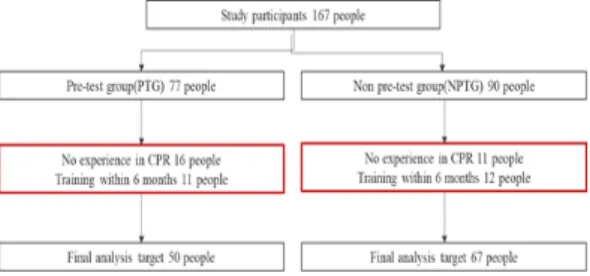
Fig. 1. General Characteristics of Participants
2. Materials and Methods 2.1 Research Participants
This study was conducted for teachers and faculty members of schools and daycare centers located in one city for a total of 13 days from September 10 to September 23, 2019. In order to minimize the technical differences related to skill skills among the study subjects, those without CPR training and those who had received training within 6 months were excluded from the final analysis. The reasons for selecting Chungcheongbuk-do as the residential area among the selection criteria for this study are as follows. This is because, in the previous study, Seoul, Daegu, and Gyeongsangbuk-do showed a CPR education rate of 40% or more, whereas Chungcheongbuk-do showed a low education rate of 31%. And by age group, participants were selected according to the result that more than 60% of those in their 20s and 40s showed an intention to teach CPR[19].
When the study sample size was calculated by setting significance level of .05, effect size of .80, and power of .80 in t-test using G-power software, the number of samples for each group was 46. However, due to the possibility of dropping out of the study, a total of 70 people were recruited. During the study, 23 people were eliminated due to abandonment due to personal reasons, and a total of 117 (PTG 50, NPTG 67) were used for final analysis. Fig. 1 shows among a total of 6 experiments, the researchers randomly selected dates and divided them into a
pre-test group (PTG) and a non-pre-test group (NPTG).
2.2 Research methods and ethical considerations
Research-related consent was obtained along with a questionnaire asking the subjects about their current health status, and those who were unable to proceed with CPR practice due to other health reasons and those who did not agree with the study were excluded from the study. In addition, it was explained in detail that the study subjects can stop whenever they feel symptoms such as dizziness, shortness of breath, or chest pain during CPR practice. Study participants agreed to participate by themselves after receiving detailed explanations on the purpose of the study, the use of data, withdrawal during participation in the study, and no disadvantages.
To the study subjects, general characteristics such as gender and age and confidence in CPR were presented through a questionnaire before education, and a questionnaire on CPR confidence was presented once more after all education and evaluation were completed. In order to increase the internal validity of this study, random assignment was conducted without prior notice to select the participants of the study. Laerdal's Little Anne QCPR was used for the mannequin used in this study, and data on the depth, speed, and accurate relaxation results of chest compression were collected in real time using the Q-CPR instructor application.
According to the recommendations of the
American Heart Association's CPR guidelines
revised in 2015, only chest compressions were
performed, excluding artificial respiration. For
PTG, pre-education skill evaluation was
conducted for 1 minute and after 60 minutes of
theoretical education, practical education was
performed for 90 minutes. In addition, NPTG
conducted 60 minutes of theoretical education
Characteristics PTG, n(%) NPTG, n(%) p
Age
20≤and<30yr. 8(16.0) 6(9.0) .213 30≤and<40yr. 14(28.0) 16(23.9) 40≤and<50yr. 8(16.0) 17(25.4) 50≤and<60yr. 19(38.0) 22(32.8) 60≤ yr. 1(2.0) 6(9.0)
Total 42.74±11.19 44.67±10.58 .343 Gender FemaleMale 23(46.0)27(54.0) 31(46.3)36(53.7) .563 Number of
CPR training within 2 years
1 23(46.0) 32(47.8)
2 24(48.0) 28(41.8) .628
>3 3(6.0) 7(10.4)
Table 1. General Characteristics of Participants and 90 minutes of practical education without evaluation of pre-educational skills. Both groups performed skill evaluation after training for 1 minute after completing all practical training.
2.3 Data analysis method
The data collected in this study were analyzed through SPSS 21.0 Version, and cross-analysis was used for general characteristics. The independent sample t-test was used to compare chest compression performance and confidence between the two groups, and the corresponding paird t-test was used to compare the chest compression performance before and after PTG training. All statistical analyzes defined that a p value of less than 0.05 was statistically significant.
3. Results
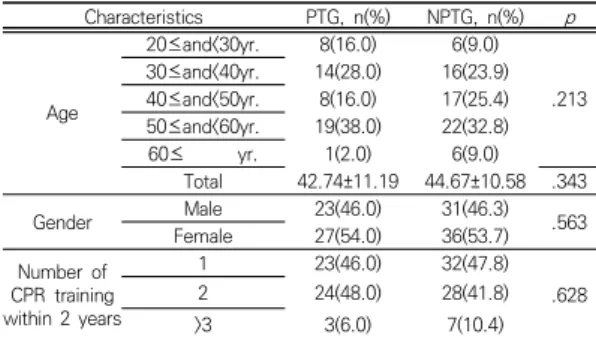
3.1 General Characteristics of Participants Table 1 shows the participants of this study were 54 men (46.15%) and 63 women (53.84%), a total of 117 participants. PTG was 50 (23 males) and NPTG was 67 (males 31). The average age of the study subjects was PTG 42.74±11.19 years old and NPTG 44.67±10.58 years old (p=.343). In terms of training experience for CPR within 2 years, two (24 patients) for PTG and one (32 patients) for NPTG (p=.628), but there was no statistically significant difference between the two groups.
3.2 Comparison of the quality of chest compressions
Table 2 shows among the results of the pre-evaluation of PTG, the chest compression depth was 7.26cm, which was deeper than the guidelines recommended by the American Heart Association. And the chest compression rate was 129 rate per minute, faster than the American Heart Association's recommended rate.
Ability to perform pre-test chest compressions in
PTG Pre-test
(M±SD) Chest compression depth (cm) 7.26±0.95 Chest compression rate (/min) 129.22±17.03 Proportion of chest complete recoil (%) 87.22±30.84
Table 2. Ability to perform pre-training chest
compressions in PTG
Table 3 shows the results of comparing the pre and post-evaluation of PTG showed that the depth and rate of chest compressions, complete recoil rate after chest compression changed statistically significantly after training.
Ability to perform PTG chest compressions before and after training
Pre-test (M±SD)
Post-
(M±SD)test t p Chest compression
depth (cm) 7.26±0.95 6.20±0.87 5.27 <.001 Chest compression rate
(/min) 129.22±17.03 107.24±4.60 9.04 <.001 Proportion of chest
complete recoil (%) 87.22±30.84 97.86±6.28 -2.33 .024
Table 3. Ability to perform PTG chest compressions
before and after training
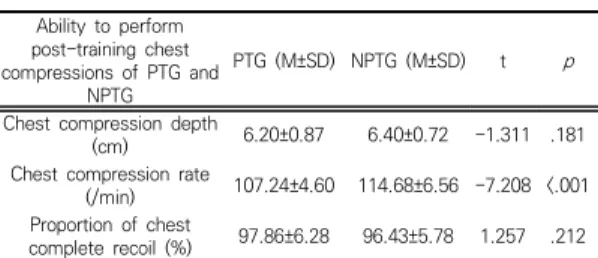
Table 4 shows in the results of chest
compression performance after training of PTG
and NPTG, there was a statistically significant
difference only in rate of chest compression.
Ability to perform post-training chest compressions of PTG and
NPTG
PTG (M±SD) NPTG (M±SD) t p Chest compression depth
(cm) 6.20±0.87 6.40±0.72 -1.311 .181
Chest compression rate
(/min) 107.24±4.60 114.68±6.56 -7.208 <.001 Proportion of chest
complete recoil (%) 97.86±6.28 96.43±5.78 1.257 .212
Table 4. Ability to perform post-training chest
compressions of PTG and NPTG
Table 5 shows there was no statistical difference in confidence before education between the two groups. However, there was a statistically significant difference in confidence after training between the two groups.
Confidence based on
pre-training assessment PTG
(M±SD) NPTG
(M±SD) t p
Pre-education confidence 6.56±1.97 6.46±2.59 .222 .825 Post-education confidence 9.60±0.63 9.06±1.30 2.955 .004
Table 5. Confidence based on pre-training assessment
4. Discussion
In this study, those who had no educational experience or who had not passed 6 months after education were excluded. The reason for this is that according to a paper published by Malcolm Woollard in 2004, after 6 months of CPR training, the skill ability was not maintained.
And it was said that within 6 months after training, practical skills still remain, so it could affect the evaluation conducted before training[20]. The reason for the 1 minute evaluation time in this study is that the previous study reported that the quality of CPR deteriorates 1 minute after the start of CPR[21].
As a result of preliminary evaluation of PTG, the chest compression depth was 7.26cm, and the chest compression rate was 129 times per minute. I think the reason for this result was that it was not physically exhausted due to short
execution time. However the proportion of chest complete recoil related result was 87.22±30.84, which showed a bad result, so it is thought that the physical strength and the proportion of chest complete recoil performance were not related.
Among the chest compression results before and after PTG training, the depth of chest compression, the rate of chest compression, and the percentage of complete relaxation after chest compression were relatively more suitable to the guidelines. These results suggest that the perception of one's ability to perform CPR was more focused on education. And it was confirmed once again the general principle that repeated practice of CPR can positively change the outcome of performance. Another reason is thought to have been more focused on training that will be carried out later as they learned his own CPR performance empirically through pre-evaluation.
In addition, the results of the two groups for
chest compression depth were relatively more
appropriate to the guideline in PTG, but both
groups showed deeper results than the range
suggested by the guideline. This reason is
thought to be a result of the short experiment
time, and it is suggested to present the result
through additional research over a longer period
of time. Among the results of chest compression
performance after training of PTG and NPTG,
both groups satisfied the standard of 100 to 120
times per minute, which is the normal range of
compression speed. It is thinked that both
groups were within the normal range because the
metronome was used to guide the chest
compression speed. Based on these results, I
think it would be effective to use a metronome
for chest compression rate education in CPR
training for the general public. As for proportion
of chest complete recoil results, PTG showed
relatively better results, but it was not statistically
significant. This reason is thought to be
insufficient for the reason that the experience of
pre-educational evaluation can completely enhance proportion of chest complete recoil.
Therefore, it is thought that additional training time for proportion of chest complete recoil should be provided in CPR education for the general public.
There was no statistically difference in confidence before education, but confidence after education increased in both groups. In particular, PTG's post-educational confidence was statistically higher than that of NPTG's post-educational confidence, which is thought to be effective in improving confidence in pre-educational evaluation. The limitation of this study is that it is difficult to generalize because it is a study of 117 people, which is only a small part of teachers and faculty members nationwide.
And since it is a study using mannequins, there may be differences from real people. In addition, in this study, only the depth of the chest compression, the speed of the chest compression, and the correct relaxation ratio result of the chest compression were confirmed.
5. Conclusion
This study was conducted to reveal the correlation between the general public's experience through pre-evaluation before education and performance ability after education, and to determine the effect on confidence in CPR. It is judged that the preliminary evaluation conducted before training has a good effect on the improvement of confidence as well as the ability to perform chest compressions.
Therefore, the following future research is suggested in consideration of the results and limitations of this study. First, In order to increase the concentration of trainees in CPR education for the general public, it is considered necessary to develop educational programs such as pre-educational evaluation conducted in this
study. Second, assuming the actual situation, a study is proposed to compare and confirm the performance of CPR by considering the average time for paramedics to arrive at the site. Third, repeated studies that supplement the limitations found in CPR education for the general public are required. Fourth, the development of CPR education programs for the general public for various educational contents and research to verify their effectiveness are suggested.
REFERENCES
[1] National Fire Agency. (2019).
Fire administration data and statistics.
[2] S. H. Kim et al. (2015). National Survey of Training Methodology between Experience and Needs for Laypersons Cardiopulmonary Resuscitation.
The Korean Society of Emergency Medicine, 26(6),
534-542.[3] S. O. Yoon, Y. H. Kwon, J. Y. An, S. O. Hong & Y. T.
Kim. (2017).
Main results of Sudden Cardiac Arrest Survey 2006-2016.
Korea Centers for Disease Control and Prevention, http://www.cdc.go.kr/CDC/contents/CdcKrContentLink.jsp?fid=31&cid=77373&ctype=6 [4] H. S. Jun & H. S. Sohn. (2015). "Effects of
Cardiopulmonary Resuscitation Education Performed by Health Teachers on Middle School Students".
Journal of Digital Convergence, 13(10),
385-395.https://doi.org/10.14400/JDC.2015.13.10.385 [5] S. H. Lim. (2015).
"Issues and Arguments", National
Assembly Research Service, No. 993
[6] Y. S. Park. (2017). The Study on Cardiopulmonary Resuscitation(CPR) Willingness to Perform and Confidence according to Converged Job Experience of School Health Teacher.
Journal of the Korea Convergence Society, 8(2),
137-147.https://doi.org/10.15207/JKCS.2017.8.2.137
[7] S. K. Kim, S. A. Kim, J. I. Kim & M. H. Park. (2018).
Willingness to Perform Cardiopulmonary Resuscitation (CPR) in Emergency Situation:
Convergence factor in Undergraduate Nursing Students.
Journal of the Korea Convergence Society, 9(8),
311-318.https://doi.org/10.15207/JKCS.2018.9.8.311
[8] Y. S. Ro et al. (2016). Public awareness and self-efficacy of cardiopulmonary resuscitation in communities and outcomes of out-of-hospital cardiac arrest:A multi-level analysis.
Resuscitation, 102,
17-24.https://doi.org/10.1016/j.resuscitation.2016.02.004 [9] D. W. Choi. (2014). Clinical Competence according to
Experiences on the Essential of Fundamental Nursing Skills in Nursing Students.
Journal of Korean Academic Society of Nursing Education, 20(2),
184-191.https://doi.org/10.5977/jkasne.2014.20.2.184 [10] S. H. Choi. (2015). Effect of Cardiopulmonary
Resuscitation Education on the knowledge, attitude and self-efficacy of elementary and middle school teachers.
Journal of Korean Public Health Nursing, 29(1),
18-28,https://doi.org/10.5932/JKPHN.2015.29.1.18
[11] H. K. Jung & T. H. Uhm. (2015). Factors that influence kindergarten teachers' willingness to perform cardiopulmonary resuscitation.
The Korean Journal of Emergency Medical Services, 19(2),
19–27.https://doi.org/10.14408/KJEMS.2015.19.2.019 [12] K. H. Kang & J. A. Yim. (2008). A Population health
characteristic analysis of willingness to perform cardiopulmonary resuscitation.
Korean Journal of Health Education and Promotion, 25(4),
43-54.[13] M. E. Park. (2013). Attitude and Intention to Execute on Cardiopulmonary Resuscitation among Workers in A University Hospital. Master thesis. Inje University, Gimhae.
[14] K. H. Kang, Y. M. Kim & H. J. Lee. (2010).
Cardiopulmonary Resuscitation Education &
Performance by Bystanders in an Emergency.
Journal of the Korean Contents Society, 10(12),
378-386.[15] S. J. Lee. (2019). A Study on the Perception and Attitude of ‘Do Not Resuscitate' in Adults.
Journal of the Korea Convergence Society, 10(6),
393-399.https://doi.org/10.15207/JKCS.2019.10.6.393
[16] H. M. Yang & J. W. Kim. (2019). A Convergence Study on Chest Compression Effects of CPR(Cardio-pulmonary resuscitation)Cube in the Layperson.
Journal of the Korea Convergence Society, 10(3),
221-225.https://doi.org/10.15207/JKCS.2019.10.3.221 [17] J. Y. Bang & J. S. Kim. (2018). Effects of a Mobile
Web-based Cardiopulmonary Resuscitation Convergence Education for Nurses.
Journal of the Korea Convergence Society, 9(3),
307-317.https://doi.org/10.15207/JKCS.2018.9.3.307
[18] L. E. Richland, N. Kornell & S. L. Kao. (2009). The pretesting effect: Do unsuccessful retrieval attempts enhance learning?
Journal of Experimental Psychology: Applied, 15(3),
243-257.[19] S. H. Kim et al. (2015). National Survey of Training Methodology between Experience and Needs for Laypersons’ Cardiopulmonary Resuscitation.
Journal of The Korean Society of Emergency Medicine, 10(3),
221-225.[20] W. Malcolm et al. (2004). Skill acquisition and retention in automated external defibrillator (AED)
use and CPR by lay responders: a prospective study.
Resuscitation, 60(1),
17-28.https://doi.org/10.1016/j.resuscitation.2003.09.006 [21] S. K. Yoou & H. K. Choi. (2012). “Changes in quality
of cardiopulmonary resuscitation over time on CPR and related rescuer.
The Korean Journal of Emergency Medical Services, 16(3),
103-115.https://doi.org/10.14408/KJEMS.2012.16.3.103