• 검색 결과가 없습니다.

Antiviral Effects of Ethyl Acetate Fraction of Distylium racemosum Leaf Extract on Adenovirus 36

N/A
N/A
Protected

Academic year: 2021

Share "Antiviral Effects of Ethyl Acetate Fraction of Distylium racemosum Leaf Extract on Adenovirus 36"

Copied!
9
0
0

로드 중.... (전체 텍스트 보기)

전체 글

(1)

Antiviral Effects of Ethyl Acetate Fraction of Distylium racemosum Leaf Extract on Adenovirus 36

Hye-Ran Kim

1

, Eun Ju Yang

1

, Jeong Hyun Chang

1

and Kyung-Soo Chang

2

*

1

Department of Clinical Laboratory Science, College of Medical Sciences, Daegu Haany University, Gyeongsan 38610, Korea

2

Department of Clinical Laboratory Science, College of Health Sciences, Catholic University of Pusan, Busan 46252, Korea Received February 14, 2020 /Revised February 27, 2020 /Accepted March 2, 2020

Distylium racemosum is an evergreen tree growing wild on Jeju Island, which has been reported to ex- ert biological activity. Obesity is induced by genetic, metabolic, environmental, and other factors.

Among these, certain bacterial and viral infections have been shown to cause obesity, which is known as infectobesity. Human adenovirus (HAdV)-36 is one of the viruses that are known to cause in- fectobesity in humans. Unlike extensive research on preventing obesity and developing anti-obesity drugs, little research has been conducted specifically on the prevention and treatment of infectobesity.

Therefore, this study aimed to evaluate the effects of phytochemicals from D. racemosum on the repli- cation of HAdV-36. A549 cells infected with HAdV-36 were treated with an ethyl acetate fraction of a D. racemosum leaf extract (DRE), and the virus titer was calculated based on the hemagglutination (HA) titer. The results showed a concentration-dependent inhibitory effect of DRE treatment on HA titers. DRE treatment was also found to inhibit the cytopathic effects of the virus and the expression of viral genes. Quercitrin was identified as the constituent of DRE exerting an inhibitory effect on HAdV-36 replication. This study shows that DRE can be used as a candidate substance for the devel- opment of treatment for HAdV-36 infections. In addition, this study provides a basis to further inves- tigate DRE for the development of anti-infectobesity medication.

Key words : Distylium racemosum, ethyl acetate fraction, extracts, human adenovirus 36, infectobesity

*Corresponding author

*Tel : +82-51-510-0565, Fax : +82-51-510-0568

*E-mail : [email protected]

This is an Open-Access article distributed under the terms of the Creative Commons Attribution Non-Commercial License (http://creativecommons.org/licenses/by-nc/3.0) which permits unrestricted non-commercial use, distribution, and reproduction in any medium, provided the original work is properly cited.

Journal of Life Science 2020 Vol. 30. No. 3. 221~229 DOI : https://doi.org/10.5352/JLS.2020.30.3.221

Introduction

Obesity, considered a new epidemic of the 21st century, is one of the most life-threatening diseases in the modern society [23]. Obesity is a condition characterized by an ab- normal increase of the body weight, resulting from a large amount of fat accumulated in adipose tissue, and causing high blood pressure or artery hardening, which leads to oth- er diseases, such as heart disease and stroke [7, 10]. It is known that obesity is caused by interactions between genet- ic, metabolic, social, cultural, and environmental factors [6].

Although it is such a multifactorial disease, it has recently been confirmed that obesity may also be developed as a re- sult of infection with certain bacterial or viruses. Obesity caused by pathogen infections is referred to as infectobesity [21]. Adipogenic viruses that cause infectobesity to human

are cytomegalovirus (CMV), herpes simplex virus 1 (HSV-1), human adenovirus (HAdV)-5, HAdV-36, SMAM-1 avian ad- enovirus, hepatitis C virus (HCV) genotype and so on. One of them is HAdV-36, which has a big effect to obesity and BMI of children and adults' over infection [25].

The adenoviruses, members of the Adenoviridae family, Mastadenovirus genus, have a symmetrically icosahedral shape and are 65-80 nm in diameter. Approximately 50 hu- man adenovirus serotypes have been described and classi- fied into six subgroups (A–F) [16]. Most adenoviruses cause not only respiratory diseases but also conjunctivitis and cystitis. HAdV-36 was first isolated in Germany in 1978 from the feces of a 6-year-old girl who suffered from diabetes and enteritis [27]. Later, it has been confirmed by animal testing that HAdV-36 induces obesity, leading to the differentiation of preadipocytes to adipocytes [3, 26]. Based on epidemio- logical studies of HAdV-36, 30% of obese people and 11%

of the non-obese in the U.S., as well as obese children in South Korea, carried HAdV-36 antibodies [1, 17].

Based on the mechanism whereby HAdV-36 causes obe-

sity, the HAdV-36 E4orf1 protein increases the mRNA level

of each major gene involved in the process of adipocyte dif-

ferentiation [24]. Since HAdV-36 is a major cause of infecto-

(2)

besity, measures are required to prevent or treat HAdV-36 infection. Although obesity prevention and treatment have been actively studied, there is insufficient research on the prevention and treatment of infectobesity. Therefore, it is necessary to develop effective drugs without adverse effects to treat the latter.

Distylium racemosum (D. racemosum), a member of the Hamamelidaceae family, is an evergreen tree growing on the Jeju island and widely distributed across Asia. Although some studies have shown inhibitory effects of a proantho- cyanidin extracted from D. racemosum on α-amylase and α- glucosidase activities and an inhibitory activity of D. race- mosum against ribonuclease H, there have been few studies regarding its anti-infectobesity effects [12]. This study aimed to evaluate the effects of an ethyl acetate fraction from a D. racemosum leaf extract (DRE) on HAdV-36 replication and to use the data as a basis for the development of natural treatment for infectobesity.

Materials and Methods

Materials

Dulbecco's modified Eagle's medium (DMEM), fetal bo- vine serum (FBS), and penicillin–streptomycin (PS) were obtained from Welgene (Daegu, Korea). 3-(4,5-Dimethylthia- zol-2-yl)-2,5-diphenyltetrazolium bromide (MTT), dimethyl sulfoxide (DMSO), and isopropanol were obtained from Amresco (Solon, OH, USA). Quercitrin was obtained from Sigma–Aldrich (St. Louis, MO, USA). A One Step SYBR PrimeScript RT-PCR kit was obtained from Takara (Tokyo, Japan). Viral RNA Purification kit (Ribospin vRD II) was ob- tained from GeneAll (Seoul, Korea). A549 (ATCC® CCL-185

™) cells were obtained from the American Type Culture Collection (Manassas, VA, USA). HAdV-36 was obtained from Professor Nam Jae-Hwan (Catholic University of Korea).

Preparation of DRE

D. racemosum leaves, native to the Jeju island, were wash- ed with distilled water three times and dried in shade for 2 weeks. Then, the leaves were powdered and used as an extraction specimen. An extract and fractions of D. race- mosum leaves were obtained by a solvent polarity gradient extraction using 70% ethanol, hexane, ethyl acetate, and butanol. After the dried specimen was extracted with 70%

ethanol two times, the extract was filtered, concentrated un- der reduced pressure, and then completely dried in a freeze-

dryer. The dried ethanol extract was partitioned after adding hexane and distilled water and concentrated at reduced pressure to obtain hexane fractions. The same procedure was repeated twice to obtain ethyl acetate and butanol fractions and a water layer. In this study, DRE and quercitrin were diluted with ethanol to a concentration of 10 mg/ml.

Cell culture and virus propagation

The human lung carcinoma cell line A549 was used to propagate HAdV-36 [16]. A549 cells were grown in DMEM with 10% FBS and 1% PS at 37℃ in a 5% CO

2

incubator.

The HAdV-36 titer was determined by a hemagglutination (HA) assay [15].

Cell viability assay

The cell viability was evaluated using MTT assay [9].

A549 cells were cultured in DMEM containing 10% FBS and 1% PS at 37℃ in a 5% CO

2

incubator, then diluted to 1×10

5

cells/ml, and 100 μl of the cell suspension was plated per well in a 96-well plate. The plate was incubated at 37℃ and 5% CO

2

for 24 hr. Then, the cells were treated with 100 μl each of DRE, diluted to concentrations of 6.25, 12.5, 25, 50, and 100 μg/ml, and quercitrin, diluted to concentrations of 50, 100, 200, and 400 μg/ml. The cells were cultured at 37℃

in a 5% CO

2

incubator for 48 hr, and then 20 μl of an MTT solution (5 mg/ml) was added to each well. After 2 hr of incubation, the media were removed, and 200 μl of DMSO was pipetted into each well. The plate was shaken for 3 min, and absorbance was determined at 560 nm using an ELISA reader (Amersham Life Sciences, Buckinghamshire, UK).

Antiviral activity assay

Antiviral assays have been described [13]. A549 cells were grown to confluence in 6-well plates. Then, the supernatant was removed from each well, and the cells were infected with 80 μl of a diluted virus suspension (4 HA units). The negative control wells were not infected with the virus. After 1 hr of incubation, the viral supernatant was removed, and 2 ml of DMEM containing 1% PS was dispensed into each well. The cells were treated with DRE (3.13, 6.25, and 12.5 μg/ml) and quercitrin (50, 100, and 200 μg/ml) for 48 hr.

Then, intracellular and extracellular viral RNA was extracted

using the Viral RNA Purification kit. E1a and E4orf1 ex-

pression levels were determined by quantitative reverse

transcription–polymerase chain reaction (qRT-PCR) using

the One Step SYBR PrimeScript RT-PCR kit. The designed

(3)

Table 2. Conditions for analysis of DRE

Column ACQUITY (2.1×100 mm HSS T3 1.8 μm) Detector UV-Vis Detector (360 nm)

Mobile phase

Solvent A: Distilled water with 0.1% formic acid Solvent B: Acetonitrile

Gradient

Time (min)

Solvent A (%)

Solvent B

(%) Flow rate

0 5 10 12 15 18 22 26

90 80 65 60 55 10 2 90

10 20 35 40 45 90 98 10

0.5 ml/min 0.5 ml/min 0.5 ml/min 0.5 ml/min 0.5 ml/min 0.5 ml/min 0.5 ml/min 0.5 ml/min Table 1. Primers used in this study

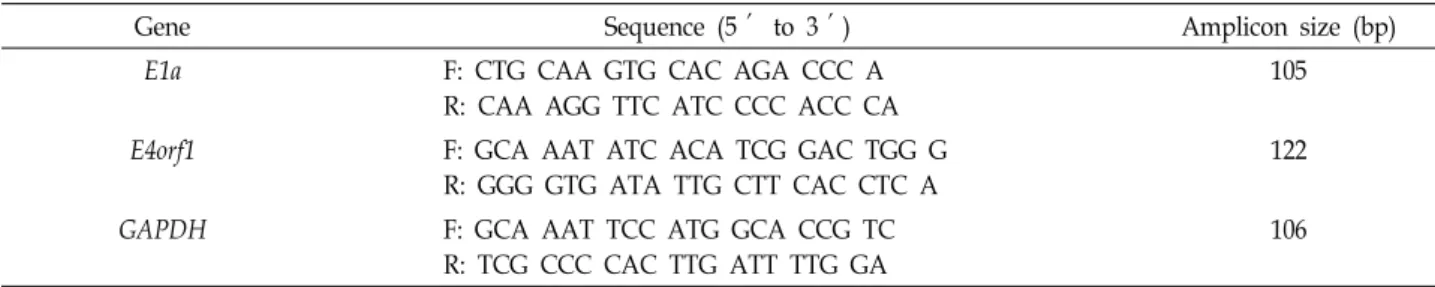
Gene Sequence (5′ to 3′) Amplicon size (bp)

E1a F: CTG CAA GTG CAC AGA CCC A

R: CAA AGG TTC ATC CCC ACC CA

105

E4orf1 F: GCA AAT ATC ACA TCG GAC TGG G

R: GGG GTG ATA TTG CTT CAC CTC A

122

GAPDH F: GCA AAT TCC ATG GCA CCG TC

R: TCG CCC CAC TTG ATT TTG GA

106

E1a: adenovirus early region 1A; E4orf1: E4 open reading frame 1; GAPDH: glyceraldehyde 3-phosphate dehydrogenase; F: forward;

R: reverse.

primers are shown in Table 1. The qRT-PCR conditions were as follows: 42℃ for 5 min and 95℃ for 10 sec, followed by 40 cycles of 95℃ for 3 sec and 60℃ for 30 sec (7,500 Fast real-time PCR system; Applied Biosystems, Foster City, CA, USA). The level of relative gene expression was determined by the 2

−ΔΔCT

method.

Hemagglutination titer assay

Confluent A549 cells were infected in a 6-well plate with 80 μl of a virus dilution containing 4 HAU and incubated at 37℃ in a 5% CO

2

incubator for 1 hr. Then, the plate was washed with phosphate-buffered saline (PBS), and the cells were treated with DRE at concentrations of 3.13, 6.25, and 12.5 μg/ml for 48 hr. Afterward, the virus supernatants were collected, and 50 μl of two-fold dilutions of the virus suspen- sion and a 1% suspension of red blood cells were mixed in a 96-well plate. The plate was left at room temperature for 30 min, and the HA titer was determined with a naked eye.

Cytopathogenic effect reduction assay

A cytopathogenic effect (CPE), which depends on the viral infection, was determined by a CPE reduction assay [22].

Confluent A549 cells were infected in a 12-well plate with 80 μl of a virus dilution containing 4 HAU and incubated at 37℃ in a 5% CO

2

incubator for 1 hr. Then, the plate was washed with PBS, and the cells were treated with DRE at concentrations of 3.13, 6.25, and 12.5 μg/ml for 48 hr. CPE was determined with a naked eye.

Identification of compounds

High-performance liquid chromatography (HPLC) and Liquid chromatography–mass spectrometry (LC-MS) were used to determine active compounds in DRE under con- ditions shown in Table 2.

Statistical analysis

Data were expressed as the mean ± standard deviation (n=3). Differences between the means of individual groups were assessed by one-way analysis of variance using the SPSS software (SPSS, Inc., Chicago, IL, USA).

Results

Cytotoxic effects and antiviral activity of DRE on A549 cells

To examine the antiviral activity of DRE against HAdV- 36, we evaluated cytotoxic effects of DRE. Effects of DRE on the viability of A549 cells were determined by the MTT assay. Cells were treated for 48 hr with various concen- trations (0-100 μg/ml) of DRE, and DRE showed cell toxicity at concentrations equal to or higher than 25 μg/ml. The cell viability rate was approximately 88.1% at a concentration of 25 μg/ml. DRE treatment did not affect the cell viability of A549 cells at concentrations of 6.12 and 12.5 μg/ml (Fig.

1). Therefore, we determined concentration that not

cytotoxicity.

(4)

Fig. 1. Effects of ethyl acetate fraction of Distylium racemosum (DRE) on A549 cell viability. A549 cells were treated with the indicated concentration (0, 6.25, 12.5, 25, 50, and 100 μg/ml) of DRE for 48 hr. Cell viability was meas- ured by MTT assay. Data are expressed as mean ± stand- ard deviation (n=3). Significant differences from control are indicated (p<0.05).

A B

C D

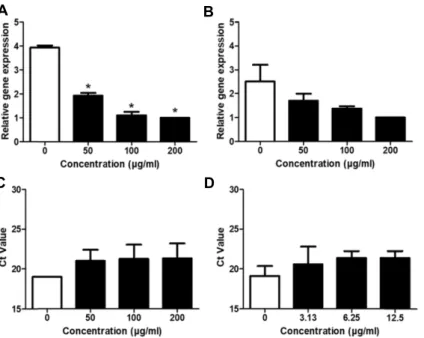
Fig. 2. Intracellular antiviral activity of ethyl acetate fraction from Distylium racemosum (DRE). (A) E1a gene expression levels (at 24 hr), (B) E1a gene expression levels (at 48 hr), (C) E4orf1 gene expression levels (at 24 hr), (D) E4orf1 gene expression levels (at 48 hr). A549 cells were infected with HAdV-36. DRE inhibited HAdV-36 replication in A549 cells. Data are expressed as mean ± standard deviation (n=

3). Significant differences from control are in- dicated (p<0.05).

After A549 cells were infected with the virus and in- cubated for 24 and 48 hr with DRE, the effect of DRE on the viral replication ability was examined by extracting viral RNA from the cells. Based on the qRT-PCR data, the E1a and E4orf1 gene expression levels were reduced by DRE treatment compared to negative control (Fig. 2). Also, After A549 cells were infected with the virus and incubated for 24 and 48 hr with DRE, the effect of DRE on the viral repli- cation ability was examined by extracting viral RNA from the virus supernatant. Based on the cycle threshold (Ct) val- ues, the E1a and E4orf1 gene expression levels were reduced by DRE treatment compared to negative control (Fig. 3).

Hemagglutination titer and cytopathogenic effect of DRE

To confirm the antiviral effect of DRE, HA titer and CPE were performed. The virus titer was determined using the HA titer. After viral infection, A549 cells were treated with DRE at 3.13, 6.25, and 12.5 μg/ml, and the virus was repro- duced for 48 hr. After 48 hr, the HA titer was suppressed in a DRE dose-dependent manner (Fig. 4). After confirming CPE of viral infection on A549 cells, CPE was found to be reduced by DRE treatment in a concentration-dependent manner, as compared with that in the untreated group (Fig.

5).

Active compounds in ethyl acetate fraction of Distylium racemosum leaf extract

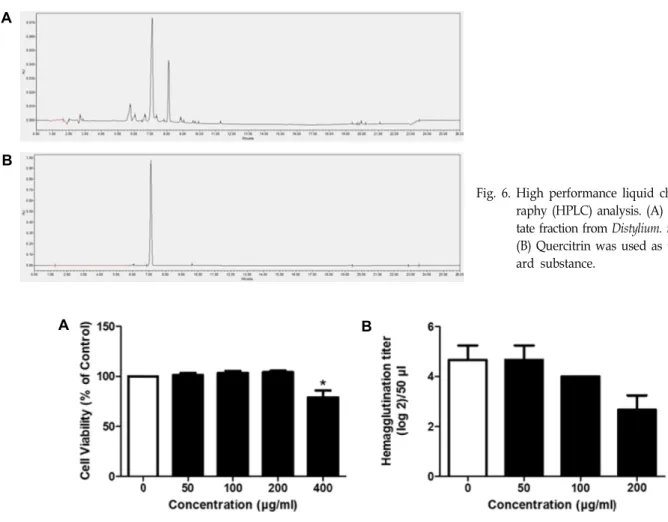
Major three peaks were identified in DRE by HPLC analysis. In addition, MS of the second peak were identified as m/z 449.11. We predicted quercitrin by results of MS. To confirm the substance, quercitrin was evaluated by HPLC.

As a result, the retention time of second peak of DRE and quercitrin was the same. Therefore, the compound in the second peak was confirmed as quercitrin (Fig. 6) and consid- ered to be responsible for the antiviral effects of DRE against HAdV-36.

Cytotoxic effects and antiviral activity of quercitrin on A549 cells

The effect of quercitrin on the viability of A549 cells was

determined by the MTT assay. Cells were treated for 48 hr

with various concentrations (0-400 μg/ml) of quercitrin, and

(5)

A B

C D

Fig. 3. Extracellular antiviral activity of ethyl acetate fraction from Distylium racemosum (DRE). (A) E1a gene expression levels (at 24 hr), (B) E1a gene expression levels (at 48 hr), (C) E4orf1 gene expression levels (at 24 hr), (D) E4orf1 gene expression levels (at 48 hr). A549 cells were infected with HAdV-36. DRE inhibited HAdV-36 replication in A549 cells. Data are expressed as mean ± standard deviation (n=3). Significant differences from control are indicated (p<0.05).

Fig. 4. Effects of ethyl acetate fraction from Distylium racemosum (DRE) on hemagglutination inhibition. DRE inhibited HAdV-36 replication in A549 cells. Data are expressed as mean ± standard deviation (n=3). Significant differ- ences from control are indicated (p<0.05).

Fig. 5. Effects of ethyl acetate fraction from Distylium racemosum (DRE) on cytopathogenic reduction. DRE inhibited the cytopathogenic effect (CPE). Data are expressed as mean

± standard deviation (n=3). Significant differences from control are indicated (p<0.05).

the compound showed cell toxicity at a concentration of 400 μg/ml. The cell viability rate was approximately 79.0% at 400 μg/ml quercitrin, but quercitrin treatment did not affect the cell viability of A549 cells at concentrations of 50, 100, and 200 μg/ml (Fig. 7A). Therefore, we determined concen- tration that not cytotoxicity. To confirm the antiviral effect of quercitrin, HA titer was performed. After viral infection, A549 cells were treated with quercitrin at 50, 100, and 200 μg/ml, and the virus was reproduced for 48 hr. After 48 hr, the HA titer was suppressed in a quercitrin at 100 and 200 μg/ml (Fig. 7B). In addition, to investigate the antiviral effect of quercitrin, gene expression level was performed.

After A549 cells were infected with the virus and incubated for 48 hr, the effect of quercitrin on the viral replication abil- ity was examined by extracting viral RNA from the cells

and virus supernatant. Based on the qRT-PCR data, the E1a and E4orf1 gene expression levels were reduced by querci- trin treatment (Fig. 8).

Discussion

Infectobesity refers to obesity caused by infection with

particular pathogens. Currently, various bacteria and viruses

that induce infectobesity have been actively studied, and

among them, HAdV-36 has been identified as a virus that

causes obesity in humans by promoting adipocyte differ-

entiation. Na et al. have shown an antiviral effect of a mul-

berry extract on HAdV-36, but there have been no other

studies on antiviral effects against HAdV-36 [18]. Thus, more

research is needed to search for natural products that are

(6)

A

B

Fig. 6. High performance liquid chromatog- raphy (HPLC) analysis. (A) Ethyl ace- tate fraction from Distylium. racemosum.

(B) Quercitrin was used as the stand- ard substance.

A B

Fig. 7. Effects of quercitrin on A549 cell viability and Hemagglutination titer. (A) A549 cell viability of quercetrin. (B) Effects of quercitrin on Hemagglutination titer. A549 cells were treated with the indicated concentration (0, 50, 100, 200, and 400 μg/ml) of quercitrin for 48 hr. Cell viability was measured by MTT assay. Quercitrin inhibited hemagglutination. Data are expressed as mean ± standard deviation (n=3). Significant differences from control are indicated (p<0.05).

highly effective anti-infectobesity drugs.

Studies using natural products from plants that grow nat- urally in Jeju have demonstrated the anti-inflammatory ef- fects of Sargassum muticum, antibacterial effects of Mollugo pentaphylla, Angelica anomala, Matteuccia orientalis, and Orixa japonica, as well as anti-obesity and antioxidant effects of Gelidium elegans [8, 11, 29]. Thus, research on Jeju natural resources need to be continued.

In this study, an ethyl acetate fraction was produced from the leaves of D. racemosum growing in Jeju, and its inhibitory efficacy on HAdV-36 replication was studied. A549 cells were infected with HAdV-36, and it was confirmed that in the DRE treatment group, HA was inhibited in a concen- tration-dependent manner, indicating that virus titers de- creased. HA is frequently used to calculate the virus titer since it can quickly determine the number of virus particles.

Nwodo et al. have determined antiviral effects of Cajanus cajan extracts on the measles virus using HA titers, and

Moradi et al. have demonstrated antiviral effects of a Peganum harmala seed extract on influenza virus also using HA titers [15, 19]

Since CPE occurs when cells are infected with a virus, viral infection can be detected using a CPE assay. In this study, we confirmed that A549 cells were infected with HAdV-36 by observing a rounded shape of infected cells.

The virus replication status can be confirmed depending on the degree of CPE. After DRE treatment, CPE was sup- pressed in a concentration-dependent manner.

In addition, the E1a and E4orf1 gene expression levels de- creased after DRE treatment compared with those without DRE treatment. This result suggested that DRE contained phytochemicals that suppressed the viral replication. Thus, HPLC was carried out, and major three peaks were detected.

The compound in one of the peaks was confirmed as querci-

trin, and its content in D. racemosum leaves was the same

as previously reported [20].

(7)

A B

C D

Fig. 8. Antiviral activity of quercitrin. (A) E1a gene expression levels (intracellular), (B) E4orf1 gene expression levels (intracellular), (C) E1a gene expression levels (extracellular), (D) E4orf1 gene expression levels (extracellular).

A549 cells were infected with HAdV-36.

Quercitrin inhibited HAdV-36 replication in A549 cells. Data are expressed as mean ± standard deviation (n=3). Significant differ- ences from control are indicated (p<0.05).

Quercitrin is a flavonoid-based compound. Flavonoids, widely distributed in plants, are effective against various hu- man pathologies, including hypertension, inflammatory con- ditions, and cancer [14]. It has been determined that querci- trin shows anti-inflammatory, antidiarrheic, antioxidant, and antinociceptive activities [2, 4, 5].

In this study, the anti-viral effect against HAdV-36 was identified with quercitrin, but it showed lower anti-virus ef- fect than DRE treatment. These results are thought to be in- dicative of the anti-viral effect by mixing quercitrin and oth- er unknown substances contained in DRE. Xu et al. have compared inhibition of human immunodeficiency virus (HIV)-1 protease using substances from Chinese medicinal herbs [28]. Therefore, additional analysis of substances in DRE is required, and after analyzing the substances, sub- stances that exhibit antiviral effects need to be identified.

In addition, the further study should be performed for path- way on viral replication.

This study revealed suppressive effects of DRE on repli- cation of HAdV-36, an obesity-inducing virus. The results can serve as a basis for the development of infectobesity treatment.

List of abbreviations

Ct: cycle threshold; DMEM: Dulbecco's modified Eagle's medium; DMSO: dimethyl sulfoxide; DRE: ethyl acetate frac- tion of Distylium racemosum leaf extract; FBS: fetal bovine serum; HA, hemagglutination; HAdV: human adenovirus;

HAU: hemagglutination unit; HPLC: high-performance liq-

uid chromatography; MTT: 3-(4,5-dimethylthiazol-2-yl)-2,5- diphenyltetrazolium bromide; PBS: phosphate-buffered sal- ine; PS: penicillin–streptomycin

Acknowledgement

This work was supported by grants from the Brain Busan 21 program.

The Conflict of Interest Statement

The authors declare that they have no conflicts of interest with the contents of this article.

References

1. Atkinson, R. L., Dhurandhar, N. V., Allison, D. B., Bowen, R. L., Israel, B. A. and Albu, J. B. 2005. Human adenovirus- 36 is associated with increased body weight and paradoxical reduction of serum lipids. Int. J. Obes. (Lond). 29, 281-286.

2. Comalada, M., Camuesco, D., Sierra, S., Ballester, I., Xaus, J., Galvez, J. and Zarzuelo, A. 2005. In vivo quercitrin anti-in- flammatory effect involves release of quercetin, which in- hibits inflammation through down-regulation of the NF-κB pathway. Eur. J. Immunol. 35, 584-592.

3. Dhurandhar, N. V., Israel, B. A., Kolesar, J. M., Mayhew, G.

F., Cook, M. E. and Atkinson, R. L. 2000. Increased adiposity in animals due to a human virus. Int. J. Obes. Relat. Metab.

Disord. 24, 989-996.

4. Galvez, J., Crespo, M. E., Jimenez, J., Suarez, A. and Zarzuelo, A. 1993. Antidiarrhoeic activity of quercitrin in mice and rats. J. Pharm. Pharmacol. 45, 157-159.

5. Hasan, S., Ahmed, I., Mondal, S., Masud, M. M., Sadhu,

(8)

S. K. and Ishibashi, M. 2006. Antioxidant, antinociceptive activity and general toxicity study of Dendrophthoe falcata and isolation of quercitrin as the major component. Orient.

Pharm. Exp. Med. 6, 355-360.

6. Hill, J. O. and Peters, J. C. 1998. Environmental contributions to the obesity epidemic. Science 280, 1371-1374.

7. Huang, Y. W., Liu, Y., Dushenkov, S. and Ho, C. T. 2009.

Anti-obesity effects of epigallocatechin-3-gallate, orange peel extract, black tea extract, caffeine and their combinations in a mouse model. J. Funct. Foods 2009, 304-310.

8. Jeon, H. J., Choi, H. S., Lee, O. H., Jeon, Y. J. and Lee, B.

Y. 2012. Inhibition of reactive oxygen species (ROS) and ni- tric oxide (NO) by Gelidium elegans using alternative drying and extraction conditions in 3T3-L1 and RAW 264.7 cells.

Prev. Nutr. Food. Sci. 17, 122-128.

9. Jo, H. J., Shin, Y. S., Park, G. N. and Chang, K. S. 2013.

Inhibition of hepatitis C virus (HCV) genotype 2a RNA rep- lication by extracts of medicinal herbs with anti-cholesterol effects. J. Med. Plant. Res. 7, 1089-1099.

10. Kim, S. K., Kim, H. J., Hur, K. Y., Choi, S. H., Ahn, C. W., Lim, S. K., Kim, K. R., Lee, H. C., Huh, K. B. and Cha, B. S. 2004. Visceral fat thickness measured by ultra- sonography can estimate not only visceral obesity but also risks of cardiovascular and metabolic diseases. Am. J. Clin.

Nutr. 79, 593-599.

11. Kim, S. S., Kim, J. Y., Lee, N. H. and Hyun, C. G. 2008.

Antibacterial and anti-inflammatory effects of Jeju medicinal plants against acne-inducing bacteria. J. Gen. Appl. Microbiol.

54, 101-106.

12. Lee, W. Y., Ahn, J. K., Park, Y. K., Park, S. Y., Kim, Y. M.

and Rhee, H. I. 2004. Inhibitory effects of proanthocyanidin extracted from Distylium racemosum on a-amylase and a-glu- cosidase activities. Kor. J. Pharmacogn. 35, 271-275.

13. Lupini, C., Cecchinato, M., Scagliarini, A., Graziani, R. and Catelli, E. 2009. In vitro antiviral activity of chestnut and quebracho woods extracts against avian reovirus and meta- pneumovirus. Res. Vet. Sci. 87, 482-487.

14. Middleton, E. Jr., Kandaswami, C. and Theoharides, T. C.

2000. The effects of plant flavonoids on mammalian cells:

implications for inflammation, heart disease, and cancer.

Pharmacol. Rev. 52, 673-751.

15. Moradi, M. T., Karimi, A., Rafieian Kopaei, M. and Fotouhi, F. 2017. In vitro antiviral effects of Peganum harmala seed extract and its total alkaloids against influenza virus. Microb.

Pathog. 110, 42-49.

16. Morfin, F., Dupuis-Girod, S., Mundweiler, S., Falcon, D.,

Carrington, D., Sedlacek, P., Bierings, M., Cetkovsky, P., Kroes, A. C., van Tol, M. J. and Thouvenot, D. 2005. In vitro susceptibility of adenovirus to antiviral drugs is species- dependent. Antivir. Ther. 10, 225-229.

17. Na, H. N., Hong, Y. M., Kim, J., Kim, H. K., Jo, I. and Nam, J. H. 2010. Association between human adenovirus-36 and lipid disorders in Korean schoolchildren. Int. J. Obes. (Lond).

34, 89-93.

18. Na, H. N., Park, S., Jeon, H. J., Kim, H. B. and Nam, J.

H. 2014. Reduction of adenovirus 36-induced obesity and inflammation by mulberry extract. Microbiol. Immunol. 58, 303-306.

19. Nwodo, U. U., Ngene, A. A., Iroegbu, C. U., Onyedikachi, O. A., Chigor, V. N. and Okoh, A. I. 2011. In vivo evaluation of the antiviral activity of Cajanus cajan on measles virus.

Arch. Virol. 156, 1551-1557.

20. Park, Y. K., Lee, W. Y., Ahn, J. K., Lee, H. J., Chin, H. S.

and Kwon, Y. J. 2003. Antioxidant compounds from Disty- lium racemosum leaves. J. Kor. Wood Sci. Technol. 31, 67-72.

21. Pasarica, M. and Dhurandhar, N. V. 2007. Infectobesity: obe- sity of infectious origin. Adv. Food. Nutr. Res. 52, 61-102.

22. Serkedjieva, J. and Hay, A. J. 1998. In vitro anti-influenza virus activity of a plant preparation from Geranium sangui- neum L. Antivir. Res. 37, 221-230.

23. van Ginneken, V., Sitnyakowsky, L. and Jeffery, J. E. 2009.

Infectobesity: viral infections (especially with human ad- enovirus-36: Ad-36) may be a cause of obesity. Med. Hypo- theses 2, 383-388.

24. Vangipuram, S. D., Sheele, J., Atkinson, R. L., Holland, T.

C. and Dhurandhar, N. V. 2004. A human adenovirus en- hances preadipocyte differentiation. Obes. Res. 12, 770-777.

25. Voss, J. D. and Dhurandhar, N. V. 2017. Viral infections and obesity. Curr. Obes. Rep. 6, 28-37.

26. Whigham, L. D., Israel, B. A. and Atkinson, R. L. 2006.

Adipogenic potential of multiple human adenoviruses in vivo and in vitro in animals. Am. J. Physiol. Regul. Integr.

Comp. Physiol. 290, R190-194.

27. Wigand, R., Gelderblom, H. and Wadell, G. 1980. New hu- man adenovirus (candidate adenovirus 36), a novel member of subgroup D. Arch. Virol. 64, 225-233.

28. Xu, H. X., Wam, M., Dong, H., But, P. P. and Foo, L. Y.

2000. Inhibitory activity of flavonoids and tannins against HIV-1 protease. Biol. Pharmaceut. Bull. 23, 1072-1076.

29. Yang, E. J., Ham, Y. M., Lee, W. J., Lee, N. H. and Hyun,

C. G. 2013. Anti-inflammatory effects of apo-9‘-fucoxanthi-

none from the brown alga, Sargassum muticum. Daru 21, 62.

(9)

초록:조록나무 잎 에틸 아세테이트 분획물의 아데노바이러스 36에 대한 항바이러스 효과

김혜란

1

․양은주

1

․장정현

1

․장경수

2

*

(

1

대구한의대학교 임상병리학과,

2

부산가톨릭대학교 임상병리학과)

비만의 원인은 유전적, 대사적 및 환경적 요인 등 다양한 가운데 특정 세균 및 바이러스 감염에 의해 비만이

유도되는 것이 확인되며 이러한 비만은 감염성 비만이라고 한다. 또한 감염성 비만을 유발하는 병원체 가운데

아데노바이러스 36이 밝혀졌다. 현재 비만 예방 및 치료제 개발에 대한 연구가 활발히 진행되는 가운데 감염성

비만의 예방 및 치료제 개발에 대한 연구는 불충불한 실정이다. 이와 관련하여 본 연구에서는 제주에 자생하는

조록나무 잎을 이용하여 분획물을 제조하고, 비만을 유도하는 사람아데노바이러스 36 증식에 미치는 영향을 평가

하고자 한다. A549세포에 사람아데노바이러스 36을 감염시키고, 조록나무 잎 에틸 아세테이트 분획물을 처리하여

바이러스 역가를 측정하였다. 그 결과, 조록나무 잎 에틸 아세테이트 분획물을 처리한군에서 농도 의존적으로 바

이러스 증식 억제능을 확인하였다. 또한 조록나무 에틸 아세테이트 분획물의 물질 분리를 한 결과, quercitrin이

확인되었으며, 표준물질 quercitrin의 사람아데노바이러스 36에 대한 증식 억제능을 확인하였다. 이러한 결과 조록

나무 잎 에틸 아세테이트 분획물은 감염성 비만 치료제 개발을 위한 효과적인 후보 물질로 사료되며, 본 연구는

감염성 비만 치료제 개발을 위한 기초 자료로 유용할 것으로 보인다.

수치

Table  2.  Conditions  for  analysis  of  DRE
Fig.  2.  Intracellular  antiviral  activity  of  ethyl  acetate  fraction  from  Distylium  racemosum  (DRE)
Fig.  3.  Extracellular  antiviral  activity  of  ethyl  acetate  fraction  from  Distylium  racemosum  (DRE)
Fig.  7.  Effects  of  quercitrin  on  A549  cell  viability  and  Hemagglutination  titer
+2

참조

관련 문서

Inhibition effects of flavonoids on hOAT1 and hOAT3: The inhibitory effects of five flavonoids such as morin, naringin, naringenin, silybin and quercetin on the uptake of [

Inhibitory effects of classified methanol extracts of Smilax china L on the COX-2 and iNOS expression of human colorectal cancer cell lines... Inhibitory

Based on the experimental results, the execution time in the matching process for 36 fingerprint minutiae, 200 chaff minutiae and 34 authentication fingerprint

The purpose of this study was to investigate the effects of sound-finding strategies based on phonological awareness on word recognition, oral reading

In the present study we investigated the proliferation effect of human oral cancer KB cell treated with pulsatilla koreana extract.. We analyzed the effects of this

출처 : IAEA 발표 자료(Comprehensive inspection exercise at bulk handling facilities, “U-235 Enrichment measurements by gamma-ray spectroscopy”) 13.  Uranium

The study on the clinical efficacy of korean red ginseng extract on postmenopausal syndrome..

The main effect according to the results of the repeated measures ANOVA on physical fitness based on test time showed a significant difference in grip