• 검색 결과가 없습니다.

Convergence Study on the Optimization for Suppression of Starch Hydrolysis using Rutin, Quercetin and Dietary Fiber Mixture Design

N/A
N/A
Protected

Academic year: 2021

Share "Convergence Study on the Optimization for Suppression of Starch Hydrolysis using Rutin, Quercetin and Dietary Fiber Mixture Design"

Copied!
7
0
0

로드 중.... (전체 텍스트 보기)

전체 글

(1)

Convergence Study on the Optimization for Suppression of Starch Hydrolysis using Rutin, Quercetin and Dietary Fiber Mixture Design

Imkyung Oh

1

, In Young Bae

2*

1

Professor, Food Science and Technology, Sunchon National University

2

Professor, Food and Nutrition, Far East University

루틴, 퀘르세틴, 식이섬유 혼합물 설계를 이용한 전분소화 지연 효과의 최적화에 대한 융합 연구

오임경

1

, 배인영

2*

1

국립순천대학교 식품공학과 교수,

2

극동대학교 식품영양학과 교수

Abstract This study was conducted to develop the efficient system for starch hydrolysis suppression using rutin, quercetin and dietary fiber through the statistical mixture design. The three components were replaced with wheat flour at the level of 10% and the mixed gel with three components was characterized by in vitro starch digestion. The mixture design was applied by simplex-centroid experimental model. The quadratic model (R

2

=0.86) was well fitted and the obtained regression equation indicated that the significant positive effects was observed in the quercetin and fiber mixture. Based on the statistical results, the best mixing ratio of quercetin and fiber was 72: 28 that led to the lowest predicted glycemic index (pGI). Their interactions on the pGI of starch digestibility were clearly visualized in the 3D surface plot. These results suggested that the mixture of quercetin and fiber interact strongly with wheat flour, consequently retarding starch hydrolysis by 15%.

Key Words : Mixture design, Glycemic index, In vitro digestibility, Rutin, Quercetin, Fiber

요 약 본 연구는 루틴, 퀘르세틴, 식이섬유가 전분 소화율에 미치는 영향을 통계적 혼합물 설계방법을 이용하여 확인 하고자 하였다. 세 가지 성분들은 모두 농도가 증가함에 따라 전분소화 지연 효과가 나타났으며, 그 중에서도 퀘르세틴 과 식이섬유가 함께 섞였을 때 가장 높은 지연 효과를 보였다. 이 혼합물 설계는 simplex-centroid 실험설계법을 이 용하였고, 최적 모델은 quadratic 모델에서 나타났다. 이때 얻어진 회귀방정식을 통하여 유의한 상승효과를 확인할 수 있었다. 최적화 통계 방법을 사용하여 혼합비를 분석한 결과 퀘르세틴과 식이섬유가 72: 28 비율에서 전분 소화 지연 효과가 최대로 나타나는 것을 확인하였다. 전분소화에 대한 영향을 3차원 표면 도표로 시각화하여 나타내었으며, 이 결과로 퀘르세틴과 식이섬유의 상호작용으로 인하여 전분 소화를 15% 이상 지연시키는 것을 확인할 수 있었다.

주제어 : 루틴, 퀘르세틴, 식이섬유, 전분 소화, 혼합물 설계

*This research was supported by the Basic Science Research Program through the National Research Foundation of Korea (NRF) funded by the Ministry of Education (NRF-2017R1D1A3B03036428).

*Corresponding Author : In Young Bae([email protected]) Received March 12, 2020

Accepted May 20, 2020 Revised April 20, 2020

Published May 28, 2020

(2)

1. Introduction

Many researches about phytochemicals have been conducted in relation to the mechanisms with reduced risk of chronic diseases such as cancer, obesity, hyperlipidemia, and type II diabetes and the increased consumption in food industry have been attributed to their bioactivities as functional materials [1, 2]. The use of phytochemical in starch digestibility has recently been paid attention due to the retarding effect of starch hydrolysis. The slowing down the rate of starch digestion led to retard blood glucose response, to reduce insulin requirements, and to cause satiety by reducing the stress on regulatory systems related to energy metabolism [3]. Various phytochemicals could decrease in vitro starch digestibility by inhibiting digestive enzyme and interacting with starch. The interaction between phytochemical and starch could alter its rheological properties, gelatinization, retrogradation, and gelling properties as well as inhibit the digestive enzyme [4, 5]. Barros et al. [6] represented the effect complex of tannin and starch in starch digestibility and Chai et al. [7] investigated the interaction between maize starch and tea polyphenol.

Rutin and quercetin are widely distributed in edible plants, and as powerful phytochemicals, they contain various bioactivities such as antioxidation [8], anti-inflammation [9], and anti-carcinogenicity [10]. Also rutin and quercetin in buckwheat was well known to act as α-amyloglucosidase inhibitors [11] and the conformation of complex between quercetin and starch resulted in alternation of the granule morphology and thermal properties and resulted in the dramatically reduction of digestion rate [12].

Dietary fiber is also known as one of the important factors that can affect starch hydrolysis. There are many studies that dietary fiber could be suppressed the starch digestibility.

In according to the Brennan [13], dietary fiber

has shown to be effective in delaying starch digestion, and they have also resulted in slow starch degradation by reducing enzyme accessibility or enclosing starch molecules. And the previous study reported that the ratio of soluble and insoluble dietary fiber could be affected the starch digestibility in food model [14]. However, the optimization using a statistical treatment among phytochemicals, dietary fiber, and starch on starch digestion have not been insufficiently studied even though a single effect based on the concentration of extract or ingredient was investigated.

Therefore, the purpose of this study was to investigate the combined effects and optimal levels of the three components (rutin, quercetin and dietary fiber) that delay the starch digestibility by using a statistical method using simplex-centroid design.

2. Materials and Methods 2.1 Materials

The dietary fiber (95% purity), rutin (95% purity), and quercetin (88% purity) from Tartary buckwheat (Fagopyrum tartaricum) were used in this study (Hunan Huacheng Biotech, Inc., China). Salivary amylase (A0521, EC 3.2.1.1), pancreatin from porcine pancreas (P7545), bile extract (B8631), and amyloglucosidase from Aspergillus niger (A9931, EC 3.2.1.3) were purchased from Sigma-Aldrich (St. Louis, MO, USA). A total starch assay kit (K-TSTA) and a glucose oxidase-peroxidase assay kit (K-GLUC) were obtained from Megazyme International Ireland Ltd. (Bray, Ireland). The wheat flour was bought from CJ Co. (Seoul, Korea).

2.2 In vitro starch digestibility and predicted glycemic index

In vitro starch digestion of wheat flour gel

(3)

(10.71%) was conducted based on the method of Minekus et al. [15]. with slight modification. Gel sample (5 g) was prepared by gelatinization by heating in a boiling water bath (20 min). For oral digestion, a salivary fluid stock solution (3.5 mL) and a salivary α-amylase solution (0.5 mL) were added in the gel sample (37°C, 2 min). And the gastric fluid stock solution (7.5 mL) and a porcine pepsin stock solution (1.6 mL) were mixed (37°C, 2 h) and the gastric phase digestion was adjusted at pH 3.0 with 1 M HCl. After then, the intestinal fluid stock solution (11 mL), a pancreatin-bile solution (7.5 mL), and amyloglucosidase (0.2 mL/gram starch) were reacted for 3 h and the intestinal phase digestion was adjusted to pH 6.0.

Hydrolyzed starch was collected at 0, 30, 60, 90, 120, and 180 min. The amount of glucose released during digestion were analyzed using GOPOD kit. The hydrolysis index (HI) was evaluated as the total glucose amount released from the sample relative to that from white bread. The pGI (predicted glycemic index) was estimated using the equation: pGI = 39.71 + 0.549HI, described by Goñi [16].

2.3 Statistical experimental design

The mixture design of the experiment was used to obtain the optimal mixture composition of three components, which were included dietary fiber, rutin and quercetin and selected based on literature research as independent variables, for retarding the starch hydrolysis in vitro starch digestion model system. The experimental design of mixed flour gels was performed using a Design expert software (DX10, Stat-Ease, Inc., MN, USA). Augmented simplex-centroid design was applied and the independent components were fiber, rutin and quercetin, coded as A, B and C, respectively. And each component was applied in five level (0, 2.5, 3.3, 5, and 10%). Simplex-centroid design was used and their experimental data are summarized in Table 1(A). Linear, quadratic, special cubic,

cubic, special quartic and quartic interaction in terms of the polynomial models were fitted to investigate the effects of each component and their interactions on the response.

2.4 Statistical analysis

The experimental measurements were conducted in triplicate. The data were analyzed by one-way analysis of variance, and the means were compared by Duncan’s multiple range test at p<0.05 by using a SPSS software (version 25, SPSS Inc., Chicago, IL, USA). The mixture design analysis and ternary plot were generated by Minitab software (version 14, Minitab Co. Ltd., USA).

3. Results and Discussion

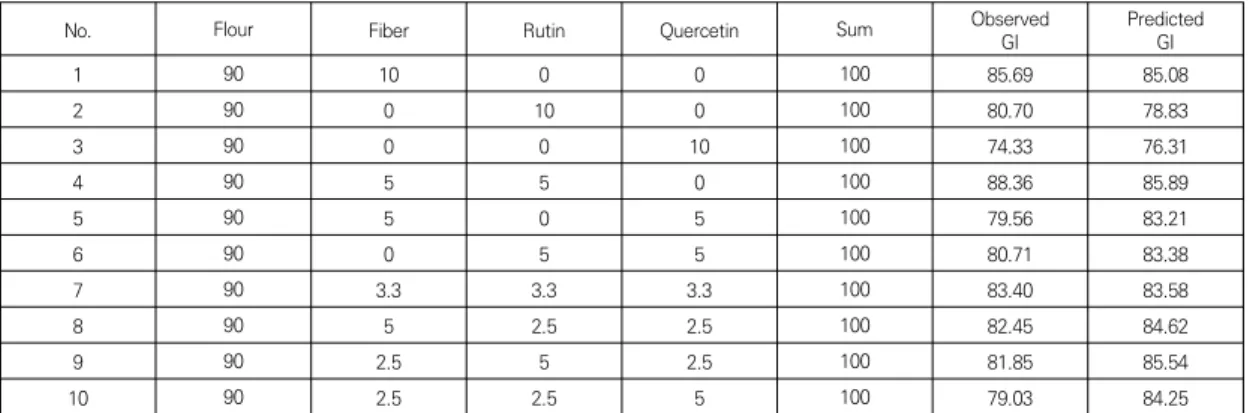
The design of experiment is a statistical method to investigate the interaction of the rutin, quercetin and dietary fiber in vitro starch digestibility and also to determine their optimal levels. Table 1 shows the results of the experimental data using simplex-centroid design.

The lowest pGI value was observed in quercetin (10%) sample (No. 3), followed by the fiber (5 and 2.5%)-quercetin (5%) samples (No. 5 and 10).

However, the samples with fiber (10%) and fiber (5%)-rutin (5%) showed a slightly decrease in pGI suppression. To further analyze the interaction between three components and the optimal level, statistical analysis of the response was performed and represented in Table 2.

The fitness and goodness of the fitted models were evaluated by the significance of lack-of-fit, and adjusted and predicted R

2

values. Linear, cubic and special cubic models were excluded from the fitting due to their significance of lack-of-fit values. Quadratic mixture model was well fitted for all variations (R

2

=0.86) compared to other mixture models as a function of the significant interaction effects between the levels.

The results of ANOVA for the response (pGI) of

(4)

No. Flour Fiber Rutin Quercetin Sum Observed

GI Predicted

GI

1 90 10 0 0 100 85.69 85.08

2 90 0 10 0 100 80.70 78.83

3 90 0 0 10 100 74.33 76.31

4 90 5 5 0 100 88.36 85.89

5 90 5 0 5 100 79.56 83.21

6 90 0 5 5 100 80.71 83.38

7 90 3.3 3.3 3.3 100 83.40 83.58

8 90 5 2.5 2.5 100 82.45 84.62

9 90 2.5 5 2.5 100 81.85 85.54

10 90 2.5 2.5 5 100 79.03 84.25

Table 1. Mixture design for 10 trials with three components and their responses

Model Lack-of-fit Standard deviation R

2

Adjusted R

2

Predicted R

2

Linear 0.0017 2.9 0.5987 0.5564 0.4367

Quadratic 0.4345 1.61 0.89567 0.8631 0.7518

Special Cubic 0.3274 1.65 0.8974 0.8564 0.71956

Cubic 0.1266 1.71 0.9047 0.8461 0.6998

Special Quartic 0.1266 1.71 0.9047 0.8461 0.6998

Quartic N/A N/A N/A N/A N/A

N/A: not analyzed

Table 2. List of summary statistics of the fitted models for the response of predicted glycemic index

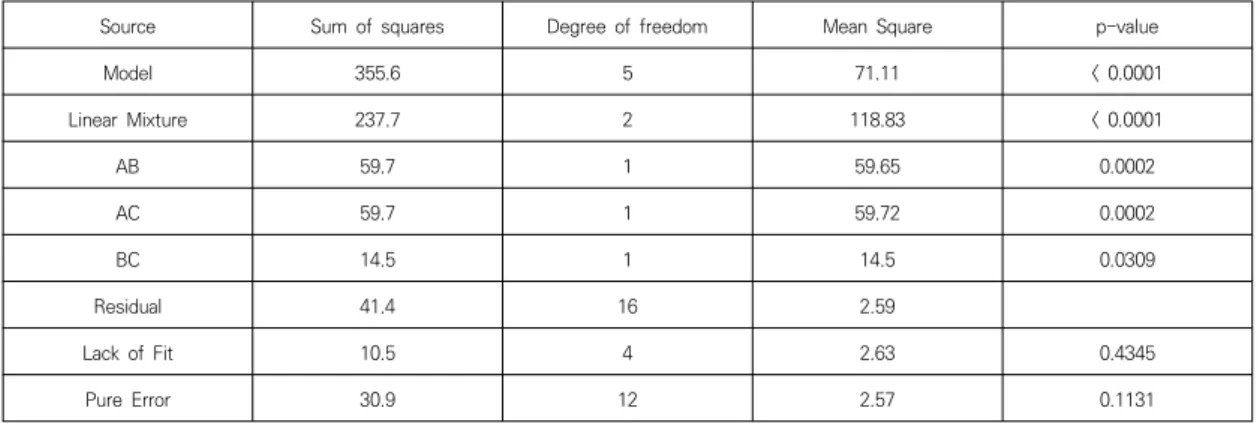
the fitted quadratic mixture model are summarized in Table 3, which was demonstrated that the pGI values experimentally obtained were close to those predicted by the fitted quadratic mixture model. The fitted model for the prediction of the response can be expressed as follow:

pGI = 85.07A + 80.50B + 75.41C + 22.73AB - 22.04AC + 11.21BC

The negative quadratic terms (AC) of the fitted regression equation indicated the antagonistic effects in vitro starch digestibility. According to the fitted regression equation, the fiber and quercetin mixture (AC) is the most effective to lower the glycemic index. But AB and BC were not observed in suppression effects.

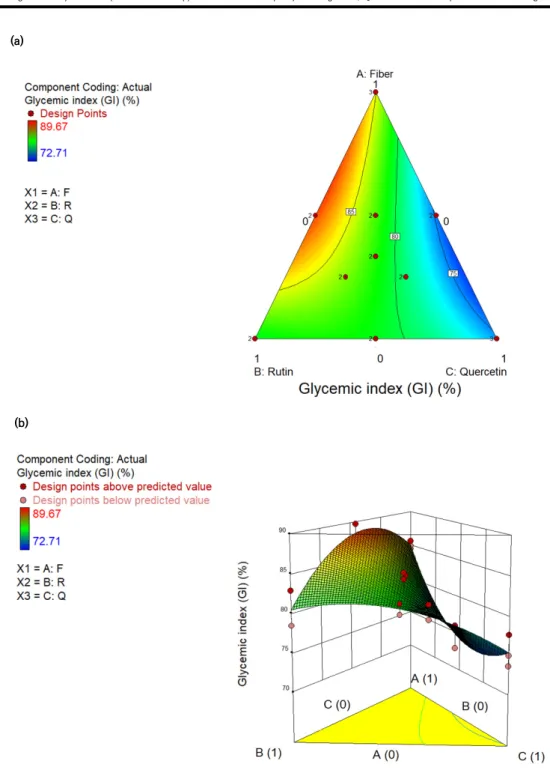
The effects of ternary mixture components and their interactions on the response (pGI) were projected onto the two-dimensional ternary contour and three-dimensional surface plots as

shown in Fig. 1(a) and (b). As can be seen in the Fig. 1(a), the effects of all individual components and binary interaction of fiber/quercetin had positive effects, while the binary interactions of fiber/rutin and rutin/quercetin synergistically gave negative effects on the pGI in vitro starch digestibility.

Furthermore, the effects of individual

components and their interactions on the pGI of

starch digestibility were clearly visualized in the

3D surface plot (Fig. 1(b)). A steep cliff indicated

that the fiber/quercetin mixture had significantly

lower effects on in vitro starch digestibility than

the other components. Moreover, when the

synergistic effects of the three components of

fiber, rutin and quercetin were analyzed using

the optimization tool, it was found that the most

effective mixing ratio of fiber and quercetin was

28:72, that was effective by 15% lowering the

glycemic index.

(5)

(a)

(b)

Fig. 1. Schematic plots of (a) ternary contour and (b) 3D surface plots for the response of predicted

glycemic index of the fitted quadratic mixture model

(6)

Source Sum of squares Degree of freedom Mean Square p-value

Model 355.6 5 71.11 < 0.0001

Linear Mixture 237.7 2 118.83 < 0.0001

AB 59.7 1 59.65 0.0002

AC 59.7 1 59.72 0.0002

BC 14.5 1 14.5 0.0309

Residual 41.4 16 2.59

Lack of Fit 10.5 4 2.63 0.4345

Pure Error 30.9 12 2.57 0.1131

Table 3. Analysis of variance (ANOVA) of the fitted quadratic mixture model for the response of predicted glycemic index

The beneficial effect of quercetin is due to partial inhibition of amylase and α-glucosidase enzyme and delay the absoption of glucose, that could ultimately control the blood glucose level [17]. The beneficial effect of dietary fiber is usually attributed to delays starch degradation in the accordance with physical mechanisms including restriction of water and entrapping starch granule [14]. Based on these properties, the synergistic effect of quercetin and dietary fiber in vitro starch digestibility could be explained in this study. Indeed, further study on physico- chemical charcteristics of their interaction is needed to provided to explain accurately this effect.

4. Conclusion

The objective of this work was to investigate the combined influences of rutin, quercetin and dietary fiber in vitro starch digestibility. That is, three components were substituted with wheat flour at the 5 levels that designed by statistical method and then their effects in vitro starch digestibility were analyzed. The quercetin and fiber mixture was the most effective in retarding starch hydrolysis and their ratio was obtained 72:28 by optimization tool. The various statistical models were analyzed to find valid experimental

model and the regression equation which was represented synergic effect on the suppression of starch hydrolysis was obtained. Although more study is needed to investigate the interaction with quercetin and dietary fiber, its combination may be useful for lowering starch digestibility.

REFERENCES

[1] C. I. Abuajah, A. C. Ogbonna & C. M. J. Osuji. (2015).

Functional components and medicinal properties of food: a review. Journal of Food Science and Technology, 52(5), 2522-2529.

[2] M. Saxena, J. Saxena, R. Nema, D. Singh & A. Gupta.

(2013). Phytochemistry of medicinal plants. Journal of Pharmacognosy and Phytochemistry, 6(1), 168-182.

[3] M. Miao, H. Jiang, B. Jiang, T. Zhang, S. W. Cui & Z.

Jin. (2014). Phytonutrients for controlling starch digestion: Evaluation of grape skin extract. Food Chemistry, 145, 205-211.

[4] F. Zhu, Y. Z. Cai, M. Sun & H. Corke. (2009). Effect of phytochemical extracts on the pasting, thermal, and gelling properties of wheat starch. Food Chemistry, 112(4), 919-923.

[5] F. Zhu, Y. Z. Cai, M. Sun & H. Corke (2008). Effect of phenolic compounds on the pasting and textural properties of wheat starch. Starch-Stärke, 60(11), 609-616.

[6] F. Barros, J. M. Awika & L. W. Rooney. (2012).

Interaction of tannins and other sorghum phenolic compounds with starch and effects on in vitro starch digestibility. Journal of Agricultural and Food Chemistry, 60(46), 11609-11617.

[7] Y. Chai, M. Wang & G. Zhang. (2013). Interaction

(7)

between amylose and tea polyphenols modulates the postprandial glycemic response to high-amylose maize starch. Journal of Agricultural and Food Chemistry, 61(36), 8608-8615.

[8] M. Chopra, P. E. Fitzsimons, J. J. Strain, D. I.

Thurnham & A. N. Howard. (2000). Nonalcoholic red wine extract and quercetin inhibit LDL oxidation without affecting plasma antioxidant vitamin and carotenoid concentrations. Clinical Chemistry, 46(8), 1162-1170.

[9] D. R. Ferry et al. (1996). Phase I clinical trial of the flavonoid quercetin: pharmacokinetics and evidence for in vivo tyrosine kinase inhibition. Clinical Cancer Research, 2(4), 659-668.

[10] M. A. Pereira et al. (1996). Effects of the phytochemicals, curcumin and quercetin, upon azoxymethane-induced colon cancer and 7, 12-dimethylbenz [a] anthracene-induced mammary cancer in rats. Carcinogenesis, 17(6), 1305-1311.

[11] Y. Q. Li, F. C. Zhou, F. Gao, J. S. Bian & F. Shan. (2009).

Comparative evaluation of quercetin, isoquercetin and rutin as inhibitors of α-glucosidase. Journal of Agricultural and Food Chemistry, 57(24), 11463-11468.

[12] L. Zhang, X. Yang, S. Li & W. Gao. Preparation, physicochemical characterization and in vitro digestibility on solid complex of maize starches with quercetin. LWT-Food Science and Technology, 44(3), 787-792.

[13] C. S. Brennan. (2005). Dietary fibre, glycaemic response, and diabetes. Molecular Nutrition and Food Research, 49(6), 560-570.

[14] I. K Oh, I. Y. Bae & H. G. Lee. (2014). In vitro starch digestion and cake quality: impact of the ratio of soluble and insoluble dietary fiber. International Journal of Biological Macromolecules, 63, 98-103.

[15] M. Minekus et al. (2014). A standardised static in vitro digestion method suitable for food–an international consensus. Food and Function, 5(6), 1113-1124.

[16] I. Goñi, A. Garcia-Alonso & F. Saura-Calixto. (1997). A starch hydrolysis procedure to estimate glycemic index. Nutrition Research, 17(3), 427-437.

[17] S. Shobana, Y. N. Sreerama & N. G. Malleshi (2009).

Composition and enzyme inhibitory properties of finger millet (Eleusine coracana L.) seed coat phenolics: Mode of inhibition of α-glucosidase and pancreatic amylase. Food Chemistry, 115(4), 1268-1273.

오 임 경(Im Kyung Oh) [정회원]

․ 2002년 2월 : 한양대학교 식품영양학 과(이학석사)

․ 2016년 8월 : 한양대학교 식품영양학 과(이학박사)

․ 2019년 8월 ~ 현재 : 국립순천대학교 식품공학과 조교수

․ 관심분야 : 식품가공, 기능성식품

․ E-Mail : [email protected]

배 인 영(In Young Bae) [종신회원]

․ 1997년 2월 : 한양대학교 식품영양학 과(이학석사)

․ 2006년 8월 : 한양대학교 식품영양학 과(이학박사)

․ 2013년 3월 ~ 현재 : 극동대학교 식품 영양학과 교수

․ 관심분야 : 식품가공, 기능성식품

․ E-Mail : [email protected]

수치

Table  1.  Mixture  design  for  10  trials  with  three  components  and  their  responses
Fig. 1. Schematic plots of (a) ternary contour and (b) 3D surface plots for the response of predicted glycemic  index  of  the  fitted  quadratic  mixture  model
Table 3. Analysis of variance (ANOVA) of the fitted quadratic mixture model for the response of predicted glycemic index

참조

관련 문서

The purpose of this study is to investigate the effect of the “problem solving and programming” area of ​​information subject on perception and

The purpose of this study is to investigate the effects on elementary school students' academic English improvement, interest, and self-confidence through the

Therefore, the aim of this study was to investigate the morphologic characteristics of the interalveolar foramen and to analyze according to sex and age using cone

The purpose of this study was to examine the effects of 8 weeks of Zumba dance exercise for obese middle-aged women on blood lipid index and vascular aging.. The subjects of

The purpose of this study was to investigate the impact of social capital and positive psychology capital on the will of start-up according to experience

The purpose of this study is to establish and design the characteristics of summer resorts according to the design manual, develop cultural products using

The purpose and necessity of this study was to investigate the effect of the 8-week GX complex exercise program on the stress index, blood lipid and APG

The purpose of this study was to examine the parents' perceptions on the current status, effects and satisfaction of personal assistant service for students