Simulation of Inductively Coupled Ar/O
2Plasma;
Effects of Operating Conditions on Plasma Properties and Uniformity of Atomic Oxygen
Seung-Kyu Park, Jin-Bae Kim and Heon Chang Kim†
†Department of Chemical Engineering, Hoseo University
ABSTRACT
This paper presents two dimensional simulation results of an inductively coupled Ar/O2 plasma reactor. The effects of operating conditions on the plasma properties and the uniformity of atomic oxygen near the wafer were systematically investigated. The plasma density had the linear dependence on the chamber pressure, the flow rate of the feed gas and the power deposited into the plasma. On the other hand, the electron temperature decreased almost linearly with the chamber pressure and the flow rate of the feed gas. The power deposited into the plasma nearly unaffected the electron temperature. The simulation results showed that the uniformity of atomic oxygen near the wafer could be improved by lowering the chamber pressure and/or the flow rate of the feed gas. However, the power deposited into the plasma had an adverse effect on the uniformity.
Key Words : Inductively Coupled Plasma, Oxygen Plasma, Radio Frequency, Atomic Oxygen, Uniformity
1. Introduction
Currently plasma etching and plasma enhanced chemical vapor deposition of thin films are employed in a variety of industries. Applications include integrated circuit (IC) manufacturing, fabrications of flat panel displays and optical sensors, decorative plating, surface cleaning and coating of materials. In the microelectronics industry, great demands on enhancement of the IC fabrication technique have resulted in an extraordinary progress in plasma technology. These advancements were made to precisely transfer more complicated circuitries to a smaller geometry. The minimum feature size of 65 nm is embedded in today's IC’s manufactured in the semiconductor industry [1]. In the fabrication of such devices, plasma etching is the only technology that can fulfill the stringent requirements of etching anisotropy, selectivity and uniformity required in modern IC manufacturing.
In spite of their high cost and technological importance, plasma processing equipment have been experimentally and statistically fine tuned, over time, at great time and material cost [2-4]. As process and product complexity as well as time and material development costs continue to increase, however, this approach becomes increasingly ineffective because large numbers of experiments need to be carried out before implementation. Time and money spent in an extensive experimental approach is astronomical. The cost of wafers needed for a comprehensive equipment testing and evaluation for an IC fabrication process has been estimated to be several hundred thousand dollars according to the National Research Council [4]. Furthermore, the experimental results often do not provide a fundamental understanding of the process, limiting their value to the employed design and operating conditions. In addition, plasma processes often generate environmentally hazardous waste [5].
Ever-increasing development costs and concerns over adverse environmental and health impact require these processes to be re-engineered and optimized in a more cost effective manner that relies less on
†E-mail : [email protected]
experimental approaches.
First principle model based simulation is the cornerstone of such efforts. This approach can help streamline and accelerate design and implementation of plasma reactors as well as rapid optimization of operating conditions without expensive and time consuming experiments [6-12]. In this regard, through the simulation of an inductively coupled Ar/O
2plasma reactor, this paper systematically investigates the effects of operating conditions on the major plasma properties and the uniformity of the atomic oxygen near the wafer.
2. Simulation of Inductively Coupled Plasma
The geometry of the ICP reactor employed to investigate the effect of operating conditions on plasma properties and atomic neutral species profile is shown in Fig. 1. The feed gas was considered to be injected at the chamber pressure into the reactor through pinholes around the edge of the upper quartz window placed under the 6 concentric inductive coils and to be pumped out through the rim of the
electrostatic chuck to the pumping port as indicated by arrows in Fig. 1(a). The radius of the chuck and the chamber was 12.5 cm and 16 cm, respectively. The distance from the top of the electrostatic chuck to the bottom of the upper quartz window was 13 cm. The ICP chamber was assumed axisymmetric, and two dimensional simulations were carried out by utilizing a commercially available plasma simulator, CFD- ACE+, to accommodate more complex geometries in the future [13]. The coil current was calculated based on the specified deposit power.
3. Results and Discussion
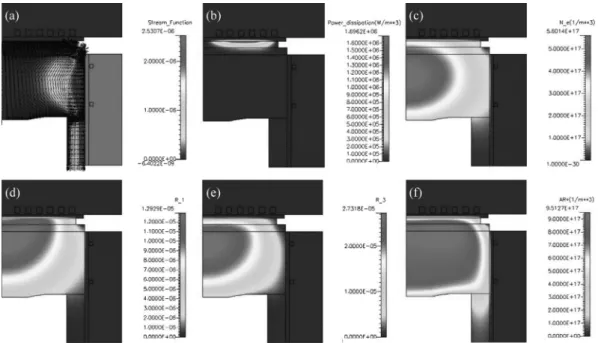
Fig. 1 shows time-averaged plasma properties obtained from the simulation of pure argon plasma at 10 mTorr. The flow rate of argon and the deposited power were set to 600 sccm and 400 W, respectively.
In Table 1, the electron impact reactions considered for argon in plasma are summarized with corresponding reaction rate coefficients, taken from [14], in an Arrhenius form. To deposit the specified power into the plasma, the coil current turned out to be 9.11 A.
As shown in Fig. 1(a), the typical flow pattern of
Fig. 1. (a) stream function with velocity vectors; (b) deposited power; (b) electron density; (d) ionization rate (R-1); (e) ionization rate (R-3); and (f) excited state (Ar*).
neutrals was laminar in the range of the feed flow rate considered in this study. Fig. 1(b) and 1(c) show the time-averaged distributions of the deposited power and plasma densities, respectively. The skin depth was less than 1 cm and the peak plasma density was 5.6×10
11cm
-3. Fig. 1(d) and 1(e) show the time- averaged distributions of ionization rates from the ground state argon (Ar) and from the metastable argon (Ar*), respectively. Although both Ar and Ar*
were predominantly ionized in the central part of the chamber, the peak ionization rate of Ar* was about twice higher and further away from the upper quartz window than that of Ar, implying that the distribution of the metastable argon, shown in Fig. 1(f), might have the propound effect on the plasma properties.
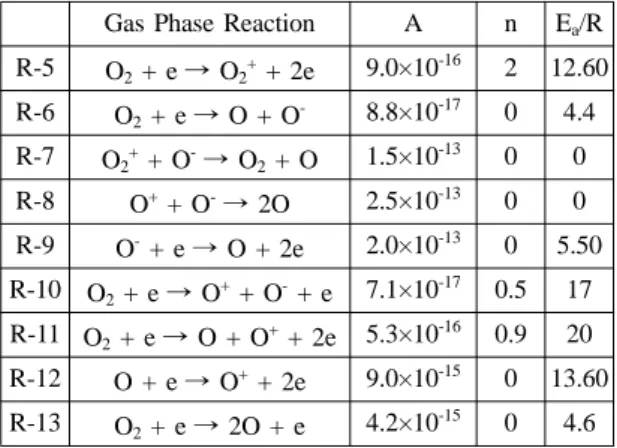
To investigate the effects of operating conditions on plasma properties, the flow rate and composition of feed gas, power and pressure were systematically varied as listed in Table 2. The electron impact reactions considered for oxygen in plasma are also summarized in Table 3.
Fig. 2 represents the dependences of plasma density and electron temperature on the operating conditions varied. As the chamber pressure increased, the plasma density monotonically increased, as shown in Fig. 2(a), while the electron temperature almost linearly decreased mainly because energetic electrons lose their more energy by more frequently colliding with neutrals. When a small amount of oxygen (8.3 vol. %) was added to argon, the plasma density increased about 60% at the relatively low pressure (10 mTorr) simply because the total flow rate increased. However the plasma density decreased about 15% at relatively higher pressure (30 mTorr) due to the high threshold energy for the ionization of
oxygen and the low electron temperature. When the total flow rate of feed increased, the electron temperature slightly decreased although the plasma density increased, as shown in Fig. 2(b). Consequently the addition of oxygen has the plasma density increased in all cases. Although the plasma density is also linearly proportional to the power deposited to the plasma, as shown in Fig. 2(c), the electron temperature almost remain constant. The plasma density and the electron temperature measured by a
Table 1. Electron impact reactions of argon in plasma andcorresponding reaction rate coefficients.
Gas Phase Reaction A n Ea/R R-1 Ar + e → Ar+ + 2e 1.2×10⁻¹³ 0 18.70 R-2 Ar + e → Ar* + 2e 1.2×10⁻¹⁴ 0 11.94 R-3 Ar* + e → Ar+ + 2e 3.0×10⁻¹³ 0.1 5.22 R-4 Ar + e → Ar + e 1.5×10⁻¹⁴ 0 0
Table 2. Operating conditions considered and calculated coil currents to deposit specified powers.
Pressure (mTorr)
Flow Rate (sccm) Power (W)
Current Total Ar O2 (A)
T-1 10 600 600 - 400 9.11
T-2 20 600 600 - 400 8.33
T-3 30 600 600 - 400 7.49
T-4 10 300 300 - 400 10.40
T-5 10 450 450 - 400 10.00
T-6 10 600 600 - 200 6.77
T-7 10 600 600 - 600 12.41
T-8 10 650 600 50 400 9.67
T-9 20 650 600 50 400 8.20
T-10 30 650 600 50 400 7.36
T-11 10 325 300 25 400 10.26
T-12 10 487.5 450 37.5 400 9.91
T-13 10 650 600 50 200 6.66
T-14 10 650 600 50 600 12.15
Table 3. Electron impact reactions of oxygen in plasma and corresponding reaction rate coefficients.
Gas Phase Reaction A n Ea/R R-5 O2 + e → O2+
+ 2e 9.0×10⁻¹⁶ 2 12.60 R-6 O2 + e → O + O- 8.8×10⁻¹⁷ 0 4.4 R-7 O2+ + O- → O2 + O 1.5×10⁻¹³ 0 0 R-8 O+ + O-→ 2O 2.5×10⁻¹³ 0 0 R-9 O- + e → O + 2e 2.0×10⁻¹³ 0 5.50 R-10 O2 + e → O+ + O- + e 7.1×10⁻¹⁷ 0.5 17 R-11 O2 + e → O + O+ + 2e 5.3×10⁻¹⁶ 0.9 20 R-12 O + e → O+ + 2e 9.0×10⁻¹⁵ 0 13.60 R-13 O2 + e → 2O + e 4.2×10⁻¹⁵ 0 4.6
Langmuir probe (ESPION from Hidden Analytical) for the case T-7 were 8.51×10
11cm
-3and 3.14 eV, respectively. The plasma density obtained by the simulation agreed well with the experimental meas- urement though the electron temperature was under predicted.
Finally, Fig. 3 represents the effects of operating conditions on the radial profile of metastable argon
and atomic oxygen near the electrostatic chuck where a wafer is placed. When pure argon was used, the chamber pressure had an adverse effect on the uniformity of the metastable distribution while the flow rate and the deposited power nearly unaffected the uniformity. Similar results were obtained with the mixture of argon and oxygen. The unformity of the atomic oxygen distribution was, however, slightly improved by reducing the total flow rate of the feed
Fig. 2. Effects of (a) chamber pressure, (b) feed flow rateand (c) deposited power on plasma density and electron temperature.
Fig. 3. Effects of chamber pressure, feed flow rate and deposited power on metastable argon and oxygen atom profiles near wafer.
gas. These results imply that the flow pattern stemmed from the chamber pressure and the feed flow has the most propound effect on the uniformity of the chemically reactive neutral species. Consequently, the chamber pressure and the feed flow rate should be kept as low as possible for the uniform modification of the wafer surface. On the other hand, the amount of the chemically reactive species available for the modification of the wafer surface need to be increased by adjusting the power deposited into the the plasma.
However, it should be noted that too high power deposition resulted in less uniform distribution of the atomic oxygen.
4. Conclusions
Through two dimensional simulations of the inductively coupled plasma reactor, the effects of operating conditions on the plasma properties and the uniformity of atomic oxygen near the wafer were systematically investigated. The plasma density had the linear dependence on the chamber pressure, the flow rate of the feed gas and the power deposited into the plasma. On the other hand, the electron temperature decreased almost linearly with the chamber pressure and the flow rate of the feed gas. The power deposited into the plasma nearly unaffected the electron tem- perature. The simulation results showed that the uniformity of atomic oxygen near the wafer could be improved by lowering the chamber pressure and/or the flow rate of the feed gas. However, the power deposited into the plasma had an adverse effect on the uniformity.
Acknowledgements
This work was carried out as an R&D project (10033780) financially supported by the Ministry of Knowledge Economy (MKE).
References
1. SEMATECH, International Technology Roadmap for Semiconductors, San Jose: Semiconductor Industry Association, 2007.
2. National Research Council, Database Needs for Mod-
eling and Simulation of Plasma Processing, Wash- ington D.C.: National Academy Press, 1996.
3. Chan, J. A., “Response Surface Methodology Improves Batch RIE Processing,” Semiconductor International, Vol. 18, pp. 85-94, 1995.
4. National Research Council, Plasma Processing of Mate- rials: Scientific Opportunities and Technological Chal- lenges, Washington D.C.: National Academy Press, 1995.
5. Mocella, M. T., “The CFC-Ozone Issue in Dry Etch Process Development,” Solid State Technol., Vol. 19, pp. 102-108, 1991.
6. Kim, H. C., and Manousiouthakis, V. I., “Dually Driven Radio Frequency Plasma Simulation with a Three Moment Model,” J. Vac. Sci. Technol. A, Vol.
16, pp. 2162-2172, 1998.
7. Kim, H. C., and Manousiouthakis, V. I., “Simulation Based Plasma Reactor Design for Improved Ion Bombardment Uniformity,” J. Vac. Sci. Technol. B, Vol. 18, pp. 841-847, 2000.
8. Kim, H. C., and Manousiouthakis, V. I., “Dust Trans- port Phenomena in a Capacitively Coupled Plasma Reactor,” J. Appl. Phys., Vol. 89, pp. 34-41, 2002.
9. Kim, H. C., and Sul, Y. T., “Development of Virtual Integrated Prototyping Simulation Environment of Plasma Chamber Analysis and Design (VIP-SEPCAD),”
J. of the Korean Society of Semiconductor Equip- ment Technology, Vol. 2, pp. 9-12, 2003.
10. Kim, H. C., Sul, Y. T., and Manousiouthakis, V. I.,
“On Rapid Computation of Time Periodic Steady State in Simulation of Capacitively Coupled RF Plasma,”
IEEE Trans. Plasma Sci., Vol. 32, pp.399-404, 2004.
11. Kim, H. C., “Effects of Phase Difference between Voltage Waves Applied to Primary and Secondary Electrodes in Dual Frequency Plasma Chamber,” J. of the Semiconductor & Display Equipment Technol- ogy, Vol. 4, pp. 11-14, 2005.
12. Park, S. K. and Kim, H. C., “Simulation of Capaci- tively Coupled RF Plasma; Effect of Secondary Elec- tron Emmision – Formation of Electron Shock Wave,”
J. of the Semiconductor & Display Equipment Tech- nology, Vol. 8, pp. 31-37, 2009.
13. ESI CFD Inc., CFD-ACE+ V2009.0 Users Manual, Huntsville: ESI CFD Inc, 2009.
14. An, Y., Lu, Y., Li, D., and Chen, Y., “Three-dimen- sional discharge simulation of inductively coupled plasma (ICP) etching reactor,” Sci. China Ser. E- Tech. Sci., Vol. 51, pp. 674-682, 2008.
접수일: 2009년 11월 23일, 심사일: 2009년 12월 4일 게재확정일: 2009년 12월 15일