1. INTRODUCTION
Recently, Photo editing softwares such as digital cameras, Paintshop Pro, and Photoshop digital can create counterfeit images easily[1-12]. Various techniques for detection of tamper images or for- gery images have been proposed in the literature [1-12]. A form of digital forgery is copy-move im- age forgery.
Copy-move is one of the forgeries and is used wherever you need to cover a part of the image to add or remove information. Copy-move image forgery refers to copying a specific area of an im- age itself and pasting it into another area of the same image [1-12]. You can paste part of an image into another part of the image to hide important information or images from the image[9]. To per- form this type of paste operation on images that can not be detected by the human eye, copy-for- gery is used for the true nature of the image[9].
This technology introduces a correlation between the original image area and the pasted content[9].
To create convincing forgery, you must resize and
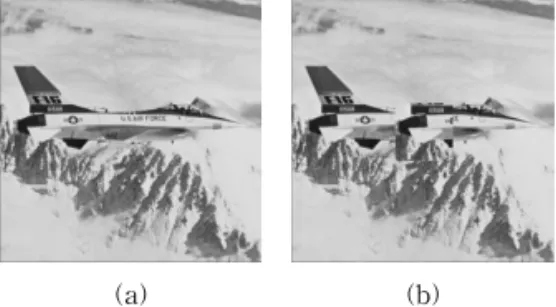
rotate the paste portion of the image[9]. Fig. 1 shows an example of copy-move forgery. Fig. 1(a) is original image of the Airplane test image. The Fig. 1(b) is copy-move forgery image [1-12].
J. Fridrich[1] proposed exact match of forgery image detection for copy move forgery image. A.
C. Popescu[2] proposed a principal component analysis (PCA) in order to reduce dimension repre- sentation on small size image blocks.
The most methods of copy-move forgery image detection are divided into overlapping blocks in the search area [1-12]. In order to detect copy-move forgery image of NxN, the copy-move image is divided into (N-B+1)2 overlapping block size B [6,9-12].
The exhaustive search method of the copy- move forgery image detection needs huge compu- tational complexity [1-4,9-12], not only spatial do- main but also frequency domain [1],[7],[9-12]. The [9-12] proposed a fast detection method of the copy-move forgery image using three step search in the spatial domain [10].
When compared to the frequency domain algo-
Fast Detection of Copy Move Image using Four Step Search Algorithm
Yong-Dal Shin†, Yong-Suk Cho††
ABSTRACT
We proposed a fast detection of copy-move image forgery using four step search algorithm in the spatial domain. In the four-step search algorithm, the search area is 21 (-10 ∼ +10), and the number of pixels to be scanned is 33. Our algorithm reduced computational complexity more than conventional copy move image forgery methods. The proposed method reduced 92.34 % of computational complexity compare to exhaustive search algorithm.
Key words: Copy-Moved Forgery Image Detection, Four Step Search Algorithm
※ Corresponding Author : Yong-Suk Cho, Address:
(31415) Younamsan-ro 52-70, Eumbong-Myun, Asan- si, Choongnam, Korea, TEL : +82-41-536-5734, FAX : +82-41-536-5739, E-mail : [email protected]
Receipt date : Nov. 8, 2017, Approval date : Dec. 6, 2017
††Dept. of IT & Securities, U1 University (E-mail : [email protected])
††Dept. of IT & Securities, U1 University
rithms, and the exhaustive search algorithms, the suggested algorithm reduced the computational complexity [9-12].
In this paper, we proposed a fast detection of copy-move image using four step search (FSS) al- gorithm in the spatial domain. In the four-step search algorithm, the search area needs 21 (-10 ∼ +10). Our algorithm reduced computational com- plexity more than conventional copy move image forgery methods. The proposed method reduced 92.34 % of computational complexity than ex- haustive search algorithm.
2. THE PROPOSED METHOD
In copy move forgery image, you must compare all the area pairs because they have different shapes and sizes to detect duplicate areas of an im- age[9]. Most overlapping block methods divide the image into overlapping blocks of fixed size. Blocks are slid by one pixel from the upper left corner of the image to the lower right corner[9]. For MxN pixel image, sliding creates (-B+1)×(-B+1) blocks[9]. Therefore, detection of copy move for- gery image needs huge complexity[10-12].
We have an image by shifting motion vec- tor (), we can get the copy-move forgery image
, such that[9]
= (1)
Fig. 2 shows copy move forgery image by image shifting motion vector x and motion vector y. C and P of the Fig. 2 are copy and pasted block
respectively.
In order to find a copy-move image region by pixel-matching, it is tested whether each pair of sub-blocks is similar[9].
We proposed a fast detection method of the copy move forgery image using four step search algo- rithm to reduce computational complexity more than conventional methods in the spatial domain.
The Koga et al [17] proposed three step search al- gorithm in the spatial domain [9-12]. It became very popular in the motion estimation for moving pictures because of its simplicity and near optimal performance. The algorithm may be described as:
[17]..
In order to detect copy move forgery image, the four step search algorithm is as follow.
Step 1: Step 1 includes a search based on a 4-pixel / 4-line resolution in a 9×9 search window with nine positions, i.e., a center point correspond- ing to a zero motion vector such as the dark circle in Fig. 3.
Step 2: Step 2 includes a search based on a 3-pixel / 3-line resolution in a 7×7 search window with nine positions, i.e., a center point correspond- ing to a zero motion vector such as the white circle in Fig. 3.
Step 3 : Step 3 includes a search based on a 2-pixel / 2-line resolution in a 5×5 search window with nine positions, i.e., a center point correspond- ing to a zero motion vector such as the dark trian- gular in Fig. 3.
(a) (b)
Fig. 1. Copy-move forgery Airplane image. (a) Original image, (b) copy-move forgery image.
C
P x
y
I
Fig. 2. Copy move forgery image by image shifting x and y.
Step 4 : Step 4 includes a search based on a 1-pixel / 1-line resolution in a 3×3 search window with nine positions, i.e., a center point correspond- ing to a zero motion vector such as the dark rec- tangular in Fig. 3.
For a maximum displacement window of 10 i.e.
w=10, the number of checking points required is [9 (Step 1) + 8 (Step 2) + 8 (Step 3) + 8 (Step 4)]
= 33 check points for search window 21 x21 pixel block.
The computational complexity of four step search algorithm needs 33 checking points.
We used block difference measure (BDM) for matching criterion of copy-moved forgery image detection [10-12]. The BDM expressed equation (2).
BDM =
(2) Where, is gray level value at the po- sition (i, j) of reference 8×8 pixel block image. The i=0,1,2,3….N-B+1, j=0,1,2,3….N-B+1. ii=0,1,2,…7, jj=0,1,2,…7. is gray level value of 8x8 pixel block at the position ( of matching search region image. The x and y are motion vec- tors, which obtained by Four step search algorithm.The maximum displacement window is 10 for FSS.
N is test image size, we used N is 256. B is a pixel block size 8. The m and n are divided non-over- lapping by 21×21 pixel block in the matching
search region image.
BDM is the sum of the differences in gray level values of the reference image block and the match- ing search image block [10-12].
We used matching criterion (MC) of copy- moved forgery image detection. The MC expressed eq. (3)[10-12].
If ( BDM == 0)
Copy-moved forgery block (3) Else
Not copy-moved forgery block
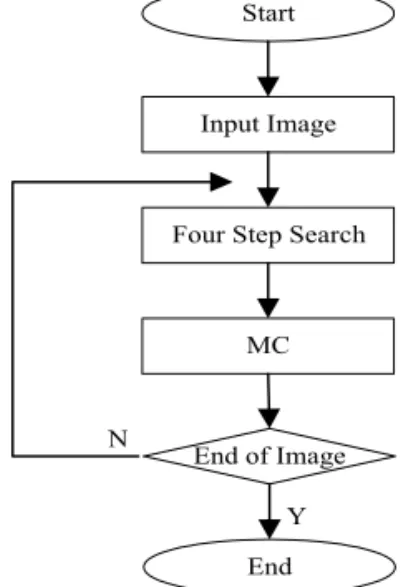
From equation (3), if BDM was 0, the block is a copy-moved forgery block. This means that the copied block image is the same as the moved block image If BDM was not 0, the block is not copy- move forgery block. This means that the copied block image is different from the moved block image. The flow chart of proposed method shows Fig. 4. From the FIG.3, we find copy move forgery image by MC, BDM using four step search algo- rithm.
3. EXPERIMENTAL RESULTS
We proposed a new fast detection method for :step 1, :step 2, :step 3, :step 4
Fig. 3. Four Step Search algorithm.
End Start
Input Image
Four Step Search
MC
End of Image
Y N
Fig. 4. The flow chart of proposed method using FSS algorithm.
copy moved image forgery using four step search algorithm in the spatial domain. The proposed method reduces computational complexity com- pared to various existing methods [10-12].
We used mcar, airplane, house images for com- puter simulations, the test images 8 bits and 256×256 pixels [9-12,14]. We tampered test images by copy-moved one image block over another, in the same image. The matching search region of test images are divide non-overlapping by 21x21 pixel block from first image location (0,0) to last image location (255,255). We used equation (2) to find BDM of copy-moved forgery image based on FSS algorithm. The MC of copy-moved image for- gery detection used equation (3). From equation (3), if BDM was 0, the block is a copy-moved for- gery block. This means that the copied block image is the same as the moved block image If BDM was not 0, the block is not copy-move forgery block.
This means that the copied block image is different from the moved block image.
In this paper, the computation complexity of FSS algorithm need 33 checking points for 21×21 pixel block. BDM of FSS algorithm is sufficient by 33 checking points instead of 441 checking points
(exhaustive search) for 21×21 pixel block to reduce computational complexity.
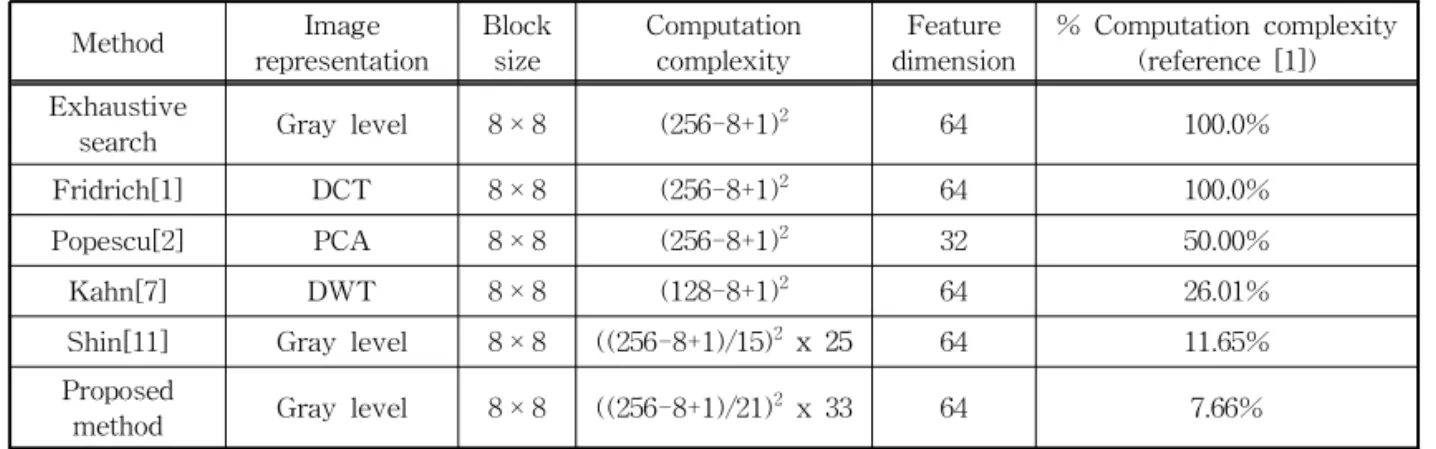
The Table 1 shows computational complexity results of the proposed method and other methods for test 3 images base on reference [1].
The proposed method reduced 92.34 % of com- putational complexity than exhaustive search [1].
In Table1, the proposed method reduced computa- tional complexity more than other methods [1,2,7].
Our method replace one pixel shift overlapping (other methods) by non-overlapping 21×21 pixel block to detect copy-moved forgery image in matching search region. The table 2 showed [11]
and proposed method. The [11] used three step search algorithm for forgery image detection, but proposed method used four step search algorithm for forgery image detection. From table 2, the search block size need 15×15 pixel block of TSS and 21×21 pixel block of FSS. The proposed meth- od used FSS, so we can be reduce computation complexity compare to [11]. The copy move for- gery image detection rate of the proposed is similar to [11].
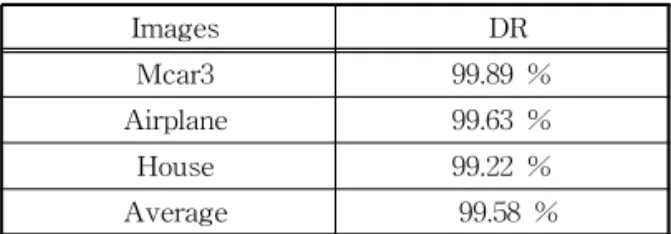
The Table 3 shows the forgery image detection rate of the proposed method. The average detection Table 1. Computational complexity results of the proposed and other methods
Method Image
representation Block
size Computation
complexity Feature
dimension % Computation complexity (reference [1]) Exhaustive
search Gray level 8 × 8 (256-8+1)2 64 100.0%
Fridrich[1] DCT 8 × 8 (256-8+1)2 64 100.0%
Popescu[2] PCA 8 × 8 (256-8+1)2 32 50.00%
Kahn[7] DWT 8 × 8 (128-8+1)2 64 26.01%
Shin[11] Gray level 8 × 8 ((256-8+1)/15)2x 25x 25x 25 64 11.65%
Proposed
method Gray level 8 × 8 ((256-8+1)/21)2 x 33 64 7.66%
Table 2. Compared three step search to proposed method of computational complexity
Methods Search block size Computation complexity % Computation complexity
Shin[11] 15 × 15 ((256-8+1)/15) 2 x 25x 25x 25 100.0 %
Proposed 21 × 21 ((256-8+1)/21) 2 x 33 65.75%
rate is 99.58 % for 3 test images.
Detection rate of copy move forgery image (DR) is expressed by equation (4).
DR = (4)
where, detected pixel number of copy move image (DPN), total pixel number of copy move image (TPN)
The Fig. 5, 6, and 7 showed results of proposed method. We showed original images, copy-moved image forgery, detection of copy-moved image forgery in the figure 5, 6, 7. The Fig. 5(a), 6 (a), 7(a) showed original images. The Fig. 5(b), 6 (b), 7(b) showed copy-move images. The Fig. 5(c), 6
(c), 7(c) showed detection image of copy move for- gery image. From the Fig. 5(c), 6 (c), and 7(c), left black box is copied, right black box is moved to image forgery block. From Fig. 5, 6, and 7, our al- gorithm detected copy-moved image forgery by 99.89%, 99.63%, and 99.22%.
4. CONCLUSIONS
In this paper, we proposed a fast detection of copy-move image using four step search algorithm in the spatial domain. In the four-step search algo- rithm, the search area needs 21 (-10 ∼ +10). Our algorithm reduced computational complexity more than conventional copy move image forgery methods. The proposed method reduced 92.34 % of computational complexity than exhaustive search algorithm.
REFERENCES
[ 1 ] J. Fridrich, D. Soukal, and J. Lukas, “Detection of Copy-move Forgery in Digital Images,”
Proceeding of Digital Forensic Research Workshop,IEEE Computer Society, pp. 55- 61, Aug. 2003.
[ 2 ] A.C. Popescu and H. Farid,Exposing Digital Forgeries by Detecting Duplicated Image Regions, Dartmouth College, Hanover, New Hampshire, USA:TR2004-515, 2004.
[ 3 ] J. Zhang, Z. Feng, and Y. Su, “A New Approach for Detecting Copy-move Forgery in Digital Images,”Proceeding of 11th IEEE Table 3. The forgery image detection rate of the pro-
posed method
Images DR
Mcar3 99.89 %
Airplane 99.63 %
House 99.22 %
Average 99.58 %
(a) (b) (c)
Fig. 5. Result of proposed method for Mcar3 image. (a) Original Image (b)Copy-Move forgery. (c) De- tection Copy-Move forgery (Black box)
(a) (b) (c)
Fig. 6. Result of proposed method for airplane image.
(a) Original Image (b)Copy-Move forgery. (c) Detection Copy-Move forgery (Black box).
(a) (b) (c)
Fig. 7. Result of proposed method for tank image. (a) Original Image (b)Copy-Move forgery. (c) De- tection Copy-Move forgery (Black box).
Singapore International Conference on Communication Systems, pp. 362-366, 2008.
[ 4 ] R. Singh, A. Oberoi, and N. Goel, “Copy Move Forgery Detection on Digital Images,”
International Journal of Computer Applica- tions, Vol. 98, No. 9, pp. 17-22, 2014.
[ 5 ] E.S. Khan and E.A. Kulkarni, “An Efficient Method for Detection of Copy-move Forgery Using Discrete Wavelet Transform,”Interna- tional Journal of Computer Science and Engineering, Vol. 2, No. 5, pp. 1801-1806, 2010.
[ 6 ] H.J. Lin, C.W. Wang, and Y.T. Kao, “Fast Copy-move Forgery Detection,”World Scien- tific and Engineering Academy and Society Transaction on Signal Processing, Vol. 5, Issue 5, pp. 188-197, 2009.
[ 7 ] S. Kahn and A. Kulkarni, “Reduced Time Complexity for Detection of Copy-move Forgery Using Discrete Wavelet Transform,”
International Journal of Computer Applications, Vol. 6, No. 7, pp. 31-36, 2010.
[ 8 ] J. Casey,An Investigation of Block Searching Algorithms for Video Frame Coders, Masters of Science Thesis of Dublin Institute of Technology, 2008.
[ 9 ] N. Singhal and S. Gandhani, “Analysis of Copy-move Forgery Image Forensics: A Review,” International J ournal of Signal P rocessing, Image P rocessing and Pattern Recognition, Vol. 8, No. 7, pp. 265-272, 2015.
[10] Y.D. Shin, “Fast Detection of Copy-move Forgery Image Using Two Step Search Algorithm,” International Journal of Security and Its Applications, Vol. 10, No. 5, pp. 203- 214, 2016.
[11] Y.D. Shin, “Fast Detection of Copy-move Forgery Image Using Three Step Search Algorithm in the Spatial Domain,”Proceeding of International Conference on Hybrid Infor- mation Technology Convergence and Hybrid Information Technology, pp. 389-395, 2012.
[12] Y.D. Shin, “Fast Detection of Copy-move Forgery Image Using DCT,”Journal of Korea Multimedia Society, Vol. 16, No. 4, pp. 411- 417, 2013.
[13] P. Yip and K.R. Rao,Discrete Cosine Trans- form: Algorithms, Advantages, and Applications, Academic Press, San Diego, CA, USA, 1990.
[14] http://sipi.usc.edu/database (accessed May, 10, 2012).
[15] http://www.ece.cmu.edu/ee899/project/deepak_
mid.htm (accessed May, 11, 2012).
[16] http://sipl.kjist.ac.kr/about/2-Famous%20ME
%20 algorithms.pdf (accessed May, 12, 2012).
[17] T. Koga, K. Iinuma, A. Hirano, Y. Iijima, and T. Ishiguro, “Motion Compensated Interframe Coding for Video Conferencing,” P roceeding of National Telecommunication Conference, pp. G5.3.1-5.3.5, 1981.
Yong-Dal Shin
is a professor in department of IT & securities at U1 university, Choongnam Korea. He received Ph.D. degree from Kyungpook national university, Daegu Ko- rea, 1994. He research areas in- clude multimedia security, digi- tal watermarking, digital forensics.
Yong-Suk Cho
Yong-Suk Cho received the B.S., M.S., and Ph.D. degree in the Department of Electronic Com- munication Engineering from Hanyang University in 1986, 1988 and 1998, respectively. From 1989 to 1996, he was a resear- cher at Korea Telecom. He has been a professor in the Department of IT & Securities at U1 University since 1996. His current research interests include finite field arithmetic, cryptography, and error-control coding.