논문 2010-47TC-11-6
Multicast Topology에서의 네트워크 코딩 성능 분석
( Network Coding Performance Analysis with Multicast Topology )
이 미 성*, 발라카난**, 이 문 호****
( Mi Sung Lee, Balakannan S.P, and Moon Ho Lee )
요 약
네트워크 코딩은 실용 네트워크 시스템에서 흥미로운 적용을 보이며 새로운 연구 분야로 인식되고 있다. 네트워크 코딩에 서, 중간 노드는 이전에 받은 정보의 선형조합 되어진 패킷을 보낼 수 있다. 수식적으로 이론 및 운영 네트워크는 네트워크 노 드들에서 코딩을 고려하는 새로운 관점으로부터 발표되었다. 우리는 다중원천 다중전송 네트워크에서 최적의 채널용량에 점근 적으로 달성하는 네트워크 코딩을 제시한다. 우리의 해석방법은 네트워크 코딩 사이에 만든 Connection들을 사용한다. 이 논문 에서 우리는 네트워크 코딩의 성능에 대해 해석했다. 또한 우리는 선형 최적화 문제를 가진 네트워크 코딩에 대한 시뮬레이션 결과를 논하고, 어떻게 네트워크 코딩을 사용 할 수 있는지를 보인다.
Abstract
Network coding is a new research area that may have interesting applications in practical networking systems. With network coding, intermediate nodes may send out packets that are linear combinations of previously received information.
The exploration of numerical, theoretical and operational networking issues from new perspectives that consider coding at network nodes. We have presented a network coding approach which asymptotically achieves optimal capacity in multi-source multicast networks. Our analysis uses connections that we make between network coding. In this paper we analysed with and without network coding performance. Also we discussed the simulation results on network coding with linear optimization problem and it shows how network coding can be used.
Keywords : Network coding, multicast, optimization, linear combinations.
Ⅰ. Introduction
Network coding generalizes network operation beyond traditional routing, or store-and-forward, approaches, allowing for mathematical operations across data streams within a network. In today’s practical communication networks such as the Internet, information delivery is performed by routing.
* 정회원, *** 정회원 전북대학교 전기전자컴퓨터공학부 (Chonbuk National University)
** 정회원, K.S. Rangasamy 기술대학교
(K.S. Rangasamy University of Technology)
※ 본 논문은 WCU R32-2009-000-200 14-0에 의하 여 이뤄졌음
접수일자:2010년8월24일, 수정완료일: 2010년11월10일
A promising generalization of routing is network coding. The potential advantages of network coding over routing include resource (e.g., bandwidth and power) efficiency, computational efficiency, and robustness to network dynamics. In the past few years, network coding is becoming an emerging communication paradigm that can provide the performance improvement in throughput and energy efficiency. Network coding was originally proposed for wired networks, and the throughput gain was illustrated by the well-known example of “butterfly”
network[1].
The selection of routes is an issue of utmost importance in data networks that has so far received
scant attention in the literature on network coding.
Indeed, the standard framework in which network coding is cast, that of network information flow problems[2], assumes that we have a network with limited-capacity links and considers whether or not a given set of connections can be simultaneously established, but gives no consideration to the resources that are consumed as a result of communicating on the links. The most notable example is today’s internet, which not only carries different types of traffic, but is also used by a vastly heterogeneous group of end users with differing valuations of network service and performance.
Network coding has emerged as an important potential approach to the operation of communication networks, especially wireless networks. The major benefit of network coding stems from its ability to mix data, across time and across flows. This makes data transmission over lossy wireless networks robust and effective. Despite this potential of network coding, we still seem far from seeing widespread implementation of network coding across networks[3~
5]. We believe a major reason for this is that it is not clear how to naturally add network coding to current network systems (the incremental deployment problem) and how network coding will behave in the wild. In order to bring the ideas of network coding into practice, we need a protocol that brings out the benefits of network coding while requiring very little change in the protocol stack.
Ⅱ. Multicast Routing for Network Coding
Network coding can improve throughput, robustness, complexity and security. The most well-known utility of network coding and the easiest to illustrate is increase of throughput. The throughput benefit is achieved by using packet transmissions more efficiently, i.e., by communicating more information with fewer packet transmission. The most famous example of this benefit was given by Ahlswede et all.[2], who considered the problem of
그림 1. multicast topology에 대한 버터플라이 네트워크 Fig. 1. Butterfly network for multicast topology.
multicast in a wireline network.
Generally in figure 1, features of multicast from a single source to two sinks. Both of the sinks wish to know the message at the source node. In the capacitated network they consider the desired multicast connection can be established only if one of the intermediate nodes breaks from the traditional routing paradigm of packet networks. Intermediate nodes are allowed only to make copies of received packets for output, and perform coding operation, also it takes two received packets, forms a new packet by talking the binary sum, or XOR of the two packets and outputs the resulting packet. If the contents of the two received packets are the vectors a and b, each comprised of bits. Then the packet that the output is ⊕, formed from the bitwise XOR of a and b. The sinks decode by performing further coding operations on the packets that they each receive. Sink recovers by b taking the XOR of a and ⊕, and likewise sink recovers by a taking the XOR of b and ⊕. Under routing, we could communicate, for example a and b to , but we would then only be able to communicate one of a or b to .
The butterfly network illustrates an important point that network coding can increase throughput for multicast in a wireline network. The nine packet transmissions that are used in the butterfly network communicate the contents of two packets. Without coding, these nine transmissions cannot be used to communicate as much information, and they must be
supplemented with additional transmissions. While network coding can increase throughput in a wireline network, its throughput benefits are not limited to multicast or to wireline networks.
Ⅲ. Network Coding with Cost Criteria
Whenever the members of a multicast group have a selfish cost objective, or when the network sets link weights to meet its objective or enforce certain policies and each multicast group is subject to a minimum weight objective, we wish to set up multicast connections at minimum cost. Network coding for multicast connections is relatively simple as we have a simple characterization of feasibility in networks with limited-capacity links[[2], Theorem 1] and, moreover, it is known that it suffices to consider linear operations over a sufficiently large finite field on a sufficiently long vector created from the source process.
To establish minimum-cost multicast with network coding, therefore, it suffices to solve problem (1) and then compute a code that achieves the optimal cost within an arbitrary factor, which can be done systematically in time polynomial in |N|, |A|, and the block length of the code[6] or, alternatively, in a random, decentralized fashion[7~9]. On the other hand, the standard approach for establishing minimum-cost multicast without network coding requires solving the Steiner tree problem on directed graphs, which is known to be NP-complete (and which, moreover, only really applies when the links are of unlimited capacity). Although tractable approximation algorithms exist for the Steiner tree problem on directed graphs (for example[10~11]), the multicast routing solutions thus obtained are suboptimal relative to the minimum-cost multicast without network coding, which in turn is suboptimal relative to when network coding is used. Hence network coding promises to provide significant cost improvements for practical multicast routing.
We present the cost calculation methods with and
그림 2. 비용으로 표시된 네트워크 코딩 Fig. 2. Network Coding with Cost.
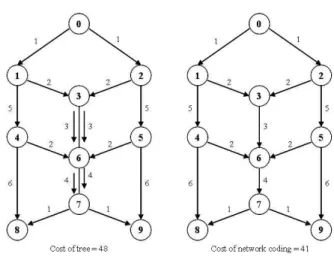
without network coding models are given in figure 2.
In this network model, node 0 is source and 8 and 9 are the sink nodes. We call the node 3, 6 and 7 are the bottleneck links between source to sinks. Nodes are connected with the links and its cost of the each link is given accordingly. Total cost of the entire network tree is 48, but the same case when we use network coding the cost is minimized into 41. So the ratio of best throughput with network coding is higher and also allowing inter-session coding. In fractional routing link capacities can be shares fractional and flows can be split and merged in arbitrarily fine scales. But in integral routing, all link capacities and flow rates have integral value.
The fact that packets need to be decoded has a minor impact on delay. It is usually not necessary to receive all encoded packets before some of the packets can be decoded. Together with a reduction in the number of required transmissions, the overall end-to-end delay with network coding is usually not larger than the normal end-to-end delay in realistic settings.
Figure 3 shows the operation of network coding for the network model. In [7], network coding is used to infer the loss rates of links in an overlay network.
For conventional active probing, packets are usually multicast to several receivers. The receivers experience the same loss event which provides information about losses in the underlying multicast
그림 3. 네트워크 코딩 흐름 그래프 Fig. 3. Network coding flow graph.
tree. After a sufficiently large number of probe packets, shared links and their loss rates can be identified with reasonable accuracy. If multiple senders unicast packets to a single receiver and these packets are combined within the network, it allows inferring the topology in much the same way as multicasting from one sender to multiple receivers.
Ⅳ. Linear Optimization Problem
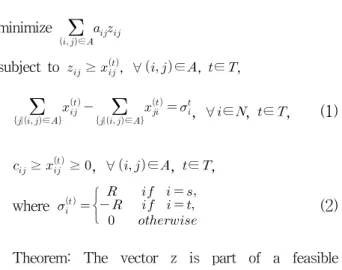
We model the network (figure 2) with a directed graph . For each link ∈, we associate nonnegative numbers and , which are the cost per unit flow and the capacity of the link, respectively. Suppose we have a source node s producing data at a positive, real rate R that wishes to transmit to a non-empty set of terminal nodes T.
Consider the following linear optimization problem:
minimize
∈
subject to ≥ , ∀ ∈, ∈,
∈
∈
,
∀∈,
∈, (1)
≥ ≥
,
∀ ∈,
∈,
where
(2)
Theorem: The vector z is part of a feasible solution for the linear optimization problem (1) if and only if there exists a network code that sets up a multicast connection in the graph G at rate arbitrarily close to R from source s to terminals in the set T and that puts a flow arbitrarily close to on each link (i, j).
Proof: First suppose that z is part of a feasible solution for the problem. Then, for any t in T, we see that the maximum flow from s to t in the network where each link (i, j) has capacity is at least R. So, by Theorem 1 of [2], a network coding solution with flow arbitrarily close to on each link (i, j) exists. Conversely, suppose that we have a network coding solution with flow arbitrarily close to
on each link (i, j). Then the capacity of each link must be at least and, moreover, flows of size R exist from s to t for each t in T (again by Theorem 1 of [2]). Therefore the vector z is part of a feasible solution for the optimization problem.
Ⅴ. Simulation Analysis
In network coding the throughput problem is more traceable and it enables efficient computation of maximum throughput. Also network coding can be used in end node at the application layer (P-2-P).
The result is a practical system for network coding that is robust to random packet loss, delay, any changes in network topology and capacity. Network coding in terms of throughput can be more than two-three times better compared to transmitting
그림 4. PDCR에서 네트워크 코딩 성능 해석
Fig. 4. Network coding performance analysis with PDCR.
그림 5. 네트워크 통신의 비교 Fig. 5. Comparison of network traffic.
uncoded blocks and also coding does not affects the bandwidth.
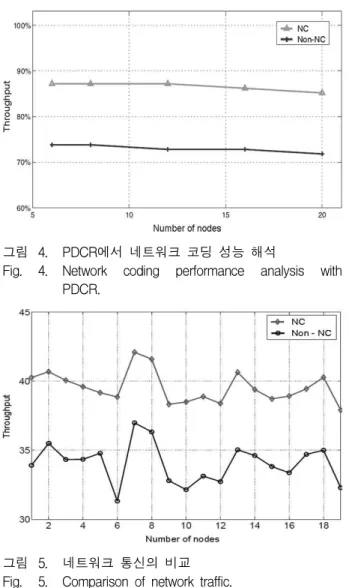
The figure 4 shows the performance analysis with PDCR[13] using network coding. In the simulation, UDP agents are used to generate exponential traffic with a fixed packet size of 3000 bytes. The link capacity between nodes is 20 Mb/s and the link delay is 30ms. We have given a designed network model with 20 nodes. Also figure 5 shows the comparison of network traffic. After scaling the loss rates with the flow, the simulations give the optimal loss rate for the design close to this value.
In network coding packets can be encoded arbitrarily, not just by end nodes, but also by nodes within the network. The desired minimum-cost subgraph is found using the following linear optimization problem.
Ⅵ. Conclusion
Network coding is for efficient computation of maximum throughput in end-to-end network. The result is a practical system for network coding that is robust to random packet loss, delay, any changes in network topology and cost. In this paper we compared the simulation results of Network Coding with Non Network Coding. So through the simulation results we proved that network coding gives the better performance. In future, we will look into extending our work to design network coding security protocols that efficiently solve encoding and decoding problem.
REFERENCES
[1] T. Salonidis, M. Garetto, A. Saha, and E.
Knightly, “Identifying High Throughput Paths in 802.11 Mesh Networks: A Model-Based Approach”, Proc. IEEE Int’l Conf. Network Protocols (ICNP), pp. 21-30, 2007.
[2] R. Ahlswede, N. Cai, S.-Y. R. Li, and R. W.
Yeung, “Network information flow”, IEEE Trans.
Inform. Theory, 46(4):1204–1216, July 2000.
[3] C. Fragouli, D. S. Lun, M. M´edard, and P.
Pakzad, “On feedback for network coding”, in Proc. of 2007 Conference on Information Sciences and Systems (CISS 2007).
[4] P. A. Chou, Y. Wu, and K. Jain, “Practical network coding”, Proc. of Allerton Conference on Communication, Control, and Computing, 2003.
[5] S. Chachulski, M. Jennings, S. Katti, and D.
Katabi, “Trading structure for randomness in wireless opportunistic routing”, Proc. of ACM SIGCOMM 2007, August 2007.
[6] S. Jaggi, P. Sanders, P. A. Chou, M. Effros, S.
Egner, K. Jain, and L. Tolhuizen, “Polynomial time algorithms for multicast network code construction”, IEEE Trans. Inform. Theory, vol.
51, No.6, June 2005.
[7] T. Ho, M. M´edard, R. Koetter, D. R. Karger, M. Effros, J. Shi, and B. Leong, “Toward a random operation of networks”, IEEE Trans.
Inform. Theory, vol 2004, pp. 1-8, 2004.
[8] T. Ho, M. M´edard, J. Shi, M. Effros, and D. R.
Karger, “On randomized network coding”, In
Proc. 41st Annual Allerton Conference on Communication, Control and Computing, Oct 2003.
[9] P. A. Chou, Y.Wu, and K. Jain, “Practical network coding”, In Proc. 41st Annual Allerton Conference on Communication, Control and Computing, Oct 2003.
[10] L. Zosin and S. Khuller, “On directed Steiner trees”, In Proc. 13th Annual ACM-SIAM Symposium on Discrete Algorithms (SODA 2002), pp. 59–63, 2002.
[11] M. Charikar, C. Chekuri, T.Y. Cheung, Z. Dai, A. Goel, S. Guha, and M. Li, “Approximation algorithms for directed Steiner problems”, In Proc. Ninth Annual ACM-SIAM Symposium on Discrete Algorithms (SODA 1998), pp. 192–200, 1998.
[12] C. Fragouli and A. Markopoulou, “A network coding approach to overlay network monitoring”, In Allerton, Sept. 2005.
[13] Balakannan S.P, Yier Yan, Jae Seung Yang and Moon Ho Lee, “End-to-End Network Delay- Constrained for QoS Multicast Routing”, The First International Conference on Networks &
Communications (NetCoM-2009), DOI 10.1109/
NetCoM.2009.50, pp.178-183, Dec 27-29, 2009.
저 자 소 개 이 미 성(정회원)
2009년 전북대학교 전자공학 학사 2009년 전북대학교 전자정보
공학부 석사 과정
<주관심분야 : 무선이동통신>
Balakannan S.P(정회원) 2003년 Bharathiar University,
Coimbatore, India. 석사 2006년 Junior Project Assistant,
IIT Kharagpur, India.
2010년 전북대학교 전자정보 공학부 박사
2010년~현재 K.S. Rangasamy 기술대학교 조교수
<주관심분야 : 무선이동통신>
이 문 호(정회원) 1967년 전북대학교
전자공학과 학사 1984년 전남대학교
전기공학과 박사 1990년 동경대학교
정보통신공학과 박사 1980년 10월~현재 전북대학교 전기전자컴퓨터
공학부 교수
<주관심분야 : 무선이동통신>