Performance Evaluation for Multicasting Video over OpenFlow-based Small-scale Network
Thuyen Minh Thi†, Thong Huynh††, In-Yeup Kong†††, Won-Joo Hwang††††
ABSTRACT
When demand for transmitting multimedia data increases, network congestion is more likely to occur and users will suffer high loss rate as well as high delay. In order to enhance quality-of-service (QoS) of video multicasting, we need to raise transmission reliability and reduce end-to-end delay. This paper proposes a routing mechanism for a OpenFlow-based small-scale network in order to multicast video reliably with low delay. In our method, multipath routing will be applied to Multiple Description (MD) Coded video to exploit its multi-description property. Through performance evaluation, our method shows improvement on loss rate, delay and video distortion.
Key words: Video Multicast, OpenFlow, Multiple Description Coded Video, Multipath Routing, Optimization of Routing.
※ Corresponding Author : Won-Joo Hwang, Address:
(621-749) Department of Information and Communica- tions Systems, Inje University, 197 Inje-ro, Gimhae-si, Gyeongsangnam-do, Korea, TEL : +82-55-320-3847, FAX : +82-55-322-6275 , E-mail : [email protected] Receipt date : Mar. 10, 2014, Revision date : Jun. 24, 2014 Approval date : Jul. 22, 2014
†Department of Information and Communication System, HSV-TRC, Inje University
(E-mail : [email protected])
††††Department of Information and Communication System, HSV-TRC, Inje University
(E-mail : [email protected])
††††Department of Electronic Engineering, Kumoh National Institute of Technology
(E-mail : [email protected])
††††Department of Information and Communication System, HSV-TRC, Inje University
1. INTRODUCTION
With the development of demand for multimedia services, network load grows quickly. When con- gestion occurs, QoS of video multicast will drop because of high packet loss rate and delay. Packets become useless when they reach destination late.
Therefore, both packet loss and delay lead to high level of video distortion. In order to deal with this problem, this paper proposes a solution that allows multicast video with low delay and low distortion.
Current advanced architectures and technologies (e.g., IntServ, Diffserv, Multiple protocol label switching (MPLS)) attempt to solve such QoS problem. However, they are built on top of dis- tributed hop-by-hop routing architecture. Without information of state and resource of the whole net-
work, it is hard to gain efficiency of routing.
OpenFlow can define flows by various ways.
This allows us to classify traffic type and define the flow that we want to support QoS enhancement.
Our algorithm is run at OpenFlow controller. It keeps up-to-date information of the network state, so it is able to perform QoS routing efficiently.
In this paper, we propose a routing mechanism in order to multicast video in OpenFlow-based network with low packet loss rate and delay.
However, due to the centralized architecture of OpenFlow, we aim to apply our method to a small-scale network to maintain low overhead and high stability. For a video source, there are many unicast flows; each of them is between the server and a client. For each flow, we consider a routing problem in order to find optimal transmitting paths.
These paths aim at boosting reliability and re- ducing delay. In the network, flows of traffic are classified at OpenFlow-enabled forwarders. Video flows are transmitted among forwarders using MD coding. In MD, video stream is encoded into several independent descriptions (i.e., substreams). The controller monitors network states and applies routing mechanism to these descriptions. Our mul- tipath routing algorithm is used for transmitting MD coded video to destination nodes. For each of these nodes, we provides different descriptions with different paths. In this way, we exploit mul- ti-descriptions property of MD. Our routing ob- jective is to find optimal paths in order to minimize video distortion at each destination node while de- lay is kept below play-back deadline.
Our model can be used in various applications.
For instance, it can be applied to a small-scale net- work, e.g., a regional part of a network operator's backbone. It will enable video service providers to multicast data with low loss rate and delay.
The summary of our contributions in this paper is expressed as follows:
∙ We propose a method to multicast video in OpenFlow-based network with low loss rate and delay. Our method performs multipath rout- ing for each connections (Section III).
∙ We formulate an optimization problem for rout- ing MD coded video (Section IV). Additionally, we use optimization methodologies to solve the modelled multipath routing problem (Section V).
2. RELATED WORKS
Video transmission in general and video multi- cast in particular have found a number of applica- tions. We describe here some previous works re- lating to them.
In [1], the authors proposed a routing protocol for multicast. They used single path to transmit data from sender to each receiver. The single path was based on hop count. In this way, if the capacity
of the shortest path did not meet the QoS require- ment, the method could not provide a path with high QoS. In [2], the authors dealt with building shared multicast tree. They used multipath routing and proposed spanning-joins protocol. When a new node wanted to join multicast tree, it broadcasted request messages to its neighborhood. Therefore, this process may face the problem of overhead.
In [3], the authors dealt with video transmission problem. They used metric distortion but the ob- jective function was Lagrangian cost function. It was not in close form as ours. Moreover, objective function did not consider packet loss due to miss- ing play-back deadline. Similarly, Mao et al. [4]
used distortion-rate function to estimate distortion based on data bit rate. Besides, they did not take play-back deadline into consideration. In [5], the authors streamed MD video over overlay net- works. Distortion was estimated by a function of source rate. They had this approximate function by experiment. In [6], differential multicast routing was considered, however, it was for DWDM networks. Therefore, it is not suitable for our tar- get networks.
In our method, centralized control mechanism of OpenFlow is employed so that we do not have problem of overhead. We derive distortion based on delay, traffic load, packet loss and play-back deadline. With distortion, we have a metric that is closer to user’s perception than metrics in [7]. We use this metric to estimate the performance of mul- ticast paths. Besides propose a mechanism, we build a mathematical model as well as provide its formulation. Furthermore, we propose a multipath routing algorithm in order to benefit from mul- ti-description property of MD coding.
3. SYSTEM MODEL
3.1 Network description
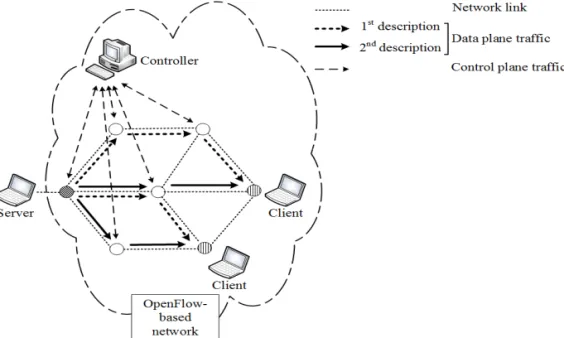
In our network (Fig. 1), data will travel from the server, through OpenFlow-based network, then
Fig. 1. OpenFlow-based network for video multicast.
arrive at the clients. For each forwarder, we con- sider two types of traffic: traffic of video flows and traffic of non-video flows. Each video flow is rout- ed on two paths from the server to its client.
Non-video flows are routed by default routing methods. This OpenFlow-based network is de- noted as a directed graph.
3.2 Problem
For each server-client pair of multicast trans- mission, we form a routing problem to find its two optimal paths. Path transmits data with distortion
. denotes one of two optimal paths. The problem can be stated as finding
argmin ∈ (1)
subject to
≤ ∆
∈
∈
where is link set; is path set; and are nodes; if the link is on path ; sim- ilarly, if the link is on path . First constraint guarantees that play-back delay re-
quirement is met, i.e, expected end-to-end delay
must be less than or equal to play-back dead- line . The value of is estimated as in [8].
Second constraint guarantees that every path is formed by connected links and each path connects source node and destination node .
This paper proposes a model for the encoding mode that generates two descriptions. Routing al- gorithm will find two paths for two descriptions.
As in [4], distortion D of each pair of paths
is
(2)
is distortion of a pixel when its data from two descriptions are lost. is central distortion when non of descriptions is loss;, are side distortions obtained when first description, second description is lost, respectively. Similarly,, ,
, are probabilities with which non of de- scriptions is loss, first description is lost, second description is lost, both description are lost, respectively.
In order to estimate distortion, we use ROPE as in [9] and make formulation as in [4].
4. PROBLEM FORMULATION
4.1 Derivation of packet loss rate
Two causes responsible for packet loss are bad link state and play-back deadline missing.
Without loss of generality, we denote two opti- mal paths with joint part and disjoint parts. We use Gilbert-Elliott model to formulate loss rate on joint part. Loss rate on disjoint parts is formulated by multiplication law of probability.
in (2) is calculated as
(3)
where
(4)
Equations (3) and (4) are described as follows.
First, in order for both packets to arrive at desti- nation without loss (), we need all following
conditions:
∙ joint part is in good condition (with probability
),
∙-th packet passes the -th disjoint part intact ( ) and also arrives at its destination on-time ().
Second, when there is only second packet ar- rives at client (), we expect that loss occurs at joint part, first disjoint part or first packet arrives late with probabilities , , , respectively. In this case, there are three possibilities as follows.
∙ joint part is in bad condition ( ),
∙ second packet passes second disjoint part intact ( ) and also arrives at its destination on-time (),
or
∙ joint part is in good condition ( ),
∙ first packet is lost at first disjoint part ( ),
∙ second packet passes second disjoint part intact ( ) and also arrives at its destination on-time (),
or
∙ joint part is in good condition ( ),
∙ first packet passes first disjoint part intact ( ) but not on-time ( ),
∙ second packet passes second disjoint part intact ( ) and also arrives at its destination on-time ().
Probability of event when first packet ar- rived at destination successfully and second packet gets lost is obtained from , , by the same way with obtaining . is probability when both packets are lost.
1. Probabilities relating to link state ( , ,
)
Packet loss in wired connection mainly comes from drop due to congestion. In this two-state Gilbert-Elliott model, we use up-state and down-state to denote the good and bad condition of the joint part. Loss rate on disjoint parts is for- mulated by multiplication law of probability.
After collecting burst length and packet loss rate from forwarders, controller is able to estimate ,
of joint part and , of disjoint parts as in [5].
2. Probabilities relating to missing play-back deadline ( )
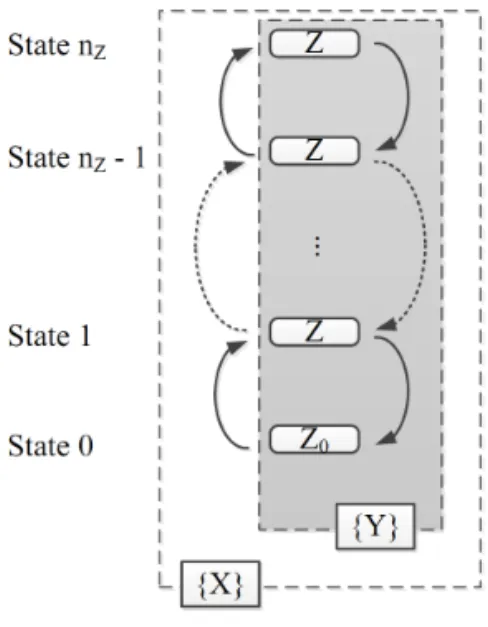
Queuing is the main cause of delay in our network. In order to measure delay, Discrete Time Markov Chain (DTMC) (Fig. 2) is adopted and ap- plied to queuing process at all nodes [10]. At each node’s queue, we examine the number of packets of the description that we want to estimate delay.
This number changes over time and forms the
Fig. 2. DTMC in a node.
states of a Markov chain. This chain is {X} and its state set is Z{
}, where is queue size. We estimate the waiting time of a packet in node's queue in order to model queuing delay. {Y} is an absorbing Markov chain derived from {X} by ignoring all arrival after the consid- ered packet arrives.
Our formulation is based on [10]. However, for video multicast in wired links, we do not consider retransmission mechanism. Therefore, each time unit, a node always transmits a packet success- fully. is probability that {X} stays at the same state between two time units. In our model, is probability with which the node is serving another packet rather than a packet of examined description.
From modelled DTMC, we have probability that
-th description is transmitted on-time by path . This probability is and it is calculated as
≤
(5)
where is probability that end-to-end delay on path equals to time unit(s) .
Now, in (5) is put into (3) and (4) to fully derive (2).
4.2 Derivation of end-to-end delay
In above DTMC, the amount of time that {X} transits from state to state 1 is calculated as shown below
where is element in transition proba- bility matrix of chain {X}.
Based on , we can estimate delay on link
. This delay is queuing delay of node . It is given as
≤ ≤ (6) where is amount of time for -th node to transit from state to state , is -th ele- ment in steady-state probability matrix of chain {X} of -th node.
Finally, we can estimate end-to-end delay
based on (6). is the sum of queuing delay
at all nodes in path . It is given as
∈
where is number of nodes in the network.
5. SOLUTION PROCEDURE
If we use binary indicator vectors of links to form routes, our problem is combinatorial opti- mization that belongs to discrete optimization. For each server-client pair, we applies subgradient method to the search for optimal solutions. This is an efficient method in discrete optimization. In each iteration of subgradient algorithm, we solve the problem's relaxed form. Our subgradient algo- rithm stops when value of subgradient equals to zero. This time, the solution of relaxed problem is globally optimal solution. This solution provides two optimal paths for transmitting video to a client.
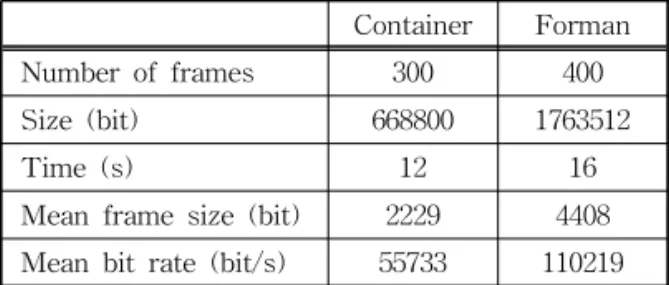
Table 1. Information of video sequences
Container Forman
Number of frames 300 400
Size (bit) 668800 1763512
Time (s) 12 16
Mean frame size (bit) 2229 4408 Mean bit rate (bit/s) 55733 110219 After finding out solution of a client, the algorithm
continues with other clients in multicast group.
Lagrangian relaxation of original problem (1) has following form
argmin ∈ ≥ (7) Then Lagrangian relaxation dual has following form
max ≥ argmin ∈ The relaxed form (7) is a routing problem. We can use objective function to estimate routing cost, we can solve this problem by using a basic routing algorithm (e.g., Dijkstra's algorithm). An idea to deal with discrete optimization problems is exploit- ing its structure in order to speed up the search for the solution. We exploit Dijkstra's Shortest Path Algorithm to find routing solutions for the Lagrangian relaxation dual. The idea of Dijkstra's algorithm is spreading out from the source node until destination node is met. When the graph of network is represented by a tree rooted at source node, our algorithm runs along the branches on tree from the root.
Conventional Dijkstra's algorithm will run from source node and gradually add more nodes to a set of selected nodes. For each iteration, it examines all unselected nodes that directly link to at least one of its selected nodes. The set of those examined nodes is called candidate set. From that candidate set, the algorithm selects the best node with least cost from the source node. Our modifi ed algorithm goes through the same processes with Dijkstra’s algorithm but it will select a pair of nodes when it starts at the source node. After that, at each iteration, the algorithm selects only one best node based on cost (i.e., distortion). In order to estimate cost, (7) requires two paths.
That why the algorithm picks up two nodes at fi rst. After that, with each candidate node, the al- gorithm adds up previous selected node to form a pair of paths.
6. SIMULATION
We build a simulated OpenFlow-based network in Opnet modeler. In the network, a server multi- casts video data to clients. Our algorithm is im- plemented at a logically centralized node. This plays the role of controller in OpenFlow. Input data is CIF version of MD coded video. Information of video sequences is shown in Table 1.
Our method is compared with a method which uses Dijkstra’s Shortest Path algorithm (DSP).
That method mixes all kinds of traffic and performs single path routing. Our method combines routing algorithm (RA) and optimization methodologies (OM), so that it is named RAOM. The evaluating metrics are received data, end-to-end delay and PSNR. The results show below are collected at one of the clients.
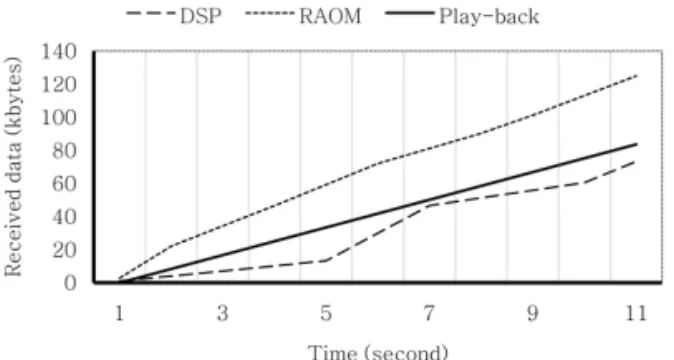
In order to evaluate loss rate, we set up a sce- nario in which RAOM and DSP transmitContainer sequence. For each method, we stream all 12 sec- onds of the sequence one time. Cumulative re- ceived data is collected at destination node. Our method sets constraint on end-to-end delay.
However, in objective of distortion, packet loss is taken into consideration. This explains that our method yield less loss than DSP. In Fig. 3, we add the solid line to show play-back rate. According to Fig. 3, our method achieves higher data rate than DSP. DSP takes 3 seconds to reach play-back rate while RAOM does not. This means DSP will en- counter initial delay longer than RAOM. On aver- age, RAOM achieves 4.5 kbytes/s higher than DSP.
Fig. 3. Received data of Container sequence.
Fig. 4. End-to-end delay of Foreman sequence.
Fig. 5. PSNR of Foreman sequence.
In order to measure end-to-end delay, we run a scenario forForeman sequence. Results is shown in Fig. 4. When the load of forwarders raises, the queuing delay will suffer. At first, RAOM produces relatively high delay. This can be explained that computing complexity requires processing time. In this way, after controller successfully solves the problem, delay gradually drops. Overall, our meth- od gains lower delay than DSP.
In order to compare PSNR, we run scenarios of Foreman sequence. We calculate PSNR based on YUV files. However, we only show PSNR of Y component because it is the most widely-used component for PSNR. Additionally, this is per- frame PSNR, i.e., it is calculated for each frame.
Fig. 5 plots PSNR of 63 of total 400 frames in Foreman sequence. The graph shows that our method achieves higher PSNR than DSP. More- over, RAOM appears to have highly dynamic rout- ing mechanism when its PSNR fluctuates greatly in comparison with DSP.
7. CONCLUSION
In this paper, we propose a routing method with QoS enhancement for video multicast. In order to have determining metric for routing, distortion of MD video is predicted. That estimation is done with regard to delay, traffic load, packet loss.
Packet loss is estimated by link state model. Delay is estimated by queuing model. We solve routing problem of each server-client pair by combining routing algorithm (i.e., Dijkstra's algorithm) and optimization methodologies (i.e., relaxation, sub- gradient). Multipath routing is applied to MD to gain loss-resilient transmission. The routing prob- lem is formulated as an optimization problem. It fi rst is relaxed by Lagrangian method; then it is solved by subgradient method. Each subgradient iteration calls a modified Dijkstra’s algorithm to fi nd locally optimal pair of paths. In simulation, we compare our method with a conventional method.
Our approach gains better performance in terms of received data, delay and PSNR.
REFERENCE
[ 1 ] T. Ballardie, P. Francis, and J. Crowcroft, “An Architecture for Scalable Inter-domain Multicast Routing,” Proceedings of ACM SIGCOMM, pp. 85-95, 1993.
[ 2 ] K. Carlberg and J. Crowcroft, "Building Shared Trees using a One-to-many Joining Mechan- ism," ACM SIGCOMM Computer Commu-
nication Review, Vol. 27, Issue 1, pp. 5-11, 1997.
[ 3 ] B.A. Heng, J.G. Apostolopoulos, and J.S. Lim,
“End-to-end Rate-distortion Optimized MD Mode Selection for Multiple Description Video Coding,” EURASIP Journal on Applied Signal Processing, Vol. 2006, Article ID 32592, pp. 1-12, 2006.
[ 4 ] S. Mao, Y.T. Hou, X. Cheng, H.D. Sherali, S.
F. Midkiff, and Y.Q. Zhang, “On Routing for Multiple Description Video over Wireless Ad Hoc Networks,” IEEE Transactions on Multimedia, Vol. 8, No. 5, pp. 1063-1074, 2006.
[ 5 ] A. Begen, Y. Altunbasak, O. Ergun, and M.
Ammar, “Multi-path Selection for Multiple Description Video Streaming over Overlay Networks,” Signal Processing: Image Com- munication, Vol. 20, No. 1, pp. 39-60, 2005.
[ 6 ] S.G. Kim and S.Y. Park, "A Study on Virtual Source-based Differentiated Multicast Routing and Wavelength Assignment Algorithms in the Next Generation Optical Internet based on DWDM Technology,"Journal of Korea Mul- timedia Society, Vol. 14, No. 5, pp. 658-668, 2011.
[ 7 ] H.E. Egilmez, S. Civanlar, and A.M. Tekalp,
“An Optimization Framework for Qos-en- abled Adaptive Video Streaming over Openfl ow Networks,”IEEE Transactions on Multi- media, Vol. 15, No. 3, pp. 710-715, 2013.
[ 8 ] M.H. Lu, P. Steenkiste, and T. Chen, “Video Streaming over 802.11 WLAN with Content- aware Adaptive Retry,”P roceeding of IEEE International Conference on Multimedia and Expo, pp. 723-726, 2005.
[ 9 ] R. Zhang, S.L. Regunathan, and K. Rose,
“Video Coding with Optimal Inter/Intra-mode Switching for Packet Loss Resilience,” IEEE Transactions on Selected Areas in Communi- cations, Vol. 18, No. 6, pp. 966-976, 2000.
[10] Y. Wang, M.C. Vuran, and S. Goddard,
“Cross-layer Analysis of the End-to-end Delay Distribution in Wireless Sensor Net- works,” IEEE/ACM Transactions on Net- working, Vol. 20, No. 1, pp. 305-318, 2012.
Thuyen Minh Thi
received his B.S. Degree in Com- puter Science from Vietnam National University, Ho Chi Minh city, Vietnam, in 2011. He received his M.Eng. degree in Information and Communication from Inje University, Gimhae, Republic of Korea, in 2014. His research interests are OpenFlow and network optimization.
Thong Huynh
received his bachelor’s degree in Electronics and Telecommuni- cation at Excellent Engineering Training Program, Ho Chi Minh University of Technology, Viet- nam in 2010 and M.E. from Department of Infomation and Communications Engineering, Inje University, Korea.
He is currently PhD candidate in the same department.
His research interests are wireless scheduling and en- ergy efficiency in wireless sensor networks.
In-Yeup Kong
received her B.S. degree, M.S.
degree and Ph.D Degree from Pusan National University, Pu- san, Republic of Korea, in 2000, 2002, and 2007. Since September 2008, she has been an associate professor at Kumoh National Institute of Technology, Gumi, Republic of Korea. Her research interests are in next-generation internet, and embedded systems.
Won-Joo Hwang
received his Ph.D Degree in Information Systems Engineer- ing from Osaka University Ja- pan in 2002. He received his B.S.
and M.S. degree in Computer Engineering from Pusan Natio- nal University, Pusan, Republic of Korea, in 1998 and 2000. Since September 2002, he has been an associate professor at Inje University, Gyeongnam, Republic of Korea. His research interests are in network optimization and cross layer design. Mr.
Hwang is a member of the IEICE and IEEE.