40(4) : 408 414 (2009)
408
밀순 물추출물의 항산화 효과 및 Streptozotocin으로 유발한 당뇨 흰쥐에서 혈당강하에 미치는 영향
이선희·이영미1·이회선2·김대기*
전북대학교의과대학및의과학연구소, 1원광대학교약학대학 한약학과,
2전북대학교농업생명과학대학응용생물공학부
Anti-oxidative and Anti-hyperglycemia Effects of Triticum aestivum Wheat Sprout Water Extracts on the Streptozotocin-induced Diabetic Mice
Sun-Hee Lee, Young-Mi Lee
1, Hoi-Seon Lee
2and Dae-Ki Kim
*Department of Immunology and Institute of Medical Science, Chonbuk National University Medical School, Jeonju, 561-180, Korea
1Department of Oriental Pharmacy, College of Pharmacy, Wonkwang University, Iksan 570-744, Korea
2Faculty of Biotechnology and Center for Agricultural Science and Technology, College of Agriculture and Life Science, Chonbuk National University, Jeonju 561-756, Korea
Abstract −This study was performed to investigate the anti-hyperglycemia effects of the Triticum aestivum wheat sprout (TAWS) water extracts in the diabetic mice. Diabetic experimental model was established by intraperitoneal injection of strep- tozotocin into male Balb/c mice. Mice were divided into five groups: normal (CON), diabetic control (DM), and three exper- imental groups (DM-100, diabetes with TAWS extracts 100mg/kg; DM-50, diabetes with TAWS extracts 50 mg/kg; DM-25, diabetes with TAWS extracts 25 mg/kg). TAWS extracts were administered orally in diabetic mice. Body weight, food intake, and blood glucose levels were recorded for 12 days and blood insulin levels were measured at the day 12. Oral administration of TAWS extracts reduced slightly food intake and induced a little body weight gain in DM-100 groups. The blood level of glucose was decreased in the dose-dependent manner; 55% in the DM-100 group and 39.7% in the DM-50 group. The blood level of insulin also was improved 10 folds in the DM-100 group and 3.6 folds in the DM-50 group compared to the DM group.
The contents of total phenolic compounds and total flavonoids in 1 g dry mass of TAWS extracts were 6.6 mg of tannic acid equivalents and 1.0 mg of 8-hydroquinolline equivalents, respectively. In addition, the antioxidant and DPPH radical scav- enging activity of TAWS extracts were 1.2 mM and 1.8 mM ascorbic acid equivalents, respectively. These results suggest that TAWS water extracts could contribute to attenuate clinical symptoms of diabetes mellitus.
Key words −Triticum aestivum wheat sprout, Diabetes mellitus, Blood glucose, Insulin, Streptozotocin
당뇨병은혈중포도당농도의증가와함께탄수화물대사 이상으로포도당이뇨로다량배설될뿐만아니라단백질 과지질대사및전해질의대사에이상을초래하는대표적 인대사성질환이다.1)당뇨병은혈중포도당의수준을정상
화하는데작용하는인슐린의분비저하및인슐린작용의결 함에의해발병한다.2)또한비만, 운동부족, 음주, 흡연등
의잘못된생활습관도당뇨병의주요유발인자로알려져있 다. 대부분의당뇨병환자들은인슐린분비장애와인슐린
저항성이동시에존재하는경우가많으며, 일반적으로체내
free radical농도와산화성스트레스가상승하게되며, 특히
항산화효소 superoxide dismutase (SOD), catalase등의활성
이감소하게되어동맥경화등의합병증을유발한다고알 려져있다.3)
최근우리나라에서당뇨병환자가급격히증가함에따라 당뇨병치료및개선에관심이높다. 양방에서당뇨병치료
제는크게인슐린을직접투여하거나, 인슐린분비촉진제,
인슐린저항개선제, 그리고당의체내흡수를방해하는약물
로탄수화물분해효소억제제등을복용하여포도당흡수를 억제하거나대사를유도하는방법이있으나장기복용에대 한안전성및높은약가등이단점이되고있다. 따라서대
*교신저자(E-mail):[email protected] (Tel):+82-63-270-3080
부분의환자들은일반적으로민간요법을찾거나양방과병 용하는경우가많다. 현재당뇨병환자의약 70%가민간요
법에따라 80~130여종에이르는항당뇨효능이있는천연
물질을사용하는것으로알려져있다. 당뇨병의식이요법에
있어서과거에는당및탄수화물섭취조절에주로초점이 맞추어져있었으나, 근래에는미량의영양소나생리활성물
질을함유하고있는천연식물성식품을이용한항당뇨효과 에미치는영향이연구되어지고있다.4)
밀 (Triticum aestivum Lamarck)은외떡잎식물벼목화본
과의한해살이작물로써소맥이라고도한다. 동의보감에서
밀은성질이약간차고, 맛이달며독이없으며, 번열(煩熱)
을제거하고, 갈증을줄이며, 이뇨작용및간기(肝氣)를보
양한다고하였다. 또한소맥피(小麥皮)라고불리는밀껍질
은성질이차지만알곡은성질이열하여탕약에껍질을벗 기지않고달여탕으로먹으면땀을멈추게하고, 허열을치
료한다고하였다. 서구선진국에서는 wheatglass라는밀순
을분말또는착즙하여영양부족및성인병등의건강기능 성보조식품으로많이이용되고있으며, 이는주로밀이발
아후 7-10일정도재배한어린순을사용한다.5)밀순에는아
미노산, 미네랄, 비타민, 클로로필등의영양소가풍부하며6)
뛰어난항산화작용을 가지고 있다.7)최근 Bar-Sela등은
wheatglass주스가암환자의항암제투여에대한부작용을개
선함을보고하였고,8) Ben-Arye등은위장관치료에효과가있
음을발표하였다.9)그러나우리나라에서는밀순에대한연
구가미진한상태이다.
본연구는마우스에 streptozotocin (STZ)을주입하여유
발시킨제1형당뇨실험동물모델을대상으로국산우리밀
품종중대표적인금강밀어린순(T.aestivum weat sprout;
TAWS)의물추출물을경구투여함으로써당뇨에미치는영
향을규명하기위하여본실험을수행하였다.
실험방법
실험 재료 − 본실험에사용된시료는국립식량과학원에 서수확한우리밀품종금강밀로써평균온도 20±1oC, 상
대습도 60~70%를유지하며무균유기농발아용피트머스
위에서발아시킨후 10일동안키운어린밀순이다. 이를
시기별로 3월초순, 5월초순, 7월초순에수확하여동결건
조하여잘게분쇄한후, TAWS건조분 100 g을정제수 1 L
에서 환류냉각하에 30분간 열탕하였다. 그 추출물을 Whatmann paper filter로여과한후 rotary evaporator(EYELA
사)에서감압농축하고완전한건조를위하여다시동결건
조하여실험에사용하였다. 본실험에사용한모든시약들
은 Sigma사로부터구입하였다.
당뇨실험동물 − 본실험을위하여생후 8주령의 Blab/c 수
컷마우스들을㈜샘타코로부터공급받아본동물사육실의
시설환경에 1주일이상적응시키고, 평균체중이 22 g±1 g 내
외의 마우스를 대상으로 streptozotocin (STZ)을 0.1 M sodium citrate buffer (pH 4.3)에녹여 체중 kg당 50 mg을 24시간간격으로 2회복강주사하여고혈당당뇨모델을구
축하였다.10)최종복강주사하고 48시간후공복시혈중포
도당농도가 250 mg/dL 이상인것을당뇨병이유발된흰쥐
로인정하고실험에사용하였다. 사육실온도는 22±2oC로
유지하였으며, 음료는정수기를통과한물을멸균하여충분
히공급하였고, 사료는중앙실험동물㈜에서구입한 AIN-76
식이사료를제공하였다. 실험동물은정상대조군 (CON)과
당뇨대조군 (DM), 및 TAWS물추출물 100 mg/kg (DM-100), 50 mg/kg (DM-50) 또는 25 mg/kg (DM-25) 등을 1일 2회
경구투여한실험군으로분류하였다. TAWS물추출물은용
량별로사용직전에정제수에녹여사용하였다.
식이섭취량 및 체중 − 실험기간동안각각실험동물들에
게 AIN-76식이사료를제공하였으며섭취량을매일일정한
시각에측정한후 12일간의총섭취량에서평균 1일섭취
량을계산하였다. 체중은 3일간격으로일정시각에측정하
였으며, 최종체중에서실험개시전의체중을감하여실험
기간중의체중변화정도를산출하였다.
혈중 포도당 측정 − 실험동물의꼬리정맥으로부터소량 의혈액을채취하였으며혈당 test machine (Abbott Diabetes Care Ltd.)을이용하여혈중포도당농도를측정하였다. 모
든실험군들의혈중포도당농도는시료의투여직전과 3일
간격으로매회일정시각에 12일간측정하였다.
혈중 인슐린 측정 − 실험동물의혈중 인슐린 농도는
ELISA법으로측정하였다. 시료를 12일동안투여하고각각
실험군을 ethyl ether로마취시킨후미리헤파린나트륨을
혈액 1 mL당 100 IU를전처리한주사기를사용하여심장
으로부터혈액을채취하였다. 혈액채취후 4oC에서 3000 rpm, 15분간원심분리하여 혈장을분리하였으며, 수시간내에 Mouse insulin ELISA kit (SHIBAYAGI Co. Japan)를이용
하여제조회사에서제공한매뉴얼에따라혈중인슐린농 도를측정하였다.
총폴리페놀 함량 측정 − 시료에함유하는총폴리페놀의 함량은 Folin-Denis 방법을응용하여측정하였다.11)건조추
출물 100 mg을 70%에탄올 10 ml에완전히녹인후이중 1 mL을 취하여 증류수 3 mL과 섞고, Folin-ciocalteau’s phenol reagent 1 mL를첨가한후상온에서혼합하였다. 5
분후 NaCO3포화용액 1 mL을잘혼합하여실온에서 1시
간동안반응시켰다. 이를흡수분광광도계 (Optizen 2120UV, Mecasys Co.)를이용하여 640 nm 파장에서흡광도를측정
하였다. 페놀화합물함량은표준물질 tannic acid를사용하
여검량선을얻고이를통하여 tannic acid에준하는총폴리
페놀함량을산출하였다.
총플라보노이드 함량 측정 − 총플라보노이드함량은 Neiva
Moreno12)등건조추출물 100 mg을 70%에탄올 10 ml에완
전히 녹인 후 0.5 ml를 취하여 초순수로 희석한 10%
aluminium nitrate nonhydrate 0.1 ml, 1M potassium acetate 0.1 ml 그리고 80% ethanol 4.3 mL를순차적으로가
하여실온에 40분방치한뒤 415 nm에서흡수분광광도계
(Optizen 2120UV, Mecasys Co.)로흡광도를측정하였다. 총
플라보노이드함량은표준물질 8-hydroxyquinoline에준하
는시료 g당함유량으로산출하였다.
Antioxidant Capacity −Antioxidant activity assay는 Marklund13)의방법에따라실시하였다. 각시료용액 0.2 ml
에 Tris-HCl (pH 8.5) 완충용액 2.6 ml와 7.2 mM pyrogallol 0.2 ml을가하여 25oC에서 10분간 반응시킨후 1 N HCl을
가하여반응을정지시켜산화된 pyrogallol의양을 420 nm
에서 측정하였다. 표준물질 ascorbic acid를 이용하여 antioxidant activity를결정하였다.
DPPH Radical Scavenging Capacity 측정 −DPPH (α,α-diphenyl-β-picrylhydrazyl)시약은항산화물질로부터전
자나수소를받아불가역적으로안정한분자를형성하는전 자공여능활성이있다. 전자공여능측정방법은 Blois 방법
에준하여실행하였다.14)전자공여능의측정은메탄올추출
물 2 ml에 0.2 mM DPPH 1 ml를넣고 vortex mix 후, 30분
간반응시킨다음 517 nm에서흡광도를측정하였다. 표준
물질 ascorbic acid를 이용하여 DPPH radical scavenging capacity를결정하였다.
통계처리 − 실험을통하여얻어진결과치는통계처리하 여평균치와표준오차 (mean±SE)를계산하였고, 각당뇨대
조군과실험군간의유효성검정을위하여 Student t-test를
사용하였다.
결과 및 고찰
체중 변화에 TAWS물추출물의 효과 − 실험기간 동안
TAWS물추출물을투여한실험군과대조군들의체중변화를
측정하였다. 실험개시에는각실험군의평균체중은비슷하
였으며, 정상실험동물에 TAWS추출물을농도별 2주간경
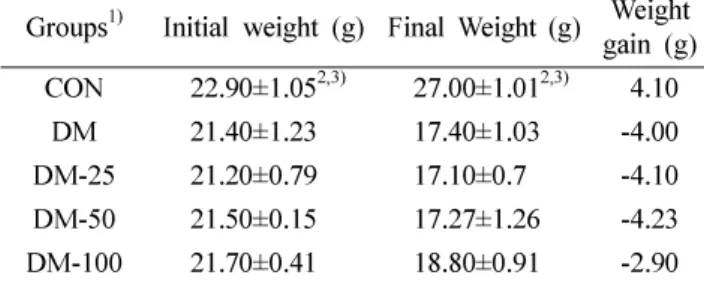
구투여한경우정상군과비교하여체중변화에차이를보 이지않았다 (Table I). STZ을투여한당뇨실험동물의경
우 3일이후부터체중이유의적으로감소하였으며, 12일경
과후당뇨대조군은정상군에비하여약 35% 정도체중감
소를보였다(Table II). 그러나 TAWS추출물 100 mg/kg을투
여한 DM-100군에서는당뇨병성체중감소가유의성있게
억제되었다. STZ 유발당뇨흰쥐의체중감소현상은물과용
질교환이가능한모세혈관의최대표면적이상대적으로감 소되어골격근을 위축시킨다고알려져있다. 이렇게 STZ
주사에의해유도된당뇨실험동물의경우감소된 체중은
alloxan으로유도된당뇨와는달리체중회복이쉽지않다
는보고가있다.15)일반적으로 STZ에 의해유도된당뇨
실험동물에서는 세포의포도당이용이저하되고, 기아상태
의대사특징을 보이기 때문에 TAWS추출물을투여한실
험군에서의 체중감소 억제효과는 제한적인 것으로사료 된다.
음료 및 식이 섭취량 변화에 TAWS물추출물의 효과 −
STZ으로 유도된제1형당뇨병에서는고혈당과더불어다
음, 다식, 및다뇨의특징적인당뇨증상을보인다. 당뇨실
험동물에서음료및식이섭취량에있어서 TAWS추출물이
미치는영향을 12일동안측정하고이를하루평균섭취량
Table I. Effects of TAWS water extracts on body weight and weight gain in normal mice experimental mice for 2 weeks.
Groups1) Initial weight (g) Final Weight (g) Weight gain (g) CON 22.60±1.122,3) 25.60±0.982,3) 3.00
T25 22.30±1.08 25.34±0.99 3.04
T50 22.52±1.23 25.54±0.53 3.02
T100 22.78±0.98 25.96±1.06 3.18
1)CON: Normal mice.
T25 group: Normal mice treated with 25 mg/kg of TAWS extracts.
T50 group: Normal mice treated with 50 mg/kg of TAWS extracts.
T100 group: Normal mice treated with 100 mg/kg of TAWS extracts.
2)All values are mean±SE (n=5).
3)Values within a column with same superscripts are not significantly different at p<0.05 by Student t-test.
Table II. Effects of TAWS water extracts on body weight and weight gain in STZ-induced diabetic mice for 12 days.
Groups1) Initial weight (g) Final Weight (g) Weight gain (g) CON 22.90±1.052,3) 27.00±1.012,3) -4.10
DM 21.40±1.23 17.40±1.03 -4.00
DM-25 21.20±0.79 17.10±0.7 -4.10
DM-50 21.50±0.15 17.27±1.26 -4.23
DM-100 21.70±0.41 18.80±0.91 -2.90
1)CON group: Normal mice.
DM group: Diabetic control mice.
DM-25 group: Diabetic mice treated with 25 mg/kg of TAWS extracts.
DM-50 group: Diabetic mice treated with 50 mg/kg of TAWS extracts.
DM-100 group: Diabetic mice treated with 100 mg/kg of TAWS extracts.
2)All values are mean±SE (n=5).
3)Values with different superscripts are significantly different at p<0.05 by Student t-test.
으로계산한결과를 Table III에나타내었다. 정상대조군
(NDM)은실험전기간에걸쳐음료및식이섭취량에있어
서커다란차이를보이지않았지만, 당뇨병이유발된대조
군(DM)과실험군(DM-100, DM-50, DM-25)은정상대조군
에비하여음료섭취량이 3배및식이섭취량이 1.5배이상
큰폭으로증가하였다. TAWS추출물을투여한경우 DM- 100실험군에서음료및식이섭취량이당뇨대조군에비하
여유의적으로감소함을보였으나저농도의 TAWS추출물
투여군에서의식이섭취량은유의적인차이가없었다. 이와
같은결과는 TAWS추출물이용량의존적으로당뇨의임상
적증상을완화시키는것으로보인다. 그러나본실험에서
사용된시료의물리적특성때문에경구로고용량을투여 하는데제한이있었으며, 실험군에서의음료및식이섭취량
의감소는영양성분을함유하고있는 TAWS추출물의강제
투여가섭취량의감소를초래했을가능성도있다.
혈중 포도당 농도의 변화에 TAWS물추출물의 효과 − 실
험동물에 TAWS추출물을 12일동안투여하고각각대조군
과실험군에서 3일간격으로혈중포도당농도를측정하여
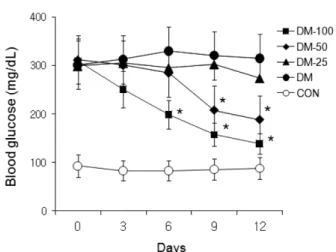
비교한결과는 Fig. 1과같다. 당뇨대조군인 DM군 (301±
45mg/dL)에비하여 TAWS추출물을투여한 DM-25군에서
는혈당저하를보이지않았지만 DM-100군과 DM-50군은
투여기간에비례하여현저한혈당 감소를보였으며, 특히 12일간투여후 DM-100군이 309±45 mg/dL에서 139±21 mg/
dL, DM-50군이 312±43 mg/dL에서 188±49 mg/dL로 각각
55%와 39.7% 혈당수준이감소하였다. 혈당저하 효과는
TAWS추출물의투여량에비례하여증가하였으며이러한결
과는 TAWS추출물에항당뇨물질이함유하고있음을제시
한다. 제1형당뇨병환자에게처방되고있는대표적인치료
제는인슐린및인슐린분비촉진제이며, 부분적으로당의
체내흡수를방해하는탄수화물분해효소억제제가알려져
있다.16) Oneda등은밀낱알에아밀라제억제제가함유하고
있음을보고하였고,17)오래전부터당뇨병에사용되어온뽕잎
에는 alpha-glycosidase 저해활성이있는 1-deoxynojirimycin18)
및 N-containing sugars19)이함유되어항당뇨효과가있음이
보고되었다. 따라서 TAWS추출물에서도이와같은아밀라
제활성을억제하는물질로부터혈당저하를유도할가능성 이있다.
혈중 인슐린 농도의 변화에 TAWS물추출물의 효과 − 실 험동물에서 TAWS추출물에의한혈당저하효과와인슐린
과의 관련성을확인하였다. STZ으로당뇨유발후 12일에
Table III. Effects of TAWS water extracts on of feed and water intake in STZ-induced diabetic mice for 12 days.
Groups1) Feed intake2)
(g/day) water intake2) (mL/day) CON 3.44±0.263,4) 0 04.29±0.413,4)
DM 5.63±1.26 14.25±2.01
DM-25 5.15±0.92 14.01±1.53
DM-50 5.63±1.26 13.90±1.97
DM-100 4.49±0.69 13.05±1.94
1)Abbreviation are the same as those of Table 2.
2)Feed intake and water intake were measured everyday for 12 days and normalized to intake weights and volumes for 24 hours, respectively.
3)All values are expressed as mean±SE (n=5).
4)Values within a column with different superscripts are significantly different at p<0.05 by Student t-test.
Fig. 1. Effects of TAWS water extracts on blood glucose levels in STZ-induced diabetic mice.
The blood glucose levels of all groups were measured at intervals of 3 days for 12 days. All values are given as means±SE (n=5). Values with asterisk are significantly different at p<0.05 vs. the diabetic groups received with/
without TAWS extracts.
Fig. 2. Effects of TAWS water extracts on plasma insulin levels in STZ-induced diabetic mice.
All animals were sacrificed at 12 days after induction of diabetes, and bloods were collected by heart puncture. All values are given as means±SE (n=5). Values with asterisk are significantly different at p<0.05 vs. the diabetic groups received with/without TAWS extracts.
걸쳐시료를투여한후 Mouse insulin ELISA kit를사용하
여혈중인슐린농도를측정하였다(Fig. 3). 정상군(CON)에
비하여당뇨대조군(DM)에서는매우낮은수준의혈중인
슐린이검출되었다. 시료를투여한경우당뇨대조군 DM
군에비해실험군 DM-100 에서 10배가량혈중인슐린농
도가증가하였고, DM-50와 DM-25실험군에서도각각 3.6
배와 1.6배의혈중인슐린농도가증가함을보였다. 일반적
으로 STZ을투여하게되면췌장베타세포가파괴되고이는
인슐린생성부족으로대사이상이나타나게되어혈중포
도당농도가증가하게된다.20-22)혈당저하작용을갖는대
부분의천연물들은폴리페놀류및플라보노이드성분들을 함유하고있으며이들은다양한작용기전을통하여항당뇨 효과를갖는다. 비파나무에서분리한 Cinchonain Ib23)및녹
차의폴리페놀24)등은인슐린분비를자극한다고보고되었다.
따라서본실험결과 TAWS추출물이췌장베타세포의인슐
린생산을자극하는효과가있음을보여주며, 또한인슐린
분비를유도할수있는성분이함유되어있을것으로사료 된다.
TAWS물추출물의 총폴리페놀 및 총플라보노이드 함량 − 천연물의생리활성물질로대표되는총폴리페놀및총플라 보노이드등의함량을조사하였다. 10일간키운 TAWS 물추
출물에서총폴리페놀함량은대표물질인 tannic acid을표준
물질로하고, 총플라보노이드함량은 8-hydroxyquinoline을
표준물질로하여 1 g당함유량으로환산하였다. 시료의물
추출건조물에는총폴리페놀이약 6.6 mg/g 해당량이검출
되었으며(Fig. 3A), 총플라보노이드는약 1.0 mg/g에해당하
는함량을보였다(Fig. 3B). 또한서로다른시기에 10일간
재배하여얻은 3개시료를비교한결과총폴리페놀및총
플라보노이드함량이유사한수준을보였다. 이결과는 10
일의짧은재배기간에서는 TAWS들의주요생리활성물질
함량에변화가없는것으로생각된다. 페놀성물질은다양
한구조와분자량을가지며, 이것들의 phenolic hydroxyl이
단백질처럼거대분자와결합을하여항산화, 항균, 항암등
의생리기능을가지는것으로알려져있다.25)플라보노이
드는 담황색또는노란색을띠는색소화합물로서 식물중 에는대부분당과결합된배당체로서존재하며인체에특 이한부작용이없는것으로알려져있다.26)최근에 Cavaliere
등은 TAWS에 Luteolin glycosides를함유한다고보고하였
다.27)
Fig. 3. The contents of total phenolic compounds (A) and total flavonoids (B) in the water extracts of TAWS.
Three of samples grown for 10 dayswere obtained at different days. The content of total phenolic compounds and total flavonoids were represented as tannic acid equivalents and 8- hydroxyquinolline equivalents/1 g dry mass of TAWS extracts, respectively. The values are expressed as mean±SE of three independent experiments.
Fig. 4.Antioxidant capacity (A) and DPPH radical scavenging capacity (B) in the water extracts of TAWS.
Three of samples were obtained at different day. The ascorbic acid equivalent antioxidant capacity (AEAC) was represented as mM ascorbic acid equivalent and mM DPPH equivalent/1 g dry mass of TAWS extracts, respectively. Values are expressed as mean±SE of three independent experiments.
TAWS물추출물의 Antioxidant Capacity 및 DPPH Radical Scavenging Capacity − 항산화물질은 free radical
에전자나수소를공여하여복합체를만들며, 전자공여능은
시료의플라보노이드및폴리페놀성물질들에대한항산화 작용의지표로알려져있다.28) TAWS추출물의 SOD유사항
산화활성및전자공여능을측정한결과 TAWS물추출건조
물의 1 g에서는 ascorbic acid 약 1.2 mM 해당량의산화억
제활성을보였으며 (Fig. 4A), 전자공여능은 DPPH의약 1.8 mM에해당하는활성을보였다(Fig. 4B). 재배시기가다
른 3개의시료에서항산화활성은총폴리페놀및총플라보
노이드함량결과에서와같이 TAWS추출물은수확시기에
크게 영향을받지 않고 비슷한 활성을 보였다. 최근에
Kulkarni등은 생밀순에서 SOD유사활성및전자공여능의
높은활성도를보고하였으며,29) Calzuola 등은 70%알코올
밀순 추출물이 강력한 Super oxide scavenge 활성과
ferricyanide에대한환원능이뛰어난항산화효과가있음을
보고하였다.30)본실험결과도이들과일치하는결과를보였
으며, 밀순에함유하는폴리페놀및플라보노이드의항산화
활성으로산화성스트레스질환에효과가있을것으로사료 된다.
결 론
본연구에서는 TAWS물추출물이 streptozotocin(STZ)로
유발한당뇨흰쥐에서혈당저하에미치는영향을밝히고자 혈중포도당농도, 체중변화, 사료및음료수섭취량, 혈중
인슐린농도의변화를조사하였다. 또한 TAWS의생리활성
물질인총폴리페놀, 총플라보노이드함량을측정하고, 항산
화활성및전자공여능을확인하였다. 실험을위해숫컷흰
쥐들을정상군(CON), 당뇨대조군(DM), 당뇨쥐에 TAWS
물추출물투여량이서로다른실험군(DM-100, DM-50, DM- 25)으로나누어실험하였다. 그결과당뇨대조군에서 4 g
이상체중이감소함에반하여추출물농도별 투여군에서
DM-100군은 2.9 g 체중감소에그쳤다. 사료및음용수섭
취측정결과역시추출물투여군에서유의적인감소를보
였다. 혈중포도당농도는정상군(CON)에비하여당뇨대조
군(DM)이 357% 증가되었으며, 실험군인 DM-100군과 DM- 50군에서는 DM-100군이투여전혈당인 309±45 mg/dL에
서투여 12일째에 139±21 mg/dL, DM-50군이 312±43 mg/
dL에서 188±49 mg/dL로각각 55%와 39.7% 감소하였다. 또
한당뇨쥐의인슐린감수성에대한관찰결과당뇨대조군에 비하여모든실험군에서높은값을보였다. 또한 TAWS 물
추출물에는폴리페놀과플라보노이드류화합물들이함유되 어있으며, 항산화활성과전자공여능이뛰어난생리활성효
과를보였다. 이러한특성은 TAWS 수확시기가서로다른
경우에도비슷한경향을나타내었다. 이상과같은결과를
통해서 TAWS 추출물은당뇨병의혈당저하및당뇨병으로
인해발생하기쉬운합병증의개선에기여할것으로사료 되며, 이들의항당뇨기전에대해서는앞으로연구가진행
되어야할것이다.
사 사
본연구는농림수산식품부농림기술개발사업(과제번호 :108156-03-1-CG000)의지원에의하여수행되었음.
인용문헌
1. Abrams, J. J., Ginsberg, H. and Grundy, S.M. (1982) Metab- olism of cholesterol and plasma triglycerides in nonketotic diabetes mellitus. Diabetes 31: 903-910.
2. Tisch, R. and Mcdevitt, H. (1966) Insulin-dependent diabetes mellitus. Cell 85: 291-297.
3. Giugliano, D., Ceriello, A. and Paolisso, G. (1996) Oxidative stress and diabetic vascular complications. Diabetes Care. 19: 257-267.
4.김경래. (1994) 당뇨병 민간요법의 실태. 당뇨병. 18: 61- 5. Hänninen ,O., Rauma, A.L., Kaartinen, K. and Nenonen, M.64.
(1999) Vegan diet in physiological health promotion. Acta Physiol Hung. 86: 171-180.
6. Nagaoka, H. (2005) Treatment of germinated wheat to increase levels of GABA and IP6 catalyzed by endogenous enzymes. Biotechnol. Prog. 21: 405-410
7. Calzuola, I., Marsili, V. and Gianfranceschi, G.L. (2004) Syn- thesis of antioxidants in wheat sprouts. J. Agric. Food Chem.
52: 5201-5206.
8. Bar-Sela, G., Tsalic, M., Fried, G. and Goldberg, H. (2007) Wheat grass juice may improve hematological toxicity related to chemotherapy in breast cancer patients: a pilot study. Nutr. Cancer. 58: 43-48.
9. Ben-Arye, E., Goldin, E., Wengrower, D., Stamper, A., Kohn, R. and Berry, E. (2002) Wheat grass juice in the treatment of active distal ulcerative colitis: a randomized double-blind pla- cebo-controlled trial. Scand. J. Gastroenterol. 37: 444-449.
10. Rakieten, N., Gordon, B.S., Cooney, D.A., Davis, R.D. and Schein, P.S. (1968) Renal tumorgenic action of streptozotocin (NSC-85998) in rats. Cancer Chemother. Rep. 52: 563-567.
11. Folin, O. and Denis, W. (1912) On phosphotungastic-phos- phomolybdic conpounds as color reagents. J. Biol. Chem. 12: 239-249.
12. Moreno, M.,Isla, M.,Sampietro, A. and Vattuone, M.(2000) Comparison of the free radical-scavenging activity ofpro- polis from several regions of Argentina.J. Ethnopharmacol.
71: 109-114
13. Pellegrin, N., Roberta, R., Min, Y. and Catherine, R.E. (1998)
Screening of dietary carotenoids and carotenoid-rich fruit extracts for antioxidant activites applying 2,2'-azinobis (3- ehylenebenzothiazoline-6-sulfonic acid) radical cation decol- orization assay. Method Enzymol. 299: 379-389.
14. Blois, M. S.(1958)Antioxidant determination by the useof stable free radical. Nature 26: 1198-1199.
15. Sexton, W. L. (1994) Skeletal muscle vascular transport capacity in diabetic rats. Diabetes 43: 225-231.
16. Raptis, S.A.andDimitriadis, G.D.(2001)Oral hypoglycemic agents: insulin secretagogues, alpha-glucosidase inhibitors and insulin sensitizers. Exp. Clin. Endocrinol. Diabetes 109 Suppl: S265-S287.
17. Oneda, H., Lee, S. and Inouye, K. (2004)Inhibitory Effect of 0.19 {alpha}-Amylase Inhibitor from Wheat Kernel on the Activity of Porcine Pancreas {alpha}-Amylase and Its Ther- mal Stability. J. Biochem. 135: 421-427
18. Asano, N., Oseki, K., Kaneko, E. and Matsui, K. (1994) Enzymic synthesis of alpha- and beta-D-glucosides of 1- deoxynojirimycin and their glycosidase inhibitory activities.
Carbohydr. Res. 258: 255-266.
19. Nojima, H., Kimura, I., Chen, F.J., Sugihara, Y., Haruno, M., Kato, A. and Asano, N. (1998) Antihyperglycemic effects of N-containing sugars from Xanthocercis zambesiaca, Morus bombycis, Aglaonema treubii, and Castanospermum australe in streptozotocin-diabetic mice. J. Nat. Prod.61: 397-400.
20. Forman, S., Estilow, M.L. and Vlienko, P. (1996) STZ dia- betes alters immunoreactive b-endorphin levels and pain per- ception after 8wk in female rats. Diabetes35: 1309-1313.
21. Furuse, M., Kimura, C., Mabayo, R.T. and Takahashi, H.
(1993) Okumura J Dietary sorbose prevents and improves hyperglycemia in genetically diabetic mice. J. Nutri.123: 59- 22. Fischer, K. J.65. andStewart,J. K. (1986)Phenylethanolamine N-methyltransferase in the brains of streptozotocin diabetic rats. Endocrinology 119: 2586-2589.
23. Qa'dan, F., Verspohl, E.J., Nahrstedt, A., Petereit, F. and
Matalka, K.Z. (2009) Cinchonain Ib isolated from Eriobotrya japonica induces insulin secretion in vitro and in vivo. J. Eth- nopharmacol. 124: 224-227.
24. Li, C., Allen, A., Kwagh, J., Doliba, N.M., Qin, W., Najafi, H., Collins, H.W., Matschinsky, F.M., Stanley, C.A. and Smith, T.J. (2006) Green tea polyphenols modulate insulin secretion by inhibiting glutamate dehydrogenase. J. Biol.
Chem. 281: 10214-10221.
25. Dural, B. and Shetty, K. (2001) The stimulation of phenolics and antioxidant activity in pea (Pisum sativum) elicited by genetically transformed Anise root extract. J. Food Biochem.
25: 361-377.
26. Miyake, Y.,Yamamoto, K. andTsujihara, N.Osawa T. (1998) Protective effects of lemon flavonoids on oxidative stress in diabetic rats. Lipid 33: 689-695.
27. Cavaliere, C., Foglia, P., Pastorini, E., Samperi, R. and Laganà, A. (2005) Identification and mass spectrometric characterization of glycosylated flavonoids in Triticum durum plants by high-performance liquid chromatography with tandem mass spectrometry. Rapid Commun. Mass Spec- trom 19: 3143-3158
28. Hertog, M. G., Feskens, E. J., Hollman, P. C., Katan, M. B.
and Kromhout, D. (1993) Dietary antioxidant flavonoids and risk of coronary heart disease: the Zutphen Elderly Study.
Lancet 342: 1007-1011.
29. Kulkarni, S. D., Tilak, J, C., Acharya, R., Rajurkar, N. S., Devasagayam, T. P. and Reddy, A. V. (2006) Evaluation of the antioxidant activity of wheatgrass (Triticum aestivum L.) as a function of growth under different conditions. Phytother.
Res. 20: 218-227.
30. Calzuola, I., Gianfranceschi, G.L. and Marsili, V. (2006) Comparative activity of antioxidants from wheat sprouts, Morinda citrifolia, fermented papaya and white tea. Int. J.
Food Sci. Nutr. 57: 168-177.
(2009년 10월 19일 접수)