Genetic Analysis of Complementary Gene Interactions of Pb and Pp Genes for the Purple Pericarp Trait in Rice
Kyung Eun Lee
1, Md Mominur Rahman
1, Jong Bae Kim
2and Sang Gu Kang
1*
1Molecular Genetics Laboratory, Department of Biotechnology, College of Life and Applied Sciences, Yeungnam University, 280 Daehak-Ro, Gyeongsan, Gyeongbuk 38541, Korea
2Institute of Health & Environment in Daegu, 215 Muhakro, Suseong-Gu, Daegu 42183, Korea
Received February 3, 2018 /Revised March 17, 2018 /Accepted April 11, 2018
The Purple pericarp (Prp) trait is a trait often bred for in black rice. Generally, the Prp trait is displayed in the color variations of seeds following the 9:3:4 purple, brown, and white ratio, respectively. The Prp trait is a recessive epistasis of two gene interactions; however, it is caused by the two com- plementation genes Pb and Pp. Here we present a study of the genetic characteristics of the Prp trait using an F
1hybrid with a Pbpb Pppp genotype. This hybrid generated four seed colors with the fol- lowing numbers: 3 dark purple, 6 medium purple, 3 brown, and 4 white (or 9 purple, 3 brown, and 4 white). However, further biochemical analysis of the all progenies divided them into two groups.
One group had the Pb_ Pp_ allelic constitutions and contained cyanidin 3-O-glucoside (C3G) in both the dark purple or medium purple seeds. The other group, however, was absent of C3G in both the brown and white seeds, resulting in a ratio of 9:7, respectively. This segregation revealed the extended Mendelian 9:7 ratios of the complementary gene interactions with a good fitness in χ
2analysis.
Further analysis revealed that brown seeds with the Pb_ pppp genotype corresponded with a null C3G, indicating that the Brown pericarp trait in rice is caused by a dominant allele of the Pb gene. Therefore, we conclude that the production of C3G is a main phenotype of the black and purple colored rice in the Prp trait, and it is governed by the complementary gene interactions between Pb and Pp genes.
Key words : Black rice, complementary gene, epistasis, Oryza sativa, purple pericarp
*Corresponding author
*Tel : +82-53-810-3025, Fax : +82-53-810-4655
*E-mail : [email protected]
This is an Open-Access article distributed under the terms of the Creative Commons Attribution Non-Commercial License (http://creativecommons.org/licenses/by-nc/3.0) which permits unrestricted non-commercial use, distribution, and reproduction in any medium, provided the original work is properly cited.
Journal of Life Science 2018 Vol. 28. No. 4. 398~407 DOI : https://doi.org/10.5352/JLS.2018.28.4.398
Introduction
Rice (Oryza sativa L.) is the major cereal crop for con- sumption of the world’s population and contains different colors such as white, red, brown, green and black [1, 4, 9-11].
Generally, the commercial name ‘black rice’ referred to the dark purple colored pericarp seed of rice, which is repre- sented by genetic Purple Pericarp (Prp) trait (http://www.
gramene.org) [2]. The black colored seeds are resulted by high accumulation of purple colored anthocyanin pigment in a single layer of cells in the pericarp of seed [10, 14, 15, 25]. The major anthocyanin pigments of black rice are cyani- din-3-0-glucoside (C3G) predominantly and peonidin-3-0- glucoside (P3G) additionally [5, 14, 16] . Because the C3G in cereals exhibited anti-cancer, anti-oxidant and anti-in-
flammatory activities, black rice was consumed widely as one of health promoting grains [3, 8, 18, 20]. Therefore, the rice Prp trait is a useful model in genetics of the purple col- ored pericarp cereals including wheat and barley [22, 23].
Two dominant genes, Pb and Pp [2, 14, 17, 21, 26], con- trolled the Prp trait in rice. Simply, it explains that the genet- ic constitutions in the ratio of 9 Pb-Pp- for purple : 3 Pb-pppp for brown : 4 pbpbPp- or pbpbpppp for white pericarps re- sulted in segregation of 9:3:4 ratios to support towards re- cessive epistasis [2]. However, the purple colored seeds of progenies were divided in the dark purple type and the me- dium purple type depending on parental genotypes gave ambiguous in the recessive epistasis [14], suggested that the phenotype of the Prp trait is not perfectly fit for the recessive epistasis in some genotypic classes by two gene interaction.
Thus, genetic interactions of the genes in Prp trait are some-
what confusing in the recessive epistasis manner or the com-
plementary gene interactions and need to be clarified
further. After 97 years passed from genetic and physiological
studies of black rice by Nagai [10], only the Pb gene of Prp
trait has well defined DNA sequence in chromosome 4 and
named OsB1 that encodes a basic helix-loop-helix (bHLH)
type transcription factor [14, 17, 21]. Therefore, further inves- tigation is achievable to define the genetic definition of Prp trait for black rice.
Although high demand of black rice for healthy func- tional foods, the yield and eating quality of black rice are relatively inferior to that of white rice [12, 21, 26]. Many black rice cultivars have been breed with improved agro- nomical traits, but eating quality and yields still need to be improved [19, 23]. Recently, by using DNA markers covering the rice genome, Maeda et al. [6] reported that Japonica type black rice was developed with superior in eating quality to other black rice varieties, but showed slightly lower yields.
Up to date, because of physiological factors and complicate genetic constitutions of two gene interactions, high yield black rice breeding is still hard than white rice breeding. One sug- gested that due to the high anthocyanin deposition in seed pericarp of black rice, chloroplasts in seed pericarp reduced the photosynthesis, resulting in yields reduction [13, 19].
Moreover, genetic complication of Prp trait is also a neg- ative factor to black rice breeding. For example, allelic com- binations of Pb and Pp are involved in resulting not only to produce various phenotypes of seed color appeared but also heterozygous progenies continued segregations [14].
Therefore, to breed black rice with enrichment in grain color, good taste and improved yield, the accurate predictions of genetic analysis of Prp trait are highly desired.
Taken together, we have some complications in analysis for the genetic constitutions of the progenies of black rice hybrids. The genetics and physiological natures of Prp trait were misinterpreted the segregation based on visible colors and it required further extended selection. In this study, we discuss the genetic definition of Prp trait of rice and sug- gests for the organization of the allelic patterns of Pb gene to yield increasing with enhanced C3G deposition in black rice.
Materials and Methods
Plant materials
We crossed a black gain rice cultivar ‘Heugnambyeo’
(YUC020) as a pollen recipient and white grain rice ‘Ishehi- kari’ (YUC044) as a pollen donor. Both are Oryza sativa L.
Japonica type. The crosses were grown and selected from 2009 to 2017 in the rice paddy field at Yeungnam University, Gyeongsan, Korea.
Phenotype analysis and agronomic data scoring The phenotypes of the purple pericarp plants and white pericarp plants were recorded [7]. In addition to the pericarp color of the materials, several agronomic traits including days to heading (DH), tiller number (TN), culm length (CL), leaf length (LL), plant height (PH), panicle exertion ability (PE), panicle length (PL), panicle number (PN), panicle thresh ability (PT), spikelet number (SN), spikelet fertility (SF) and 100-grain weight were evaluated. Specifically, plants in each line were evaluated for each type of agronomic data considered. The heading date for each plant was recorded as the first developing panicle to emerge approximately 1 cm beyond the leaf sheath of the flag leaf. For grain weight, 100 ripped spikelets were de-hulled and the weight in grams was measured.
Genetic analysis
The inheritance patterns of the pericarp color were ana- lyzed by following previous study [14]. To evaluate the in- heritance pattern of purple pericarps, segregation analysis of the purple pericarps was carried out using progenies of crosses. Segregation analysis and selection for pericarp color were performed to F
7progeny. The genotype of the parents was determined based on the seed pericarp color pheno- types of the F
1, F
2and progenies. Determination of dominant or recessive alleles of Pb genes among progenies was per- formed based on PCR-based polymorphism of the OsB1 nu- cleotide sequences (accession number U39860) [14, 21].
Briefly, in the OsB1 DNA sequences of a coding region of Pb gene, the recessive allele pb of the white rice showed the 2 bp (GT) insertion. In the GT deleted sequence of the domi- nant Pb allele offered a 5’-GGATCC sequence, which was cut by BamH1 restriction enzyme. However, the recessive pb allele offered a 5’-GGATGTCC sequence, uncut by BamH1 restriction enzyme. To accomplish the restriction enzyme as- sisted polymorphism of Pb genes, we used primers for OsB1 sequences for a forward primer 5’-GGGAGAAGCTCAACG AGATG and a reverse primer 5’-GGGTGGCAGATTCATC ACTT. The 1.2 kb of PCR amplified fragments was purified and digested with BamHI and then electrophoresed on 1.2%
agarose gel to determine allelic constitution of each plant [14].
Cyanidin-3-O-glucoside detection
C3G was measured by following methods. One gram rice
sample was taken and ground in to powder form. Methanol
Table 1. Segregation analysis in the cross between purple pericarp rice and white pericarp rice based on the recessive epistasis of the gene interaction
F2 segregation χ2 (9:3:4) Df=2 p-value
Color phenotype Ratio Genotype Observed Expected
Purple (9) Pb_ Pp_
165 165.94.
Brown (3) Pb_ pppp
55 55.31
White (4) pbpb Pb_, pbpb pppp
75 73.75
Total
295
295 0.02 <0.99
Segregation ratio is 9:3:4.
Table 2. Segregation analysis in the cross between purple pericarp rice and white pericarp rice based on the inheritance pattern of seed pericarp color
F2 segregation
χ
2(3:6:3:4) Df=3 p-valueColor phenotype Ratio Genotype Observed Expected
Dark Purple (3) PbPb PpPp
40 55.31
Medium Purple (6) PbPb Pp_
125 110.63
Brown (3) Pb_ pppp
55 55.31
White (4) pbpb Pp_, pbpb pppp
75 73.75
Total
295
295 1.50 0.9~0.5
Segregation ratio is 3:6:3:4.
extract was prepared by using a solution of 15 ml HCl/
methanol (0.15% HCl/methanol) for 4 hr and this process was repeated three times. The extracts were then centrifuged at 10,000× g for 20 min and passed through a 0.25 μm PVDF filter (Millipore, Billerica, MA, USA). The filtered samples (10 μl) were subsequently injected into an HPLC (high per- formance liquid chromatography) (Sheseido, Tokyo, Japan) system. Separation was conducted using a CAP CELL PAK C18 column (4.6x250 mm; Sheseido) at 30℃ with the de- tection absorbance set at 520 nm. Kuromanin (Sigma, St.
Louis, USA) was used as standard chemicals for measure- ment of C3G. C3G contents were determined as follows: C3G content = Concentration of standard C3G × (area of sample peak/area of C3G peak) × (diluted sample / weight of sam- ple).
Results
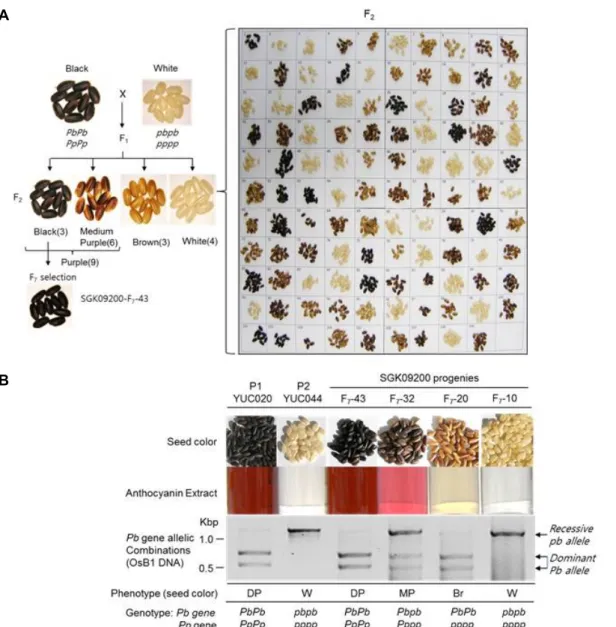
Analysis of genetic constitution of Prp trait The segregation pattern of pericarp colors in pedigree analysis of Prp trait was analyzed in Fig. 1. The cross named SGK09200 produced F
1seeds with the medium purple peri- carp seeds, demonstrated that black rice (YUC020) should have the homozygous dominant alleles of PbPb PpPp genes and white rice (YUC044) should have the homozygous re- cessive alleles of pbpb pppp genes. Therefore, we obtained a complete heterozygous F
1plant with Prp trait consisted in alleles of the Pb and Pp genes. However, the F
2generation
segregated various colored pericarp seeds. Mainly, the segre- gation pattern of pericarp colors in the F
2rice seeds clearly appeared novel phenotypes such as medium purple and brown purple compared with parental type as dark purple and white (Fig. 1A). The 259 offspring of the F
2plants classi- fied with 165 plants of purple pericarp seeds both dark and medium purple, 55 plants of brown pericarp seeds and 75 plants of white pericarp seeds. The segregation ratio showed 9 purple : 3 brown : 4 white (χ
2= 0.02, p<0.99) (Table 1).
The Mendelian ratio 9:3:4 fit to recessive epistasis of two gene interaction. Indeed, the purple seeds consist of two types, dark purple and medium purple, depending on the degree of color intensity. Therefore, self-pollination of F
1purple seed individuals showed four possible patterns out- comes with dark purple, medium purple, brown and white pericarp colors. This resulted that the ratio of the four color patterns was the ratio of 3 dark purple : 6 medium purple : 3 brown : 4 white (χ
2= 1.5, 0.90<p<0.50) (Table 2).
Genotype and phenotype analysis of the progenies We further analyzed segregation patterns of color pheno- types of seed pericarps how correspondent to genotypes and chemical phenotypes of the selected progenies (Fig. 1B).
Pigments were extracted from the seeds of black rice
YUC020 and its progenies of the 7
thgenerations including
F
7-43 and F
7-32 plants. The reddish purple pigment was ex-
tracted from dark purple pericarp seeds but pink pigment
was extracted in medium purple pericarp seeds of F
7-32.
A
B
Fig. 1. Segregation pattern and allelic analysis of pericarp colors in rice seeds. (A) Black rice with dark purple pericarp (PbPb PpPp) was crossed with white pericarp rice (pbpb pppp) and named SGK09200. F1 plants produced medium purple pericarp rice (Pbpb Pppp). F2 plants produced four different color types of seeds; dark purple, medium purple, brown and white in pericarps were presented in the left panel. In the F2 rice seeds, medium purple and brown were appeared as novel phenotypes, not in the parental types. SGK09200-F7-43 was continued to be selected through seven generations. Black rice YUC020
‘Heugnambyeo’ used as pollen recipient. White pericarp rice YUC044 ‘Ishehikary’ used as pollen donor. (B) Allelic poly- morphism among progenies of the crosses between black pericarp rice and white pericarp rice. The pigments were extracted by 70% ethanol from each seeds. Red and pink colors retained by C3G. The rice allelic genotypes of Pb gene were determined using BamH1 restriction enzyme digestion of OsB1 DNA fragments. Recessive Pb allele (1.2 kb) was not digested with BamH1 because of 2 bp (GT) insertion in the restriction site. Dominant Pb allele was digested with BamH1 resulted in divided into two DNA fragments of 0.5 kb and 0.7 kb in the length. Phenotypes and genotypes are indicated by the pericarp colors, with ‘DP’ indicating dark purple, ‘MP’ indicating medium and mixed purple, ‘Br’ indicating brown and ‘W’ indicating white.
However, the extracts of brown pericarp seeds of F
7-20 plant showed light yellow (Fig. 1B). No pigment extracted from white pericarp seeds of YUC044 and F
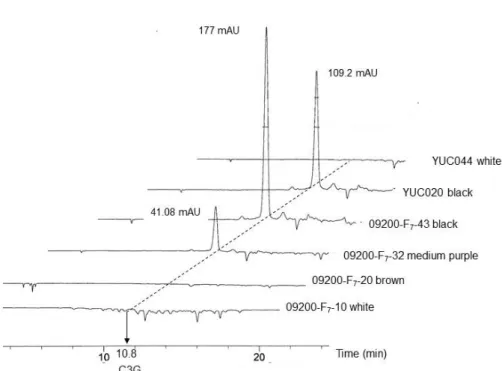
7-10 (Fig. 1B). By liquid chromatography analysis, cyanidin-3-O-glucoside was con- tained only in the red and pink pigments of seed extracts
in the Fig. 1B (Fig. 2).
To define phenotypic traits in seed color patterns and bio-
chemical characters of the selected progenies were determine
using Pb allelic polymorphisms. Previous researchers dis-
covered that the Pb alleles are coded OsB1 protein, which
Fig. 2. Cyanidin-3-O-glucoside profile of black rice and white rice. HPLC profiles were obtained of extracts from the black (dark purple), medium purple, brown or white pericarps of rice seeds of the F7 progenies. Parents were YUC020 and YUC044.
The peaks in 10.8 minutes of retention time are C3G. A high amount of C3G was detected in the ‘09200-F7-43’ (PbPb PpPp).
There were no detectable peak of C3G in the white seed (pbpb pppp) and brown seed (PbPb pppp). Retention time is shown on the horizontal line and the amount of absorption unit (mAU) is shown on the each peak.
functions as a basic helix-loop-helix transcription factor [17, 21]. Therefore, allelic genotypes of Pb gene in the progenies were determined by PCR based polymorphisms using a spe- cific primer set presented in the part of materials. In the OsB1 DNA sequences, a BamH1 restriction enzyme site is presented in the dominant allele, but absented in a recessive pb allele. Therefore, BamH1 restriction digestion of the 1.2 kb PCR products of OsB1 DNA from purple rice produced two DNA fragments, while those of white pericarp rice were not restricted [8]. As shown in figure 1B, further poly- morphism analyses were revealed that the gene con- stitutions of homozygous PbPb dominant alleles were two dark purple (DP, black) include YUC020 and F
7-43 and a brown (Br) F
7-20, indicating that Pb gene is not directly de- termine to purple color deposition by C3G synthesis.
Meanwhile, white seeds phenotype of YUC044 and F
7-10 were revealed homozygous recessive alleles of pbpb gene constitution. However, the medium purple pericarp (MP) of F
7-32 showed three bands, indicating that MP phenotype was consisted with heterozygous alleles of Pbpb gene constitution. To make an additional remark, the alleles of Pp gene were determined by segregation analysis in gen- erations of progenies (Fig. 1B). Pigment production was re- quired at least one dominant allele in the two genes Pb and
Pp. However, the degree of color intensity in the seed ex- tracts was appeared to be determined by the numbers of dominant alleles of the two genes.
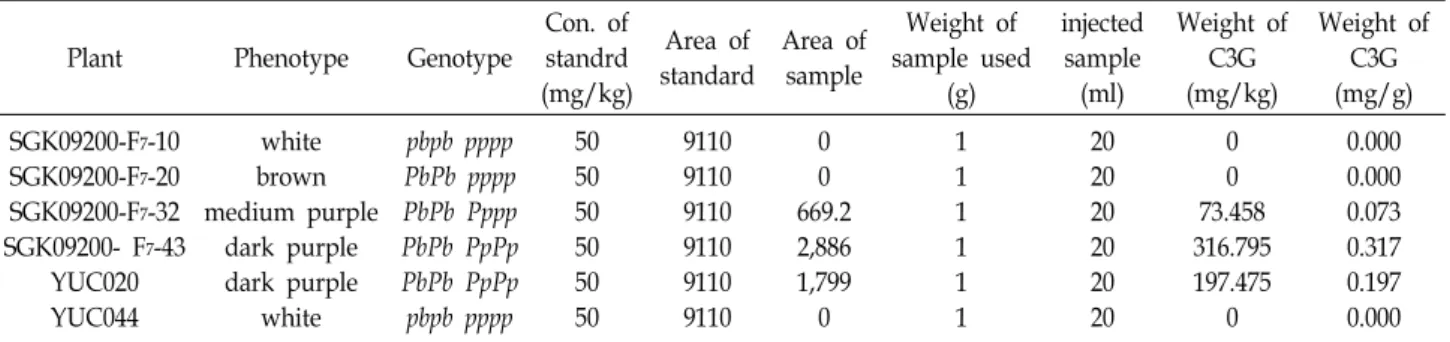
Contents of cyanidin-3-O-glucoside in genotypes Previously, C3G was determined by the number of domi- nant Pp alleles [14]. Consistently, we confirmed yet again to support the function of Pp gene by measuring the quantity of C3G of the experimental plants (Fig. 2). As shown in the HPLC data, relatively high amount of C3G was contained in the dark purple phenotypes of YUC020 and F
7-43 (Fig.
2, Table 3). The F
7-43 contained about 316.8 mg/kg of C3G.
However, no C3G peak identified in the white pericarp
seeds of YUC020, F
7-10 and the brown pericarp seed of F
7-20
(PbPb pppp). Here, we clearly identified that brown pericarp
F
7-20 of PbPb pppp genetic constitution did not produce C3G
(Table 3). The number of copies of dominant Pb and Pp al-
leles determined the level of C3G. Additionally, biochemical
phenotypes of the progenies demonstrated that only two
phenotypes are presented either C3G contained or absent
(Table 3, Fig. 1B). Therefore, we rearranged new segregation
ratio instead of the ratio 9:3:4(Table 1). When we consider
the biochemical phenotype of cyanidin-3-O-glucoside con-
tent, it gives rise to a good fit to a ratio of 9 present C3G
Table 3. Quantification of cyanidin-3-O-glucoside in the progenies for definition of biochemical phenotypes compared with visible color phenotypes and genotypes
Plant Phenotype Genotype
Con. of standrd (mg/kg)
Area of standard
Area of sample
Weight of sample used
(g)
injected sample
(ml)
Weight of C3G (mg/kg)
Weight of C3G (mg/g) SGK09200-F7-10
SGK09200-F7-20 SGK09200-F7-32 SGK09200- F7-43
YUC020 YUC044
white brown medium purple
dark purple dark purple
white
pbpb pppp PbPb pppp PbPb Pppp PbPb PpPp PbPb PpPp pbpb pppp
50 50 50 50 50 50
9110 9110 9110 9110 9110 9110
0 0 669.2 2,886 1,799 0
1 1 1 1 1 1
20 20 20 20 20 20
0 0 73.458 316.795 197.475
0
0.000 0.000 0.073 0.317 0.197 0.000
*All measuring were performed three times repeated. C3G is cyanidin-3-O-glucoside. s
Table 4. Segregation analysis of biochemical phenotype in the cross between purple pericarp rice and white pericarp rice based on the complementary gene action
F2 segregation
χ
2 (9:7)Df=1. p-value
Color phenotype C3G Chemical phenotype
Ratio Genotype Observed Expected
Purple C3G exist
(9) Pb_ Pp_
165 165.94
Brown or White null
(7)
Pb_ pppp, pbpb Pp_, pbpb pppp 130
129.06
Total
295
295 0.00 1
Segregation ratio is 9:7.
*C3G is cyanidin-3-O-glucoside
Table 5. Comparative agronomic traits among purple and white pericarp rice
Cultivar Pericarp color
Plant height
(cm)
Culm length (cm)
Flag leaf length
(cm)
Flag leaf width
(cm)
No. of tillers per
plant
No. of panicle per plant
Panicle length (cm)
No. of grains per
panicle
Seed fertility
(%)
100 seed weight
(g) YUC044
(Isehikari) White 107.7±1.5 68.9±1.1 38.8±0.7 1.22±.03 16.2±1.4 14.6±1.4 18.0±0.2 111.0±4.9 98.2±1.1 2.25±.14 YUC020
(Heugnam- byeo)
Black 97.0±0.7 66.8±1.0 30.4±0.8 1.21±.02 15.3±1.4 14.0±1.3 16.1±0.3 120.4±5.5 98.9±1.1 2.04±.09
SGK09200-
F7-43 Black 119.4±0.8 78.9±1.1 39.0±1.8 1.34±0.07 20.9±1.8 25.3±1.0 22.0±0.5 160.1±1.2 98.63±2.0 2.50±.24 Data are means±standard error of five observations for each trait. SGK09200 crossed between ‘Ishikari’ (O. sativa Japonica) and
‘Heugnambyeo’ (O. sativa Japonica).
: 7 absent C3G that displayed the complementary gene ac- tion between Pb and Pp genes (χ
2= 0, P=1) (Table 4).
Analysis of Pb allelic polymorphism for selection To improve yields and C3G contents of black rice, we per- formed selections for progenies of the cross, ‘Heugnambyeo’
(YUC020) and ‘Ishehikari’ (YUC044), by Pb allelic determi- nation by polymorphism analysis (Fig. 1B). Since the F
2as well as next progenies were segregated continually in vari-
ous different types with anthocyanin colors as shown in fig-
ure 1, it was hard to select the good breeding lines with
high yield and improved quantity of anthocyanin. To over-
come this, we selected some candidate progenies of homo-
zygous PbPb allelic combination assisted with Pb genotyping
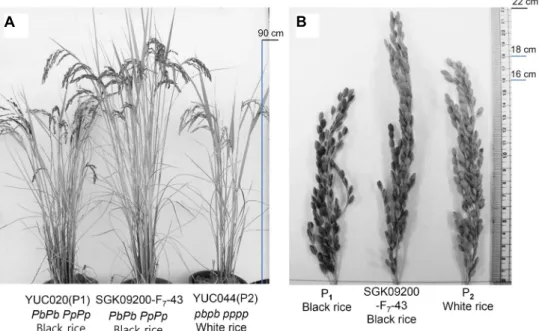
(Fig. 1B). Finally, we selected the SGK09200-F
7-43 individual
(Fig 3, Table 5). Specifically, the plant height of F
7-43 was
119.4 cm that taller than parental types and more tiller num-
bers than their parents (Table 4). Moreover, we find im-
A B
Fig. 3. Selected black rice progeny having homozygous Pb and Pp alleles. Plant features (A) and spikelets (B) were compared with pollen donor YUC044 (P1), pollen recipient YUC020 (P2) and a selected black rice line, SGK09200-F7-43.
proved in tiller and panicle number per plant, panicle length, number of grains per panicle and 100 seed weight than those of parents (Table 5). The selected F
7-43 plant showed dark purple pericarp with 0.317 mg/g of cyani- din-3-O-glucoside that is relatively high percentage among parents and other progenies. We finally established that the genotype of the selected F
7-43 plant line showed the alleles of two genes constituted with homozygous pairs as PbPb PpPp (Fig. 1B, Table 3).
Discussion
Rice Purple pericarp (Prp) trait caused by the complementary gene action of Pb and Pp genes
Historically, rice Purple pericarp (Prp) trait has been de- fined the formation of purple color in seed pericarp named
‘Black rice’ [2, 10]. Further genetics determined that Prp trait is determined with recessive epistasis by the interaction of two genes, Pb and Pp [2, 17, 21]. The Pb gene linked in chro- mosome 4 and coded OsB1 DNA sequence that encodes a helix-loop-helix transcription factor to control genes in- volved in the biochemical pathway to C3G synthesis [2, 17].
Basically, it explains that the genetic constituted ratio of 9 Pb_ Pp_ purple : 3 Pb_ pppp brown : 4 pbpb Pp_ or pbpb pppp non-color pericarps resulted in segregation to fit the Mende- lian 9:3:4 ratios, supporting the recessive epistasis in genetic hypothesis [2]. However, the purple pericarp seeds of the
cross between a black seed of homozygous dominant and a white seed of homozygous recessive divided two different patterns of seeds, such as dark purple and medium purple produced by alleles of Pp gene [14]. Briefly, the segregation pattern of the Pp alleles was correlated with the amount of anthocyanin in the segregation of 1 dark purple (Pb_ PpPp) : 2 medium purple (Pb_ Pppp). Hence, we obtained all F
1showed medium purple, indicating that the F
1plant con- sisted with heterozygous alleles of Pbpb Pppp genes (Fig. 1A).
Based on our visible color variation of seed pericarps, the
F
1hybrid produced 4 different seed pericarp color types in
F
2progeny with the ratio of 3 dark purple : 6 medium purple
: 3 brown : 4 white pericarp colored rice (χ
2= 1.5, P=0.90-
0.50), suggesting that it is acceptable ratio of segregation
(Table 2). However, the χ
2= 1.5 value of the analysis based
on the ratio 3:6:3:4 is larger than the χ
2= 0.05 value of the
ratio 9:3:4. This can be further clarified that some medium
purple seeds to be considered as dark purple seeds due to
undistinguishable visibility (Fig. 1A). Consequently, when
3 dark purple and 6 medium purple considered as one pur-
ple group, resulted in the ratio 9:3(br):4. However, the ratio
3:6:3:4 in phenotype segregation of the rice Prp trait was also
acceptable in color visibility. Furthermore, the rice Prp trait
in color visibility was indefinite with ambiguous for the re-
cessive epistasis manner with the ratio 9:3:4 (Table 1). Cer-
tainly, rice is a true-breeding species, therefore, the non-pa-
rental phenotype of the medium purple (MP) should be true
originated by genetic combinations not to by physiological events. In here, when we accounted the segregated numbers of progenies depending upon visibility of seed colors, we also challenged to define the genetic interactions of the genes involved in the Prp. Up to date, because the genetic analysis based on seed colors is ambiguous, it has been under- standable why the genetic interaction of this rice Prp trait was considered either the recessive epistasis (9:3:4) or the complementation interactions (9:7) of two genes, Pb and Pp [2, 14].
In fact, biochemical phenotype should be reflecting in a metabolic pathway mediated by the functions of proteins.
Our further biochemical analysis clearly revealed that both dark purple and medium purple seeds had only C3G (Fig.
1B, Fig. 2 and Table 3). Analysis of biochemical phenotype showed a good fit to the ratio 9 presence C3G : 7 absence C3G in the F
2generations (Table 4). In the analysis, the brown or white pericarp seeds does not contain C3G (Table 3) and consistently showed the same results of previous data [14]. Yet again, self-pollination of the F
1hybrid generation generated F
2progeny in the ratio of 9 presences C3G : 7 absence C3G. The extended Mendelian 9:7 ratios among the F
2progeny established is true, supporting that a comple- mentary gene interaction between Pb and Pp genes de- termine the black rice Prp trait. In conclusion, based on the true complementary gene interactions of rice Prp trait, the dominant alleles of two genes involve together (Pb_ Pp_) in the one metabolic pathway to produce C3G in the peri- carp of rice. The other three genotypic classes, including Pb_
pppp, pbpb Pp_ and pbpb pppp, could not synthesize C3G due to non-functional factors produced by recessive alleles of pb and pp to accomplish the pathway for C3G production, re- sulting in no purple colored pericarp seeds. Therefore, based on color visibility in previous reports, black or purple rice was caused by recessive epistasis gene interaction. But, we define here that Prp trait was presented by biochemical phe- notypes which was resulted by complementary action by two different genes, Pb and Pp. This genetic definition of rice Prp trait may be applied basic genetics of the purple colored pericarp cereals, including wheat and barley [22, 24].
Analysis of Pb allele helps to black rice breeding Rice Prp trait has been known as a manner of recessive epistasis (9:3:4) by previous genetic analysis based on visual phenotype [10]. This recessive epistasic trait made compli- cate and hardship for black rice breeding [14]. When we con-
sidered the ratio 9 of the segregation by the recessive epis- tasis of Prp trait, the purple pericarp progenies in cross be- tween black and white rice could be considered 56.25% of purple pericarp progenies among all segregated progenies.
Thus, it was expected that selection of the dark black rice with good agronomic characters in the population with high probability. However, when we selected the medium purple with visible color phenotype, the selected progenies were continued segregation in further generations. This caused by heterozygous Pb- Pp- genotypes and resulted in not only complicated but also required hard work in breeding for dark purple pericarp rice until achievement progenies hav- ing homozygous dominant pairs of Pb and Pp genes (Fig.
2 and Table 4). Indeed, because dominant Pp allele was in- complete dominance to recessive pp allele [14], homozygous PbPb allelic constitution was 1/3 of both and medium purple pericarp progenies. Therefore, only 18.75% among all segre- gated progenies of Pb and Pp genes was dark purple peri- carp plants because of the ratio of 3 dark purple : 6 medium purple : 3 brown : 4 white (Fig. 1A). Furthermore, in the selected 18.75% progenies, the chance to select for plants with good agronomic characters was rare. In this simple as- sumption, the selection for dark purple black rice with good agronomic characters will be required to maintenance large population and repeat segregation analysis for years. This may be one of the disadvantages to breed a good black rice cultivar [12, 13]. However, as presented in the figure 1B, we performed genotypic determination of Pb allele in the group of purple pericarp progenies because plants with homo- zygous dominant PpPp and Pb_ showed purple. Purely dark purple consisted with homozygous dominant alleles of Pp gene. However, one out of selected three dark purple proge- nies might consist with heterozygous alleles of Pb gene such as a Pbpb PpPp genotype, resulting in continuing segregation into dark purple and medium purple rice. Therefore, allelic determination to homozygous Pb alleles in purple progenies is very useful to select the dark purple line progenies.
Moreover, when we determined Pb genotype of the selected dark purple lines, selection was more accessible to improve agronomic characters of black rice. By Pb gene alleles as- sisted genotyping, we precisely worked to improve high yield and agronomic characters of black rice with high con- tent of C3G.
As we discussed in genetic constitutions of rice Prp trait,
we selected F
7-43 plant that showed the alleles of two genes
constituted as homozygous pairs as PbPb PpPp (Fig. 1B).
Furthermore, C3G concentration in the progeny SGK09200 F
7-43 increased 1.6 folds than the black parent YUC020 and 4.3 folds increased than medium purple (Fig. 2, Table 3).
The selected black rice showed improved agronomic charac- ters in tiller numbers, panicle length, grains in panicle and seed weight compared than those of parents (Table 5).
Therefore, we demonstrated that black rice cultivar having better agronomic characters with increasing C3G could be selected by allelic analysis of Pb gene.
In conclusion, here we confirm that the rice Purple pericarp (Prp) is caused by the complementary action of two different genes, Pb and Pp, based on analyses of color phenotype, bio- chemical phenotype and DNA based genotype. In addition, the genotyping of Pb alleles would be useful in breeding black rice by reducing the efforts to select the good black rice lines in a massive progenies having seed color variations.
Acknowledgements
This research was supported by Basic Science Research Program through the National Research Foundation of Korea (NRF) funded by the Ministry of Education (2017R1A 6A3A01011299) for Dr. Kyung Eun Lee. This research was mainly supported by Basic Science Research Program through the National Research Foundation of Korea (NRF) funded by the Ministry of Education (NRF-2013R1A1A201 3248).
References
1. Higashi, T., Yamaguchi, M., Oyamada, Z., Sunohara, Y., Kowata, H., Tamura, Y., Yokogami, N., Sasaki, T., Abe, S.
and Matsunaga, K. 1997. Breeding of a purple grain gluti- nous rice cultivar Asamurasaki. Bull. Tohoku Natl. Agric. Exp.
Stn. 92, 1-13.
2. Hsieh, S. C. and Chang, T. M. 1964. Genetic analysis in rice.
IV. Genes for purple pericarp and other characters. Jpn. J.
Breed. 14, 141-149.
3. Hyun, J. W. and Chung, H. S. 2004. Cyanidin and malvidin from Oryza sativa cv. Heugjinjubyeo mediate cytotoxicity against human monocytic leukemia cells by arrest of G2/M phase and induction of apoptosis. J. Agric. Food. Chem. 52, 2213-2217.
4. Kang, S. G., Pandeya, D., Kim, S. S. and Suh, H. S. 2006.
Morphological characters of panicle and seed mutants of rice. Kor. J. Crop. Sci. 51, 348-355.
5. Lee, J. H. 2010. Identification and quantification of anthocya- nins from the grains of black rice (Oryza sativa L.) varieties.
Food. Sci. Biotechnol. 19, 391-397.
6. Maeda, H., Yamaguchi, T., Omoteno, M., Takarada, T.,
Fujita, K., Murata, K., Iyama, Y., Kojima, Y., Morikawa, M., Ozaki, H., Mukaino, N., Kidani, Y. and Ebitani, T. 2014.
Genetic dissection of black grain rice by the development of a near isogenic line. Breed Sci. 64, 134-141.
7. Martin. M. N. and Kang, S. G. 2012. Genetic and phenotypic analysis of lax 1-6, a mutant allele of LAX PANICLE1 in rice. J. Plant Biol. 55, 50-63.
8. Min, S. W., Ryu, S. N. and Kim, D. H. 2010. Anti-in- flammatory effects of black rice, cyanidin-3-O-β-d-glyco- side, and its metabolites, cyanidin and protocatechuic acid.
Int. Immunopharmacol. 10, 959-966.
9. Mitra, S. K., Gupta, S. N. and Gangulii, P. M. 1928. Color inheritance in rice. Mem. Dept. Agric. Indian. Bot. 15, 85-102.
10. Nagai, I. 1921. A genetico-physiological study on the for- mation of anthocyanin and brown pigments in plants. J. Col.
Agr. Imp. Univ. Tokyo 8, 1-92.
11. Parnell, F. R., Rangaswamy-Ayyangar, G. N. and Ramiah, K. 1922. The inheritance of characters in rice. II. Mem. Dept.
Agrc. Indian Bot. 11, 185-208.
12. Rahman, M. M., Lee, K. E. and Kang, S. G. 2015. Studies on the effects of pericarp pigmentation on grain develop- ment and yield of black rice. Indian J. Genet. 75, 426-433.
13. Rahman, M. M., Lee, K. E. and Kang, S. G. 2016. Allelic gene interaction and anthocyanin biosynthesis of purple pericarp trait for yield improvement in black rice. J. Life Sci.
26, 727-736.
14. Rahman, M. M., Lee, K. E., Lee, E. S., Matin, M. N., Lee, D. S., Yun, J. S., Kim, J. B. and Kang, S. G. 2013. The genetic constitutions of complementary Genes Pp and Pb determine the purple color variation in pericarps with cyanidin-3-O- glucoside depositions in black rice. J. Plant Biol. 56, 24-31.
15. Reddy, V. S., Dash, S. and Reddy, A. R. 1995. Anthocyanin pathway in rice (Oryza sativa L.): identification of a mutant showing dominant inhibition of anthocyanins in leaf and accumulation of proanthocyanidins in pericarps. Theor.
Appl. Genet. 91, 301-312.
16. Ryu, S. N., Park, S. Z. and Ho, C. T. 1998. High performance liquid chromatographic determination of anthocyanin pig- ments in some varieties of black rice. J. Food Drug Analysis 6, 729-736.
17. Sakamoto, W., Ohmori, T., Kageyama, K., Miyazaki, C., Saito, A., Murata, M., Noda, K. and Maekawa, M. 2001. The Purple leaf (Pl) locus of rice: the Plw allele has a complex organization and includes two genes encoding basic he- lix-loop-helix proteins involved in anthocyanin biosynthesis.
Plant Cell Physiol. 42, 982-991.
18. Takashi, I., Bing, X., Yoichi, Y., Masaharu, N. and Tetsuya, K. 2001. Antioxidant activity of anthocyanin extract from purple black rice. J. Med. Food. 4, 211-218.
19. Takita, T., Higashi, T., Yamaguchi, M., Yokogami, N., Kataoka, T., Tamura, Y., Kowata, H., Oyamada, Z. and Sunohara, Y. 2001. Breeding of a new purple grain rice culti- var Okuno-murasaki. Bull. Tohoku. Natl. Agric. Exp. Stn. 98, 1-10.
20. Tsuda, T., Horio, F. and Osawa, T. 2002. Cyanidin 3-O-β- glucoside suppresses nitric oxide production during a zy-
초록:흑미의 자색종자과피( Purple pericarp ) 형질을 결정하는 상보적 유전자 Pb 와 Pp 유전자들의 상호관계 분석
이경은
1․라만 모하마드 모미너
1․김종배
2․강상구
1*
(1영남대학교 생명응용과학대학 생명공학과, 2대구시 보건환경연구원)
벼 자색 종자과피(Purple pericarp, Prp) 형질은 주요 생리활성물질인 안토시아닌 C3G 생성에 관여하며 흑미를 결정하는 주요 유전형질이다. Prp 유전형질을 가진 흑미와 종자과피에 색이 없는 벼를 교배할 경우 그 후대는 검정색, 갈색, 백색이 각각 9:3:4로 분리된다. 1921년 Nagai에 의하여 제시된 바 벼 종자 색의 9:3:4 유전분리비로 인하여 벼 Prp 형질은 유전자의 열성상위(recessive epistasis) 현상으로 해석되었다. 그러나 흑미를 결정하는 Prp 형질은 두 개의 상보적 유전자들의 상호관계(complementary gene interaction)에 의한 것이기도 하다. 본 연구에 서는 이러한 논란이 발생되는 이유를 설명하기 위하여 두 유전자의 조성이 완전한 이형접합인 Pbpb Pppp 유전자
형을 가진 F
1잡종을 만들었다. 이들의 자손은 진한자색(검정), 중간자색, 갈색, 백색 종자이며 각각 3:6:3:4로 분리
되었다. 즉, 검정색, 갈색, 백색의 종자가 각각 9:3:4의 비율로 분리된다. 그러나 생화학적인 분석결과 이들은 안토 시아닌 중 cyanidin 3-O-glucoside (C3G)가 축적된 검정색 종자와 C3G가 없는 갈색 또는 백색 종자인 두 개의 집단을 분리되며 정확히 9:7의 분리 비를 갖는다. 이 경우 벼 Prp 형질을 갖는 검정쌀 또는 흑미는 전형적인 상보 적 유전자의 상호관계에 의한 유전현상이다. 즉, 흑미의 자색 종피 형질 발현에는 Pb 유전자와 Pp 유전자에서 각 각 한 개 이상의 우성대립인자의 발현이 필요하다. 그러나 Pb 유전자만 우성대립인자가 존재하는 Pb_ pppp 유전 자형의 벼는 C3G를 생성하지 못하고 갈색 종자과피(Brown pericarp, Brp) 형질을 갖게 된다. 즉 갈색쌀는 우성 Pb 유전자의 우성대립인자에 의하여 결정된다. 그러므로 종피색을 결정하는 Prp 형질의 유전양상은 열성상위 현상으 로 보이나 흑미의 결정요소인 안토시아닌 C3G의 함유 여부에 관한 유전분석을 시행하면 9:7의 비율로서 전형적 인 두 개의 유전자가 모두 관여하는 상보적 유전현상이다. 유전적 정의는 유전자의 최종산물에 의한 물리적 또는 화학적 결정이다. 그러므로 결론하여 검정 쌀의 주요 생리활성물질인 안토시아닌 C3G 생성에 관한 유전현상은 Pb와 Pp 유전자의 상보적 유전자의 상호에 의한 것이다.
mosan treatmentin rats. J. Nutr. Sci. Vitaminol. 48, 305-310.
21. Wang, C. and Shu, Q. 2007 Fine mapping and candidate gene analysis of Purple pericarp gene Pb in rice (Oryza sativa L.). Chinese Sci. Bull. 52, 3097-3104.
22. Woodward, R. W. and Thieret, J. W. 1953. A genetic study of complementary genes for purple lemma, palea, and peri- carp in barley (Hordeum vulgare L.). Agron. J. 45, 182-185.
23. Xing, P. L., Lan, S. Q., Zhang, Y. L. and Liu, Y. P. 2010.
Identification of molecular markers linked to the genes for purple grain color in wheat (Triticum aestivum). Genet.
Resour. Crop Evol. 57, 1007-1012.
24. Xing, Y. and Zhang, Q. 2010. Genetic and molecular bases of rice yield. Annu. Rev. Plant Biol. 61, 421-442.
25. Yoon, H. H., Paik, Y. S., Kim, J. B. and Hahn, T. R. 1995.
Identification of anthocyanidins from Korean pigmented rice. Agric. Chem. Biotechnol. 38, 581-583.
26. Zhang, M. W., Zhou, J. and Peng, Z. M. 1994. Effects of different sowing date on yield traits and pigment contents in purple pericarp rice. J. Hubei Agril. Sci. 1, l-4.