Characterization of Neutral Invertase from Fast Growing Pea (Pisum sativum L.) Seedlings after Gibberellic Acid (GA) Treatment
Donggiun Kim*
Department of Life Science, Silla University, Busan 46958, Korea
Received July 22, 2015 /Revised September 4, 2015 /Accepted September 9, 2015
Invertase (β-D-fructosfuranosidase, EC 3.2.1.26) catalyzes the hydrolysis of sucrose into D-glucose and D-fructose. Three biochemical subgroups of invertases have been investigated in plants: vacuolar (soluble acid), cytoplasmic (soluble alkaline), and cell wall-bound (insoluble acid) invertases. An iso- form of neutral invertase was purified from pea seedlings (Pisum sativum L.) and treated with gibber- ellic acid (GA) by sequential procedures consisting of ammonium sulfate precipitation, ion-exchange chromatography, absorption chromatography, and reactive green-19 affinity chromatography. The re- sults of the overall insoluble invertase purification were a 430-fold increase. The purified neutral in- vertase was not glycosylated and had an optimum pH between neutral and alkaline (pH 6.8-7.5). It was inhibited by Tris, as well as by heavy metals, such as Hg2+ and Cu2+. Typical Michaelis–Menten kinetics were observed when the activity of the purified invertase was measured, with sucrose concen- trations up to 100 mM. The Km and Vmax values were 12.95 mM and 2.98 U/min, respectively. The molecular mass was around 20 kDa. The sucrose-cleaving enzyme activity of this enzyme is similar to that of sucrose synthase and fructosyltransferase, but its biochemical characteristics are different from those of sucrose synthase and fructosyltransferase. Based on this biochemical characterization and existing knowledge, neutral INV is an invertase isoform in plants.
Key words : β-D-fructosfuranosidase, characterization, Pisum sativum L., neutral invertase, purification
*Corresponding author
*Tel : +82-51-999-6915, Fax : +82-51-999-6406
*E-mail : [email protected]
This is an Open-Access article distributed under the terms of the Creative Commons Attribution Non-Commercial License (http://creativecommons.org/licenses/by-nc/3.0) which permits unrestricted non-commercial use, distribution, and reproduction in any medium, provided the original work is properly cited.
ISSN (Online) 2287-3406 Journal of Life Science 2015 Vol. 25. No. 9. 1021~1026 DOI : http://dx.doi.org/10.5352/JLS.2015.25.9.1021
Introduction
Invertase (β-D-fructosfuranosidase, EC 3.2.1.26) catalyses the hydrolysis of sucrose into D-glucose and D-fructose, the main forms of carbon and energy supply in plant metabolism. Invertases (INV) are widely distributed in the plant world and numerous studies describing them have been published [11, 14, 18, 19]. Plant invertases can be classi- fied into different subgroups based on solubility, optimum pH, isoelectric point, and subcellular localization [23, 29]. In plants, three biochemical subgroups of invertases namely va- cuolar (V-INVs), cell wall-bound (CW-INV), and cytoplasmic invertases (Cyto-INV) have been reported and characterized.
The enzyme activities of these proteins were not inhibited by heavy metal ions such as Hg2+ and Ag2+ so that they might not have sulfhydryl groups at catalytic sites [27].
The Cyto-INV as a third type invertase is also called by
neutral/alkaline invertase (N/A-INV) due to their pH-opti- mum (pH 6.8-8.0) and subcellular localization [27]. Insoluble alkiline-INV is a true member of β-fructofuranosidase which can react with sucrose as well as raffinose as substrates.
Recently, small amounts of N/A-INV genes were cloned and characterized. N/A-INVs, unlike acidic invertase, are not a member of fructofuranosidases because N/A-INVs are all non-glycosylated proteins and can hydrolyze preferentially or solely sucrose [27, 30, 34]. Their molecular weights range between 60 kDa and 70 kDa by SDS-PAGE. The isolated ac- tive enzyme is commonly described as a tetramer or octamer [3, 8, 21]. N/A-INVs seem to have other catalytic sites which are not shown in acidic invertase because their activities are strongly inhibited by glucose, fructose, or Tris but not in- hibited by heavy metal ions [23].
Most known functions about invertases are specific to par- ticular developmental stages [10]. Vacuolar (V)-INVs play a critical role in maintaining and regulating sugar balance in fruit tissues and mature tubers [25]. V-INV involves in the mobilization of vacuolar sucrose in sucrose-storing organ [12] and is necessary in normal root elongation of Arabidopsis [26]. The enzyme activity of CW-INV was in- creased when plants were wounded and attacked by patho- gens as well as during early embryo development [28]. In
Table 1. Purification of neutral invertase from Pisum sativum L.
Purification step Total volume (ml)
Total protein (mg)
Total activity (U)
Specific activity (U/mg)
Purification fold Crude extract
DEAE Green-19 Hydroxyapatite Q anion exchanger
1300.0 45.5 13.8 6.5 5.0
1835.00 18.70
1.30 0.33 0.15
24.00 2.20 1.70 1.25 0.85
0.0132 0.1200 1.3100 3.7900 5.6700
1.0 9.0 99.0 287.0 430 maize, CW-INV has an important role in normal kernel de-
velopment [4] and pollen tube extension [9].
Gibberellic acid (GA) has been reported to increase in- vertase activity and enhanced plant growth with soluble sac- charides [29].
Although N/A-INV is considered to be involved in plant growth and development as a maintenance enzyme and thought to be indispensible in normal plant growth [10].
Generally neutral/alkaline invertases are believed to have low and unstable activity [23, 35] and it is very difficult to investigate the roles of neutral/alkaline invertases [2].
Although there has been little report about N/A-INV compared to other type of invertases. Recently, it was re- ported that N/A-INV could be localized in subcellular or- ganelles such as chloroplast and mitochondria as well as cy- toplasm [22, 31]. In addition, neutral/alkaline cytoplasmic invertase can be also localized in nucleus [13, 32]. Hence, the presence and biochemical nature of an invertase lo- calized in subcellular organelles is under the special attention. Moreover, the important facts about the invertase localization in subcellular organelles suggest that invertases can be present not only as a soluble form but as an insoluble form. The insoluble neutral/alkaline N/A-INV invertase in plant system with the characteristics of neutral-to-alkaline pH optima (pH 6.8-8.0) and membrane-bound activity is expected. In this paper, I purified and characterized an in- soluble neural INV from tissues of fast growing pea seed- lings after gibberellic acid treatment.
Materials and Methods
Plant materials and reagents
Seeds of the garden pea, Pisum sativum L. cv. Little Marvel (dwarf) or Alaska (tall), were planted and grown in the greenhouse at Silla University, Korea. The surface sterilized seeds were grown at room temperature in the dark for 7 days before treatment with 15 μM gibberellic acid (GA3) sol- ution [14, 15]. The sprayed plants were harvested after 2
days. The required tissues were harvested separately, weigh- ed and stored at -80oC. All common reagents were of ana- lytical grade and were performed according to the methods of Kim et. al. [14, 15].
Enzyme purification and characterization
For the enzyme purification, crude extract preparation, ammonium sulfate precipitation, DEAE-Sepharose anion-ex- change chromatography, absorption chromatography, re- active Green-19 affinity chromatography, Q-Sepharose anion- exchange chromatography, and concentration methods were performed according to the methods of Kim et. al. [14, 15].
Determination of optimum pH and temperature, effect of a number of reagents (Tris-HCl, CuSO4 and HgCl2), substrate specificity and enzyme kinetics were performed according to the methods of Kim et. al. [14, 15]. Sodium Dodecyl Sulfate-Polyacrylamide Gel Electrophoresis (SDS-PAGE) was performed according to the methods of Kim et. al. [14, 15].
Results
Purification of insoluble invertase
The neutral invertase was obtained from the washed tis- sue residues after the soluble invertase activity had been removed. Insoluble invertase was extracted with enzyme ex- traction buffer containing 1 M NaCl. The protein sample in high-salt buffer solution was dialyzed in NaCl-free, 10 mM HEPES buffer (pH 7.2) at 4oC. The dialysate was passed through a DEAE-Sepharose column equilibrated with 10 mM HEPES buffer (pH 7.2).
The sequential procedures (data not shown) have been done with absorption chromatography, and reactive Green- 19 affinity chromatography. The results of the typical IN-INV purification are presented in Table 1. The overall purification was 430-fold increase (Table 1).
Characterization of neutral invertase
The optimum pH and temperature of the purified in-
Fig. 1. Effect of pH A and temperature B on activity of the insoluble neutral invertase from Pisum sativum L. All da- ta were adjusted relative to the maximum activity (100%) for each enzyme. All experiments were performed 3-5 times and results were represented by averages of in- dividual data.
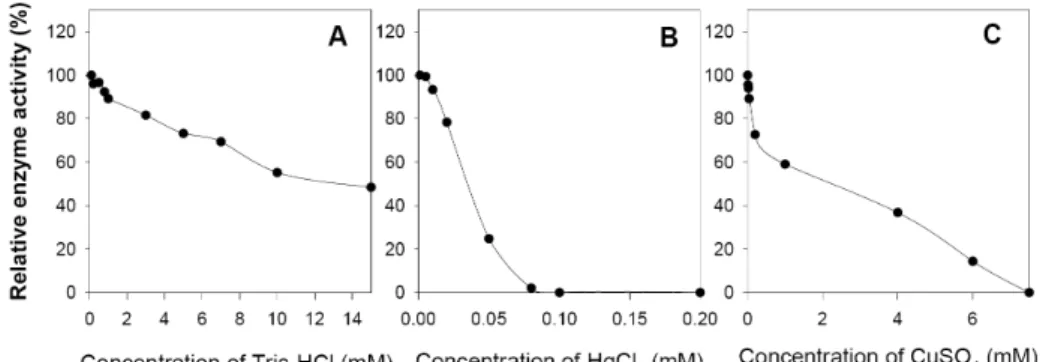
Fig. 2. Effects of Tris-HCl (A), HgCl2 (B) and CuSO4 (C) on activity of insoluble neutral invertase from Pisum sativum L. In each assay, the inhibitor was pre-incubated with enzyme for 5 min before substrate (50 mM sucrose) was added to the reaction mixture. Results are expressed as % initial activity. All experiments were performed 3-5 times and results were represented by averages of individual data.
Fig. 3. Saturation curves of insoluble neutral invertase from Pisum sativum L. for sucrose. The inset shows the Lineweaver–Burk plot. All experiments were per- formed 3-5 times and results were represented by aver- ages of individual data.
Table 2. Substrate specificity of the purified neutral invertase from Pisum sativum L.
Substrate Enzyme activity (%)
Sucrose Melezitose Raffinose Trehalose
100 3.08 66.10
*N/D
*N/D, Not detected vertase were determined (Fig. 1). Enzyme showed activity
in a range from pH 5 to 9. IN-INV had optimum activity at pH 6.8-7.5 (Fig. 1A). The activity of enzyme preparation was examined from 20oC to 70oC (Fig. 1B). IN-INV was most active at 37oC. We examined the effect of increasing concen- trations of Tris-HCl, HgCl2, or CuSO4 on the activity of the purified enzyme (Fig. 2). 10 mM Tris-HCl, 0.03 mM HgCl2, or 1.18 mM CuSO4 inhibited IN-INV activity by about 50%
(Fig. 2).
Typical Michaelis-Menten kinetics was observed when the activity of the purified invertase was measured sucrose con- centrations up to 100 mM (Fig. 3). The Km and Vmax value of IN-INV were determined to be 12.95 mM and 2.98 U/min, respectively. Catalytic coefficiency (Vmax/Km) value for IN-INV was 0.23.
A substrate should contain an unsubstituted β-D-fructo- furanosyl residue. I examined the abilities of the purified IN-INV to hydrolyze a range of oligosaccharides. The results are expressed as a percentage of the substrate hydrolyzed
relative to sucrose (Table 2). The tested oligosaccharides were raffinose (Gal-α-1,6-Glu-β-1,2-Fru), melezitose (Glu-α- 1,3-Fru-α-1,2-Glu) and trehalose (Glu-α-1,1-Glu). Raffinose, a β-fructofuranoside, was hydrolyzed to about 66.1% of the rate at which sucrose (Glu-β-1,2-Fru) was hydrolyzed.
Melezitose, an α-fructofuranoside, was approximately 3.08%
hydrolyzed and trehalose, an α-glucopyranoside, was not
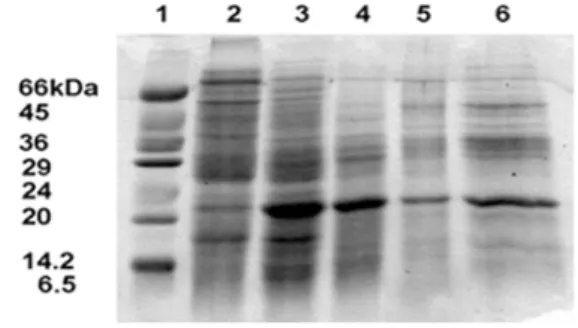
Fig. 4. SDS-PAGE analysis of protein samples from various stages of insoluble neutral invertase purification. Approx- imately 20 μg of protein were added to lanes 2–6. One band around 20kDa was gradually increased. The 10%
gels were stained with Coomassie Blue. Lane 1, low mo- lecular weight marker; lane 2, buffer/NaCl extract after dialysis; lane 3, peak of invertase activity eluted from DEAE-Sepharose; lane 4, peak of activity eluted from Green 19; lane 5, peak of activity eluted from hydrox- yapatite; lane 6, invertase activity eluted from Q- Sepharose.
detected for hydrolyzation (Table 2). Hence, the sucrose-hy- drolyzing enzymes isolated in this study appeared to be typ- ical β-fructofuranosidases.
The molecular weights of the purified invertases were de- termined around 20 kDa by SDS-PAGE (Fig. 4).
Discussion
To isolate this enzyme from cell residue, the purification steps were performed after the readily insoluble protein was washed with HEPES buffer (pH 7.2) containing 1M NaCl.
And then IN-INV proteins were sequentially eluted by DEAE- and Q-Sepharose anion exchanger, hydroxyapatite chromatography, and Green-19 adsorption chromatography.
This cytoplasmic isozyme has apparently non-glycosylated (data not shown) because IN-INV did not react with con- canavalin-A sepharose chromatography according to Lee and Sturm [21]. This enzyme has been purified and the prod- uct contains a complex mixture of polypeptides and possibly several related proteins such multi-mer structures as a tet- ramer [3, 8, 21]. SDS-PAGE results indicated two major poly- peptides with molecular weights of 20 and 80 kDa after oc- tyl-agarose chromatography (data not shown). IEF-PAGE yielded a relatively diffuse band of activity and a broad band reacting with the antibody against broad bean IN-INV (data not shown). We will study more for understanding these problems in a future.
The studies on inhibition of pea invertase activity by Hg2+,
Cu2+, or Tris have shown that IN-INV has properties con- sistent with those of other previously reported invertases [21, 24]. In the present study, pea IN-INV activity was strongly inhibited by Cu2+, similar to what was observed for the activities of alkaline invertase from soybean nodules, carrot suspension cultured cells, and pea seedling [8, 14, 21].
Pea IN-INV was completely inhibited by Hg2+, suggesting that one or more reduced sulfhydryl groups might be essen- tial for the activity.
The kinetic properties of alkaline invertases were similar to those of other plants. Apparently, the responses of the enzymes to increasing sucrose concentrations followed Michaelis-Menten kinetics. The Km value of IN-INV for su- crose was determined to be 12.95 mM in this study (Fig.
3). For other plants, the Km values for alkaline invertase have been reported to range from 8.9 to 65 mM [3, 8, 21, 24].
IN-INV showed a selective β-fructofuranosidase activity, displaying clear substrate preference for sucrose and β- fructofuranosides. This β-fructofuranosidase activity dis- tinguishes α-linked fructose residues from β-linked fructose residues and β-fructofuranosidase is unable to hydrolyze glucose linkages (Table 2). This establishes the IN-INV as a true invertase and not α-glucosidase, sucrase.
If IN-INV is localized in cell walls, the optimum pH should be acidic. However, in this work, IN-INV was ex- tracted with high salt buffer and the optimum pH of IN-INV was pH 6.8-7.5. IN-INV seems to be strongly bound to cyto- plasmic membranous components.
In addition to invertases, two types of sucrose cleaving enzymes, sucrose synthase and fructosyltransferase, have been reported [1, 7, 16, 23, 33]. Sucrose synthase was sub- cellularly localized in cytosol and was also found as a tran- siently membrane-bound form at plasma membrane and to- noplast membrane [16]. Fructosyltransferase showed fructan biosynthetic and degrading enzyme activity and sucrolytic activity in cytosol. Fructosyltransferase revealed the similar sequence homology with V-INV [7, 23, 33]. These two en- zymes are soluble proteins and their optimal pH is acidic (pH 6.0-6.5 for sucrose synthase and pH 5.0-6.0 for fructosyl- transferase). In this study, we purified and characterized a sucrose cleavaging enzyme from pea seedlings. This enzyme is similar to sucrose synthase and fructosyltransferase in su- crose cleavaging enzyme activity, but its biochemical charac- teristics are different from those of sucrose synthase and fructosyltransferase. Taken together based on the bio- chemical characterization and our knowledge, IN-INV is the
characterized membrane-bound isoform among neutral in- vertases in pea.
Acknowledgement
This study was supported by a grant from Silla University.
References
1. Barratt, D., Derbyshire, P., Findlay, K., Pike, M., Wellner, N., Lunn, J., Feil, R., Simpson, C., Maule, A. and Smith, A. 2009. Normal growth of Arabidopsis requires cytosolic in- vertase but not sucrose synthase. PNAS 106, 13124-13129.
2. Bonfig, K., Berger, S., Fatima, T., Gonzalez, M. and Roitsch, T. 2007. Metabolic control of seedling development by invertases. Funct. Plant Biol. 34, 508-516.
3. Chen, J. and Black, C. 1992. Biochemical and immunological properties of alkaline invertase isolated from sprouting soy- bean hypocotyls. Arch. Biochem. Biophy. 295, 61-69.
4. Cheng, W., Taliercio, E. and Chourey, P. 1996. The Miniature1 seed locus of maize encodes a cell wall invertase required for normal development of endosperm and maternal cells in the pedicel. Plant Cell 8, 971-983.
5. Doehlert, D. and Felker, F. 1987. Characterization and dis- tribution of invertase activity in developing maize (Zea mays) kernels. Physiol. Plant. 70, 51-57.
6. Fahrendorf, T. and Beck, E. 1990. Cytosolic and cell- wall-bound acid invertases from leaves of Urtica dioica L.:
a comparison. Planta 180, 237-244.
7. Gallagher, J. Cairns, A. and Pollock, C. 2004. Cloning and characterization of a putative fructosyltransferase and two putative invertase genes from the temperate grass Lolium temulentum L. J. Exp. Bot. 55, 557-569.
8. Godt, D. and Roitsch, T. 2006. The developmental and organ specific expression of sucrose cleaving enzymes in sugar beet suggests a transition between apoplasmic and symplas- mic phloem unloading in the tap roots. Plant Physiol.
Biochem. 44, 656-665.
9. Goetz, M., Godt, D., Guivarc'h, A., Kahmann, U., Chriqui, D. and Roitsch, T. 2001. Induction of male sterility in plants by metabolic engineering of the carbohydrate supply. PNAS 98, 6522-6527.
10. Greiner, S., Krausgrill, S. and Rausch, T. 1998. Cloning of a tobacco apoplasmic invertase inhibitor. Proof of function of the recombinant protein and expression analysis during plant development. Plant Physiol. 116, 733-742.
11. Hashizume, H., Tanase, K., Shiratake, K., Mori, H. and Yamaki, S. 2003. Purification and characterization of two soluble acid invertase isozymes from Japanese pear fruit.
Phytochem. 63, 125-129.
12. Husain, S., Thomas, B., Kingston-Smith, A. and Foyer, C.
2001. Invertase protein, but not activity, is present through- out development of Lycopersicon esculentum and L. pimpinelli- folium fruit. New Phytol. 150, 73-81.
13. Ji, X., Van den Ende, W., Van Laere, A., Cheng, S. and Bennett, J. 2005. Structure, evolution, and expression of the two invertase gene families of rice. J. Mol. Evol. 60, 615-634.
14. Kim, D., Park, S., Chung, Y., Park, J., Lee, S. and Lee, T.
K. 2010. Biochemical characterization of soluble acid and al- kaline invertases from shoots of etiolated pea seedlings. J.
Integr. Plant. Biol. 52, 536-548.
15. Kim, D., Lee, G., Chang, M., Park, J., Chung, Y., Lee, S.
and Lee, T. K. 2011. Purification and biochemical characteri- zation of insoluble acid invertase (INAC-INV) from pea seedlings. J. Agric. Food Chem. 59, 11228-11233.
16. Koch, K. 2004. Sucrose metabolism: regulatory mechanisms and pivotal roles in sugar sensing and plant development.
Curr. Opin. Plant Biol. 7, 235-246.
17. Konno, Y., Vedvick, T., Fitzmaurice, L. and Mirkov, T. 1993.
Purification, characterization, and subcellular localization of soluble invertase from tomato fruit. J. Plant Physiol. 141, 385-392.
18. Lin, C., Lin, H., Wang, A. and Sung, H. 1999. Purification and characterization of an alkaline invertase from shoots of etiolated rice seedlings. New Phytol. 142, 427-434.
19. Liu, C., Huang, L., Chang, C. and Sung, H. 2006. Purification and characterization of soluble invertases from suspen- sion-cultured bamboo (Bambusa edulis) cells. Food Chem. 96, 621-631.
20. Miller, W. and Ranwala, A. 1994. Characterization and local- ization of three soluble invertase forms from Lilium long- iflorum flower buds. Physiol. Plant. 92, 247-253.
21. Morell, M. and Copeland, L. 1984. Enzymes of sucrose breakdown in soybean nodules: alkaline invertase. Plant Physiol. 74, 1030-1034.
22. Murayama, S. and Handa, H. 2007. Genes for alkaline/neu- tral invertase in rice: alkaline/neutral invertases are located in plant mitochondria and also in plastids. Planta 225, 1193-1203.
23. Roitsch, T. and Gonzalez, M. C. 2004. Function and regu- lation of plant invertases: sweet sensations. Trends Plant Sci.
9, 606-613.
24. Ross, H., McRae, D. and Davies, H. 1996. Sucrolytic enzyme activities in cotyledons of the faba bean (developmental changes and purification of alkaline invertase). Plant Physiol.
111, 329-338.
25. Scholes, J., Bundock, N., Wilde, R. and Rolfe, S. 1996. The impact of reduced vacuolar invertase activity on the photo- synthetic and carbohydrate metabolism of tomato. Planta 200, 265-272.
26. Sergeeva, L., Keurentjes, J., Bentsink, L., Vonk, J., van der Plas, L., Koornneef, M. and Vreugdenhil, D. 2006. Vacuolar invertase regulates elongation of Arabidopsis thaliana roots as revealed by QTL and mutant analysis. PNAS 103, 2994- 2999.
27. Sturm, A. 1999. Invertases. Primary structures, functions, and roles in plant development and sucrose partitioning.
Plant Physiol. 121, 1-7.
28. Swarbrick, P., Schulze-Lefert, P. and Scholes, J. 2006.
Metabolic consequences of susceptibility and resistance
초록:GA 처리 후 급 성장하는 완두콩(
Pisum sativum
L.) 발아체로부터 분리된 중성 invertase의 특성김동균*
(신라대학교 생명과학과)
Invertase (β-D-fructosfuranosidase, EC 3.2.1.26)는 설탕을 포도당과 과당으로 가수분해하는 반응을 촉매한다.
3종류의 invertases [액포(수용성 산), 세포질(수용성 알칼리) 및 세포벽 결합]가 식물에서 연구되어 왔다. 우리는 순차적인 ammonium sulfate 침전, 이온교환크로마토그래피, 흡수크로마토그래피, Green-19 친화크로마토그래피 과정을 통해 완두콩(Pisum sativum L.) 발아체로부터 중성 invertase의 세포막 연결 isoform을 430배 순수 분리하 였다. 분리된 세포막과 결합 된insoluble invertase (IN-INV)는 최적 pH는 중성에서 알칼리 사이(pH 6.8-7.5)로 나 타났다. 이 효소는 Tris 뿐만 아니라 Hg2+ and Cu2+와 같은 중금속에 의해 저해되었다. IN-INV 의 Km과 Vmax 값은 각각 12.95 mM과 2.98 U/min으로 측정되었다. IN-INV는 기질로써 과당뿐만 아니라 라피노오스와 반응하기 때 문에 진정한 β-fructofuranosidase로 판명되었다. IN-INV의 분자량 20 kDa이었다. 위 결과로 볼 때 GA 영향으로 급속히 자라는 발아체에서 단백질이 분리되었는데 특징적으로 invertase였다.
(race-specific and broad-spectrum) in barley leaves chal- lenged with powdery mildew. Plant Cell Environ. 29, 1061-1076.
29. Tymowska-Lalanne, Z. and Kreis, M. 1998. The plant in- vertases: physiology, biochemistry and molecular biology.
Adv. Bot. Resear. 28, 71-117.
30. Vargas, W., Cumino, A. and Salerno, G. 2003. Cyanobacterial alkaline/neutral invertases. Origin of sucrose hydrolysis in the plant cytosol? Planta 216, 951-960.
31. Vargas, W., Pontis, H. and Salerno, G. 2008. New insights on sucrose metabolism: evidence for an active A/N-Inv in chloroplasts uncovers a novel component of the intracellular carbon trafficking. Planta 227, 795-807.
32. Vargas, W. and Salerno, G. 2010. The Cinderella story of sucrose hydrolysis: Alkaline/neutral invertases, from cya-
nobacteria to unforeseen roles in plant cytosol and organ- elles. Plant Sci. 178, 1-8.
33. Vijn, I. and Smeekens, S. 1999. Fructan: more than a reserve carbohydrate?. Plant Physiol. 120, 351-360.
34. Walker, R. and Al Winters, C. 1997. Purification and charac- terization of invertases from leaves of Lolium temulentum.
New Phytol. 135, 259-266.
35. Yao, S., Kodama, R., Wang, H., Ichii, M., Taketa, S. and Yoshida, H. 2009. Analysis of the rice SHORT-ROOT5 gene revealed functional diversification of plant neutral/alkaline invertase family. Plant Sci. 176, 627-634.
36. Zhang, L., Cohn, N. and Mitchell, J. 1996. Induction of a pea cell-wall invertase gene by wounding and its localized expression in phloem. Plant Physiol. 112, 1111-1117.