• 검색 결과가 없습니다.

A Convergence Study on Wearing Contact Lenses after Corneal Refractive Surgery

N/A
N/A
Protected

Academic year: 2021

Share "A Convergence Study on Wearing Contact Lenses after Corneal Refractive Surgery"

Copied!
9
0
0

로드 중.... (전체 텍스트 보기)

전체 글

(1)

1. Introduction

According to Gallup Korea in 2017, the rate of the wearer of glasses and contact lenses is 60.7%. It was 24% in 1987 and has been steadily increased by more than double[1]. Besides to the method of correcting refractive error, wearing glasses increased for UV blocking[2-4]. In order to escape from the discomfort of

glasses[5], people choose to wear contact lenses instead of glasses for cosmetic purpose[6] and they choose surgical method in case of impossibility of wearing contact lenses. Corneal refractive surgery was initiated as PRK(Photo refractive keratectomy) in 1983 by Trokel et al[7], LASIK(Laser-assisted sub-epithelial keratomy) and LASEK(Laser epithelial keratomileusis) etc. are being used[8]. Techniques have been improved

A Convergence Study on Wearing Contact Lenses after Corneal Refractive Surgery

Hye-Won Park

Department of Preventive Medicine, College of Medicine, Kangwon National University

각막굴절수술 후 콘택트렌즈 착용에 대한 융복합적 연구

박혜원

강원대학교 의과대학 예방의학교실

Abstract Aims of this study was to investigate on the actual condition of contact lens wearing after corneal refractive surgery, base curves and diameters of lenses on sale, and to confirm movement of lens and wear patterns when wearing of lenses in the modified cornea. After surgery, 16.5% of the respondents had experience wearing contact lenses. Also, the mostly distributed contact lenses had B.C. 8.6mm and DIA.14.0mm. The corneas of 24 eye after corneal refractive surgery were flat, the lenses moved towards inferior and temporal when wearing the lens. After corneal refractive surgery, contact lens wear may feel uncomfortable may require the detailed description and sophisticated fitting due to the limited type of contact lens. It is thought that convergence will be necessary in the industry and clinical study of contact lenses.

Key Words : Convergence, Corneal refractive surgery, Contact lens, Survey, Base curve, Diameter

요 약 본 연구에서는 각막굴절수술 후 콘택트렌즈 착용 실태, 유통 중인 콘택트렌즈의 베이스커브와 직경을 조사하여, 변형된 각막에 콘택트렌즈를 착용하였을 때 렌즈 움직임과 착용양상을 확인해보고자 하였다. 각막굴절수술 후 16.5%가 콘 택트렌즈를 착용한 경험이 있었다. 또한, 콘택트렌즈의 베이스커브는 8.6 mm, 직경은 14.0 mm가 가장 많은 비중을 차지하 였다. 각막굴절수술 한 24안의 각막은 편평하였으며, 콘택트렌즈를 착용했을 때 렌즈는 이측과 하측으로 모두 이동하였다.

각막굴절수술 후 콘택트렌즈 착용으로 불편함을 느낄 수 있어 렌즈 착용시 상세한 설명과 한정적인 렌즈의 종류로 정교한 피팅이 필요하며, 콘택트렌즈의 산업과 임상적인 연구에서 융합이 필요할 것이라고 생각된다.

주제어 : 융합, 각막굴절수술, 콘택트렌즈, 설문, 베이스커브, 직경

*Corresponding Author : Hye-Won Park ([email protected]) Received May 9, 2018

Accepted August 20, 2018

Revised July 19, 2018 Published August 28, 2018

(2)

and the surgery is practiced in earnest since 1990s in Korea. It is estimated that more than 100 thousand people has received the surgery with variously developed technique[9]. There are several kinds of surgical methods however the fundamental principle is to correct eyesight by ablating cornea to the extent of subject’s refractive power with laser. A study reported that the thickness of central cornea is thinner than the peripheral cornea’s since the centre zone is ablated more than the peripheral zone[10]. The cornea of non-operated subject has aspheric surface that flattens to the periphery[11]. In other words, corneal radius of the periphery zone is flatter than the central zone’s. On the other hand, the shape of centre cornea of operated subject is flat and corneal radius of the periphery zone is steeper than the central zone’s[12]. However, there were some cases in which the operated subjects wear contact lenses for cosmetic reasons[13] or the correction of myopic regressive[14]. There is difference between the shapes of cornea of before and after the surgery and it could cause discomfort in wearing contact lenses. However, there is little research.

Hereby, Some of those who had corneal refractive surgery to improve some discomforts wear contact lenses on the modified cornea for a cosmetic reason.

This study is conducted to find out the degrees of movement of contact lens, discomforts, and wearing sensations of lenses on the modified corneas. We used the most used type of lenses after researching what is the most common base curve and diameter among all that is on sale.

2. Methods

2.1 Survey subject

This study is targeting 216 adults(15 male, 246 female) who had corneal refractive surgery between June 2015 and September 2015. We conducted a survey on the actual condition of contact lens wearing after corneal refractive surgery.

2.2 Examine on the real state of the distribution of soft contact lenses

We examined base curve(B.C.) and diameter(DIA.) of 328 soft contact lenses from 37 companies, which are for sale from June to September 2015.

2.3 Wear of Contact Lens After Corneal Refractive Surgery

2.3.1 Subjects

This study is targeting 12 adults (24 eyes) of average age 22.5±1.60, including 7 females and 5 males.

It has been more than 6 months since they have received corneal refractive surgery and they are not showing any symptom of eye diseases and have no recent history of drug use. They received the explanation of the purpose of this study and agreed to proceed. They had LASIK 6 eye and LASEK 18 eye and there was no difference in surgical method.

2.3.2 Experiment method

Contact lenses used for this study were cosmetic

contact lens. Which means, subjects wore these lenses

for cosmetic purpose. The lenses had 8.6mm of base

curve, 14.0mm of diameter, 38% of water content, and

S 0.00D of refractive power. We used the corneal

topography(OCULUS, Keratograph V 1.65) to measure

the shape of subject’s cornea. We measured steep

corneal curvature(radius), flat corneal curvature(radius),

corneal astigmatism of cornea. Frequency of blinking

was measured with contact lenses on. We measured 3

times every 1 minute with for using auto refraction

keratometer and used the average value so that the

subjects were oblivious of the test. Movement was

observed using slit lamp(TOPCON, SL-D7). The

location of lenses after blinking while looking at front

was photographed and the photograph measured the

movement of lenses using MICROSOFT OFFICE

VISIO 2007. The subjects, who had corneal refractive

surgery, answered the subjective symptom

questionnaires after wearing the contact lenses. We

(3)

used the subjective symptom questionnaires from the study of Park et al.[15] subjects assessed about 8 subjective symptoms including dryness, movement, tickle, itchiness, sting, soreness, teardrop, and eye redness. Each subject was evaluated on a scale of one to five and the more they feel comfortable the higher number they gave.

2.4 Statistical analysis The actual condition of contact lens wearing after corneal refractive surgery

Statistical analysis was applied for every single data using SPSS Statistics 18.0. We displayed the data of the actual condition of contact lens wearing after corneal refractive surgery and base curve and diameter of contact lenses with percentage and descriptive statistic. We marked shape of cornea, movement of contact lenses, and subjective assessment with mean ± standard deviation, and used regression analysis for both horizontal and vertical movement of contact lenses and correction analysis of Spearman for movement of contact lenses, frequency of blinking, and subject symptoms assessment. We determined that there is statistically significant difference if the significance level(p-value) is 0.05 and less on the basis of 95%

reliability.

3. RESULTS and DISCUSSION

3.1 The actual condition of contact lens wearing after corneal refractive surgery Among 261 subjects (15 male, 246 female), 16.5% of them have tried wearing contact lenses after the corneal refractive surgery is shown in Table 1 and 88.4% of them wore cosmetic contact lenses[Fig. 1].

They wore average 7.16±3.18 hours per day. 79.1%

of them had subjective symptoms, and 39.5%, 18.6%, 14.0%, 4.7%, and 2.3% of them had the feeling of dryness, movement, eye redness, teardrop, and pain respectively[Fig. 2]. 25.7% of subjects were planning to

wear contact lenses in the future. This result shows that people who went through the corneal refractive surgery actually wear contact lenses and we expect more people will wear them in the future. We assume that the proportion of cosmetic contact lenses is high because the majority of subjects were female and they are more likely to wear lenses for a cosmetic purpose[16] than male. They wear average 7 hours a day and they answered that they are having subjective discomforts. It is different than the recommended wearing time of cosmetic contact lenses, which is 4hours[17]. Long-term use of contact lenses could damage corneal epithelium and this could progress to some illness such as corneitis. Thus, an optician should give a detailed explanation[18] of the side effect, subjective symptoms, and wearing time.

Table 1. Usage state of contact lenses after corneal refractive surgery

Questionnaire Yes(%) No(%)

I have experienced contact lens wear after

corneal refractive surgery. 16.5 83.5

I experienced subjective symptoms when

wearing a contact lens. 79.1 20.9

I plan to wear a contact lens. 25.7 74.3

Fig. 1. Types of contact lenses worn after corneal

refractive surgery

(4)

Fig. 2. Subjective symptoms of uncomfortable after wearing contact lenses

3.2 Examine the base curve and the diameter of contact lens

We examined base curve(B.C.) and diameter(DIA.) of 328 soft contact lenses from 37 companies, which are for sale, and 106 of them were clear lenses for visual correction and 222 of them were for cosmetics.

4.0%(13) of them had 8.1mm of base curve, 0.6%(2) had 8.3mm, 2.7%(9) had 8.4mm, 5.8%(19) had 8.5mm, 70.7%(232) had 8.6mm, 13.5%(44) had 8.7mm, 4.9%(16) had 8.8mm, 0.6%(2) had 8.9mm, and 0.9%(3) had 9.0mm. Among 37 companies, 37.8%(14) of them produced only one type of base curve and diameter.

0.3%(1) of them had 12.7mm of diameter, 0.3%(1) had 13.0mm, 0.3%(1) had 13.3mm, 0.3%(1) had 13.5mm, 0.6%(2) had 13.7mm, 1.5%(5) had 13.8mm, 41.2%(135) had 14.0mm, 1.2%(4) had 14.1mm, and 35.1%(115) had 14.2mm, and 4.0%(13) had 14.3mm, and 2.1%(7) had 14.4mm, and 11.0%(36) had 14.5mm, and 0.6%(2) had 14.8mm, and 1.5%(5) had 15.0mm[Fig. 3]. Also, only 1.52%(5) of them produced the different base curve for one type of lens. The mostly distributed contact lenses had B.C. 8.6mm and DIA.14.0mm. 70.7% of contact lenses on the market have B.C. 8.6mm, 41.2% of them had DIA.14.0mm, and 35.1% of them had DIA.14.2mm.

Since two sizes take up more than half of the market, the customers have a very limited range of options.

This could cause some problems for the contact lens fitting condition.

(A)

(B)

Fig. 3. Actual investigation of contact lens in Korea (A) Base curve, (B) Diameter

3.3 Wear of contact lens after corneal refractive surgery

3.3.1 Corneal shape of contact lens wearer Corneal shape of contact lens wearer is shown in Table 2. Corneal topography showed that the average flat corneal curvature was 39.02±2.09D and the corneal radius was 8.65±0.38mm, and the average steep corneal curvature was 40.01±1.94D and the corneal radius was 8.44±0.38mm, and the average corneal astigmatism was 0.99±0.44D. It was shown that the corneal shape of the subject who had corneal refractive surgery was flat.

The previous study of Lee et al.[19] demonstrated the

similar result with this study showing that the

subjects’ cornea was flattened after the surgery. In that

study, before LASIK, the preoperative corneal

curvature was 43.75±1.03D and it became 39.29±1.66D

(5)

after the surgery. Jung et al.[20] reported that non-operated university students’ average corneal radius are 7.94±0.22mm for flat corneal radius and 7.76±0.23mm for steep corneal radius. Park and Kim[21]

reported that corneal refractive surgery operated subjects’ average corneal radius are 8.41±0.31mm for flat corneal radius and 8.21±0.34mm for steep corneal radius. The values of those studies seem similarly flat as this study. We could learn that the shape of corneas, which were ablated with laser, was flatter than those weren’t. After corneal refractive surgery, the prescribed contact lenses are normally for flattened cornea[22] and we suppose that one need to give better attention to relatively more flat cornea when they put on contact lenses.

Table 2. Corneal shape data of the subject

Variable Mean±SD

Flat K(D) 39.02±2.09

Steep K(D) 40.01±1.94

Corneal astigmatism(D) 0.99±0.44

3.3.2 The center of contact lens in corneal refractive surgery subject

In 24 eye, which is stabilized with wearing contact lenses, the centre location of contact moved towards inferior in vertical direction and towards temporal in horizontal direction. The centre location of contact lens is demonstrated in Fig.4. From corneal vertex, lenses moved average 1.75±0.82mm towards temporal and 2.80±1.26mm towards inferior[Fig. 5].

Fig. 4. Center location of contact lens wearing after corneal refractive surgery(Right eye).

It moves more in vertical direction than in horizontal direction. Each movement of 1mm from corneal vertex towards temporal was followed by the movement of 0.63mm towards inferior(F=4.427, p=.047).

Fig. 5. contact lens movement after contact lens wearing

In addition, the centre location of lenses moved 3.50±0.93mm from corneal vertex. Every time they move 1mm towards inferior and temporal, the distance between corneal vertex and the centre of lenses increased by 0.78mm and 0.55mm respectively(F=64.596, p=.000). In normal state of fitting, there should be about 1mm of movement when looking at front after blinking[22]. We had to try different type of the base curve but most of the cosmetic contact lenses sold in Korea had 8.6mm of base curve. We suppose that various type of base curve is needed for shape-modified cornea since there is discomfort in wearing. Park et al.[23] reported that the movement of contact lenses decreases when the water content is higher. The tendency of higher water content contact lenses to collect foreign substance changes the shape of contact lenses and this interfere the circulation of teardrops[24]. The percentage of water content of the contact lenses used in this study was 38% and we consider additional study is required to clarify the difference between various rates of water content[25].

Another study also reported that the movement of

contact lenses is influenced by the wearing time and

(6)

whether the lenses made of the same material are stained or not[26]. It is thought that we need to put consideration at various angles before wearing contact lenses after corneal refractive surgery since there are various factors that affect the movement of lenses.

3.3.3 Movement of contact lens and blinking Subjects’ average frequency of blinking was 26.31±7.65 times per minute. Also, the movement of contact lenses towards inferior in vertical direction has relevance to the frequency of blinking(r=0.449, p=.028)[Fig. 6] but the movement in horizontal direction does not(r=0.153, p=.474). The average frequency of blinking in normal state is 12 times per minute[22]. The study of Park at al.[27] reported that the average frequency of blinking immediately after wearing the contact lenses on is more than 25 times per minute and the similar result with this study showing that who are wearing cosmetic contact lenses blinks more frequently. It is thought that the frequency of blinking has increased because the lenses move towards inferior more since there were changes in the shape of cornea[20]. Additional research should be followed on the effect of lens worn time[27] and the pressure of the eye[28] to the frequency of blinking.

Fig. 6. A scatter plot of the effect of blinking on vertical distance movement.

3.3.4 Subjective symptom

We conducted subjective symptom questionnaires

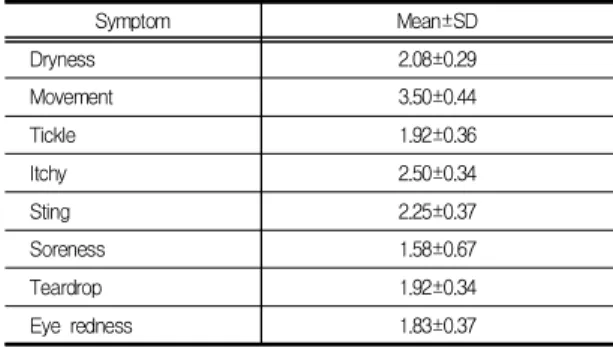
right after subjects wear the contact lenses. After wearing the contact lenses, in the order they gave were 3.50±0.44 for movement, and it was followed by 2.50±0.34 for itchiness, 2.25±0.37 for sting, 2.08±0.29 for dryness, 1.92±0.36 for tickle and 1.92±0.34 for teardrop, 1.83±0.37 for eye redness, and 1.58±0.19 for soreness[Table 3]. The reason why the movement acquired the highest number is that the lenses deviated the centre of cornea. The movement of lenses and feeling of movement were correlative(r=0.493, p=.034) and the further the lenses go, the higher number they were given. Non-operated subjects wearing cosmetic contact lenses for a long time showed 15% of dryness and itchiness and 14% of tiredness[29]. There was difference in subjective symptoms between operated and non-operated subjects. But other than dryness, itchiness, sting, and dryness showed similar aspect even after wearing for a long time. The surgery damages sensory nerves of cornea and lowers the sensory perception. It leads to the decrease of frequency of blinking and teardrops, which eventually make the eyes dry[30,31]. It is thought that contact lenses will put more dryness into the dry eyes[32,33].

Symptom Mean±SD

Dryness 2.08±0.29

Movement 3.50±0.44

Tickle 1.92±0.36

Itchy 2.50±0.34

Sting 2.25±0.37

Soreness 1.58±0.67

Teardrop 1.92±0.34

Eye redness 1.83±0.37

Table 3. Mean of subjective symptom scores

4. CONCLUSIONS

Survey on the actual condition showed 16.5% people

who had corneal refractive surgery have experience

wearing contact lenses after the surgery and 88.4% of

them wore cosmetic contact lenses. They wore average

(7)

7.16±3.18 hours per day and 79.1% of them had subjective symptoms such as the feelings of dryness, movement, eye redness, teardrop, and pain respectively.

It is expected that 25.7% of subjects will wear contact lenses in the future. In addition, they wore the mostly distributed type of cosmetic contact lenses, which has B.C 8.6mm, DIA 14.0mm. After corneal refractive surgery, the lenses will not stay in the centre of cornea since the shape has changed. Also, there should be a wide range of base curve to choose from but the option on the market is limited. We observed the location of the contact lenses on the cornea, which was modified with corneal refractive surgery. It was observed when the contact lenses are stabilized on the cornea. The lenses moved more in vertical direction than horizontal direction and all of the lenses in 24 eye moved towards inferior and temporal. The location of lenses was off the center and it was different from the expectation as we anticipated steep-fitting. It seems that there is interrelationship between the blinking and the movement of contact lenses, and that the movement of contact lenses increases the frequency of blinking. In subjective symptom assessment, the intensity of discomfort was in order of movement, itchiness, sting, dryness, teardrop, eye redness, and soreness. The movement of lenses and the feeling of movement has correlationship and the further the lenses go the higher number the feeling of movement received. This study has shown that the lousy central stability of contact lenses on the corneal refractive surgery operated cornea could give the uncomfortable feeling of movement so that a more sophisticated fitting due to the limited type of contact lens with detailed description to the wearer. It is thought that convergence will be necessary in the industry and clinical study of contact lenses.

REFERENCES

[1] http://www.optic.or.kr/Cate_03/eOpticnews.asp?nm ode=view&OnsSeq=3569&search_what=&keyword=2017

년&search_type=0&page=2.

[2] H. S. Kim. (2018). Assessment of UV Blocking Performance for Development of Converged Technologies of Vision Correcting Spectacle Lenses.

Journal of The Korea Convergence Society, 9(4), 93-98.

DOI : 10.15207/JKCS.2018.9.4.093

[3] D. H. Han. (2018). A study on the polarized spectacle lens with photochromic UV blocking function of refractive index 1.60. Journal of Convergence for Information Technology, 8(1), 147-152.

DOI : 10.22156/CS4SMB.2018.8.1.147

[4] K. S. Song & S. H. Joo. (2016). Study on the blue light hazard protection rate of blue light coated lenses.

Korean J Vis Sci., 18(4), 525-533.

DOI : 10.17337/JMBI.2016.18.4.525

[5] H. J. Kim, K. J. Lee, K. C. Mar, S. J. Chung & H. J. Oh.

(2000). A study on the complaints of spectacle wearers.

Korean J Vis Sci., 2(2), 197-203.

[6] T. H. Kim, G. R. Min & A. Y. Sung. (2005). Study on the contact lenses wear status of university students. J Korean Ophthalmol Soc., 10(2), 151-157.

[7] S. L. Trokel, R. Srinivasan & B. Braren. (1983). Excimer laser surgery of the cornea. Am J Ophthalmol Sci., 96(6), 710-715.

DOI : 10.1016/S0002-9394(14)71911-7

[8] D. H. Yoon. (2006). Ophthalmology, 7

th

ed. Seoul : Iljokak Pub.

[9] H. Y. Moon, J. H. Cheon & K. B. Kim. (2013). A literature study on treatment of acupuncture and acupressure for myopia by focusing korean, english, and chinese. J Korean Ori Ped., 27(4), 99-107. DOI : 10.7778/jpkm.2013.27.4.099

[10] J. H. Park, J. H. Kang & K. H. Jin. (2009). Changes in the cornea and anterior chamber after LASEK:

Pentacam findings. J Korean Ophthalmol Soc., 50(4), 510-517.

DOI : 10.3341/jkos.2009.50.4.510

[11] P. M. Kiely, G. Smith & L. G. Carney. (1982). The mean shape of the human cornea. J Mod Opt., 29(8), 1027-1040.

DOI : 10.1080/713820960

[12] J. T. Holladay, D. R. Dudeja & J. Chang. (1999).

Functional vision and corneal changes after laser in situ keratomileusis determined by contrast sensitivity, glare testing, and corneal topography. J Cataract Refract Surg. 25(5), 663-669.

DOI : 10.1016/S0886-3350(99)00011-5

[13] http://www.hankookilbo.com/v/403ea2e851b9ab0

(8)

4a996beab4a480a30.

[14] L. Spadea, L. Mosca & E. Balestrazzi. (2000).

Effectiveness of LASIK to correct refractive error after penetrating keratoplasty. The authors' results in four patients suggest the effectiveness of laser in situ keratomileusis in the correction of refractive error after penetrating keratoplasty. Ophthalmic surgery and lasers, 31(2), 111-120.

DOI : 10.3928/1542-8877-20000301-07

[15] M. J. Park, H. L. Kwon, S. A. Choi & S. R. Kim. (2013).

Changes in subjective/objective symptoms and the light transmissibility of lens associated with verusage of daily disposable circle contact lenses in normal eyes. J Korean Ophthalmic Opt Soc., 18(4), 429-439.

DOI : 10.14479/jkoos.2013.18.4.429

[16] S. Y. Park. (2018). The Effect of Subjective Body Type Recognition on Weight Change in Women with Normal BMI. Journal of Convergence for Information Technology, 9(4), 313-320.

DOI : 10.15207/JKCS.2018.9.4.313

[17] S. H. Park, S. R. Kim & M. J. Park. (2011). The effect of circle lens and soft contact lens with identical material in clinical application on the eyes. J Korean Oph Opt Soc., 16(2), 147-157.

[18] Y. Y. Song, H. J. Oh & M. A. Jung. (2014). Survey on Contact Lens Wear Status in Gyeonggido. Journal of digital convergence, 12(2), 373-378.

DOI : 10.14400/JDC.2014.12.2.373

[19] S. N. Lee, S. H. Choi & C. S. Kim. (2002). Comparison of corneal power measured by different methods after refractive surgery. J Korean Ophthalmol Soc., 43(8), 1409-1417.

[20] S. J. Jung, H. J. Lee, S. S. Baek, M. A. Jung & K. C.

Mah. (2009). Analysis of corneal radius by age and refractive error. Korean J Vis Sci., 11(3), 173-185.

[21] H. W. Park & T. H. Kim. (2017). A study on contact lens wear status of after corneal refractive surgery subjects.

Korean J Vis Sci., 19(1), 9-17.

[22] K. J Lee & K. C. Mah. (1995). Contact Lens, 1

st

ed. Seoul : Daehakseorim Pub.

[23] M. J. Park, G. T. Cho, S. H. Shin, H. S. Lee & D. S. Kim.

(2005). The diameter and base curve changes of soft contact Lens by protein deposition. J Korean Ophthalmol Soc., 10(3), 165-171.

[24] F. Fornasiero, F. Krull, J. M. Prausnitz & C. J. Radke.

(2005). Steady-state diffusion of water through soft contact lens materials. Biomaterials, 26(28), 5704-5716.

DOI : 10.1016/j.biomaterials.2005.02.028

[25] K. S. Kim. (2018). Comparison of Physical Properties of Domestic Contact Lenses-Focusing on oxygen transmissibility. Journal of Convergence for Information Technology, 9(1), 393-403.

DOI : 10.15207/JKCS.2018.9.1.393

[26] S. R. Park, S. H. Park, S. O. Joo, H. R. Lee & M. J. Park.

(2012). A comparison of the movements of circle contact lens and soft contact lens with identical material on cornea. J Korean Ophthalmic Opt Soc., 17(1), 27-35.

[27] M. J. Park, S. Y. Kang, J. I. Chang, A. R. Han & S. R.

Kim. (2014). Changes in subjective discomfort, blinking rate, lens centration and the light transmittance of lens induced by exceeding use of daily disposable circle contact lenses in dry eyes. J Korean Ophthalmic Opt Soc., 19(2), 153-162.

DOI : 10.14479/jkoos.2014.19.2.153

[28] S. I. Park, Y. J. Lee, H. S. Lee & M. J. Park. (2007). The momentary movement of soft contact Lens by blinking : The change of movement depending on wearing time.

J Korean Ophthalmic Opt Soc., 12(1), 1-7.

[29] M. J. Park, H. L. Kwon, S. A. Choi & S. R. Kim. (2013).

Changes in subjective/objective symptoms and the light transmittance of lens associated with overusage of daily disposable circle contact lenses in normal eyes. J Korean Ophthalmic Opt Soc., 18(4), 429-439.

DOI : 10.14479/jkoos.2013.18.4.429

[30] D. Raoof & R. Pineda R. (2014). Dry eye after laser in-situ keratomileusis. Semin Ophthalmol., 29(5-6), 358-362.

DOI : 10.3109/08820538.2014.962663

[31] J. Horwath-Winter, B. Vidic, G. Schwantzer & O.

Schmut. (2004). Early changes in corneal sensation, ocular surface integrity, and tear-film function after laser-assisted subepithelial keratectomy. J Cataract Refract Surg., 30(11), 2316-2321.

DOI : 10.1016/j.jcrs.2004.03.042

[32] H. J. Oh & J. Y. Lee. (2012). The differences of tear film for young Korean of a day indoor space. The Journal of digital policy & management, 10(11), 535-540.

DOI : 10.14400/JDPM.2012.10.11.535

[33] H. J. Oh, H. Y. Doo, S. H. Sim, S. M. Choi & S. J. Oh.

(2016). The Study of tear film stability for normal eyes in adults. Journal of Convergence for Information Technology, 6(4), 85-91.

DOI : 10.22156/CS4SMB.2016.6.4.085

(9)

박 혜 원(Park, Hye Won) [정회원]

▪2016년 8월 : 백석대학교 안경광 학과(보건학석사)

▪2017년 3월 ~ 현재 : 강원대학교 예방의학과 박사과정

▪관심분야 : 안과학, 콘택트렌즈학, 예방의학

▪E-Mail : [email protected]

수치

Fig.  1.  Types  of  contact  lenses  worn  after  corneal  refractive  surgery
Fig.  2.  Subjective  symptoms  of  uncomfortable  after  wearing  contact  lenses
Fig.  4.  Center  location  of  contact  lens  wearing  after corneal  refractive  surgery(Right  eye).
Fig.  6.  A  scatter  plot  of  the  effect  of  blinking  on  vertical  distance  movement.

참조

관련 문서

The purpose of this study was to evaluate the effect of these substances on bone regeneration by applying these materials to bone defects after cyst

The purpose of this study was to investigate the effects of a disability awareness program on improving the attitudes of regular elementary school

In terms of the relationship between personal service contact and passengers' emotions, this study classified service contact quality factors into four groups based on

This study was conducted to investigate the storage period and optimal temperature of seed potato which were based on technique of dormancy prolonging by

Objective: The purpose of this study was to investigate the effect of clinical practice satisfaction on professional self-concept among dental hygiene students.. Methods:

This study was conducted to investigate the effects of 12 weeks after school physical activity program on body composition and PAPS in obese elementary

The purpose of this study was to investigate the impact of social capital and positive psychology capital on the will of start-up according to experience

This study prepares an educational program which helps the patients reduce anxiety on surgery which is considered as one of the biggest emotional crises