1. Introduction
In the contemporary society where appearance is competitive, the act of dressing up the appearance is a tendency not only for women but also actively for men.
Modern men are investing a lot of time and effort in
their own ways of expressing their desires or to make a good impression on others, and the increase in these men has led to the activation of the cosmetics and fashion market[1]. It is thought that men's consumption behavior and perception change are easily influenced by socio‐psychological value and other
The effect of Anemarrhena asphodeloides ethanolic extracts on hair growth effect in mice
Jang-Soon Park
Dep. of Beauty Art, Songwon University, 73, Songamro, Nam-gu, Gwangju, Korea
지모(知母) 에탄올 추출물이 쥐의 모발 성장에 미치는 영향
박장순
송원대학교 뷰티예술학과
Abstract We have studied anemarrhena asphodeloides, a hair growth promoter as an alternative medicine agent to compensate for the disadvantages of minoxidil, which has excellent hair growth promoting effect on follicular epithelial cells. anemarrhena asphodeloide, an Rhizome plant of aemarrhena asphodeloide family, is a traditional medicinal plant used in Korea as an antipyretic, antidiabetic, antidepressant, antiinflammatory. We applied and observed anemarrhena asphodeloides ethanol extracts to the back of mice, and there was no significant difference in body weight and food intake among all groups of mice. The ethanol extract of anemarrhena asphodeloides showed vigorous hair growth promoting effect without changing the serum composition and thus it is considered to be useful as a hair growth promoter in the future.
Key Words : Anemarrhena asphodeloides, Male C57BL/6 mice, alopecia, hair growth effect, body weight
요 약 여포 상피세포에 우수한 모발성장 촉진효과를 보이는 minoxidil의 단점을 보완하고자 대체의학제재로서의 모발 성장 촉진제로 지모를 연구하였다. 지모과(知母科)의 뿌리식물인 지모(知母)는 해열제, 항 당뇨병, 항우울제, 항염제 등으로 이용되고 있는 한국의 전통적인 약용식물이다.
지모 에탄올 추출물을 마우스의 등에 도포하여 관찰하였는데 모든 그룹의 마우스에서 체중과 음식 섭취량은 유의한 차이를 보이지 않았다. 지모 에탄올 추출물은 혈청 조성의 변화 없이 왕성한 모발성장 촉진효과를 보임으로써 향후 모발성장 촉진 제로서 유용한 가치가 있으리라 사료된다.
주제어 : 지모(知母), 6주령 수컷 쥐, 탈모증, 모발성장효과, 체중
*Corresponding Author : Jang-Soon Park([email protected]) Received January 8, 2018
Accepted August 20, 2018
Revised March 2, 2018 Published August 28, 2018
people's perception [2].
It is Alopecia that works as a negative factor in the social trend such as the frenzy of trimming modern men's appearance. Alopecia is overwhelmingly frequently prevalent among males than females, which is a direct factor that seems to look older for his age.
Minoxidil, widely used as a hair loss treatment in the market, has excellent pharmacological effects as well as side effects. Therefore, the development of natural materials is more active than ever. However, most of these natural substances have many problems such as odor, color, poor stability, narrow antimicrobial spectrum, difficulty in shape and the like. Therefore, further research is required until commercialization, and it is difficult to commercialize them due to material and economic problems [4].
Various studies should be continued to overcome many problems. Through this study, it is considered that the results of this study will be valuable data for A. asphodeloides to be tested for its usefulness as a hair growth promoter.
2. Theoretical background
2.1 Anemarrhena asphodeloides
A. asphodeloides is a taste of bitter with cold temperate which replenishes the body to cool off the hot stuff, or smooth the bowels to make good out, and it is a drug used for the treatment of pathologies such as chest tightness, diabetes, arthritis, etc. Experimental antimicrobial, antipyretic, antihypertensive, and analgesic effects have proved to be effective [5]. In addition, this study demonstrated that A. asphodeloides is effective as an inhibitor of 5α‐reductase, which plays an important role in the pathogenesis of enlarged prostate [6].
The main traditional Chinese medicine (TCM) treatment was the herbal decoctions and granules. The frequently used herbs were root of Bupleurum falcatum, fruit of Prunella vulgaris var. aleutica, root
stem of A. asphodeloides, dried fungus nucleus of Poria cocos, Rehmannia glutinosa var. purpurea, peony Paeonia suffruticosa Andrews, bark of Phellodendron amurense, roots of a plant Paeoniae lactiflora. On the other hand, the main western medicine (WM) for precocious puberty was Gonadotropin-releasing hormone agonist (GnRHa)[7].
2.2 alopecia
Hair loss refers to the state of hair lacking or absence at the area where hair should normally exist, and is usually a phenomenon of hair loss [8].
Korean people generally have about 50,000 to 70,000 pieces of hair. The number of telogen hair is about 10%
of the total hair, and the telogen period is about 3 months though there are individual differences.
Taking this into consideration to calculate, 10% of telogen hair is between 50,000 and 70,000, and the telogen period is approximately three months. Formula:
50,000‐70,000 pieces / 100 days = 50‐70 pieces per day. That is, it is normal that about 50 to 70 pieces of hair are lost per day. If you lose more than 100 pieces of hair per day, you should be suspicious of alopecia [9]. Testosterone is converted to a di-hydrotestosterone (DHT) hormone by the action of a 5α‐reductase, and the presence of these hormones causes male pattern hair loss [11]. Especially, hair loss occurs in patients who are receiving chemotherapy, and it is known that doxorubicin, epirubicin, and cyclophosphamide, which are typical drugs used for cancer treatment, cause hair loss [12].
2.3 Minoxidil
Minoxidil was originally used as a hypertensive agent. It has been used as a depilatory drug by revealing that there is depilation effect in side effects of this hypertensive agent. The efficacy mechanism of this drug is not clear, but Minoxidil is effective in stopping hair loss or slowing hair loss, and it is known that the effect is better in the parietal lobe than in the frontal lobe [13].
A stronger concentration of Minoxidil 5% (extra strength Rogaine) is currently available, and it is known that the effect is more powerful than the 2%
solution.
If you stop, the hair loss process will return to its original state. In fact, when you stop Minoxidil, you will see a rapid loss of hair within a week. Of the many products promoting the prevention of female hair loss, the only anti‐depressant approved by the FDA is Minoxidil 2% (Rogaine) solution. The 2% solution is applied to the scalp twice daily to stimulate hair growth and to enhance the quality of hair growth. It takes about 6 months to 1 year to determine whether the treatment is effective or not [14].
3. Materials and Methods
3.1 Preparation of plant extracts
1kg of A. asphodeloides purchased from UNIQ F&F Co., Ltd. (Seoul, Korea) was finely pulverized and mixed with 1L of ethanol and refluxed‐cooling twice for 1 hour to prepare the extract.
After 2 days of storage at room temperature, the extract was filtered using a filter paper (Whatman No.
2).
Then, the combined filtrate was concentrated to dryness by rotary evaporation (EYELA A‐3S) at 40°C. Then, 56.7g of the concentrate obtained was dissolved in DMSO to prepare a stock solution of A.
asphodeloides extract (100mg/mL), which was then stored at 20°C and in use.
3.2 Animal test
Male C57BL/6 mice (6 weeks old) were purchased from the Daehan BioLink, Incheon, South Korea. The male C57BL/6 mice were maintained at 200 to 300 Lux for 12 hours, and twelve hours at night were adapted to the ambient environment (temperature 23±3℃, relative humidity 50±10%) for 1 week while the lighting was controlled by a conventional system with
external light interception. They were then used in the experiment.
Male C57BL/6 mice were housed in clean racks.
Feeds for laboratory animals were freely fed and cages were replaced every 3 days.
A total of 20 animals were tested, and they were divided into four groups and were bred: normal group, negative control group, minoxidil group, and AAEE group.
The mice were anesthetized by intraperitoneal injection of a mixture of ketamine hydrochloride (Yuhan, Seoul, Korea) and rompun (Bayer Korea, Seoul, Korea).
To maintain anesthesia during the epilating process, inhalation anesthesia was performed with isoflurane (hanapharm, Seoul, Korea).
This study used rosin‐wax mixture as the depilation reagent, and anesthesia machine V70100 (Surgivet, USA) was used for inhalation anesthesia.
Body weights of male C57BL/6 mice were measured at 8:00am as a whole using an electronic balance before feeding. By restricting the mouse in a plastic bowl and measuring the body weight, the error range according to the movement of the mouse was minimized.
3.3 Analysis of serum
After 12 h overnight fasting, blood samples (approximately 5 mL) of all mice were immediately centrifuged at 3000 g for 10 min. Serum was analyzed by using a Hitachi 7020 Automatic Analyzer (Hitachi, Ltd., Tokyo, Japan).
3.4 Statistical analysis
All values are expressed as the mean ± deviation of the three independently tested values. And all measurements were made in triplicate and all values are represented as mean ± S.E.M.
4. Results
4.1 AAEE reduces body weight
After 4 weeks of treatment, body weight of 4 groups didn’t show significant difference. Fig. 1.
Fig. 1. Changes of body weight
4.2 AAEE reduces food intake
Food intake of 4 groups didn’t show significant difference. Fig. 2.
Fig. 2. Changes of food intake
4.3 AAEE shows hair growth effect
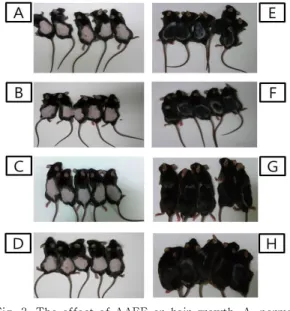
In order to search for hair growth promoting agents from alternative medicine, we investigated hair growth promoting effect of the AAEE using male C57BL/6 mice. Among 4 groups, group treated with the AAEE was superior to all the other groups tested in hair growth promoting effect. Fig. 3.
Fig. 3. The effect of AAEE on hair growth. A, normal group before test; B, negative control group before test; C, minoxidil group before test;
D, AAEE group before test; E, normal group after 4 weeks; F, negative control group after 4 weeks; G, minoxidil group after 4 weeks; H, essence group after 4 weeks.
4.4 AAEE changes composition of serum To study whether AAEE could composition of serum in mice, the serum was analyzed. Results showed that AAEE treatment did increase the PLT of the mice. Table 1. However, the other composition was not significantly different between the three groups.
Table 1.
Table 1. Effect of AAEE on serum in mice.
Content N NC PC AAEE
WBC (103/μL) 3.3 3.2 3.1 3.3
RBC (103/μL) 9.98 9.89 9.98 9.89
Hgb (g/dL) 14.2 13 14.1 14.2
Hct (%) 46.6 46.4 46.6 46.5
MCV (μm3) 46.7 47.4 46.6 46.9
MCH (pg) 14.2 14.1 14.2 14.1
MCHC (g/dL) 30.5 30.4 30.5 30.4
RDW (%) 14 14.2 14 14
N, normal; NC, negative control; PC, positive control; AAEE, A.
asphodeloides ethanolic extracts.
5. Discussion
Hair is considered to be a primary com ponent of an individual's general appearance. Androgenetic alopecia (AGA) or male-pattern hair loss is the most common form of alopecia in men, affecting ~50% of the male population.
Minoxidil used in individuals with alopecia is reported to exert growth-promoting effects on follicular epithelial cells[16].
However, the minoxidil has more adverse effects[17].
In this study, AAEE showed hair growth promoting effect in mice with normal body weight and capacity for eating possessing normal composition of serum.
Therefore, future studies on AAEE are required to observe its mechanism and active pure compound. And it is thought that it will be possible to apply it as a hair growth promoter in the future.
REFERENCES
[1] S. H. Yim. (2012). A Study on Attitudes toward Man's Appearance Management and Cosmetics Purchasing Behavior. Master dissertation. Sook-myung Women' University, Seoul.
[2] H. J. Kwon & J. S. Park. (2017). Awareness of Men's Makeup depending on the Recognition of Influence of Appearance on Success. Journal of The Korea Convergence Society, 8(4), 231-237.
[3] A. K. Gupta & Carviel, J. (2017). Treating Alopecia Areata: current Practices Versus New Directions.
Journal of the Clinical Dermatology, 18(1), 67-75.
[4] J. S. Park & H. J. Kwon. (2017). Antimicrobial activity
against Propionibacterium acnes bacteria of Smilacis glabrae Rhizoma extracts. Journal of The Korea Convergence Society, 8(12), 425-430,
[5] E. J. Shin. (1994). Studies on the Steroid Saponin and Xanthone Components of Anemarrhena asphodeloides.
Master dissertation. Andong University, Andong.
[6] M. H. Lee. The Effects of Anemarrhena asphodeloides on Experimental Rat Model of Benign Prostatic Hyperplasia. Doctoral dissertation. Dong-shin University, Na-ju.
[7] J. H. Kweon & S. Y. Lee & S. H. Yu. (2017). The Trend of Clinical Research on Treatment for Precocious Puberty-Focusing on Recent Studies in the Chinese Medical Journal CAJ. Journal of Korean Oriental Pediatrics, 31(1), 63-73.
[8] M. J. Kim. (2012). The research about Scalp treatments by self-recognition of adult's losing hair. Journal of The Korea Convergence Society, 3(3), 21-27.
[9] S. H. Park. (2014). A survey of satisfaction on hair loss treatment : a comparison of hair trans plan. Master dissertation. Chang-won National University, Chang-won.
[10] J. W. Young & Y. S. Kim & J. E. Kim & H. Kang.
(2017). A Case of Androgenetic Alopecia in an Adolescent Female with Response to Topical Minoxidil.
Journal of The Korean Society of Dermatology, 55(1), 52-55.
[11] H. H. Lee & M. Y. Jung & S. J. Kim. (2005). Scalp Care
& Medical Treatment. Seoul : Chung-ram Publishing.
[12] J. S. Park & H. J. Kwon. (2017). The Effects of Wig Wearing on Scalp Disorders in Female Patients with Cancer. Journal of The Korea Convergence Society, 8(4), 279-285.
[13] H. Jung. (2017). Protective Effects on Dermal Papilla Cell of Ophiopogon Japonicus Root Polysaccharide and Its Application to Hair Loss Prevention Product.
Doctoral dissertation. Eulji University, Daejeon.
[14] S. E. Ha. (2006). Empirical study on the scalp care conditioning for hair loss and customer satisfaction.
Master dissertation. Chung-ang university, Seoul.
[15] J. S. Park. (2013). The Promoting Effect of Pleuropterus cilinervis and Cornus officinalis Extracts Fermented with Lactobacillus rhamnosus on Hair Growth In C57BL/6 Mice. Doctoral dissertation. Kwang-ju Woman's University, Gwang-ju.
[16] Tanigaki-Obana, N. & Ito. M. (1992). Effects of cepharanthine and minoxidil on proliferation, differentiation, and keratinization of cultured cells from
PLT (103/μL) 518 516 518 5
91
MPV (μm3) 5.4 5.6 5.4 5.3
PCT (%) 0.28 0.28 0.28 0.27
PDW (%) 27.1 27.2 27.1 27.2
the murine hair apparatus. Journal of the Dermatological Research, 284(5), 290-296.
[17] E. A. Olsen & Whiting, D. & Bergfeld, W. & Miller, J.
& Hordinsky, M & Wanser, R. & Zhang, P. & Kohut, B.
(2002). A randomized clinical trial of 5% topical minoxidil versus 2% topical minoxidil and placebo in the treatment of androgenetic alopecia in men. Journal of The American Academy Dermatology, 47(3), 377-385.
박 장 순(Jang-Soon Park) [정회원]
▪2013년 2월 : 광주여자대학교 미 용과학과(미용학박사)
▪2015년 3월 ~ 현재 : 송원대학교 뷰티예술학과 교수
▪관심분야 : 헤어미용, 뷰티 생리학
▪E-mail : [email protected]