• 검색 결과가 없습니다.

Hair growth promoting effects of emodin in telogenic C57BL/6 mice

N/A
N/A
Protected

Academic year: 2021

Share "Hair growth promoting effects of emodin in telogenic C57BL/6 mice"

Copied!
5
0
0

로드 중.... (전체 텍스트 보기)

전체 글

(1)

Korean J Vet Res(2016) 56(2) : 97~101 http://dx.doi.org/10.14405/kjvr.2016.56.2.97

97

<Original Article>

Hair growth promoting effects of emodin in telogenic C57BL/6 mice

Jung-Min Yon

1

, Seul Gi Park

1

, Chunmei Lin

2

, Lee Wha Gwon

1

, Jong-Geol Lee

1

, In-Jeoung Baek

3

, Beom Jun Lee

1

, Young Won Yun

1

, Sang-Yoon Nam

1,

*

1

College of Veterinary Medicine and Research Institute of Veterinary Medicine, Chungbuk National University, Cheongju 28644, Korea

2

College of Chinese Medicinal Materials, Jilin Agricultural University, Changchun 130-118, China

3

Asan Institute for Life Sciences, University of Ulsan College of Medicine, Seoul 05505, Korea (Received: May 2, 2016; Revised: May 24, 2016; Accepted: May 30, 2016)

Abstract : Emodin is an anthraquinone derivative from the roots of Rheum officinale Baill that possesses a variety of biological activities, including inhibition of 5α-reductase and prostaglandin D2. In this study, we investigated whether emodin promotes hair growth. After emodin was topically applied to the shaved dorsal skin of telogenic C57BL/6 N mice, the hair growth rate and morphological analysis were evaluated in dorsal skin for 15 days. After 13 days of treatment, minoxidil or emodin (0.01% or 0.1%)-treated groups showed remarkable regrowth of hairs relative to the vehicle control group. Scoring of the hair growth and rate of hair growth area for 15 days revealed that groups treated with minoxidil and 0.1% emodin were significantly higher than the vehicle control group. Histological examination revealed the emodin and minoxidil groups markedly recovered the number and morphology of hair follicles, including the subcutis depth, relative to the vehicle group. These results suggest that emodin has an excellent promoting effect in hair growth similar to that of minoxidil and might be useful for treatment of baldness or alopecia.

Keywords : C57BL/6 mice, alopecia, emodin, hair growth

Introduction

Hair loss is a common and distressing symptom that affects men and women of all ages. Hair loss, which has a variety of causes including androgenetic alopecia, radiother- apy, chemotherapy, and nutrition, occurs when the normal cycle of hair growth changes. Hair growth is controlled by a unique repetitive cycle comprised of anagen, catagen and tel- ogen phases. Therefore, hair follicles undergo cyclic changes between phases of rapid growth (anagen), regression (cat- agen), and resting (telogen). Normally, hair follicles are con- tracted after the anagen phase and the hair shaft falls out during the catagen or telogen phase. As the follicles begin a new anagen phase, it grows back to its original size and pro- duces new hair of normal thickness [13, 18].

Androgenetic alopecia is the most common cause of hair loss affecting both men and women. The 5- α reductase related to androgenetic alopecia is responsible for converting test- osterone into dihydrotestosterone (DHT). Because DHT shortens the growth phase of the follicles and size of the hair folli- cles, it is considered to be a potent agent at triggering hair growth and/or hair loss [7, 8, 21]. Recent studies have reported that prostaglandin D2 (PGD2) was abnormally more abun-

dant in a bald scalp than a haired scalp, especially for patients with androgenetic alopecia, and that it had the capac- ity to decrease hair lengthening [5, 11].

Emodin (from Rheum emodi, a Himalayan rhubarb), 6- methyl-1,3,8-trihydroxyanthraquinone, which is the most common natural anthraquinone, occurs in the roots and rhi- zomes of several higher plants, fungi, and lichens [19]. It has been reported that emodin possesses various biological activ- ities, including anti-inflammatory, anti-bacterial, and anti- cancer activities. Emodin also inhibits the 5 α-reductase activity and reduces serum PGD2 levels in a dose-dependent manner [3, 9, 17, 20], suggesting that it would be a good candidate for prevention of androgenetic alopecia.

The number of men and women who suffer hair loss and/

or hair thinning are increasing in accordance with changes in lifestyle and nutritional balance. Therefore, it is important to develop new materials to prevent hair loss and promote hair growth. However, despite a variety of activities of emodin, the hair growth promoting effects of emodin are currently unknown. In this study, we examined the hair growth pro- moting effects of emodin in C57BL/6 mice that were syn- chronized in the telogen stage.

*Corresponding author

Tel: +82-43-261-2596, Fax: +82-43-271-3246

E-mail: [email protected]

(2)

Materials and Methods

Chemicals

Emodin was purchased from Sigma Chemical Co. (St, Louis, MO, USA) and dissolved in 50% ethanol. We used two concentrations of emodin (0.01% and 0.1%) in ethanol.

In addition, 5% minoxidil as the positive control was pur- chased from Hyundai Pharmaceutical (Korea).

Animal experiments

Male C57BL/6 mice (5 weeks old) were purchased from KOATECH (Korea). The animals were housed in polysul- fone cages in a well-ventilated room maintained at 21 ± 2

o

C and 55 ± 10% relative humidity under a 12 hour light/dark cycle. The animals were fed standard mouse chow (Samy- ang, Korea) and provided tap water ad libitum. All experi- ments were approved by the Chungbuk National University Animal Care Committee and conducted according to the Guide for Care and Use of Animals (Chungbuk National University Animal Care Committee, CBNUA-469-13-02). To

produce new hairs, existing follicles undergo cycles of growth (anagen), regression (catagen) and rest (telogen). The skin of C57BL/6 mice in a resting telogen phase is a pale pink color and skin color of an active hair growth anagen phase becomes dark gray or black. Hair growth stops at catagen phase and the skin transitions are back to the telogen phase, returning to a pale pink color. During anagen phase, hair follicles pro- duce an entire hair shaft from tip to root, but during catagen and telogen phases, the follicles become to regress and lie dormant in a resting phase [1, 10]. After confirming homoge- neously-pink skin color in the back skin of C57BL/6 mice in a telogen phase, the dorsal skin hair was shaved in this study.

The animals were randomly allotted to the experiment, and then subdivided into 4 groups: 50% ethanol (vehicle con- trol), minoxidil, 0.01% emodin, and 0.1% emodin. Starting the following day (1 day), 200 µL of each sample was topi- cally applied daily for 15 days.

Photographs of hair growth states

At 1, 4, 7, 10, 13, and 15 days after topical application,

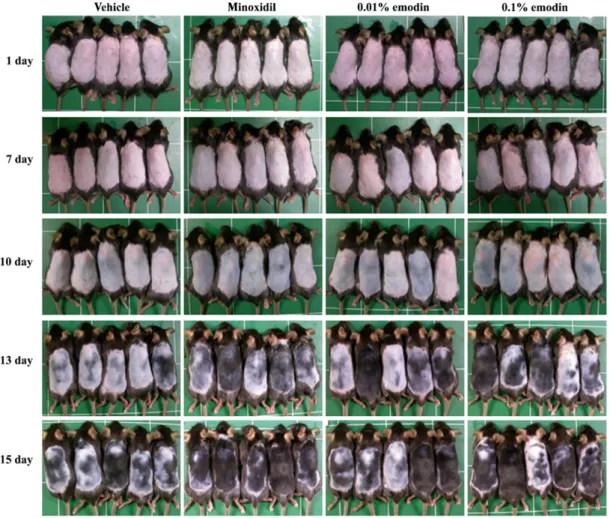
Fig. 1. Hair growth promoting effects of emodin. Telogen-matched C57BL/6J mice (6 weeks old) were shaved and topically treated

with vehicle (50% ethanol), 5% minoxidil, or emodin (0.01% and 0.1%). The back skins were photographed at 1, 7, 10, 13, and 15

days after depilation under anesthesia with diethyl ether. After 13 days, hair growth in the minoxidil, 0.01% emodin, and 0.1% emodin-

treated groups was accelerated relative to the vehicle control group.

(3)

photographs of each group of mice were taken while the ani- mals were anesthetized under diethyl ether.

Hair growth scoring

Promotion of hair growth was evaluated by observing the skin color, which is indicative of the telogen to anagen con- version [13]. The hair growth effect was morphometrically calculated using the following hair growth score: score 0, no hair growth; score 1, less than 30% growth; score 2, 30% to less than 50% growth; score 3, 50% to less than 70% growth;

score 4, 70% to 100% growth [12]. The rate of hair growth area to clipped area was (hair growth area/clipped area) ×100.

Histological examination

Mice were euthanized with diethyl ether, after which the dorsal skin tissue was extracted. At 7 and 15 days, mice were sacrificed to obtain dermal skin specimens. Skin samples were removed, fixed in 10% neutral buffered formalin and processed according to routine histological techniques. Para- plast-embedded tissues were sectioned to a thickness of 4 µm, then stained with hematoxylin and eosin (H&E).

Statistical analysis

Statistical differences between groups were analyzed by one-way analysis of variance (ANOVA) followed by Tukey’s multiple comparison test. Statistical significance was estab- lished at p < 0.05. All data were expressed as the mean ± SE.

Results

Change in hair growth

Emodin application did not show any adverse effects in dorsal dermal skin for the duration of the experiment. The vehicle control group revealed a low recovery in hair growth.

However, the skin colors in groups treated with minoxidil, 0.01% emodin, and 0.1% emodin began to change to light gray after 7 days, and on 10 days the skin color had changed from pink to black in all groups of mice. After 13 days, hair growth in the minoxidil, 0.01% emodin, and 0.1% emodin- treated groups was accelerated relative to the vehicle control group (Fig. 1).

Hair growth scores

As shown in Table 1, the dorsal skin of mice was hairless on days 1 to 10 (hair growth score: 0) in all groups. How- ever, at day 13, hair growth was significantly higher in the minoxidil and 0.1% emodin groups than the vehicle group.

Hair growth scores in the minoxidil, 0.01% emodin, and 0.1% emodin groups were significantly elevated relative to the vehicle group for 15 days (p < 0.05).

Rate of hair growth area to clipped area

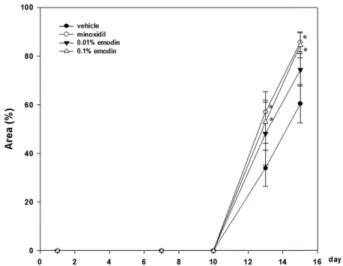
At day 13, hair growth rates in the minoxidil (57 ± 8.5%) and 0.1% emodin (53 ± 8.9%) groups were significantly higher than in the vehicle group (34 ± 7.3%). At day 15, minoxidil

(86 ± 3.9%), 0.01% emodin (74 ± 6.6%), and 0.1% emodin (85 ± 5.3%) applications significantly enhanced hair growth relative to the vehicle alone (60 ± 7.9%) group (p < 0.05; Fig. 2).

Histological examination

An increase in the number and size of hair follicles is con- sidered an indicator of the transition of hair growth from the telogen to the anagen phases [16]. An increase of the size and number of hair follicles can be observed in the deep sub- cutis during the anagen phase [4]. To investigate the progres- sion of hair follicles in the hair cycle, H&E staining was conducted. At day 7, the hair follicles in the 0.1% emodin group had progressed to the anagen stage, whereas those in the other groups remained in the telogen stage. At day 15, the emodin and minoxidil groups showed markedly increases in the number and morphology of hair follicles, including the subcutis depth, relative to the vehicle group (Fig. 3).

Fig. 2. Rate of hair growth area to denuded area in C57BL/6J mice after topical application of emodin. At day 15, minoxidil, 0.01% emodin, and 0.1% emodin applications had significantly enhanced hair growth relative to vehicle alone ( p < 0.05). The rate of hair growth area to clipped area was (hair growth area / clipped area) ×100. The results are shown as the mean values ± SE (

*

p < 0.05 vs. vehicle).

Table 1. Scores of hair growth in C57BL/6 mice after topical application of emodin for 15 days

Vehicle Minoxidil 0.01% emodin 0.1% emodin

Day 1 0 0 0 0

Day 7 0 0 0 0

Day 10 0 0 0 0

Day 13 1.5 ± 0.33 2.7 ± 0.39

*

2.2 ± 0.59 2.4 ± 0.40

*

Day 15 2.8 ± 0.34 3.8 ± 0.17

*

3.3 ± 0.29

*

3.6 ± 0.23

*

Hair growth scoring index: no hair growth (0), < 25% hair growth (1), 25–50% hair growth (2), 50–75% hair growth (3), and 75–

100% hair growth (4). The results shown are the mean values ± SE

(

*

p < 0.05 vs. vehicle).

(4)

Discussion

Hair loss is caused by many factors ranging from genetics to the environment. Recently, the number of men and women suffering from hair loss has increased dramatically. Although hair loss disorder is not life-threatening, it is emotionally dis- tressing to the patient and causes afflicted individuals to have withering during daily social interactions. Therefore, it is of great importance to develop new materials to prevent hair loss and promote hair growth.

Minoxidil is widely used for the treatment of hair loss and is available without a prescription. This compound effec- tively promotes hair growth by dilating blood vessels and opening potassium channels in both males and females with androgenic alopecia [6, 14]. It is generally well maintained, but side effects including severe allergic reaction, hypertri- chosis, and temporary hair loss have been reported [2, 15].

Recently, herbal medicines have received increased attention owing to their hair promoting potential with no side effects.

In this study, we examined the hair growth promoting effects of emodin in C57BL/6 mice.

Emodin showed no adverse side effects during 15 days of dermal application to the mice. The color of dermal skin was light gray in the emodin (0.01% and 0.1%) treated groups on day 7 after depilation. At day 13, the emodin (0.01% and 0.1%) groups surpassed vehicle group in hair growth activity, simi- lar to the minoxidil group. Furthermore, the 0.1% emodin group had significantly higher hair growth and rate of hair growth area than the vehicle group after 13 days. In the rep- resentative longitudinal sections, increasing hair follicles and a thickened epidermis were observed in the emodin treated groups compared with the vehicle group. These findings indicate that emodin has hair growth promoting activity sim- ilar to minoxidil in rodent models.

Fig. 3. Hair follicle growth in telogen-matched C57BL/6J mice treated with emodin. At day 15, the emodin and minoxidil groups

showed markedly increased number and morphology of hair follicles including the subcutis depth relative to the vehicle group. The

effects of 0.01% and 0.1% emodin on the hair follicles in mice were analyzed using hematoxylin-eosin staining. Longitudinal sections

of the back skins (7 and 15 days) were stained, and the image shown is a representative picture of mice. 100×.

(5)

Androgenetic alopecia, which is known to be the most common cause of hair loss, is associated with increased DHT levels. Five alpha-reductase, which is produced in many tis- sues of males and females, participates in steroid metabo- lism that leads to conversion of testosterone into DHT [3, 7, 21]. PGD2 also inhibits hair growth of patients with androge- netic alopecia and has the capacity to decrease hair lengthen- ing [5, 11]. Emodin possesses antioxidative activities including increased superoxide dismutase (SOD) activity, and SOD1, SOD2, and cytosolic glutathione peroxidase mRNA as well as anti-inflammatory activities. Also, emodin inhibited 5 α- reductase by the hydroxyl group and attenuated the PGD2 activities by blocking NF- κB, a major transcription factor for COX-2 in a dose dependent manner [3, 9, 22]. Therefore, based on the results of the present study, we can infer that emodin may act via inhibitions of 5 α-reductase and PGD2 activities, as well as through antioxidative and anti-inflam- matory activities. In this study, we demonstrated morpholog- ically that two doses of emodin (0.01% or 0.1%) promote the hair growth in dorsal skin of the shaved telogenic mice.

In conclusion, emodin significantly promoted hair growth with no side effects in a mouse model. It is possible that the hair follicles were stimulated to enter into anagen by emodin application, resulting in shortening of the time required for full growth. Although emodin was found to have a definite hair growth promoting effect in this study, further investiga- tions are needed to clarify its molecular mechanism of action.

Acknowledgments

This work was supported by the Basic Science Research Program (2013R1A2A2A03016519 and 2014R1A1A3052735) and the Priority Research Centers Program (2015R1A6A1 A04020885) through the National Research Foundation of Korea (NRF) funded by the Ministry of Education, Science and Technology and by a research grant from Chungbuk National University in 2013.

References

1. Alonso L, Fuchs E. The hair cycle. J Cell Sci 2006, 119, 391-393.

2. Chellini PR, Pirmez R, Raso P, Sodré CT. Generalized hypertrichosis induced by topical minoxidil in an adult woman. Int J Trichology 2015, 7, 182-183.

3. Cho CH, Bae JS, Kim YU. 5alpha-reductase inhibitory components as antiandrogens from herbal medicine. J Acupunct Meridian Stud 2010, 3, 116-118.

4. Datta K, Singh AT, Mukherjee A, Bhat B, Ramesh B, Burman AC. Eclipta alba extract with potential for hair growth promoting activity. J Ethnopharmacol 2009, 124, 450- 456.

5. Garza LA, Liu Y, Yang Z, Alagesan B, Lawson JA, Norberg SM, Loy DE, Zhao T, Blatt HB, Stanton DC, Carrasco L, Ahluwalia G, Fischer SM, FitzGerald GA, Cotsarelis G. Prostaglandin D

2

inhibits hair growth and is

elevated in bald scalp of men with androgenetic alopecia. Sci Transl Med 2012, 4, 126ra34.

6. Goren A, Shapiro J, Roberts J, McCoy J, Desai N, Zarrab Z, Pietrzak A, Lotti T. Clinical utility and validity of minoxidil response testing in androgenetic alopecia. Dermatol Ther 2015, 28, 13-16.

7. Hoffmann R, Happle R. Current understanding of androgenetic alopecia. Part I: etiopathogenesis. Eur J Dermatol 2000, 10, 319-327.

8. Jain R, De-Eknamkul W. Potential targets in the discovery of new hair growth promoters for androgenic alopecia. Expert Opin Ther Targets 2014, 18, 787-806.

9. Lu Y, Yang JH, Li X, Hwangbo K, Hwang SL, Taketomi Y, Murakami M, Chang YC, Kim CH, Son JK, Chang HW. Emodin, a naturally occurring anthraquinone derivative, suppresses IgE-mediated anaphylactic reaction and mast cell activation. Biochem Pharmacol 2011, 82, 1700-1708.

10. Müller-Röver S, Handjiski B, van der Veen C, Eichmüller S, Foitzik K, McKay IA, Stenn KS, Paus R. A compre- hensive guide for the accurate classification of murine hair follicles in distinct hair cycle stages. J Invest Dermatol 2001, 117, 3-15.

11. Nieves A, Garza LA. Does prostaglandin D

2

hold the cure to male pattern baldness? Exp Dermatol 2014, 23, 224-227.

12. Oh JY, Park MA, Kim YC. Peppermint oil promotes hair growth without toxic signs. Toxicol Res 2014, 30, 297-304.

13. Paus R, Foitzik K. In search of the "hair cycle clock": a guided tour. Differentiation 2004, 72, 489-511.

14. Roberts J, Desai N, McCoy J, Goren A. Sulfotransferase activity in plucked hair follicles predicts response to topical minoxidil in the treatment of female androgenetic alopecia.

Dermatol Ther 2014, 27, 252-254.

15. Rossi A, Cantisani C, Melis L, Iorio A, Scali E, Calvieri S. Minoxidil use in dermatology, side effects and recent patents. Recent Pat Inflamm Allergy Drug Discov 2012, 6, 130-136.

16. Shin HS, Lee JM, Park SY, Yang JE, Kim JH, Yi TH.

Hair growth activity of crataegus pinnatifida on C57BL/6 mouse model. Phytother Res 2013, 27, 1352-1357.

17. Shrimali D, Shanmugam MK, Kumar AP, Zhang J, Tan BK, Ahn KS, Sethi G. Targeted abrogation of diverse signal transduction cascades by emodin for the treatment of inflammatory disorders and cancer. Cancer Lett 2013, 341, 139-149.

18. Stenn KS, Paus R. Controls of hair follicle cycling. Physiol Rev 2001, 81, 449-494.

19. Vasas A, Orbán-Gyapai O, Hohmann J. The genus Rumex:

review of traditional uses, phytochemistry and pharmacology.

J Ethnopharmacol 2015, 175, 198-228.

20. Wei WT, Lin SZ, Liu DL, Wang ZH. The distinct mechanisms of the antitumor activity of emodin in different types of cancer (Review). Oncol Rep 2013, 30, 2555-2562.

21. Yim E, Nole KL, Tosti A. 5α-reductase inhibitors in androgenetic alopecia. Curr Opin Endocrinol Diabetes Obes 2014, 21, 493-498.

22. Yon JM, Lin C, Oh KW, Baek HS, Lee BJ, Yun YW, Nam SY. Emodin prevents ethanol-induced developmental anomalies in cultured mouse fetus through multiple activities.

Birth Defects Res B Dev Reprod Toxicol 2013, 98, 268-275.

수치

Fig. 1. Hair growth promoting effects of emodin. Telogen-matched C57BL/6J mice (6 weeks old) were shaved and topically treated with vehicle (50% ethanol), 5% minoxidil, or emodin (0.01% and 0.1%)
Fig. 2. Rate of hair growth area to denuded area in C57BL/6J mice after topical application of emodin
Fig. 3. Hair follicle growth in telogen-matched C57BL/6J mice treated with emodin. At day 15, the emodin and minoxidil groups showed markedly increased number and morphology of hair follicles including the subcutis depth relative to the vehicle group

참조

관련 문서

The results of the study on how Boswellia affects the hair cycle of the inflammatory skin(? scalp) caused by DNCB in mice are as follows, Experimental method : 5 week-old

In this study, platelet-derived growth factors-BB (PDGF-BB), vascular endothelial growth factor (VEGF), and insulin-like growth factor-1 (IGF-1) were quantified in the PRF

§  Each effect creates two positive loops: One increases sales through market share gains, and one increases sales through expansion of the total size of the market.. Chapter

Atomic force microscopic observation of the hair treated by a mixture of 2% protein and 10% oil sample.... (55) 다양한 단백질 정량법 중에서 Bradford 법은 Sensitive

This study researched the possibility of using natural products for hair growth agents and hair loss prevention materials based on the test for the antioxidant and

To obtain data for the optimal growth conditions for crops in this intelligent plant growing system, sensors were used to measure and control the

The cell growth rate, biomass productivity, oil content and fatty acid composition of T.. oculata, candidates for biodiesel production were measured using

In this paper, it has been investigated that how to determine the growth conditions such as the growth temperature, the ratio of Ⅵ/Ⅱ and the growth rate