The Anti-oxidative Activities of Fermented Hibiscus syriacus Extract in High Fat Diet-induced obese C57BL/6 Mice
Ha Neul Lee and Bae Jin Ha*
Department of Pharmaceutical Engineering and College of Medical Life Science, Silla University, 1-1 San, Gwaebup-dong, Sasang-gu, Busan 617-736, Korea
Received March 29, 2017 /Revised May 19, 2017 /Accepted May 22, 2017
The purpose of this study was to evaluate the anti-oxidative effects of fermented Hibiscus syriacus ex- tract on obese mice. The antioxidant experiments were conducted both in vivo and in vitro. The in vi- tro experiment was measured through the use of nitric oxide (NO) free radical scavenging activity.
The results showed that the scavenging activity of the NO free radical in fermented Hibiscus syriacus extract had higher activity than unfermented Hibiscus syriacus extract. The in vivo experiments were divided into a normal dietary group, a high fat dietary group (CON), a high fat dietary + fermented Hibiscus syriacus extract group (FH), and a high fat dietary + unfermented Hibiscus syriacus extract group. These four groups received intraperitoneal administrations for four weeks. Next, the levels of superoxide dismutase (SOD), catalase (CAT), and malondialdehyde (MDA) in a liver homogenate were measured. The results showed that the levels of SOD and CAT in FH were higher than the CON and MDA levels, which were significantly decreased in FH. Consequently, fermented Hibiscus syriacus extract had an inhibitive effect on oxidative stress and a heightening effect on antioxidant enzyme ac- tivity in obese mice, suggesting that fermented Hibiscus syriacus extract could be utilized as a useful, natural antioxidant.
Key words : Antioxidative activities, fermentation, Hibiscus syriacus
*Corresponding author
*Tel : +82-051-999-5337, Fax : +82-51-999-5684 E-mail : [email protected]
This is an Open-Access article distributed under the terms of the Creative Commons Attribution Non-Commercial License (http://creativecommons.org/licenses/by-nc/3.0) which permits unrestricted non-commercial use, distribution, and reproduction in any medium, provided the original work is properly cited.
Journal of Life Science 2017 Vol. 27. No. 7. 790~795 DOI : https://doi.org/10.5352/JLS.2017.27.7.790
서 론
유산균은 인간이 미생물 중에서 이용 가능한 가장 유익한 미생물의 한 종류로 우리 몸에 유익균의 성장을 촉진하는 생 균활성제제이다. 이러한 유산균의 기능은 항산화 효능, 위장 기능 개선, 면역증진, 영양소의 흡수를 높이는 등 다양한 생리 조절작용을 하는 것으로 보고되었다[12, 21, 25]. 자연계에 존 재하는 배당체 화합물들은 화합물 자체의 활성보다 화합물에 존재하는 당을 분해하여야만 더 많은 약효를 나타낸다고 알려 져 있어 당류를 분해하고 젖산을 생성하는 세균인 유산균을 이용한 유산균 발효가 각광받고 있다[8, 25]. 이러한 유산균 발효는 천연 소재의 조직에 영향을 주어 추출 시 추출 수율을 증대시키고, 활성 성분의 용출을 용이하게 하여 활성 성분 증 가 및 천연물과 미생물 상호간의 상승작용에 의해 생리활성 효과를 극대화시킬 수 있는 공정으로 알려져 있어 최근 유산 균 발효를 통한 여러 유익한 효능에 대한 다양한 연구가 활발
히 진행되고 있다[6, 8, 21, 25].
무궁화는 아욱과 무궁화 속에 속하는 낙엽성 소교목 또는 낙엽활엽관목으로 인도, 중국, 시베리아 등지에 널리 분포한 다[7, 28]. 무궁화의 잎은 난형, 꽃은 홑꽃, 화관은 종모양이고, 중심부는 붉은색을 나타내며, 꽃잎 끝부분은 엷은 자색 또는 흰색이다[27, 29]. 무궁화의 꽃, 잎, 씨앗과 껍질 등 모든 부위는 식용 가능하며 “동의보감”에는 줄기와 꽃을 차로 다려 마시면 사혈과 장풍 등에 효과가 있는 것으로 기록되어 있고, 전통의 학에서 과실은 거담제 및 기침에 사용되고 껍질은 습진 및 건선에 사용된다[28, 29].
생체의 대사과정에서 불가피하게 발생하는 하이드록시라
디칼(ㆍOH), 슈퍼옥사이드 라디칼(ㆍO2
-), 과산화수소(H
2O
2),
등을 활성산소(Reactive oxygen species, ROS)라 한다[10, 14,
18]. 활성산소는 세포막의 고불포화 지방산과 반응하여 지질
과산화를 촉진하여 지질과산화물의 최종산물인 malondialde-
hyde (MDA)를 생성할 뿐만 아니라 세포 구성 성분인 지질,
단백질, 당과 유전자의 핵산 DNA도 손상시켜 DNA변성, 지
방의 산화 등 세포소기관의 손상을 초래함으로써 뇌졸중 등과
같은 뇌질환은 물론, 각종 돌연변이나 암, 노화의 원인이 되기
도 한다[3, 16, 18, 23]. 이러한 활성산소는 비만 관련 증세에
영향을 미친다고도 알려져 있으며, 체내에 지방이 축적될 경
우 산화스트레스가 높아지는 경향을 보이고, 이는 항산화 효
소활성을 감소시켜 체내 항산화 시스템의 불균형을 이루는
과정과 밀접한 관계가 있다고 보고되고 있다[11, 13, 19]. 이렇
Table 1. Experimental design of mice
Experimental group Food intake Dose of sample
NOR CON FH NFH
Normal diet intake High-fat diet intake High-fat diet intake High-fat diet intake
5 ml/kg of water-fed 5 ml/kg of water-fed
100 mg/kg of fermented Hibiscus syriacus-fed 100 mg/kg of unfermented Hibiscus syriacus-fed NOR: Normal group.
CON: High fat dietary group.
FH : High fat dietary and fermented Hibiscus syriacus group.
NFH : High fat dietary and unfermented Hibiscus syriacus group.
게 비만과도 관계가 있는 활성산소로 인해 생체 내 생기는 노화와 질병으로부터 대항하는 물질인 항산화제는 외부에서 체내로 공급이 가능한 비타민 C, E, 카로티노이드 및 천연물에 많이 들어있는 플라보노이드 성분, 폴리 페놀류와 생체가 정 상적인 상태라면 체내에 존재하는 SOD, CAT, GPX 같은 효소 적 방어체계 항산화제 등이 있다[2, 10, 15, 18]. 정상적인 대사 과정에 있어 문제가 발생되거나 물리, 화학적인 외부자극에 의한 심한 산화적 스트레스에 의해 산화-항산화의 불균형을 초래하여 효과적으로 활성산소를 제거할 수 없는 경우가 발생 될 수 있기 때문에 외부로부터 항산화 물질을 섭취해야만 한 다[10, 18, 23]. 많은 학자들은 오래 전부터 합성 항산화제인 butylated hydroxyl toluene (BHT), butylated hydroxy anisol (BHA) 등을 개발해왔다[18, 23]. 하지만 이러한 합성 항산화제 는 항산화력이 매우 우수하지만 생체 효소 기능 장애, 실험동 물에서 간, 폐, 신장 등에 심각한 독성작용을 일으키는 것으로 알려졌다[14, 15, 18, 23]. 그래서 생체 부작용이 없고 강력한 항산화력을 갖춘 천연 항산화 물질에 대한 연구가 날로 증가 하고 있다[14, 23]. 따라서 본 연구에서는 비만과 밀접한 관련 이 있다는 산화스트레스 및 항산화 효소활성 개선을 위한 생 체 부작용이 없고 강력한 항산화력을 갖춘 천연 항산화 물질 을 개발하고자 천연물질인 무궁화를 유산균 발효하여 발효한 무궁화의 항산화력에 대한 연구를 진행하였다.
재료 및 방법
실험 재료
발효 무궁화와 비발효 무궁화는 (주)헤어그린(부산시 북구 만덕1로, 대한민국)에서 받아 실험에 사용하였다. 재료는 무궁 화 꽃, 잎, 나무껍질, 뿌리를 모두 사용하였으나, 주로 줄기를 사용하였다. 재료는 3~4월에 채취하여 일차적으로 살균하고, 추출에 용이하고자 30~40℃에서 열풍으로 건조 후 분쇄하였 다. 비발효 무궁화는 정제수와 무궁화 재료를 70:30로 혼합하 고, 구연산을 넣어 pH를 6.0~7.0으로 조절하였다. 그 후 15~2 0℃에서 2일간 그대로 두어 습윤 되게 하였다. 습윤된 비발효 무궁화는 진공저압 방법으로 4시간 동안 1차 가열한 후 2일간 실온에서 1차 숙성시킨 후 동일한 조건으로 2차 가열 및 숙성 시켜 실험에 사용하였다. 발효 무궁화는 비발효 무궁화 제조
방법과 같이 2차 숙성시킨 후 락토바실러스람노수스(Lactobai- lius rhamnosus)를 접종하여 24시간 동안 20℃에서 1차 발효시 켰다. 발효시킨 후 60 RPM으로 원심분리하여 유효성분을 추 출한 후 4시간 동안 진공저압 방법으로 90℃로 가열시켰다.
가열시킨 후 스트렙토코커스써모필러스(Stretococcus thermo- philus)를 접종하여 진공상태에서 45℃로 24시간 동안 2차 발 효시켜 이를 실험에 사용하였다.
실험동물
실험동물은 15 g 내외의 C57BL/6 암컷을 (주)샘타코 바이 오 코리아에서 구입하여 7일간 자유 배식하여 적응기간을 가 진 후 실험에 사용하였다. 적응기간 후 물과 일반식이를 먹인 정상군(NOR), 물과 고지방식이를 먹인 대조군(CON), 발효 무 궁화 추출물과 고지방식이를 먹인 발효 무궁화군(FH), 비발효 무궁화 추출물과 고지방식이를 먹인 비발효 무궁화군(NFH) 으로 군을 나눠 주6일, 4주 동안 일정한 시간에 무게를 측정하 였고, 물 10 ml에 발효 무궁화, 비발효 무궁화 0.2 g을 녹여 sample을 제조하였으며, Table 1과 같은 용량으로 복강 투여 하였다(신라대학교 동물윤리위원회에서 승인 받음. SUACAC- 2015-010).
실험방법
Nitric oxide (NO) free radical 소거활성 측정 Nitric oxide (NO) free radical 소거활성 측정은 Marcocci법 [24]을 변형하여 측정하였다. 시료용액 또는 20 mM phos- phate buffer (pH 7.4) 500 μl에 10 mM sodium nitroprusside 용액 500 μl를 첨가하여 150분간 상온에 반응을 한 후 Greiss 용액을 넣어 혼합하였다. 그 다음 96 well plate에 200 μl씩 분주하 여 542 nm에서 흡광도를 측정하였으며, 다음 식과 같이 계산 하였다.
NO radical scavenging activity (%) = {1-(S-C)} ×100 S : sample (sample added with Greiss solution) C : control (buffer added with Greiss solution)
간 균질물의 총 단백질 측정
단백질 정량은 Lowry법[17]을 사용하여 측정하였으며, 표준
단백질 시료는 Bovine serum albumin (BSA)을 사용하였다.
Fig. 1. Comparison of body weight of mice. NOR: Normal group, CON: High fat dietary group, FH: High fat diet- ary and fermented Hibiscus syriacus group, NFH : High fat dietary and unfermented Hibiscus syriacu groups.
Fig. 2. Nitric oxide (NO) radical scavenging activities of FH and NFH. Ascorbic acid: Positive control, FH: Fermented Hibiscus syiacus, NFH: Unfermented Hibiscus syiacus.
All the values were expressed as means ± S.D. (n = 4) a,b,c are different (p<0.001) group by one-way ANOVA followed by Duncan’s post hoc tests.
간 조직 중 Catalase (CAT)활성 측정
CAT활성 측정은 Aebi법[1]을 변형하여 측정하였다. 1.9 ml 의 PBS (0.05 M, pH 7.0), 100 μl의 간 균질액을 혼합한 후 H
2O
2용액 1 ml을 첨가한 뒤 240 nm에서 1분 30초간 흡광도를 측정하였다. 활성도는 nmol/mg protein으로 나타내었다.
간 조직 중 Superoxide dismutase (SOD)활성 측정 SOD활성 측정은 Beauchamp와 Fridovich법[4]을 변형하여 측정하였다. 0.2 mM K-phosphate buffer (pH 7.4) 6720 μl, 1 mM xanthine 100 μl, 1% sodium deoxychlorate 300 μl, 1.5 mM KCN 300 μl, 0.2 mM cytochrome C 1500 μl를 넣은 혼합 액에 간 균질액 80 μl를 넣고, xanthine oxidase 원액 10 μl를 넣은 후 550 nm에서 2분간 흡광도 변화를 측정하였다. 효소 활성도는 superoxide dismutase standard (Sigma Co., USA) 를 표준액으로 사용하여 비교 측정하였다.
간 조직 중 Malondialdehyde (MDA) 정량
간의 MDA 수치는 Ha [5]의 방법에 따라 측정하였다. 7%
sodium dodecyl sulfate 1 ml와 간 균질액 500 μl를 혼합하였 다. 혼합 후 37℃에서 30분간 반응시킨 후 0.67% thiobarbitur- icacid 2 ml를 첨가하여 1시간 동안 끓는 물에서 가열하였다.
가열 후 즉시 냉각시킨 뒤 butanol 5 ml를 첨가하였다. 첨가 후 3,000 RPM에서 10분간 원심분리하였다. 그 다음 상층액을 사용하여 535 nm에서 흡광도를 측정하였다. 표준 시약으로는 1,1,4,4-tetra-ethoxypropane (TET)를 사용하여 비교 측정하였 다.
통계적 분석
본 실험에 대한 모든 실험 결과는 평균값와 표준편차로 나 타내었고, 통계적 유의성은 IBM SPSS Statistics Ver. 21 (IBM, NY, USA)를 이용한 one-way ANOVA로 검정하였으며, 사후 검증으로는 Duncan’s post-hoc test를 실시하였고 유의성은 p<0.01 또는 p<0.001로 하였다.
결과 및 고찰
체중의 변화
각 군별 체중의 변화는 Fig. 1과 같다. 정상군(NOR)과 비 교하였을 때 대조군(CON), 발효 무궁화군(FH), 비발효 무 궁화군(NFH) 모두 체중이 증가하는 것을 보였다. 고지방식 이를 먹인 실험군만 비교하였을 때 대조군(CON)이 가장 체 중이 높았으며, 발효 무궁화군(FH)이 가장 낮은 체중을 나 타내었다.
Nitric oxide (NO) free radical 소거활성 측정 Nitric oxide (NO)는 산화질소인 Arginine으로부터 Nitric oxide synthase에 의하여 만들어지는 산화물질로 NO의 소거
활성 측정을 통하여 항산화 활성을 검증할 수 있다[22]. 발효 무궁화 추출물과 비발효 무궁화의 추출물의 NO free radical 소거활성 측정 결과는 다음 Fig. 2과 같다.
발효 무궁화 추출물과 비발효 무궁화 추출물의 NO free radical 소거활성은 농도의존적으로 감소하였다. 발효 무궁화 추출물의 NO free radical 소거활성은 1,000, 500 , 250 및 125 ug/ml의 농도에서 71.35±0.52, 69.21±0.34, 62.83±1.10 및 59.01±1.78%로 나타났으며, 동일한 농도의 비발효 무궁화 추 출물에서는 64.21±1.00, 61.24±0.21, 59.99±0.38 및 56.93±0.47%
로 측정되었다. 모든 농도에서의 발효 무궁화 추출물은 비발 효 무궁화 추출물보다 더 높은 NO free radical 소거활성을 나타내었다.
Lee [22] 등의 연구에 의하며 다시마 추출액에 대한 NO
free radical 소거활성을 조사한 결과, 다시마 추출원액의 50,
Fig. 4. Effects of FH and NFH on SOD levels in liver homoge- nate. NOR: Normal group, CON: High fat dietary group, FH: High fat dietary and fermented Hibiscus sy- riacus group, NFH : High fat dietary and unfermented Hibiscus syriacu groups. All the values were expressed as means ± S.D. (n=5) a,b,c are different (p<0.01) group by one-way ANOVA followed by Duncan’s post hoc test.
Fig. 3. Effects of FH and NFH on CAT levels in liver homog- enate. NOR: Normal group, CON: High fat dietary group, FH: High fat dietary and fermented Hibiscus sy- riacus group, NFH : High fat dietary and unfermented Hibiscus syriacu groups. All the values were expressed as means ± S.D. (n=5) a,b,c are different (p<0.01) group by one-way ANOVA followed by Duncan’s post hoc test.
100 ug/ml 농도에서 12.3, 29.6%의 활성을 나타내고, 동일한 농도의 다시마 발효액은 29.9, 57.9%의 활성을 나타냈다. 이러 한 연구 결과를 보아 발효 무궁화 추출물이 비발효 무궁화 추출물보다 더 높은 NO free radical 소거활성을 나타내는 것 과 유사한 경향을 나타냄으로 발효 과정을 통해 NO free radi- cal 소거활성이 증가하는 것으로 사료된다.
간 조직 중 Catalase (CAT)활성 측정
자연계에 존재하는 생명체는 산화에 의한 조직 손상으로부 터 자신을 보호하기 위한 방어체계를 갖추고 있다. 방어기전 은 항산화 활성효소인 catalase가 존재함으로써 과산화수소 (H
2O
2)를 무독성의 물(H
2O)로 환원시키거나 ethnol, meth- anol과 같은 hydrogen donor의 산화에 관여하는 효소로 라디 칼을 소거시키는 작용을 한다[2, 26].
간 균질액에서의 CAT활성은 Fig. 3과 같다. 정상군(NOR) 은 18.57±2.31 nmol/mg protein, 대조군(CON)은 4.01±0.79 nmol/mg protein, 발효 무궁화군(FH)은 12.54±1.36 nmol/
mg protein, 비발효 무궁화군(NFH)은 11.02±0.41 nmol/mg protein로 측정되었다. 발효 무궁화군의 CAT활성이 대조군과 비교하여 56.6~61% 증가하여 실험군 중 정상군과 가장 유사한 수치를 나타내었다.
Bae [2] 등의 연구에서 비만을 유도하기 위해 고지방식이를 먹인 대조군의 CAT활성에 비해 FRN-E (발효서목태엑기스) 를 섭취한 군의 CAT활성이 크게 증가하여 정상군과 유사한 수치를 나타내어 발효 서목태가 CAT활성에 유의적인 효과가 있는 것을 확인하였다. 이러한 연구의 결과로 보아 발효 무궁 화 섭취군이 고지방식이를 먹인 대조군에 비해 CAT활성이 크게 증가한 것과 동일한 결과를 나타냄으로, 발효 무궁화 추
출물이 고지방식이를 섭취한 비만 쥐에서의 CAT활성을 증가 시키는 것으로 사료된다.
간 조직 중 Superoxide dismutase (SOD)활성 측정 일반적으로 생명체에는 superoxide dismutase, catalase, glutathione, peroxidase, selenium 등이 존재하여 일정수준 이 하의 radical에 의해 발생되는 산화적 스트레스는 생명현상에 큰 지장이 되지 않는다[23].
간 균질액에서의 SOD활성은 Fig. 4과 같다. 정상군은 15.33
±1.95 nmol/mg protein, 대조군은 4.95±0.95 nmol/mg pro- tein, 발효 무궁화군은 11.13±1.20 nmol/mg protein, 비발효 무궁화군은 9.59±1.18 nmol/mg protein로 측정되었다. 발효 무궁화군은 대조군과 비교하여 56.5~63.2% 증가하여 실험군 중 정상군에 가장 유사한 수치를 나타냈다.
Bae [2] 등의 연구에서 대조군의 SOD활성보다 FRN-B군(발 효서목태음료섭취군)의 SOD활성이 증가하여 정상군으로의 회복을 확인하였다. 본 연구에서도 이러한 연구 결과와 유사 한 결과를 나타내는 것을 확인하여, 발효 무궁화 추출물이 고 지방식이를 섭취한 비만 쥐의 SOD활성 증가에 도움을 주는 것으로 사료된다.
간 조직 중 Malondialdehyde (MDA) 정량
MDA는 지질과산화물의 최종산물으로, 생체막 기능에 영 향을 주어 DNA 손상 및 단백질 변형을 유발시켜 기능을 저하 시키고, 생체 노화를 촉진시키는 원인 물질이다[3].
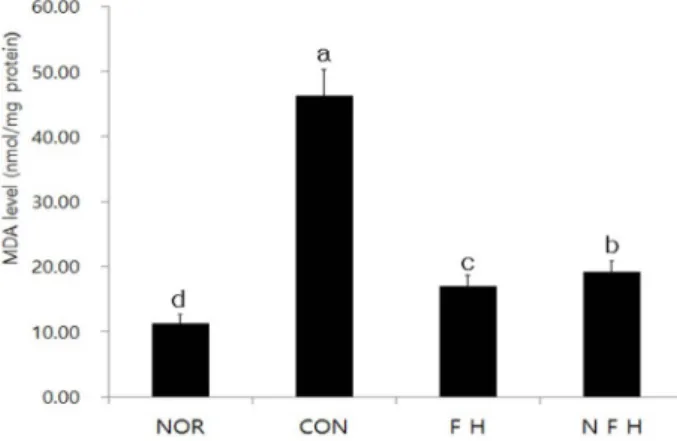
간 균질액에서의 MDA 함량은 Fig. 5와 같다. 정상군은
11.22±1.46 nmol/mg protein, 대조군은 46.26±4.10 nmol/mg
protein, 발효 무궁화군은 17.06±1.62 nmol/mg protein, 비발
효 무궁화군은 19.21±1.68 nmol/mg protein로 측정되었다. 발
Fig. 5. Effects of FH and NFH on MDA levels in liver homoge- nate. NOR: Normal group, CON: High fat dietary group, FH: High fat dietary and fermented Hibiscus sy- riacus group, NFH : High fat dietary and unfermented Hibiscus syriacu groups. All the values were expressed as means ± S.D. (n=5) a,b,c are different (p<0.01) group by one-way ANOVA followed by Duncan’s post hoc test.
효 무궁화군은 대조군과 비교하여 82.5~84.1% 감소하여 실험 군 중 정상군과 가장 유사한 수치를 나타내었다.
Kim [11] 등의 연구에 의하면 HF군(고지방식이군)에 비해 HF+EQS군(고지방식이+녹차혼합물)의 MDA의 수치가 낮아 진 것으로 보아 EQS의 투여로 인해 간 조직 내 지질과산화물 의 생성을 감소시키는 것을 확인하였다. 이러한 연구 결과로 보아 발효 무궁화 섭취군의 MDA 생성량이 대조군에 비해 감소하여 실험군 중 정상군과 가장 유사한 수치를 나타냈다.
발효 무궁화 추출물이 고지방식이를 섭취한 비만 쥐의 간 조 직 내 지질과산화물의 생성을 감소시키는 것을 확인, 이는 발 효 무궁화 추출물이 지질과산화를 억제작용을 하는 것으로 사료된다.
References
1. Aebi, H. 1984. Catalase in vitro, in : Packer. L , ed methods in enzymology. N. Y. Academic. 105, 121-126.
2. Bae, G. J. and Ha, B. J. 2015. Antioxidative effect of fer- mented Rhynchosia nulubilis in obese rats. J. Fd Hyg. Safety 30, 383-389.
3. Beak, Y. H. and Lee, S. H. 2010. The effect of aerobic exercise and Allium Tuberosum intake on blood lipids, MDA and an- tioxidant enzyme in rats. J. Life Sci. 20, 245-252.
4. Beauchamp, C. and Fridovich, I. 1971. Superoxide dis- mutase: improved assays and an assay applicable to acryl- amide gels. Anal. Biochem. 44, 276-287.
5. Ha, B. J. 1985. Studies on the antilipidperoxidation effect of brazilin and hematoxylin. Ph. D. Dissertation. Seoul uni- versity, Seoul, Korea.
6. Ha, J. H., Seo, Y. C., Choi, W. Y., Kim, J. S., Kim, H. H., Ahn, J. H and Lee, H. Y. 2010. Enhancement of antioxidant
activities of bark of Berberis koreana Palibin by lactic acid fermentation. Kor. J. Med. Crop Sci. 18, 421-428.
7. Jang, A. R. 2012. Study on cosmetic physiological and skin cell activity of Hibiscus syriacus extracts. M.S. dissertation, Hannam University, Daejeon, Korea.
8. Jeon, J. M., Choi, S. K., Kim, Y. J., Jang, S. J., Cheon, J. W.
and Lee, H. S. 2011. Antioxidant and antiaging effect of gin- seng berry extract fermented by lactic acid bacteria. J. Soc.
Cosmet. Scientists Korea 37, 75-81.
9. Jung, Y. J. and Choi, M. J. 2015. Effects of chunggukjang and greentea-chunggukjang on lipid profile and anti- oxidative enzyme activity of liver tissue in growing rats fed cholesterol. J. East Asian Soc. Dietary Life 25, 278-286.
10. Kang, H. J., Kim, H. S., Jeon, I. H., Mok, J. Y., Han, K. S.
and Jang, S. I. 2013. Effects of antioxidant and blood flow improvement of grape leaf extract and resveratrol from Vitis romaneti. J. Kor. Soc Food Sci Nutr. 42, 1736-1743.
11. Kim, J. D., Lee, B. I., Jeon, Y. H., Bak, J. P., Jin, H. R. and Lim, B. O. 2010. Anti-oxidative and anti-inflammatory ef- fects of green tea mixture and dietary fiber on liver of high fat diet-induced obese rats. Kor. J. Med. Crop Sci. 18, 224-230.
12. Kim, J. H., Lee, W. J., Cho, Y. W. and Kim, K. Y. 2009.
Storage-life and palatability extension of Betula platyphylla Sap using lactic acid bacteria fermentation. J. Kor. Soc. Food Sci. Nutr. 38, 787-794.
13. Kim, J. Y., Shin, M. S. and Heo, Y. R. 2014. Effects of stabi- lized rice bran on obesity and antioxidative enzyme activity in high fat diet-induced obese C57BL/6 mice. J. Kor. Soc.
Food Sci. Nutr. 43, 1148-1157.
14. Kim, M. A. 2014. Influences of feral haw (Crataegus pinnatifi- da BUNGE) on the antioxidative activities and lipid metabo- lism functional improvement in dyslipidemic rats. M.S. dis- sertation, Busan University, Busan, Korea.
15. Kim, S. M., Kim, D. Y., Park, H. R., Seo, J. H., Yeom, B.
M., Jin, Y. J. and Pyo, Y. H. 2014. Screening the antioxidant components and antioxidant activitiy of extracts derived from five varieties of edible spring flowers. Kor. J. Food Sci.
Technol. 46, 13-18.
16. Kim, S. W., Jeong, S. T. and Baek, Y. H. 2013. Effects of cheonggukjang diet and aerobic exercise on lipid metabo- lism and antioxidant enzyme in rats. J. Life Sci. 23, 657-663.
17. Kobayashi, M., Fujita, M. and Mitsuhashi, H. 1984. Compo- nents of Cnidium officinale Makino: occurrence of pregneno- lone, coniferylferulate, ferulate and hydroxylprthalides.
Chem. Pharm. Bull. 32, 3770-3773.
18. Lee, E. J and Bae, J. H. 2011. Study on the alleviation of an alcohol induced hangover and the antioxidant activity by mulberry fruit. Kor. J. Food Nutr. 24, 204-209.
19. Lee, E. J. 2014. Effect of a pumpkin, corn silk, and adzuki bean on antioxidant activity and anti-obesity in diet-induced obese rat. M.S. dissertation, Kyungnam university, Kyung- nam, Korea.
20. Lee, H. J., Lee, S. W., Park, C. G., Ahn, Y. S., Kim, J. S., Bang, M. S., Oh, C. H. and Kim, C. T. 2015. Effects of white Habiscus syriacus L. flower extracts on antioxidant activity and bone resorption inhibition. Kor. J. Med. Crop Sci. 23,
초록:고지방식이로 유도된 비만 C57BL/6 쥐에서 발효 무궁화 추출물의 항산화 활성
이하늘․하배진*
(신라대학교 바이오과학과 제약공학전공)
본 연구의 목적은 비만 쥐에서의 발효 무궁화 추출물의 항산화 효과를 평가를 위해 수행되었다. 항산화 실험은 in vivo와 in vitro 둘 다 진행하였다. In vitro 실험은 산화질소 자유 라디칼 소거활성을 사용하여 측정하였다. 발효 무궁화 추출물에서의 산화질소 자유 라디칼 소거활성은 비발효 무궁화 추출물보다 높게 나타났다. In vivo 실험은 정상식이군(NOR), 고지방식이군(CON), 고지방식이+발효 무궁화 추출물군(FH)과 고지방식이+비발효 무궁화 추 출물군(NFH)로 나눴고, 4군은 4주 동안 복강투여하였다. 그리고 간 균질액의 SOD, CAT, MDA 수준을 측정하였 다. 그 결과 FH군의 SOD와 CAT 수준은 CON군보다 높게 나타났으며, FH군의 MDA 수준은 CON군에 비해 현 저하게 감소하였다. 결론적으로 발효 무궁화 추출물은 비만 쥐에서의 산화적 스트레스 억제 효과와 항산화 효소 활성 증가 효과를 가지며, 유용한 천연 항산화제의 원료로 사용할 수 있음을 제안한다.
190-197.
21. Lee, J. J., Son, H. Y., Choi, Y. M., Cho, J. H., Min, J. K.
and Oh, H. K. 2016. Physicochemical components and anti- oxidant activity of Sparassis crispa mixture fermented by lac- tic acid bacteria. Kor. J. Food Preserv. 23, 361-368.
22. Lee, S. J. 2016. Bioactive substances searching and bio- activiteis evalution of fermented Sargassum siliquanstrum.
M.S. dissertation, Silla University, Busan, Korea.
23. Lim, K. T. and Shim, J. H. 1997. Antioxidative effects of ethanol extracts from Rhus Verniciflua Stokes (RVS) on mouse whole brain cells. Kor. J. Food Sci. Technol. 29, 1248-1254.
24. Marcocci, L., Packer, L., Dory-Lefaix, M. T., Sakaki, A. and Gerdes-Albert, M. 1994. Antioxidation action of Ginkgo biloba extract egb 76. Methods Enz. 234, 462-475.
25. Park, S. J., Kim, D. H., Paek, N. S. and Kim, S. S. 2006.
Preparation and quality characteristics of the fermentation
product of ginseng by lactic acid bacteria (FGL). J. Ginseng Res. 30, 88-94.
26. Sung, K. S., Chun, C., Kwon, Y. H., Kim, K. H. and Chang, C. C. 2000. Effects of red ginseng component on the anti- oxidative enzymes activities and lipid peroxidation in the liver of mice. J. Ginseng Res. 24, 29-34.
27. Yoo, I. D., Lee, I. K., Ryoo, I. J., Choung, D. H., Han, K.
H. and Yun, B. S. 1997. Studies on the constituents of Hibiscus syriacus (I). Kor. J. Pharmacoan. 28, 112-116.
28. Yoo, K. O., Lim, H. T. and Kim, J. H. 1996. Studies on the flavonoids of the Hibiscus syriacus L. complex. Kor. J. Plant.
Res. 9, 224-229.
29. Yoon, S. W. 2016. Effect of absolute from Hibiscus syriacus L. flower on skin regeneration and wound healing in keratinocyte. M.S. dissertation, Hoseo University, Chung- nam, Korea.