• 검색 결과가 없습니다.

Evaluation of the Partial Compressive Strength according to the Wood Grain Direction

N/A
N/A
Protected

Academic year: 2021

Share "Evaluation of the Partial Compressive Strength according to the Wood Grain Direction"

Copied!
5
0
0

로드 중.... (전체 텍스트 보기)

전체 글

(1)

* 1 Received on November 2, 2012; accepted on March 7, 2013

* 2 Department of Housing Environmental Design, Chonbuk National University, Jeonju 561-756, Korea

* 3 Department of Forest Sciences, Seoul National University, Seoul 151-742, Korea

Corresponding author : Gwang-Chul Kim (e-mail: [email protected])

Evaluation of the Partial Compressive Strength according to the Wood Grain Direction* 1

Chun-Young Park *

2

, Hyung-Kun Kim *

3

, Jun-Jae Lee *

3

and Gwang-Chul Kim *

2†

ABSTRACT

Bearing occurs by the rotations of members induced from horizontal or vertical load at traditional wood- en joint in frame. The bearing between wooden members is not occurring at the whole surface of joint, but occurring only at the particular bearing area. In this study, partial bearing according to the different grain direction was evaluated. The partial compressive strength showed 3 times higher than pure com- pressive strength perpendicular to grain, 1.5 times higher than parallel to grain and 3.3 times higher than both of them. It is expected that this result can be very importantly applied when evaluating and analyzing the actual behavior of traditional wooden mortise and tenon joint.

Keywords : embedment, partial compressive strength, mortise and tenon joint, wood grain

1. INTRODUCTION

Bearing behavior to wood members occurs at inner part of the connection and does in between post and beam member of the connection when it is subjected to horizontal or vertical load, which is the formal characteristic of the connection of Korean traditional post-beam structure. In the past, researchers applied compressive strength of wood according to wood direction and Hankins’

equation for the structural analysis of mortise and tenon joint. However it is apt to face two pro- blems as considering behavior of the real con- nection; 1) bearing of wood is not the result of

the whole compression but the result of partial compression, 2) not easy to apply Hankins’

equation because the contact area changes with the rotational angle although surface which sub- jected to compression have angle to the grain,

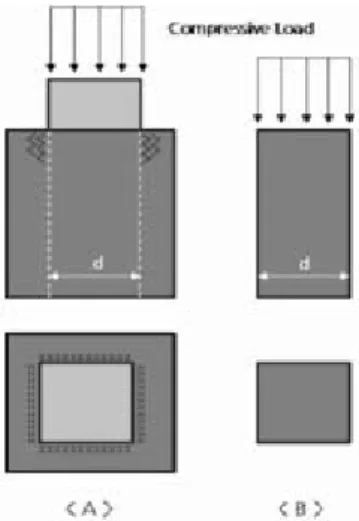
Partial compression means the bearing sub-

jected not to the whole surface but part of the

surface. In this case, the shear behavior occurs at

the boundary between two members and the com-

pression to the grain act on the contact area at

the same time. It leads to higher strength than

the previous whole compression strength (Fig. 1).

(2)

Fig. 1. Outline of the partial compression.

In addition, the area can be expressed as the function of the rotational angle because the sur- face area changes according to the change of the rotational angle. And theoretically only plastic area exists as soon as bearing started on the ba- sis of material mechanics.

Kim (2011) conducted compressive test with structural sized lumber and reported that skin timber with even 25% of cross section area showed almost 50% compressive performance of solid timber. This means that the resistance is not ex- actly proportional to the area and it would have greater effect on timber because it is nonhomo- geneous material. Kang et al. (2001) made a re- search on compressive behavior by separating early wood and late wood of Japanese Sugi and concluded that early wood has one fourth of maximum strength and MOE compare to late wood. In particular, late wood shows short elastic range and long plastic range while early wood shows linear deformation behavior. That is, the behavior differs from the bearing of early and late wood in traditional joint and proves that the effect of early and late wood should be con- sidered. Jang (2000) reported that compressive strength is proportional to velocity of ultrasonic

wave according to the angle of wood grain. It means that the performance of the joint with mortise and tenon is more complicated because of the cross of wood grains of wood members.

Generally, compressive deformation induces shear stress between close cells and separates middle lamella or parenchyma cell. And it is oc- curred by the tiny kink which means local deform- ation of micro-fibril structures after the separation of the outer and middle lamella of the tracheid.

Bearing of wood regarding the behavior of tra- ditional connection occurs in joint, under joint and upper horizontal member of connection. But the type of bearing is different from compress- ion behavior typically used. It shows partial bearing behavior accompanied with shear one.

Not only the bearing of wood, but also the shape of every part of member would change. In this study, compressive strength of the partial bearing will be evaluated according to the wood grain.

2. MATERIALS AND METHODS

2.1. Materials

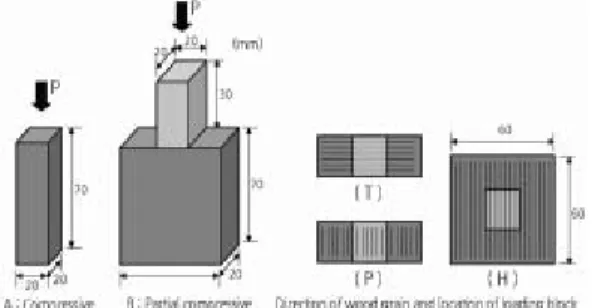
Domestic Larch ( Larix kaempferi) was used and moisture contents (M.C.) was 12.8% (stan- dard deviation : 0.5). Average specific gravity was 0.53 (standard deviation, 0.08). Specimens were manufactured with the compressive surface of 20 × 20 (mm), the replication of test was ten.

To reduce the variation within materials, speci-

mens were selected from 6 different material

groups. Compressive length was controlled to 70

mm. Specimen were manufactured to have differ-

ent grain direction and compressive surface as

shown in Fig. 2 (Perpendicular to the grain, Pa-

rallel to the grain and both of them). To com-

pare the result, pure compressive specimen was

made with the parallel to the grain. After the

test, M.C. and specific gravity of each specimen

were measured.

(3)

Fig. 2. Schematic diagram of specimen, angle of grain and location of loading block.

Fig. 3. Photograph of compressive test.

2.2. Methods

In order to evaluate partial compression of wood, tests were conducted in accordance with KS F 2206 which defines wood compression test.

Length of the specimen was 70 mm and loading speed was set up at 0.3 mm/min with universal test machine (Zwick, 100 kN). And loading block was manufactured parallel to grain using same species to achieve the objective of this study which aimed to evaluate the performance of wood to wood connection. Specimens were prepared in different type as shown in Fig. 2 considering the characteristic of surface which the wood grain was broken by the loading block. Test for com- pression strength was conducted as shown in

Fig. 3 Compressive strength was divided into pa- rallel and perpendicular to grain. In case of partial compression, the location of loading block was divided into tangential(T), parallel(P) and both of them to the grain on contact area as shown in Fig. 2 To secure the accuracy of experiment, compressive specimens used for comparison were taken from the same member.

3. RESULTS AND DISCUSSION

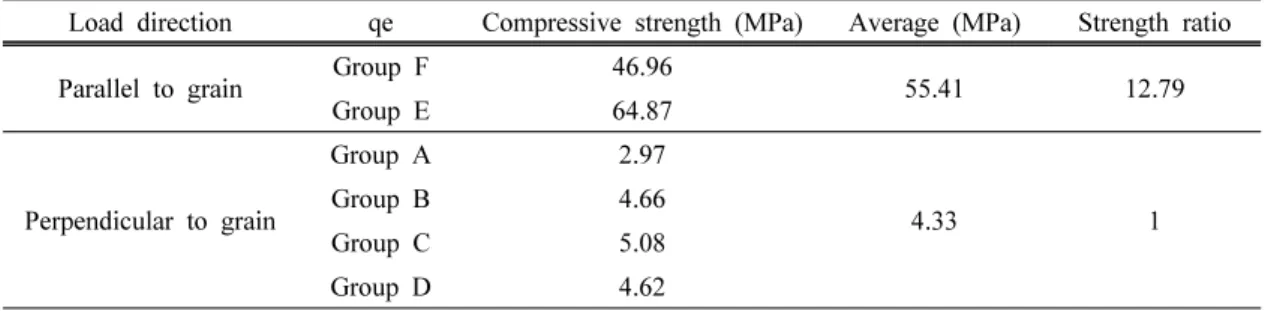
3.1. Evaluation of Compression Strength Compressive strength of wood has significant difference according to the grain of angle. Tests to evaluate compressive strength were coducted in two directions, parallel and perpendicular to the grain. Compressive strength showed devition between material groups. The result showed that compressive strength perpendicular to the grain was 1/13 compared to that of parallel to the grain, and the value was 4.3 MPa on average. As com- pressive behavior of traditional connection occur perpendicular to the grain of horizontal and verti- cal members, partial compressive strength was evaluated based on compressive strength of per- pendicular to the grain. Test results were shown in Table 1.

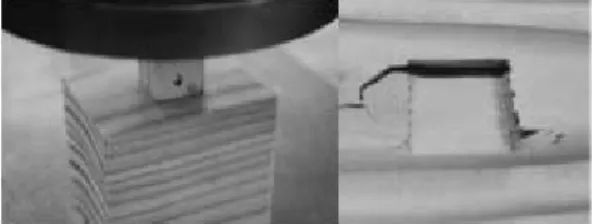
3.2. Evaluation of Partial Compressive Strength with Two Shear Surfaces Evaluation of partial compressive strength was conducted as shown in Fig. 4. Failure mode was shown in right side of the Fig. 4. And that fail- ure occurred by both the bearing which acts per- pendicular to the grain and the wrecking failure of edge.

The result shows increase of strength compar- ed to the whole compressive strength and different value according to the direction of loading block.

As shown in the Table 2, the strength when the

(4)

Table 1. Compressive strength of pure compressive specimen

Load direction qe Compressive strength (MPa) Average (MPa) Strength ratio

Parallel to grain Group F 46.96

55.41 12.79

Group E 64.87

Perpendicular to grain

Group A 2.97

4.33 1

Group B 4.66

Group C 5.08

Group D 4.62

Fig. 4. Photograph of partial compressive test.

Table 2. Partial compressive strength

Materials Load direction Compressive strength (MPa) Strength ratio

Group A Perpendicular 2.97 1

Partial (Perpendicular, T) 8.94 3.01 2.89

Group B Perpendicular 4.66 1

Partial (Perpendicular, T) 12.91 2.77

Group C Perpendicular 5.08 1

Partial (Parallel, P) 7.32 1.44 1.46

Group D Perpendicular 4.62 1

Partial (Parallel, P) 6.90 1.49

loading block was located in the direction per- pendicular to the grain has increased about 3 times compared to the whole compressive test and about 1.5 times when the block located pa- rallel to the grain.

The difference of strength ratio is caused by the location of the boundary between two mem- bers. In the partial compression perpendicular to grain on the contact area, the fibers cross the boundary and break off by the loading block so

the strength increased. In parallel to grain, the fibers were divided and split perpendicular to fiber.

From the result, the direction and the number of the boundary should be considered in the structural analysis of wood to wood joints such as the mortise and tenon joint. In structural de- sign of post and beam structure, the design val- ue of compressive strength was utilized and the results generally did not consider.

3.3 Evaluation of Partial Compressive Strength with Four Shear Surfaces Based on the test shown above, compressive test of specimen which had 4 interfaces was con- ducted. In these cases, breaking off and splitting of the wood fibers occur at the same time. Fail- ure modes are shown in Fig. 5.

As much as 3.5 times higher strength com-

(5)

Fig. 5. Photograph of partial compressive strength test.

Table 3. Partial compressive strength Materials Load direction Compressive

strength (MPa)

Strength ratio

Group A

Perpendicular 2.97 1

Partial (Perpen-

dicular, H) 9.76 3.29

Predicted result 10.40 3.5

pared to the whole compression test was expect- ed from the previous results and the actual strength was similar (Table 3). the splitting bet- ween wood fibers is less effective on the other hand, the breaking off the fiber is more effective.

CONCLUSIONS

In design and analysis of wood to wood joint, the compressive strength of the whole area has been utilized to evaluate and predict the behavior and design values of the joint. However com- pressive strength was different according to the direction and location of the boundary between wood members which were manufactured wood to wood joints. In this study, the results show about 3 times increase in strength when the boundary was perpendicular to the grain on com- pressive surface, 1.5 times when it was parallel to grain and 3.3 times when it had both of them.

The results should be considered in the design and analysis of wood to wood to joint especially, traditional wood joint with mortise and tenon so it would increase the accuracy of calculation.

ACKNOWLEDGMENTS

This paper was supported by research funds of Chonbuk National University in 2012.

REFERENCES

1. Ali Awaludin, Watanachai Smittakorn, Takuro Hirai, Toshiro Hayashikawa. 2007. Vearing pro- perties of Shorea Obtusa beneath a laterally loaded bolt, J. wood Sci. 53: 204∼216.

2. Chun Won Kang, Tsutsurni Juichi, Sang Sik Jang. 2001. Mechanical Behaviour of Earlywood and Latewood under Longitudinal Compression Load, J. Korean wood science and technology 29(2): 76∼83.

3. Gwang Chul Kim. 2011. A Study on the Compressive Capacity of Yellow Poplar Skin- timber, J. Korean wood science and technology.

39(4): 333∼343.

4. Kei Sawata, Motoi. 2002. Determination of embedding strength of wood for dowel-type fasteners, J. wood Sci. 48: 138∼146.

5. Kweonhwan Hwang, Kohei Komatsu. 2002.

Bearing properties of engineered wood products

Ⅰ: Effects of dowel diameter and loading direct- ion, J. wood Sci. 48: 295∼301.

6. Sang Sik Jang. 2000. Effects of Moisture content

and Slope of Grain on Ultrasonic Transmission

Speed of wood, J. Korean wood science and

technology 28(2): 10 ∼18.

수치

Fig. 1. Outline of the partial compression.
Fig. 2. Schematic diagram of specimen, angle of  grain and location of loading block.
Table 1. Compressive strength of pure compressive specimen
Fig. 5. Photograph of partial compressive strength test.

참조

관련 문서

He appreciates the efforts from the officials at KIA, including members from the Ministry of Interior, Kuwait General Administration of Customs, as well as all workers

A cross section of wood from a white-pocket area of decayed wood showing delignified wood cells. These cells have no middle lamella (this is the area between

웹 표준을 지원하는 플랫폼에서 큰 수정없이 실행 가능함 패키징을 통해 다양한 기기를 위한 앱을 작성할 수 있음 네이티브 앱과

_____ culture appears to be attractive (도시의) to the

A tangential section of the common ivy, Hedera helix, shows some vasicentric tracheids to the left of the vessel, which is the white space at right.. A maceration of the wood

The index is calculated with the latest 5-year auction data of 400 selected Classic, Modern, and Contemporary Chinese painting artists from major auction houses..

After first field tests, we expect electric passenger drones or eVTOL aircraft (short for electric vertical take-off and landing) to start providing commercial mobility

Moving from Traditional Payment Rails to Payment Networks 73 Fiat Currency Stablecoins Create More Interoperability between Ecosystems 74 Cryptocurrency and