
무선 이동 네트워크에서의 위치 관리 기술에 대한 고찰
공기식 *
요 약
본 논문에서는, 무선 셀룰러 네트워크와 Mobile IP 기반의 네트워크를 위해 제안되었던 기존의 다양 한 위치 관리 기법들에 대한 광범위한 소개 및 분류법을 제시한다. 또한, 기존에 제안되었던 다양한 위 치 관리 기법들로부터, 네트워크의 종류와 관계없이 위치 관리 기법들의 이해를 돕기 위한 유용한 가이 드를 제공할 수 있는 공통의 핵심 기술들 및 주요 설계상의 목표와 성능 고려 사항 등을 도출해 낸다.
본 논문의 목적은 위치 관리를 위한 새로운 기법을 제안하는 것이라기보다는, 기존에 제안되었던 위치 관리 기법들의 다양한 설계상의 핵심적인 특징들을 도출해내고, 차세대 무선 이동 네트워크에서 보다 효율적이고 최적화된 위치 관리 기법을 설계하기 위해 근간이 되는 핵심 개념 및 기술들에 대한 통찰력 을 향상시키는 것을 그 목적으로 한다. 또한, 이러한 근간이 되는 개념 및 기술들은 네트워크의 종류와 관계없이 향후의 이동 컴퓨팅 환경에서 보다 효율적인 이동성 및 서비스 품질 제공을 위해서도 쉽게 적 용될 수 있을 것으로 기대되는 바이다.
A Survey of Location Management Techniques in Wireless Mobile Networks
Ki-Sik Kong*
Abstract
In this paper, we provide a comprehensive overview and classification on a wide range of the existing location management schemes which have been reported for wireless cellular networks and Mobile IP-based networks, respectively. In addition, from the various previous literature, we derive common key conceptual techniques, their main design goals and performance considerations on them, which can provide a useful guidance for understanding location management schemes regardless of network types. The aim of this paper is not to propose a new scheme for location management, but to highlight the various key design features involved in the design of the existing location management schemes, and to enhance an insight into the fundamental principles and techniques for designing more efficient and optimized location management scheme in future wireless mobile networks. We expect that regardless of network types, these underlying fundamental principles and conceptual techniques could be also easily tailored for more efficient mobility/QoS support in future mobile computing environments.
Keywords : location management, wireless cellular networks, Mobile IP-based networks
1. Introduction
Cellular mobile communication and Internet are currently two major distinct technology
※ 제일저자(First Author) : 공기식
접수일:2010년 08월 06일, 수정일:2010년 11월 15일, 완료일:2010년 12월 23일
* 남서울대학교 멀티미디어학과
[email protected]
waves. Cellular mobile communication has
evolved from the telecommunication networks
which have been developed from traditional
circuit-switched voice services. The legacy
2G/2.5G wireless cellular systems such as
IS-41 [1] and GSM [2] correspond to such a
technology wave, and the today’s cellular
mobile communication is rapidly in the process
of evolution from 2G/2.5G wireless cellular
systems to 3G wireless cellular systems such as UMTS and CDMA2000. On the contrary, the Internet has been developed for data communication based on packet-switching technology that allows each user to use a variety of applications such as web services, ftp and e-mail. In recent years, due to the popularity of laptop computer, smart phone, and the Internet, there have been a lot of demands and interests on IP mobility support [3, 4, 5, 6].
One of the most important and challenging issues in mobile computing environments is location management. Location management [7, 8, 9] enables the networks to track the location of a mobile user and discover its current point-of-attachment for call delivery or packet delivery. A lot of location management schemes for wireless cellular networks and Mobile IP-based networks have been proposed over the past decade. Although these schemes proposed for each network are different in their details, we argue that the underlying fundamental principles and common conceptual techniques of location management schemes are essentially almost the same.
The research for more enhanced and optimized location management is inevitable in order to more efficiently manage a huge population of mobile subscribers and provide them with a range of services in future wireless mobile networks. From the viewpoint of location management in wireless mobile networks, although there have been several good surveys on efficient location management schemes for wireless cellular networks [7, 8], the surveys on location management for Mobile IP-based networks [6, 9, 10] have been only focused on reviewing well-known standard protocols such as Mobile IPv6 (MIPv6) [4], Hierarchical MIPv6 (HMIPv6) [5], and Proxy MIPv6 (PMIPv6) [10]. Besides, there have not been any efforts to try to understand various location management
schemes for wireless cellular networks and Mobile IP-based networks together from the viewpoint of the fundamental common design philosophy. Therefore, in this paper, we first provide a comprehensive overview and classification on various existing location management schemes which have been proposed for Mobile IP-based networks as well as wireless cellular networks. Then, from this study, we derive common key conceptual techniques, main design goals and performance considerations on them. As far as the authors are aware, this is the first ever survey paper which analyzes from the viewpoint of the common conceptual techniques used for location management regardless of network types. In addition, these common conceptual techniques are also expected to be easily applied for more efficient mobility and quality-of-service(QoS) support in any type of network in future mobile computing environments.
2. Location Management in Wireless Mobile Networks
Location management can be considered as being composed of the following two operations regardless of network types:
l Location update: This operation occurs when a mobile user changes its location, which results in a movement from its current point-of-attachment to the different one.
l Location lookup: This operation occurs when the network is locating a mobile user * to determine its current point-of-attachment.
* In this paper, we use the terms mobile user, mobile terminal (MT), and mobile node (MN) interchangeably. Specifically, in wireless cellular networks jargon, the term MT is generally used, whereas the term MN is used in Mobile IP-based networks jargon.
(Figure 1) Location registration in wireless cellular networks
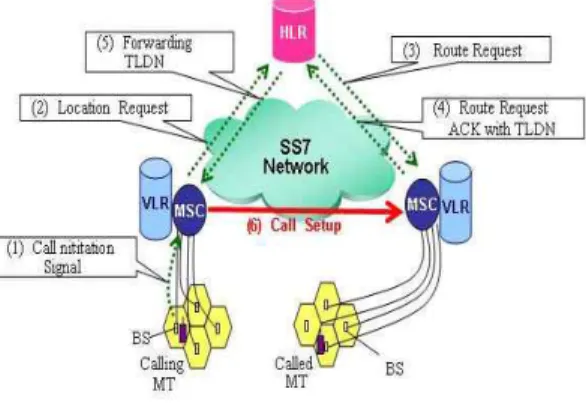
(Figure 2) Call delivery in wireless cellular networks
In wireless cellular networks,
location updatecorresponds to the location registration procedure. In Mobile IP-based networks, it corresponds to the location registration (in Mobile IPv4(MIPv4) [3]) or the binding update (in MIPv6 [4]) procedure. On the other hand,
location lookupcorresponds to the call delivery procedure in wireless cellular networks, whereas it corresponds to the packet delivery procedure in Mobile IP-based networks. In this section, we provide a brief overview of the standard location management protocols in wireless circuit-switched networks and wireless packet-switched networks.
2.1 Location Management in Wireless Circuit-Switched Networks
Location management in wireless circuit-switched networks is primarily supported by two international standards:
EIA/TIA IS-41 [1] and the ETSI GSM [2]. In these standards, the call processing and location management functions are based on Signal System No.7 (SS7) [11]. The both standards maintain location information of MTs by employing the two-tier database architecture. They utilize the databases called the Home Location Register (HLR) and the Visitor Location Register (VLR). The HLR
maintains location information and permanent user profile for each MT, and the VLRs are distributed throughout the network to store location information of each MT currently residing in the Registration Area (RA). There are two major procedures in the location management for wireless cellular networks:
location registration and call delivery. The former is the procedure that an MT updates location databases such as HLR and VLR whenever the MT moves to a new RA, and the latter is the procedure required when the network attempts to deliver a call to a target MT when a call for that MT is initiated.
Figure 1 and 2 briefly show the location registration and call delivery procedure in wireless cellular network, which can be considered as the representative wireless circuit-switched networks. More details can be found in [7].
2.2 Location Management in Wireless Packet-Switched Networks
Location management in wireless
packet-switched networks is primarily
supported by IETF Mobile IP and its various
extensions. MIPv4 [3] introduces three new
functional entities: Home Agent (HA), Foreign
Agent (FA), and Mobile Node (MN).
(Figure 3) Location management in Mobile IPv6 networks
Whenever an MN visits any network away from home network, each MN must register with its HA in order to track the MN’s current IP address. There are two IP addresses associated with each MN, one is for identification and the other is for routing. That is, each MN is assigned a permanent IP address called Home Address (HoA) in its home network, and it is also assigned a temporary IP address called Care-of-Address (CoA) in its foreign networks. The HA in the home network maintains a mobility binding between HoA and CoA in a binding cache, so all the packets destined to the MN are intercepted by the HA, and tunneled to the FA, where they are forwarded to the MN.
However, MIPv4 in its basic form has some serious problems such as triangle routing, traffic bottleneck at the HA, and limited IP address space, etc. Thus, MIPv6 [4] has been developed by the IETF with some new functionalities.
Figure 3 briefly shows the binding update and packet delivery procedure in MIPv6 networks [4]. Although MIPv6 may be similar with MIPv4 in many aspects, it has much improvement that the protocol is fully integrated into an IP. Support for route optimization in MIPv6 is built-in as a
fundamental part of the protocol, rather than being added on as an optional part of extensions. So, the Correspondent Node (CN) is able to send packets directly to an MN when it has a recent binding entry for the MN in its binding cache.
3. Key Conceptual Techniques for Efficient Location Management
Current location management standards do not consider each mobile user's mobility/traffic characteristics. Thus, such a static and globally applicable approach may not be efficient for supporting a huge user population.
In addition, unnecessary control traffic and database access load due to such a static and globally applicable location management may cause serious performance degradation in the networks. Therefore, the previous literature on location management in wireless cellular networks and Mobile IP-based networks has been focused on designing more efficient and more optimized per-user location management schemes. However, although the techniques required for each network are different in their details, we argue that the underlying fundamental principles and common conceptual techniques of their location management schemes are essentially almost the same regardless of network types. In this section, from the viewpoint of common key conceptual techniques used for efficient location management, we analyze the previous literature, providing a comprehensive overview and classification on them. Table 1, 2 and 3 will provide a useful guidance to analyze and compare the previous literature, and will help to find some resemblance between them from the viewpoint of common conceptual aspects.
3.1 Location caching-based technique
The key observation for location caching is
Items Wireless circuit-switched networks Wireless packet-switched networks Representative network Wireless cellular networks Mobile IP-based networks
Location management standards IS-41, GSM MIPv4, MIPv6
Standards organizations EIA/TIA, ETSI IETF
Location management operations Location registration,
Call delivery Binding update,
Packet delivery Mobile entity Mobile terminal (or cellular phone) Mobile node (or mobile host) Location database
(for permanent information) HLR HA
Location database
(for temporary information) VLR FA
Mobile entity identifier IMSI
(International Mobile Station Identity) HoA
Mobile entity locator MSRN
(Mobile Station Roaming Number) CoA
Switching method Connection-oriented Connectionless
<Table 1> Simple comparisons between wireless circuit-switched networks and wireless packet-switched networks
that, in many cases, it should be possible to reuse a user's location information obtained during the previous call to that user [12, 13, 14]. Location caching is useful for those users who receive calls frequently relative to the rate at which they relocate. Similar to the idea of exploiting locality of file accesses, this technique exploits the spatial and temporal locality of calls received by users. To locate a user, the cache at the caller's side is queried first. If the location of the user is found at the cache, then a query is launched to the indicated location without contacting the user's home location database * . Otherwise, home location database is queried.
Location caching concept has been also applied to Mobile IP-based networks for efficient location management. Note that various MIPv6 enhancement protocols as well as MIPv6 [4] can be basically considered as adopting location caching-based technique because all CNs should maintain its binding cache for MNs.
The performance of location caching-based
* It corresponds to the HLR in wireless cellular networks or the HA in Mobile IP-based networks.
techniques may be quite different according to when the cache invalidation being determined or where the location caches about the MNs being located in the system. Various researches for estimating optimal time threshold to maintain location cache information have been reported for wireless cellular networks (in [15]) and Mobile IP-based networks (in [16, 17]), respectively.
Similar to the location caching-based techniques for wireless cellular networks, the location caches for Mobile IP-based networks may be also positioned in the network entities, not the CNs. In [18], the authors moved the functionality of maintaining and updating binding caches from the individual CNs to the correspondent agents (CA). On the other hand, the authors in [19, 20] proposed a client-side proxy-based integrated cache consistency and mobility management scheme for minimizing the overall network traffic generated.
3.2 Location forwarding-based technique
If the mobility of a mobile user is relatively
high, it may be too expensive to update all
the location database entries whenever it
moves. The key idea of location forwarding is
that instead of updating the location database located far away from the mobile user, at each move, the reporting in location change can be reduced by simply setting up a forwarding pointer from the old point-of- attachment * to the new one [21].
Various variations related to location forwarding in wireless cellular networks are reported in [22, 23, 24]. In [22], a hierarchical version of location forwarding was proposed, in which a two-level mobility management was introduced by selecting a set of VLRs as mobility agents (MAs) responsible for location management in geographically larger area compared with the RA of the VLR. An enhanced version of the work in [22] was proposed in [23]. Also, the hybrid approaches using location forwarding have been reported for efficient location management in wireless cellular networks [25, 26].
Recently, location forwarding concept has been also applied to Mobile IP-based networks for efficient location management. Similar to [21], the authors in [27] proposed that instead of updating the home networks far away, the MNs inform their new CoAs to the previous FAs. So, the location update traffic can be localized. In [28], a pointer forwarding scheme with mobility-aware binding update in HMIPv6 networks was proposed. In this scheme, a pointer chain between access routers (ARs) is established to reduce the binding update traffic to the mobility anchor point (MAP). In [29], a lazy update strategy using location forwarding technique was proposed for HMIPv6 networks.
In location forwarding-based technique, location lookup (or routing) cost may increase in case of long forwarding pointer chain.
Thus, the determination of the optimal forwarding pointer chain length is important.
* It corresponds to the VLR in wireless cellular networks or the FA/AR in MIPv4/MIPv6 networks.
The issues related to the determination of optimal pointer chain threshold have been discussed for wireless cellular networks (in [21]), MIPv4 networks (in [27]), and HMIPv6 networks (in [28]), respectively.
3.3 Local anchor-based technique
The basic idea of local anchor is that the traffic due to location update can be reduced by managing local movements in a localized manner. In [30], instead of transmitting registration messages to the HLR, location changes are reported to the local anchor.
When an incoming call arrives, the HLR is queried, which, in turn, queries the local anchor in order to determine the current location of the MT. Two different versions of the local anchor can be possible:
static local anchorand
dynamic local anchor. In the static local anchor scheme, the serving VLR of the MT during the last call arrival is selected as the local anchor. In the dynamic local anchor scheme, after a movement, the serving VLR of the MT becomes the local anchor if this will result in lower expected cost. Otherwise, the local anchor is not changed. Apart from the two local anchor schemes mentioned above, other choices for local anchor may be possible.
In [31], an intelligent network architecture using
a fixed local anchorto support Universal Personal Telecommunication (UPT) services was proposed. In this scheme, a selected VLR within an LSTP region serves as the local anchor for all MTs within the LSTP region. In [14], a fixed local anchor concept was also used for localized location management.
Local anchor-based technique has been also applied to Mobile IP-based networks for efficient location management. By using fixed local anchor concept, in [31], when an MN changes the subnets within a same localized domain (i.e., a MAP domain), it only sends the binding update message to the MAP.
Therefore, HMIPv6 makes the MN's mobility
within MAP domain transparent to the HA and the CNs, and only when the MN crosses a MAP domain, it sends the binding update message to the MAP, the HA, and, potentially, the CNs. Similar to dynamic local anchor concept in [30], the authors in [32] proposed a new distributed system architecture where each FA can function either as an FA or a GFA (Gateway FA). In this scheme, the regional network boundary is dynamically adjusted according to the up-to-date mobility and traffic load for each MN. Similar scheme using dynamic local anchor concept in MIPv6 networks was also proposed in [33].
The issues related to the selection of appropriate local anchor have been studied for wireless cellular networks (in [30]) and HMIPv6 networks (in [34, 35]), respectively.
3.4 Profile-based technique
In real life, most users tend to follow regular routines during some specific periods or on some days of the week. Therefore, once these mobility patterns can be recognized in a mobile user's profile, location management becomes not only easier but also more efficient. Inspired by such an idea, in [36, 37], the profile-based strategies were proposed to improve the performance of location management by increasing the intelligence of the location lookup procedure in wireless cellular networks.
Mobility patterns based on mobility profiles can be also exploited for paging or handover procedures. In [38], the authors proposed mobility pattern-based location management scheme using the movement profile. In this scheme, mobility pattern is learned and the system pages only most probable area. In [39], the authors proposed that an intra-RA location update is performed whenever the MT changes its location between the anchor cell (i.e., the cell where the MT usually stays for a significant period) and the rest of the cells
in the RA. For an incoming call, either the anchor cell or the rest of cells in the RA is paged to locate the MT. Thus, the paging cost is greatly reduced, especially when the called MT is located in its anchor cell.
In [40], the authors proposed seamless Mobile IPv6 (SMIPv6) to improve handover by predicting user location based on users' mobility patterns. In [41], in order to reduce the signaling traffic within a MAP domain in HMIPv6 networks, the authors proposed a history-based mobility management strategy, which is inspired by both the idea in [39] and the observations in [36]. This scheme enables an MN to selectively switch its mobility management protocols according to whether it is in its home cell or not in HMIPv6 networks.
3.5 Replication-based technique
Generally, home location database may become the bottleneck when there are a large number of mobile users in the network. Thus, maintaining the location information of specific users at selected local location databases may be helpful for faster location lookup since a mobile user's location is more likely to be obtained by a single lookup on the local database rather than a high latency remote lookup [42]. In wireless cellular networks, the problem of the overloaded HLR should be also solved by providing load balancing. In [43], the authors suggested replicating the HLR to avoid the performance bottleneck at the HLR, and they also conducted the various load and access pattern-related experiments. In [44], the authors proposed a new intersystem location management scheme, based on the replication of roaming users’ profiles at mobility gateway.
In Mobile IP-based networks, just like the
HLR in wireless cellular networks, the HA
may become the bottleneck when there are a
large number of MNs in the networks. In [45],
the authors proposed a replicated server
architecture in which multiple HAs are used
Techniques Key conceptual ideas Location caching-based
technique Reuse the user’s location information obtained during the previous call to that user.
Location forwarding-based technique
Instead of updating the location database such as HLR or HA, which is located far away from the user, just report the location change by simply setting up a forwarding pointer from the old point-of-attachment to the new one.
Local anchor-based technique
Manage a user’s location change in a localized manner. In other words, the location information of the user is reported to the local anchor instead of reporting it to the location database such as HLR or HA, which is located far away from the user.
Profile-based technique
Maintain an individual user profile, and take appropriate action for location management according to its profile.
Replication-based technique
Replicate a user’s location information at the selected zones from which it receives the most calls.
<Table 2> Classification and derived key conceptual ideas of location management techniques
to provide load balancing.
Sometimes, in case of the location database failure, incoming calls may be lost. In order to provide the fault-tolerance, the authors in [46]
proposed a distributed location management scheme for wireless cellular networks, which provides high availability (i.e., fault-tolerance) by replicating the MT's location information in the location registers. Similar to the design goals shown in [46], the authors in [47]
proposed a novel protocol with multiple mobile agents (MA) where only double mobility bindings are maintained in the whole system.
When an HA is failed, its backup HA can take it over in a short time without fetching the bindings from other places.
Generally, the associated cost of replication is the update cost incurred in maintaining consistent replicas every time a user moves.
Therefore, a policy to place appropriate replications is essentially required, and its use must be carefully considered.
4. Discussions
Until now, we have reviewed and analyzed a variety of existing location management schemes in Mobile IP-based networks as well as in wireless cellular networks. The basic
philosophy behind the various literature is to devise more efficient and optimized per-user location management schemes using a mobile user's mobility/traffic characteristics. For this purpose, various location management schemes have been reported in the literature. From the viewpoint of the fundamental design philosophy on them regardless of network types, we can classify and summarize them into five techniques as shown in Table 2. Also, we can derive the main design goals and performance considerations for adopting them as shown in Table 3, which is expected to provide a useful guidance for designing more efficient and optimized location management scheme in future wireless mobile networks.
Various hybrid proposals for cellular networks or Mobile IP-based networks have been also reported in the literature that combine two or more techniques mentioned above. In such cases, the hybrid techniques may have all advantages of the combined techniques, or may enhance some advantage of one technique while lessening some disadvantage of the other technique.
The key conceptual techniques and
fundamental design philosophy that we have
analyzed in this paper have been extensively
applied to the wireless cellular networks and
Techniques Main design goals Performance considerations Location
caching-based techniques
§ Reducing location lookup cost.
§ Reducing the load at remote database such as HLR and HA.
§ How to determine an optimal time threshold for maintaining location cache?
§ At what entity should the location cache be placed?
Location forwarding-based
techniques
§ Reducing location update cost.
§ Reducing the load at remote database such as HLR and HA
§ How to determine an optimal pointer chain length?
§ Location lookup cost may increase in case of long forwarding pointer chain.
Local anchor-based
techniques
§ Reducing location update cost.
§ Reducing the load at remote database such as HLR and HA.
§ How to select the local anchor for optimal performance gain?
§ For supporting dynamic anchor-based scheme, all the local databases such as VLR and FA/AR require the capabilities of dynamic local anchor.
Profile-based techniques
§ May be exploited for efficient location lookup, paging, and handover, etc.
§ Preferable for the mobile users that follow their expected behaviors.
§ How to create an individual user's profile?
§ Pattern learning process for creating and maintaining user profile may be needed.
Replication-based techniques
§ Reducing location lookup cost
§ May provide the load balancing or fault-tolerance.
§ Where should the replicas be maintained?
§ Additional update cost incurred in maintaining consistent replicas may occur.
<Table 3> Main design goals and performance considerations of the key conceptual techniques
Mobile IP-based networks, respectively.
Moreover, they can be easily tailored for more optimized location/mobility management and QoS support in various types of networks such as mobile ad-hoc networks [48, 49] and 3G/B3G networks [50, 51, 52].
5. Conclusions
From the viewpoint of common key conceptual techniques and ideas, we have reviewed and analyzed a variety of existing location management schemes in wireless cellular networks and Mobile IP-based networks. In addition, we have demonstrated that the underlying fundamental principles of location management schemes, regardless of network types, are essentially almost the same by exemplifying various schemes and their main design features, and so on. In this paper, even if we have introduced a few of the hybrid approaches, various hybrid location management schemes are being reported recently. Thus, our future research directions
will be focused on analyzing various hybrid location management schemes which have been reported for the wireless cellular networks and Mobile IP-based networks, respectively.
REFERENCES
[1] EIA/TIA, “Cellular radio-telecommunications inters ystem operations,” Technical Report IS-41 Revision C, EIA/TIA, 1995.
[2] M. Mouly and M.B. Paulet, “The GSM system for mobile communications,” Palaiseau, France, Techni cal Report, 1992.
[3] C. Perkins, “IP mobility support for IPv4,” IETF RFC 3344, Aug. 2002.
[4] D. Johnson and C. Perkins, “Mobility support in IPv 6,” IETF RFC 3775, June 2004.
[5] H. Soliman, C. Castelluccia, K. Malki, and L. Bellier,
“Hierarchical Mobile IPv6 mobility management (H MIPv6),” IETF RFC 4140, Aug. 2005.
[6] D. Saha et el, “Mobility support in IP: a survey of related protocols,” IEEE Network, vol.18, no.6, pp.34 -40, Nov./Dec. 2004.
[7] I. F. Akyildiz et al., “Mobility management in next-g eneration wireless systems,” Proc. IEEE, vol.87, no.8, pp.1347-1384, Aug.1999.
[8] S. Tabbane, “Location management methods for thir d-generation mobile systems,” IEEE Commun. Ma g., vol.35, no.8, pp72-84, Aug. 1997.
[9] I. F.Akyildiz et al., “A survey of mobility managemen t in next-generation all-IP-based wireless systems,”
IEEE Wireless Commun., vol.11, no.4, pp.16-28, Aug.
2004.
[10] K. -S. Kong, Y. Han, M. Shin, H. Yoo, and W. Lee,
"Mobility management for all-IP mobile networks:
Mobile IPv6 vs. Proxy Mobile IPv6," IEEE Wireless Commun., vol.15, no.2, pp.36-45, April 2008.
[11] Y. B. Lin and S. K. Devries, “PCS network signaling using SS7,” IEEE Commun. Mag., vol.33, pp.44-55, June 1995.
[12] R. Jain, Y. Lin, C. Lo, and S. Mohan, “A caching strategy to reduce network impacts of PCS,” IEEE J. Sel. Areas Commun., pp.1434-1445, 1994.
[13] R. Jain and F. Anjum, “Caching in hierarchical user location databases for PCS,” Proc. PWC’99, pp.496- 500, Feb. 1999.
[14] K. -S. Kong, "Performance analysis of profile-base d location caching with fixed local anchor for next- generation wireless networks," IEICE Trans. Com mun., vol.91-B, no.11, pp.3595-3607, Nov. 2008.
[15] Y. B. Lin, “Determining the user locations for perso nal communications services networks,” IEEE Tran s. Veh. Technol., vol.43, pp.466-473, Aug. 1994.
[16] Z. Wu, “An approach for optimizing binding lifetime with Mobile IPv6,” Proc. IEEE LCN’03, pp.82-88, Oct. 2003.
[17] S. Kwon, S. Nam, H. Hwang, and D. Sung, “Analysi s of a mobility management scheme considering bat tery power conservation in IP-based mobile networ ks,” IEEE Trans. Veh. Technol., vol.53, no.6, pp.
1882-1890, Nov. 2004.
[18] R. Vadali, L. Jianhui, W. Yiqiong, and C. Guohong,
“Agent-based route optimization for mobile IP,” Pr oc. IEEE VTC’01, vol.4, pp.2731-2735, Oct. 2001.
[19] W. He and I. Chen, “Proxy-based hybrid cache man agement in Mobile IP systems," Information Proces sing Letters, vol.106, no.1, pp.26-32, Mar. 2008.
[20] W. He and I. Chen, “A proxy-based integrated cach e consistency and mobility management scheme for client-server applications in Mobile IP systems," Jo urnal of Parallel and Distributed Computing, vol.69, no.6, pp.559-572, June 2009.
[21] R. Jain and Y.B.Lin, “An auxiliary user location stra
tegy employing forwarding pointers to reduce netw ork impact of PCS,” ACM-Baltzer J. WINET, vol.1, no.2, pp.197-210, July 1995.
[22] W. Ma and Y. Fang, “Two-level pointer forwarding strategy for location management in PCS network s,” IEEE Trans. MobilCom., vol.1, no.1, pp.32-45, Jan./Mar. 2002.
[23] C. Kant, P. Arun, and N. Prakash, “Two-level singl e-chain pointer forwarding strategy: a new scheme for location management in mobile communication,"
IET Commun., vol.1, no.6, pp.1224-1229, 2007.
[24] K. Kondepu, and C. Kumar, “An effective pointer-b ased HLR location registration scheme in location management for PCS networks," Proc. COMSNET S'09. pp.1-2, 2009.
[25] W. Ma and Y. Fang, “A pointer forwarding based local anchoring (POFLA) scheme for wireless netw orks,” IEEE Trans. Veh. Technol., vol.54, no.3, pp.1 135-1146, May 2005.
[26] I. Chen and B. Gu, “Quantitative analysis of a hybri d replication with forwarding strategy for efficient and uniform location management in mobile wireles s networks,” IEEE Trans. MobilCom., vol.2, no.1, pp.3-15, Jan.-Mar. 2003.
[27] W. Ma and Y. Fang, “Dynamic hierarchical mobility management strategy for Mobile IP networks,” IEE E J. Sel. Areas Commun., vol.22, no.4, pp.664-676, May 2004.
[28] S. Pack, B. Lee, T. Kwon, and Y. Choi, “A pointer forwarding scheme with mobility-aware binding up date in Mobile IPv6 networks," Computer Commun., vol.31, no.5, pp.873-884, Mar. 2008.
[29] M. Yi, U. Song, and C. Hwang, “A Lazy Update Strategy for Minimizing Signaling Cost Using the Forwarding Pointer in Mobile IP," J. Info. Sci. and Eng., vol.21, no.2, pp.259-286, 2005.
[30] J. Ho, I. Akyildiz., “Local anchor scheme for reducin g signaling costs in personal communications netw orks,” IEEE/ACM Trans. Networking, vol.4, no.5, pp.709-726, Oct. 1996.
[31] E. Bae, M. Chung, and D. Sung, “Performance analy sis of a fixed local anchor scheme for supporting UPT services,” Computer Commun., vol.23, no.18, pp.1763-1776, Dec. 2000.
[32] J. Xie, and I. Akyildiz, “A novel distributed dynamic location management scheme for minimizing signali ng costs in Mobile IP,” IEEE Trans. MobilCom.,
vol.1, no.3, pp.163-174, July-Sept. 2002.
[33] C. Pyo, L. Jie, and H. Kameda, “A dynamic and distributed domain-based mobility management me thod for Mobile IPv6,” Proc. VTC'03, vol.3, pp.1964 -1968 Oct. 2003
[34] S. Pack, T. Kwon, and Y. Choi, “A performance comparison of mobility anchor point selection sche mes in Hierarchical Mobile IPv6 networks," Comput er Networks, vol.51, no.6, pp.1630-1642, April 2007.
[35] T. Taleb et el, “DEMAPS: A Load-Transition-Base d Mobility Management Scheme for an Efficient Sel ection of MAP in Mobile IPv6 Networks," IEEE Tra ns. on Veh. Tech., vol.58, no.2, pp.954-965, 2009.
[36] A. Quintero and O. Carcia, “A profile-based strateg y for managing user mobility in third-generation mobile systems,” IEEE Commun. Mag., vol.42, no.9, pp.134-139, Sept. 2004.
[37] J. Singh and M. Karnan, “Using a Novel Intelligent Location Management Strategy in Cellular Network s," Proc.ICSAP'10, pp.238-242, 2010.
[38] D. Senzaki, G. Chakraborty, H. Mabuchi, and M.
Matsuhara, “Mobility pattern learning and route pre diction based location management in PCS network,
" Proc.AINA'06, 2006.
[39] Z. Mao, “An intra-LA location update strategy for reducing paging cost,” IEEE Commun. Lett., vol.6, no.8, pp.334-335, Aug. 2002.
[40] A. Quintero, S. Pierre, and L. Alaoui, “A mobility management model based on users’ mobility profile s for IPv6 networks," Computer Commun., vol.30, no.1, pp.66-80, Dec. 2006.
[41] K. -S. Kong, S. Roh, and C. Hwang, “History-based auxiliary mobility management strategy for hierarc hical Mobile IPv6 networks,” IEICE Trans. Fundam entals, vol.E88-A, no.7, pp.1845-1858, July 2005.
[42] N. Shivakumar, J. Jannink, and J. Widom, “Per-user profile replication in mobile environments: algorith ms, analysis, and simulation results,” ACM/Kluwer MONET, vol.2, no.2, pp.129-140, Oct. 1997.
[43] G. Chen and S. Lee, “Evaluation of distributed and replicated HLR for location management in PCS Ne twork,” J. Info. Sci. and Eng., vol.19, no.1, pp.85-10 1, 2003.
[44] H. Lee and D. Cho, “An efficient location manageme nt scheme based on replication strategy for intersys tem roaming in mobile wireless networks," Comput er Commun., vol.29, no.16, pp.3238-3249, Oct. 2007.
[45] J. Jue et el, “Design and analysis of a replicated
server architecture for supporting IP-host mobilit y,” Cluster Computing, vol.1, no.2, pp.249-260, 1998.
[46] D. Lee, H. Kim, J. Lee, and Y. Lin, “Performance Analysis of the Distributed Location Management Scheme in Large Mobile Networks," Int'l Journal of Info. Proc. Syst., vol.1, no.1, pp.55-61, Nov. 2005.
[47] Y. Huang and M. Chuang, “Fault tolerance for home agents in mobile IP," Computer Networks, vol.50, no.18, pp.3686-3700, Dec. 2007.
[48] Y. -C. Hu et el, “Caching strategies in on-demand routing protocols for wireless Ad Hoc network,” Pr oc. ACM MOBICOM’00, pp. 231-242, Aug. 2000.
[49] L. Wang and N. Zhang, “A location management scheme based on pointers strategy in the roaming cluster for the ad-hoc networks,” Proc. ICPWC'02, pp.275-279, 2002.
[50] A. Quintero, "A user pattern learning strategy for managing users' mobility in UMTS networks," IEE E Trans. MobilCom., vol.4, no.6, pp.552-566, Nov./D ec., 2005.
[51] G. Lee, T. Wang, and C. Tseng, “Resource reservati on with pointer forwarding schemes for the Mobile RSVP,” IEEE commun. Lett., vol.5, no.7, pp.298-30 0, July 2001.
[52] V. Pandey, D. Ghosal, and B. Mukherjee, “Exploitin g user profiles to support differentiated services in next-generation wireless networks,” IEEE Networ k, vol.18, no.5, pp.40-48, Sept./Oct. 2004.
공 기 식
1999년 : 고려대학교 컴퓨터학과 (이학사)
2001년 : 고려대학교 컴퓨터학과 (이학석사)
2005년 : 고려대학교 컴퓨터학과 (이학박사)
2005년~2007년: 고려대학교 컴퓨터정보통신연구소 연구교수
2007년: 이화여자대학교 정보통신공학부 연구교수 2008년: 고려대학교 BK21소프트웨어사업단
연구교수
2009년~현 재: 남서울대학교 멀티미디어학과 전임강사
관심분야: 무선 이동 네트워크, IPv6 이동성 관리, 멀티미디어통신 등
![Figure 3 briefly shows the binding update and packet delivery procedure in MIPv6 networks [4]](https://thumb-ap.123doks.com/thumbv2/123dokinfo/4868320.530348/4.892.131.427.136.358/figure-briefly-binding-update-packet-delivery-procedure-networks.webp)
