41(10), 1395~1401(2012) http://dx.doi.org/10.3746/jkfn.2012.41.10.1395
생강, 울금, 강황 추출물의 항산화 효과, AChE 억제활성 및 GABA 함량
정연섭1․박성진1․박정현2․지광환3․이인선1․양선아2†
1
계명대학교 식품가공학과
2
계명대학교 전통 미생물자원 개발 및 산업화 연구센터
3
금오공과대학교 응용화학과
Effects of Ethanol Extracts from Zingiber officinale Rosc., Curcuma longa L., and Curcuma aromatica Salisb. on Acetylcholinesterase and
Antioxidant Activities as well as GABA Contents
Yeon-Seop Jung1, Sung-Jin Park1, Jung-Hyun Park2, Kwang-Hwan Jhee3, In-Seon Lee1, and Seun-Ah Yang2†
1Dept. of Food Science and Technology, and
2The Center for Traditional Microorganism Resources, Keimyung University, Daegu 704-701, Korea
3Dept. of Applied Chemistry, Kumoh National Institute of Technology, Gyeongbuk 730-701, Korea
Abstract
This study investigated the cognition-related effects on antioxidant activities, γ-aminobutyric acid (GABA) contents, and AChE inhibitory activities in ethanol extracts from Zingiber officinale Rosc. (Korea), Curcuma longa L. (Korea), Curcuma longa L. (Myanmar), and Curcuma aromatica Salisb. (India). These extracts were investigated to determine the relationships among total polyphenols as well as DPPH and ABTS radical scaveng- ing activities, GABA contents, and acetylcholinestrase (AChE) inhibitory activity. For the results, C. longa L.
from Myanmar exhibited the highest contents of curcumin (97.1 μg/mg), total polyphenols (98.4 μg/mg), and GABA (1.31 μg/mg), as well as the strongest radical scavenging activities and AChE inhibitory activity. In addition, C. aromatica Salisb from India, which had the highest total polyphenol content (98.4 μg/mg) and stron- gest radical scavenging activities, exhibited relatively high AChE inhibitory activity similar to that of C. longa L. from Myanmar. On the other hand, Z. officinale Rosc. and C. longa L. from Korea showed low contents of curcumin (12.2 μg/mg) and polyphenols (85.7 μg/mg), as well as low AChE inhibitory activities. However, we could detect 1.11 μg/mg of GABA in these extracts, which was similar to that of C. longa L. from Myanmar.
Therefore, GABA content was not correlated with AChE inhibitory activity. Based on the results, AChE inhibitory activity is highly correlated with polyphenol contents in Zingibearceae family. Overall, among the Zingiberaceae tested, C. longa L. from Myanmar might be a strong candidate as a cognitive-enhancing ingredient.
Key words: Zingiberaceae, antioxidant, gamma-aminobutyric acid, acetylcholinesterase, Curcuma aromatica Salisb.
†
Corresponding author. E-mail: [email protected]
†
Phone: 82-53-580-6449, Fax: 82-53-580-6449
서 론
현대 의학의 발달과 생활수준의 향상으로 평균수명이 증 가되면서 기억력은 그 중요성이 증대되고 있으며, 사회적으 로 학습량이 많은 청소년에서부터 노년에 이르기까지 주요 관심 대상이 되고 있다. 기억력과 관련이 있는 acetylcho- line(ACh), dopamine, γ-aminobutyric acid(GABA) 등의 신경전달물질은 노화가 진행됨에 따라 감소하고(1), 이로 인 한 기억력의 저하는 노인 인구 증가와 함께 증가하는 치매 등의 인지기능 관련 환자의 사회생활 가능 여부를 결정하는 중요한 요소이다(2). Alzheimer's disease(AD)의 주 증상인 기억력 장애는 기억과 학습에 있어서 중요한 역할을 수행하
는 cholinergic system의 심각한 손상에 의한 것으로 알려졌
다(3). 인체 내 전기적신호를 전달하는 신경전달물질인 ACh
의 향상이 AD에서 인지기능 개선에 도움이 된다고 알려지
면서 cholinergic agonist나 acetylcholinesterase(AChE) in-
hibitor들을 통한 시냅스 사이트에서의 ACh 수준 증가에 대
한 연구가 진행되고 있으며, 무스카린 수용체 저해제인 sco-
polamine에 의한 인지적 결함을 가진 동물모델을 이용한 연
구도 진행되고 있다(4,5). 현재까지 개발된 기억력 개선 약물
들에는 무스카린성 ACh 수용체에 대한 효능제, ACh 생성촉
진제, AChE 저해제 등 여러 가지 작용기전에 따라 ACh 성
신경세포의 기능을 강화시켜줄 수 있는 많은 약물들이 개발
되어 왔으나, 효과가 일시적이고 미약하며 심각한 부작용
및 독성 때문에 아직 사용에 논란의 여지가 많은 상태다 (6-8).
GABA(γ-amino butyric acid)는 포유동물의 뇌나 척수 에 존재하는 신경 전달 물질로 의약적으로는 뇌의 혈류를 개선하여 뇌의 산소 공급을 증가시켜 뇌의 대사 향상 및 의 욕저하 등의 치료제로 사용되며, 자연계에 분포하는 비단백 질 아미노산의 일종으로 GABA 함유량이 높은 식품을 brain food라고도 한다(9,10). 또한, GABA는 혈압강하작용, 통증 과 불안증세 완화, 당뇨병 예방, 불면, 우울증 완화 등과 같은 기능성을 나타내는 것으로 보고되었으며(11), GABA의 농 도가 급격히 감소하거나 함량이 줄어들 때에는 발작이나 경 련 등이 발생하고 이러한 현상이 지속될 시 간질이나 치매 등 신경에 관계된 신경성 질환을 일으킬 수 있는 것으로 알 려져 있다(12).
생강과(
Zingiberaceae) 식물로 생강(
Zingiber officinaleRosc.), 울금(
Curcuma longaL.), 강황(
Curcuma aromaticaSalisb.) 등이 국내에서 재배되고 있으며, 이들의 지하경 특 성을 살펴보면 울금은 오렌지색에 가깝고 강황은 선명한 황 색을 나타낸다(13). 이들의 대표적인 성분인 curcumin[1,7- bis-(4-hydroxy-3-methoxyphenyl-1,6-hepatadiene-3,5- dione]은 폴리페놀 성분으로, 노란색의 색소와 향신료로 사 용되고 있다. Curcumin은 오랜 기간 식생활에 사용되어 왔 으며, 미국 FDA에서는 GRAS(Generally Recognized as Safe)로 분류되어 있다(14,15). 현재 우리나라에서는 울금 에 탄올 추출물의 항산화 활성비교, 흰쥐의 간 손상에 대한 울 금 추출물의 간 기능 개선 효과, 강황에서 초임계 유체 추출 한 curcumin의 생리활성, CO
2를 이용한 강황에서의 curcu- min 초임계 유체 추출의 최적화 등 이들의 생리활성에 관한 연구가 활발히 이루어지고 있다(16-19).
전술한 바와 같이 여러 가지 작용기전에 따라 ACh성 신 경세포의 기능을 강화시켜줄 수 있는 ACh성 약물들이 속속 개발되고 있고, 그 약리 작용 기전은 거의 AChE 저해 효과 를 약효의 근간으로 삼고 있다(20). 본 연구에서는 시중에서 식용으로 가장 많이 사용되고 있는 생강과 식물 중 울금(
C.longa
L. 국산, 미얀마산), 강황(
C. aromaticaS. 인도산) 및 생강(
Z. officinaleRosc.) 추출물의 GABA 함량, AChE 저해 활성 및 항산화 효과 등의 생리 활성의 상관관계를 살펴보고 자 실험을 수행하였다.
재료 및 방법
시료 제조
본 실험에 사용된 생강과 4종은 생강(
Z. officinaleRosc., Korea), 울금(
C. longaL., Korea), 울금(
C. longaL., Myan- mar), 강황(
C. aromaticaSalisb., India)은 한약재시장 (www.hanyakjae.net)에서 건조 상태의 것을 구입하여 사용 하였다. 시료는 수세한 후 건조하여 실험에 사용하였다. 건
조 시료 100 g에 10배(w/v)의 70% ethanol(Mallinckrodt Baker Inc., Philipsburg, MT, USA)을 첨가하여 24시간 동 안 정치 추출하고, 이를 3회 반복하였다. 추출액은 여과지 (Whatman No. 3, Whatman Internatinal Ltd., Maidstone, England)로 여과한 다음 rotary evaporator(UT-1000, EYELA, Tokyo, Japan)로 55
oC에서 농축한 후 동결 건조하 여 2.7 g(국산 생강), 14.9 g, 14.7 g(국산, 미얀마산 울금), 21.3 g(인도산 강황) ethanol 추출물로 사용하였다.
Gingerol 및 shogaol 함량
생강과 4종 추출물에 함유된 6-gingerol, 8-gingerol, 10- gingerol, 6-shogaol, curcumin 함량을 HPLC(Jasco Co., Tokyo, Japan)를 이용하여 정량하였다. 분석표준물질은 6- gingerol, 8-gingerol, 10-gingerol, 6-shogaol은 Chromadex 사(Laguna Hills, CA, USA)에서 구입하여 사용하였다. 생 강과 4종 추출물을 5 mg/mL 농도로 메탄올에 녹인 후 0.45 μ m syringe filter(Millipore, Billetica, MA, USA)로 여과하 여 분석용 시료로 사용하였다. 분석용 칼럼은 Waters sym- metry C-8 reversed phase column(150×3.9 mm, Cat. No.
WATO 54235, Waters Corp., Milford, MA, USA), 이동상 용매는 methanol-water(46:35, v/v, 1 mL/min)를 사용하였 으며, UV detecter(282 nm)를 이용하여 함량을 측정하였다.
총 폴리페놀 함량 측정
총 폴리페놀 함량은 Folin-Denis법(21)을 응용하여 측정 하였다. 70% 에탄올 추출물 시료 1 mg을 증류수 1 mL에 녹이고 10배 희석한 희석액 2 mL에 2배로 희석한 Folin 시약 2 mL을 첨가하고 잘 혼합한 후 3분간 방치하여 2 mL의 10%
Na
2CO
3를 서서히 가한다. 이 혼합액을 1시간 동안 방치한 후 UV/visible spectrophotometer를 사용하여 700 nm에서 흡광도를 측정하였다. 이때 총 폴리페놀 함량은 tannic acid 를 정량하여 작성한 표준곡선으로부터 함량을 구하였다. 표 준곡선의 tannic acid 최종농도가 5, 10, 25, 75, 100 μg/mL가 되도록 하여 위와 같은 방법으로 700 nm에서 흡광도를 측정 하여 작성하였다.
DPPH radical 소거활성
시료의 free radical 소거활성은 Blois(22)의 방법을 변형
하여 stable radical인 α,α-diphenyl-β-picrylhydrazyl(DPPH,
Sigma Chemical Co., St. Louis, MO, USA)에 대한 환원력
을 측정한 것으로 99% methanol에 각 시료를 녹여 농도별로
희석한 희석액 160 μL와 메탄올에 녹인 0.15 mM DPPH 용
액 40 μL를 가하여 실온에 30분 방치한 후 517 nm에서 흡광
도를 측정하였다. 각 시료 추출물의 유리라디칼 소거활성은
시료를 첨가하지 않은 대조구의 흡광도를 1/2로 환원시키는
데 필요한 시료의 농도인 RC
50값으로 나타내었다. 이때 활
성비교를 위하여 합성항산화제인 butylated hydroxyl ani-
sole(BHA)을 사용하였다.
Table 1. Contents of gingerols and curcumin in the EtOH extracts from Zingiberaceae
Sample Contents (μg/mg)
6-gingerol 6-shogaol 8-gingerol 10-gingerol curcumin Z. officinale Rosc.
C. longa Linne (Korea) C. longa Linne (Myanmar) C. aromatica Salisb. (India)
16.7 ND
1)ND ND
ND 1.2 ND ND
ND 3.0 ND ND
ND 1.9 ND ND
1.5 1.67 97.08 12.19
1)
ND: not detected.
ABTS radical 소거활성
ABTS[2,2'-azino-bis(3-ethylbenzthiazoline-6-sulfonic acid)] radical을 이용한 항산화력 측정은 ABTS cation de- colourisation assay 방법(23)에 의하여 실시하였다. 7 mM ABTS(Sigma Chemical Co.)와 2.45 mM potassium persul- fate를 최종 농도로 혼합하여 실온인 암소에서 24시간 동안 방치하여 ABTS
+·을 형성시킨 후 96 well에 734 nm에서 흡 광도 값이 0.70(±0.02)이 되도록 phosphate buffer saline (PBS, pH 4)으로 희석하였다. 희석된 ABTS용액 180 μL에 sample 20 μL를 가하여 잘 혼합하고 정확히 1분 동안 방치한 후 흡광도를 측정하였다. 각 시료 추출물과 단일 물질의 유 리 라디칼 소거 활성은 시료를 첨가하지 않은 대조구의 흡광 도를 1/2로 환원시키는데 필요한 시료의 농도를 RC
50값으 로 나타내었다.
GABA 함량 측정
시료에서 GABA 정량분석은 Zhang과 Bown의 방법(24) 을 96 well plate에 맞게 수정하여 실시하였다. Eppendorf tube에 시료 0.1 g과 메탄올 400 μL를 넣고 잘 섞은 다음 60~70
oC에 예열된 water bath에서 약 30분간 완전히 건조 시켰다. 여기에 70 mM LaCl
31 mL을 가하여 잘 섞고 13,000
×
g에서 5분간 원심분리 한 후에 상등액 700 μL와 0.1 M KOH 160 μL를 eppendorf tube에 첨가한 다음 3~5분간 교 반하고, 다시 13,000×
g에서 5분간 원심분리 한 후 상등액을 희석하여 GABA 함량 측정에 이용하였다. GABA 함량은 GABase를 이용하는 효소 방법을 사용하였고 생성되는 NADPH의 양을 ELISA reader(Molecular Deivce Co., Sun- nyvale, CA, USA)를 이용하여 340 nm에서 측정하였다.
AChE 저해 효과
저해 활성 측정은 Ellman과 Courtney 법(25)과 Sandahl 과 Jenkins법(26)을 변형하여 수행하였다. AChE(Sigma Chemical Co.) 효소는 일정량씩 분주하여 80
oC 이하에서 보 관하였으며, 최종 농도는 0.22 unit로 사용하였다. 또한 기질 은 0.2 M의 sodium phosphate buffer(pH 8.0)에 녹인 15 mM 의 acetylcholine iodide를 사용하였으며, 발색 시약인 0.01 M 5,5-dithio-bis(2-nitrobenzoic acid)(DTNB)는 0.2 M의 sodium phosphate buffer(pH 7.0)에 녹여 제조하였다. 효소 반응은 다음과 같이 전개하였다. 25 μL의 시료와 25 μL AChE 효소(0.22 U)를 가한 뒤 37
oC에서 15분간 pre- incubation하고, 125 μL의 DTNB 용액과 기질 25 μL를 가하
여 반응시킨 후 ELISA reader(Molecular Deivce Co.)를 이 용하여 412 nm에서 흡광도를 측정하였다. 이때 대조물질로 는 대표약물로 알려져 있는 eserine hemisulfate salt를 이용 하였으며, 결과는 control군에 대한 %로 표시하였다.
Inhibition (%)=[1-{(S-S
0)/(C-C
0)}]×100 S: tested samples (enzyme, sample solution with assay
buffer, DTNB, substrate) S
0: tested samples at zero time
C: control after 60 min of incubation (enzyme, assay buffer, DTNB, substrate)
C
0: control at zero time 통계처리
실험결과의 통계분석은 SPSS program(Version 18.0, Chicago, IL, USA)을 이용한 일원분산분석법을 실시하여 Duncan’s multiple range test에 의해 시료간의 유의적 차이 (p<0.05)를 검정하였다.
결과 및 고찰
생강과 4종 추출물의 유용성분 함량
생강의 유용성분으로 알려진 6-gingerol, 8-gingerol, 10- gingerol, 6-shogaol 및 색소 성분인 curcumin의 각 추출물 에 따른 함유량을 측정하기 위하여 ethanol 추출물을 HPLC 로 분석하여 전체 피크 면적에 대한 해당 피크 비율로 표시 하였다(Table 1). 생강 추출물의 주성분은 6-gingerol(16.7 μ g/mg)이었으며, 나머지 성분들도 1.2~3.0 μg/mg 정도로 함유하고 있는 것으로 나타났다. 페놀화합물의 일종인 6- gingerol은 항당뇨, 지질 저하 효과, 항염증 및 항산화 효능을 나타내는 것으로 보고되었다(27). 생강 주요 성분의 DPPH, superoxide, hydroxyl 라디칼에 대한 소거능은 6-shogaol, 10-gingerol, 8-gingerol, 6-gingerol의 순으로 나타났으며, 염증 유발인자인 산화질소 및 prostaglandin E2(PGE2)의 생 성도 6-shogaol에서 가장 높은 것으로 보고되었다(28). 또 한, 6-shogaol의 항종양 효과는 피부암 유발 마우스를 이용 하여 시험한 결과, 6-gingerol 및 curcumin보다 높으며 이는 6-shogaol의 강한 염증 억제 활성과 연관이 있는 것으로 알 려졌다(29).
한편 울금과 강황 추출물에는 gingerol과 shogaol은 검출
되지 않았으며 curcumin이 주요 성분인 것으로 나타났고, 특
Table 2. Contents of total polyphenols in the EtOH extracts from Zingiberaceae
Sample Total polyphenols
1)(μg/mg) Z. officinale Rosc. (Korea)
C. longa Linne (Korea) C. longa Linne (Myanmar) C. aromatica Salisb. (India)
39.7±15.0
2)42.5±11.4 98.4±12.6 85.7±10.1
1)
Micrograms of total polyphenol content/mg plants based on tannic acid as standard.
2)
Data represent mean±SD of three independent experiments.
0 20 40 60 80 100 120Z. officinale Rosc
C. longa Linne (Korea)
C. longa Linne (Myanmar)
C. aromatica Salisb (India)
BHA
R C
50v a lu e μ g /m L .
b
d c c
a
(A)
Z. officinale C. longa C. longa C. aromatica BHA Rose. Linne (Korea) Linne Salisb (India) (Myanmar)
0 20 40 60 80 100 120
Z. officinale Rosc
C. longa Linne (Korea)
C. longa Linne (Myanmar)
C. aromatica Salisb (India)
Trolox
R C
50v a lu e μ g /m L .
b
e d c
a
(B)
Z. officinale C. longa C. longa C. aromatica Trolox Rose. Linne (Korea) Linne Salisb (India) (Myanmar)
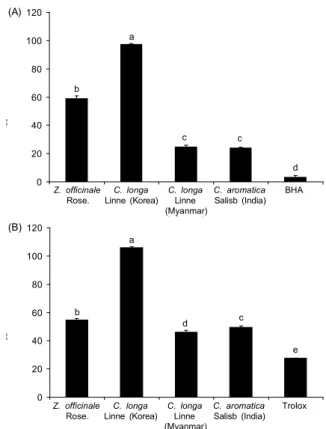
Fig. 1. RC
50values of the EtOH extracts from Zingiberaceae against DPPH (A) and ABTS (B) radicals. RC
50values are the concentrations required for 50% reduction of DPPH or ABTS radicals. The concentration unit of trolox was μM. Data represent mean±SD of three independent experiments. Values with differ- ent superscripts are significantly different (p<0.05).
히 미얀마산 울금에서는 curcumin을 약 100 μg/mg 함유하 고 있는 것으로 나타났다. Jeong 등(30)은 HPLC에 의한 인 도산 강황의 curcumin 함량 분석 시 초임계 추출물은 18.9 μ g/mg, 에탄올 추출물은 22.5 μg/mg, 열수추출물은 0.4 μg/
mg으로 보고하였다. 이 결과와 비교하면 미얀마산 울금이 curcumin을 상당히 많이 함유하고 있는 것을 알 수 있다.
총 폴리페놀 함량 측정
식품내의 지질이나 체내 생체막에 존재하는 지질은 활성 산소의 존재 하에 유리기와 연쇄반응을 일으켜 산화되어 식 품의 품질변화 및 생체노화의 원인이 되며(31), 이러한 산화 반응을 방지하기 위한 물질로 페놀성 화합물이 널리 이용되 고 있어(32,33) 추출물에 함유된 페놀성 화합물의 함량을 조 사하였다. 생강과 식물 ethanol 추출물에 존재하는 총 폴리 페놀 함량은 tannic acid를 기준물질로 하여 측정하였다 (Table 2). 그 결과, 미얀마산 울금과 인도산 강황에서 각각 약 98.4 μg/mg과 85.7 μg/mg으로 높은 폴리페놀 함량을 나 타냈으며, 국산 울금과 생강의 경우 42.5 μg/mg, 39.7 μg/mg 으로 각각 나타났다. Curcumin과 같은 페놀류 물질들은 식 물체에 독특한 색을 부여하며 산화반응을 억제하고 미생물 의 공격을 막아 식물 자체를 보호하며 식품 등에서는 고유한 맛에 관여한다(34). 미얀마산 울금에서 가장 높은 폴리페놀 함량을 보인 것은 이러한 curcumin을 가장 많이 함유하고 있기 때문인 것으로 사료된다.
DPPH radicals 소거활성
노인성 치매의 경우 신경세포의 사멸에 의한 것으로, 활성 산소의 산화적 스트레스에 의하여 뇌조직에서 지질과산화 의 증가, 단백질과 DNA 산화의 증가 및 신경세포 사멸 등에 의하여 유발된다고 보고 있다(35,36). 따라서 본 실험에서는 DPPH를 이용하여 라디칼 소거활성을 측정하였다. DPPH는 화학적으로 안정된 free radical을 가지고 있는 수용성 물질 로 ascorbic acid, tocopherol, polyhydroxy 방향족 화합물 등에 의해 환원되어 짙은 자색이 탈색되는데, 이것은 다양한 천연 소재로부터 항산화 물질을 검색하는데 많이 이용되고 있다(37). 본 실험에서는 4종의 생강과 식물의 ethanol 추출 물을 이용하여 합성 항산화제인 BHA의 항산화 효과를 DPPH의 소거활성을 측정하여 비교하였으며 그 결과는 Fig.
1에 나타내었다. Control인 ethanol을 100%로 할 때, DPPH
radical을 50% 소거하는 농도 RC
50은 생강 추출물이 59.1±
1.64 μg/mL로 나타났고, 국내산 울금 추출물의 경우 97.4±
0.64 μg/mL로 다소 낮은 라디칼 소거활성을 나타냈다. 반면 미얀마산 울금 추출물과 인도산 강황 추출물은 각각 25.0
± 0.91, 24.2±0.44 μg/mL로 강력한 라디칼 소거활성을 나타 냈다. Kang 등(38)은 DPPH에 대한 라디칼 소거활성은 페놀 산, 플라보노이드 및 페놀성 화합물에 의해 기인된다고 하였 으며, 본 실험에서도 총 폴리페놀 함량이 높은 미얀마산 울 금 및 인도산 강황에서 높은 라디칼 소거능을 나타내는 경향 을 보여, 이들의 라디칼 소거능은 생강과 4종 추출물 중에 함유되어 있는 페놀성 물질과 관련성이 있는 것으로 사료된 다. 한편, 국산 생강의 경우 총 폴리페놀 함량은 국산 강황과 비슷하였으나 라디칼 소거능은 이보다 높게 나타난 것은 강 력한 항산화제로 알려진 6-shogaol을 함유하고 있는 것에 기인한 것으로 사료된다.
ABTS radicals 소거활성
ABTS와 potassium persulfate를 암소에 방치하면 ABTS
anion이 생성되는데 추출물의 항산화력에 의해 ABTS anion
이 소거되어 radical 특유의 색인 청록색이 탈색된다. 이와
같이 ABTS anion 탈색반응은 이미 생성된 free radical의
제거 정도를 흡광도 값으로 나타내어 ABTS radical의 소거
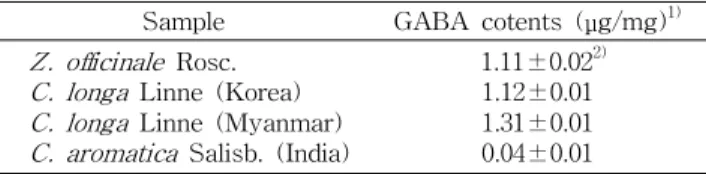
Table 3. GABA contents in the EtOH extracts from Zingiber- aceae
Sample GABA cotents (μg/mg)
1)Z. officinale Rosc.
C. longa Linne (Korea) C. longa Linne (Myanmar) C. aromatica Salisb. (India)
1.11±0.02
2)1.12±0.01 1.31±0.01 0.04±0.01
1)
Micrograms of GABA content/mg plants based on GABA as standard.
2)
Data represent mean±SD of three independent experiments.
Table 4. Inhibitory effects of the EtOH extracts from Zingi- beraceae on AChE activity
Sample Inhibitory activity (%) Z. officinale Rosc.
C. longa Linne (Korea) C. longa Linne (Myanmar) C. aromatica Salisb. (India)
7.08±5.82
b1)7.55±2.26
b52.95±5.58
a50.75±3.65
a1)
Data represent mean±SD of three independent experiments.
Values with different superscripts are significantly different between groups at p<0.05 by Duncan’s multiple comparison tests. Inhibitory activities were tested at 500 μg/mL of the samples.
활성을 측정하는 방법으로 ABTS anion 탈색반응이 1분 안 에 종료되므로 단시간에 측정할 수 있고, 소수성과 친수성 모두에 적용 가능하다(39).
본 실험에서는 생강과 4종의 추출물과 trolox의 ABTS radical의 소거활성을 측정하여 Fig. 1에 나타내었다. ABTS radical 소거활성 또한 DPPH radical 소거활성과 유사하게 국내산 울금 추출물의 경우 RC
50값이 105.9±0.74 μg/mL로 다소 낮은 radical 소거활성을 보였으며 생강, 미얀마산 울 금, 인도산 강황의 경우 54.6±0.95, 45.9±1.35, 49.3±1.18 μ g/mL로 높은 radical 소거활성을 나타내었다. DPPH radi- cal 소거활성이 ABTS radical 소거활성보다 높게 나온 경향 을 볼 수 있는데 이는 ABTS radical이 DPPH radical보다 좀 더 강력한 산화물질이기 때문인 것으로 사료된다(40).
GABA 함량 측정
비단백질 아미노산인 GABA는 뇌나 척추에 존재하는 신 경전달 물질로 혈류를 개선하며 뇌의 산소공급을 증가시켜 뇌의 대사촉진 및 뇌 기억을 증진시키는 뇌의 영양제로 알려 져 있다(41-43). 본 연구에서는 생강과 4종의 에탄올 추출물 을 대상 시료로 하여 γ-ABAT와 SSADH 두 효소로 이루 어진 GABase 효소를 이용하여 GABA 함량을 측정하였으 며, 그 결과는 Table 3에 나타내었다. 생강과 4종의 EtOH 추출물 중 인도산 강황 추출물이 0.04±0.01 μg/mg으로 다 소 낮은 GABA 함량을 보인 반면, 나머지 3종의 식물에서는 약 1 μg/mg 이상의 높은 함량을 나타내었다. 특히 미얀마산 울금에서 1.31±0.01 μg/mg으로 가장 높은 GABA 함량을 나타냈다. 이상의 결과로 GABA 함량과 생강과 식물의 라디 칼 소거능과는 상관성이 없는 것으로 사료된다.
AChE 저해 효과
체내의 신경전달물질 중 대표적인 신경전달물질인 ace- tylcholine은 acetyl CoA와 choline이 choline acetyltrase- ferase(ChAT) 효소의 작용을 받아 합성되며 이것은 다시 AChE 효소의 작용으로 acetate와 choline으로 분해된다. 따 라서 체내의 신경전달이 원활하게 이루어지려면 acetylcho- line에 영향을 미치는 ChAT와 AChE 효소의 활성이 매우 중요하다(44).
AChE 억제 활성을 500 μg/mL 농도에서 측정한 결과, 항 산화 효과가 높았던 미얀마산 울금과 인도산 강황 추출물에
서 각각 약 53%와 51%로 높게 나타났으며 국산 생강, 울금 추출물은 이 농도에서는 약 7%로 낮은 억제 효과를 나타내 었다(Table 4). Kim 등(20)은 340종의 생약재를 이용하여 100 μg/mL의 농도에서 AChE 저해 활성을 검색한 결과, 강 황이 약 17%, 울금이 약 35%의 AChE 저해 활성을 보인다고 보고하였으며, 본 실험에서도 이와 유사한 결과를 얻을 수 있었다. 또한 총 폴리페놀 함량과 라디칼 소거능이 높았던 미얀마산 울금과 인도산 강황 추출물에서만 AChE 저해 활 성을 나타내어 향후 항산화 활성 및 폴리페놀 함량과 AChE 억제 활성 간의 상관관계에 대해서 과학적으로 검증할 필요 성이 있다고 사료된다.
요 약
생강과 식물의 인지기능 관련 활성을 검토하고 종류와 산 지에 따른 차이를 비교하기 위하여, 시중에서 많이 사용되고 고품질로 알려져 있는 국산 생강과 울금, 미얀마산 울금과 인도산 강황의 항산화 효과, GABA 함량, 활성성분 분석, 그리고 AChE 억제 활성을 측정하였다. 미얀마산 울금 에탄 올추출물에서 총 폴리페놀(98 μg/mg), curcumin(97.1 μg/
mg), GABA 함량(1.31 μg/mg)이 가장 높았으며, DPPH, ABTS 라디칼 소거능 및 AChE 저해능도 비교적 높게 나타 났다. 한편, 인도산 강황 추출물도 미얀마산 울금과 비슷한 항산화 효과와 AChE 저해 효과가 나타났으나, curcumin (12.2 μg/mg)과 GABA(0.04 μg/mg) 함량은 매우 낮게 나타 났다. 국산 생강과 울금 추출물의 경우 총 폴리페놀 함량은 비슷하였으나(39.7~42.5 μg/mg) 6-gingerol, 6-shogaol 등 의 진저롤류를 함유하고 있는 생강 추출물에서 울금보다 높 은 라디칼 소거능, 특히 강한 ABTS 라디칼 소거능을 나타 내었으며, AChE 저해능은 두 추출물 모두 매우 낮은 것으로 나타났다. 국내산 2가지 추출물의 GABA 함량(약 1.11 μg/
mg)은 미얀마산 울금과 비슷한 정도로 높게 검출되어 라디
칼 소거능과 AChE 억제능은 GABA 함량과는 상관성이 없
었다. 따라서 본 실험에 사용한 4가지 생강과 식물 추출물의
AChE 억제능은 총 폴리페놀 함량과 밀접한 관계가 있으며,
curcumin 함량, 라디칼 소거능 및 GABA 함량과는 직접적
인 상관관계가 없는 것으로 나타났다. 이상의 결과와 같이,
미얀마산 울금은 나머지 추출물과 비교하여 높은 항산화 활 성과 curcumin 및 GABA 함량, 그리고 비교적 높은 AChE 저해활성을 갖는 강력한 인지능 개선 소재로 활용될 수 있을 것으로 사료된다.
감사의 글
이 논문은 2011년도 정부(교육과학기술부)의 재원으로 한 국연구재단의 기초연구사업(No.2011-0014190)과 지식경제 부(지역산업지원사업)(과제번호: A001100388)의 사업비를 지원 받아 연구되었음에 감사드립니다.
문 헌