오메가-3 지방산 함유 복분자종자유에 의한 고지방식이 유도 고지혈증 마우스의 혈중 중성지방 및 콜레스테롤 감소 효과
전혜린1․오수진2․남현수2․송윤석3․최경철1
1울산대학교의과대학
2(주)제이크린베리너리
3(재)전북생물산업진흥원
Reduction of Plasma Triglycerides and Cholesterol in High Fat Diet-Induced Hyper-Lipidemic Mice by n-3 Fatty Acid from Bokbunja
(Rubus coreanus Miquel) Seed Oil
Hyelin Jeon1, Su-Jin Oh2, Hyun Soo Nam2, Yoon Seok Song3, and Kyung-Chul Choi1
1Department of Biomedical Sciences, University of Ulsan College of Medicine
2JKberrynary
3Jeonbuk Institute for Bioindustry
ABSTRACT To investigate the effect of n-3 fatty acid from Bokbunja (Rubus coreanus Miq.) seed oil (BSO), we examined improvement of plasma triglycerides and cholesterol in vivo. Five-week-old ICR mice were divided into five groups of six mice each; Control, high fat diet (HFD) control (negative control), salmon oil control (positive control, HFD+commercial n-3 fatty acid), and BSO experimental groups (HFD+1 g/60 kg BW/d, HFD+2 g/60 kg BW/d). After 4 weeks of BSO treatment, we measured serum triglyceride and cholesterol levels. The levels of low-den- sity lipoprotein/very-low-density lipoprotein-cholesterol, high-density lipoprotein-cholesterol, and total cholesterol were significantly (P<0.05) reduced in the group fed BSO at 2 g/60 kg BW/d compared to the negative control. Levels of triglycerides, which are similar to cholesterol, were also significantly (P<0.05) reduced in the same group. To investigate further, we tested blood coagulation parameters. Prothrombin time (PT) and activated partial thromboplastin time (aPTT) were not significantly different among the five groups according to BSO. However, the 2 g/60 kg BW/d BSO group treated with PT and aPTT showed a tendency to live longer than the negative control. Taken together, BSO might improve blood homeostasis mediated via hypo-lipidemic and anti-coagulation activities.
Key words: Bokbunja seed oil, Rubus coreanus, hyper-lipidemia, blood flow improvement, omega-3
Received 25 March 2015; Accepted 10 April 2015
Corresponding author: Kyung-Chul Choi, Department of Biomed- ical Sciences, University of Ulsan College of Medicine, Seoul 138-736, Korea
E-mail: [email protected], Phone: +82-2-3010-2087
서 론
최근 식생활의 서구화와 더불어 생활의 편리화로 인해 섭 취하는 영양은 과다한 반면, 운동량은 적어져 대사성질환과 같은 선진국형 질병이 증가하고 있다(1-3). 2013년 우리나 라 사망원인통계에서 순환기계통질환 원인 사망자 수는 57,182명으로 21.5%를 차지했다(4). 순환기계통질환에 포 함되는 동맥경화증을 일으키는 주요 원인으로는 고지혈증 이 있는데(5,6), 이는 총콜레스테롤, 중성지방 등 혈액 내 지질의 농도가 비정상적으로 높은 상태를 말하며, 이러한 고지혈증에 의해서 혈액순환에 장애가 생길 수 있다(6-8).
이러한 대사성질환은 치료보다 예방이 중요한 질환으로 여 겨져 이를 위한 식이조절 및 식품의 기능성 탐구가 강조되고 있다.
그중에서도 오메가-3 지방산은 식품을 통해 공급받을 수 있는 필수지방산으로 eicosapentaenoic acid(EPA), do- cosahexaenoic acid(DHA)를 포함한다. EPA와 DHA의 전 구체인 α-linolenic acid(리놀렌산)를 섭취할 경우 체내에서 EPA와 DHA가 합성되기는 하지만 전환되는 효율이 낮기 때문에 EPA와 DHA가 풍부한 식품을 섭취하는 것이 더 좋 다고 알려져 있다(9-11). 여러 연구들에 의하면 오메가-3 지방산 등이 고지혈증 환자의 혈중 지방감소(12,13), 혈전 생성억제(14,15), 죽상동맥경화를 유발시킬 수 있는 플라크 생성억제(16,17), 혈관내피세포의 이완촉진(18,19) 등을 통해 혈액순환 개선에 도움을 주는 것으로 알려져 있다(20).
오표자(烏藨子), 대맥매(大麥莓), 삽전표(揷田藨), 재앙표 (裁秧藨)라고도 불리는 복분자는 장미과(Rosaceae)에 속하
는 낙엽관목으로 학명은 Rubus coreanus Miquel이며, 우 리나라 중부 이남의 산기슭 양지에서 자라는 식물로 흰 분으 로 덮인 줄기와 갈고리 모양의 가시가 특징이고 높이는 2~3 m 정도이다. 5~6월에 꽃이 피고 7~8월에 열매가 성숙되어 둥글고 붉은색으로 익다가 나중에 흑색으로 완숙된다 (21,22). 우리나라에서 복분자(覆盆子)라는 명칭은 한약재 로 사용되는 장미과 식물의 ‘복분자 딸기’와 ‘산딸기나무 딸 기’의 미성숙 종자를 말린 것을 총칭하는데,「동의보감」에 따르면 한방에서 강장(强壯), 강정(强精), 명목(明目), 이뇨 제의 효능이 있고, 빈뇨(頻尿)를 치료한다고 하여 약용으로 널리 쓰여 왔다.
우리나라에서 자생하는 복분자(Rubus coreanus Miq.) 는 열매의 성숙도에 따라 생리활성도가 달라지고(23), 열매, 잎, 줄기 부위에도 생리활성 효과가가 다르게 나타난다고 알려져 있다(24). 특히 열매의 생리활성 성분으로는 안토시 아닌과 다양한 폴리페놀 등이 보고되어 있다(25-27). 또한 그에 대한 생리활성 연구는 항암(21,28), 항산화(28-30), 면역(28,31,32), 골다공증(33), 항스트레스 및 콜레스테롤 과 혈압개선(24), 기억력감퇴 개선(27) 등에서 이루어졌다.
그러나 대부분의 연구는 복분자 열매의 과즙이나 잎, 열매 추출물을 이용한 것이며, 복분자종자유를 이용한 연구는 미 비한 실정이다. 복분자 열매의 과즙을 착즙하고 남은 복분자 슬러지를 이용해 착유과정을 거쳐 생산되는 복분자종자유 는 식물성 오일로 리놀레산(1.11 mg/g), 폴리페놀(0.68 mg/g), 플라보노이드(1.13 mg/g) 그리고 비타민 E(8.30 mg α-TE/100g)를 함유한다. 또한 오메가-3 지방산인 리 놀렌산과 오메가-6 지방산인 리놀레산이 풍부하고 감마리 놀렌산을 포함하는 것이 특징이며, 이를 통한 혈중 중성지방 과 콜레스테롤 수치의 개선이 가능할 것이라 예상하였다.
이뿐만 아니라 이러한 성분들은 대표적인 성인병인 비만, 당뇨 질환 개선에도 영향을 줄 것으로 예상되었다. 따라서 주스를 만들고 버려지는 복분자에서 분리된 씨로부터 얻을 수 있는 복분자종자유를 이용하여 콜레스테롤 및 중성지방 감소에 대한 기능성을 확인하고 이를 이용한 다양한 활용 방안을 모색하고자 연구를 수행하게 되었다.
재료 및 방법
복분자종자유의 공급
복분자종자유(Bokbunja seed oil; BSO)는 (주)제이크린 베리너리(Seoul, Korea)에서 공급받아 사용하였다. 복분자 종자유는 특허기술(특허등록번호: 10-1168169-0000)을 이용해 착유한 것이며, 간단히 서술하자면 다음과 같다. 복분 자 열매는 1차 착즙을 거쳐 과즙을 얻은 뒤 그 잔사를 압착기 에 넣고 농축액을 얻는 2차 착즙과정을 거친다. 2차 착즙까 지 거친 복분자 열매의 잔사는 체-진동기기에서 분리한 후 원심분리기(ADS-1003CS, Hanil SME, Anyang, Korea) 로 2,000~5,000 rpm, 10~30분간 씨만을 재분리하여 오일
러브형(OIL LOVE, Dasan FoodMachine, Siheung, Korea) 또는 익스펠라형(D-1680, Dasan FoodMachine) 착유기를 사용하여 80~150℃에서 5~40분간 압착, 착유하여 얻는다.
지방산 조성과 잔류농약 검사
식품의약품안전처로부터 식품위생검사 기관으로 지정된 한국기능식품연구원(Seongnam, Korea)에 의뢰하여 복분 자종자유의 지방산 분석 및 폴리페놀과 플라보노이드 분석, 그리고 잔류농약, 곰팡이 독소, 세균 수 및 대장균군 수 검사 를 실시했다.
동물사육
본 실험에서 사용된 고지혈증 모델은 ICR 마우스에 고지 방식이를 제공하여 고지혈증을 유도하는 모델로 5주령의 암 컷과 수컷 마우스(25±2 g)를 (주)중앙실험동물(Seoul, Ko- rea)로부터 공급받아 일주일 동안 안정기를 가진 뒤, 45%
fat 함량을 가지는 식이((주)중앙실험동물) 일정량과 식수를 충분히 공급하고 항온(25±2°C), 항습(50±5%), dark/light 12시간의 조건을 유지하였다. 총 4주간의 실험기간 동안 실 험동물에게 주어지는 복분자종자유는 각 군별로 경구 투여 되었고, 양성대조군은 시판되는 연어유(오메가-3 지방산) 가 경구 투여되었다. 이 실험은 서울아산병원 아산생명과학 연구원 실험동물연구실에서 동물실험윤리위원회의 승인(승 인번호: 2014-12-025)을 받아 진행되었으며, 실험기간 동 안 연구 지침을 준수하였다.
실험군은 마우스 6마리를 한 군으로 하여 정상대조군 (Normal control), 음성대조군(Negative control, 고지혈 증 유도군, high fat diet; HFD), 양성대조군(Positive con- trol, 고지혈증 유도 및 오메가-3 제공군, commercial n-3 fatty acid), 복분자종자유 급이군(고지혈증 유도 및 BSO 제공군, 1 g/60 kg BW/d(BSO 1 g), 2 g/60 kg BW/d(BSO 2 g))으로 하였고 마우스는 난괴법을 이용, 무작위로 배정되 었다.
정상대조군은 기본사료(normal chow)를 자율급식으로 제공하며 실험군과 같은 스트레스 강도를 주기 위해 경구 투여를 실시하였는데, 이때 투여물질은 0.5% carboxy- methyl cellulose(CMC) 용액으로 하였으며 연어유 및 복분 자종자유 급이군과 같은 부피를 주입하였다. 음성대조군은 45% fat을 함유하는 고지방식이를 자율급식으로 제공하며 마찬가지로 0.5% CMC 용액을 경구 투여하였다. 양성대조 군은 45% fat을 함유하는 고지방식이를 자율급식으로 제공 하며 시판되는 연어유(오메가-3 지방산)를 2 g/60 kg BW/
d가 되도록 경구 투여하였다. 마지막으로 복분자종자유를 제공하는 급이군 또한 45% fat을 함유하는 고지방식이를 자율급식으로 제공하며 각 군당 복분자종자유를 1 g/60 kg BW/d, 2 g/60 kg BW/d가 되도록 매일 경구 투여하였다.
실험이 시작된 이후 종료될 때까지 체중은 매주 2회 측정하 여 기록하였고, 식이섭취량 또한 일주일에 2회 측정하여 식
이효율을 산출하는 데 이용하였다.
식이효율 계산
매주 제공된 사료의 값에서 섭취 후 남은 사료의 값을 제 하여 각 군의 식이섭취량을 구하고 체중의 증가와 비교하여 식이효율을 산출해내었고 표로 나타내었다.
Food efficiency rate (FER)= weight gain (g) food intake (g)
혈액채취 및 장기무게 측정
실험 종료 시 Avertin(2,2,2-Tribromoethanol, Sigma- Aldrich Co., St. Louis, MO, USA)으로 전신 마취하여 안와 채혈방법을 통해 혈액을 채취하였고, 이는 3.8% sodium citrate(Sigma-Aldrich Co.)와 9:1의 비율로 섞어 혈액 응 고를 억제하였다. 개복하여 주요 장기의 변화가 있는지 확인 하고 주요 장기의 무게를 측정, 기록하도록 하여 군간 차이 가 있는지 확인하였다.
혈중 중성지방 및 콜레스테롤 측정
혈액은 1,500×g에서 원심분리(Sorvall™ Legend™ Micro 17 Micro centrifuge, Thermo Scientific Inc., Waltham, MA, USA) 하여 혈장을 분리해내었다. 혈구와 분리된 혈장 을 멸균된 튜브에 옮기고 혈중 중성지방과 콜레스테롤을 측 정하는 데에 이용하였다. 혈중 중성지방 측정은 Triglycer- ide colorimetric assay kit(Cayman, Ann Arbor, MI, USA)을 이용하였고, 콜레스테롤 측정은 EnzyChrom HDL and LDL/VLDL assay kit(Bioassay system, Hayward, CA, USA)을 이용해 각각의 실험을 진행하였으며, 각각의 흡광도는 SpectraMax 340PC384 Microplate Reader (Molecular Devices, Sunnyvale, CA, USA)로 측정하였다.
Prothrombin time(PT), activated partial thromboplastin time(aPTT) 측정
혈장을 이용하여 PT와 aPTT를 측정하였는데, PT 측정 에는 HemosIL RecombiPlasTin 2G(Instrumentation Lab- oratory, Orangeburg, NY, USA)를 이용하였고, aPTT는 APTT-SP-0020006300(Instrumentation Laboratory) 측 정 시약을 이용하여 실험하였는데, 시약과 혈장을 반응시켜 혈액응고측정기기인 ACL9000(Instrumentation Labora- tory)에 넣고 혈장이 응고되는 시간을 측정하여 결과 값을 표로 나타내었다.
통계처리
본 실험에서 얻어진 모든 분석 자료는 평균±표준오차 (mean±SE)로 나타내었으며, 군간 유의성 검증은 Student's t-test 분석법을 실시하여 P<0.05와 P<0.001 수준에서 검 증하였다.
결과 및 고찰
복분자종자유의 지방산 조성과 총 폴리페놀 및 플라보노이드 복분자종자유 조성 분석에서(Table 1) 오메가-6 지방산 인 linoleic acid(리놀레산)가 42.63%로 가장 높았으며, li- nolenic acid(리놀렌산)가 23.83%로 다음을 차지하였다.
이 리놀렌산은 오메가-3 지방산의 한 종류이며, EPA와 DHA의 전구체로 작용하여 체내에서 전환이 가능하다고 알 려져 있다(9-11). 지방산 조성을 분석한 결과 복분자종자유 에 EPA나 DHA는 거의 없지만, 전구체인 리놀렌산이 풍부 한 것을 확인하였다. 식물성 리놀렌산이 혈중 지질의 조성에 긍정적인 영향을 준다(34-36)는 연구 결과를 바탕으로 복 분자종자유가 혈중 중성지방 및 콜레스테롤 개선 기능성을 가질 것이라고 사료하였다. 또한 비타민 E(37-39)와 플라 보노이드, 폴리페놀류(40-43)가 혈액 내에서 강력한 항산 화제로써 기능한다는 연구와 플라보노이드에 의해 혈중지 질 개선의 효과를 가진다는 보고(44,45)가 있는데, 복분자 종자유에 함유된 비타민 E(8.3 mg α-TE/100 g)와 총폴리 페놀, 총플라보노이드가 혈중 콜레스테롤 산화 억제 및 개선 에 영향을 줄 것으로 기대되었다.
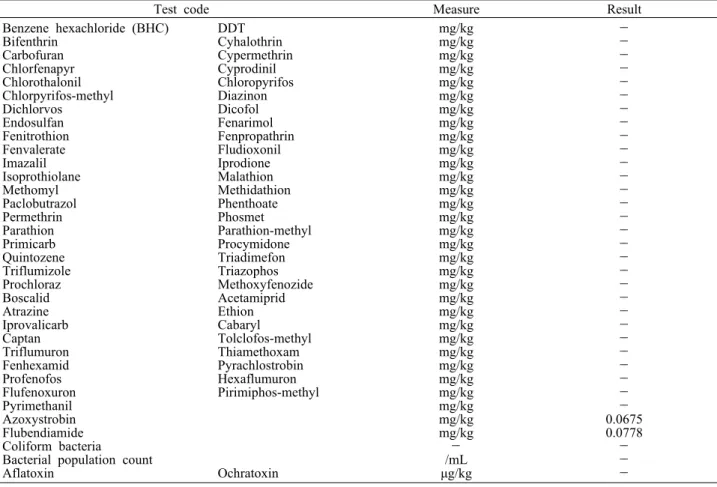
복분자종자유의 잔류농약, 곰팡이독소, 세균 및 중금속 검사 식품 내 잔류농약, 곰팡이독소, 세균 수 및 대장균군 수 검사를 실시하여 식용으로 적합한지 확인하였다. 이 복분자 종자유의 경우에는 Table 2의 결과와 같이 잔류농약 부분에 서 아족시스트로빈(azoxystrobin, 0.0675 mg/kg)과 플루 벤디아마이드(flubendiamide, 0.0778 mg/kg)만이 미량으 로 검출되었고 곰팡이독소(총 아플라톡신, 오크라톡신)와 대장균군, 세균은 검출되지 않았다. 식품의약품안전처가 발 표한「식품의 농약 잔류 허용기준」에 따르면 아족시스트 로빈은 복분자에서 3 mg/kg 미만으로 검출될 경우 식품으 로의 섭취가 가능하고, 플루벤디아마이드는 복분자에 대한 기준이 없으므로 ADI(잔류농약일일섭취허용량)를 따랐다.
플루벤디아마이드는 ADI가 0.0017 mg/kg BW/d로 60kg 의 사람이 섭취할 때 1.02 mg/60 kg BW/d 미만일 경우 식품 섭취가 가능하다. 따라서 복분자종자유는 식품으로 섭 취하는 데에 결격사유가 없으므로 동물이나 사람에 경구 투 여하여도 문제되지 않음을 확인하였다.
식이효율 및 체중 증가
Table 3의 결과와 같이 식이섭취량의 경우 각 군당 유의 적 차이가 나지 않는 반면에, weight gain과 식이효율(FER) 모두에서 음성대조군 대비 양성대조군과 BSO 2 g 급이군의 값이 유의적으로 감소(P<0.05)한 것을 확인하였다. Table 1에 따르면 복분자종자유는 공액리놀레산(CLA)이 1.11 mg/g, cis-9-, trans-11-CLA, trans-10-, cis-12-CLA 가 47.03% 포함되어 있는데, 기존의 연구 결과에 따르면 CLA는 에너지 소비를 증가시키고 체중 감소에 도움이 되는
Table 1. Fatty acid composition, total polyphenols, and flavonoids test certificate of the Bokbunja seed oil (BSO)
Test code Measure Result
Butyric acid Caproic acid Lauric acid Tridecanoic acid
cis-10-Penta decanoic acid cis-10-Hepta decanoic acid Eicosadienoic acid
cis-8,11,14-Eicosatrienoic acid cis-11,14,17-Eicosatrienoic acid Linoelaidic acid
Pentadecanoic acid Erucic acid Lignoceric acid Myristoleic acid Behenic acid Palmitic acid Palmitoleic acid Stearic acid Oleic acid Linoleic acid γ-Linolenic acid Linolenic acid Arachidic acid cis-11-Eicosenoic acid Vitamin D
Vitamin E
Conjugated linolenic acid (CLA)
cis-9-, trans-11-CLA, trans-10-, cis-12-CLA Total polyphenol
Total flavonoid Catechin
Capric acid Caprylic acid Myristic acid Undecanoic acid Heptadecanoic acid Elaidic acid Arachinoic acid Eicosapentaenoic acid Henicosanoic acid Docosadienoic acid Docohexaenoic acid Tricosanoic acid Nervonic acid
g/100 g g/100 g g/100 g g/100 g g/100 g g/100 g g/100 g g/100 g g/100 g g/100 g g/100 g g/100 g g/100 g g/100 g g/100 g g/100 g g/100 g g/100 g g/100 g g/100 g g/100 g g/100 g g/100 g g/100 g μg/100 g mg α-TE/100 g
mg/g% mg/gmg/g mg/g
-
-
-
-
-
-
-
-
-
-
-
-
-
- 0.14 2.09 0.08 0.80 7.95 42.63 0.08 23.83 0.28 0.18
- 8.30 1.11 47.03 0.68 1.13
-
Table 2. Residual insecticides, fungal toxins, bacterial counting, and coli form count inspection certificate of the Bokbunja seed oil (BSO)
Test code Measure Result
Benzene hexachloride (BHC) Bifenthrin
Carbofuran Chlorfenapyr Chlorothalonil Chlorpyrifos-methyl Dichlorvos
Endosulfan Fenitrothion Fenvalerate Imazalil Isoprothiolane Methomyl Paclobutrazol Permethrin Parathion Primicarb Quintozene Triflumizole Prochloraz Boscalid Atrazine Iprovalicarb Captan Triflumuron Fenhexamid Profenofos Flufenoxuron Pyrimethanil Azoxystrobin Flubendiamide Coliform bacteria
Bacterial population count Aflatoxin
DDTCyhalothrin Cypermethrin Cyprodinil Chloropyrifos Diazinon Dicofol Fenarimol Fenpropathrin Fludioxonil Iprodione Malathion Methidathion Phenthoate Phosmet Parathion-methyl Procymidone Triadimefon Triazophos Methoxyfenozide Acetamiprid Ethion Cabaryl
Tolclofos-methyl Thiamethoxam Pyrachlostrobin Hexaflumuron Pirimiphos-methyl
Ochratoxin
mg/kg mg/kg mg/kg mg/kg mg/kg mg/kg mg/kg mg/kg mg/kg mg/kg mg/kg mg/kg mg/kg mg/kg mg/kg mg/kg mg/kg mg/kg mg/kg mg/kg mg/kg mg/kg mg/kg mg/kg mg/kg mg/kg mg/kg mg/kg mg/kg mg/kg mg/kg
- μg/kg/mL
-
-
-
-
-
-
-
-
-
-
-
-
-
-
-
-
-
-
-
-
-
-
-
-
-
-
-
-
- 0.0675 0.0778
-
-
-
Table 3. Weight gain, food intake, and food efficiency rate of mice
Group Weight gain1) Food intake2) FER3)
Male
Normal control Negative control Positive control BSO 1 g/60 kg BW/d BSO 2 g/60 kg BW/d
9.45±1.20* 15.26±0.65###
11.42±1.31###,*
14.9±1.64# 13.6±0.56#,*
8.89±0.34 8.42±0.31 8.32±1.16 7.92±1.09 8.42±0.55
0.19±0.02* 0.34±0.05# 0.19±0.04* 0.32±0.05# 0.25±0.04#,*
Female
Normal control Negative control Positive control BSO 1 g/60 kg BW/d BSO 2 g/60 kg BW/d
8.29±0.61* 13.53±0.61###
9.42±0.69* 12.9±0.95###
11.4±1.27#,*
8.61±0.46 7.82±1.04 8.28±1.16 7.66±0.67 7.63±0.63
0.11±0.02* 0.26±0.04# 0.18±0.03#,*
0.28±0.02###
0.2±0.02###,*
1)Weight gain (g)=final body weight-start body weight.
2)Food intake (g)= food intake (g/week).
3)FER=weight gain (g/week)/ food intake (g/week).
Each results represents the mean±SE (n=6).
#P<0.05 and ###P<0.001 compared with the Normal control.
*P<0.05 compared with the Negative control.
Table 4. Average organ weight of each experiment group
Normal control Negative control Positive control BSO 1 g/
60 kg BW/d BSO 2 g/
60 kg BW/d Heart Male
Female
0.22±0.01 0.20±0.04
0.22±0.02 0.17±0.03
0.20±0.03 0.22±0.06
0.23±0.02 0.18±0.03
0.23±0.02 0.18±0.02 Liver Male
Female 2.42±0.23
1.84±0.04 2.21±0.07
1.94±0.08 1.97±0.10
1.81±0.28 2.61±0.24
2.12±0.49 2.55±0.32 1.91±0.28 Kidney Male
Female
0.75±0.11 0.47±0.06
0.68±0.05 0.45±0.06
0.58±0.05 0.53±0.04
0.66±0.02 0.56±0.02
0.62±0.07 0.47±0.03 Spleen Male
Female 0.14±0.02
0.19±0.03 0.15±0.04
0.17±0.04 0.17±0.02
0.25±0.05 0.19±0.05
0.21±0.05 0.16±0.02 0.15±0.04 Each results represents the mean±SE (n=6).
것으로 알려져 있다(46,47). 이러한 연구 결과를 바탕으로 복분자종자유에 포함된 CLA가 실험동물의 체중 감소와 식 이효율 저하에 영향을 미쳤을 것으로 여겨진다.
복분자종자유 섭취에 따른 장기무게
각 군당 장기의 무게(Table 4)는 유의적 차이가 나타나지 않았고 대조군과 실험군 사이에 어떤 해부학적인 이상 또한 나타나지 않았다. 고지혈증을 유도하기 위해 45% fat을 포 함하는 고지방식이를 섭취하도록 하였고 혈중 중성지방이 나 콜레스테롤의 수치가 비정상적으로 증가한 것을 통해 고 지혈증이 발병한 것을 확인하였으며 각 장기의 색깔이나 모 양이 정상대조군과 차이가 나지 않은 것도 확인하였다.
혈중 중성지방과 콜레스테롤 변화
Fig. 1은 수컷 마우스와 암컷 마우스의 혈중 중성지방을 각각 나타낸 그래프이다. 수컷과 암컷 마우스 모두에서 음성 대조군의 중성지방 농도가 정상대조군에 비해 유의적인 차 이(P<0.001)를 보이며 증가하는 것을 확인하였는데, 수컷 마우스의 정상대조군 혈중 중성지방은 90.69±4.21 mg/dL 인 것에 반해 음성대조군은 138.85±6.02 mg/dL로 정상대 조군보다 약 65.3% 높은 결과를 보였다. 또한 암컷 마우스
에서도 정상대조군의 혈중 중성지방은 89.19±4.60 mg/dL 이고 음성대조군에서는 136.72±5.86 mg/dL로, 음성대조군 이 정상대조군에 비해 65.2% 높은 것을 확인하였으며, 45%
fat diet를 통해 고지혈증이 유도되었다는 것을 알 수 있었 다. 고지혈증이 유도된 수컷 마우스는 양성대조군이 95.40±
8.99 mg/dL, BSO 2 g 급이군에서 97.24±4.58 mg/dL로 음성대조군 대비 각각 약 68.71%, 70% 수준으로 감소하며 유의적으로 감소(P<0.001)하는 것을 확인하였다. 그리고 특히 암컷 마우스의 경우에는 음성대조군에 대비하여 양성 대조군에서 90.80±7.21 mg/dL로 감소하여 음성대조군 대 비 66.4% 수준이 되었고, 복분자종자유 급이군 모두에서 (BSO 1 g은 93.5±3.46 mg/dL로 음성대조군 대비 68.3%
수준, BSO 2 g은 90.63±5.24 mg/dL로 음성대조군 대비 66.3% 수준) 유의적으로 중성지방이 감소(P<0.001)하는 것을 확인하였다.
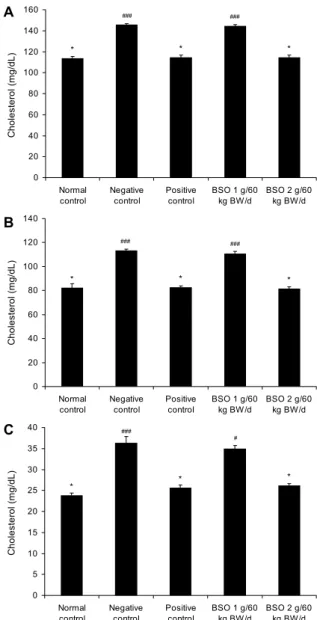
Fig. 2의 A, B, C는 수컷 마우스의 총콜레스테롤, HDL, LDL/VLDL-콜레스테롤의 수치를 그래프로 나타낸 결과이 다. 총콜레스테롤은 113.97±1.47 mg/dL에서 146.08±0.70 mg/dL로, HDL-콜레스테롤은 82.50±3.30 mg/dL에서 113.47±1.07 mg/dL로, LDL/VLDL-콜레스테롤은 23.86
±0.49 mg/dL에서 36.39±1.49 mg/dL로 증가함으로써 정
*
###
*
###
*
0 20 40 60 80 100 120 140 160
Normal control
Negative control
Positive control
BSO 1 g/60 kg BW/d
BSO 2 g/60 kg BW/d
Cholesterol (mg/dL) .
A
*
###
*
###
*
0 20 40 60 80 100 120 140
Normal control
Negative control
Positive control
BSO 1 g/60 kg BW/d
BSO 2 g/60 kg BW/d
Cholesterol (mg/dL) .
B
*
#
*
###
*
0 5 10 15 20 25 30 35 40
Normal control
Negative control
Positive control
BSO 1 g/60 kg BW/d
BSO 2 g/60 kg BW/d
Cholesterol (mg/dL) .
C
Fig. 2. Cholesterol of male ICR mice. (A) male's total cholester- ol, (B) male's HDL-cholesterol, (C) male's LDL/VLDL-choles- terol. Each bar represents the mean±SE of 6 mice. #P<0.05 and
###P<0.001 compared with the Normal control, *P<0.05 com- pared with the Negative control.
***
#
***
###
***
0 20 40 60 80 100 120 140 160
Normal control
Negative control
Positive control
BSO 1 g/60 kg BW/d
BSO 2 g/60 kg BW/d
Triglyceride (mg/dL) .
A
***
###
*** *** ***
0 20 40 60 80 100 120 140 160
Normal control
Negative control
Positive control
BSO 1 g/60 kg BW/d
BSO 2 g/60 kg BW/d
Triglyceride (mg/dL) .
B
Fig. 1. Triglycerides of ICR mice. (A) male's triglycerides, (B) female's triglycerides. Each bar represents the mean±SE of 6 mice. #P<0.05 and ###P<0.001 compared with the Normal control. ***P<0.001 compared with the Negative control.
상대조군에 비해 음성대조군의 수치가 유의적으로(P<0.001) 높아진 것을 확인하였다. 혈중 중성지방의 결과와 마찬가지 로 혈중 콜레스테롤 또한 음성대조군에 비하여 양성대조군 (총콜레스테롤은 114.78±1.94 mg/dL, HDL-콜레스테롤 은 82.75±1.04 mg/dL, LDL/VLDL-콜레스테롤은 25.62
±0.73 mg/dL)과 복분자종자유 급이군(BSO 2 g)(총콜레스 테롤은 114.61±2.35 mg/dL, HDL-콜레스테롤은 81.77±
1.37 mg/dL, LDL/VLDL-콜레스테롤은 26.22±0.39 mg/
dL)에서 유의적으로(P<0.05) 감소하는 결과를 얻었다. 그 래프의 경향을 분석해 보았을 때 HDL-콜레스테롤, LDL/
VLDL-콜레스테롤의 양 모두 변함으로써 총콜레스테롤 양 도 함께 변하게 된 것으로 생각된다. 양성대조군으로 사용된 시판되는 연어유와 복분자종자유(BSO 2 g)는 혈중 콜레스 테롤(총, HDL, LDL/VLDL)의 변화에 긍정적인 영향을 줄 수 있음을 확인하였다.
Fig. 3은 암컷 마우스의 총콜레스테롤 양과 HDL, LDL/
VLDL-콜레스테롤 수치를 그래프로 나타낸 결과로써 암컷 마우스도 수컷 마우스와 비슷한 결과가 도출되었다. 암컷 마 우스의 혈중 총콜레스테롤이 134.30±1.03 mg/dL로 정상 대조군 대비 약 79% 증가하였고 HDL-콜레스테롤은 110.29
±1.13 mg/dL로 정상대조군 대비 약 67.6%, LDL/VLDL- 콜레스테롤은 35.44±0.79 mg/dL로 정상대조군 대비 약 65.3% 증가함으로써 모두 정상대조군에 비해 음성대조군
의 수치가 유의적으로(P<0.001) 높아진 것을 확인하였다.
그에 반해 음성대조군에 비하여 양성대조군(총콜레스테롤 은 105.98±1.13 mg/dL, HDL-콜레스테롤은 76.75±1.66 mg/dL, LDL/VLDL-콜레스테롤은 25.2±0.88 mg/dL)과 복분자종자유 급이군(BSO 2 g)(총콜레스테롤은 103.73±
2.09 mg/dL, HDL-콜레스테롤은 77.80±1.7 mg/dL, LDL/
VLDL-콜레스테롤은 24.44±0.91 mg/dL)은 유의적으로 (P<0.05) 감소하는 결과를 얻었다. 수컷의 결과와 마찬가지 로 HDL-콜레스테롤, LDL/VLDL-콜레스테롤의 증감에 따 라 총콜레스테롤의 양 모두 변하게 된 것으로 생각되며 양성 대조군으로 사용된 시판 연어유와 복분자종자유(BSO 2 g) 는 수컷뿐만 아니라 암컷 마우스에서도 혈중 콜레스테롤 (총, HDL, LDL/VLDL)의 변화에 긍정적인 영향을 줄 수 있
0 5 10 15 20 25 30 35
Normal control
Negative control
Positive control
BSO 1 g/60 kg BW/d
BSO 2 g/60 kg BW/d
Time (s) .
PT aPTT n.s
A
0 5 10 15 20 25 30 35
Normal control
Negative control
Positive control
BSO 1 g/60 kg BW/d
BSO 2 g/60 kg BW/d
Time (s) .
PT aPTT n.s
B
Fig. 4. PT and aPTT of male and female. (A) male PT and aPTT, (B) female PT and aPTT. Each bar represents the mean±SE of 6 mice. NS: no significance.
*
###
*
###
*
0 20 40 60 80 100 120 140 160
Normal
control Negative
control Positive
control BSO 1 g/60
kg BW/d BSO 2 g/60 kg BW/d
Cholesterol (mg/dL) .
A
*
###
*
###
*
0 20 40 60 80 100 120
Normal control
Negative control
Positive control
BSO 1 g/60 kg BW/d
BSO 2 g/60 kg BW/d
Cholesterol (mg/dL) .
B
*
###
*
###
*
0 5 10 15 20 25 30 35 40
Normal
control Negative
control Positive
control BSO 1 g/60
kg BW/d BSO 2 g/60 kg BW/d
Cholesterol (mg/dL) .
C
Fig. 3. Cholesterol of female. (A) female's total-cholesterol, (B) female's HDL-cholesterol, (C) female's LDL/VLDL-cholesterol.
Each bar represents the mean±SE of 6 mice. #P<0.05 and
###P<0.001 compared with the Normal control, *P<0.05 com- pared with the Negative control.
음을 확인하였다. 이러한 결과는 복분자종자유 내에 포함되 어 있는 오메가-3 지방산뿐만 아니라 폴리페놀류와 플라보 노이드의 혈중지질 개선 효과에 의한 것으로 사료된다.
PT, aPTT 결과
Fig. 4에 나타낸 바와 같이 PT와 aPTT 모두에서 대조군 과 실험군 사이에 유의적인 차이는 나타나지 않았다. Fig.
4A는 수컷 마우스의 PT와 aPTT를 나타낸 그래프로 음성 대조군의 PT는 19.62±1.05초, aPTT는 28.73±0.74초로 정상대조군 대비하여 혈장응고시간이 각각 약 85.4%, 71.4
% 수준으로 감소하는 경향, 즉 혈액이 좀 더 빨리 굳는 경향 을 보인 반면에 양성대조군으로 사용된 시판 연어유나 복분 자종자유를 먹인 마우스의 PT는 각각 21.10±0.52초, 20.7
±0.23초, 21.15±0.39초로 혈장응고시간이 유의적으로 증 가하지는 않았다. 마찬가지로 aPTT 또한 각각 31.82±0.69 초, 30.72±1.12초, 31.93±0.54초로 음성대조군에 대비하 여 그 시간이 유의미하게 증가하지 않았다. 또한 Fig. 4B는 암컷 마우스의 PT와 aPTT 값을 나타낸 것으로 수컷 마우스 의 결과와 마찬가지로 음성대조군의 PT는 18.82±0.10초, aPTT는 28.17±1.20초로 정상대조군 대비하여 혈장응고 시간이 각각 약 90.1%, 88.7% 수준으로 감소하는 경향, 즉 혈액이 좀 더 빨리 굳는 경향을 보였다. 반면 양성대조군으 로 사용된 연어유나 복분자종자유를 먹인 마우스의 PT는 각각 20.10±1.55초, 19.97±0.18초, 20.68±0.98초로 혈 액응고시간이 유의적으로 증가하지는 않았으며, 마찬가지 로 aPTT 또한 각각 31.08±1.20초, 30.93±0.48초, 31.15
±0.74초로 음성대조군에 대비하여 혈장응고시간이 유의적 으로 증가하지 않았다. 이러한 실험 결과를 바탕으로 복분자 종자유의 섭취가 혈장응고시간 증가에 유의적 차이를 나타 내지 못하는 것으로 확인되었다.
지금까지의 결과에서 복분자종자유가 혈중 중성지방과 콜레스테롤의 수치를 낮추는 데에 긍정적 영향을 미치는 것 을 확인하였으나, 혈전 형성 억제 실험에 대해서는 유의적인 효과를 나타내지는 못하였다. 그러나 앞선 결과들을 종합해 본 결과 복분자종자유가 혈중 지방 수치에 미치는 긍정적인 영향에 의해 혈액순환 개선 가능성을 보일 것으로 사료되며, 실제로 혈전 형성 억제에 유의적인 영향을 미치는지에 대한
추후 연구가 필요할 것으로 여겨진다.
요 약
본 실험의 복분자종자유는 리놀렌산 238.3 mg/g, 리놀레산 과 감마리놀렌산 427.1 mg/g을 포함하며 이는 고시된 범위 내의 섭취량이므로 독성시험 없이 4주 동안 매일 경구 투여 로 암컷과 수컷 쥐 모두에게 섭취하도록 하였다. 또한 성인 정상체중을 약 60 kg으로 설정하고 60 kg의 성인이 하루 1 g, 2 g을 각각 섭취할 때의 혈중 지방의 감소 효과를 알아 보기 위해 급이군의 설정을 1 g/60 kg BW/d(BSO 1 g), 2 g/60 kg BW/d(BSO 2 g)로 정하였다. 양성대조군의 경우 에 판매되는 연어유 1,000 mg 캡슐을 2정 섭취하는 것을 권장하였고, 이에 맞추어 2 g/60 kg BW/d로 설정하게 되었 다. 실험기간 종료 후 마우스를 희생시켜 혈액을 얻었으며, 복분자종자유(BSO 2 g)를 섭취한 마우스에서 총콜레스테 롤 및 HDL, LDL/VLDL-콜레스테롤과 혈중 중성지방이 유 의적으로 감소하는 것을 확인할 수 있었다(P<0.05). 이를 종합해 보았을 때 복분자종자유는 고지혈증 상태를 개선하 고 미약하지만 항응고 활성을 통해 혈액의 항상성을 유지하 도록 돕는 작용을 한다고 할 수 있다. 따라서 앞으로 동물 유래가 아닌 식물유래 복분자종자유를 이용한다면 고지혈 증 개선 효과와 혈액 항응고 활성을 조절할 수 있을 것이며, 더욱 다양한 표적 인자 분석을 통하여 복분자종자유의 고지 혈, 항응고 및 혈행개선 기전연구가 가능할 것이라 판단된 다.
감사의 글
본 연구는 (재)호남광역경제권 선도산업육성사업 라이프케 어사업(과제번호:R0002192)의 일환으로 수행된 결과로 이 에 감사드립니다.
REFERENCES
1. Cho SH. 1994. Dietary lipid and atherosclerosis. J Korean Soc Food Nutr 23: 170-179.
2. Lee YS, Lee MY, Lee SY. 2014. The risk of metabolic syndrome by dietary patterns of middle-aged adults in Gyeonggi province. Korean J Community Nutr 19: 527-536.
3. Park YS, Park HJ, Won SI. 2011. Association of fatty acid intake and dyslipidemia in Korean adults: Korea national health and nutrition survey, 1998-2007. J East Asian Soc Dietary Life 21: 789-807.
4. Statistics Korea. 2014. 2013 cause of death statistics. Statis- tics Korea, Daejeon, Korea. p 4-43.
5. Hong SJ, Oh DJ, Kim EJ, Lee SJ, Shin SH, Choi JI, Choi CW, Park JS, Ahn JC, Park CG, Seo HS, Ro YM. 2003.
The comparison of serum lipid levels and risk factors ac- cording to the status of coronary atherosclerosis in Koreans.
Korean Circ J 33: 465-474.
6. Hwang WM, Bae JH, Kim KY, Synn YC. 2005. Impacts of atherosclerotic coronary risk factors on atherosclerotic
surrogates in patients with coronary artery disease. Korean Circ J 35: 131-139.
7. Chung HK, Shin MJ, Cha YJ, Lee KH. 2011. Effect of onion peel extracts on blood lipid profile and blood coagulation in high fat fed SD rats. Korean J Food & Nutr 24: 442-450.
8. Cheon JH, Lee JY, Kim JH, Park MH, Lee SH, Kong CS, Kim YY, Yu KH, Kim MH. 2015. Effects of fermented Saragassum thunbergii on platelet aggregation and serum lipid levels in obese rat induced by high fat diet. Journal of Life Science 25: 456-462.
9. Lim HJ, Cho KH, Choue R. 2005. The effects of functional tea (Mori Folium, Lycii Fructus, Chrysanthemi Flos, Zizyphi Fructus, Sesamum Semen, Raphani Semen) supplement with medical nutrition therapy on the blood lipid levels and anti- oxidant status in subjects with hyperlipidemia. J Korean Soc Food Sci Nutr 34: 42-56.
10. Lee MJ, Lee SJ, Choi HR, Lee JH, Jeong JT, Choi KM, Cha JD, Hwang SM, Park JH, Lee JH, Lee TB. 2014.
Cholesterol improvement effects of co-treatment with black raspberry and red ginseng extracts in mice fed a high choles- terol diet. J Korean Soc Food Sci Nutr 43: 1491-1499.
11. Sanders TAB, Lewis F, Slaughter S, Griffin BA, Griffin M, Davies I, Millward DJ, Cooper JA, Miller GJ. 2006. Effect of varying the ratio of n-6 to n-3 fatty acids by increasing the dietary intake of α-linolenic acid, eicosapentaenoic and docosahexaenoic acid, or both on fibrinogen and clotting factors Ⅶ and Ⅻ in persons aged 45-70 y: the OPTILIP study. Am J Clin Nutr 84: 513-522.
12. Lee SN, Park HK, Kim YE, Hwang IH, Huh BY. 1991.
Lipid-lowering effect of omega-3 fatty acid in patients with hypercholesterolemia. J Korean Acad Fam Med 12: 1-7.
13. Laidlaw M, Holub BJ. 2003. Effects of supplementation with fish oil-derived n-3 fatty acids and γ-linolenic acid on circu- lating plasma lipids and fatty acid profiles in women. Am J Clin Nutr 77: 37-42.
14. Robinson JG, Stone NJ. 2006. Antiatherosclerotic and antith- rombotic effects of omega-3 fatty acids. Am J Cardiol 98:
39-49.
15. Lovegrove JA, Lovegrove SS, Lesauvage SV, Brady LM, Saini N, Minihane AM, Williams CM. 2004. Moderate fish- oil supplementation reverses low-platelet, long-chain n-3 polyunsaturated fatty acid status and reduces plasma tri- acylglycerol concentrations in British Indo-Asians. Am J Clin Nutr 79: 974-982.
16. Thies F, Garry JM, Yaqoob P, Rerkasem K, Williams J, Shearman CP, Gallagher PJ, Calder PC, Grimble RF. 2003.
Association of n-3 polyunsaturated fatty acids with stability of atherosclerotic plaques: a randomised controlled trial.
Lancet 361: 477-485.
17. Djoussé L, Arnett DK, Carr JJ, Eckfeldt JH, Hopkins PN, Province MA, Ellison RC. 2005. Dietary linolenic acid is inversely associated with calcified atherosclerotic plaque in the coronary arteries: the National Heart, Lung, and Blood Institute Family Heart Study. Circulation 111: 2921-2926.
18. Lopez-Garcia E, Schulze MB, Manson JE, Meigs JB, Albert CM, Rifai N, Willett WC, Hu FB. 2004. Consumption of (n-3) fatty acids is related to plasma biomarkers of in- flammation and endothelial activation in women. J Nutr 134: 1806-1811.
19. Ambring A, Johansson M, Axelsen M, Gan L, Strandvik B, Friberg P. 2006. Mediterranean-inspired diet lowers the ratio of serum phospholipid n-6 to n-3 fatty acids, the number of leukocytes and platelets, and vascular endothelial growth factor in healthy subjects. Am J Clin Nutr 83: 575-581.
20. Jeong S, Kim JY, Paek JE, Kim J, Kwak JS, Kwon O. 2013.
Systematic review of the effect of omega-3 fatty acids on improvement of blood flow while focused on evaluation of claims for health functional food. J Nutr Health 46: 226- 238.
21. Jeon YH, Choi SW, Kim MR. 2009. Antimutagenic and cy- totoxic activity of ethanol and water extracts from Rubus coreanum. Korean J Food Cookery Sci 25: 379-386.
22. Kim MJ, Lee U, Kim SH, Chung HG. 2002. Variation of leaf, fruiting characteristics in Rubus coreanus Miq. Korean J Breed 34: 50-56.
23. Cha HS, Youn AR, Park PJ. Choi HR, Kim BS. 2007.
Comparison of physiological acvivities of Rubus coreanus and Miquel during maturation. J Korean Soc Food Sci Nutr 36: 683-688.
24. Lee MJ, Lee SJ, Choi HR, Lee JH, Kwon JW, Chae KS, Jeong JT, Lee TB. 2014. Improvement of cholesterol and blood pressure in fruit, leaf and stem extracts from black raspberry in vitro. Korean J Medicinal Crop Sci 22: 177- 187.
25. Ohtani K, Miyajima C, Takahasi T, Kasai R, Tanaka O, Hahn DR, Naruhashi N. 1990. A dimeric triterpene-glyco- side from Rubus coreanus. Phytochemistry 29: 3275-3280.
26. Kim YH, Kang SS. 1993. Triterpenoids from Rubus Fructus (Bogbunja). Arch Pharm Res 16: 109-113.
27. Choi MR, Lee MY, Kim JE, Hong JE, Jang K, Lee JY, Chun JW, Kim TH, Shin HK, Kim EJ. 2012. Rubus coreanus Miquel improves on impairment of memory in senescence- accelerated mouse (SAM). J Korean Soc Food Sci Nutr 41:
1253-1258.
28. Choung MG, Lim JD. 2012. Antioxidant, anticancer and immune activation of anthocyanin fraction from Rubus cor- eanus Miquel fruits (Bokbunja). Korean J Medicinal Crop Sci 20: 259-269.
29. Jeong HS, Han JG, Ha JH, Kim Y, Oh SH, Kim SS, Jeong MH, Choi GP, Park UY, Lee HY. 2009. Antioxidant activ- ities and skin-whitening effects of nano-encapsuled water extract from Rubus coreanus Miquel. Korean J Medicinal Crop Sci 17: 83-89.
30. Choe M, Shin GJ, Choi GP, Do JH, Kim JD. 2003. Syner- gistic effects of extracts from Korean red ginseng, Saururus chinensis (Lour.) Baill. and Rubus coreanus Miq. on anti- oxidative activities in rats. Korean J Medicinal Crop Sci 11: 148-154.
31. Won KS, Lee TW, Eun JS, Song JM. 2003. Effect of Rubus coreanus Miquel on the specific immune response in mice.
Korean J Oriental Physiology & Pathology 17: 656-661.
32. Kwon MC, Kim CH, Na CS, Kwak HG, Kim JC, Lee HY.
2007. Comparison of immuno-modulatory regulatory activ- ities of Rubus coreanus Miquel by ultra high pressure ex- tracts process. Korean J Medicinal Crop Sci 15: 398-404.
33. Shin H, Lee H. 2010. Effects of pharmacopuncture with RUBI FRUCTUS infusion solution at KI10 on osteoporotic rats induced by ovariectomy. The Journal of Korean Acu- puncture & Moxibustion Society 27: 99-114.
34. Karvonen HM, Aro A, Tapola NS, Salminen I, Uusitupa
MI, Sarkkinen ES. 2002. Effect of α-linolenic acid-rich Camelina sativa oil on serum fatty acid composition and serum lipids in hypercholesterolemic subjects. Metabolism 51: 1253-1260.
35. Zatonski W, Campos H, Willett W. 2008. Rapid declines in coronary heart disease mortality in Eastern Europe are associated with increased consumption of oils rich in al- pha-linolenic acid. Eur J Epidemiol 23: 3-10.
36. Ayerza R, Coates W. 2005. Ground chia seed and chia oil effects on plasma lipids and fatty acids in the rat. Nutrition Research 25: 995-1003.
37. Bae JH, Kim KB, Kim KS, Han SW, Kim YN, Park SY, Lee IK, Kim KY, Nam CW, Huh IS, Lee HJ, Lee SM.
1998. The effect of vitamin E on the endothelial function following a single high-fat meal in normal subjects, patients with coronary heart disease and patients with diabetes.
Korean Circulation J 28: 1538-1551.
38. Lim JY, Kim OH, Kim JH. 2006. Effects of antioxidant supplementation on lipid profiles in elderly women. Korean J Community Nutr 11: 133-142.
39. Lee CM. 2000. The effect of the administration of red gin- seng and vitamin E on the activation of antioxidizing en- zyme and the formation of lipid peroxidation in blood. The Korean Journal of Physical Education 39: 476-488.
40. Jo HJ, Kim JW, Yoon JA, Kim KI, Chung KH, Song BC, An JH. 2014. Antioxidant activities of Amarnth (Amaranthus spp. L.) flower extracts. Korean J Food & Nutr 27: 175-182.
41. Chung SH, Moon YJ, Kim SG, Kim KY, Lee KT, Kim HK, Whang WK. 2008. Isolation of flavonoids from Carthami flos and their antioxidative activity. Yakhak Hoeji 52: 241- 251.
42. Park S, Chae KS, Son RH, Jung J, Im Y, Kwon JW. 2012.
Quality characteristics and antioxidant activity of bokbunja (black raspberry) vinegars. Food Eng Prog 16: 340-346.
43. Lee JW, Do JH. 2000. Determination of total phenolic com- pounds from the fruit of Rubus coreanum and antioxidative activity. J Korean Soc Food Sci Nutr 29: 943-947.
44. Choi Y, Lee YJ, Lee S, Chae C, Park S, Kim SS, An H, King D, Han C, Hong H. 2012. Effect of concentrated Dangyooja-derived flavonoids extract added to citrus bever- age on obesity and blood lipids in rats. Kor J Hort Sci Technol 30: 214-219.
45. Lee SJ, Park HJ, Song Y, Jang SH, Goo AJ, Ko YG, Cho JH. 2014. Antioxidant activity and anti-obesity effect of Coprinus comatus in Zucker rat (fa/fa). Korean J Ver Serv 3: 51-58.
46. Terpstra AH, Beynen AC, Everts H, Kocsis S, Katan MB, Zock PL. 2002. The decrease in body fat in mice fed con- jugated linoleic acid is due to increases in energy expend- iture and energy loss in the excreta. J Nutr 132: 940-945.
47. Gaullier JM, Halse J, Høye K, Kristiansen K, Fagertun H, Vik H, Gudmundsen O. 2005. Supplementation with con- jugated linoleic acid for 24 months is well tolerated by and reduces body fat mass in healthy, overweight humans. J Nutr 135: 778-784.