1. INTRODUCTION
Many plants have bioactive components in their essential oils which consist of volatile and fragrant substances of plants (Guenther, 1948).
Natural essential oils are usually mixtures of terpenoids (mainly monoterpenoids and sesqui- terpenoids), aromatic and aliphatic compounds.
Essential oils can be used for fine fragrances, flavouring and aromatherapy. The most com-
mon collection methods of these oils are steam distillation, extraction with solvents, and expression.
The development of chromatographic techni- que has allowed considerable progress in the study of the chemical composition of essential oil.
Gas chromatography (GC) or gas chromatog- raphy-mass spectroscopy (GC-MS) are used for
Original Article
Essential Oil Analysis of Illicium anistum L. Extracts 1
Hee-Jeong Min
2⋅Chan-Soo Kim
3⋅Hwa-Ja Hyun
3⋅Young-Soo Bae
2,†ABSTRACT
Fresh japanese anise (Illicium anisatum L.) tree leaves were collected and ground after drying. The essential oils of the leaves were analyzed by gas chromatography-mass spectrometry (GC-MS) using headspace (HS) and solid phase-microextra (SPME) methods.
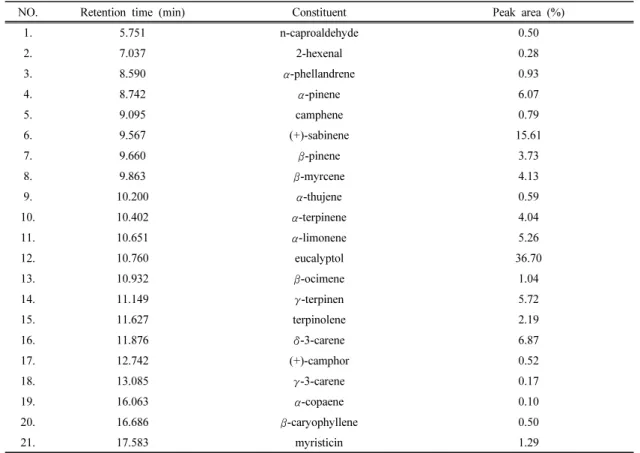
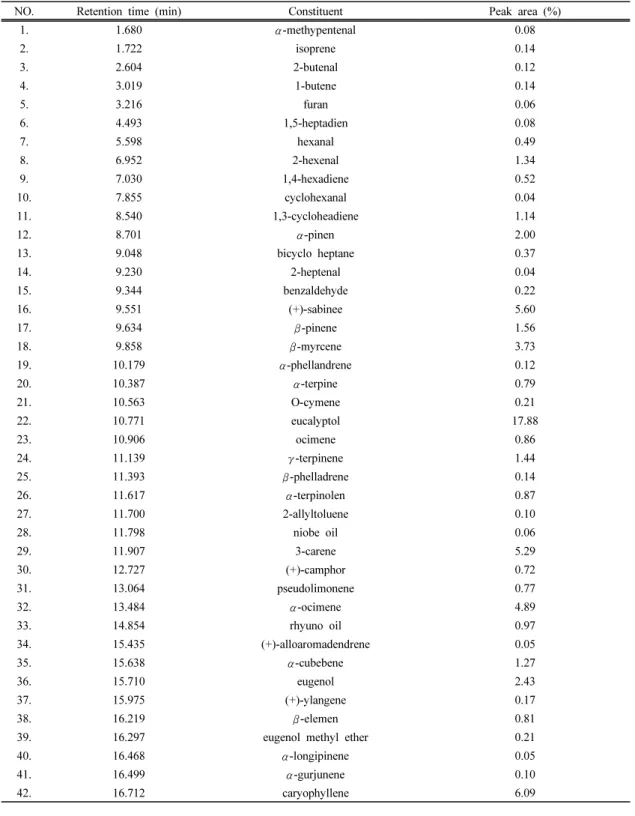
Volatile components of the leaves were identified 21 and 65 components in HS and SPME, respectively. The main components of the essential oils obtained by HS method were eucalyptol (36.7%), (+)-sabinene (15.61%), δ-3-carene (6.87%), α-pinene (6.07%), γ-terpinen (5.72%), α-limonene (5.26%), β-myrcene (4.13%), α-terpinene (4.04%) and β-pinene (3.73%). The other components were less than 3.5%. SPME method also showed that eu- calyptol (17.88%) was main. The other were 5-allyl-1-methoxy-2 (13.29%), caryophyllene (6.09%), (+)-sabinene (5.60%), α-ocimene (4.89%) and β-myrcene (3.73%), and the rest were less amounts than 3.5%. This work in- dicated that many more volatile components were isolated, comparing to the previous literature data and that SPME method was much more effective than HS method in the analysis of the volatile components.
Keywords : Japanese anise tree (llicium anisatum L.), volatile components, headspace, solid phase-microextra, GC-MS analysis
1
Date Received June 15, 2017, Date Accepted July 31, 2017
2
Department of Forest Biomaterials Engineering, College of Forest and Environmental Sciences, Kangwon National University, Chuncheon 24341, Republic of Korea
3
Warm and Subtropical Forest Research Center, National Institute of Forest Service, Seogwipo 63582, Republic of Korea
†