Research Article Open Access http://dx.doi.org/10.5423/RPD.2014.20.1.037
Research in Plant Disease
The Korean Society of Plant Pathology pISSN 1598-2262, eISSN 2233-9191
선충 억제 활성 식물 추출물의 선발
Screening of Plant Extracts for Nemastatic Activity
김동근1* · 류영현1 · 허창석1 · 류정아1 · 연일권1 · 이윤수2
1유기농업연구소, 2강원대학교 식물자원응용공학과
Donggeun Kim1*, Younghyun Ryu1, Changseok Huh1, Junga Ryu1, Ilkwon Yeon1 and Younsu Lee2
1Organic Agriculture Research Institute, Uiseong 769-803, Korea
2Department of Applied Plant Science, Kangwon National University, Chuncheon 200-701, Korea
A total of 2,714 methanol extracts of 1,677 plant species in 178 families were screened for nemastatic activity against Rhabditis sp. by 96-well microplate bioassay. The plant extracts with a concentration of 5,000 μg/ml were mixed with aqueous nematode solution containing about 20 Rhabditis sp. and their activity was exam- ined daily for 7 days. Out of 2,714 plant extracts examined in this test, 2,362 (87.0%) showed no negative influ- ence on the nematode activity, while 187 (6.9%) inhibited nematode activity about 50%, 95 (3.5%) inhibited nematode activity over 90%, and 70 (2.6%) rather enhanced nematode activity. Among those showing over 50% nemastatic activity, 25 extracts were randomly selected for further screening with Rhabditis sp. and with juveniles of Meloidogyne incognita. The screening revealed that 11 extracts (44%) were consistently nemas- tatic. The 282 extracts with nemastatic activity could be of use in future studies on nematicidal plants.
Keywords : Meloidogyne sp. Nematicidal, Nemastatic, Plant extracts, Rhabditis
서 론
2000년대에 들어와서 안전 농산물 생산에 대한 소비자의 요 구가 늘어나고 그동안 식물기생성선충 방제에 효과적으로 사 용되어왔던 많은 합성 살선충제(Aldicarb, DBCP, EDB, D-D, Methyl bromide 등)들이 인축 및 환경에 대한 고독성 문제로 등 록이 취소되면서, 이들 합성 살선충제를 대체할 수 있는 방안과 천연 살선충제 개발에 대한 연구가 증가하고 있다.
그동안 친환경적인 선충방제 연구의 일환으로 식물로부터 살선충 물질을 탐색하고자 하는 연구가 전 세계적으로 활발하 게 이루어졌다(Grewal, 1989; Siddiqui와 Alam, 1990; Verma 등, 1989; Whapham 등, 1994). 살선충 활성을 가진 식물의 예 로 인도의 Couroupita quianensis(포탄나무)와 Pentanema indicum(Pavaraj 등, 2012), Piper betle(후추류, Wiratno 등, 2009), 남아프리카의 Hippobromus pauciflorus와 Berchemia
zeyheri(McGaw 등, 2007), Ocimum sanctum와 O. basilicum(바 질류, Chatterjee 등, 1982), 일본 오키나와의 Bidens pilosa var.
radiata(흰도깨비바늘, Satoshi 등, 2008), 수단의 Cucumis melo var. agrestis와 Acacia nilotica(가시아카시아, Elbadri 등, 2008), 이스라엘의 Myrtus communis(은매화, Oka 등, 2012) 등이 있다.
전통적으로는 녹비 및 식물의 잔재물을 토양에 혼입하여 식 물기생성 선충을 방제하는 방법이 사용되어왔는데, 그 효과는 다양하며, 그중에서도 님(Melia azadirach), 아주까리(Ricinus conmunis), 만수국(Tagetes patula) 처리는 선충 방제에 효과적 이었고(Germani 등, 1983; Mojtahedi 등 1993; Prot 등, 1992), 반면에 유채종자, 갈퀴류, 수단그라스 처리는 효과가 불확실하 였다(Johnson 등, 1992; MacGuidwin와 Layne, 1995).
한의학에는 약 300종의 식물이 구충제로 등록되어있으며 (Huang, 1993; Perry, 1980), Ferris와 Zheng(1999)는 전통 한약 재 중에서 구충제로 사용되는 식물을 선별하여 선충 활성에 미 치는 영향을 시험하고 몇몇 한약제가 뿌리혹선충(Meloidogyne javanica)과 뿌리썩이선충(Pratylenchus vulnus) 활성을 억제한 다고 하였다.
*Corresponding author Tel : +82-54-832-9669 Fax: +82-54-833-1359 E-mail: [email protected]
Received February 11, 2014 Revised March 12, 2014 Accepted March 20, 2014 Email)
Received January 9, 2014 Revised February 28, 2014 Accepted March 11, 2014
살선충제 시험을 하기 위해서는 시험 기간 중 실험에 필요한 선충이 항상 안정적으로 공급될 수 있어야 한다. 식물기생성선 충은 순활물기생균으로 식물체에 직접 접종하여 배양해야함 으로 배양기간이 40-60일로 오래 걸리고 발육생태가 다양하 여 안정적인 선충 공급이 어렵다. 또한 식물기생성선충은 움직 임이 느리기 때문에 현미경으로는 살선충제의 영향을 받았는 지 아닌지를 판단하기가 어려운 점이 있다. 염색을 통하여 선충 의 생사를 판별하는 방법이 있지만(Moriarty, 1964) 이 방법은 신속하게 다량의 시료를 검토하기에는 적합하지 않다. 반면, 부 식성선충은 인공배지에서 쉽게 배양이 가능하고, 배양기간이 7-10일로 짧으며, 움직임이 활발하여 현미경하에서 살선충제 의 영향을 받았는지를 쉽게 판단할 수 있다. 부식성선충을 살선 충제 선발시험의 시험재료로 사용하기 위해서는 1) 살선충제 시험에 가장 적합한 선충 종과 2) 부식성선충을 이용한 살선충 제 선발 시험 결과와 식물기생성 선충을 이용한 시험 결과와의 일치성이 문제가 된다. Tarjan(1955)은 여러 종류의 선충을 이 용하여 살선충제 선발 시험을 수행하고 “모든 선충은 살선충제 에 비슷하게 반응한다”고 하였으며, Preiser(1962), McGaw 등 (2007)은 부식성선충을 이용하여 살선충제 선발 시험을 수행하 였다.
본 연구에서는 경북농업기술원 유기농업연구소와 한국식물 추출물은행에서 분리한 식물의 methanol 조추출물 2,714종을 수집하고 이들 조추출물이 선충에 미치는 영향을 검토하였다.
재료 및 방법
조추출물 확보. 건조된 식물체를 0.6 mm 이하로 분쇄하여 건조시료를 제조하고, 건조시료 100 g을 5 l 삼각플라스크에 넣 고 MeOH 2 l를 부어 실온에서 24시간 두었다가 Methanol 분획을 2장의 여과지(Whatman #1)를 이용하여 감압 여과하였다. 감압 여과된 Methanol 분획은 회전진공농축기(Buchi R-215)로 감압 농축하여 조추출물을 확보하였다. 한국식물추출물은행으로부 터 입수된 조추출물도 위와 유사한 과정을 거쳐 제조되었으며 총 2,714점의 조추출물을 확보하였다(Table 1).
부식선충 배양 및 분리. 부식성선충(Rhabditis sp.) 배양은 Kim 등(1997)의 방법을 이용하였다. 250 ml 용량의 삼각 플라스 크에 Nutrient broth 75 ml를 넣고 Escherichia coli를 2일 배양한 후, 20마리/ml의 부식성선충을 접종하여, 28oC, 150 rpm에서 6일간 배양하여 시험에 사용하였다. 필요시 Nutrient agar 배지 에 Escherichia coli와 부식선충을 접종하여 선충을 배양하고, 배 양된 선충은 Baermann 깔데기법으로 선충을 순수 분리하였다 (Southey, 1986). 분리된 부식성선충은 냉장고에 보관하면서 시 험에 사용하였다.
뿌리혹선충 유충 분리. 고구마뿌리혹선충(Meloidogyne
Table 1. Plant Family and number of species tested in this study Plant Family No. of plant species
Tested Nemastatic activitya
Acanthaceae 1 0
Aceraceae 16 9
Actinidiaceae 4 1
Agavaceae 1 0
Aizoaceae 3 0
Alangiaceae 1 0
Alismataceae 4 0
Amaranthaceae 9 0
Amaryllidaceae 10 0
Anacardiaceae 5 2
Apiaceae 4 1
Apocynaceae 2 0
Aquifoliaceae 8 1
Aracea 17 2
Araliaceae 15 2
Aristolochiaceae 4 1
Asclepiadaceae 3 0
Asparagaceae 1 0
Aspidaceae 25 6
Aspleniaceae 2 0
Asteraceae 9 2
Balsaminaceae 3 0
Begoniaceae 1 0
Berberidaceae 6 1
Betulaceae 15 7
Bignoniaceae 3 2
Boraginaceae 7 0
Brassicaceae 1 0
Buxaceae 2 1
Campanulaceae 11 0
Cannabinaceae 2 0
Cannaceae 1 0
Capparidaceae 1 0
Caprifoliaceae 28 3
Caryophyllaceae 25 0
Celastraceae 13 2
Ceratophyllaceae 1 1
Cercidiphyllaceae 1 0
Chenopodiaceae 14 0
Chloranthaceae 3 0
Commelinaceae 5 0
Compositae 155 6
Convolvulaceae 8 0
Cornaceae 7 5
aNemastatic activity : nematode movement decreased over 50% com- pared to control.
Table 1. Continued
Plant Family No. of plant species Tested Nemastatic activitya
Crassulaceae 14 5
Cruciferae 30 1
Cucurbitaceae 11 0
Cupressaceae 9 3
Cycadaceae 1 0
Cyperaceae 32 5
Davalliaceae 1 0
Dennstaedtiaceae 1 0
Dioscoreaceae 8 0
Dipsacaceae 1 0
Ebenaceae 2 1
Elaeagnaceae 4 0
Elaeocarpaceae 1 0
Empetraceae 1 1
Equisetaceae 3 0
Ericaceae 10 4
Eriocaulaceae 2 0
Eucommiaceae 1 0
Euphorbiaceae 24 9
Fabaceae 5 1
Fagaceae 14 1
Flacourtiaceae 2 0
Fumariaceae 8 0
Gentianaceae 5 0
Geraniaceae 8 4
Ginkgoaceae 1 1
Gleicheniaceae 2 0
Gramineae 74 1
Guttiferae 5 4
Haloragaceae 3 1
Hamamelidaceae 4 2
Hippocastanaceae 1 1
Hyacinthaceae 1 0
Hydrocaryaceae 2 1
Hydrocharitaceae 2 0
Illiciaceae 1 0
Iridaceae 13 2
Juglandaceae 3 1
Juncaceae 7 0
Labiatae 39 1
Lamiaceae 11 0
Lardizabalaceae 2 0
Lauraceae 13 3
Leguminosae 66 3
Lemnaceae 2 0
Table 1. Continued
Plant Family No. of plant species Tested Nemastatic activitya
Lentibulariaceae 1 0
Liliaceae 69 2
Linaceae 1 0
Lobeliaceae 2 0
Loganiaceae 1 0
Loranthaceae 4 0
Lycopodiaceae 4 0
Lythraceae 5 1
Magnoliaceae 12 3
Malvaceae 11 1
Marsileaceae 1 0
Meliaceae 2 1
Menispermaceae 4 0
Moraceae 13 5
Myricaceae 1 0
Myrsinaceae 3 1
Myrtaceae 1 1
Nyctaginaceae 1 0
Nymphaeaceae 5 2
Oleaceae 19 2
Onagraceae 9 4
Ophioglossaceae 1 0
Opuntiaceae 1 0
Orchidaceae 14 0
Orobanchaceae 2 0
Osmundaceae 1 0
Oxalidaceae 3 0
Paeoniaceae 2 1
Papaveraceae 6 2
Passifloraceae 1 0
Pedalidaceae 1 0
Phytolaccaceae 3 0
Pinaceae 15 7
Piperaceae 1 0
Pittosporaceae 1 0
Plantaginaceae 5 0
Platanaceae 1 0
Plumbaginaceae 1 0
Poaceae 3 0
Podocarpaceae 1 0
Polemoniaceae 2 0
Polygonaceae 41 14
Polypodiaceae 8 0
Pontederiaceae 3 0
Portulacaceae 2 0
incognita)이 심하게 감염된 참외 뿌리를 채집하고, 뿌리에 생긴 혹과 난랑으로부터 뿌리혹선충 유충을 분리하여 실험에 사용 하였다. 뿌리혹선충 유충의 분리는 Taylor와 Sasser(1978)의 방 법을 이용하였는데, 뿌리혹선충에 심하게 감염된 뿌리 100 g을 1% NaOCl 500 ml와 같이 넣고 믹서기를 이용하여 40초간 분쇄 하였다. 분쇄된 시료는 200 mesh 채에 부어 거친 찌꺼기를 걷 어내고, 500 mesh 채에 모았다. 500 mesh 채에 모인 시료는 다 시 Baermann 깔데기법으로 선충을 순수 분리하였다. 분리된 뿌리혹선충 유충은 냉장고에 보관하면서 시험에 사용하였다.
96-well microplate를 이용한 식물 조추출물 선발. 먼저 조추출물 0.1 g을 Ethanol 1 ml에 녹이고 이를 다시 증류수로 20배 희석하여(200배 희석) 시험에 사용하였다. 무처리는 조추 출물이 들어있지 않은 Ethanol을 동일 배율로 희석하였다. 선충 억제 활성 검정은 96-well microplate를 사용하였는데, 96-well microplate 홀에 조추출물 희석액 60 μl와 부식성선충 20마리 를 접종하였다(조추출물 시험 농도 5,000 μg/ml). 선충이 접종 된 96-well microplate는 건조를 방지하기 위하여 microplate 뚜껑을 덮고 비닐로 밀봉하여 25oC 항온기에 두었다. 접종된 96-well microplate는 해부현미경을 이용하여 1일 간격으로 1주일간 선충의 운동성을 관찰하였다.
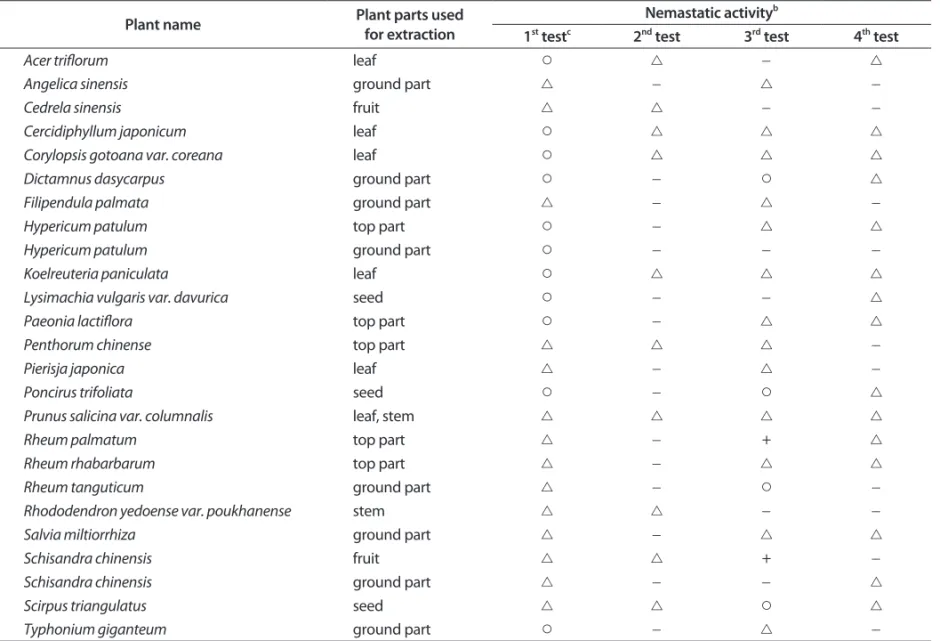
현미경 관찰 결과 조추출물이 부식성선충의 운동성에 전혀 영향을 주지 않는 시료는 -, 선충의 움직임이 약 50% 정도 억제 된 시료는 △, 선충의 움직임이 90% 이상 억제된 시료는 ○, 부 식성선충의 밀도가 증가된(성장, 산란, 유충 부화) 시료는 +로 표시하였다(+, - 시료 미제시) (Table 2 & 3).
선발된 조추출물을 이용한 재확인 시험. 96-well microplate 를 이용한 조추출물 선발 시험이 적절한지를 검토하기 위하여 1차 검정에서 선충의 움직임이 50% 이상 억제된(△ 혹은 ○) 시 료 중에서 임의로 25개의 추출물을 선택하여 2, 3, 4차 반복 시 험을 수행하였다. 재확인 시험은 1차와 동일한 방법으로 4차까 지 실시되었는데, 2차, 3차는 부식선충을 이용하였고, 4차 시험 은 식물기생성선충인 뿌리혹선충 유충을 이용하였다.
결과 및 고찰
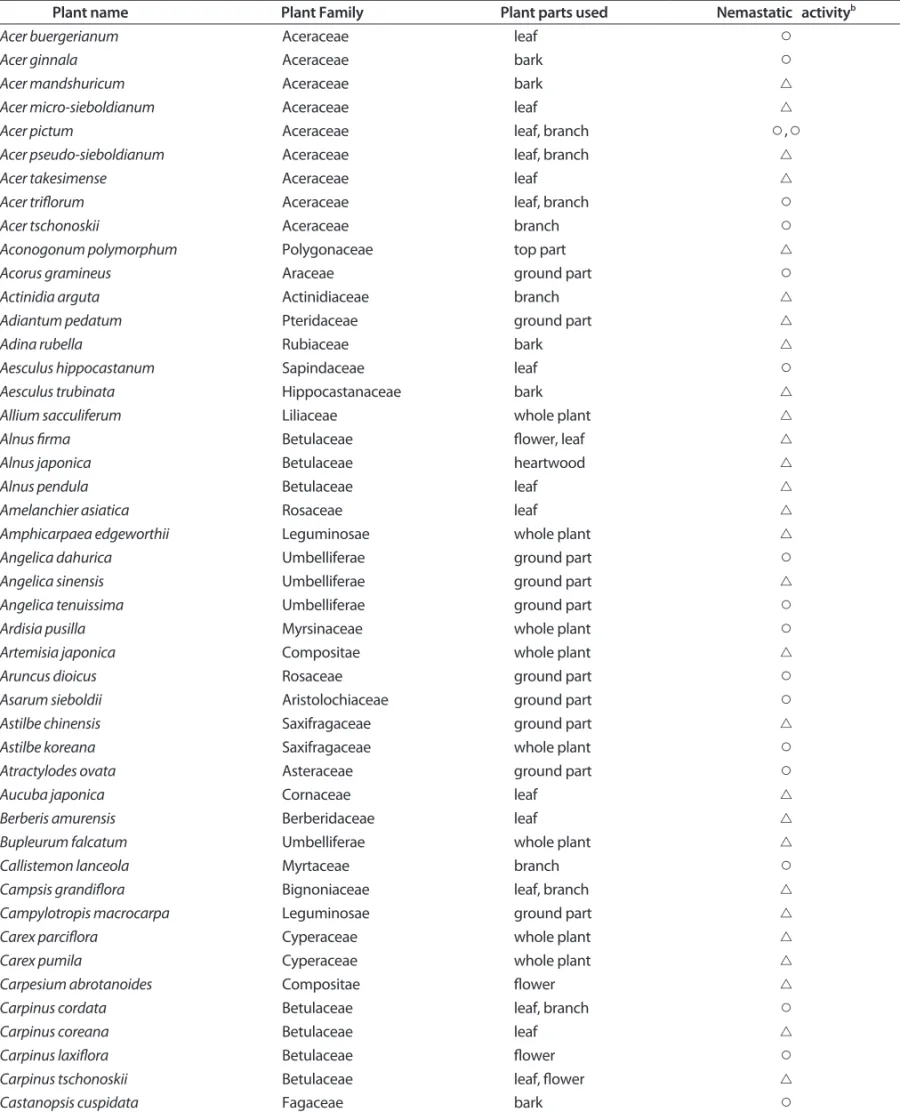
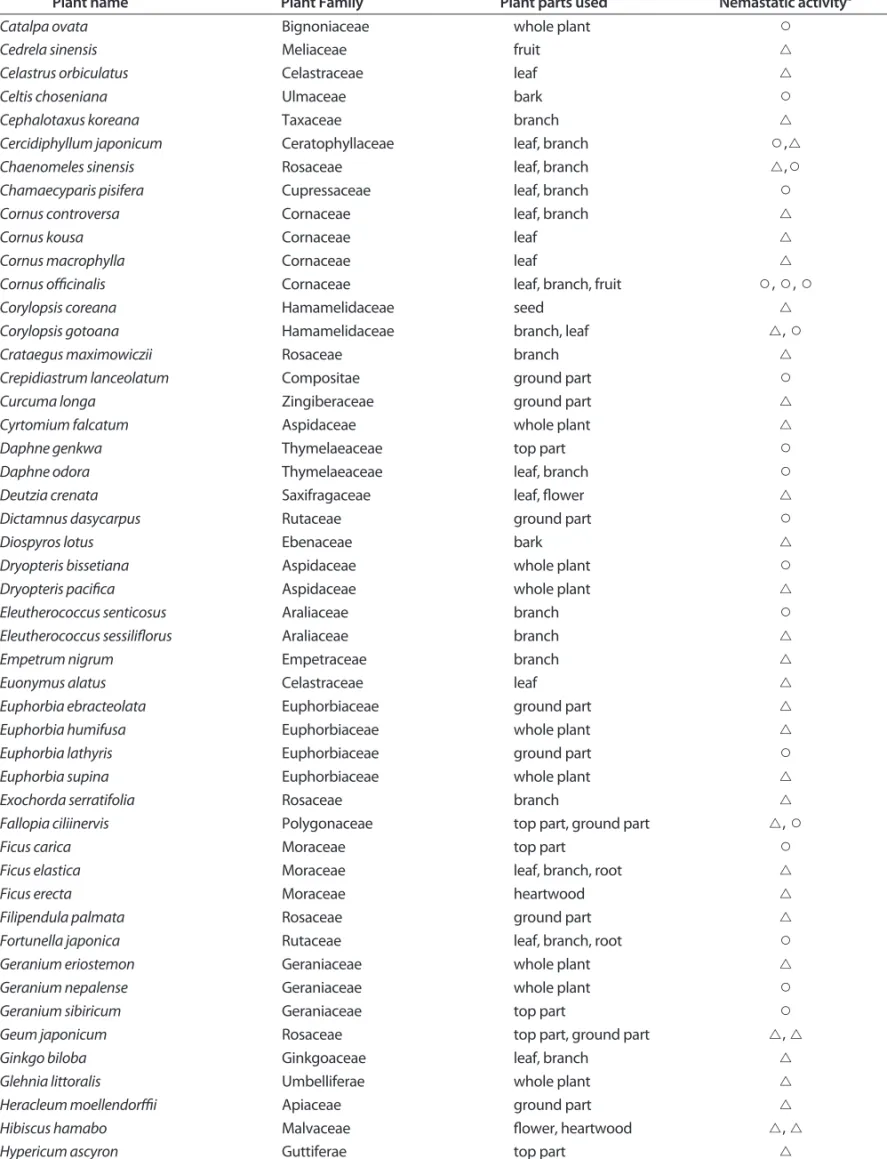
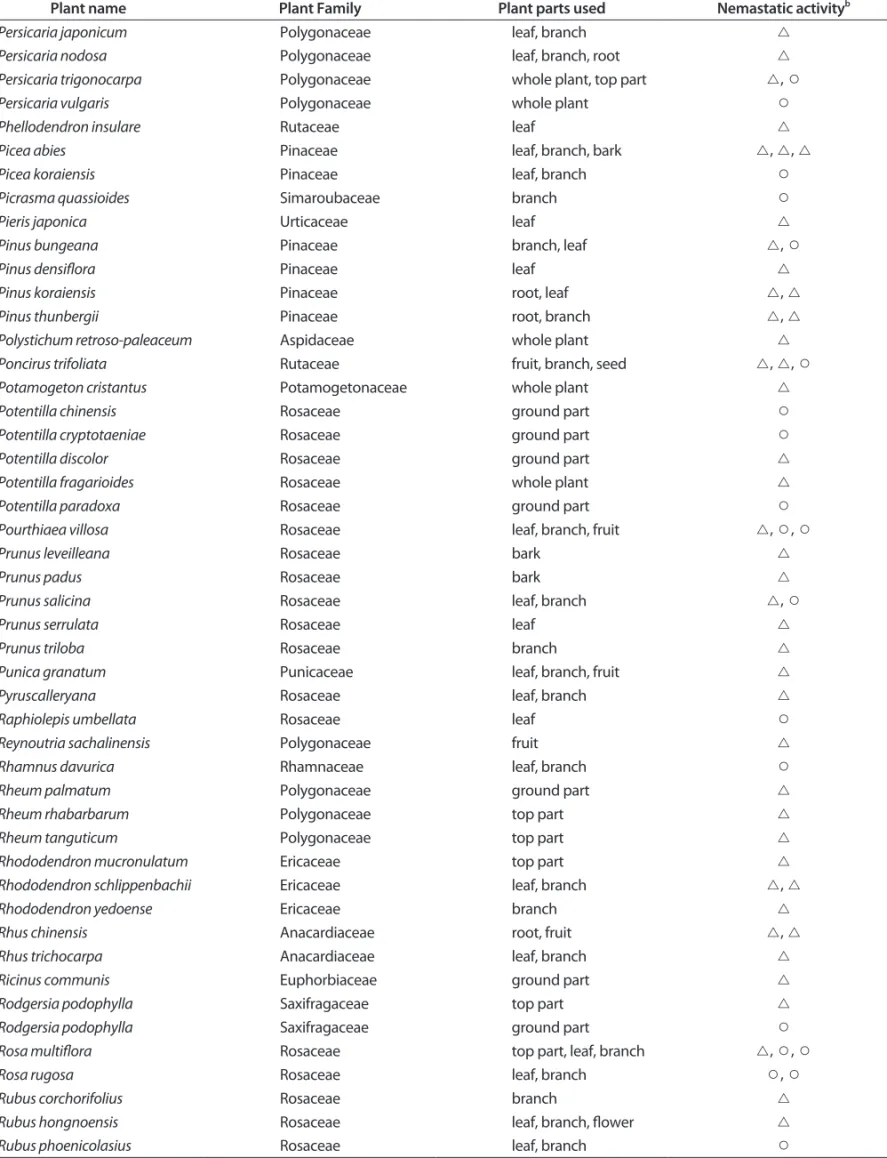
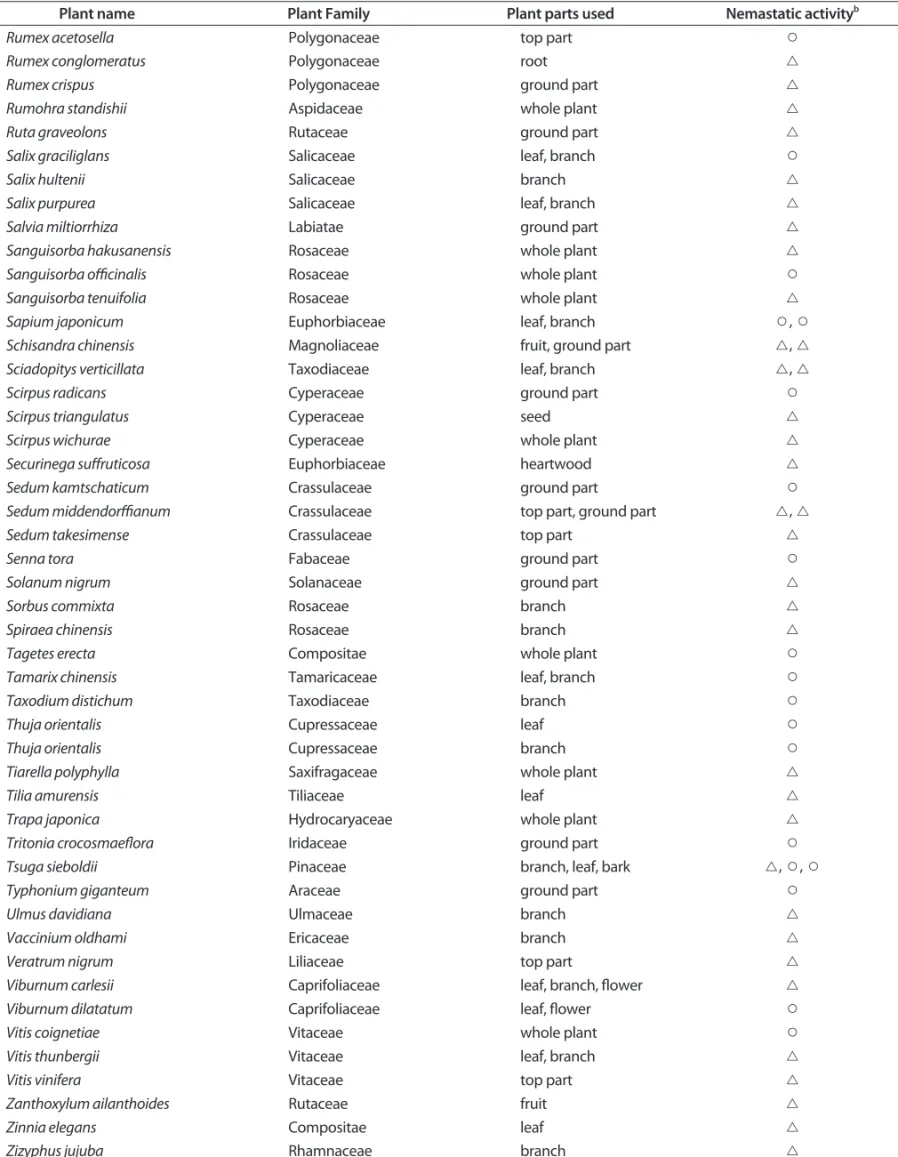
178과, 1,677종의 식물을 부위별로 나누어 제조된 총 2,714점 의 조추출물이 선충에 미치는 영향을 시험한 결과, 부식선충을 이용한 1차 시험에서 2,362종(87.0%)의 조추출물은 부식성선 충에 전혀 영향을 미치지 않았고, 187종(6.9%)의 조추출물은 부 식성선충의 활성을 약간 억제하였으며, 95종(3.5%)의 조추출물 은 현저한 억제를 보인 반면, 70종(2.6%)의 조추출물에서는 오 히려 부식성선충이 번식되는 것이 관찰되었다(Table 2).
국내 연구에서 Choi 등(2006)은 40종의 식물을 이용하여 소 나무재선충을 대상으로 96-well microplate bioassay를 실시하 Table 1. Continued
Plant Family No. of plant species Tested Nemastatic activitya
Potamogetonaceae 6 1
Primulaceae 11 2
Pteridaceae 9 1
Punicaceae 1 1
Pyrolaceae 1 0
Ranunculaceae 48 0
Rhamnaceae 8 2
Rosaceae 104 33
Rubiaceae 19 1
Rutaceae 17 6
Sabiaceae 2 1
Salicaceae 16 3
Salviniaceae 1 0
Santalaceae 1 0
Sapindaceae 4 2
Saururaceae 1 0
Saxifragaceae 30 7
Scheuchzeriaceae 1 0
Schizaeaceae 1 0
Scrophulariaceae 24 1
Selaginellaceae 3 0
Simaroubaceae 2 1
Solanaceae 19 2
Sparganiaceae 1 0
Staphyleaceae 2 0
Sterculiaceae 3 0
Styracaceae 2 0
Symplocaceae 4 0
Tamaricaceae 1 1
Taxaceae 4 1
Taxodiaceae 4 2
Theaceae 8 0
Thymelaeaceae 5 2
Tiliaceae 8 1
Typhaceae 2 0
Ulmaceae 10 2
Umbelliferae 39 5
Urticaceae 15 1
Valerianaceae 5 0
Verbenaceae 9 0
Violaceae 18 0
Vitaceae 8 3
Zingiberaceae 4 1
Zosteraceae 1 0
Total 1,677 241
Table 2. List of plant species showing nemastatic activitya
Plant name Plant Family Plant parts used Nemastatic activityb
Acer buergerianum Aceraceae leaf ○
Acer ginnala Aceraceae bark ○
Acer mandshuricum Aceraceae bark △
Acer micro-sieboldianum Aceraceae leaf △
Acer pictum Aceraceae leaf, branch ○,○
Acer pseudo-sieboldianum Aceraceae leaf, branch △
Acer takesimense Aceraceae leaf △
Acer triflorum Aceraceae leaf, branch ○
Acer tschonoskii Aceraceae branch ○
Aconogonum polymorphum Polygonaceae top part △
Acorus gramineus Araceae ground part ○
Actinidia arguta Actinidiaceae branch △
Adiantum pedatum Pteridaceae ground part △
Adina rubella Rubiaceae bark △
Aesculus hippocastanum Sapindaceae leaf ○
Aesculus trubinata Hippocastanaceae bark △
Allium sacculiferum Liliaceae whole plant △
Alnus firma Betulaceae flower, leaf △
Alnus japonica Betulaceae heartwood △
Alnus pendula Betulaceae leaf △
Amelanchier asiatica Rosaceae leaf △
Amphicarpaea edgeworthii Leguminosae whole plant △
Angelica dahurica Umbelliferae ground part ○
Angelica sinensis Umbelliferae ground part △
Angelica tenuissima Umbelliferae ground part ○
Ardisia pusilla Myrsinaceae whole plant ○
Artemisia japonica Compositae whole plant △
Aruncus dioicus Rosaceae ground part ○
Asarum sieboldii Aristolochiaceae ground part ○
Astilbe chinensis Saxifragaceae ground part △
Astilbe koreana Saxifragaceae whole plant ○
Atractylodes ovata Asteraceae ground part ○
Aucuba japonica Cornaceae leaf △
Berberis amurensis Berberidaceae leaf △
Bupleurum falcatum Umbelliferae whole plant △
Callistemon lanceola Myrtaceae branch ○
Campsis grandiflora Bignoniaceae leaf, branch △
Campylotropis macrocarpa Leguminosae ground part △
Carex parciflora Cyperaceae whole plant △
Carex pumila Cyperaceae whole plant △
Carpesium abrotanoides Compositae flower △
Carpinus cordata Betulaceae leaf, branch ○
Carpinus coreana Betulaceae leaf △
Carpinus laxiflora Betulaceae flower ○
Carpinus tschonoskii Betulaceae leaf, flower △
Castanopsis cuspidata Fagaceae bark ○
aTwenty Rhabditis sp. nematodes were inoculated in 96-well microplate containing 5,000 μg/ml of plant extract and observed daily for 7 days for their activity.
bNemastatic activity : △ = movement decreased 50%, ○ = movement decreased more than 90%.
Table 2. Continued
Plant name Plant Family Plant parts used Nemastatic activityb
Catalpa ovata Bignoniaceae whole plant ○
Cedrela sinensis Meliaceae fruit △
Celastrus orbiculatus Celastraceae leaf △
Celtis choseniana Ulmaceae bark ○
Cephalotaxus koreana Taxaceae branch △
Cercidiphyllum japonicum Ceratophyllaceae leaf, branch ○,△
Chaenomeles sinensis Rosaceae leaf, branch △,○
Chamaecyparis pisifera Cupressaceae leaf, branch ○
Cornus controversa Cornaceae leaf, branch △
Cornus kousa Cornaceae leaf △
Cornus macrophylla Cornaceae leaf △
Cornus officinalis Cornaceae leaf, branch, fruit ○, ○, ○
Corylopsis coreana Hamamelidaceae seed △
Corylopsis gotoana Hamamelidaceae branch, leaf △, ○
Crataegus maximowiczii Rosaceae branch △
Crepidiastrum lanceolatum Compositae ground part ○
Curcuma longa Zingiberaceae ground part △
Cyrtomium falcatum Aspidaceae whole plant △
Daphne genkwa Thymelaeaceae top part ○
Daphne odora Thymelaeaceae leaf, branch ○
Deutzia crenata Saxifragaceae leaf, flower △
Dictamnus dasycarpus Rutaceae ground part ○
Diospyros lotus Ebenaceae bark △
Dryopteris bissetiana Aspidaceae whole plant ○
Dryopteris pacifica Aspidaceae whole plant △
Eleutherococcus senticosus Araliaceae branch ○
Eleutherococcus sessiliflorus Araliaceae branch △
Empetrum nigrum Empetraceae branch △
Euonymus alatus Celastraceae leaf △
Euphorbia ebracteolata Euphorbiaceae ground part △
Euphorbia humifusa Euphorbiaceae whole plant △
Euphorbia lathyris Euphorbiaceae ground part ○
Euphorbia supina Euphorbiaceae whole plant △
Exochorda serratifolia Rosaceae branch △
Fallopia ciliinervis Polygonaceae top part, ground part △, ○
Ficus carica Moraceae top part ○
Ficus elastica Moraceae leaf, branch, root △
Ficus erecta Moraceae heartwood △
Filipendula palmata Rosaceae ground part △
Fortunella japonica Rutaceae leaf, branch, root ○
Geranium eriostemon Geraniaceae whole plant △
Geranium nepalense Geraniaceae whole plant ○
Geranium sibiricum Geraniaceae top part ○
Geum japonicum Rosaceae top part, ground part △, △
Ginkgo biloba Ginkgoaceae leaf, branch △
Glehnia littoralis Umbelliferae whole plant △
Heracleum moellendorffii Apiaceae ground part △
Hibiscus hamabo Malvaceae flower, heartwood △, △
Hypericum ascyron Guttiferae top part △
Table 2. Continued
Plant name Plant Family Plant parts used Nemastatic activityb
Hypericum oliganthum Guttiferae top part △
Hypericum patulum Guttiferae top part, ground part ○, ○
Ilex crenata Aquifoliaceae leaf △
Indigofera pseudotinctoria Leguminosae whole plant △
Inula helenium Compositae ground part △
Iris netschinskia Iridaceae seed △
Jasminum nudiforum Oleaceae leaf, branch △
Juglans mandshurica Juglandaceae branch, leaf △, ○
Juniperus virginiana Cupressaceae leaf, branch △
Kirengeshoma koreana Saxifragaceae root ○
Koelreuteria paniculata Sapindaceae leaf ○
Lagerstroemia indica Lythraceae leaf ○
Largerstroemia indica Lythraceae bark, heartwood △, △
Leibnitzia anandria Asteraceae ground part △
Lepidium ruderale Cruciferae whole plant △
Ligustrum quihoui Oleaceae leaf △
Lindera erythrocarpa Lauraceae branch △
Lindera glauca Lauraceae leaf △
Lindera obtusiloba Lauraceae flower ○
Liriodendron tulipifera Magnoliaceae branch △
Lonicera coreana Caprifoliaceae branch △
Ludwigia prostrata Onagraceae whole plant △
Lycopersicon esculentum Solanaceae whole plant △
Lysimachia clethroides Primulaceae whole plant △
Lysimachia vulgaris Primulaceae seed ○
Macleaya cordata Papaveraceae whole plant △
Magnolia liliiflora Magnoliaceae top part △
Mallotus japonicus Euphorbiaceae fruit, leaf, branch △, △, △
Malus baccata Rosaceae branch ○
Malus pumila Rosaceae leaf, branch △, △
Malus sieboldii Rosaceae bark ○
Mazus miquelii Scrophulariaceae whole plant △
Meliosma oldhamii Sabiaceae bark △
Morus alba Moraceae branch, ground part ○, ○
Morus bombycis Moraceae leaf, branch △
Mukdenia rossii Saxifragaceae top part ○
Myriophyllum verticillatum Haloragaceae whole plant △
Nuphar pumilium Nymphaeaceae whole plant △
Nymphaea tetragona Nymphaeaceae ground part ○
Oenothera laciniata Onagraceae whole plant △
Oenothera lamarckiana Onagraceae whole plant ○
Oenothera speciosa Onagraceae top part △
Onoclea sensibilis Aspidaceae ground part △
Pachysandra terminalis Buxaceae whole plant △
Paeonia lactiflora Paeoniaceae top part ○
Panicum dichotomiflorum Gramineae whole plant △
Papaver coreanum Papaveraceae whole plant ○
Pelargonium inquinans Geraniaceae whole plant △
Penthorum chinense Crassulaceae top part, ground part △, ○
Persicaria conspicua Polygonaceae whole plant △
Table 2. Continued
Plant name Plant Family Plant parts used Nemastatic activityb
Persicaria japonicum Polygonaceae leaf, branch △
Persicaria nodosa Polygonaceae leaf, branch, root △
Persicaria trigonocarpa Polygonaceae whole plant, top part △, ○
Persicaria vulgaris Polygonaceae whole plant ○
Phellodendron insulare Rutaceae leaf △
Picea abies Pinaceae leaf, branch, bark △, △, △
Picea koraiensis Pinaceae leaf, branch ○
Picrasma quassioides Simaroubaceae branch ○
Pieris japonica Urticaceae leaf △
Pinus bungeana Pinaceae branch, leaf △, ○
Pinus densiflora Pinaceae leaf △
Pinus koraiensis Pinaceae root, leaf △, △
Pinus thunbergii Pinaceae root, branch △, △
Polystichum retroso-paleaceum Aspidaceae whole plant △
Poncirus trifoliata Rutaceae fruit, branch, seed △, △, ○
Potamogeton cristantus Potamogetonaceae whole plant △
Potentilla chinensis Rosaceae ground part ○
Potentilla cryptotaeniae Rosaceae ground part ○
Potentilla discolor Rosaceae ground part △
Potentilla fragarioides Rosaceae whole plant △
Potentilla paradoxa Rosaceae ground part ○
Pourthiaea villosa Rosaceae leaf, branch, fruit △, ○, ○
Prunus leveilleana Rosaceae bark △
Prunus padus Rosaceae bark △
Prunus salicina Rosaceae leaf, branch △, ○
Prunus serrulata Rosaceae leaf △
Prunus triloba Rosaceae branch △
Punica granatum Punicaceae leaf, branch, fruit △
Pyruscalleryana Rosaceae leaf, branch △
Raphiolepis umbellata Rosaceae leaf ○
Reynoutria sachalinensis Polygonaceae fruit △
Rhamnus davurica Rhamnaceae leaf, branch ○
Rheum palmatum Polygonaceae ground part △
Rheum rhabarbarum Polygonaceae top part △
Rheum tanguticum Polygonaceae top part △
Rhododendron mucronulatum Ericaceae top part △
Rhododendron schlippenbachii Ericaceae leaf, branch △, △
Rhododendron yedoense Ericaceae branch △
Rhus chinensis Anacardiaceae root, fruit △, △
Rhus trichocarpa Anacardiaceae leaf, branch △
Ricinus communis Euphorbiaceae ground part △
Rodgersia podophylla Saxifragaceae top part △
Rodgersia podophylla Saxifragaceae ground part ○
Rosa multiflora Rosaceae top part, leaf, branch △, ○, ○
Rosa rugosa Rosaceae leaf, branch ○, ○
Rubus corchorifolius Rosaceae branch △
Rubus hongnoensis Rosaceae leaf, branch, flower △
Rubus phoenicolasius Rosaceae leaf, branch ○
Table 2. Continued
Plant name Plant Family Plant parts used Nemastatic activityb
Rumex acetosella Polygonaceae top part ○
Rumex conglomeratus Polygonaceae root △
Rumex crispus Polygonaceae ground part △
Rumohra standishii Aspidaceae whole plant △
Ruta graveolons Rutaceae ground part △
Salix graciliglans Salicaceae leaf, branch ○
Salix hultenii Salicaceae branch △
Salix purpurea Salicaceae leaf, branch △
Salvia miltiorrhiza Labiatae ground part △
Sanguisorba hakusanensis Rosaceae whole plant △
Sanguisorba officinalis Rosaceae whole plant ○
Sanguisorba tenuifolia Rosaceae whole plant △
Sapium japonicum Euphorbiaceae leaf, branch ○, ○
Schisandra chinensis Magnoliaceae fruit, ground part △, △
Sciadopitys verticillata Taxodiaceae leaf, branch △, △
Scirpus radicans Cyperaceae ground part ○
Scirpus triangulatus Cyperaceae seed △
Scirpus wichurae Cyperaceae whole plant △
Securinega suffruticosa Euphorbiaceae heartwood △
Sedum kamtschaticum Crassulaceae ground part ○
Sedum middendorffianum Crassulaceae top part, ground part △, △
Sedum takesimense Crassulaceae top part △
Senna tora Fabaceae ground part ○
Solanum nigrum Solanaceae ground part △
Sorbus commixta Rosaceae branch △
Spiraea chinensis Rosaceae branch △
Tagetes erecta Compositae whole plant ○
Tamarix chinensis Tamaricaceae leaf, branch ○
Taxodium distichum Taxodiaceae branch ○
Thuja orientalis Cupressaceae leaf ○
Thuja orientalis Cupressaceae branch ○
Tiarella polyphylla Saxifragaceae whole plant △
Tilia amurensis Tiliaceae leaf △
Trapa japonica Hydrocaryaceae whole plant △
Tritonia crocosmaeflora Iridaceae ground part ○
Tsuga sieboldii Pinaceae branch, leaf, bark △, ○, ○
Typhonium giganteum Araceae ground part ○
Ulmus davidiana Ulmaceae branch △
Vaccinium oldhami Ericaceae branch △
Veratrum nigrum Liliaceae top part △
Viburnum carlesii Caprifoliaceae leaf, branch, flower △
Viburnum dilatatum Caprifoliaceae leaf, flower ○
Vitis coignetiae Vitaceae whole plant ○
Vitis thunbergii Vitaceae leaf, branch △
Vitis vinifera Vitaceae top part △
Zanthoxylum ailanthoides Rutaceae fruit △
Zinnia elegans Compositae leaf △
Zizyphus jujuba Rhamnaceae branch △
고 석창포(Acorus gramineus), 족도리풀(Asiasarum sieboldi), 팔 각향(Illicium verum), 산내자(Kaempferia galanga)에서 살선충 작용을 보고하였다. 이번 연구에서도 석창포 지하부, 족도리풀 지하부 조추출물은 강한 선충억제 활성을 보여 Choi 등(2006) 의 연구와 동일한 결과를 보였다.
Kim 등(1998)은 만수국(Tagetes patula), 잔디(Zoysia japonica), 산검양옻나무(Rhus sylvestris), 붉나무(R. chinensis), 양파(Allium cepa) 추출액을 토양에 처리하면 뿌리혹선충(M. hapla)의 난랑 발생이 억제된다고 하였다. 이번 연구에서는 붉나무(R. chinensis) 뿌리, 열매에서 선충억제 활성이 있었다.
반면, Lim 등(2004)은 43종 식물의 Methanol 조추출물을 이 용하여 뿌리혹선충(Meloidogyne incognita)에 대한 억제 작용을 시험하고, 쇠비름(Portulaca oleracea), 쇠별꽃(Stellaria aquatica)의 조추출물에서 선충 억제활성이 있다고 하였으나, 이번 연구에
서는 모두 억제효과가 나타나지 않았다.
메리골드속(Tagetes) 식물은 선충에 면역성으로 알려져 있으 며 혼작, 윤작, 식물 잔재물 토양 혼입 등의 방법으로 선충 방제 에 이용되고 있다. 이번 시험에서는 천수국(Tagetes erecta), 만 수국아재비(T. minuta), 만수국(T. patula) 조추출물이 시험되었 는데, 천수국(T. erecta)에서만 강한 선충억제 활성이 인정되었다.
소리쟁이속(Rumex)에는 약 200종이 있는데 주요 성분은 oxalic acid, tannin으로 수렴작용이 있는 신맛이 나는 식물이다.
이번 시험에서 수영(Rumex acetosa), 애기수영(R. acetosella), 묵 밭소리쟁이(R. conglomeratus), 소리쟁이(R. crispus), 참소리쟁 이(R. japonica), 개대황(R. longifolius), 돌소루쟁이(R. obtusifolius) 등 7종이 시험되었는데, 이들 중 애기수영(R. acetosella) 지상부, 묵밭소리쟁이(R. conglomeratus) 뿌리, 소리쟁이(R. crispus) 뿌 리는 선충 억제 효과가 있었다.
Table 3. Nemastatic activity of the selected plant extractsa
Plant name Plant parts used
for extraction
Nemastatic activityb
1st testc 2nd test 3rd test 4th test
Acer triflorum leaf ○ △ - △
Angelica sinensis ground part △ - △ -
Cedrela sinensis fruit △ △ - -
Cercidiphyllum japonicum leaf ○ △ △ △
Corylopsis gotoana var. coreana leaf ○ △ △ △
Dictamnus dasycarpus ground part ○ - ○ △
Filipendula palmata ground part △ - △ -
Hypericum patulum top part ○ - △ △
Hypericum patulum ground part ○ - - -
Koelreuteria paniculata leaf ○ △ △ △
Lysimachia vulgaris var. davurica seed ○ - - △
Paeonia lactiflora top part ○ - △ △
Penthorum chinense top part △ △ △ -
Pierisja japonica leaf △ - △ -
Poncirus trifoliata seed ○ - ○ △
Prunus salicina var. columnalis leaf, stem △ △ △ △
Rheum palmatum top part △ - + △
Rheum rhabarbarum top part △ - △ △
Rheum tanguticum ground part △ - ○ -
Rhododendron yedoense var. poukhanense stem △ △ - -
Salvia miltiorrhiza ground part △ - △ △
Schisandra chinensis fruit △ △ + -
Schisandra chinensis ground part △ - - △
Scirpus triangulatus seed △ △ ○ △
Typhonium giganteum ground part ○ - △ -
a Twenty nematodes/species were inoculated in 96-well microplate containing 5,000 μg/ml of plant extract and observed daily for 7 days for their activity.
b Nemastatic activity : + = nematode numbers are increased, - = movement not influenced at all, △ = movement decreased 50%, ○ = movement decreased more than 90%.
c Nematode species : 1st, 2nd, 3rd test = Rhabditis sp., 4th test = Juveniles of Meloidogyne incognita.
본초강목, 동의보감, 민간에서 사용되는 구충제 중에서 이 번 연구에서 선충 억제 작용을 보인 것은 학명 순으로 구릿대 (Angelica dahurica) 지하부, 당귀(Angelica sinensis) 지하부, 족 도리풀(Asarum sieboldii) 지하부, 담배풀(학슬, Carpesium abro- tanoides) 꽃, 개오동(노나무, 재백피, Catalpa ovata), 개비자 (Cephalotaxus koreana) 줄기, 산수유(山茱萸, Cornus officinalis) 열매, 잎, 줄기, 야광나무(Crataegus maximowiczii) 줄기, 팥꽃나 무(패화, Daphne genkwa), 감(枾, Diospyros kaki) 나무 껍질, 담 배풀(Carpesium abrotanoides) 꽃, 목향(土木香, 황화채, Inula helenium) 지하부, 사과(Malus pumila) 잎, 줄기, 뽕나무(桑白皮, Morus alba) 줄기, 뿌리, 소태나무(고목, 苦木, Picrasma quassioides) 줄기, 피마자(Ricinus communis) 지하부, 소나무(백송, 반송, 잣 나무, Pinus spp.) 잎, 석류(금앵근, Punica granatum), 마가목(마 아목, 馬牙木, Sorbus commixta) 줄기, 느릅나무(무이, 蕪荑, Ulmus davidiana var. japonica) 줄기, 참여로(Veratrum nigrum) 지상부, 가막살나무(협미, Viburnum diatatum) 잎과 꽃 등이었 다. 이들 중 구릿대, 당귀, 족도리풀, 야광나무, 피마자, 마가목, 느릅나무, 참여로, 가막살나무는 Ferris와 Zheng(1999)의 시험 에서도 선충억제 효과를 보인 식물이다.
반면, 본초강목, 동의보감, 민간에서 사용되는 구충제 중에 서 이번 연구에서 선충 억제 작용이 없었던 것은 학명 순으로 짚신나물(용아초, 龍牙草; Agrimonia pilosa), 가죽나무(저근피, Ailanthus altissima), 자귀나무(합환피, Albizia julibrissin), 파(Al- lium fistulosum), 마늘(대산, Allium sativum), 산부추(산비, 山菲, Allium thumbergii), 황해쑥(Artemisia argyi), 약쑥(Artemisia prin- ceps), 천문동(Asparagus cochinchinensis), 동백(Camellia japoni- ca), 삼잎(Cannabis sativa), 명아주(Chenopodium album), 귤껍 질(진피, Citrus unshiu), 녹나무(장뇌향, Cinnamomum camphora), 호박(남과, 南瓜, Cucurbita moschata), 당근(Daucus carota), 술 패랭이꽃(Dianthus superbus), 관중(貫衆. 면마, 綿馬, 범고비, 호 랑고비, Dryopteris crassirhizoma), 용담(Gentiana scabra), 은행 (행인, Ginkgo biloba), 약모밀(Houttuynia cordata), 산박하(깻잎 나물, Isodon inflexus), 호두나무(추백피, Juglans sinensis), 수염 가래꽃(Lobelia chinensis), 구기자(Lycium chinense), 후박(Mach- ilus thunbergii), 멀구슬나무 껍질(고련피, 苦皮, Melia azedar- ach), 담배(Nicotiana tabacum), 볏짚(Oryza sativa), 고비(구척, 狗脊, Osmunda japonica), 덩이괭이밥(Oxalis articulata), 황벽 나무(Phellodendron amurense), 대나무 잎(Phyllostachys bam- busoides), 미국자리공(Phytolacca americana), 질경이(Plantago asiatica), 쇠비름(Portulaca oleracea), 복사나무(Prunus persica) 개구리자리(Ranunculus sceleratus), 옻나무(Rhus verniciflua), 소 리쟁이(Rumex crispus), 참소리쟁이(R. japonica), 돌소리쟁이(R.
obtusifolius), 무릇(Scilla scilloides), 고삼(너삼, 苦蔘, Sophora flavescens), 밀(Triticum aestivum), 산앵도(도이, 都李, Vaccinium koreanum), 순비기나무(만현, Vitex rotundifolia), 산초나무 열매 (조피나무, 분디나무, 천초, 川椒, Zanthoxylum schinifolium), 생
강(새양, 生薑, Zingiber officinale) 등이다. 이들 중 개구리자리, 구기자, 담배, 덩이괭이밥, 돌소리쟁이, 밀, 복사나무, 소리쟁이, 수염가래꽃, 쇠비름, 술패랭이꽃, 약모밀, 자귀나무, 질경이, 짚 신나물, 용담, 천문동, 파, 황해쑥 등은 Ferris와 Zheng(1999)의 시험에서는 선충억제 작용이 있다고 하였으나, 이번 시험에서 는 억제 작용이 나타나지 않았다. 시험재료 준비에서 Ferris와 Zheng(1999)는 물 추출물을 이용하였고, 이번 시험은 Methanol 추출물을 이용한 차이가 있다. 전통의 구충제 중에서 Table 1에 기재되지 않은 백부근, 황련, 비자, 빈랑, 사군자 등은 시험되지 않았다.
국내 선충 방제용 친환경제품 중에 주원료가 고삼인 제품 이 있다. 그러나 이번 시험에서 고삼 조추출물은 선충 억제 효 과가 없었으며, 고삼과 같은 속의 회화나무(Sophora japonica) 도 선충 억제 효과가 없었다. 고삼의 주요 성분은 matrine, oxy- matrine로 알려져 있는데, matrine, oxymatrine 성분을 이용한 시험에서도 선충 억제 작용은 없었다(Kim, D.G. 미발표결과).
회화나무속(Sophora)에는 45종이 있는데, 국내 종은 Sophora flavescens(고삼)로 생각되고 중국에는 Sophora tonkinensis, So- phora subprostrata, Sophora angustifolia(Narrowleaf Sophora), Sophora alopecuroides 종이 있다. 중국 Sophora속에 대한 추가 적인 검토가 필요하다.
사람이나 동물에 사용되는 구충제의 작용기작은 1) 근육마 비 작용을 일으키는 imidazothiazole levamisole, tetrahydro- pyrimidines pyrantel, morantel, pyrimidine methyridine, 2) 특히 산소가 부족한 상태에서 선충의 근육마비를 일으키는 piperazine, 3) 체강 근육마비 작용을 하는 avermectins, milbe- mycins, 4) 선충 미세소관 생성 억제작용을 하는 thiabendazole, mebendazole, 5) 선충의 arachidonic acid 대사작용을 방해하 는 diethylcarbamazine 등으로 나누는데, 일반적으로 사람이나 동물에 사용되는 구충제를 토양의 식물기생성선충 방제에 사 용하는 것은 약제의 토양내 분산 및 침투성 문제, 가격 등의 이 유로 직접적인 이용은 어렵다고 알려져 있다. 그러나 구충제 식 물의 녹비 재배나 식물 잔재물 토양 혼입 등을 통한 선충 방제 효과는 검토가 필요하다. 토양 처리가 아닌 주로 소나무에 처리 되는 소나무재선충 방제에는 avermectins이 이용되고 있다.
1차 검정에서 선충억제 활성을 보인 25개의 추출물을 선택하 여 2, 3, 4차 반복 시험을 수행한 결과, 계수나무 잎, 히어리 잎 등 12종 시료는 반복 시험에서도 지속적인 선충억제 활성을 보였 고, 복자기 등 13종 시료는 반복에 따라 선충억제 활성이 일정 하지 않아 재선발 효율은 약 4% 정도였다(Table 3). 이상의 결과 로 미루어, 부식성선충과 96-well microplate를 이용한 식물 조 추출물의 선충억제 활성 선발시험은 충분히 검토할 가치가있 으며 앞으로 식물 조출물물 선발시험에 활용될 수 있을 것으로 생각된다.
식물 조추출물의 선충억제 활성은 식물의 생육시기, 추출 용 매, 추출물 사용 농도 등에 따라 차이가 있을 수 있다. 이번 시험