서 론
키틴(chitin)은 N-acetylglucosamine (포도당 2번 탄소에 N- 아세틸이 붙어 있음)이 β(1,4) 결합된 다당류로서 곰팡이 의 세포벽, 무척추동물의 외골격, 큐티클, 난각 등의 주요 구성 성분으로 외부 환경으로부터 세포를 보호한다(Nag- pure 등, 2014; Sharp, 2013; Singh 등, 2014). 키틴은 지구상에 서 셀룰로오스 다음으로 풍부한 자원으로서 인간에게 여 러 유용한 용도로 활용되고, 자연계에서는 다양한 키틴분
해미생물들에 의해서 분해되어 재순환된다(Brzezinska 등, 2014; Sharp, 2013). 토양에서는 방선균의 45%–69%, 곰팡이 의 32%–40%가 키틴을 분해하고, 호수에서는 세균의 15%
정도가 키틴을 분해하여 탄소원과 질소원으로 이용한다 (Brzezinska 등, 2014).
키틴분해효소(chitinase)는 바이러스에서 인간까지 거의 모든 생물이 생산하는 것으로 알려져 있다. 이들 중에서 곤 충 병원성 바이러스, 생물적 방제 세균, 병원성 곰팡이들 의 키티나아제는 기주의 침입 및 분해에 중요한 역할을 하 고, 식물과 인간의 키티나아제는 병해충의 침입에 대한 방 어 역할을 한다(Hodgson 등, 2013; Rathore와 Gupta, 2015).
©The Korean Society of Plant Pathology
cc
This is an open access article distributed under the terms of the Creative Commons Attribution Non-Commercial License (http://creativecommons.org/ licens- es/by-nc/4.0/), which permits unrestricted non-commercial use, distribution, and reproduction in any medium, provided the original work is properly cited.
Open Access
Research in Plant Disease pISSN 1598-2262, eISSN 2233-9191 www.online-rpd.org
19
키틴분해세균의 현장 대량 배양방법을 이용한 효과적인 식물병의 생물적 방제 전략
An Effective and Practical Strategy for Biocontrol of Plant Diseases Using On-Site Mass Cultivation of Chitin-Degrading Bacteria
*Corresponding author Tel: +82-61-750-3864 Fax: +82-61-750-3208 E-mail: [email protected]
김영철
1
ㆍ강범용1
ㆍ김용환2
ㆍ박서기3
*1전남대학교 친환경농업연구소, 2단국대학교 식량생명공학과, 3순천대학교 식물의학과
Young-Cheol Kim 1 , Beom Ryong Kang 1 , Yong Hwan Kim 2 , and Seur Kee Park 3 *
1
Institute of Environmentally-Friendly Agriculture, Chonnam National University, Gwangju 61186, Korea
2
Department of Crop Science and Biotechnology, Dankook University, Cheonan 31116, Korea
3
Department of Plant Medicine, Sunchon National University, Suncheon 57922, Korea
Received February 8, 2017 Revised February 19, 2017 Accepted February 21, 2017
Recent worldwide demand for organic and sustainable agriculture products is driving the development of formulations of biopesticides effective in the field. Biopesticides have the benefit of environmentally-friendly qualities. However, biocontrol approaches largely have been ineffective in controlling plant pests in field conditions. Previously, we developed a cost-effective biocontrol formulation containing chitin and chitinase-producing biocontrol bacteria with field efficacy. This formulated product has successfully suppressed various plant diseases in the field conditions. In this review, we focus on ecological aspects and the potential mechanisms underpinning the success of chitinase-producing bacteria. In addition, we discuss the possibility on-site cultivation of the formulated products to further strengthen the approach as being farmer friendly and successful.
Keywords: Biocontrol, Biopesticide, Chitinase, Chitin-based bioformulated product
Mini-Review
다양한 생물로부터 분리된 키티나아제 유전자들은 유용미 생물 또는 직접 작물에 도입, 발현시켜서 식물 병해충 방제 효과를 높이려는 연구가 이루어졌고, 키틴분해미생물들을 이용한 생물적 방제와 그들의 억제 기작에 대한 연구들도 많이 이루어졌다(Brzezinska 등, 2014; Singh 등, 2014). 키틴 과 그의 분해산물들도 병해충 방제에 직접 또는 간접적으 로 역할을 하는 것으로 알려져 있다(Sharp, 2013). 따라서 키 틴과 키틴분해미생물들을 단독 또는 혼합 처리하여 생물 적 방제효과를 높이려는 연구가 많이 이루어졌다(Ahmed 등, 2003; Cretoiu 등, 2013; Giotis 등, 2009; Muymas 등, 2015;
Rajkumar 등, 2008).
본 리뷰 논문에서는 이들 키틴분해미생물을 활용하여 실 제 포장에서 효과적으로 식물병 생물적 방제에 활용되는 방법에 대해 소개하고자 한다. 식물병원균과 선충을 억제 하는 키틴분해세균의 종류와 그들의 억제 기작, 키틴과 키 틴분해세균을 이용한 생물적 방제 효과의 증대 방법과 이 들 방법을 이용하여 조제한 생물적방제원의 포장 실험 결 과를 기술하였다. 이들 키틴과 키틴분해미생물을 활용한 키틴 기반 제형이 실제 포장에서 효율적인 생물적 방제의 활용에 도움이 되기를 기대한다.
식물병 방제용 키틴분해세균
작물의 재배 토양, 근권, 엽권에는 다양한 키틴분해미생 물들이 존재한다. 한 연구에 의하면 토양으로부터 분리한 75개의 키틴분해미생물 중에서 세균이 51균주, 방선균이 13균주, 곰팡이가 11균주로 분리되었다(Divatar 등, 2016). 근 권에서는 Mitsuaria, Lysobacter, Serratia, Paenibacillus, Bacillus,
Erwinia, Aeromonas, Pseudomonas, Achromobacter, Flavobac- terium과 Microbacterium속 등의 키틴분해세균들이 주로 분
리되었다(Someya 등, 2011). 엽권에서는 주로 Pseudomonas,Clavibacter, Acinetobacter, Micrococcus, Brevundimonas, Bacillus, Stenotrophomonas와 Rhizobium속 키틴분해미생물들의 검
출 빈도가 높았다(Chernov 등, 2013).항균활성 키틴분해세균. 그람 음성의 키틴분해세균으 로서 토양에서 분리된 Alcaligenus xylosoxidans, Aeromonas
hydrophila SBK1과 Pseudomonas fluorescens PB27 등은 Rhizoc- tonia bataticola, Fusarium sp.와 Aspergillus flavus 등의 식물병
원균의 생육을 억제하였다(Akocak 등, 2015; Halder 등, 2013;Vaidya 등, 2001). Chromobacterium strain C-61은 Rhizoctonia
solani에 대한 in vitro 생육억제 능력이 높아 생물적 방제균
으로 활용되고 있다(Park 등, 1995). Lysobacter enzymogenes 는 토양, 근권, 엽권 모두에서 분리되고 strain에 따라 다 양한 식물병원균을 억제하였다. 즉, 토양에서 분리한 L.
enzymogenes strain LE429는 Phytophthora capsici, Fusarium oxysporum, Pythium aphanidermatum, R. solani 등에 항균 활
성을 보였고(Han 등, 2010), 오이 근권 분리균 strain 3.1T8은P. aphanidermatum에 강한 항균 활성을 보였다(Folman 등,
2003). 한편, 잔디 엽권 분리균인 strain C3은 R. solani, Bipolarissorokiniana, Uromyces appendiculatus, Fusarium graminearum
등이 일으키는 지상부의 병과 Magnaporthe poae, Pythiumultimum에 의한 토양병 발생을 억제했다(Giesler와 Yuen,
1998; Jochum 등, 2006; Kobayashi와 Yuen, 2005; Kobayashi 등, 2005; Sullivan 등, 2003; Yuen 등, 2001, 2003; Zhang과 Yuen, 1999). 키틴을 분해하는 Serratia속 중에서 S. marcescens는 주 로 엽권에서 분리되었는데, 토마토 잎에서 분리된 strain B2 는 R. solani, F. oxysporum, Botrytis cinerea 등의 토양병 또는 지상부병을 억제하였다(Akutsu 등, 1993; Someya 등, 2000, 2001, 2005). 땅콩 잎에서 분리된 strain GPS는 Phaeoisariopsispersonata, 땅콩 꼬투리로부터 분리한 strain JPP1은 Aspergil- lus parasiticus에 의해서 일어나는 지상부의 병을 억제하였
다(Kishore 등, 2005a; Wang 등, 2013). 한편, Serratia plymuthica 는 주로 토양과 근권에서 분리되었는데, B. cinerea, Sclero-tinia sclerotiorum, Verticillium dahlia, Phytophthora cactorum, R.
solani, Cladosporium sp.와 Alternaria alternata에 의해서 일어
나는 지상부병 또는 토양병들을 억제하였다(Jankiewicz와 Brzezinska, 2015; Kamensky 등, 2003; Kurze 등, 2001).식물병원균을 억제하는 그람 양성의 키틴분해세균으로 서 Bacillus속과 Paenibacillus속의 다양한 종이 보고되었다.
Bacillus속은 토양과 근권에서 분리되었는데, B. amyloliquefa- ciens, B. atrophaeus, B. cereus, B. licheniformis, B. pumilus, B. sub- tilis, B. thuringiensis 등의 다양한 종이 지상부와 토양의 여러
병을 억제하는 것으로 보고되었다(Azizah 등, 2015; Ghasemi 등, 2010; Hammami 등, 2013; Liu 등, 2010; Narasimhan와 Shi- vakumar, 2012; Reyes‐Ramírez 등, 2004; Shanmugam 등, 2013;Slimene 등, 2015). Paenibacillus속은 토양으로부터 분리된 P.
illinoisensis와 P. kribbensis가 지상부와 토양의 다양한 병원균
들을 억제하였다(Subbanna 등, 2016; Xu 등, 2014).살선충활성 키틴분해세균. 그람 음성 키틴분해세균 으로 Chromobacterium sp., Lysobacter sp., Pseudomonas sp., S.
plymuthica 등이 주로 선충을 억제하는 것으로 보고되었다.
토양으로부터 분리된 Chromobacterium sp.는 감자시스트
선충인 Globodera rostochiensis 알의 부화를 억제하고(Cronin 등, 1997), Pseudomonas chitinolytica는 뿌리혹선충인 Meloido-
gyne javanica 유충의 감염과 생존을 억제하였다(Spiegel 등,
1991). 근권으로부터 분리된 Pseudomonas sp.는 Trichodorusprimitivus에 대한 살선충 활성을 나타냈고(Insunza 등, 2002), S. plymuthica는 Meloidogyne ethiopica의 증식을 억제하였다
(Aballay 등, 2013). Lysobacter속에서는 토양으로부터 분리된L. enzymogenes가 G. rostochiensis 알의 부화를 억제하고, 근
권 분리균인 L. enzymogenes가 T. primitivus에 대한 살선충 능 력을 나타냈으며(Cronin 등, 1997; Insunza 등, 2002), 토양에 서 분리된 Lysobacter capsici YS1215가 Meloidogyne sp.에 대한 생물적 방제 활성을 나타냈다(Lee 등, 2013). 또한 엽권 분리 균인 L. enzymogenes C-3는 다양한 식물병 방제 능력뿐만 아 니라 선충에서도 Caenorhabditis elegans, Heterodera schachtii,M. javanica, Pratylenchus penetrans, Aphelenchoides fragariae
와 같은 다양한 종에 대해 살선충 능력을 보였다(Chen 등, 2006).선충 방제용 그람 양성의 키틴분해세균은 토양으로부 터 분리된 Bacillus속과 Paenibacillus속에서 보고되었는데,
Bacillus속에서는 B. pumilus L1이 뿌리혹선충인 Meloidogyne arenaria, B. licheniformis MH48이 소나무재선충인 Bursa- phelenchus xylophilus에 대해 살선충 효능을 보였다(Jeong
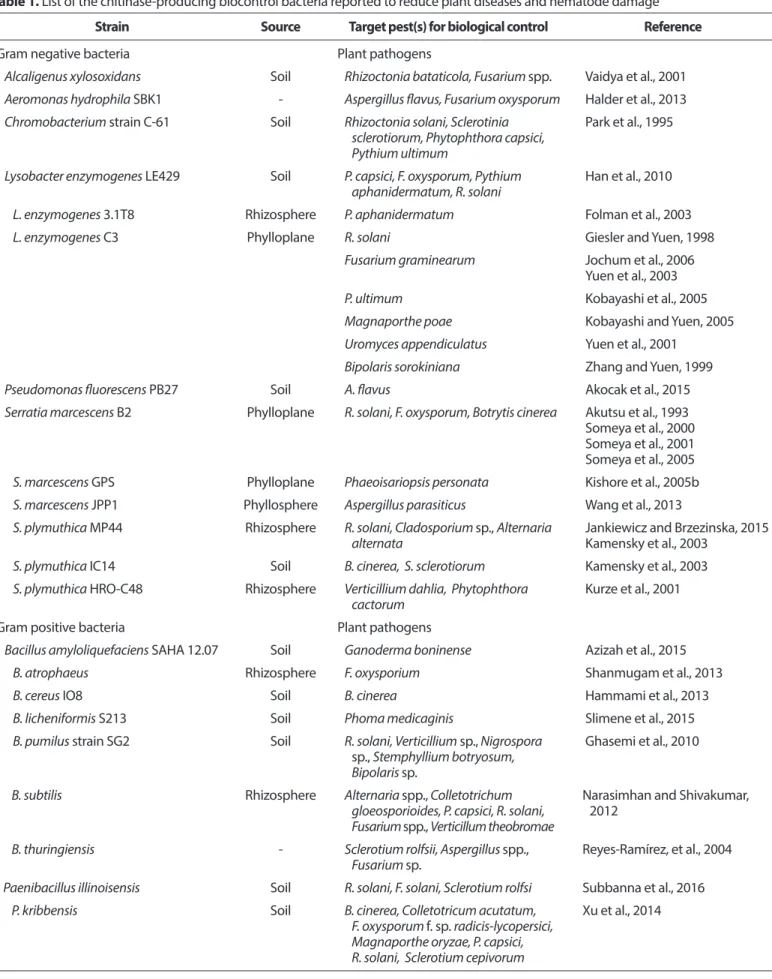
등, 2015; Lee 와 Kim, 2016). Paenibacillus속에서는 P. ehimensis RS820, P. elgii HOA73, P. illinoisis KJA-424, P. polymyxa GBR-1이 뿌리혹선충인 Meloidogyne spp.를 살선충하는 균주로 보고 되었다(Hong 등, 2013; Jung 등, 2002; Khan 등, 2008; Nguyen 등, 2013) (Table 1) .키틴과 키틴분해세균을 이용한 생물적 방제
키틴은 식물과 키틴분해세균들의 생육을 촉진하고, 키 틴분해산물(키틴 및 키토올리고당)은 병원균이나 선충을 직접 억제하기도 하고 식물에 저항성을 유도하기도 한다 (Sharp, 2013). 한편, 키틴분해세균들은 병원균이나 선충을 억제하는 다양한 물질을 생산하고, 식물에 저항성을 유도 하거나 식물의 생육을 촉진하는 경우도 있다(Brzezinska 등, 2014; Nagpure 등, 2014; Singh 등, 2014). 따라서 키틴 단독 또 는 키틴분해미생물과 혼합 처리하여 식물병의 방제 효과 를 높이려는 보고가 많다.
키틴 단독 또는 키틴분해세균과의 혼합 처리에 의 한 식물병 방제. 토양에 키틴을 처리함으로써 작물의 생
육이 증가되었다는 보고들이 있다. 키틴 처리에 의해서 상 추의 신선중 및 건물중, 잎의 수, 폭 및 길이가 증가하였고 (Muymas 등, 2015), 약용식물의 생육과 엽록소함량이 증가 하였으며(Liopa-Tsakalidi 등, 2010), 토마토 수확량이 현저 히 증가하였다(Giotis 등, 2009). 키틴을 처리함으로써 토양 병이 억제되었다는 보고들도 있다. 즉, F. oxysporum에 의한 셀러리의 토양병(Bell 등, 1998), R. solani에 의한 사탕무우의 토양병(Postma와 Schilder, 2015), Pyrenochaeta lycopersici와
Verticillium albo-atrum에 의한 토마토 토양병 등이 억제되었
다(Giotis 등, 2009). 키틴을 토양에 처리하면 유용미생물, 특 히 키틴분해미생물들이 크게 증가하여 토양병이 억제되 고, 이러한 방제 효과는 장기간 지속되는 것으로 보고되었 다(Cretoiu 등, 2013).한편, 키틴분해세균 배양액과 키틴의 혼합액을 종자 침 지 또는 토양관주하여 방제효과가 증대되었다는 보고가 있다. 즉, 키틴(0.5%)을 처리한 토양에 키틴분해세균인 Pseu-
domonas spp. 배양 현탁액에 침지된 고추 종자를 파종하면
키틴만 처리했을 때보다 R. solani에 대한 방제 효과가 증대 되었고(Rajkumar 등, 2008), 키틴(0.5%)을 Bacillus 배양 현탁 액에 첨가해서 종자 침지 또는 토양관주하면 세균현탁액 만 처리했을 때보다 Phytophthora와 Rhizoctonia에 대한 방제 효과가 증대하였다(Ahmed 등, 2003). 또한, 키틴 첨가 peat 에 B. subtilis를 조제하여 종자처리하면 세균현탁액을 처리 했을 때보다 Aspergillus niger와 Fusarium udum에 대한 방제 효과가 더 높았다(Manjula와 Podile, 2001).지상부병의 경우에는 분무 살포해야 하기 때문에 col- loidal chitin으로 전환해서 키틴분해세균과 혼합하여 살포 하는데, 대부분의 연구에서 키틴분해세균만 살포한 것보 다 더 좋은 방제효과를 나타냈다. 즉, 키틴분해세균인 Bacil-
lus circulans GRS243와 S. marcescens GPS5, B. cereus CRS7을
colloidal chitin과 혼합 살포함으로써 땅콩의 late leaf spot, chickpea의 잿빛곰팡이병에 대한 방제효과가 증대되었 다(Kishore와 Pande, 2007; Kishore 등, 2005a). 또한, 키틴분 해세균과 colloidal chitin을 혼합해서 살포하면 처리된 세 균의 생존율이 증가하고 더 높은 키티나아제를 생산하며 (Kishore 등, 2005a), 식물에서 병 방어에 관련된 여러 효소들 (chitinase, β-1,3-glucanase, peroxidase 및 phenylalanine am- monia lyase)의 활성이 더 높아진다는 보고가 있다(Kishore 등, 2005b). 한편, 키틴분해세균을 키틴액체배지에서 배양 한 액을 살포하면 키틴분해세균과 colloidal chitin을 혼합해 서 살포한 것보다 더 좋은 방제 효과를 나타냈고, 이 배양액 의 방제 효과는 화학 살균제와 비슷한 수준을 나타냈다고Table 1. List of the chitinase-producing biocontrol bacteria reported to reduce plant diseases and nematode damage
Strain Source Target pest(s) for biological control Reference
Gram negative bacteria Plant pathogens
Alcaligenus xylosoxidans Soil Rhizoctonia bataticola, Fusarium spp. Vaidya et al., 2001 Aeromonas hydrophila SBK1 - Aspergillus flavus, Fusarium oxysporum Halder et al., 2013 Chromobacterium strain C-61 Soil Rhizoctonia solani, Sclerotinia
sclerotiorum, Phytophthora capsici, Pythium ultimum
Park et al., 1995
Lysobacter enzymogenes LE429 Soil P. capsici, F. oxysporum, Pythium
aphanidermatum, R. solani Han et al., 2010 L. enzymogenes 3.1T8 Rhizosphere P. aphanidermatum Folman et al., 2003
L. enzymogenes C3 Phylloplane R. solani Giesler and Yuen, 1998
Fusarium graminearum Jochum et al., 2006 Yuen et al., 2003
P. ultimum Kobayashi et al., 2005
Magnaporthe poae Kobayashi and Yuen, 2005
Uromyces appendiculatus Yuen et al., 2001 Bipolaris sorokiniana Zhang and Yuen, 1999
Pseudomonas fluorescens PB27 Soil A. flavus Akocak et al., 2015
Serratia marcescens B2 Phylloplane R. solani, F. oxysporum, Botrytis cinerea Akutsu et al., 1993 Someya et al., 2000 Someya et al., 2001 Someya et al., 2005 S. marcescens GPS Phylloplane Phaeoisariopsis personata Kishore et al., 2005b S. marcescens JPP1 Phyllosphere Aspergillus parasiticus Wang et al., 2013 S. plymuthica MP44 Rhizosphere R. solani, Cladosporium sp., Alternaria
alternata Jankiewicz and Brzezinska, 2015
Kamensky et al., 2003 S. plymuthica IC14 Soil B. cinerea, S. sclerotiorum Kamensky et al., 2003 S. plymuthica HRO-C48 Rhizosphere Verticillium dahlia, Phytophthora
cactorum Kurze et al., 2001
Gram positive bacteria Plant pathogens
Bacillus amyloliquefaciens SAHA 12.07 Soil Ganoderma boninense Azizah et al., 2015
B. atrophaeus Rhizosphere F. oxysporium Shanmugam et al., 2013
B. cereus IO8 Soil B. cinerea Hammami et al., 2013
B. licheniformis S213 Soil Phoma medicaginis Slimene et al., 2015
B. pumilus strain SG2 Soil R. solani, Verticillium sp., Nigrospora sp., Stemphyllium botryosum, Bipolaris sp.
Ghasemi et al., 2010
B. subtilis Rhizosphere Alternaria spp., Colletotrichum gloeosporioides, P. capsici, R. solani, Fusarium spp., Verticillum theobromae
Narasimhan and Shivakumar, 2012
B. thuringiensis - Sclerotium rolfsii, Aspergillus spp.,
Fusarium sp. Reyes‐Ramírez, et al., 2004
Paenibacillus illinoisensis Soil R. solani, F. solani, Sclerotium rolfsi Subbanna et al., 2016 P. kribbensis Soil B. cinerea, Colletotricum acutatum,
F. oxysporum f. sp. radicis-lycopersici, Magnaporthe oryzae, P. capsici, R. solani, Sclerotium cepivorum
Xu et al., 2014
하였다(Yuen 등, 2001).
키틴 처리에 의한 선충 방제. 키틴을 처리함으로써 토 양 중에 분포하는 식물기생선충의 밀도가 감소하였다는 보고가 많은데, 뿌리혹선충인 M. arenaria, M. incognita, M.
javanica와 시스트 선충인 Heterodera glycines, H. trifolii, 그리
고 Pratylenchus spp., Tylenchus spp.의 밀도는 현저히 감소 하였다(Godoy 등, 1983; Hallmann 등, 1999; Ladner 등, 2008;Mian 등, 1982; Radwan 등, 2012; Rodríguez-Kábana 등, 1984;
Sarathchandra 등, 1996; Spiegel 등, 1987). 하지만, chitin-urea 처리에 의해서 토마토의 M. incognita, 감자의 M. chitwoodi, 호두의 Pratylenchus vulnus는 감소하였지만, H. schachtii (Westerdahl 등, 1992)와 토마토의 M. hapla 밀도에는 영향이 없다는 보고도 있다(Bélair와 Tremblay, 1995). 한편, 선충에 대한 억제효과는 토양에 처리된 키틴의 농도에 따라 차이 가 있는데(Ladner 등, 2008; Mian 등, 1982; Spiegel 등, 1987), 고농도의 키틴을 처리하면 작물에 해가 되는 경우도 보고 되었다(D’Addabbo, 1995; Godoy 등, 1983; Rodríguez-Kábana, 1986; Spiegel 등, 1987).
키틴을 처리하여 토양 선충이 생물적 방제된 토양에서는 전반적으로 다양한 미생물들이 크게 증가한 것으로 보고 되었다. 즉, 키틴을 처리함으로써 토양 세균이 13배, 곰팡이
가 2.5배 증가하였고(Sarathchandra 등, 1996), 처리되지 않 은 토양에서 발견되지 않았던 새로운 세균이나 식물 생육 에 이로운 내생 세균, 그리고 키틴분해미생물의 밀도가 증 가하였으며(Hallmann 등, 1999), 선충의 난에 기생하는 곰 팡이가 많이 증가하였다는 보고가 있다(Mian 등, 1982; Ro- dríguez-Kábana 등, 1984). 또한, 키틴을 처리한 토양에서는 pH, conductivity, nitrate-nitrogen, ammonia-nitrogen과 chi- tinase 활성이 증가하였고(Godoy 등, 1983), aryl phosphatase, chitinase와 urease 활성 등이 증가하였다(Mian 등, 1982). 따 라서 키틴의 처리에 의한 토양 선충 억제는 키틴분해미생 물의 증가에 의한 chitinase 생산의 증가(Sarathchandra 등, 1996)와 키틴이 분해되면서 발생한 암모니아에 의한 결과 로 추정되었다(Spiegel 등, 1987).
키틴분해세균들의 혼합 처리에 의한 방제. 키틴분해 세균들의 단독 또는 혼합 처리에 의한 방제 효과는 대상 작 물병과 생물적 방제균의 조합에 따라 달랐다. 즉, F. oxyspo-
rum에 대한 작물병 방제 효과는 Paenibacillus sp.와 Strepto- myces sp.를 단독 처리한 것보다 혼합 처리함으로써 증대
하였지만(Singh 등, 1999), Sclerotinia minor에 대한 방제효과 는 S. marcescens를 단독 처리하였을 경우와 S. marcescens, S.viridodiasticus 및 Micromonospora carbonacea를 혼합 처리하 Table 1. Continued
Strain Source Target pest(s) for biological control Reference
Gram negative bacteria Nematodes
Chromobacterium sp.
Lysobacter enzymogenes Soil Globodera rostochiensis Cronin et al., 1997
L. enzymogenes C3 Phylloplane Caenorhabditis elegans, Heterodera schachtii, Meloidogyne javanica, Pratylenchus penetrans, Aphelenchoides fragariae
Chen et al., 2006
L. enzymogenes, Pseudomonas sp., Rizoplane Trichodorus primitivus Insunza et al., 2002
L. capsici YS1215 Soil Meloidogyne sp. Lee et al., 2013
P. chitinolytica Soil M. javanica Spiegel et al., 1991
Serratia plymuthica Soil Meloidogyne ethiopica Aballay et al., 2013
Gram positive bacteria Nematodes
Bacillus licheniformis MH48 Soil Bursaphelenchus xylophilus Jeong et al., 2015
B. pumilus L1 Soil Meloidogyne arenaria Lee and Kim, 2016
Paenibacillus ehimensis RS820 Soil M. incognita Hong et al., 2013
P. elgii HOA73 Soil M. incognita Nguyen et al., 2013
P. illinoisensis KJA-424 Soil M. incognita Jung et al., 2002
P. polymyxa GBR-1 Rhizoplane M. incognita Khan et al., 2008
였을 경우에 비슷하였다(El-Tarabily 등, 1996). 하지만, 식물 병 억제 기작이 다른 균주들을 혼합 처리하였을 경우에는 전반적으로 병 방제효과가 증가하였다. 즉, cellulase를 생 산하는 M. carbonacea와 항생물질을 생산하는 Streptomyces
violascens의 혼합 처리에 의한 Phytophthora cinnamom에 대
한 방제 효과(El-Tarabily 등, 1996)와 siderophore를 생산하는Pseudomonas putida WCS358과 식물에 저항성을 유도하는 P.
putida RE8의 혼합 처리에 의한 무 시들음병에 대한 방제 효
과는 상승하였다(de Boer 등, 2003). 또한, 식물생장촉진균 인 B. subtilis, 식물병 저항성 유도균인 B. amyloliquefaciens와 chitosan으로 구성되어 있는 제형(LS213)에 3종류의 생육촉 진세균을 첨가하였을 경우, 모든 조합에서 고추와 토마토 의 생육 및 방제효과가 증가되었지만 생육촉진 효능은 B. li-cheniformis를 첨가한 제형에서, 병 방제 효능은 P. fluorescens
를 첨가한 제형에서 증진되었다(Domenech 등, 2006). 따라 서 키틴분해세균들 중에서도 병 억제 기작이 다른 균주들 을 혼합해서 처리하면 방제효과가 더 상승될 것으로 추정 된다.키틴분해세균들의 생물적 방제기작
식물병에 대한 생물적 방제 기작은 길항 세균에 따라 다 양하지만, 주로 효소 및 항생물질(독소)의 생산, 영양분에 대한 경쟁, 식물의 생장 촉진 및 저항성 유도 등을 통하여 일 어나는 것으로 알려져 있다(Pal과 Gardener, 2006). 식물병을 억제하는 키틴분해세균들 중에서도 생물적 방제에 관여하 는 효소(chitinase, β-1,3-glucanase), 항생물질(pyrrolnitrin), 영 양분 경쟁(siderophore), 생육촉진물질(IAA) 등을 생산하는 균주(Kalbe 등, 1996), 효소(chitinase, chitobiase)와 항생물질 을 생산하는 균주(Someya 등, 2001), chitinase, 인산분해 효 소, IAA를 생산하는 균주(Abiala 등, 2015), 식물에 저항성을 유도하여 병을 억제하는 균주(Sato 등, 2014) 등 다양한 기 작이 관여할 것으로 추정되었다. 선충에 대한 생물적 방제 균들 중에서도 항생물질, 독소, chitinase, protease 등을 생산 하거나 식물에 저항성을 유도하는 다양한 키틴분해세균들 이 보고되었다(Bottjer 등, 1985; Chen 등, 2006; Niu 등, 2006;
Ramamoorthy 등, 2001; Tian 등, 2007a, 2007b).
이 리뷰에서는 본 연구실에서 키틴 기반 제형을 조제하 는 데 키틴분해미생물로 이용된 3종류의 그람 음성 세균에 대해서만 생물적 방제 기작에 대해서 서술한다(Table 2).
Lysobacter enzymogenes의 생물적 방제기작. 다
양한 식물병에 효과를 보이는 L. enzymogenes는 길항 균 주와 병원체의 조합에 따라 다양한 억제 기작이 관여한 다(Hayward 등, 2010). L. enzymogenes strain C3는 chitin, β-glucan, alginate, gelatin, carboxymethyl cellulose 분해 효소 를 분비하는데(Sullivan 등, 2003), chitinase는 B. sorokiniana 의 포자 발아 및 발아관신장을 억제하는 중요 인자로 보 고되었고(Zhang 등, 2001), β-1,3-glucanases는 tall fescure의 Bipolaris leaf spot과 사탕무의 Pythium 잘록병 방제에 중요 한 역할을 하는 것으로 보고되었다(Palumbo 등, 2005). 동일 한 strain은 B. sorokiniana, F. graminearum, R. solani, S. sclerotio-
rum, P. ultimum과 P. sojae 등 다양한 식물병원곰팡이와 선충
을 억제하는 항생물질인 dihydromaltophilin (heat-stable an- tifungal factor, HSAF) (Li 등, 2008; Yu 등, 2007; Yuen 등, 2006), 잔디병 방제에 기여하는 biosurfactant (Kobayashi와 Yuen, 2005) 등의 항균물질뿐만 아니라, 식물에 저항성을 유도하 여 B. sorokiniana의 포자 발아 및 병 발생을 억제하였다(Kilic- Ekici와 Yuen, 2003, 2004). Strain OH11은 protease, chitinase 및 β-1,3-glucanase (Qian 등, 2009)의 생물적 방제에 관련 된 효소와 세균을 억제하는 cyclic lipodepsipeptide (Zhang 등, 2011)가 중요한 인자로 보고되었다. 또한 strain LE429은 chitinase, β-1,3-glucanase, protease, gelatinase, lipase 등의 분 해효소를 생산하며(Han 등, 2010), strain 3.1T8도 protease, lipase 및 항균 물질이 생물적 방제에 중요한 기작으로 보 고되었다(Folman 등, 2003, 2004). L. enzymogenes의 genome sequence는 이미 보고된 효소와 항균물질 이외에 더 많은 항균 물질을 생산할 것으로 분석되어 앞으로 식물병 억제 에 기여할 수 있는 더 다양한 물질들이 밝혀질 것으로 생각 된다(de Bruijn 등, 2015).Serratia plymuthica의 생물적 방제 기작. 키틴분 해미생물인 S. plymuthica의 생물적 방제 기작도 균주에 따 라 매우 다양하였다(de Vleesschauwer와 Höfte, 2007). 특 히, 동일 지역(유채 근권)에서 분리된 S. plymuthica들 중 에서도 chitinase, β-1,3-glucanase, pyrrolnitrin, siderophore, IAA 등의 생물적 방제 인자를 모두 생산하는 균주, 이들의 어떤 인자를 생산하지 못하는 균주 등 매우 다양하였다 (Kalbe 등, 1996). 또한 오이 잿빛곰팡이병(B. cinerea)과 균핵 병(S. sclerotiorum)을 억제한 strain IC14는 chitinase, protease, pyrrolnitrin, siderophore 및 IAA를 생산하고(Kamensky 등, 2003), 딸기 생장을 촉진하고 V. dahliae, P. cactorum을 억제 한 strain HRO-C48은 chitinase, protease, pyrrolnitrin, 휘발성 유기화합물, siderophore, IAA를 생산하는 것으로 보고되었
다(Frankowski 등, 2001; Kurze 등, 2001; Müller 등, 2009). 이들 중에서 병 억제에 대한 chitinase의 역할은 매우 낮은 것으 로 추정되었다(Frankowski 등, 2001). 한편, strain A153은 식 물병원균에 대해 항균 spectrum이 다른 다양한 항생물질 들(pyrrolnitrin, haterumalide NA, B 및 NE)을 생산하고(Leven- fors 등, 2004), 항세균성 물질인 andrimid와 살선충 물질인 zeamine을 생산하였다(Hellberg 등, 2015; Matilla 등, 2016b).
이 외에 항세균성 물질로서 박테리오신인 serracin P를 생산 하는 균주(Jabrane 등, 2002), 휘발성 유기화합물인 dimethyl disulfide를 생산하는 생물적 방제균(Dandurishvili 등, 2011), 기주 식물에 저항성을 유도하여 병을 억제하는 균주도 보 고되었다(Benhamou 등, 2000). 한편 strain A153의 genome sequence에 의하면 아직까지 보고되지 않은 다양한 항생물 질 생합성 유전자군이 보고되었다(Matilla 등, 2016a). 따라 서 S. plymuthica에 의한 생물적 방제는 더 다양한 물질들의
생산에 의해서 이루어질 것으로 추정된다.
Chromobacterium속의 생물적 방제기작. C. viola-
ceum은 chitinase, violacein, cyanide 등이 생물적 방제에 중
요한 인자로 알려져 있다(Barreto 등, 2008; Chernin 등, 1998;Michaels와 Corpe, 1965). Violacein은 인간의 주요 병원균인
Mycobacterium tuberculosis, Trypanosoma cruzi 및 Leishmania
sp. 등을 억제하고 피부 질환치료에 유용한 것으로 알려져 있다(De Souza 등, 1999; Durán 등, 1994; Leon 등, 2001). 또 한 이 세균은 항세균, 항바이러스 및 항암 활성을 갖는 것으 로 보고되었고(da Silva Melo 등, 2000; Rettori와 Durán, 1998;Ueda 등, 1994), 항세균성 물질인 aerocyanidin과 aerocavin이 알려져 있다(Parker 등, 1988; Singh 등, 1988). 아울러, C. viola-
ceum의 게놈 분석에 의하면 chitinase와 violacein, phenazine,
cyanide 및 lipopeptide 등의 생물적 방제에 관여되는 유전Table 2. Bacterial determinants involved in biocontrol of plant diseases and nematode damage for chitinase-producing Serratia, Lyso- bacter and Chromobacterium isolates
Strain Target pests for
biological control Bacterial determinant Reference
Lysobacter enzymogenesis Strain C-3,
Strain OH11, Strain LE429
Fungi Chitinase, β-1,3-glucanase, protease, etc. Sullivan et al., 2003 Qian et al., 2009 Han et al., 2010
Strain C-3 Fungi
Nematodes Dihydromaltophilin (HSAF) Li et al., 2008
Yu et al., 2007 Yuen et al., 2006
Strain C-3 Fungi Biosurfactant Kobayashi and Yuen, 2005
Strain C-3 Fungi Induced systemic resistance Kilic-Ekici and Yuen, 2003, 2004
Strain OH11 Bacteria Lipodepsipeptide (WAP-8294A2) Zhang et al., 2011
Serratia plymuthica
Strain IC14 Fungi Chitinase, protease, pyrrolnitrin,
siderophores, IAA Kamensky et al., 2003
Strain HRO-C48 Fungi Chitinase, protease, pyrrolnitrin,
siderophore, volatile organic compounds, IAA
Frankowski et al., 2001 Kurze et al., 2001 Müller et al., 2009
Strain A153 Fungi Pyrrolnitrin, haterumalide NA, B, NE Levenfors et al., 2004
Bacteria Andrimid Matilla et al., 2016b
Nematode Zeamine Hellberg et al., 2015
Chromobacterium violaceum Fungi, bacteria
Protozoa Chitinase, violacein, cyanide Barreto et al., 2008 Chernin et al., 1998 Michaels and Corpe,1965 Leon et al., 2001
Bacteria Aerocyanidin, aerocavin Parker et al., 1988
Singh et al., 1988
Chromobacterium strain C-61 Fungi Chitinases, lipopeptide Kim et al., 2014
Park et al., 2005
HSAF, heat-stable antifungal factor.
자가 존재하여 이들이 중요한 생물적 방제 인자로 작용할 것으로 추정된다(Brazilian National Genome Project Consor- tium, 2003). 본 연구팀에서 분리한 Chromobacterium strain C-61 균주는 다른 키틴분해세균들에 비하여 토양에서 분리 되는 빈도가 낮았지만(Park 등, 1995), 다른 키틴분해세균들 에 비하여 키틴분해능력이 높고 특히 R. solani에 대한 억제 력이 높았으며, 작물의 모잘록병 억제에 관여하는 여러 chi- tinases를 분비하였다(Park 등, 2005). 최근 이 균주로부터 식 물병 억제에 중요한 역할을 하는 신규 cyclic lipopeptide가 중요한 항균 물질로 동정되었고(Kim 등, 2014), 이들 이외에 도 다양한 생물적 방제인자들이 있을 것으로 draft genome sequence에 의해 분석되었으며(Kim 등, 2011), 그들 중 extra- cellular chitinase와 항생물질은 quorum sensing에 의해서 조 절됨을 증명하였다(Kim 등, 2017).
키틴 기반 제형 조제 및 포장에서 생물적 방제 효능
키틴 기반 제형 조제. 키틴분해세균을 키틴+최소영 양배지에서 배양하면 세균의 증식은 물론 그들이 키틴을 분해하기 위한 여러 효소들을 분비하고, 그러한 효소들에 의해서 분해되었거나 분해 과정에 있는 다양한 키틴 올리 고머, 아직 분해되지 않은 키틴들이 존재하며, 세균에 따라 다양한 항균물질들을 분비한다. 따라서 키틴+최소영양배 지에서 자란 키틴분해세균의 배양액 속에는 고농도의 세 균, 다양한 세포외 분해효소와 항균물질, 다양한 키틴 올리 고머와 키틴들이 포함되어 있다(Fig. 1). 이러한 요소들은 모 두 식물병원균이나 선충 방제에 직접 또는 간접적으로 역 할을 하는 것으로 알려져 있다. 즉, 키틴은 식물의 생장을 촉 진하고 키틴분해미생물들을 증식시켜 방제에 기여하고, 키틴 올리고머들은 식물병원진균이나 선충을 직접 억제하 거나 인식 및 침입의 방해, 식물에 방어 반응을 일으켜 방제 에 기여하는 것으로 알려져 있다(Barber 등, 1989; Kielak 등, 2013; Sharp, 2013; Shibuya와 Minami, 2001). 또한 세균, 분해 효소 및 항균물질들은 상호복합적으로 작용하여 방제효과 를 증대한다(Brzezinska 등, 2014; Nagpure 등, 2014; Singh 등, 2014). 이와 같이 조제된 키틴분해세균들의 배양액은 세균 만으로 이루어진 현탁액보다 균주에 따라 10배에서 25배 정도 더 높은 항균 활성을 나타냈고, 뿌리혹선충에 대한 살 충률도 훨씬 더 좋았다.
한편, 토양 중에는 다양한 병원균, 선충이 분포하고, 그들 이 상호 복합적으로 작용하여 피해를 상승시킨다. 따라서
방제효과를 높이기 위해서는 그들 모두를 억제할 수 있어 야 하는데, 이를 위해서는 특정 병원균을 억제하는 각 균주 를 혼합 배양해서 사용해야 할 것이다. 예를 들면, 고추 역병 의 주요 병원균은 P. capsici이지만, R. solani, F. oxysporum, Fu-
sarium solani, Ralstonia solanacearum 등이 복합적으로 작용
하여 발생하고(Park과 Kim, 1991), 여기에 선충이 존재하면 피해는 더 커질 것이다. 따라서 본 연구팀에서는 토양에 분 포하는 키틴분해세균 중에서 P. capsici에 항균 활성이 높은S. plymuthica, R. solani에 항균 활성이 높은 Chromobacterium
sp C-61, Fusarium spp.에 항균 활성이 높은 L. enzymogenes 를 선발하여 키틴영양배지에서 혼합 배양하였다(Kim 등, 2008). 이들 키틴분해세균들은 다양한 식물병원균 및 선충 을 억제하고, 그들을 억제하는 다양한 물질들을 생산하는 것으로 보고되었다(Table 2). 따라서 이들을 혼합 배양하면 더 다양한 억제 물질이 생성될 것으로 추정된다. 그러나 배 양액 자체를 살포하여 병해충을 방제하고자 할 경우에는 식물병원균들의 생육에 필요한 영양원들이 포함되어 있지 않아야 할 것이다. 따라서 본 연구팀에서는 식물병원균들 은 자라지 못하면서 키틴분해세균들만 자랄 수 있는 ‘키틴+최소영양배지(키틴 기반 제형)’를 개발하고, 이 배지에서 방 제 활성이 최대로 될 수 있는 배양 조건을 확립하였다(Kim 등, 2008). 또한 농민들이 자가 배양하여 사용할 수 있도록 대량배양기에서의 배양 조건을 확립(Fig. 1)하여 포장에서 다양한 식물병에 대한 방제효과를 검증하였다.
포장에서 키틴 기반 제형의 식물병 방제 효과. S.
plymuthica, Chromobacterium sp. C-61, L. enzymogenes가 키틴
최소영양배지에서 배양된 키틴 기반 제형은 포장에서 고 추 역병, 오이와 호박의 뿌리혹선충에 대해 생물적 방제 효 능이 높았다(Fig. 2). 고추 역병 방제 효과는 키틴 기반 제형 의 처리 농도 및 처리 시기, 포장의 병 발생 정도에 따라 차 이가 있었지만, 원액의 토양 관주는 모든 조건에서 높은 방 제 효과(77%–100%의 방제가)를 나타냈다. 그러나 10배 희 석액의 경우 병이 적게 걸린 포장에서는 우수한 방제 효과 (75%–92% 방제가)를 나타냈지만 병이 심하게 걸린 포장 (41%–75% 발병주율)에서는 36%–50% 정도의 방제효과를 나타냈다(Kim 등, 2008). 선충이 발생한 포장에 대조구인 배 지를 처리한 오이는 거의 생육하지 못하였으나 키틴 기반 제형 처리구에서는 선충을 접종하지 않은 멸균 토양에서 생육한 오이와 동일한 생장률을 나타냈다. 또한 포장에 오 이를 정식하고 물 대신에 75배 희석한 키틴 기반 제형을 5 일 간격 점적 관주하였을 경우, 30일과 60일 후 오이의 초장Chitin degrading bacteria
Formulation Cultivation
Fermenter Medium
- Chitin - Inorganic salts Chitin-degrading bacteria (2 3 species)
25 28 C 10 20 days
C
The formulated products - Chitin degrading bacteria - Lytic enzymes
- Antibiotics - Chitin oligomers - Chitin
Fig. 1. Growth by fermentation of a formulation with biocontrol activity. The fermentation can be conducted on site with a defined mixture of two to three chitin-degrading bacterial species. The growth medium can be cost effective and includes chitin to induce both effective multiplication of the active biocontrol agents and the production of chitinases. The bacteria are selected to provide unique bio- control potentials of an array of plant pests. Fermentation can occur to field applicable levels within two weeks. The formulation not only contains cells of the biocontrol active bacteria but also a mixture of their metabolites, degradative enzymes and bioactive chitin oligo- mers with varied potentials in biocontrol. Control of microbial diseases, as well as insect and nematode pests is feasible.
Phytophthora blight on pepper Root-knot nematode on cucumber Root-knot nematode on pumpkin
Powdery mildew on pepper Powdery mildew on tomato Powdery mildew on cucumber
Fig. 2. Effective biocontrol of formulations based on chitin-degradation microbes against plant diseases and root-knot nematode dam-
age under commercial crop-growing conditions. The fermented formulation was treated three times at 10-day intervals by foliar or root-
drenches to the different crops. Significant biocontrol efficacy was observed when the crop plants were treated with 5-fold or 10-fold
diluted product. Images of root-knot nematode on cucumber and powdery mildew on pepper were cited from paper of Ha et al. (2014)
and Seo et al. (2007), respectively.
이 7%와 10% 촉진되었고, 근권 뿌리혹선충 밀도가 78%와 69% 감소하였다. 특히, 점적 관주된 부위의 뿌리에는 혹이 전혀 형성되지 않은 반면에 관주가 되지 않은 부위의 뿌리 에는 무수한 혹이 형성되어 있었기 때문에 이 키틴 기반 제 형은 뿌리혹선충 생물적 방제의 직접적인 원인으로 추정 되었다(Ha 등, 2014). 호박에서도 키틴 기반 제형을 희석하 여 점적 관주하였을 경우에는 물을 관주한 지역보다 작물 의 생육이 높았고, 뿌리혹선충의 밀도와 뿌리혹이 감소되 었다(Fig. 2).
지상부병에 대해서는 세 균주와 두 균주에 의해서 조제 된 키틴 기반 제형의 방제효과가 비슷하였다. 따라서 두 균 주(Chromobacterium sp C-61과 L. enzymogenes)에 의해서 조 제된 키틴 기반 제형을 분무 살포하였는데, 흰가루병에 대 한 방제효과가 높았다(Fig. 2). 즉, 고추, 토마토, 오이의 흰가 루병 모두 살포 4–6일 후 흰가루병이 완전 방제되었지만, 방제 지속 기간은 살포 후의 환경조건에 크게 영향을 받았 다. 예를 들어 오전 9시보다 오후 6시에 살포하거나 살포 다음날 비가 올 경우에는 그 방제지속기간이 더 오래 지속 되었다. 그러나 전반적으로 고추 흰가루병의 경우 병 발생 이 심한 포장에서는 5일 간격, 병 발생이 시작되는 포장에 서는 7일 간격 살포하여 흰가루병이 100% 방제되었다(Seo 등, 2007). 오이 흰가루병의 경우 봄에는 10일 간격, 겨울철 에는 15일 간격의 살포에 의해서 완벽하게 방제되었다. 인 삼 탄저병과 점무늬병에 대한 방제 효과도 병 발생이 낮을 경우(탄저병 30%, 점무늬병 75%)에는 살균제에서와 비슷 한 효과를 나타냈으나 병 발생이 심할 경우(탄저병 70%, 점 무늬병 100%)에는 살균제의 효과보다 약간 낮았다(Kim 등, 2010). 오이 노균병, 토마토 잎곰팡이병, 잿빛곰팡이병 등에 대한 방제 효과는 살균제의 효과에 미치지 못하였다(data not shown). 하지만, 작물병 발생 초기 혹은 병원균이 식물 조직 내로 들어가기 전에 예방적으로 살포하거나 화학 농 약보다 살포 횟수를 늘려서 살포하면 방제가 가능할 것으 로 판단되었다. 하지만 노지의 고추 탄저병이나 감 둥근무 늬낙엽병에 대한 효과는 등록된 살균제에 비하여 방제 능 력이 효과적이지 못하였다(data not shown). 결론적으로 본 연구팀에서 개발한 키틴 기반 제형은 포장에서 토양병 및 선충을 효과적으로 방제하고, 시설 내에서 발생하는 지상 부병의 방제에도 활용될 수 있을 것으로 판단되었다. 그러 나 이 제형은 병원균이나 선충에 직접 접촉해야만 효과가 있고, 그 효과가 환경에 크게 영향 받기 때문에 이런 점들을 고려해서 살포하면 성공적인 방제가 이루어질 수 있으리 라 생각된다.
결론 및 앞으로의 전망
본 연구팀에서 개발한 키틴 기반 제형에는 생물적 방제 키틴분해미생물과 식물의 생육과 병 방제에 기여할 수 있 는 다양한 물질들이 포함되어 있다. 이 제형은 세균만으로 이루어진 현탁액보다 훨씬 더 높은 방제 활성을 갖고, 고추 역병, 오이 뿌리혹선충, 각종 흰가루병의 경우에는 유기합 성농약 대신 사용해도 될 정도의 방제효과를 나타냈다. 또 한 특정 병원체 억제 키틴분해세균들을 혼합 배양하면, 방 제 활성의 증가뿐만 아니라 방제스펙트럼이 확대되는 장 점이 있다. 일반적으로 화학유기농약이나 미생물농약의 단점이 좁은 적용 스펙트럼이지만, 본 연구팀에서 개발한 키틴 기반 제형은 다양한 식물병을 방제하고 생물 비료의 역할도 할 수 있는 장점을 갖는다.
한편, 작물을 친환경적으로 재배하기 위해서는 식물병뿐 만 아니라 해충까지 해결해야 한다. 키틴분해세균들 중에 서 해충을 억제하는 균주들도 많이 보고되었다(Aggarwal 등, 2015; Liu 등, 2002; Otsu 등, 2003; Singh 등, 2016). 예를 들 어 B. thuringiensis는 고추의 문제 해충인 담배거세미나방, 담 배나방과 검거세미나방을 비롯한 여러 해충을 억제하고, 다른 키틴분해세균이나 다른 세균의 chitinase를 첨가하면 살충효과가 더 높아지고(Regev 등, 1996; Sneh 등, 1983), col- loidal chitin을 첨가한 배지에서 자란 배양액은 더 높은 살 충 활성을 갖는다(Wiwat 등, 2000). 따라서 살충효과가 좋은 키틴분해세균을 선발하여 본 시스템에 추가하면 해충 방 제에 이용될 수 있는 생물적방제원이 될 수 있을 것이고, 여 기에 식물병원균과 선충 억제 키틴분해세균들을 첨가해서 배양하면 식물병, 선충, 해충 모두를 방제할 수 있는 생물적 방제원이 될 수 있으리라 생각된다. 앞으로 이런 측면의 연 구도 진행될 것으로 전망해 본다.
이 생물적방제원의 조제에 소요되는 비용은 저렴하고, 일반 농가에서 직접 배양해서 사용할 수 있다. 또한 다른 단 계 거치지 않고 바로 분무 살포가 가능하고, 물에 희석하여 점적 관주도 가능하다. 따라서 시설 재배 농가, 특히 친환경 재배 농가에서는 활용해 볼 가치가 있다고 생각된다. 그러 나 자가 배양된 세균을 계대 배양하면 오염된 세균들로 인 하여 방제효과가 떨어진다. 따라서 생물적방제원을 만들 때는 항상 새로운 균주와 배지를 넣어주어야 하고, 이를 위 해서는 앞으로 새로운 균주와 배지를 상업화해서 판매하 거나 지자체에서 준비해서 공급해 줄 수 있는 시스템을 확 립해야 한다.
요 약
유기농 및 지속 가능한 농산물에 대한 최근의 전 세계적 인 수요는 농가 현장에서 사용 가능한 생물 농약의 개발 및 활용에 대한 요구가 증대되고 있다. 그러나 대부분의 생물 학적 방제 방법은 실제 현장 조건에서 식물병 방제 스펙트 럼이 제한적이고 효능이 높지 않다. 본 연구팀은 키틴분해 미생물과 키틴을 활용하여 적은 비용으로 방제효과가 우 수한 키틴 기반 제형을 개발했다. 이 제형은 포장 조건에서 다양한 식물병을 성공적으로 방제하였다. 본 리뷰에서는 성공적인 포장 연구와 관련하여 이 제형에 함유되어 있는 키틴분해미생물들의 생태학적 측면과 생물적 방제 기작에 대해 기술하였다 또한 현장에서 키틴분해미생물의 현장 대량 배양과 효과적인 생물학적 방제 방법을 사용하여 농 민 친화적인 수단으로 확대 할 수 있는 생물적 방제 방법과 전략의 가능성에 대해 논의했다.
Conflicts of Interest
No potential conflict of interest relevant to this article was reported.
Acknowledgement
This paper was supported by Sunchon National University Research Fund in 2016.